

Nothing is more deflating than a packet of seeds that looks perfect on the label but yields weak, uneven seedlings two weeks into the cycle. Growers recognize the pattern: some cannabis strains germinate like clockwork and push vigorous seedlings, while others fizzle or produce slow, fragile starters despite identical care. That variability usually points back to differences in seed quality, not just luck.
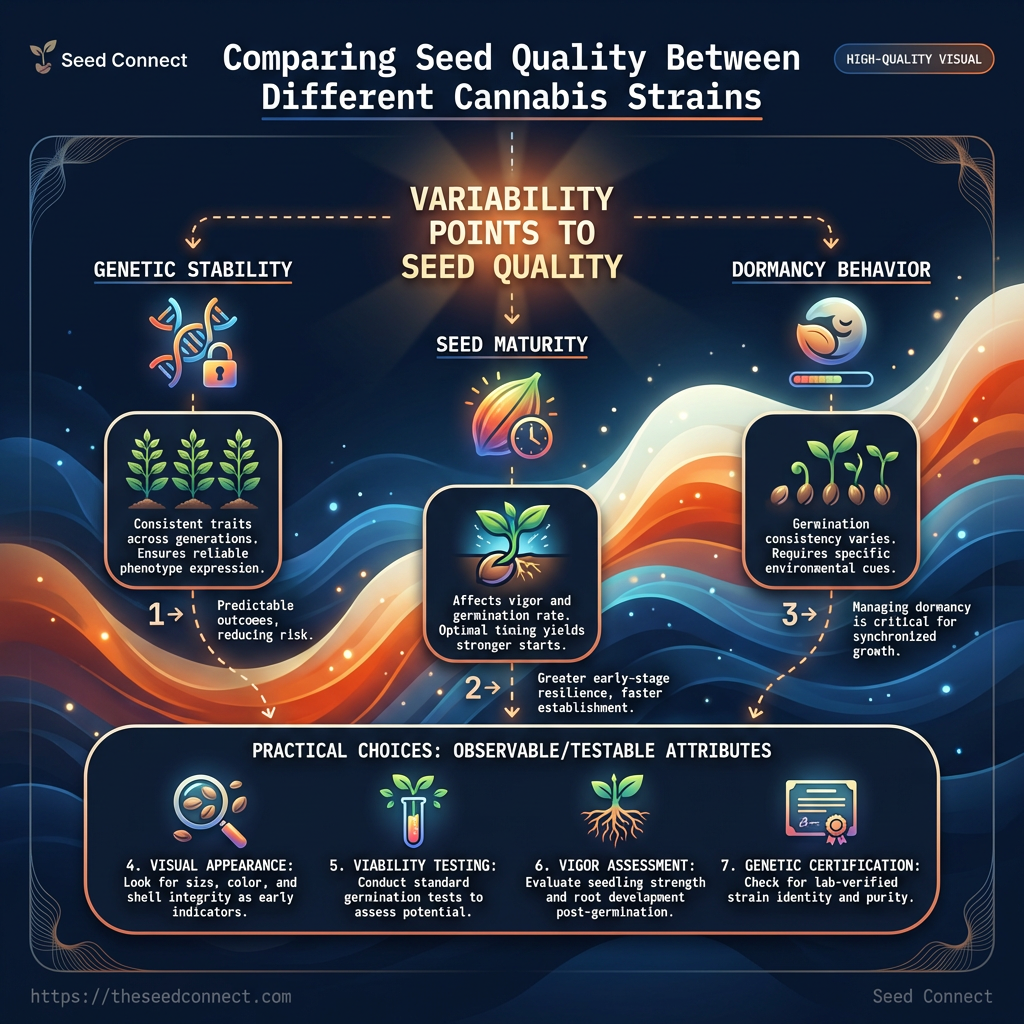
Understanding why those differences arise means moving past strain legend and into measurable traits. Comparing strain characteristics such as genetic stability, seed maturity at harvest, and dormancy behavior reveals why some varieties consistently outperform others in germination and early vigor. The comparison that follows focuses on attributes growers can observe or test, so choices become practical rather than hopeful.
What Is Seed Quality for Cannabis Strains?
Seed quality describes how likely a seed is to produce a healthy, true-to-type plant under normal growing conditions. Good seed quality isn’t just “does it sprout?” — it’s about predictability, health, and how well the seed preserves the breeder’s intended strain characteristics.
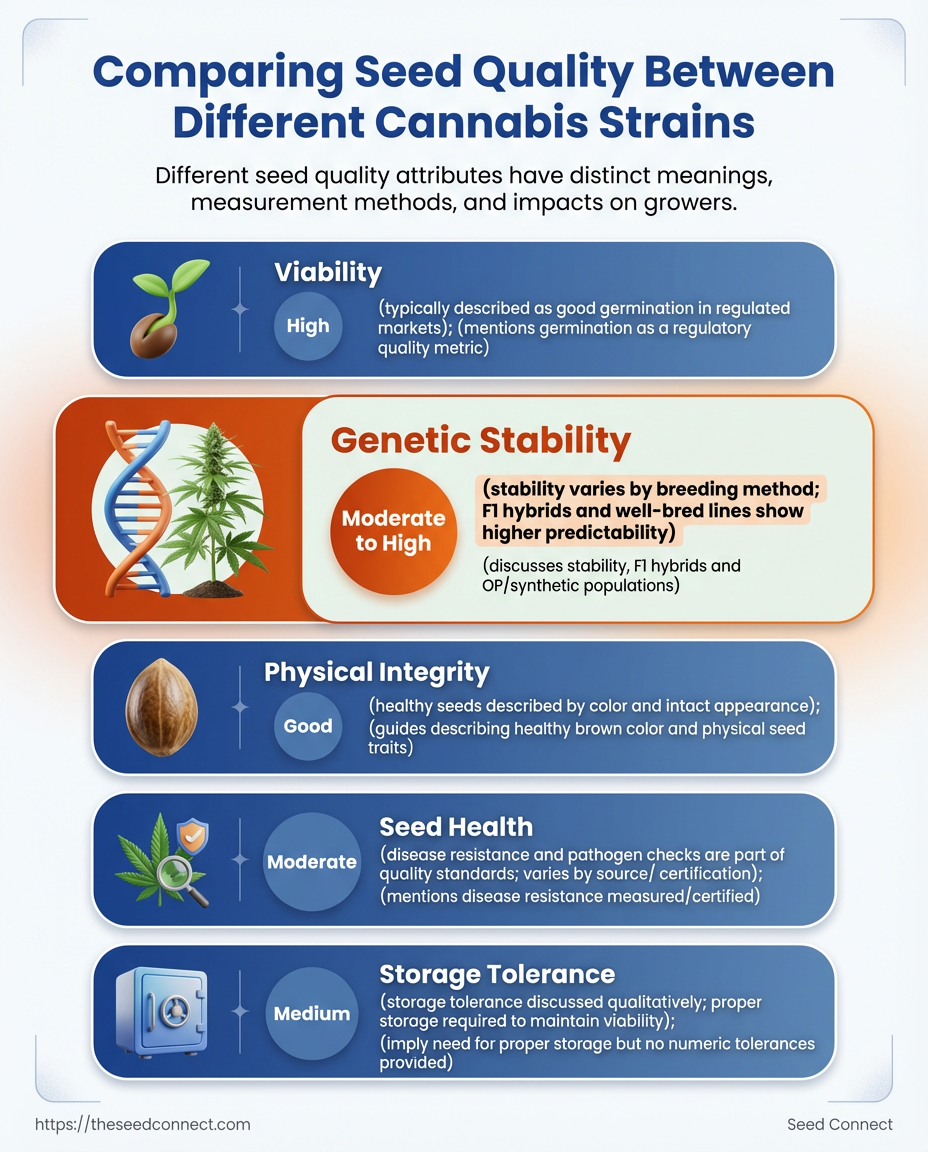
Viability: The seed’s ability to germinate and produce a vigorous seedling. Genetic Stability: How consistently offspring express the strain’s targeted traits across generations. Physical Integrity: Seed size, hardness, shell color and surface—indicators of maturity and handling. Seed Health: Freedom from disease, pests, or internal pathogens that reduce vigor. Storage Tolerance: How well seeds survive time and variable storage conditions without losing viability.
How seed quality and strain characteristics interact matters more than growers often assume. Genetics set the blueprint: a stabilized hybrid will give much more predictable growth patterns, cannabinoid profiles, and yields than an unstable F1 or a variable landrace. But even great genetics can be ruined by poor seed health or rough handling.
How strain characteristics relate to seed quality
Genetics vs. seed condition
Strain characteristics are encoded in DNA; seed quality is how faithfully and reliably that DNA will express in a crop. High genetic stability means phenotypes—plant height, flowering time, terpene profile—show up within a narrow range. Low seed quality increases phenotypic scatter: mixed sex expression, variable potency, or inconsistent flowering schedules.
Landraces and stabilized hybrids: trade-offs
Landraces: High genetic diversity: good for breeding but produces variable offspring. Stabilized hybrids: Narrow, predictable traits: better for growers seeking consistency. Breeders’ selection pressure—how many generations they select for a trait—directly increases genetic stability and thus effective seed quality.
Practical signs a seed is high quality: Uniform appearance: consistent size and color across the batch. High firmness: indicates maturity and lower internal damage. * High germination rate in small-sample tests: 90%+ is what professional breeders aim for.
A quick matrix of seed quality attributes and what they indicate for growers
| Quality Attribute | What It Means | How It’s Measured | Grower Impact |
|---|---|---|---|
| Viability | Ability to germinate | Germination tests (% over 7–14 days) | Predicts crop establishment rate |
| Genetic Stability | Consistent trait expression | Line trials, phenotype uniformity | Predictable harvest timing & quality |
| Physical Integrity | Seed maturity and handling quality | Visual inspection, density tests | Affects germination vigor |
| Seed Health | Absence of pathogens/pests | Lab assays, cut tests | Reduces seedling losses |
| Storage Tolerance | Longevity under storage | Accelerated aging tests | Affects long-term inventory value |
Key insight: Prioritize seeds with both high genetic stability and demonstrated viability; physical and health checks are the quickest ways to screen lots before large-scale planting.
For reliable, well-characterized options when selecting genetics, consider reputable sources such as cannabis seeds for sale that disclose breeding history and germination guarantees. Knowing both the genetic background and the seed’s condition saves time, reduces surprises, and makes outcomes repeatable.
How Does Seed Quality Work? The Mechanisms Behind Good and Bad Seeds
Good seeds carry a living embryo, stored nutrients, and an intact seed coat; poor seeds lack one or more of those essentials. Seed quality is fundamentally about viability and vigor: viability is whether a seed can germinate, vigor is how robust the resulting seedling will be. Both are shaped long before harvest and by what happens afterward.
How seeds develop and what kills viability
Healthy seed development requires a mature embryo, proper nutrient deposition, and a dry, stable environment as the seed ripens.
- Mature vs. immature seeds: Mature seeds have a fully formed embryo, darker hardened seed coat, and higher stored carbohydrates. Immature seeds often look green or soft and show poor or zero germination.
- Mother plant health: Nutrient stress, disease, or poor light during seed fill reduces stored energy and produces malformed embryos.
- Pollination timing: Early or late pollination relative to the mother plant’s flowering window can yield improperly developed seeds with low germination.
- Moisture and drying practices: If seeds are harvested too wet or dried too quickly at high heat, the embryo can be damaged; too slow drying in humid air encourages fungal growth that eats seed reserves.
Embryo: The living plant inside the seed; damage here removes viability.
Seed coat: Protective layer; compromised coats increase moisture uptake and pathogen entry.
Post-harvest handling, storage, and deterioration
Proper handling after harvest preserves both viability and vigor.
- Gentle cleaning: Removing chaff and non-seed material reduces microbial load.
- Controlled drying: Aim for seeds that feel firm, not brittle; avoid temperatures above
35°Cduring drying. - Optimal storage: Cool, dry, and dark conditions slow metabolism and deterioration.
Simple at-home viability checks
- Prepare a damp paper towel and place 10 seeds evenly spaced.
- Fold towel, put inside a plastic bag, and keep at room temperature (20–25°C).
- Check daily for germination over 7–14 days and calculate germination percentage.
- A cut test: slice a seed open—plump, creamy interior suggests viability; hollow or brown interior suggests non-viable.
Provide numeric guidelines for storage conditions and expected shelf-life under different conditions
| Storage Condition | Temperature (°C/°F) | Relative Humidity (%) | Expected Seed Viability After 1 Year |
|---|---|---|---|
| Cool & Dry (refrigerated) | 4°C / 39°F | 20–30% | 85–95% |
| Room temperature, dry | 20–22°C / 68–72°F | 30–40% | 60–80% |
| Warm & humid | 25–30°C / 77–86°F | 60–80% | 10–30% |
| Airtight, low-oxygen | 4–10°C / 39–50°F | 10–20% | 90–98% |
| Frozen (long-term) | −18°C / 0°F | <10% | 95–99% |
Key insight: Cooler temperatures and lower humidity consistently preserve viability; airtight, low-oxygen storage is best for multi-year preservation.
For practical sourcing, browse cannabis seeds for sale to compare varieties and check breeder storage notes. For broader context on long-term seed conservation, see the Seed bank overview on Wikipedia and the USDA Agricultural Research Service main site. Keeping seeds cool, dry, and dark pays off: small investments in drying and proper storage mean far higher germination when planting day arrives.
Why Seed Quality Matters: Grower Outcomes and Strain Performance
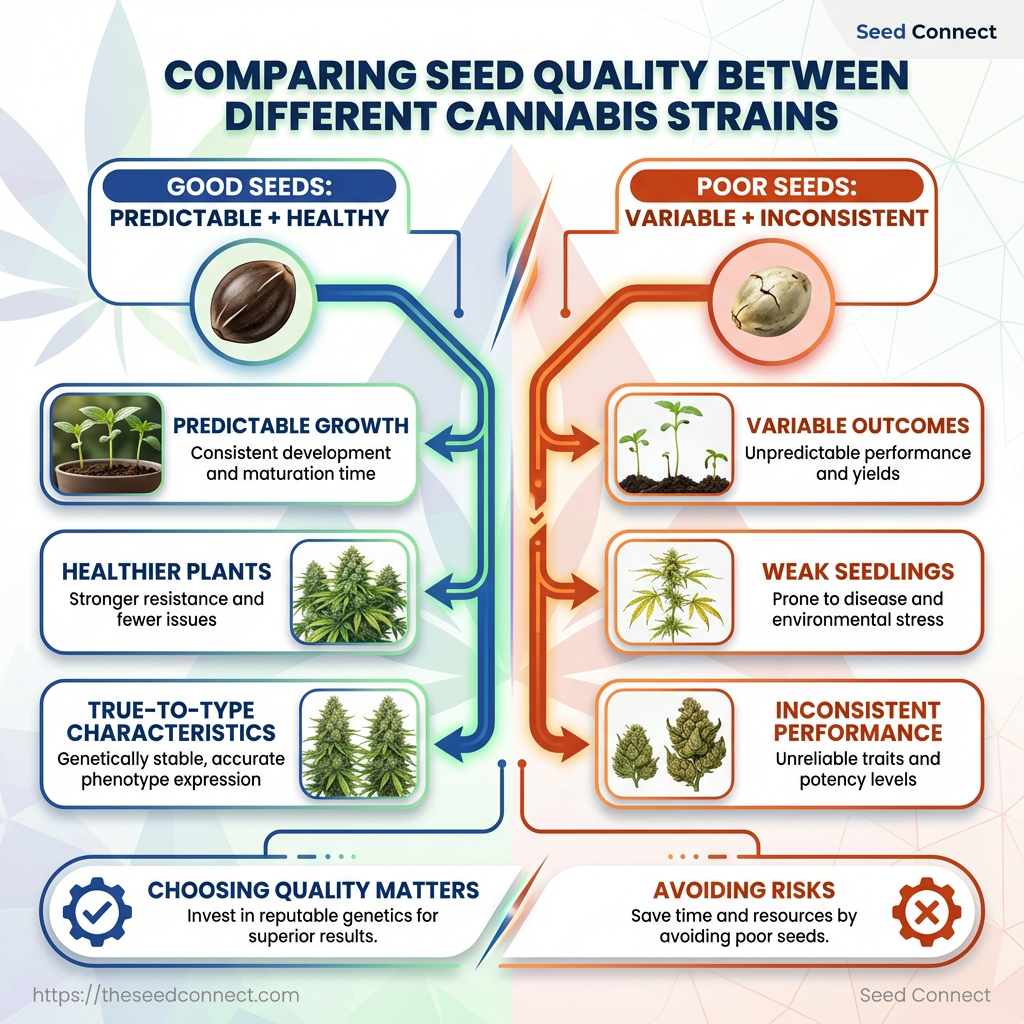
Seed quality drives outcomes more than most growers realize. Healthy, true-to-type seeds translate directly into predictable germination, uniform crop development, consistent cannabinoid and terpene profiles, and ultimately dependable yield. Poor seed lots force extra culling, uneven nutrient and light management, longer grow cycles, and wider variability in potency — all of which eat into profit or enjoyment depending on whether the grow is commercial or hobby.
Typical outcomes for high-, medium-, and low-quality seed lots across key grower metrics
| Metric | High-quality seeds | Medium-quality seeds | Low-quality seeds |
|---|---|---|---|
| Expected Germination Rate | 90–98% reliable germination | 70–89% variable germination | 40–69% poor germination |
| Phenotype Uniformity | 85–95% uniformity | 60–80% mixed phenotypes | <60% high variability |
| Average Time to Maturity | Within target window ±5% | ±10–15% variance | ±20%+ delays common |
| Yield Consistency | Predictable per-plant yield | Moderate variability between plants | Wide yield swings; many underperform |
| Risk of Pests/Disease | Lower (vigorous plants) | Moderate risk | Elevated risk; weak vigor increases susceptibility |
Key insight: High-quality seed lots reduce surprises at every stage — fewer empty pots, synchronized nutrient and light schedules, and tighter harvest windows. For growers scaling operations, that predictability converts to lower labor and operational costs; for hobbyists it means consistent, repeatable results.
Practical impacts on germination, uniformity, and yield show up as everyday headaches or advantages. Germination rate approximates final plant count: if a 100-seed pack is advertised at 95% but performs at 70%, plan for 25–30% more seed to hit the same harvest. Uniformity affects canopy management: mixed phenotypes force staggered feeding and variable light positioning, disrupting harvest timing. Seed genetics quality also biases chemical expression — stable breeding produces repeatable cannabinoid/terpene ranges, while low-quality lots give inconsistent potency.
When choosing seeds, priorities shift by goal.
Commercial priorities: high germination data, breeder pedigree, batch testing, clear return policies, and consistent phenotype expression. Hobby priorities: variety, cost-effectiveness, and ease (consider autoflower or feminized for simplicity).
- Check documented germination data and ask for batch results.
- Verify breeder reputation and ask about phenotype ratios.
- Match seed type (
feminized,regular,autoflower) to workflow and goals.
For reliable starts, consider trusted sources like cannabis seeds for sale when pedigree and germination guarantees matter. Choosing the right seed quality removes guesswork from feeding, light scheduling, and harvest planning — which is where real gains in yield and consistency appear.
Common Misconceptions When Comparing Seed Quality
Most growers jump to surface signals—color, price, or marketing—when judging seed quality. That often leads to wrong conclusions. Seed quality is about viability, genetic stability, and honest breeder practices, not superficial traits. Practical verification beats assumptions every time: perform a simple germination test, check breeder transparency (batch numbers, germination rate), and factor in storage history before writing off a pack.
Side-by-side myth vs. reality with actionable verification steps
| Myth | Reality | How to Verify | Why It Matters |
|---|---|---|---|
| Seed color indicates quality | Appearance can vary by strain and drying; color alone is unreliable | Check germination rate with a 25-seed test and inspect for mold or cracks |
Prevents discarding viable seeds or buying poor stock based on looks |
| Feminized seeds equal identical plants | Feminized seeds prevent males but still show phenotypic variation | Review breeder photos, read phenotype notes, and grow multiple seeds to compare | Sets expectations for variability in yield, structure, and terpene profile |
| Older seeds won’t germinate | Age reduces viability but proper storage preserves viability for years | Test germ rate; ask breeder for production/harvest date and storage conditions | Avoids unnecessary waste and informs purchase decisions for backups |
| High price = high quality | Price can reflect rarity or branding, not guaranteed germination or stability | Request germination guarantee, batch reports, or customer reviews | Protects budget and focuses spending on verifiable value |
| All seeds from a breeder are equally stable | Stability varies by line; some crosses are more consistent than others | Ask for stability metrics, parent lineage, and breeder testing protocols | Helps choose strains that match grower goals and reduce surprises |
Practical checks to run today: Germination test: Place 10–25 seeds between moist paper towels; record sprout rate after 7–10 days. Batch audit: Ask for production date and batch number; cross-check breeder notes. * Storage review: Seed kept cool and dry often doubles viable lifespan compared with room-temperature storage.
Industry-savvy growers rely on small experiments and breeder transparency rather than gut feelings. For reliable sourcing when you want documented germ rates and expert support, consider browsing cannabis seeds for sale. Trust data over assumptions, and the results will follow.
Real-World Examples: Comparing Seed Quality Across Popular Strains
Modern commercial growers expect consistency; small-scale breeders and collectors accept variability for unique traits. Below are three real-world case studies that show how seed quality shows up differently between stabilized hybrids, landrace/heirloom lines, and auto-flowering genetics — and what to test before committing seed lots to a full run.
Stabilized modern hybrid (high-yield commercial strain)
Stabilized hybrids usually deliver predictable germination, uniform growth, and performance that scales.
- Genetic stability: Modern commercial strains are bred for uniform phenotypes and consistent cannabinoid/terpene expression.
- Germination expectation: High germination rates when breeder batch data and transparent practices are provided.
- Quick validation: Run a small germination check before planting large batches.
- Soak 10 seeds for 12–24 hours in lukewarm water.
- Transfer to a moist paper towel inside a zip bag at ~22°C.
- Score germination percentage at 7 days and compare to breeder claims.
Recommended action: prioritize breeders who publish batch germination data and cultivation notes. Many commercial suppliers also list expected yield and flowering window.
Landrace or rare heirloom strain
Landraces offer genetic richness and unusual chemotypes, but that diversity can mean variability in growth and yield.
- Higher genetic diversity: Expect a wider range of heights, flavors, and cannabinoid ratios.
- Unique profiles: Potential for rare terpenes or niche cannabinoid mixes prized by collectors.
- Due diligence: Ask for pedigree, collection notes, and any historical germination results.
Practical tip: grow a small selection first and keep careful phenotype records to decide which plants to stabilize or reseed. Document parent origin and microclimate notes — those matter for future selection.
Auto-flowering seeds and quality considerations
Auto-flowering seeds are convenient but require different handling and different quality checks than photoperiod strains.
- Seed size & vigor: Autos are often smaller; gentle handling improves outcomes.
- True-to-type verification: Confirm breeder data shows consistent auto-flowering behavior across several generations.
- Testing protocol: Run a 20-seed small-number germination and observe onset of flowering to verify autos.
If buying autos in bulk, stagger small test batches to confirm both germination and true auto timing before scaling.
For reliable sourcing, consider reputable suppliers and, when relevant, check offerings like cannabis seeds for sale that provide germination guarantees and breeder transparency. Practical testing upfront saves time and money and helps match seed choice to grow goals, whether commercial uniformity or exploring rare chemotypes.
📥 Download: Seed Quality Comparison Checklist Template (PDF)
How to Compare Seed Quality Between Strains: A Step-by-Step Checklist
Comparing seed quality between strains starts before you buy and continues when the seeds arrive. Start by collecting verifiable seller data, then run the same, repeatable tests on each lot so scores are comparable. That process turns subjective impressions into a small dataset you can act on—deciding which strain to scale, which batch to reject, and when to ask for replacements.
Pre-purchase and seller vetting steps
- Ask for germination data: Request recent batch germination rates and the sample size used.
- Request harvest dates: Freshness matters—older harvests generally show reduced viability.
- Confirm parentage: Know the reported mother/father genetics and whether the line was stabilized.
- Probe production environment: Was seed production greenhouse, indoor, or outdoor? Each has implications for purity.
- Check guarantees: Look for explicit germination guarantees or replacement policies.
- Review breeder reputation: Look for independent grower reports, not just seller copy.
- Ask for seed-lot photos: Clear, close photos of multiple seeds in the lot reveal size and uniformity.
Provide a quick seller-vetting checklist template growers can copy
| Verification Item | What to Ask/Look For | Acceptable Answer/Red Flag |
|---|---|---|
| Germination rate data | Recent test %, sample size, test protocol | Acceptable: ≥85% on 50+ seeds; Red flag: no data or <60% |
| Seed harvest date | Exact harvest/pack date on lot | Acceptable: within 12 months; Red flag: no date or >24 months |
| Breeder reputation | Reviews, breeder history, community feedback | Acceptable: consistent positive reports; Red flag: mixed/anonymous reviews |
| Return or replacement policy | Clear terms for non-germinating seeds | Acceptable: written guarantee/replacement; Red flag: no policy |
| Photos of seed lot | High-res images showing multiple seeds | Acceptable: uniform size and color; Red flag: broken/oddly sized seeds |
Key insight: Treat seller-provided data as the first filter—if a seller can’t or won’t provide this information, that alone is a practical red flag. Good breeders make this data easy to share.
On-arrival tests and comparison scoring
Run identical tests for every lot and log results. The core is a standardized paper-towel germination test plus visual and genetic-consistency checks.
Tools & materials
- Paper towels, clear trays, spray bottle, labels, marker
- Thermometer (optional) and a small notebook or spreadsheet
- Place two layers of damp paper towel in a clear tray and label with lot ID and date.
- Put 20 seeds from the lot on the towel, spaced evenly.
- Fold towel over seeds, mist with clean water, and close tray lid to hold humidity.
- Keep trays at
20–25°Cin indirect light; check daily, misting if towels dry. - Record time-to-radicle and count seeds with radicles at day 3, 5, 7, and 10.
Scoring system (example)
Germination Test (%): Actual % from 20-seed test. Physical Score (0–5): 0 = lots of damage; 5 = uniform, undamaged seeds. * Genetic Consistency Score (0–5): 5 = seedlings phenotypically identical; 0 = wide variation. Overall Score: Weighted average (Germ% 0.6) + (Physical 0.2) + (Genetic 0.2), normalized to 100.
Template comparison table for scoring multiple seed lots across key attributes
| Seed Lot | Germination Test (%) | Physical Score (0-5) | Genetic Consistency Score (0-5) | Overall Score |
|---|---|---|---|---|
| Lot A (Strain X) | 90 | 5 | 4 | 92 |
| Lot B (Strain Y) | 75 | 4 | 3 | 76 |
| Lot C (Strain Z) | 60 | 3 | 2 | 62 |
| Lot D (Control/Benchmarked lot) | 95 | 5 | 5 | 97 |
| Notes/Action | Replace if <70% or overall <70 | Re-order/test more seeds | Consider breeder contact for variability | Hold back scaling |
Key insight: Using a shared rubric removes guesswork—lots scoring above ~85 are safe to scale, 70–85 need cautious trial grows, below 70 should prompt replacements or refunds.
If you want a single next step, run this checklist on a small sample from each strain before committing to larger orders. It saves time, money, and a lot of frustration. Also consider checking cannabis seeds for sale for options with clear germination guarantees.
Conclusion
After working through what makes seed quality dependable, how those mechanisms play out in the tray, and how to compare strains side‑by‑side, a few things become clear: healthy genetics, consistent germination practices, and close attention to strain characteristics drive predictably strong seedlings. The real-world comparisons earlier — where one popular strain delivered uniform, vigorous sprouts while another showed mixed vigor despite identical care — show that seed provenance and storage matter as much as watering schedules. If you’re asking whether to prioritize genetics over short-term cost, the pattern shows higher‑quality seeds usually save time, nutrients, and disappointment downstream.
For next steps, start by testing a small batch to validate germination rates, log strain characteristics you observe, and keep notes that let you make meaningful seed quality comparisons over time. Order from sources that guarantee germination and track performance by strain so future choices are data-driven. To streamline sourcing, consider Shop germination-guaranteed cannabis seeds as one option for high-quality, confidence-backed seed purchases. If questions remain about germination methods or interpreting early seedling traits, revisit the checklist in this article and compare notes against the strain characteristics most important to your goals.