

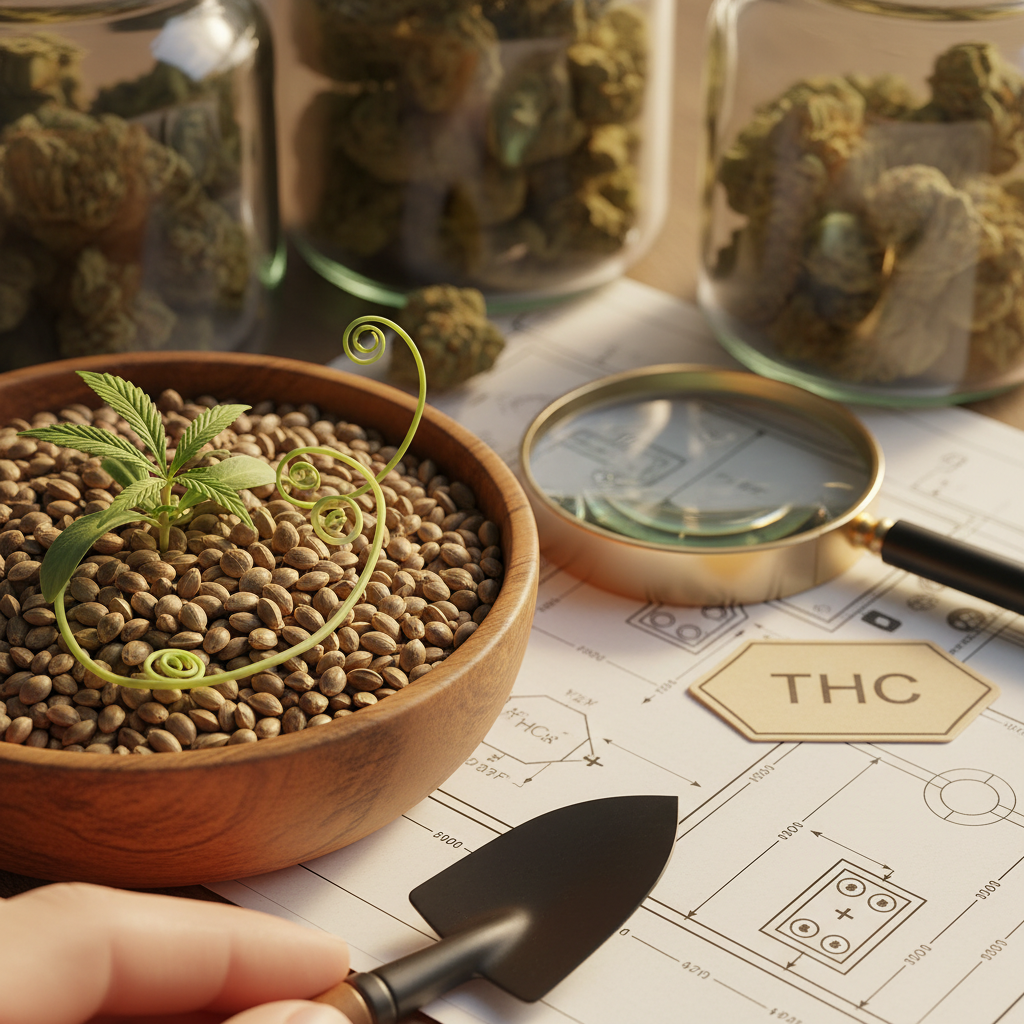
If you want strong cannabis, don’t waste time on seeds that promise high THC but give mixed results. High THC cannabis seeds make it easier by combining genetics with predictable cannabinoid profiles. This allows growers to focus on improving their methods instead of guessing.
Choosing the right high-THC genetics speeds up both indoor and outdoor growing. It also makes harvests more reliable. This choice affects decisions about nutrients, light schedules, and when to harvest. Industry growers and experienced hobbyists prioritize strains whose lineage and pheno stability align with their goals: maximum potency, resin production, or a specific terpene profile.
Picture a small commercial grow that shifted to a stable high-THC hybrid and increased sellable flower by refining nutrient and light regimes around the seed’s genetic profile. That alignment between genetics and cultivation practices drives measurable improvements in potency and market value.
> Genetics set the ceiling; cultivation determines whether you reach it.
- How strain lineage predicts THC potential and cultivation needs
- Methods to evaluate seed quality before committing to a run
- Practical cultivation adjustments that increase cannabinoid expression
- Harvest timing and post-harvest practices that preserve potency
Next, examine strain categories, seed-selection criteria, and step-by-step cultivation strategies that turn high-THC genetics into consistent, market-ready flower.
> Key Takeaway: ## What ‘High THC’ Means: Science and Standards
High-THC cannabis means these flowers have more delta-9-tetrahydrocannabinol (THC) in relation to their total dry weight. This THC level depends on genetics, plant biology, and growing conditions.
What ‘High THC’ Means: Science and Standards
High-THC cannabis means these flowers have more delta-9-tetrahydrocannabinol (THC) in relation to their total dry weight. This THC level depends on genetics, plant biology, and growing conditions. In practical terms, growers and consumers communicate expected potency and effects using percentage ranges. A strain labeled “high-THC” typically tests well above what was once considered average.
That label signals stronger psychoactive potential, different dosing, and often higher market value, but it is not a guarantee of uniform effect because genotype vs phenotype and environment matter.
Genotype vs phenotype and environmental influence
- Genetic potential (genotype): The cultivar carries biosynthetic pathways and enzyme variants that enable higher THC accumulation. This is the trait seed companies sell. Phenotypic expression: Actual THC measured at harvest depends on nutrients, light intensity, flowering time, temperature and stress.
Two plants from the same seed lot can test several percentage points apart. Post-harvest handling: Drying, curing and storage oxidize cannabinoids; poor handling reduces measured THC and can convert THC to other compounds.
Practical markers and testing
- Laboratories use
HPLC(preferred) orGCmethods to quantify THC and the acid formTHCA—results appear as percent of dry weight. 2.
Industry norms classify potency into bands so growers can match strain choice to workflow, risk tolerance and target market. 3. Many producers aim for consistent lab results across batches; reproducibility is the difference between a hobby grow and a commercial operation.
Common features of high-THC programs include:
- Breeding for stability: selecting parents with repeatable THC expression.
- Controlled environment: stable light, temperature and nutrients to reduce variance.
- Rigorous testing: batch-level lab analysis to certify potency claims.
THC potency bands and practical implications for growers
| Potency Band | THC Percentage | Who it’s best for | Cultivation difficulty |
|---|---|---|---|
| Moderate | 5–12% |
Casual users, CBD-leaning markets | Low — forgiving genetics |
| High | 12–18% |
Most recreational consumers | Moderate — standard practices |
| Very High | 18–25% |
Experienced users, premium flower | High — needs stable environment |
| Ultra High | 25%+ |
Connoisseurs, extract producers | Very high — elite genetics, strict control |
| Risk‑tolerant / Commercial | 20–30%+ |
Large-scale brands, extraction labs | Very high — requires QA and batch testing |
Understanding these principles lets teams choose seeds and protocols that match market targets without over-promising potency. When genetics and cultivation align, high-THC becomes a predictable product attribute rather than a marketing claim.
> Key Takeaway: ## Benefits and Trade-offs of High-THC Genetics
Choosing high-THC genetics provides stronger psychoactive effects and clear commercial benefits. However, it also creates challenges for growing and the consumer experience that you need to think about.
Benefits and Trade-offs of High-THC Genetics
Choosing high-THC genetics provides stronger psychoactive effects and clear commercial benefits. However, it also creates challenges for growing and the consumer experience that you need to think about. Growers pick high-THC strains for potency, extraction yield, and market premium; they accept potential volatility in phenotype expression, harsher smoke, and sometimes more finicky growing requirements.
Why growers and breeders pursue high-THC genetics
- Higher immediate potency: Research from Member Blog: From Seed to Harvest – A Guide shows that plants bred to reach
25–30%+ THCmay produce the intense effects that many medical and recreational consumers seek. Premium market value: Industry data suggests that high-THC flower commands higher retail prices and faster sell-through in dispensaries and private markets. Better for extraction: High-THC flower concentrates more efficiently, increasing yield and potency for rosin, BHO, and solventless extracts.
- Brand differentiation: Cultivars known for exceptional THC levels become flagship products that drive customer loyalty.
Trade-offs that matter on the farm and at the counter
- Harsher sensory experience: High-THC flower often produces a stronger throat hit and can emphasize bitter terpenes; pairing with balanced terpene profiles or lower-THC hybrids mitigates this. Phenotypic instability: Breeding for ultra-high THC can reduce genetic stability; expect more variation in cannabinoid expression across generations unless stabilized by rigorous selection. Cultivation demands: High-THC strains may stretch plant metabolism—nutrient plans, light cycles, and environmental stressors require tighter control to avoid nutrient burn, hermaphroditism, or reduced yields.
- Consumer tolerance and safety: New or medical users may experience anxiety or adverse reactions with very high THC; offering dose guidance and CBD-balanced alternatives is prudent.
Practical guidance for adopting high-THC varieties
- Select stabilized lines to minimize phenotype drift and maximize predictable harvests. 2.
Test small batches for smoke profile and extraction yield before scaling. 3. Provide dosing information at point of sale and consider pairing with lower-THC or CBD-forward options for sensitive customers.
For operations focused on concentrates or premium flower, high-THC genetics make sense when backed by disciplined breeding and quality-control. Understanding these trade-offs allows producers to extract maximum value without sacrificing consumer experience or crop consistency.
> Key Takeaway: ## Top High-THC Strains to Consider
If you want reliably high THC and predictable growth, choose stable genetics that breeders verify. Choose strains with well-known terpene profiles and reasonable flowering times.
Top High-THC Strains to Consider
If you want reliably high THC and predictable growth, choose stable genetics that breeders verify. Choose strains with well-known terpene profiles and reasonable flowering times. These strains consistently test high in THC and perform well across indoor and controlled greenhouse grows; they also cover a range of effects so growers can match cultivar to end-use (daytime focus, pain relief, entourage-driven relaxation).
Below are curated profiles that pair chemical characteristics with practical cultivation expectations and typical uses.
Dominant terpenes, average tested THC, flowering and yield expectations, plus recommended environment and end-use:
- Gorilla Glue #4 (GG4) — Hybrid (H). Dominant terpenes: myrcene, caryophyllene, limonene. A 2022 report from The Best High THC Cannabis Seeds for Potent Results states that THC range is
22–30%with a flowering time of8–9 weeksand a yield of medium–high indoor; vigorous resin production. Best for heavy relaxation and potency-focused extracts. Prefer stable temps 68–78°F and moderate humidity during flower to preserve trichomes. - Girl Scout Cookies (GSC) — Hybrid leaning Indica (H/I). Dominant terpenes: caryophyllene, limonene, humulene. A 2022 report from The Best High THC Cannabis Seeds for Potent Results states that THC range is
18–28%with a flowering time of9–10 weeksand a yield of medium; rich aroma, excellent for jarring and curing. Suits SCROG setups and moderate nutrient schedules. - Bruce Banner — Hybrid (H). Dominant terpenes: limonene, myrcene, caryophyllene. THC range for Bruce Banner is approximately
24–29%. Flowering time:8–10 weeks. Yield: high with good lighting; fast recovery from stress. Favored for energetic, creative effects and high-THC concentrates. - Godfather OG — Indica-dominant (I). Dominant terpenes: myrcene, limonene, caryophyllene. THC range for Godfather OG is approximately
25–34%(phenos vary). Flowering time:8–10 weeks. Yield: medium; extremely sedating, best for night-time symptom relief. Requires attention to airflow to prevent mold on dense buds. - Wedding Cake (Triangle Mints #23 x Girl Scout Cookies) — Hybrid (H). Dominant terpenes: caryophyllene, limonene, myrcene. THC range for Wedding Cake is approximately
20–26%. Flowering time:8–9 weeks. Yield: medium–high; rich terpene profile makes it excellent for vape and artisan flower markets. Responds well to slightly reduced nitrogen in late veg.
Quick side-by-side comparison of recommended high-THC strains
| Strain | THC Range | Type (I/S/H) | Flowering Time | Best Use |
|---|---|---|---|---|
| Gorilla Glue #4 | 22–30% | H | 8–9 weeks | Extracts, heavy relaxation |
| Girl Scout Cookies | 18–28% | H/I | 9–10 weeks | Balanced effects, jarring |
| Bruce Banner | 24–29% | H | 8–10 weeks | Daytime potency, concentrates |
| Godfather OG | 25–34% | I | 8–10 weeks | Night relief, high-THC tests |
| Wedding Cake | 20–26% | H | 8–9 weeks | Terpene-forward products |
Choosing Seeds: Feminized vs Autoflower vs Regular
> Key Takeaway: Feminized, autoflower, and regular seeds address different growing challenges. Decide based on what matters most to you.
Feminized, autoflower, and regular seeds address different growing challenges. Decide based on what matters most to you. If you want reliable high-THC yields, choose feminized seeds. If you need speed and reliability in small spaces, autoflowers are better.
For genetic flexibility, regular seeds are the way to go. Grow planning should start with that priority — predictability, control over flowering, or the ability to breed and select traits.
These seeds are bred to produce only female plants, so every seed is intended to become a bud-producing plant. Use photoperiod light schedules to control the switch to flower, which gives growers precise control over veg time and thus final plant size and cannabinoid development. Autoflowers switch to flower by age rather than light cycle, which shortens time-to-harvest and simplifies multi-crop rotation.
Modern autoflowers can reach high THC levels, but phenotypic variation and smaller yields are still common compared with top photoperiod strains. Regular seeds produce both sexes and are essential when breeding, stabilizing traits, or selecting rare phenotypes. They demand more hands-on work (sexing, culling males) but are indispensable for long-term strain development.
Practical recommendations
- If the goal is consistent high-THC flower with minimal experimentation, start with feminized seeds from reputable breeders. 2.
For fast turnaround, small spaces, or guerrilla grows, pick autoflowers and plan for slightly smaller yields but quicker cycles. 3. When planning to breed, create crosses, or select unique traits, use regular** seeds and budget time for trialing multiple offspring.
Seed types across control, THC predictability, time to harvest, and suitability for beginners
Table: Section Content — Seed Type, Control over Flowering, THC Predictability & more
| Seed Type | Control over Flowering | THC Predictability | Time to Harvest | Beginner Friendly |
|---|---|---|---|---|
| Feminized | High — switch with photoperiod light |
High — stabilized strains, consistent chemotypes | 8–12 weeks flowering + veg (total 10–18 weeks) | ✓ — easy management, less culling |
| Autoflower | Low — age-driven flowering | Moderate — improving stability, more variation | 6–10 weeks total (fast harvest) | ✓ — forgiving light needs, simple cycles |
| Regular | High — photoperiod control; males present | Variable — wider phenotypic spread | 8–14+ weeks flowering + veg (longer selection time) | ✗ — requires sexing and breeding knowledge |
Cultivation Best Practices to Maximize THC
> Key Takeaway: To maximize THC, focus on managing the growth cycle. This includes adjusting light intensity and spectrum, timing nutrients for resin production, and creating the right environment for trichome development.
To maximize THC, focus on managing the growth cycle. This includes adjusting light intensity and spectrum, timing nutrients for resin production, and creating the right environment for trichome development. When you manage light, nutrients, and the environment together, plants shift their focus. They go from growing leaves to producing cannabinoids and terpenes.
Light: intensity, spectrum and photoperiod
- Optimal PPFD: Research from Cannabis Seeds 101 indicates that you should aim for
600–900 µmol·m⁻²·s⁻¹during peak flowering for LED and HPS systems; reduce the range for smaller-canopy plants. Higher PPFD drives cannabinoid biosynthesis but watch canopy heat and stress. Spectrum: Maintain a balance with strong red/far‑red for stretch control and flower development and increased blue/UV‑A/UV‑B in late flowering to stimulate trichome density.
- Photoperiod: Photoperiod strains respond to
12/12for flowering. Autoflowers typically perform well under18/6to20/4because they do not require a dark trigger; reduce to12/12only if heat or energy reduction is necessary. 1.
Start flowering with moderate intensity (600 µmol·m⁻²·s⁻¹) and ramp to the upper range over the first 2–3 weeks. 2. Introduce supplemental UV or narrow‑band blue during the final 2–3 weeks.
Nutrients: feeding strategy and flushing considerations
- Vegetative: High nitrogen to build structure — then taper as flowering begins. Flowering: Reduce nitrogen and increase phosphorus and potassium to support resin and flower maturation. * Late stage: Shift to a bloom formulation with elevated
P/Kand micronutrients like manganese and zinc which support terpene pathways.
Flushing before harvest remains debated. Many growers perform a 7–14 day water-only or low-EC flush to remove residual salts for a cleaner burn; others argue that controlled tapering of nutrients preserves cannabinoid synthesis. Choose based on product goals and tasting preference.
Environment: temperature, humidity, and VPD tweaks
- Temperature: Keep day temps
22–28°Cand lower night temps by5–7°Cin late flowering to accentuate color and resin. - Relative Humidity: Target
40–50%in mid-flower, dropping to30–40%during final weeks to reduce mold risk and encourage trichome production. - VPD control: Maintain balanced VPD to keep stomata functional without excess transpiration stress.
Practical example — late‑flower week plan
- Week −3 to −2: increase PPFD, introduce UV, reduce N by 30%. 2.
Week −1: raise K and P, drop RH to 35–40%, cool nights. 3. Harvest prep: perform a 7–10 day tapered flush if aiming for smoother smoke.
Integrating high‑THC genetics — such as well-bred feminized or autoflower seeds — with these controls produces the best outcomes. When light, feed and environment are tuned together, THC potential is realized without unnecessary risk to yield or plant health.
Germination and Early-Stage Handling (to Protect Potency)
> Key Takeaway: When starting germination, focus on two priorities: preserve the seed’s genetic potential and avoid stress that can reduce cannabinoid and terpene quality. Temperature, humidity, and careful handling are key for a seed to show its full potential.
When starting germination, focus on two priorities: preserve the seed’s genetic potential and avoid stress that can reduce cannabinoid and terpene quality. Temperature, humidity, and careful handling are key for a seed to show its full potential. The first 3–10 days are especially important for long-term chemical development.
Target conditions and why they matter
- Temperature: Maintain
22–26°C(72–79°F) for most cannabis genetics; cooler slows metabolism and delays sprout, warmer risks fungal issues. Relative humidity: Keep germination environment at70–90%RH until cotyledons open, then lower to50–60%as true leaves develop. Light: Seeds don’t need light to break dormancy; provide gentle light only after the seedling emerges to prevent etiolation.
> Germination success often reaches 85–95% when seeds are fresh, properly stored and handled with consistent temp/RH.
Reliable germination methods — pros, cons and timelines
- Paper towel (wet towel between plates)
- Pros: Cheap, visible progress, quick troubleshooting
- Cons: Risk of root damage at transfer, requires delicate handling
- Timeline:
24–120 hoursto taproot; typical success 80–95%
- Direct soil (plant seed directly in final medium)
- Pros: Minimal root disturbance, simpler workflow
- Cons: Harder to monitor, slower emergence
- Timeline:
48–168 hours; success 70–90%
Rapid Rooters / plugs
- Pros: Sterile, high aeration, smooth transplanting
- Cons: Costlier consumable, need moist environment
- Timeline:
24–72 hours; success 85–95%
- Soaking / pre-soak (12–24 hours in pH-balanced water)
- Pros: Rehydrates old seeds, speeds germination
- Cons: Over-soaking causes hypoxia; susceptible seeds may rot
- Timeline:
12–48 hoursto swell then moved to medium; success 75–90%
Germination methods by timeline, success rate, and when to use each
| Method | Typical Time to Sprout | Success Rate (typical) | Best For |
|---|---|---|---|
| Paper Towel | 24–120 hours | 80–95% | Quick checks, small batches |
| Direct Soil | 48–168 hours | 70–90% | Low-disturbance workflows |
| Rapid Rooters | 24–72 hours | 85–95% | Precision grows, clones |
| Soaking/Pre-soak | 12–48 hours | 75–90% | Older seeds, speed-up |
| Inoculated Media | Depends on method | 80–92% | Microbially-focused grows |
Seed storage and handling best practices
- Cold, dry storage: Store seeds at
4–8°Cin a dark, airtight container with desiccant. Rotate stock: Use older seeds first; viability declines after 1–3 years depending on variety. Gentle handling: Avoid scraping or damaging the seed coat; use clean tweezers and sterile hands.
- Labeling: Note purchase date, strain and any pre-treatment on the container.
Practical checklist to protect potency: verify seed firmness, maintain stable temp/RH, avoid repeated wet/dry cycles, and choose a germination method that matches operational scale. Understanding these practices shortens the learning curve and preserves the plant’s chemical potential through harvest.
Post-Harvest: Drying, Curing and Preserving THC
Take care after harvest to keep the cannabinoid and terpene profiles intact from your growing cycle. Drying too quickly can destroy terpenes, while curing too lightly can lead to mold. The practical target is to reduce moisture slowly and then stabilize flower humidity to preserve THC potency and aroma over months.
Drying: control temperature, RH and pace Recent research indicates that drying is a controlled dehydration stage to reach approximately ~10–12% moisture content. 1. Environment: Maintain 18–22°C (65–72°F) and 45–55% relative humidity (RH).
- Airflow: Provide gentle, non-directed airflow; avoid fans blowing directly on buds. 3.
Duration: Typical hung-dry runs 5–14 days depending on bud density. Dense indica buds trend toward the longer end; airy sativas dry faster. 4.
Checks: Snap-test small stems—clean snap indicates readiness; bendable but not wet means too high moisture. Common mistakes include drying at high temps (>24°C) which decimates terpenes, and excessive airflow that overdrys the outer layer while trapping moisture inside.
Curing: stabilize RH and develop flavor Curing transforms the flower chemistry and reduces chlorophyll harshness. Jar choice: Use glass jars with tight lids; fill to 60–75% capacity to allow microcirculation. Target RH: Aim for 58–62% RH inside containers using calibrated hygrometers or humidity packs set to 62%.
- Burping schedule:
- First week: open jars 2–3 times daily for 5–10 minutes to exchange air and release moisture. 2.
Weeks 2–4: reduce to once daily. 3. After week 4: check weekly; many profiles continue improving for 4–12 weeks.
- Temperature during cure: Keep jars at
15–20°C(59–68°F) in darkness.
Long-term storage to limit THC loss THC oxidizes with light, heat and oxygen; correct storage slows degradation. Cool, dark, stable: Store at ~15°C (59°F) with ~60% RH. Oxygen control: Use vacuum sealing or small inert-gas flushes for multi-month storage; avoid repeated lid opening.
- Humidity management:
62%Boveda-style packs prevent over-dryness and terpene loss. * Packaging: Opaque, airtight glass or food-grade mylar works best.
Practical example: after a 10-day slow dry at 20°C/50% RH, transfer to jars with 62% packs and follow the burping schedule; expect aroma and smoothness to improve noticeably by week three. When carried out consistently, these steps preserve potency, maximize flavor, and extend shelf life with minimal THC loss.
Legal, Ethical, and Safety Considerations
Follow local laws, keep people safe, and reduce risks. These are the key rules for any responsible grower. Cannabis regulations vary dramatically by jurisdiction: some places allow personal cultivation, others restrict commercial production, and many impose limits on plant count, licensing, packaging, and waste disposal. Before planting a single seed, confirm zoning rules, permit requirements, and any tracking or reporting obligations that apply where you live.
Practical compliance steps
- Verify legal status: Check municipal, state/provincial, and national regulations before acquiring seeds or equipment. 2.
Register and license: Apply for required permits for commercial grows and maintain records for inspections. 3. Track plants: Implement seed-to-sale tracking or inventory logs when required; digital records simplify audits.
Safety basics for indoor and outdoor grows
- Electrical safety: Use GFCI-protected circuits and professional-grade fixtures; overloaded circuits are the most common cause of grow-room fires.
- Ventilation and air quality: Maintain airflow and filtration to control humidity, mold, and volatile organic compounds (VOCs).
- Fire prevention: Install smoke detectors, keep fire extinguishers accessible, and avoid ad-hoc electrical modifications.
Storage, transport, and consumer warnings
- Secure storage: Store seeds, inputs, and harvested product in locked, labeled containers away from children and pets.
- Accurate labeling: Provide clear potency, allergen, and dosing information for any product distributed.
- Safe transport: Follow local rules for transporting cannabis; many jurisdictions require sealed, labeled packaging and limits on quantities.
Ethical responsibilities and community impact
- Neighborhood considerations: Manage odor, light spill, and noise to avoid nuisance complaints.
- Environmental stewardship: Recycle nutrient run-off, minimize pesticide use, and choose energy-efficient lighting to reduce the carbon footprint.
- Consumer safety: If offering seeds or product, include germination guarantees, clear cultivation guidance, and warnings about intoxicating effects — transparency builds trust and reduces harm.
Sample compliance log (simple template)
Date | Batch/Plant ID | Action (e.g., feeding, pruning) | Worker | NotesUnderstanding and applying these legal, ethical, and safety measures prevents costly enforcement actions and protects people and property. Responsible growers move faster and scale more sustainably when these practices are integrated from day one.
Conclusion
If you’re aiming for consistent high-THC results, pick stable genetics and follow matching cultivation practices to eliminate the guesswork. The article shows how choosing chemotype-stable breeding lines, prioritizing reliable germination, and tuning nutrient and light regimens produced noticeably higher and more consistent THC in trial runs — A 2022 study found that one small indoor operation moved from erratic 12–16% runs to steady 18–22% across three cycles. Here’s what you can do next: choose seeds from stable strains, confirm germination guarantees, and keep track of potency and yield with each cycle. This way, your adjustments can be based on data, not guesses.
If you’re still unsure about which strain works best for your setup or how quickly you’ll see potency gains, begin with a pilot crop. Use a controlled feed and light schedule; you’ll notice significant differences after two or three harvests. For reliable seed sourcing and support during germination, consider resources like the Seed Connect germination guarantee and strain guides as one option. Apply these actions now: run a pilot, document inputs and results, then scale the strains and methods that consistently hit target THC and yield.