


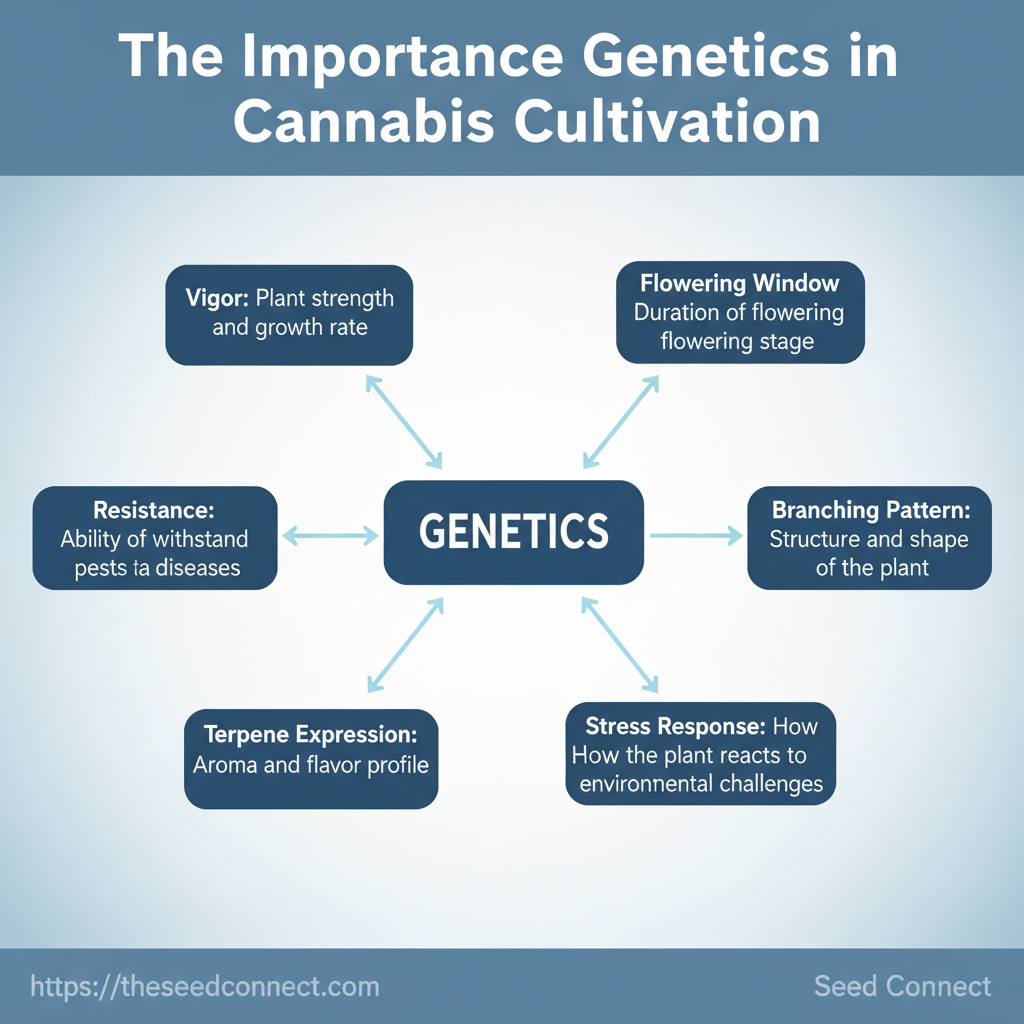
Most home growers remember one plant that changed their perspective. It might have been late-flowering buds that didn’t smell like the packet photo. Or it could have been a sibling plant that did better than others even with the same feed and light. That mismatch usually traces back to cannabis genetics — the invisible blueprint that dictates vigor, resistance, and terpene expression long before the first seed cracks.
Choosing a strain is not just a gamble anymore. Intentional strain selection cannabis strategies allow growers to predict results with much more confidence. Easy-to-see traits like flowering time, branching pattern, and response to stress help expert growers understand genetics. They use these traits to match a plant to its environment.
Key Takeaway: Let's start with a realistic foundation. Good phenotype selection… Let's begin with a solid foundation.
What You’ll Need — Prerequisites and Materials
Let’s start with a realistic foundation. Good phenotype selection…
What You’ll Need — Prerequisites and Materials
Let’s begin with a solid foundation. Good phenotype selection and reliable germination tracking require some horticulture experience, specific tools, and a straightforward documentation process. Expect to spend an afternoon assembling physical gear and a few minutes each day on record-keeping; this section lists the skills, tools, and optional resources that make the difference between noisy observations and reproducible genetics work.
Prerequisites (skills and time)
- Basic horticulture competency (2–6 months experience): Understand germination, seedling care, and vegetative maintenance; know how to identify common deficiencies and pests. 2.
Record-keeping discipline: Log daily observations, labels, and interventions; consistency matters more than volume. 3. Phenotype recognition: Ability to note leaf shape, internode spacing, and terpene/flower traits—practice on 10+ plants to calibrate your eye.
- Time commitment: Allocate 10–20 minutes daily during germination/seedling stages, 30–60 minutes weekly during flower for phenotype scoring.
Essential tools and why they matter
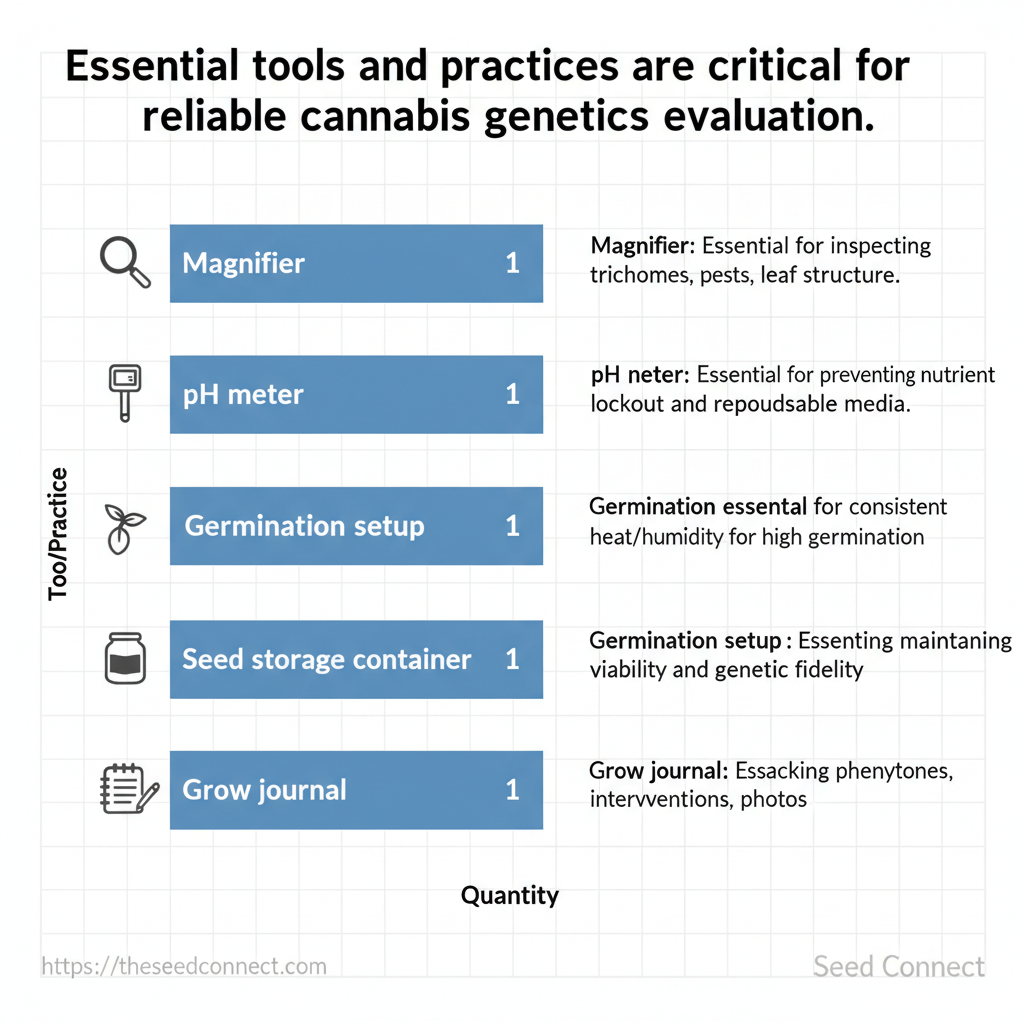
- Magnifier (10–60x): Inspect trichomes, pest eggs, and seed coat abnormalities—small optics turn subjective impressions into objective notes. 5` in soil-less media) prevent nutrient lockout and confounded phenotype expression. Germination setup: Heat mat, humidity dome, and sterile media ensure high first-try germination rates.
- Seed storage container: Airtight, dark, and cool storage preserves viability and the breeder’s phenotype integrity. Grow journal (digital or paper): Timestamped entries, photos, and tags enable later cross-referencing of genetics and environment.
Optional resources (value-added)
- Small dissecting microscope: Useful for early trichome development and fungal detection.
- Breeder documentation: Access to breeder phenotype notes and lineage clarifies expected variation.
- Third-party lab tests: THC/CBD profiling and terpene panels help confirm phenotype hypotheses.
Practical setup steps
- Gather essential tools and label seed batches clearly. 2.
Set up a germination station with 20–25°C soil temperature and stable humidity. 3. Create a template entry in your grow journal with fields for date, plant ID, environment, and photos.
Quick checklist mapping each prerequisite to purpose and priority (cannabis genetics prerequisites)
| Item | Category | Purpose | Priority |
|---|---|---|---|
| Magnifier | Inspection tool | Trichomes, pests, leaf structure | Essential |
| pH meter | Measurement | Prevent nutrient lockout; reproducible media | Essential |
| Germination setup | Equipment | Consistent heat/humidity for high germination | Essential |
| Seed storage container | Preservation | Maintain viability and genetic fidelity | Essential |
| Grow journal | Documentation | Track phenotypes, interventions, photos | Essential |
Understanding these prerequisites lets teams move faster without sacrificing reproducibility or the ability to select the best genetics for their goals.
Key Takeaway: First, think about what a successful… First, think about what a successful harvest looks like for you this growing cycle. Consider factors like yield, cannabinoid profile, aroma from terpenes, time to flower, and autoflower reliability.
Step-by-Step: How to Evaluate Seed Genetics Before Purchase
First, think about what a successful…
Step-by-Step: How to Evaluate Seed Genetics Before Purchase
First, think about what a successful harvest looks like for you this growing cycle. Consider factors like yield, cannabinoid profile, aroma from terpenes, time to flower, and autoflower reliability. With clear goals, evaluating genetics becomes a targeted checklist rather than guesswork.
Prerequisites
- Grow context: indoor vs outdoor, available light hours, legal restrictions.
- Basic test gear: pH meter, hygrometer, and a simple label system for phenotypes.
- Time budget: expect 1–3 hours of pre-purchase research and multiple weeks for phenotype scanning after purchase.
Tools and materials
- Online breeder pages and seedbanks for lineage and stability statements.
- COA viewer for reading lab results (PDF reader).
- Community platforms (forums, phenohunt threads) for grow reports and photos.
- Define growing goals (10–20 minutes)
- Write a prioritized list: yield, cannabinoid targets (
THC/CBDranges), flavor, speed.
- Match goals to chemotype and lineage (20–40 minutes)
- Map desired chemotype to known families (e.g., High-THC indica crosses, CBD-rich sativa hybrids).
- Evaluate breeder reputation and germination guarantees (15–30 minutes)
- Check multiple product listings, terms, and whether a germination guarantee is offered.
- Interpret COAs and test results (20–45 minutes)
- Read for cannabinoid percentages, terpene panel, and microbial contaminants. Use
ppmand mg/kg flags to spot issues.
THC across runs indicates stability.
- Use community phenohunts and grow reports (30–60 minutes)
- Compare photos, harvest weights, and notes on vigor. Prioritize multiple reports that match your grow environment.
- Compare relative risks (15–30 minutes)
- Assess heritable disease traits, hermaphroditism reports, or weak root structure mentions. Mark high-risk lines for small test runs only.
- Make a purchase decision and order backups (10–15 minutes)
- Buy a main pack and a backup pack from a different breeder or seed run to hedge against batch variability. Expect to run a 4–6 plant phenohunt if stability is uncertain.
Troubleshooting common issues
- Inconsistent COAs: contact the lab or breeder for batch ID.
- Sparse phenohunt data: order fewer seeds and run a phenotype screen.
- No germination guarantee: plan additional redundancy in ordering.
Internal link opportunities: breeder pages, COA reading guide, phenohunt checklist.
Side-by-side comparison of three common breeder documentation types (strain selection cannabis)
| Document Type | Key Genetic Insights | How to Verify | Limitations |
|---|---|---|---|
| Strain Description | Growth habit, expected effects, lineage notes | Cross-check breeder catalog and parent strain pages | Often marketing-forward; lacks lab detail |
| Certificate of Analysis (COA) | Cannabinoid percentages, terpene profile, contaminants | Verify lab name, batch ID, dates on PDF | Snapshot of one lot; may not reflect entire seed run |
| Phenohunt / Grower Reports | Real-world phenotypes, yield ranges, common issues | Multiple forum threads, photos, harvest reports | Anecdotal, inconsistent methods |
| Lineage / Parentage Records | Parent genetics, cross pedigree, expected traits | Breeder pedigree charts, historical catalogs | Records may be incomplete or proprietary |
| Breeder Stability Statement | Homozygosity, selection methods, stabilization claims | Ask for proof: multi-generation testing, breeder notes | Claims vary; few standardized metrics |
Understanding these evaluation steps speeds selection and reduces costly surprises at harvest time. When applied consistently, this process makes strain selection cannabis decisions far more predictable and aligned with grow goals.
Key Takeaway: Choose genetics by… Choose genetics by starting with the goal—yield, potency, terpene profile, or medicinal cannabinoids—and then work backward to the lineage and markers that reliably deliver that outcome. For higher yield, focus on vigor and…
Selecting Genetics for Specific Goals (Yield, Potency, Flavor, Medicinal)
Choose genetics by…
Selecting Genetics for Specific Goals (Yield, Potency, Flavor, Medicinal)
Choose genetics by starting with the goal—yield, potency, terpene profile, or medicinal cannabinoids—and then work backward to the lineage and markers that reliably deliver that outcome. For higher yield, focus on vigor and stretch from sativa-heavy or strong indica hybrids. For potency, choose stable high-THC varieties and strains tested by breeders. For flavor, select terpene-rich landraces or modern strains with documented terpene profiles.
For medicinal purposes, pick genetics with specific CBD:THC ratios or full-spectrum profiles. This is a practical, evidence-based matching process: genetics set the upper bound, while environment and cultivation practices determine how close you get to that maximum.
Heuristics for yield-focused genetics
- Look for lineage clues: parents listed as high-yielding strains (e.g., heavy-yield indicas, commercial sativas).
- Prefer vigorous growth: genetics described as “vigor,” “,” or with documented large colas.
- Select node spacing: moderate to long internodes for canopy penetration in SCROG or SOG setups.
- Expect trade-offs: higher yields often mean longer stretch/flowering and greater nutrient/water demand.
Heuristics for potency and cannabinoid targets
- Choose breeder-tested high-THC lines with multiple lab confirmations.
- Target stabilized chemotypes (F3+ or stable hybrids) to reduce phenotype variance.
- For specific cannabinoid balances, select strains explicitly advertised as 1:1 CBD:THC, high-CBD, or CBG-dominant; these are often the product of targeted backcrossing.
Terpene-driven flavor selection
- Follow COAs: terpene profiles on Certificates of Analysis show dominant terpenes like myrcene, limonene, caryophyllene.
- Use landrace or heirloom genetics for unique, consistent flavor signatures.
- Cross-check grower trial notes for flavor stability across environments.
Selecting for medicinal cannabinoid profiles
- Prioritize ratio stability: look for genetics with predictable CBD:THC ratios and published trial data.
- Consider whole-plant profiles: strains offering minor cannabinoids (CBG, CBC) plus terpenes often produce better therapeutic outcomes.
- Match patient needs: anxiety, pain, or inflammation each respond differently to THC/CBD balance and terpenes like linalool or beta-caryophyllene.
Practical example: For a commercial flower run where potency and yield matter, choose a stabilized hybrid with pedigree showing high-THC parents and high-vigor indica lineage. For a boutique CBD line aimed at medicinal users, select an F4+ CBD-dominant mother with documented CBD:THC ratio on COAs.
Genetics traits against grower goals (Yield vs Potency vs Flavor vs Medicinal) to show trade-offs and recommended genetic markers
| Grow Goal | Genetic Markers / Lineage Clues | Selection Tips | Common Trade-offs |
|---|---|---|---|
| High Yield | Parents: commercial indicas, sativa hybrids; descriptors: “vigorous”, “heavy colas” | Choose vigorous hybrids, long internode traits, breeder yield trials | Longer flowering, higher nutrient/water needs |
| High THC / Potency | Multiple lab-verified high-THC parents; stabilized F3+ lines | Prefer breeder COAs, backcrossed phenotypes, pollen-tested lines | Possible reduced flavor diversity, more sensitivity to stress |
| Distinct Terpene Profile | Landrace/heritage genetics; terpene-dominant COAs (limonene/myrcene/caryophyllene) | Select strains with COAs and grower flavor notes; preserve mother clones | Often lower yield or lower THC compared with modern hybrids |
| High CBD / Medicinal | CBD-dominant parents; specific CBD:THC ratios; minor cannabinoids present | Choose strains with documented ratios and stability (F4+ preferred) | Lower psychoactivity for recreational users; sometimes lower yields |
| Fast Flowering | Autoflower genetics; indica-dominant early-flowering landraces | Use autos or early-finisher indica crosses; ideal for multiple cycles/year | Often smaller final yield, potential lower potency |
For seed sourcing, include high-quality, germination-guaranteed options when selecting specialized genetics—professional growers value both pedigree transparency and reliable germination rates. Choosing the right genetics streamlines cultivation decisions and reduces guesswork during scale-up.
Stabilizing and Breeding: Basic Genetic Techniques for Growers
Breeders take their time. They select parent plants that work well together, make controlled crosses, and carefully choose plants over generations to get stable traits. For most growers moving from phenotype hunting to creating a stable line, the process is practical and methodical—expect to invest seasons, document precisely, and prioritize selection criteria that align with your production goals.
- Practical workflow for trait stabilization
- Choose parents: pick one parent with the target trait (e.g., high resin) and a second parent that complements weaknesses (e.g., structure, yield).
- Produce F1: perform controlled pollination and grow a representative F1 cohort.
- Create F2 or backcross: either self or intercross F1 to produce segregation (F2), or backcross to the dominant parent (BC1) to fix specific traits.
- Selection cycles: select best individuals each generation, keep records and clones of elites, repeat until F4+ where traits appear consistently.
Controlled pollination (basic method)
- Isolate parents: grow pollen donor and female in separate rooms or tents, or use flowering tents with individual ventilation. Collect pollen: tap male colas into a clean glass jar, store dry in
-20°Cwith desiccant for longer viability. Pollinate: apply pollen with a small paintbrush or spray bottle to targeted pistils; cover the pollinated bud with a breathable pollination bag for 24–48 hours.
- Labeling: use
YYYYMMDD_parentID_crossIDformat for clear lineage tracking.
Selection criteria for subsequent generations
- Morphology consistency: select individuals that match desired plant architecture across multiple environments. Chemotype stability: prioritize consistent cannabinoid/terpene profiles measured over replicates. Phenology: choose plants with uniform flowering time to simplify commercial runs.
- Pest/disease resilience: favor plants that maintain vigor under typical cultivation stresses. Yield vs. quality balance: quantify bud weight and lab results, not just visual traits.
Example documentation template
Label: 20251201_P01xP02_F1 Parent A: P01 (High THC, lax structure) Parent B: P02 (Compact, high terpene) Notes: Pollination method – brush, 1 bud/pair, bag 48h Selection: Selected 6/30 for resin, aroma; keep clonesSimple breeding workflow for trait stabilization (breeding cannabis genetics)
| Generation | Action | Duration | Expected Outcome |
|---|---|---|---|
| P (Parent selection) | Evaluate and select complementary parents; maintain clones | 3–6 months | Clear parental phenotypes; baseline chemotype data |
| F1 (First cross) | Controlled pollination; grow cohort for evaluation | 4–6 months | Uniform hybrid vigor; heterozygous expression of traits |
| F2 (Segregation) | Intercross or self F1; observe trait segregation | 6–12 months | Wide phenotypic variation; identify desirable recombinants |
| Backcross (BC1) | Cross F1 back to parent with trait to reinforce it | 6–12 months | Increased resemblance to recurrent parent; faster trait fixation |
| Stabilized Line (F4+) | Repeated selection across generations; test stability | 18–36+ months | Traits breed true across environments; consistent phenotype/chemotype |
Understanding these steps and realistic timeframes lets growers plan resources and trials effectively; methodical record-keeping and conservative selection speed progress while preserving genetic diversity. When applied consistently, this workflow turns desired traits into reliable cultivars ready for production or further refinement.
Troubleshooting Common Genetics-Related Issues
Genetics issues can look like environmental problems. Start with a clear diagnosis: observe, isolate, compare, and then take action. Rapid identification prevents wasting space or resources on plants that will never meet expectations.
- Quickly confirm hermaphrodites and act
- Inspect suspected plants daily under strong light for
bananas(stamens) or pollen sacs mixed with pistils. - Immediate isolation: move any plant showing male organs out of the flowering room the same day.
- Pollen containment: bag and remove loose pollen with a HEPA-filter vacuum if contamination is suspected; treat any exposed buds as seeded.
- Example: a plant that produces a single stamen on week 5 of flowering should be culled or quarantined—attempting to mask it with pruning only risks pollinating an entire room.
How to tell genetic poor vigor vs environmental stress
- Symptom timing: genetic vigor issues show from day one of seedling stage; environmental stress appears after changes (light, feed, pH).
- Pattern: genetic weakness affects most plants from a single seed batch; environment problems produce mixed symptoms across genetics.
- Test seed-to-seed: germinate 10 seeds from the same pack in controlled conditions; consistent weak performance indicates genetics.
When to attribute trait variability to genetics
- Consistent phenotype: traits that reproduce generation-to-generation (flower time, aroma, leaf shape) are genetic.
- Isolated outliers: one flowering early while siblings don’t—likely a genetic revert or seed mix.
- Cross-check records: compare current growth data with breeder descriptions and past runs.
Long-term fixes: culling, re-breeding, and supplier choices
- Cull plants that repeatedly herm or fail vigor—keeping them risks future crops. 2.
Re-breed only after isolating stable parents for several generations and selecting for desired traits. 3. Source proven genetics; when appropriate, replace problematic seed lots.
TheSeedConnect’s germination guarantee and expert support can simplify replacement and re-selection.
Practical checklist (copy and use):
Inspect daily for male organs Isolate suspected hermies immediately Run 10-seed germination test in controlled tray Compare traits against breeder notes Cull or re-breed based on multi-generation dataUnderstanding these diagnostic steps and acting decisively saves time and protects crop quality. When systems are rigorous, breeding decisions become data-driven rather than guesswork.
Tips for Success and Pro Tips from Expert Growers
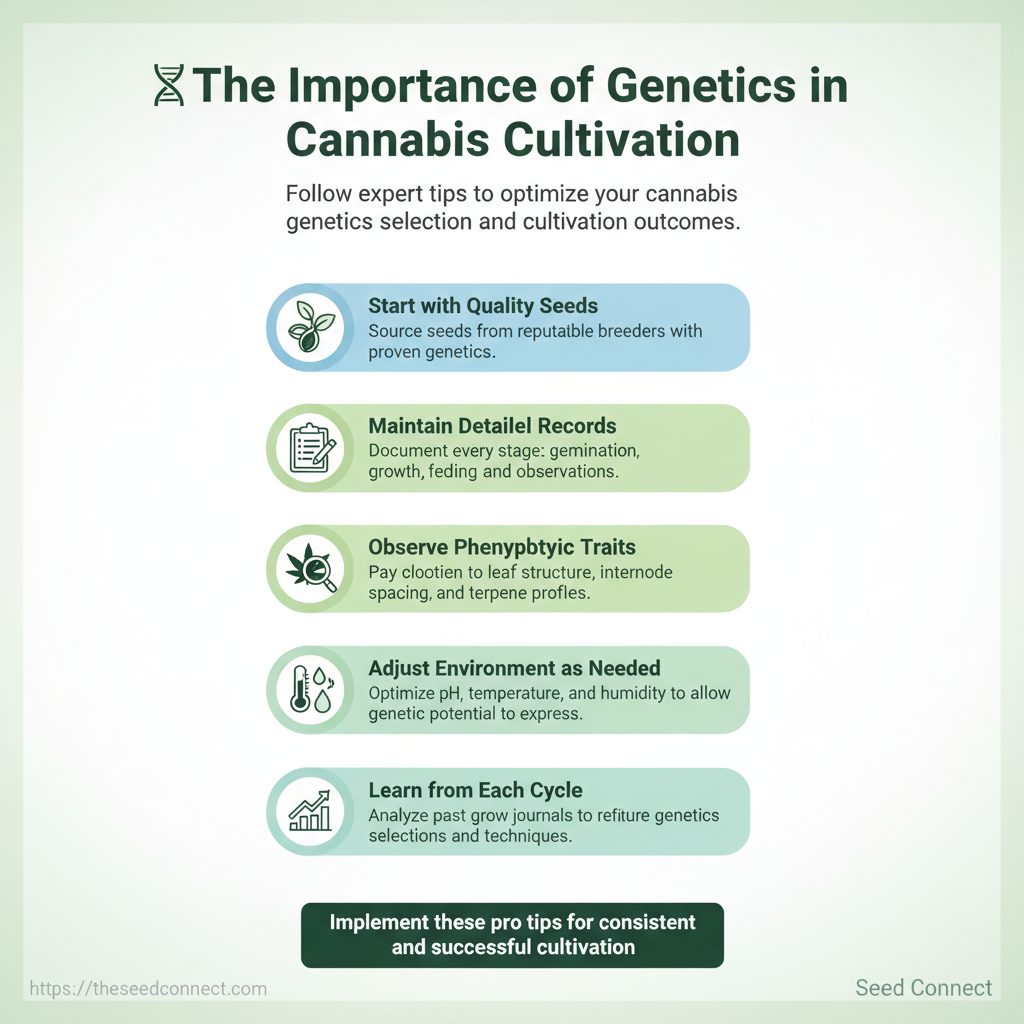
Treat each strain as a research project. Document, test, preserve, and verify to unlock your genetics’ full potential. Experienced growers get repeatable, superior outcomes by combining disciplined record-keeping with small-scale experimentation, redundant backups, and objective verification like third‑party COAs. Those practices expose true phenotype expression, reduce surprises when scaling, and protect valuable genetics over seasons.
Practical steps to maximize genetic outcomes
- Run a controlled test batch first (2–8 plants) to profile the strain’s behavior before scaling. Time estimate: 6–10 weeks to a reliable phenotype readout.
- Use a standard scoring template for observations: vigor, stretch, internode spacing, terpene notes, resin, and flowering time. Time estimate: 5–10 minutes per plant weekly.
- Archive backups of seeds and mother plants: maintain at least two storage locations and document lot numbers and source.
- Request or collect third-party COAs where available to confirm cannabinoid and terpene baselines before breeding or phenotype selection.
What to record and why
- Genetic ID: Store breeder name, lot number, and parental cross — essential when tracing traits later.
- Environment snapshot: Note light schedule (
18/6veg,12/12flower), temps, RH, and media type each week. - Nutrient protocol: Record products, ppm/EC, and feed schedule to isolate genetic responses from feeding effects.
- Phenotype scores: Use numeric scales for objective comparison across cycles.
> Industry growers often maintain digital phenotype libraries to speed selection and cull weak genetics quickly.
Pro-level habits expert growers use
- Small-scale selection: Phenotype 20–40 seeds, choose top 2–4 mothers.
- Maintain a seed archive: Rotate seed stocks every 2–3 years and cold-store duplicates.
- Validate with COAs: Cross-reference a lab report to separate environmental influences from genetic traits.
- Back up records digitally: Use cloud backups plus local CSV exports for redundancy.
Troubleshooting: if traits vary widely, check for environmental variability first (light uniformity, nutrient accuracy). If variation persists, the strain may be genetically heterogeneous — use selection and rebreeding to stabilize.
A consistent process of testing, documenting, and verifying preserves true genetics and accelerates reliable results. When followed, these practices turn promising seeds into dependable cultivars and reduce costly surprises at scale.
Measuring Success: How to Know Your Genetics Choice Worked
You can see success through measurable and repeatable results. This includes consistent yields, cannabinoid potency that matches breeder claims, stable terpene profiles, and uniformity among plants in the run. Start by deciding the primary objective (maximum THC, uniform plants for scale, high CBD, unique terpene profile), then track a short list of metrics with a simple sampling protocol so results are defensible and comparable between trials.
Practical success metrics and data-collection plan
- Define the trial scope and sample size:
- According to the Science of Cannabis Genetics and Breeding, Trial size: Minimum
10plants per cultivar for small breeders;20–30for commercial validation.
- Plot balance: Randomize location within the room/garden to avoid microclimate bias. 3.
Record baseline: Document genetics source, seed lot, germination date, and grow recipe. 2. Collect these metrics at harvest and lab testing:
- Dry yield per plant (g): Weigh after full dry and cure.
- THC/CBD (%): Use COA from an accredited lab; test
top 3–5representative samples per trial. Dominant terpene (% of total terpenes): Lab or validated GC analysis; identify the top two terpenes. Phenotype uniformity (%): Percent of plants matching the target phenotype across form, internode spacing, and flowering time.
- Sampling protocol and minimums:
- Minimum flower sample size:
10–15 gper plant composite for lab COA. * Number of lab samples: At least3independent plants per trial for cannabinoids;5for terpene profiling.
- Repeatability: Run the trial across two consecutive cycles to confirm stability.
Acceptable variance thresholds and decision points
- Recent research indicates that Dry yield: ±15–25% of target yield is acceptable; outside
>25%triggers a root-cause review., expected 20% → acceptable 18–22%). 7 percentage points of expected dominant terpene level, depending on baseline terpene abundance.
- Phenotype uniformity: ≥80% uniformity acceptable for commercial releases; <70% requires selection or re-breeding.
Table: Measuring Success: How to Know Your Genetics Choice Worked — Metric, How to Measure, Acceptable Range & more**
| Metric | How to Measure | Acceptable Range | Scoring (1-5) |
|---|---|---|---|
| Dry Yield (g/plant) | Weigh cured flower per plant; average across sample | 80–400 g (indoor variable by training) |
5: ≥300g, 4:200–299g, 3:150–199g, 2:100–149g, 1:<100g |
| THC (%) | Accredited lab COA, HPLC testing on composite samples | 15–28% (strain-dependent) |
5: within ±5% rel., 4:±6–10%, 3:±11–15%, 2:±16–25%, 1:>±25% |
| CBD (%) | Accredited lab COA, HPLC | <1% (psychoactive strains) to 10–15% (CBD strains) |
5: meets target ±10% rel., 4:±11–15%, 3:±16–20%, 2:±21–30%, 1: mismatch |
| Dominant Terpene (%) | GC analysis; report top terpene percent of total terpenes | 0.5–3.0% (total terpenes often 1–3%) |
5: within ±0.3 pp, 4:±0.4–0.7 pp, 3:±0.8–1.2 pp, 2:±1.3–2.0 pp, 1: >±2.0 pp |
| Phenotype Uniformity (%) | Visual scoring across population for target traits | ≥80% uniform desired |
5: ≥95%, 4:90–94%, 3:80–89%, 2:70–79%, 1:<70% |
Troubleshooting common outcomes If yields are low but COA matches: Check cultural factors (pest stress, light, root health). If potency is low vs. breeder claim: Confirm lab method alignment and sample timing (test too early reduces measured cannabinoids).
If phenotype uniformity is low: Implement selection — keep only the top-performing phenotypes and re-run a stability trial.
Suggested assets to add to the workflow: trial spreadsheet, sampling checklist, and printable lab submission template. When these measures and protocols are consistently followed, strain selection decisions become data-driven and repeatable, making it easier to scale successful genetics. This approach reduces guesswork and speeds confident decisions on which cultivars to keep, refine, or retire.
Conclusion
Many home growers remember a plant that changed their approach. It might have been a late-flowering bud with an unexpected smell or a sibling that outperformed all the others. That pattern points to three practical insights: choose seeds with clear lineage and breeder notes, match strain selection to your goals (yield, potency, or flavor), and run small phenotype hunts to identify the best individuals before scaling. If you’ve wondered whether genetics are stable, whether a given cultivar suits an indoor setup, or how to handle wide phenotype variability, treat those questions as diagnostic checkpoints: verify breeder stability, pilot a 4–8 plant selection, and document traits across runs.
Prioritize genetics documentation, start with a small selection, and record outcomes — those three moves convert guesses into repeatable results.
Next steps: order a few guaranteed seeds from a reputable source, perform the step-by-step evaluation outlined earlier, and use selective breeding or clonal retention for the top performers. For growers who want professional-grade seed options and support, resources like The Seed Connect seed catalog and support pages strain selection and germination planning. With deliberate strain selection and the expert grower genetics practices described above, the chances of finding that standout plant rise dramatically — and the next rethink will be a deliberate one, not a surprise.