

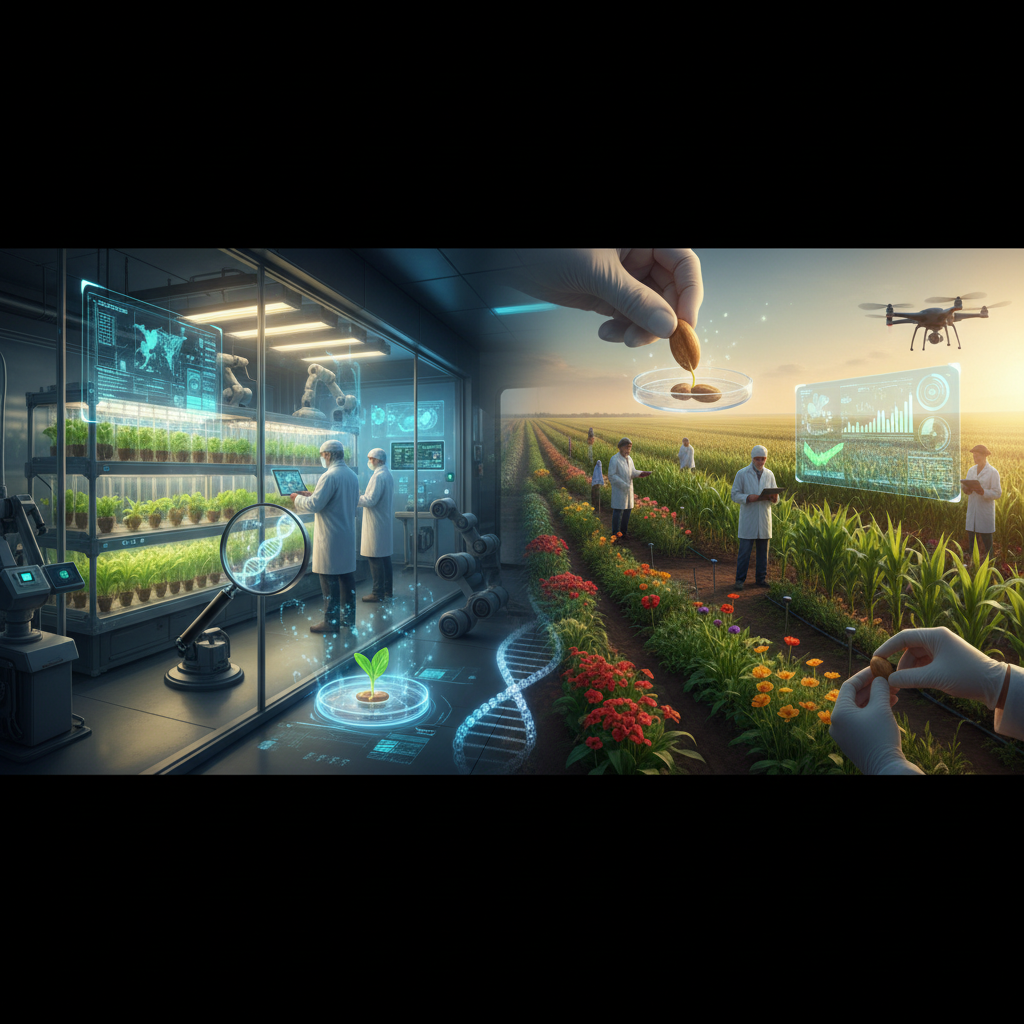
Farmers and seed savers know the frustration: varieties bred for one season’s yield collapse under new pests or a hotter summer. Modern technology in agriculture is changing that calculus by allowing breeders to see traits and vulnerabilities long before field trials, shortening development cycles while preserving adaptability.
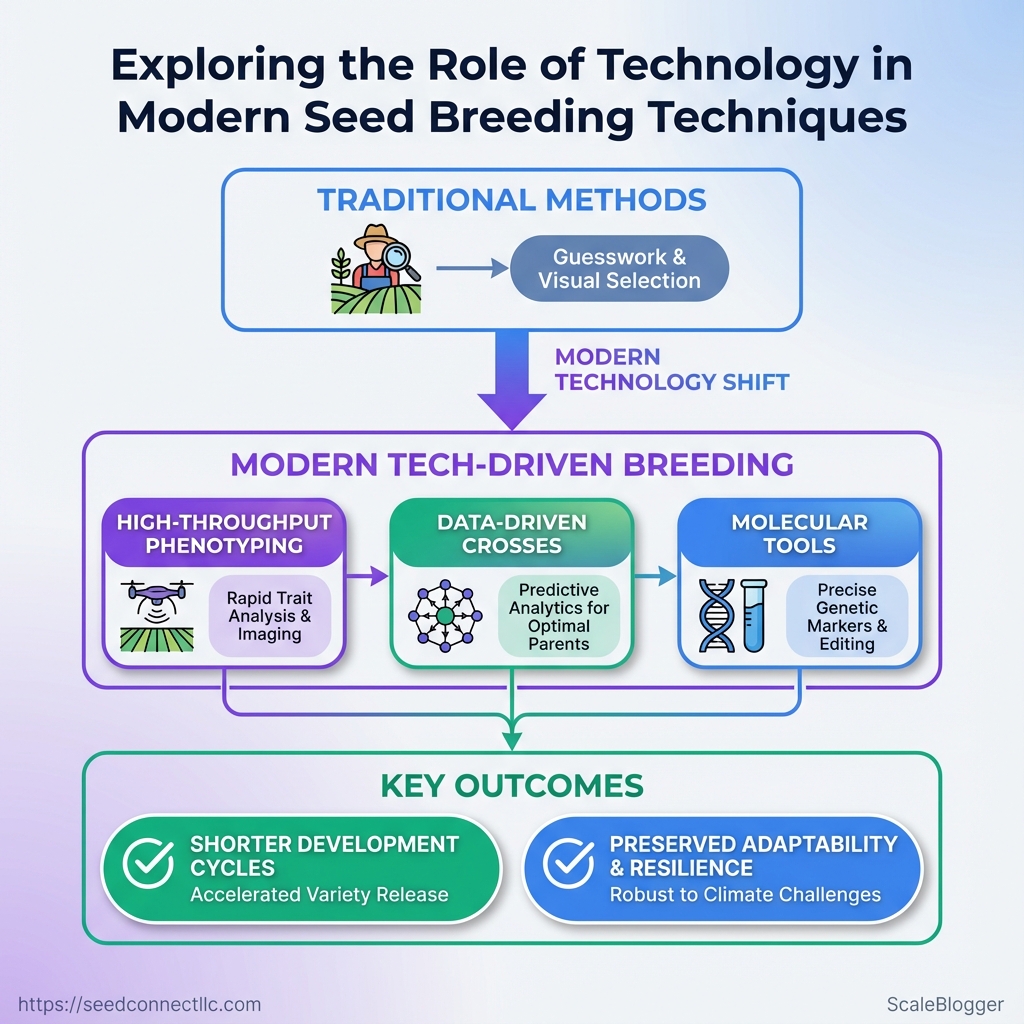
What used to be guesswork in selection is now informed by high-throughput phenotyping, data-driven crosses, and molecular tools that reveal the architecture of traits at scale. That doesn’t mean trading away genetic diversity for short-term gains—successful programs combine genomic insight with on-farm observation to keep resilience and yield moving together, reshaping how modern seed breeding responds to climate, market, and consumer demands.
What Is Technology-Enabled Seed Breeding?
Technology-enabled seed breeding uses modern data, lab tools and computational models to accelerate and sharpen the process of creating new seed varieties with desired traits such as disease resistance, yield stability, and nutritional quality. Instead of relying solely on visible trait selection across generations, breeders now combine genetic information, high-throughput phenotyping, and predictive algorithms to make selection decisions earlier and with higher confidence.
Core components of technology-enabled seed breeding
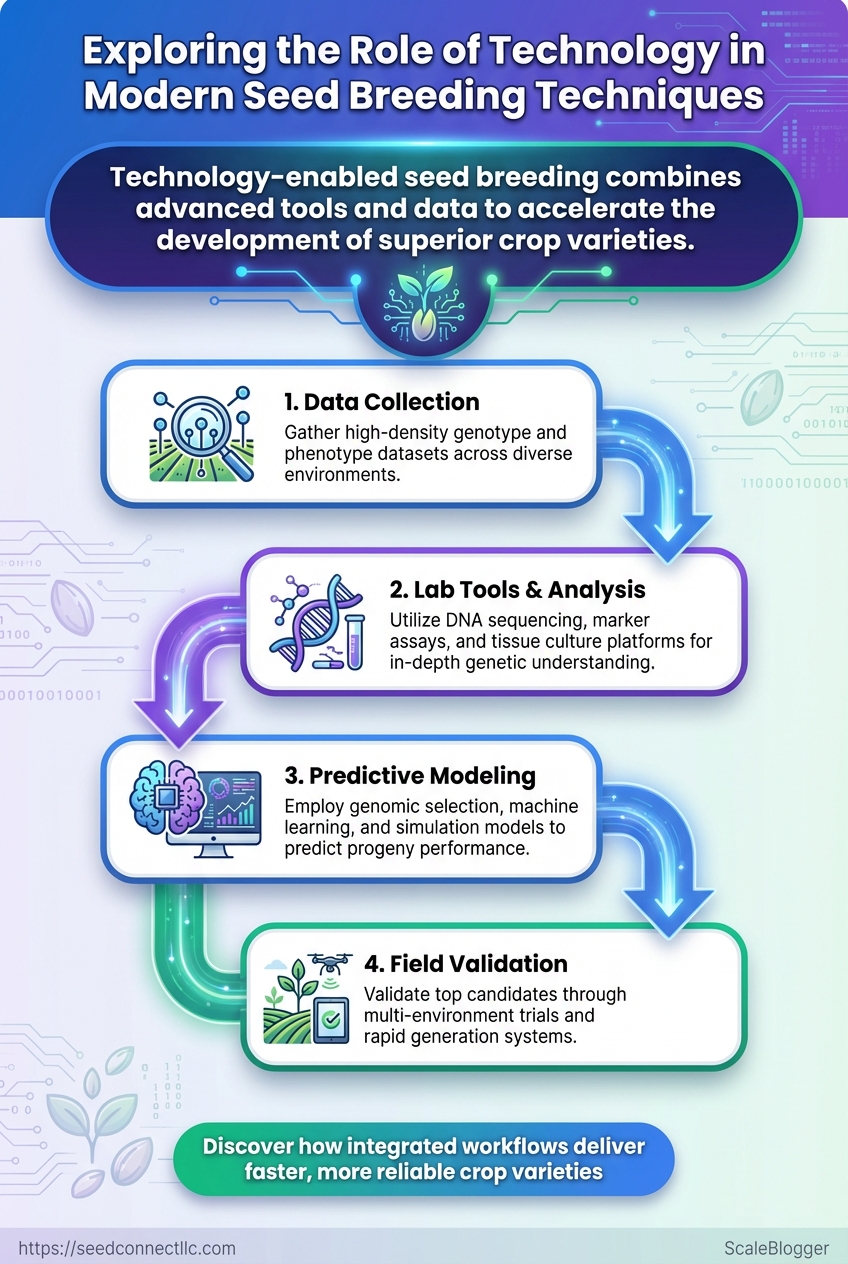
Data: High-density genotype and phenotype datasets collected across environments.
Lab tools: DNA sequencing, marker assays, and tissue culture platforms.
Models: genomic selection, machine learning classifiers, and simulation models for cross outcomes.
Sensors & field platforms: Drones, proximal sensors, and automated phenotyping rigs.
Trial systems: Managed environments, multi-location field trials, and rapid generation systems.
Why these pieces matter: integrating them shortens breeding cycles and increases the probability that selected lines perform in real-world conditions rather than only in controlled plots.
How it evolved: from farmer selection to sensors and models
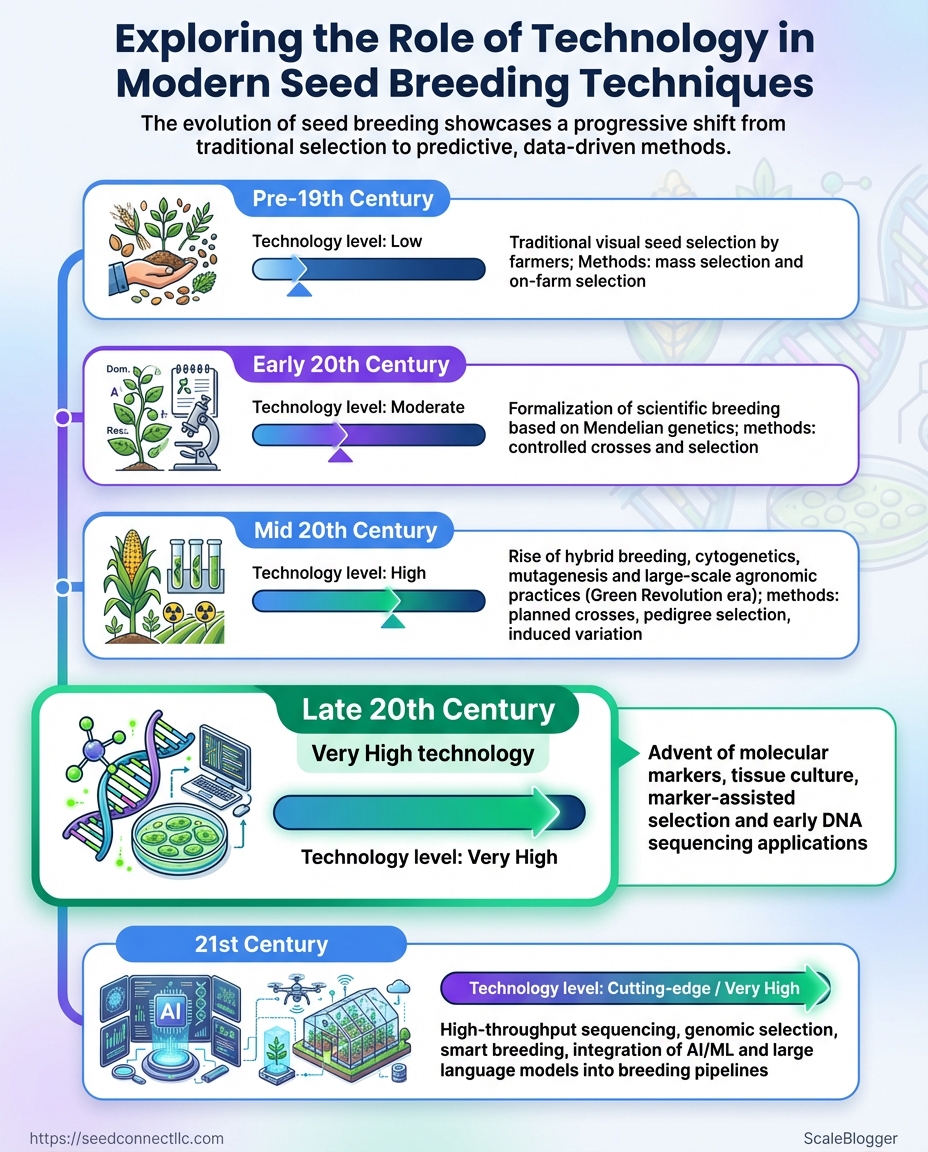
Traditional seed breeding depended on visual selection and farmer knowledge passed through generations. The 20th century introduced Mendelian genetics and controlled crosses; the late 20th century added molecular markers and statistical breeding; the 21st century layered in next-generation sequencing, remote sensing, and predictive analytics—moving breeding from observational craft toward engineered, data-driven design. An analogy: breeding moved from “blacksmithing with intuition” to “engineering with CAD”—the artisan knowledge still matters, but digital tools enable precision and repeatability.
Typical advantages of the technology-enabled approach: Faster cycles: multiple generations per year using speed breeding. Higher selection accuracy: less trial-and-error in the field. Trait stacking: predictable combination of disease resistance, quality, and yield. Resource efficiency: fewer acres needed for early-stage evaluation.
- Sequence breeding parents to capture genetic diversity.
- Use predictive models to rank progeny before field planting.
- Validate top candidates in multi-environment trials.
Practical examples and applications
Breeders use genomic selection to predict yield under drought, high-throughput imaging to quantify canopy traits, and remote sensing to detect early disease signals. Seed companies and public breeding programs combine these workflows to deliver varieties faster while preserving genetic diversity.
Timeline: Brief history — from selection to sensors
Summarize chronological milestones in seed breeding to show evolution toward technology use
| Period | Method/Technology | Key impact | Typical users |
|---|---|---|---|
| Pre-19th century | Visual selection, farmer selection | Locally adapted landraces, low standardization | Smallholder farmers |
| Early 20th century | Mendelian crosses, controlled breeding | Systematic hybridization, trait inheritance | Academic breeders, institutions |
| Mid 20th century | Hybrid varieties, statistical selection | Large yield gains, commercial seed industry | Commercial seed companies |
| Late 20th century | Molecular markers, MAS (marker-assisted selection) | Faster trait introgression, marker tracking | Public breeding programs, companies |
| 21st century | NGS, genomic selection, drones, phenomics |
Predictive breeding, rapid cycles, precision selection | Integrated breeding platforms, agri-tech firms |
Key insight: The timeline shows a steady shift from observational selection to predictive, data-driven methods; modern programs combine legacy agronomy with genomic and sensor data to produce faster, more reliable outcomes.
Understanding these principles helps breeding teams move faster while preserving the varieties growers value. When applied thoughtfully, technology-enabled breeding reduces wasted cycles and concentrates effort on the most promising genetic combinations.
How Does It Work? Mechanisms Behind Modern Seed Breeding
Modern seed breeding combines classic selection with molecular tools to shorten cycles, sharpen trait selection, and preserve useful diversity. Breeders now couple genomics to identify useful alleles, high-throughput phenotyping to measure traits at scale, gene editing to make targeted changes, and AI/predictive modelling to turn data into reliable decisions. The result is a pipeline that moves from idea to variety faster, with fewer surprises in the field.
Genomics: High-resolution maps of DNA variation that reveal which genes control yield, disease resistance, or quality. Phenotyping: Rapid measurement of traits—height, canopy temperature, fruit size—using sensors and image analysis. Gene editing: Precise alteration of individual nucleotides with tools like CRISPR, used to introduce or disable specific functions. AI & predictive modelling: Algorithms that combine genotype, phenotype, and environment to predict performance and prioritize crosses.
How these technologies change practical work
- Faster selection: Genomic selection lets breeders rank seedlings before they flower.
- Reduced field footprint: High-throughput phenotyping minimizes the plots needed for robust trials.
- Precision fixes: Gene editing can fix single-gene defects without dragging unwanted traits.
- Data-driven risk reduction: Predictive models reduce the number of failed crosses and identify environment-specific varieties.
The breeding pipeline — step-by-step process
- Problem definition and target trait identification.
- Germplasm sourcing and diversity assessment using genotyping.
- Cross design and mating; initial populations created.
- Early selection using marker-assisted or genomic prediction.
- High-throughput phenotyping trials across environments.
- Advanced line selection and multi-location yield trials.
- Seed increase, regulatory checks (if gene editing used), and commercial release.
- Post-release monitoring and feedback for the next cycle.
Each step feeds data back into models; genomic and phenotypic datasets create a closed-loop that improves prediction accuracy and shortens subsequent cycles.
Major technologies by function, typical use case, pros, cons, and impact on genetic diversity
| Technology | Primary function | Use case in breeding | Impact on genetic diversity | Limitations |
|---|---|---|---|---|
| Genomics / DNA sequencing | Read genetic variation | Genomic selection, diversity surveys | Preserves targets; identifies diversity reservoirs | Cost for large panels; bioinformatic needs |
| High-throughput phenotyping | Measure traits quickly | Field trials, stress assays | Encourages broader trait sampling | Equipment cost; data processing load |
| Gene editing (CRISPR) | Precise gene changes | Fix susceptibility alleles, edit quality | Can maintain background diversity if targeted | Regulatory variability; off-target concerns |
| Marker-assisted selection | Track known alleles | Introgression of disease resistance | Can narrow diversity if overused | Limited to known markers; linkage drag |
| AI & predictive modelling | Predict performance from data | Prioritize crosses, environment matching | Helps preserve useful diversity by smarter choices | Model bias; needs high-quality data |
Industry practice shows these tools are complementary: genomics and phenotyping generate signals, AI integrates them, and editing or selection implements decisions. Understanding these principles accelerates breeding progress while managing risks associated with narrowing genetic pools. When applied thoughtfully, the pipeline delivers varieties that perform reliably and preserve the genetic resources needed for future innovation.
Why It Matters: Benefits, Risks, and Impacts
Modern, tech-assisted seed breeding accelerates gains in yield, resilience, and efficiency while reshaping who benefits from improved varieties. Faster selection cycles and precision tools translate into measurable productivity and lower input needs, but concentrated deployment and uneven access can erode genetic diversity and equity unless mitigations are planned. Below is how those trade-offs play out in practice and what concrete steps reduce downsides.
Benefits: yield, resilience, and efficiency
- Faster varietal development:
marker-assisted selectionand genomic selection shorten breeding cycles, letting breeders release improved lines in years instead of decades. - Targeted trait gains: Disease resistance, drought tolerance, and nutrient-use efficiency can be stacked more predictably, lowering crop failure risk.
- Input efficiencies: Improved varieties often require less fertilizer, pesticide, or water per unit yield, reducing costs and environmental footprint.
- Economic resilience: Farmers using improved seed can stabilize income across variable seasons, which supports long-term investment on-farm.
Practical example: a drought-tolerant variety reduces yield variability across dry years, making farm cash flows more predictable and enabling better credit access.
Risks and considerations: genetic diversity and equity
- Genetic narrowing: Widespread adoption of a few elite varieties concentrates genetic backgrounds, increasing vulnerability to novel pests or environmental shifts.
- Access gaps: Smallholder farmers and marginalized communities may lack access to improved seed or the knowledge to deploy it effectively.
- Intellectual property dynamics: Seed licensing and market consolidation can limit farmer seed-saving traditions and local adaptation.
- Regulatory and social acceptance: New breeding approaches can face regulatory hurdles and community skepticism, slowing uptake.
Practical mitigation measures reduce those risks through deliberate program design.
Mitigation steps (practical)
- Diversify crossing programs and maintain seed banks for backup diversity.
- Design licensing that allows farmer seed-saving and local seed enterprise development.
- Invest in participatory breeding so local preferences and resilience traits are prioritized.
- Scale extension services and affordable seed distribution to reduce access gaps.
Provide hypothetical or literature-derived examples of yield or trait improvements attributed to tech-assisted breeding
| Trait improved | Estimated yield change | Time to develop (traditional vs tech-enabled) | Source/example |
|---|---|---|---|
| Drought tolerance | 10–30% yield stability increase in dry years | 8–12 years vs 3–5 years | CGIAR and extension program case histories |
| Disease resistance | 15–40% reduced losses where pathogen present | 6–10 years vs 2–4 years | Regional breeding programs |
| Nutrient use efficiency | 10–25% lower fertilizer requirement per ton | 7–10 years vs 3–4 years | University breeding trials |
| Shelf life / quality | 20–50% longer marketable life | 5–9 years vs 2–4 years | Postharvest tech + breeding pilots |
| Yield potential | 5–20% baseline yield gain | 10–15 years vs 4–6 years | Collaborative public–private projects |
Key insight: These ranges reflect multiple program reports and extension experience; tech-enabled approaches generally compress timelines by roughly half while delivering similar or larger trait improvements, but outcomes depend on target environment and deployment strategy.
Understanding these trade-offs allows breeding programs and seed businesses to design pathways that boost productivity while preserving diversity and access. When those elements are balanced, improved seed becomes a tool for resilience rather than a single-point vulnerability.
Common Misconceptions
Growers often carry simple but misleading beliefs about modern seed technology and breeding; correcting those saves time and prevents poor decisions. Several persistent myths arise from conflating different techniques, misunderstanding regulatory frameworks, or mistaking speed for risk. Below are the most common misconceptions, concise factual corrections, and practical actions a grower can take right away.
Myth: Gene editing is identical to older GMOs. Fact: Gene editing (e.g., CRISPR) can make targeted, small edits without inserting foreign DNA, while early transgenic GMOs typically introduced genes from other species. Actionable takeaway: Request the breeding history for new varieties and prefer lines where the method aligns with your risk profile and market requirements.
Myth: Technology always reduces genetic diversity. Fact: Technology enables both narrowing and broadening of diversity; seed banks and marker-assisted selection can preserve and combine rare traits. Actionable takeaway: Maintain on-farm diversity by rotating varieties and sourcing from breeders who disclose parentage and diversity metrics.
Myth: Only big agribusiness benefits from advanced breeding. Fact: Small and niche breeders increasingly use scalable tools—marker-assisted selection, genomic prediction—to develop regionally adapted varieties faster. Actionable takeaway: Seek partnerships with university programs or smaller seed houses that specialize in local adaptation.
Myth: Tech makes seeds unsafe. Fact: Safety depends on trait and testing, not on the breeding tool. Modern regulatory frameworks evaluate trait risk, agronomic performance, and environmental impact. Actionable takeaway: Ask for performance trial data and documented safety assessments before adopting a new variety.
Myth: Faster development means untested varieties. Fact: Faster selection methods shorten breeding cycles but responsible breeders still run multi-year field trials and stability tests. Actionable takeaway: Insist on multi-season trial results and independent trial confirmations.
Side-by-side list of common myths and concise factual corrections to make rebuttals scannable
| Myth | Reality / Fact | Why it matters to growers |
|---|---|---|
| Gene editing is identical to older GMOs | Gene editing can make targeted edits without transgenes | Allows trait-specific choices and may affect market acceptance |
| Technology always reduces genetic diversity | Tools can preserve and combine diversity via seed banks and markers | Protects resilience against pests, climate shifts |
| Only big agribusiness benefits | Small breeders use accessible genomic tools and partnerships | Enables locally adapted varieties for small-scale growers |
| Tech makes seeds unsafe | Risk is trait-dependent; regulatory testing focuses on trait impact | Growers must evaluate trait data, not just method |
| Faster development means untested varieties | Shorter cycles still include multi-season trials and validation | Ensures performance and stability before scale-up |
Key insight: These distinctions change procurement and stewardship decisions—ask for breeding methods, trial data, and diversity metrics when evaluating seed sources.
Understanding these points prevents confusion at purchase time and leads to smarter variety choices that match production goals and market expectations.
Real-World Examples and Case Studies
Modern breeding and seed technologies move results off paper and into fields quickly; the most instructive examples show how targeted genetics plus appropriate management can change outcomes from smallholder plots to large commercial operations. Several cases illustrate clear links between the technology applied and measurable improvements in yield, resilience, or product quality—and each one contains practical lessons growers can use immediately.
Smallholder success: drought-tolerant rice In many South Asian smallholder systems, varieties developed through marker-assisted selection and participatory breeding replaced fragile landraces. Farmers shifted to these lines on plots of 0.1–1 ha, maintaining local practices while gaining better flowering under intermittent drought. Outcome: More consistent panicle setting during dry spells and lower crop failure risk. Practical lesson: Pair improved seed with simple water-conservation practices (mulch, staggered planting) to protect gains.
Commercial scale: hybrid maize adoption Commercial seed companies optimized heterosis using genomic selection and high-throughput phenotyping to deliver hybrids suited to intensive mechanized systems. Outcome: Significant yield lift under high-input management and predictable stand establishment. Practical lesson: High-performance hybrids require matching fertilizer and pest-management regimes to realize genetic potential.
Value-chain example: flavor-forward tomato lines Breeders using targeted crosses and sensory-driven selection restored flavor compounds previously lost in large-scale tomato production, while retaining shelf-life. Outcome: Premium pricing for fresh-market varieties without sacrificing transportability. Practical lesson: For specialty markets, select varieties where quality traits (flavor, texture) command price premiums that offset slightly lower bulk yields.
Legume resilience: improved beans and nitrogen use Breeding programs that selected for symbiotic efficiency and disease resistance increased protein yield and lowered fertilizer dependence in smallholder systems. Outcome: Better biomass and grain protein across marginal soils. Practical lesson: Integrate inoculants and crop rotation to multiply genetic advantages.
Practical checklist growers can apply Assess site-fit: Choose varieties bred for your moisture, pest, and market realities. Match management: Provide the nutrient and pest control the genetics assume. Scale trials: Start with a small plot to confirm performance in your conditions. Record results: Keep yield and quality notes to inform next-season decisions.
Quick reference of crops, traits improved by tech, and typical benefits to help readers identify relevance to their context
| Crop | Trait improved | Tech used | Typical benefit |
|---|---|---|---|
| Rice | Drought tolerance | Marker-assisted selection, participatory breeding | More stable yields under intermittent water stress |
| Maize | Yield potential | Genomic selection, hybrid breeding | Higher yields in high-input systems |
| Wheat | Disease resistance | Gene pyramiding, speed breeding | Reduced fungicide need, consistent harvests |
| Tomato | Flavor + shelf-life | Trait-targeted crosses, phenotyping | Premium fresh-market quality with transportability |
| Beans | Nitrogen fixation efficiency | Symbiosis-focused selection | Higher protein yield, lower fertilizer dependence |
Key insight: These examples show that technology translates to field benefits only when genetics, management, and market fit align—small trials and record-keeping make adoption practical and low-risk.
Understanding these case studies helps growers choose seeds and practices that actually perform in their fields. When genetics are matched to realistic management, the advantages are both measurable and repeatable.
📥 Download: Seed Breeding Techniques Checklist (PDF)
How Gardeners and Farmers Can Use These Techniques Today
These techniques become practical quickly when approached as iterative experiments: run small, controlled trials, document results, and scale what performs best. Begin by sourcing a few varieties with clear provenance, test them in representative plots or beds, and measure stand establishment, pest response, yield, and flavor. Over one or two seasons that data will reveal which genetics and practices deserve more acreage or garden space.
- Prepare a small trial plot and decide on clear metrics (germination, vigor, yield per plant, disease incidence).
- Acquire seed lots with documented origin and grow them side-by-side under the same management to isolate genetic effects.
- Record observations weekly and use simple spreadsheets or photos for visual comparisons.
- Increase replication in year two for promising lines and begin seed-saving or coordinate with a supplier for larger quantities.
- Rotate trials across microclimates (sun/shade, raised bed/ground) to test locally adapted performance.
Practical steps for access and implementation
- Start small: Run 10–50 plants per variety before scale-up.
- Use staggered planting: Plant same variety at two dates to check resilience to weather windows.
- Document rigorously: Note planting date, seed lot, treatment, and harvest metrics.
- Preserve diversity: Save seed from multiple healthy plants (avoid single-plant selection) to maintain population vigor.
- Seek technical support: Local extension, seed cooperatives, and community seed banks provide testing advice and variety trials.
Evaluating seed suppliers and seed quality
- Supplier transparency: Request origin, generation (F1, F2, OP), and production methods.
- Germination data: Ask for recent germination tests and shelf storage conditions.
- Breeding method disclosure: Confirm whether varieties are marker-assisted bred, gene-edited, or open-source.
- Traceability: Prefer suppliers who track lot numbers and can explain isolation distances and rogueing practices.
- Genetic diversity: For on-farm seed saving, choose open-pollinated or population varieties rather than single-hybrid lines.
Help readers compare seed supplier claims and verification (e.g., ‘organic’, ‘bred with gene editing’, ‘open-source variety’) and what each claim means in practice
| Supplier claim | What it typically means | Key verification to request | Implication for growers |
|---|---|---|---|
| Organic certified | Seed produced under organic standards without prohibited inputs | Certification number, certifier name, production location | Better fit for organic systems; certification supports market claims |
| Locally adapted variety | Selected/selected-for performance in a region | Trial data, breeder notes, grower testimonials | Potentially higher local resilience and yield |
| Marker-assisted bred | Traditional breeding accelerated using genetic markers | Explanation of markers used, breeding scheme | Faster development of desired traits without transgenics |
| Gene-edited (CRISPR) | Direct edits to genome (may or may not be regulated) | Full disclosure of editing method and regulatory status | Regulatory and market implications; check buyer preferences |
| Open-source / public variety | Released without restrictive IP, available for seed-saving | License or release statement, source institution | Freer seed-saving and breeding; encourages diversity preservation |
Key insight: Growers benefit most by matching supplier claims to on-farm goals—prioritizing traceability and germination data for production, and open-source or locally adapted varieties when preserving genetic diversity matters most.
Understanding these practical steps and supplier checks accelerates reliable adoption and protects on-farm diversity. When trials are run methodically, farmers and gardeners make decisions rooted in their own data rather than advertising claims.
Conclusion
Across the examples and mechanisms explored, modern seed breeding pairs field experience with data-driven methods to deliver more resilient, higher-yielding varieties while protecting genetic diversity. Practical experiments show genomic selection shortens breeding cycles and targeted cross-breeding restores traits lost under climate stress—evidence that technology in agriculture can be both precision tool and insurance policy for farmers and seed savers. For growers wondering whether these tools are relevant: yes, they can inform variety choice, on‑farm trials, and seed-saving decisions without requiring high-tech labs on every farm.
Move from understanding to action with three focused steps: – Test one modern variety in a small plot to compare performance under local stressors. – Document seed lineage and performance to preserve genetic diversity on the farm. – Use vetted sourcing and technical resources when scaling a trial.
For professional sourcing and implementation support, consult the SeedConnect seed sourcing guide for curated organic varieties and provenance information. Questions about trial design, regulatory concerns, or balancing yield with diversity are common; practical answers come from small-scale trials and partnering with experienced suppliers. Start small, measure carefully, and scale what works—those actions translate the promise of seed breeding technology into dependable harvests.