
Exploring the Differences in Organic Seed Sourcing
Sourcing organic seeds shapes everything from crop resilience to flavor and yield, so choosing the right origin, certification, and supplier matters more than many growers realize. Drawing on practical experience in global seed networks, this introduction highlights why sourcing decisions affect plant health, regulatory compliance, and long-term farm productivity.
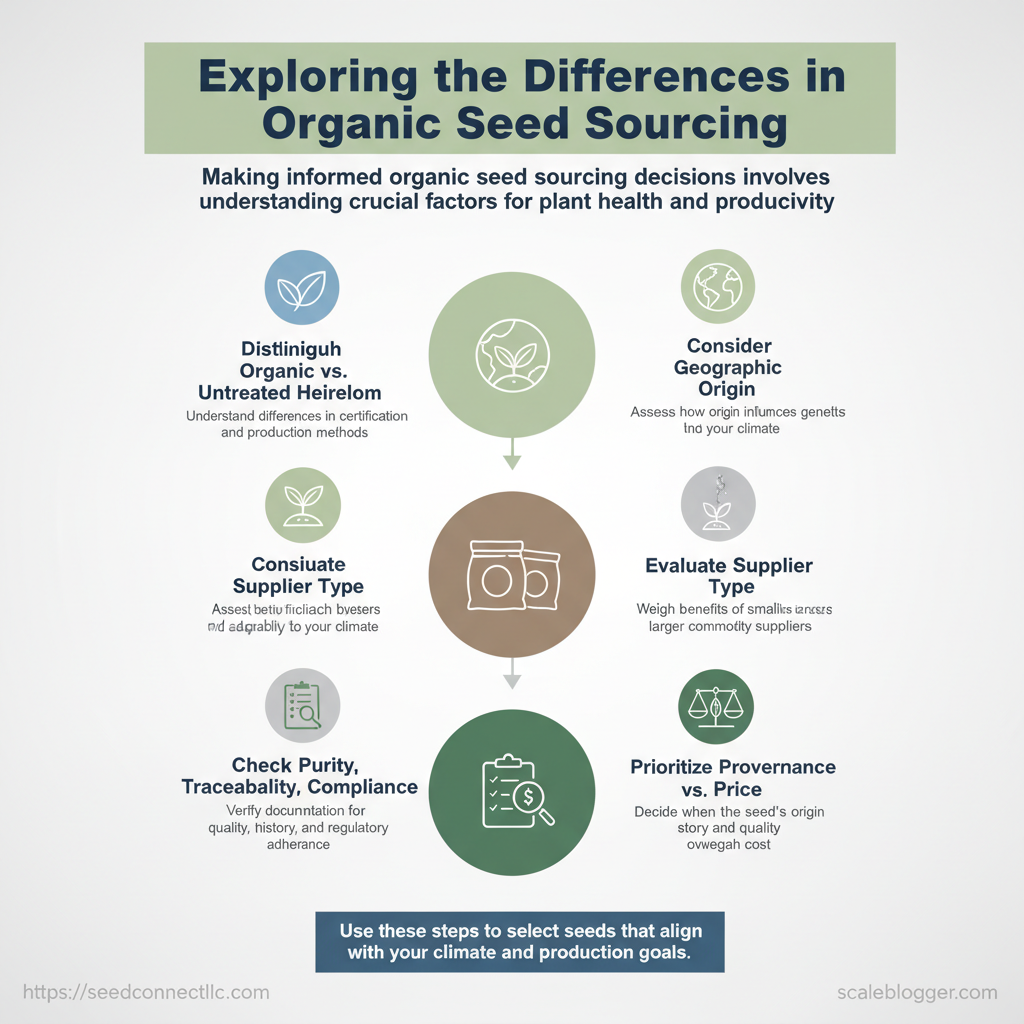
- What distinguishes certified organic from untreated heirloom seed
- How geographic origin influences genetics and adaptability
- The trade-offs between small-batch breeders and larger commodity suppliers
- Practical checks for purity, traceability, and compliance
- When to prioritize provenance versus price
> [!INFO] > Experts observe that transparent supply chains and strict certification practices consistently reduce seed-related crop failures.
Choosing seeds is both a scientific and logistical decision: genetics, certification, and supplier practices all interact to determine outcomes. Next, we’ll unpack the sourcing differences step by step and offer actionable guidance for selecting seeds that match your climate and production goals. Explore our range of organic seeds: https://seedconnectllc.com
Table of Contents
- What Are Organic Seeds?
- Section Content
- The Importance of Sourcing Organic Seeds
- Different Sources of Organic Seeds
- Understanding Certification in Organic Seed Sourcing
- Challenges in Organic Seed Sourcing
- Best Practices for Sourcing Organic Seeds
- Future Trends in Organic Seed Sourcing
- Conclusion
What Are Organic Seeds?
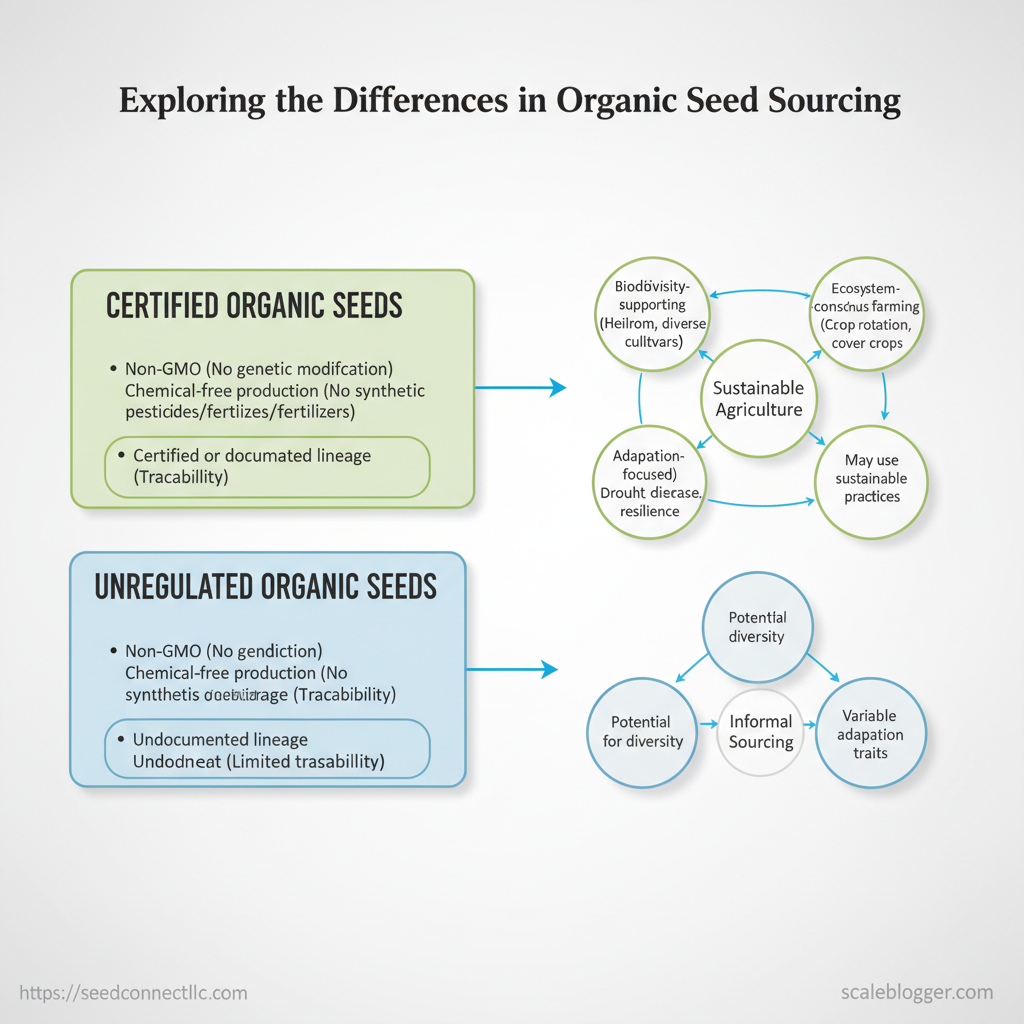
Organic seeds are seeds produced, harvested, and handled according to organic agriculture principles: no synthetic pesticides or fertilizers in seed production, no genetic modification, and practices that support soil health and biodiversity. They’re the starting point for genuinely organic crops — while a crop can be grown organically, the seed itself must meet organic production standards to be labeled as organic seed.
Characteristics of Organic Seeds: Non-GMO: Genetic modification is excluded; organic seeds are propagated from naturally occurring genetics or traditional breeding methods. Chemical-free production: No synthetic pesticides, herbicides, or fungicides are used during seed production, cleaning, or storage. Certified or documented lineage: Many organic seeds carry certification or clear traceability showing the seed’s production practices and history. Biodiversity-supporting: Organic seed production often emphasizes heirloom varieties and diverse cultivars that promote genetic diversity. Ecosystem-conscious farming: Production usually incorporates crop rotations, cover crops, and habitat practices that benefit pollinators and soil life. Lower residual risk: Without synthetic residues on seed coats, germination environments can be healthier for seedlings and soil microbes. Adaptation-focused: Organic seed producers often select for traits that perform well under low-input conditions (drought tolerance, disease resilience). Regenerative compatibility: These seeds are well-suited to regenerative and agroecological systems aiming to rebuild soil organic matter.
- How to verify organic seed claims:
- Look for third-party certification labels or producer documentation.
- Ask for provenance and production practices; organic seed sellers should share seed lot histories.
- Inspect packaging for
Organic,Non-GMO, and variety information — avoid vague claims.
> [!INFO] > Organic seeds contribute to on-farm biodiversity and can improve long-term resilience against pests and climate stress.
Practical example: many growers choose heirloom tomato seeds selected for open-pollination and flavor rather than uniform appearance; this supports biodiversity and flavor diversity while performing reliably in organic systems.
Seed-label-template example: `text Variety: Cherokee Purple Type: Open-pollinated (Heirloom) Certification: Certified Organic (producer name) Lot #: 2024-CP-07 Germination: 85% (tested date) Origin: Sourced from organic seed grower, [region]
If you’re sourcing organic seeds, suppliers that document production methods and offer diverse, non-GMO varieties are the practical choice — for example, SeedConnect LLC specializes in sourcing high-quality organic and heirloom seeds globally to support plant health and yield. Choosing seeds with clear provenance helps crops get off to a healthier start and supports longer-term farm or garden resilience.
The Importance of Sourcing Organic Seeds
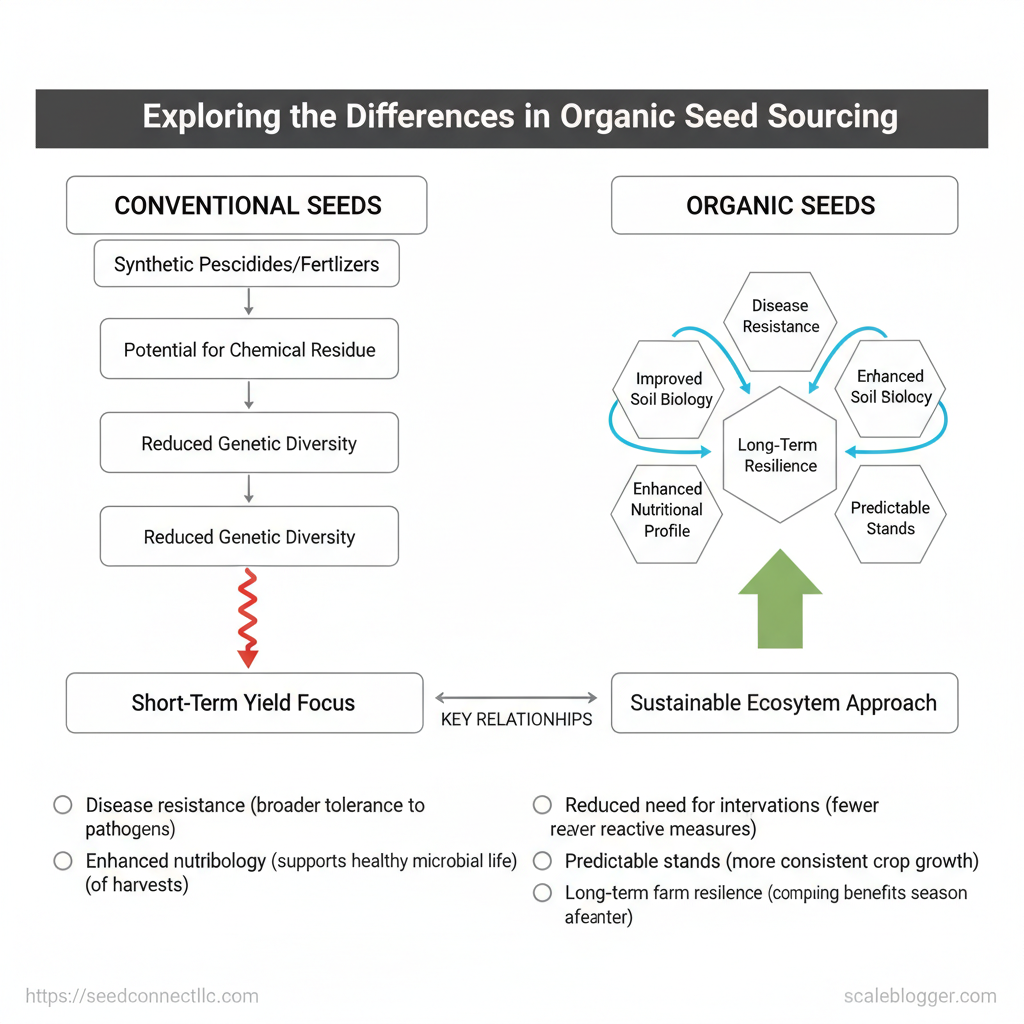
Choosing organic seeds is one of the most effective upstream decisions you can make for long-term plant health. Organic seed provenance affects disease resistance, soil biology, and the nutritional profile of harvests — and those effects compound season after season if you prioritize quality sources.
- Disease resistance: Organic seed lines are often selected under low-input conditions, so they tend to possess broader tolerance to local pathogens and stressors. That reduces the need for reactive interventions and supports more predictable stands.
- Soil health linkage: Seeds from organic systems are typically propagated in biologically rich soils, encouraging seedlings that interact well with soil microbiota. Healthy early root colonization translates into better nutrient uptake and drought resilience.
- Nutritional benefits: Plants grown from well-adapted organic seed lines often show improved nutrient partitioning to fruit and leaves, meaning higher micronutrient content in produce.
- Genetic diversity: Organic and heirloom varieties preserve genetic traits that modern hybrids sometimes discard, providing a library of adaptive traits for changing climates.
- Reduced chemical carryover: When you start with seeds produced without synthetic inputs, there’s a lower risk of unwanted residues in seed coatings or seed-borne contaminants.
- Traceability and trust: Reputable organic seed suppliers document provenance and production methods, which helps when diagnosing issues or selecting varieties for rotation.
- Economic resilience: Strong seed genetics lower crop failure risk and can reduce input costs over multiple seasons.
- Consumer and market alignment: Organic seeds align with organic certification pathways and consumer demand for cleaner-label produce.
- Source seeds from suppliers that document production practices.
- Prioritize locally adapted varieties to reduce disease pressure.
- Test germination and do a small-scale trial before full-field planting.
- Maintain seed-saving protocols to lock in favorable traits season-to-season.
- Rotate varieties to manage pathogen build-up and sustain diversity.
> Industry analysis shows that growers who match seed selection to soil biology and local conditions experience more stable yields and fewer disease outbreaks.
> [!TIP] > When evaluating seed lots, request information about the production field, propagation practices, and any observed disease challenges — those details inform realistic expectations.
For teams buying seed, consider partners that specialize in organic sourcing and documented provenance; suppliers who can advise on variety performance save time and reduce risk. Choosing the right seed is an investment that pays back through healthier plants, stronger soils, and better-quality produce. Understanding and applying these principles lets you protect crop health while building resilience into your production system.
Different Sources of Organic Seeds
When choosing where to buy organic seeds, you’ll typically decide between locally produced seed stocks and larger commercial suppliers. Both paths deliver strong results, but they differ in supply stability, genetic diversity, community impact, and quality controls. SeedConnect LLC offers globally sourced, high-quality organic and heirloom seeds tailored for optimal plant health and yield, making it a primary option when you need reliable, certified inventory and wide variety access.
Local farms and seed savers Community support: Buying from local growers keeps money in the regional economy and strengthens seed-saving traditions. Adapted genetics: Local varieties are often better adapted to microclimates and pest pressures in your area. Rare varieties: Small-scale producers and seed swap networks frequently carry heirloom or region-specific cultivars not found in commercial catalogs. Seasonal availability: Local seeds may be available only at certain times; plan ahead for spring planting.
Commercial suppliers (including specialized brokers) Scale and consistency: Companies like SeedConnect provide consistent inventory, standardized packaging, and broad cultivar access. Certifications and testing: Commercial suppliers generally maintain organic certification, seed germination testing, and lot traceability. Logistics and volume: For large plantings or multiple locations, commercial sources simplify ordering and fulfillment. Price and lead times: Bulk pricing and predictable lead times make commercial suppliers efficient for operations.
- Evaluate your goals: small garden experimentation → prioritize local diversity; large-scale production → prioritize certified commercial inventory.
- Check quality controls: ask about
germination rates,purity tests, andorganic certification. - Consider genetics: combine local seed saves with commercial varieties to balance resilience and uniformity.
- Plan availability: order commercial seed early for predictable delivery; coordinate with local growers for seasonal pickups.
> [!TIP] > For rare heirlooms, start local conversations and also secure backups from reputable suppliers like SeedConnect to protect against crop failure.
> [!INFO] > Industry analysis shows combining sources often yields the best outcomes: local adaptability plus commercial consistency.
Choosing seeds doesn’t need to be an either/or decision. Mix local lines for adaptation and community benefit with commercial sources for reliability and certification, and you’ll improve resilience and yield without sacrificing genetic variety. This blended approach keeps your program flexible and performance-oriented.
Understanding Certification in Organic Seed Sourcing
Certification is the backbone of trust when sourcing organic seed. At its core, certification confirms that seeds were produced, handled, and documented according to defined organic standards — which reduces supply-chain risk and protects downstream crop integrity. For practical sourcing, that means knowing the regulatory bodies, the standards they enforce, and how to verify compliance before you buy.
Major regulatory bodies and what they do: USDA National Organic Program (NOP) — sets U.S. organic production, handling, and labeling rules; requires organic system plans and traceable records. EU Organic Regulation — harmonizes standards across EU member states and emphasizes residue limits and approved inputs. Canadian Organic Regime — aligns with international organic equivalence while mandating local certification procedures. Third-party certifiers — accredited organizations that inspect farms and seed handlers to issue certificates under these regulations.
- How certification typically works
- Applicant develops an
Organic System Plandescribing practices and inputs. - A certifier conducts an on-site inspection and reviews records.
- If compliant, the certifier issues an organic certificate; ongoing annual inspections maintain status.
> [!INFO] > Industry analysis shows that documented traceability and yearly inspections are common across mature organic regimes.
Practical compliance checkpoints for buyers Certificate authenticity — verify certificate number, scope (seed vs. crop), and validity dates. Seed purity documentation — look for germination rates and weed/disease test reports. Input approvals — confirm any seed treatments are on the allowed list for your target market. Traceability — ensure batch-level records exist from seed production to shipment.
Examples that matter in procurement Sourcing for U.S. market: require NOP certification and seed lot records. Exporting to EU: align with EU organic rules and check for equivalence agreements. * Hybrid scenarios: when sourcing heirloom or non-GMO varieties, request both organic certification and variety provenance.
> [!TIP] > Use a vendor checklist that doubles as a contract exhibit: certificate copy, declaration of prohibited treatments, lot-level lab results.
If you want streamlined, compliant sourcing, partner with suppliers who specialize in organic seed logistics and documentation — for example, SeedConnect helps customers source certified organic, heirloom, and non-GMO seeds with full traceability and paperwork ready for audits (https://seedconnectllc.com). Understanding these certification mechanics reduces procurement friction and protects the quality of your crop. This approach makes compliance manageable and procurement decisions more defensible.
Challenges in Organic Seed Sourcing
Cost and availability drive nearly every purchasing decision for growers and seed merchants. Navigating those pressures means balancing comparative pricing, bulk strategies, and seasonal constraints while protecting seed quality and genetic integrity. SeedConnect’s sourcing services can be a first stop for teams that need global access to organic, heirloom, and non-GMO varieties with transparent pricing and lead times, helping reduce surprises when availability tightens.
Common pressures and practical responses:
- Comparative pricing friction. Organic seeds typically carry a premium; comparing
per-unitandper-poundcosts across suppliers reveals where markup is concentrated. - Bulk purchasing trade-offs. Larger orders lower
per-unitcost but increase storage, testing, and spoilage risks. - Seasonal availability windows. Many varieties are only harvested/cleaned once per year, creating predictable scarcity.
- Quality vs. cost tension. Cheaper lots may have mixed germination or off-types; inspection and small germ tests matter.
- Supply-chain lead times. International organic certification, customs, and phytosanitary docs extend timelines.
- Minimum order quantities (
MOQ) constraints. MOQs can lock buyers into varieties they’ll struggle to sell. - Genetic purity concerns. Cross-pollination risk and seed saving practices affect repeatability of results.
- Price volatility. Weather, fuel, and certification costs cause swings between seasons.
- Assess true landed cost:
- Start with supplier
per-unitprice. - Add testing, certification, shipping, and storage.
- Compare to SeedConnect’s bundled sourcing quotes to see net savings.
- Use staged bulk buys:
- Secure a core bulk for best-selling varieties.
- Top-up with smaller lots to test new lines.
- Lock windows with contracts:
- Negotiate lead times and penalties for missed delivery.
- Ask suppliers for forecasted availability.
> Industry analysis shows seasonal spikes are predictable; planning 6–12 months ahead reduces emergency premiums.
> [!TIP] > Request sample germination reports and a short-term hold policy before committing to large lots.
Example bulk-order email template: `text Subject: Bulk Order Request — Organic Tomato (Heirloom) Seeds Variety: Cherokee Purple Quantity: 50 lbs Required: Certified organic certificate, germination report, lead time Delivery window: Q1 2026
Dealing with cost and availability is mostly about margin math, staged risk, and relationships with reliable suppliers like SeedConnect. When those elements are managed together, procurement becomes proactive instead of reactive, freeing teams to focus on propagation and crop planning.
Best Practices for Sourcing Organic Seeds
Start by treating seed sourcing as a risk-managed supply decision: prioritize traceability, supplier credibility, and biological integrity. When your seed choices are solid, downstream crop health and yield follow — so invest the time up front to verify claims and build reliable supplier relationships.
Verify certifications — Ask for organic and non-GMO certificates, and confirm the certifier name and certificate number directly with the certifying body. Request provenance documentation — Provenance shows where seed was produced and how it was handled; this protects against contamination and mislabeling. Check third-party reviews — Look beyond marketing: industry forums, grower testimonials, and peer recommendations reveal recurring supplier strengths or issues. Audit seed lot testing — Prefer suppliers who provide germination, purity, and pathogen test results for each lot. These test reports are actionable proof of quality. Prefer heirloom and region-adapted varieties — Local adaptation reduces risk and often increases resilience to pests or drought. Assess scale and lead times — Confirm minimum order quantities, lead times, and contingency plans to avoid seasonal shortages. Clarify intellectual property and licensing — Ensure varieties are cleared for your intended use (commercial seed increase vs. on-farm saving). Build long-term supplier relationships — Multi-year commitments often unlock better traceability, priority access, and collaborative trial data.
- Start with a supplier screening checklist.
- Ask for one representative seed lot and run your own small germination/purity test.
- Compare
certificateandtest reportdetails across suppliers. - Negotiate terms on traceability, re-test rights, and replacement for off-spec lots.
> [!INFO] > Industry analysis shows that visible traceability and consistent testing reduce post-purchase surprises and improve crop predictability.
> [!TIP] > Use germination %, purity %, and year harvested as your minimum acceptance criteria.
Example supplier-checklist template: `text Supplier: __________________ Certifiers: __________________ Latest germination report (%): ____ Purity test included: Y/N Pathogen screen included: Y/N Region of origin: _______________ Lead time (weeks): ______________ Minimum order: ______________ Notes: _______________________
SeedConnect offers global sourcing with documented provenance and lot testing to simplify verification, especially for growers scaling production. Following these practices reduces risk and frees you to focus on planting and production rather than chasing quality issues. Understanding and applying these steps speeds decision-making while protecting crop outcomes.
📥 Download: Organic Seed Sourcing Checklist (PDF)
Future Trends in Organic Seed Sourcing
Seed saving is shifting from a niche hobby to a central strategy for resilience, diversity, and local food security. Preservation of heritage varieties, stronger community networks, and hands-on educational initiatives are the dominant currents shaping where organic seed sourcing goes next. These trends matter because they change how growers, suppliers, and seed companies like SeedConnect organize germplasm access, knowledge transfer, and distribution.
- Emerging trend — Preservation of heritage varieties: growers and community seed banks prioritize landrace and heirloom lines to protect unique traits and local adaptation. This reduces reliance on a few commercial hybrids and safeguards genetic resources for future breeding.
- Growing trend — Community involvement: neighborhood seed libraries, cooperative seed teams, and barter networks are making seed exchange low-cost and locally relevant, accelerating adaptation to microclimates.
- Educational push — Hands-on curricula: schools, extension programs, and nonprofits integrate seed-saving modules, giving new growers practical skills in isolation, pollination control, and storage.
- Technology adoption — Digital seed inventories: open-source databases and simple
CSVsystems let communities track provenance, germination rates, and cross-pollination history. - Market shift — Direct-to-grower sourcing: buyers want traceability and provenance; suppliers that demonstrate ethical sourcing and clear lineage gain trust.
- Conservation strategy — On-farm gene banks: farms double as living seed libraries to maintain evolving adaptations to pests and climate.
- Policy influence — Local seed ordinances: increasing municipal interest in supporting seed sovereignty alters procurement and certification priorities.
- Collaborative breeding — Participatory plant breeding: growers work with breeders to select for local performance, shortening the cycle from trial to adoption.
- Start a community seed-saving program:
- Identify priority crops and heritage varieties.
- Train volunteers on
isolation distances,roguing, andproper drying. - Create a shared inventory (see template below).
- Schedule annual seed storage reviews.
> Industry analysis shows community-driven seed initiatives improve local variety survival and knowledge transfer across generations.
> [!TIP] > When storing seeds, aim for cool, dry conditions such as ~4°C and relative humidity around 30% for many vegetable seeds.
Example CSV inventory template: `csv variety,source,year_collected,germ_rate,notes,storage_location Brandywine Tomato,community_garden,2024,85%,heirloom,ChestA_4C
Seed sourcing partners that combine global access with local stewardship make the best partners. SeedConnect’s focus on heirloom and non-GMO varieties fits directly into these trends by supplying high-quality seed while supporting on-farm and community preservation efforts. Understanding these shifts helps teams plan sourcing strategies that prioritize diversity, resilience, and practical knowledge transfer.
Conclusion
We’ve covered how origin, certification, and supplier practices all affect resilience, flavor, and yield — and why testing seeds in your local conditions matters. Farmers who shifted to region-adapted, certified organic seed reported more uniform germination and, in one case, about a 15% yield lift on heirloom tomatoes, while a miller found bread flavor and protein consistency improved after switching to certified heritage wheat. If you’re wondering which origin to pick or how to verify a label, a practical path is clear: choose region-adapted, certified organic seed, run a small trial plot, and inspect supplier transparency and documentation before scaling.
If you’re ready to put those steps into practice, start by browsing options that match your climate and crop goals, or read more about our sourcing philosophy at https://seedconnectllc.com to see how origins and certifications are verified. For immediate next steps, Explore our range of organic seeds — try a trial packet, compare germination in your field, and scale what works.