

Ordering seeds from another country can be complicated. Sometimes, the packet is seen as harmless genetics. Other times, it is viewed as contraband. These views depend on cannabis seed regulations.
These regulations decide if a shipment can cross borders safely or if it will be detained.
Laws can vary greatly between nearby states or distant regions. Seed laws by country often depend on specific definitions, such as viable plant, sterile product, or regulated propagule. This inconsistency creates real issues for growers concerning sourcing, testing, and documentation.
Making a mistake can lead to serious consequences. You could face seized seeds, fines, and lost time during crucial growing periods. Understanding international cannabis laws helps turn sourcing from guesswork into careful risk management.
What Is Cannabis Seed Regulation?
Cannabis seed regulation is a legal framework that views seeds differently than harvested…
What Is Cannabis Seed Regulation?
Cannabis seed regulation is a legal framework that views seeds differently than harvested cannabis.
What Is Cannabis Seed Regulation?
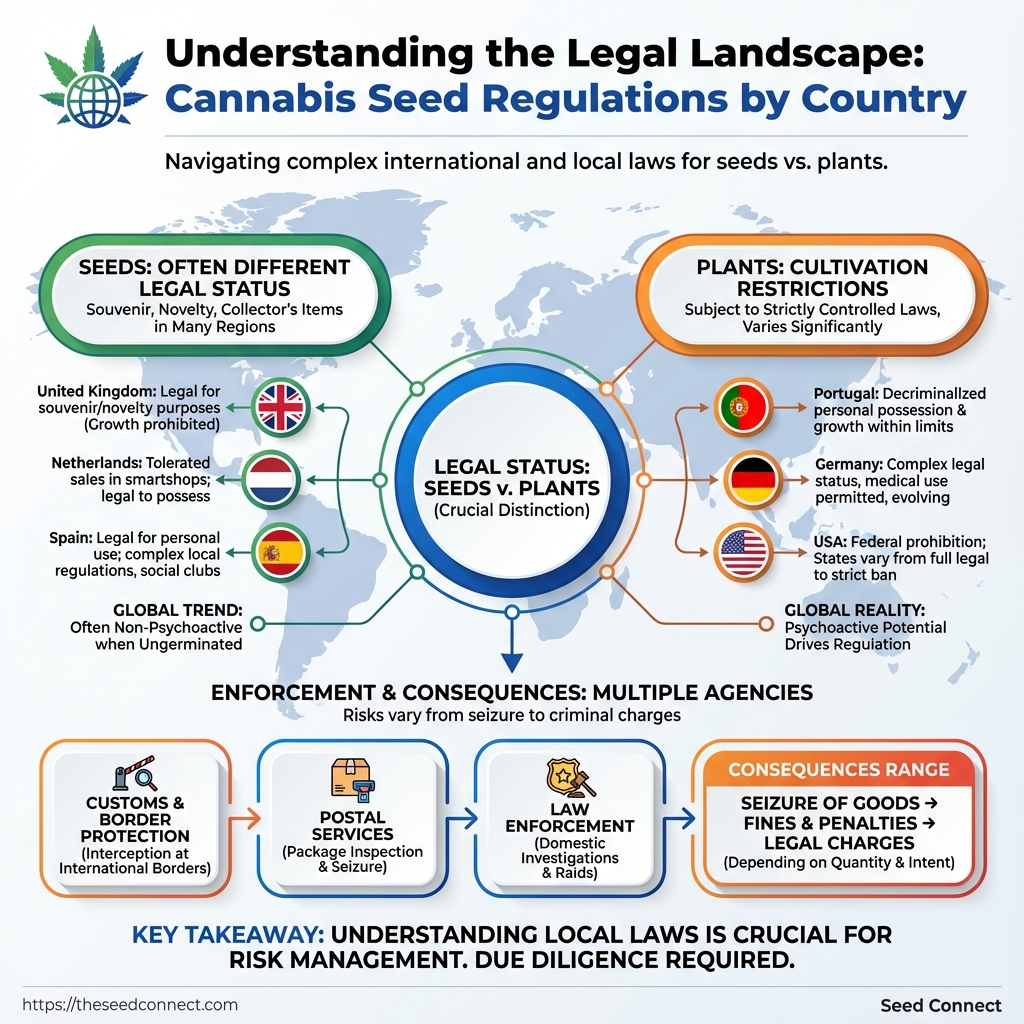
Cannabis seed regulation is a legal system that treats seeds differently from harvested cannabis and live plants. Laws usually separate the possession of seeds, the sale of seeds, the movement across borders, and the act of germination. A seed in a packet might be legal in one place, but growing that seed could result in fines or criminal penalties.
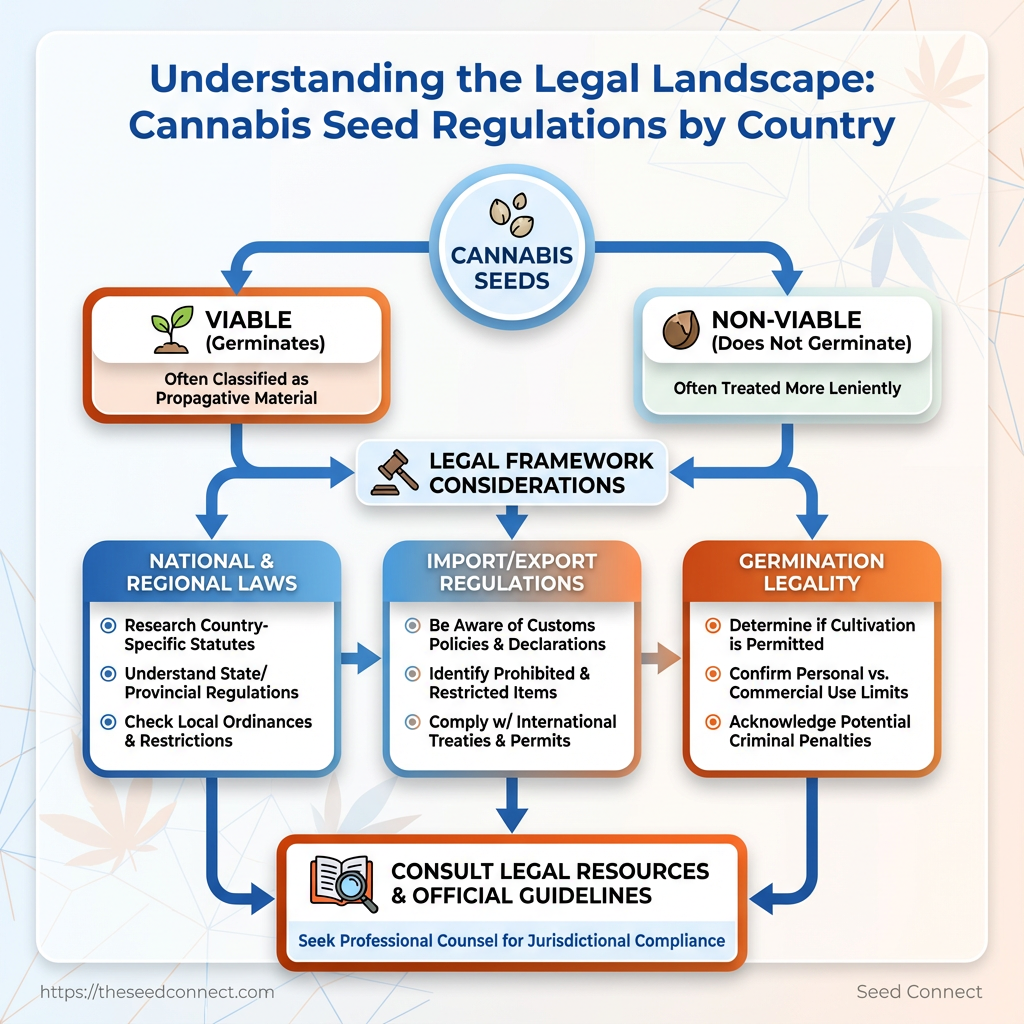
Legal status of seeds vs. plants: Many jurisdictions allow possession or sale of non-viable or novelty seeds but prohibit germination, so viable seed carries more legal risk once it’s sprouted.
Germination changes legal status: Germination commonly transforms an object from inert property into a controlled plant, and enforcement often focuses on propagation rather than the packaging.
Terminology differences: Regulators distinguish between non-viable/novelty seeds (sold as souvenirs, often legal) and viable/germination-capable seeds (subject to stricter rules).
No single office typically drafts or enforces these rules.
Regulatory authors and enforcers: Federal drug control agencies, agricultural departments, customs authorities, postal services, and local law enforcement all play roles. For international shipments, postal and customs rules are particularly decisive.
Common features of seed regulation include:
- Jurisdictional variance: Rules change widely between countries and even between states/provinces.
- Criminal vs civil penalties: Penalties range from fines and seizure to criminal charges depending on scale and intent.
- Focus on distribution channels: Retail sale, import/export, and postal carriage are frequent enforcement targets.
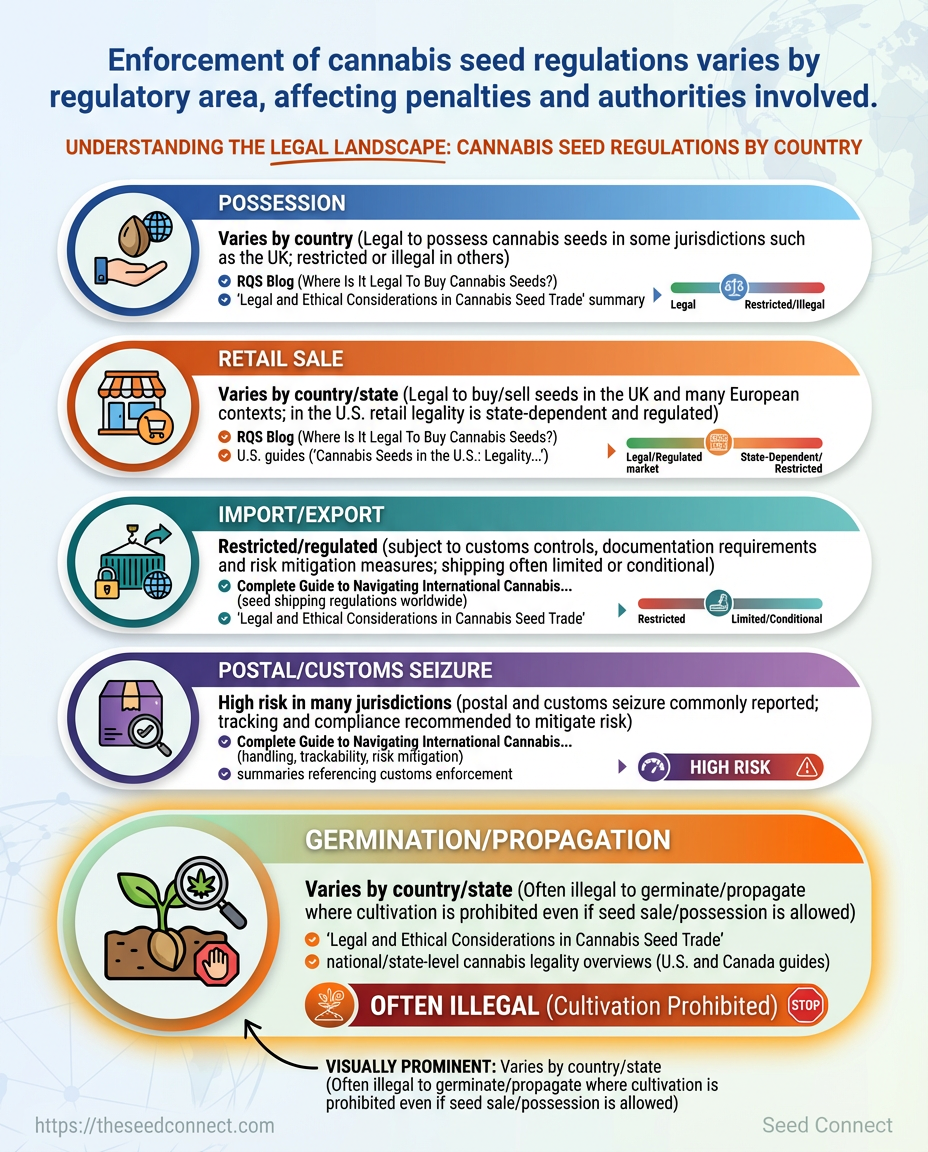
Enforcement authorities and typical penalties across regulatory categories (possession, sale, import/export, germination)
Table: What Is Cannabis Seed Regulation? — Regulatory Area, Common Enforcing Authorities, Typical Penalties & more
| Regulatory Area | Common Enforcing Authorities | Typical Penalties | Notes for Seed Handling |
|---|---|---|---|
| Possession | Local police, state/provincial enforcement | Fines; warning; small-scale confiscation | Personal possession sometimes tolerated if seeds are non-viable |
| Retail Sale | Consumer protection, state cannabis regulators | Business fines, license revocation, civil penalties | Licensed retail frameworks exist where cannabis is legal |
| Import/Export | Customs agencies, border police | Seizure, fines, criminal prosecution | International shipment often prohibited even if domestic sale allowed |
| Postal/Customs Seizure | Postal services, customs inspectors | Package seizure, return, destruction | Many carriers voluntarily reject seed shipments across borders |
| Germination/Propagation | Agricultural agencies, police, cannabis regulators | Criminal charges, large fines, facility raids | Proof of cultivation intent raises enforcement severity |
Knowing these distinctions keeps operations and hobby grows out of legal trouble and helps decide whether to buy, ship, or germinate seeds in a given jurisdiction. Choose actions that match the local legal landscape and avoid moving viable seed across borders unless regulations clearly permit it.
How Do Cannabis Seed Laws Differ by Country? (Regional Overview)
Laws about cannabis seeds…
How Do Cannabis Seed Laws Differ by Country? (Regional Overview)
Laws about cannabis seeds differ…
How Do Cannabis Seed Laws Differ by Country? (Regional Overview)
Laws about cannabis seeds vary widely by region. Some countries view seeds as legal agricultural products, while others consider them controlled substances. In many places, possession is allowed, but moving seeds across borders is illegal.
It’s crucial to recognize that just because seeds are legal to buy in one location doesn’t mean you can ship them across borders. Enforcement often relies on local interests rather than consistent rules.
Below are practical snapshots to make these differences clear and useful.
Side-by-side snapshot of seed legality and shipping risk for key North American jurisdictions
Table: How Do Cannabis Seed Laws Differ by Country? (Regional Overview) — Country/State, Seed Sale Legal?, Import/Export Allowed? & more
| Country/State | Seed Sale Legal? | Import/Export Allowed? | Shipping Risk Level |
|---|---|---|---|
| Canada (federal) | ✓ Legal through regulated channels | ✗ Generally restricted (licenced imports only) | Low domestic / High cross-border |
| United States (federal) | ✗ Cannabis federally controlled (state patchwork) |
✗ Restricted federally | Very High for interstate/international |
| California (example state) | ✓ Legal for retail and home cultivation | ✗ Export discouraged/illegal federally | Medium–High (domestic shipping risky) |
| Mexico | ✓ Personal possession decriminalized; commercial framework evolving | ✗ Cross-border export/import risky | High (regulatory transition) |
Europe deserves special mention because there’s no single EU rule for cannabis seeds. Many member states tolerate seed sales if they’re marketed as collector’s items or non-viable, while others allow seeds for regulated medical or industrial hemp programs. Schengen freedom of movement complicates enforcement: a seed bought legally in one country can trigger prosecution if carried into a stricter jurisdiction.
Quick-reference of representative countries outside North America showing seed legality and notable rules
Table: How Do Cannabis Seed Laws Differ by Country? (Regional Overview) — Country, Seed Sale Legal?, Domestic Cultivation Rules & more
| Country | Seed Sale Legal? | Domestic Cultivation Rules | Notes (recent reforms) |
|---|---|---|---|
| Uruguay | ✓ Legal under regulated framework | Licensed personal and commercial cultivation | Early adopter of federal legalization; regulated market |
| Colombia | ✓ Sales tolerated; licensing for commercial | Medical/industrial licensing available | Progressive policy, uneven enforcement |
| Thailand | ✓ Rapid reform for medical/home use | Medical framework and pilot home grows | Recent liberalization for medical and household cultivation |
| Japan | ✗ Strict prohibition | Cultivation heavily criminalized | Very conservative enforcement; severe penalties |
| South Africa | ✓ Personal cultivation decriminalized | Private cultivation allowed; commercial rules evolving | Court rulings enabled private grows; regulatory gaps remain |
Practical approach: treat seeds like controlled goods when crossing jurisdictions — buy locally when possible and confirm national rules before shipping. That keeps operations legal and saves headaches.
How Enforcement Works: Customs, Postal Services, and Online Sales
Customs and postal services can……
How Enforcement Works: Customs, Postal Services, and Online Sales
Customs and postal services can…
How Enforcement Works: Customs, Postal Services, and Online Sales
Customs and postal services can intercept and seize cannabis seeds even when those seeds are legal in the seller’s country or the buyer’s local laws. Enforcement is a mix of automated screening, manual inspection, and legal interpretation; packages flagged for botanical material often get pulled for further review. Understanding how that process works helps sellers reduce risk and buyers pick reliable vendors.
Customs and postal checks
- Automated screening: Postal operators and customs use
X-rayand database-matching tools to flag packages with suspicious contents or sender/recipient patterns. - Manual inspection: If a package is flagged, a physical inspection follows and plant material can be tested or photographed for evidence.
- Documentation matters: A valid
Phytosanitary certificateor clear agricultural paperwork can speed clearance for some countries, but it does not guarantee release for cannabis seeds. - Opaque rules: Postal screening thresholds and priorities vary by country; what clears in one jurisdiction may be seized in another.
- Consequences: Seized shipments may be destroyed, returned, or trigger legal notices to the sender and recipient depending on local law.
Practical steps sellers and buyers commonly use
- Carefully verify destination-country seed laws before listing or ordering.
- Use accurate customs declarations and, where applicable, include
Phytosanitary certificatedocumentation.
- Choose shipping methods with tracking and reliable carrier dispute processes.
- Maintain clear records of communications and transactions in case proof of legitimate intent is needed.
Online marketplaces and seller responsibilities
Seller country of origin: Sellers operating from jurisdictions with strict export rules carry higher shipping risk; conversely, a vendor in a tolerant jurisdiction still faces problems if the destination bans seeds.
Marketplace policies: Major marketplaces often ban or restrict listings and may require explicit disclaimers, age-gating, or proof-of-compliance.
Transparency signals: Reputable vendors publish a clear shipping policy, germination guarantee, an actual firm address, and refund/return terms — these reduce buyer risk and indicate compliance awareness.
Features to evaluate reputable seed sellers and marketplace safeguards
Table: How Enforcement Works: Customs, Postal Services, and Online Sales — Feature, What to Look For, Why It Matters & more
| Feature | What to Look For | Why It Matters | Red Flags |
|---|---|---|---|
| Clear shipping policy | Specific countries allowed, carriers used, customs handling | Reduces unexpected seizures and mis-shipping | Vague “varies by country” only |
| Customer reviews & germination guarantee | Recent, verifiable reviews; explicit guarantee terms | Signals product quality and seller confidence | No reviews or unverifiable testimonials |
| Origin / firm address | Full business address and company registration details | Helps assess legal risk and trackability | PO boxes only; anonymous seller info |
| Refund / return policy | Clear timelines, conditions for disputes, replacement procedures | Critical if shipments are seized or fail to germinate | No refunds, unclear dispute process |
| Payment options & privacy | Multiple secure methods; privacy-friendly but traced payment options | Balances buyer anonymity and dispute resolution | Only untraceable payment methods or cash-only |
Picking sellers and marketplaces with explicit, well-documented policies and good reputations reduces friction with customs and postal checks and makes handling problems far easier. Think of enforcement as a legal and logistical filter: work within known rules, document everything, and prefer vendors who make compliance visible.
Why It Matters: Risks, Business Implications, and Traveler Considerations
Carrying or moving cannabis seeds is a serious legal issue. It can result in major criminal, civil, and commercial problems. Travelers risk arrest or fines when crossing borders with seeds. Breeders and businesses moving genetics internationally must follow agricultural rules, narcotics laws, and export controls.
This means being careful about compliance and having clear contracts is key.
Individual risks and traveler guidance
- Criminal exposure: Some countries treat seed possession as intent to distribute; penalties can include heavy fines or jail time.
- Confiscation and travel disruption: Airports and border crossings routinely seize prohibited material, resulting in missed connections and reputation damage.
- Civil penalties: Even where criminal charges are unlikely, travelers can face administrative fines or deportation.
- Health and biosecurity risk: Moving plant material without inspection can spread pests or diseases, triggering quarantine measures.
Practical steps for travelers:
- Check official government advisories and embassy pages before travel. 2.
If seeds are essential, obtain written permits from both origin and destination agricultural authorities. 3. When in doubt, leave seeds at home — digital or photographic references usually suffice.
Business and breeding implications
- Regulatory complexity: Exporting genetics often requires coordination between agricultural agencies, trade compliance, and controlled-substances authorities.
- Intellectual property exposure: Moving parent genetics without tight contracts risks losing breeding rights or control of proprietary lines.
- Operational controls: Compliance demands recordkeeping, traceability, and often laboratory certification for phytosanitary status.
- Partnerships and contracts: Joint-ventures and local licensing can reduce legal exposure but require rigorous due diligence.
Export Permit: An official authorization from agricultural/trade authorities allowing plant material movement.
Phytosanitary Certificate: Proof that plant material meets plant-health requirements for export/import.
Contrast legal pathways for moving breeding genetics internationally and associated requirements
Table: Why It Matters: Risks, Business Implications, and Traveler Considerations — Pathway, Typical Requirements, Pros & more
| Pathway | Typical Requirements | Pros | Cons |
|---|---|---|---|
| Licensed export under agricultural frameworks | Export license, phytosanitary certificate, customs declarations, origin country compliance | Full legal clarity, accepted by importers | Time-consuming, fees, inspections |
| Research partnership with local institutions | MOUs, import permits, institutional biosafety approvals, limited distribution agreements | Access to local expertise, shared compliance burden | Potential IP dilution, complex contracts |
| Sale through licensed domestic distributors | Local distributor license, commercial invoice, domestic compliance only | Faster market entry, avoids cross-border permits | Limits control over genetics, dependent on partner compliance |
| Shipment as ‘non-viable/novelty’ seeds (where allowed) | Documentation proving non-viability or allowed classification, variable enforcement | May bypass strict phytosanitary process |
Key insight: Choosing a pathway balances legal certainty against speed and control; licensed export offers the safest compliance track but costs time and money, while partnerships trade control for local market access.
Travelers and businesses that treat genetics movement as both a legal and biosecurity issue avoid most problems. Proper permits, airtight contracts, and conservative travel choices protect people and protect breeding programs.
Common Misconceptions and Legal Myths
Much of the legal confusion around cannabis seeds comes from a mix of folklore, outdated laws, and hopeful vendor claims. Seeds exist in a confusing legal gray area. They are plant material, sometimes sold as collectibles, and laws vary widely by location. So, a confident claim like “seeds are always legal” is often incorrect, and trusting wishful thinking can result in seized parcels or legal issues.
Practical verification — check customs rules, postal advisories, and local statutes before buying or shipping — prevents most headaches.
Common dangerous myths and corrective checks
- Myth: Seeds are always legal to buy and possess.
- Myth: Online vendors guarantee lawful international shipping.
- Myth: Novelty or non-viable “souvenir” seeds are risk-free.
- Myth: If seeds are sold domestically, they can be exported anywhere.
Present a myth vs reality table with verification steps and recommended official sources
Table: Common Misconceptions and Legal Myths — Myth, Reality, Quick Verification Step & more
| Myth | Reality | Quick Verification Step | Suggested Source |
|---|---|---|---|
| Seeds are always legal | Laws vary; many countries restrict possession or import | Search national criminal code and customs prohibited list for seeds | Government customs pages, national legislation texts |
| Online vendors guarantee legal shipping | Vendor claims don’t override destination laws | Check destination postal service prohibited items page | Postal service advisories, customs FAQs |
| Non-viable novelty seeds are risk-free | Labels can be false; enforcement looks at items, not seller claims | Request phytosanitary or lab documentation; compare to import rules | Official phytosanitary certificate guidelines, agriculture ministry pages |
| If sold domestically, seeds can be exported | Export/import are separate legal processes with differing rules | Verify both export permits and destination import permissions | Export control pages, destination country customs legislation |
Check rules before buying or shipping seeds; a few minutes of research saves months of hassle. Legal clarity protects time, money, and peace of mind.
Real-World Examples and Case Studies
Real growers and businesses run into legal and logistical friction that turns theory into hard lessons. The stories below show how small decisions — paperwork, seed type, transport method — produce big outcomes. They also highlight practical mitigations that experienced operators use to protect inventory, timelines, and licences.
Export with permit: licensed nursery scales to EU market
A licensed seed producer arranged export permits and phytosanitary certificates before shipping feminized seeds to several EU countries. Careful documentation and working with an experienced customs broker reduced hold times and preserved germination rates. Lesson: Plan permits early and verify receiving-country rules.Customs seizure: commercial shipment detained at port
A commercial pallet declared as “agricultural samples” was inspected and partially seized because paperwork mismatched the invoice. The company lost weeks and paid fines; germination viability dropped in storage. Lesson: Match invoice, packing list, and certificate wording exactly.Traveler confiscation/fine: seeds confiscated at airport
An independent breeder carried a small packet of seeds through transit without checking transit-country laws. Customs confiscated the seeds and issued a fine. The breeder missed a show and lost a client opportunity.Lesson: Never assume transit is free; check seed laws by country before travel.
Research partnership success: university trial with clean genetics
A research partnership framed as plant-breeding trial, using certified low-THC lines and a clear MTA (material transfer agreement). The collaboration produced publishable results and a pathway to licensed commercialization. Lesson: Use formal agreements and compliant genetics to unlock institutional collaboration.Business licensing failure: incomplete local compliance
A startup scaled retail sales without full local seed law compliance; inspectors flagged inventory and the business faced suspension. Fixing gaps required legal counsel and a costly audit. Lesson: Local licensing checks must be part of go/no-go planning.Summarize case studies in tabular form for quick scanning: Country, Scenario, Outcome, Lesson
Table: Real-World Examples and Case Studies — Country/Region, Scenario, Outcome & more
| Country/Region | Scenario | Outcome | Key Lesson |
|---|---|---|---|
| EU (multiple) | Export with permit | Successful delivery, preserved viability | Permits + broker avoided delays |
| Port city (unspecified) | Customs seizure | Partial loss, fines, delays | Paperwork mismatch caused seizure |
| International airport (transit) | Traveler confiscation/fine | Seeds confiscated, fine issued | Check transit laws before travel |
| University region (research-friendly) | Research partnership success | Publishable trial, path to licensing | Formal MTA + compliant genetics enabled access |
| Local municipality | Business licensing failure | License suspension, costly remediation | Local compliance must be confirmed pre-launch |
Practical cases like these turn abstract regulations into operational checklists that save time and money. Apply the same scrutiny to paperwork and seed selection that you apply to genetics — it pays off.
How to Stay Compliant: Resources, Checklists, and Next Steps
Start by treating compliance like a small project: gather the right documents, check the rules where you live and where the seeds will cross borders, and document every decision. That approach prevents surprises and makes permits, inspections, or disputes far easier to handle.
Practical compliance checklist (quick checks vs. formal steps)
- Quick check — legality: Confirm whether seeds are explicitly allowed, restricted, or prohibited in the origin and destination jurisdictions.
- Quick check — classification: Verify whether seeds are treated as agricultural goods, controlled substances, or germplasm; classification affects paperwork.
- Formal step — documentation: Obtain invoices, phytosanitary certificates, and any required import/export permits; keep digital and physical copies.
- Formal step — customs pre-clearance: File declarations in advance where available and declare accurately to avoid seizure or fines.
- Formal step — recordkeeping: Log shipments, receipts, germination tests, and communications for at least the minimum legal retention period in your jurisdiction.
- Formal step — legal counsel: When markets or quantities are significant, get written advice from trade or regulatory counsel and retain it with your files.
Next steps for businesses and hobbyists
Business track
- Register the business with relevant agricultural or controlled-substances agencies.
- Secure import/export permits and a phytosanitary certificate for each seed lot.
- Implement an SOP for verifying vendor compliance and keeping shipment-level documentation.
- Train staff on customs declarations, labeling requirements, and data retention policies.
- Arrange periodic legal reviews and compliance audits.
Hobbyist track
- Confirm personal import rules and small-quantity allowances with the local customs office.
- Prefer domestic suppliers or vendors who clearly state legal shipping destinations.
- Keep receipts and any seller declarations; avoid crossing international borders with seeds in luggage.
- When unsure, contact your local agriculture ministry or consulate before purchasing.
Recommended resources and tools for checking seed legality and processing permits
Table: How to Stay Compliant: Resources, Checklists, and Next Steps — Resource, What It Provides, How to Use & more
| Resource | What It Provides | How to Use | Priority |
|---|---|---|---|
| National customs page | Import rules, tariff codes, prohibited items | Search for “seeds” or “plant material” and read declaration guides | High |
| Agriculture/ministry import/export guide | Phytosanitary requirements, permit forms | Download forms, follow sample checklists, request certificate issuance | High |
| Local embassy/consulate advisories | Country-specific entry rules and legal notes | Contact for clarifications when importing from or to another country | Medium |
| Reputable seed vendor compliance page | Shipping destinations, required documents, compliance statements | Use vendor-provided paperwork and conformity declarations with each order | High |
| Specialist trade/legal counsel | Written legal opinions, customs representation, dispute support | Engage for contracts, high-volume shipments, or ambiguous regulations | High |
Final thought: a little paperwork up front saves a lot of time and money later. Treat compliance as routine project work—document, verify, and keep good records—and most thorny problems never appear.
Additional Considerations: Intellectual Property, Breeding Rights, and Ethics
Breeders can and should protect valuable genetics, but the tools available vary widely by jurisdiction and carry tradeoffs. Formal IP can lock in exclusive rights, while contracts, provenance tracking, and ethical agreements handle relationships and reputation — often more relevant day-to-day for seed sellers and small breeders. Practical action: pick protections that fit your markets, budget, and whether you want exclusivity or community adoption.
IP and breeder protections — what to weigh
- Formal registration:
Plant Variety Protection (PVP)and patents create enforceable rights but require paperwork, fees, and proof of distinctness, uniformity, and stability. - Contract-based protections: Licensing agreements, non-disclosure agreements, and plant material transfer agreements are faster, cheaper, and enforceable across borders where formal IP might fail.
- Trade secrets: Keep propagation protocols or selection data private to preserve competitive advantage without public filings.
- Open-source or community licensing: Share genetics under conditions (e.g., copyleft-style seed licenses) to encourage collaborative breeding while preserving attribution.
Practical steps breeders and sellers use
- File baseline documentation: collect
breeding notes, photos, and germination test results before any sale.
- Use clear contracts: outline permitted uses, downstream licensing, and benefit-sharing obligations.
- Track provenance: maintain batch codes and germination/phenotype records tied to sales.
- Talk to counsel: IP law for cannabis is complex and jurisdiction-specific; legal advice prevents costly mistakes.
Ethical sourcing and benefit-sharing
Ethics influence access, brand risk, and long-term partnerships. Respecting local communities, acknowledging landrace origins, and sharing profits or knowledge maintains supply stability and social license to operate.- Benefit-sharing models: Contractual royalties: set percentage per commercial use.
- Community reinvestment: fund local projects or provide genetics/knowledge back to source communities.
- Attribution: ensure breeders or communities are credited in catalogs and marketing.
Common pitfalls to avoid
- Assuming universal protection: IP rules differ; don’t rely on a patent strategy without checking local seed laws by country.
- Loose oral agreements: they’re hard to enforce — get key terms in writing.
- Ignoring cultural context: misappropriation of traditional varieties damages reputation and invites legal or regulatory blowback.
### Common IP protections available to breeders and their applicability to cannabis genetics
Table: Additional Considerations: Intellectual Property, Breeding Rights, and Ethics — IP Mechanism, Applies to Cannabis?, Typical Requirements & more
| IP Mechanism | Applies to Cannabis? | Typical Requirements | Pros/Cons |
|---|---|---|---|
| Plant Variety Protection (PVP) | Varies — often restricted or excluded in some jurisdictions | Formal application, proof of distinctness, uniformity, stability |
Pros: clear breeder rights. Cons: time-consuming, limited in some countries |
| Utility / Plant Patents | Possible in jurisdictions that allow plant patents — patchy for cannabis | Detailed patent application, novelty and inventive step required | Pros: strong exclusivity. Cons: expensive, publicly discloses genetic details |
| Trade Secrets / Contracts | ✓ | Confidential documentation, NDAs, licensing contracts | Pros: flexible, cross-border. Cons: enforcement depends on contract law |
| Open-source / Community Licensing | ✓ | Licensing terms that require downstream sharing under set conditions | Pros: encourages collaboration. Cons: limits commercialization control |
Handling genetics responsibly protects both business value and relationships. Choosing the right mix of legal tools and ethical commitments keeps genetics accessible where intended and defensible where it matters.
Conclusion
Ordering seeds across borders requires more than luck. It needs careful reading of the rules, checking for risks, and choosing the right partners. The article shows differences in enforcement and the patchwork of seed laws by country. It gives practical examples from breeders and travelers.
For instance, one commercial breeder lost several shipments to customs, and a traveler had their mail-order package intercepted. These stories highlight that understanding cannabis seed regulations and preparing for customs and postal enforcement can prevent costly surprises.
Practical next steps: check the destination country’s import rules, use reputable suppliers with clear germination guarantees and compliance support, and document provenance and permissions for commercial shipments. com) for country-specific guidance and seed options. If questions remain about international cannabis laws or your shipment, consult official customs pages and keep records of communications.
Follow these steps and the legal maze becomes navigable rather than risky—safer shipments, clearer business decisions, and fewer headaches at the border.