

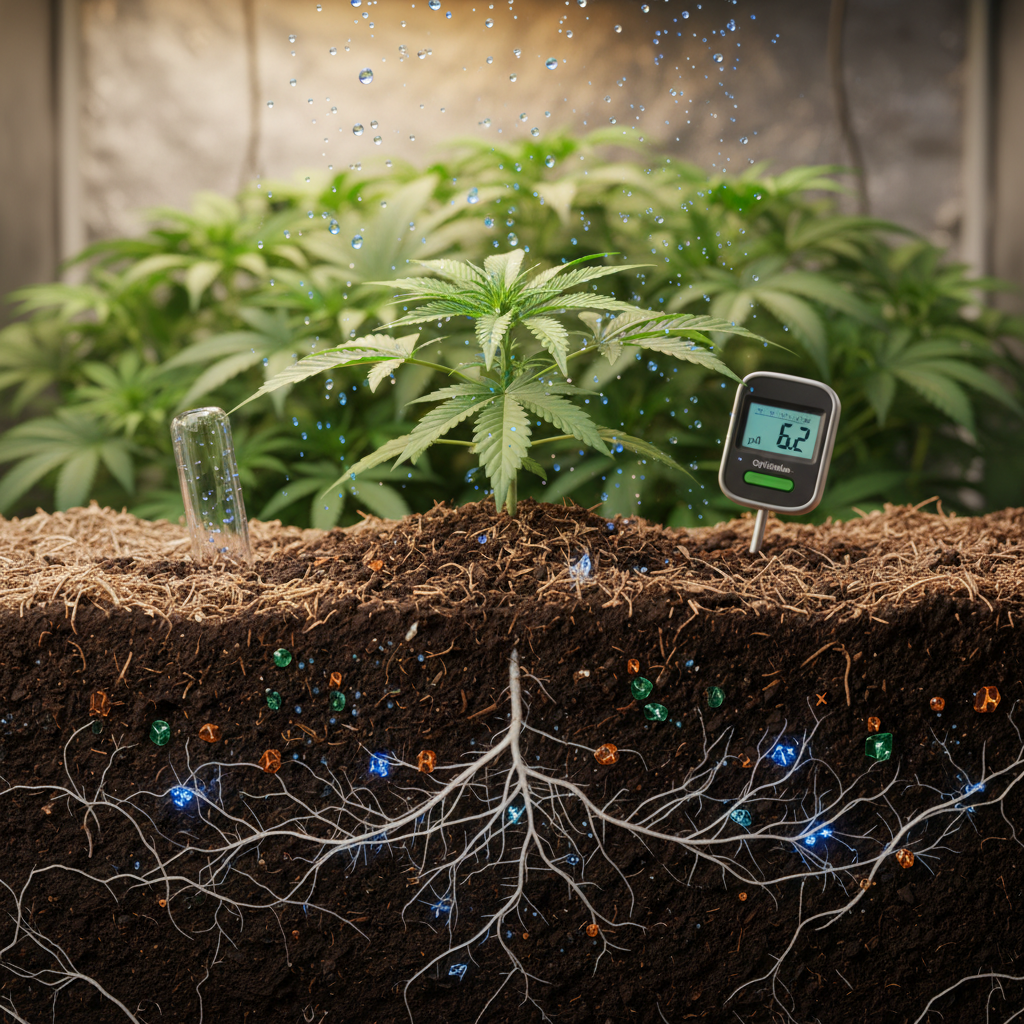
You enter the tent. The top leaves look healthy, but the lower canopy is weak and clumped. This is a classic sign that your soil might be struggling. That foundation is soil health.
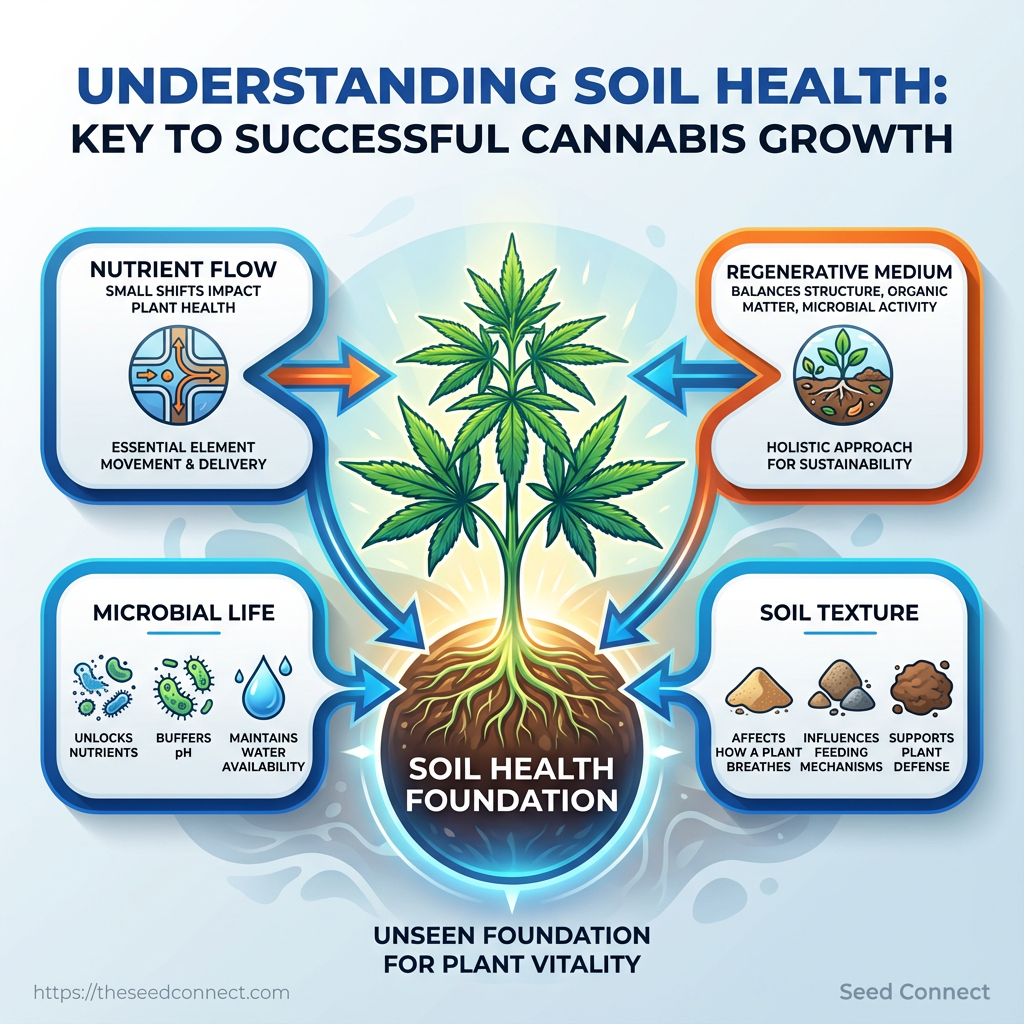
Small changes in texture, biology, or nutrient flow affect how a plant breathes, feeds, and defends itself. Good soil does more than hold roots. It feeds microbes that unlock nutrients, stabilize pH levels, and retain water when the lights go off.
Most growers treat nutrients like a recipe and forget the kitchen. When growing cannabis, you must think like both a soil scientist and a chef. This means balancing structure, organic matter, and microbial activity so roots can spread freely. Understanding the difference between a quick-fix nutrient feed and a living medium that regenerates fertility separates backyard luck from reliable, repeatable harvests.
Understanding Soil Health Basics
Soil isn’t just dirt under your pot; it’s a living medium that impacts root respiration and nutrient delivery.
Understanding Soil Health Basics
Soil is not just dirt under your pot. It’s a living medium that affects how roots breathe, provide nutrients, and how predictable your cannabis growth is. Healthy soil balances three physical traits: texture, structure, and porosity. It also needs biological activity and chemistry.
For growers, the practical outcome is simple: get texture and organic matter right, and most nutrient and water problems become manageable.
Soil Composition and Why It Matters
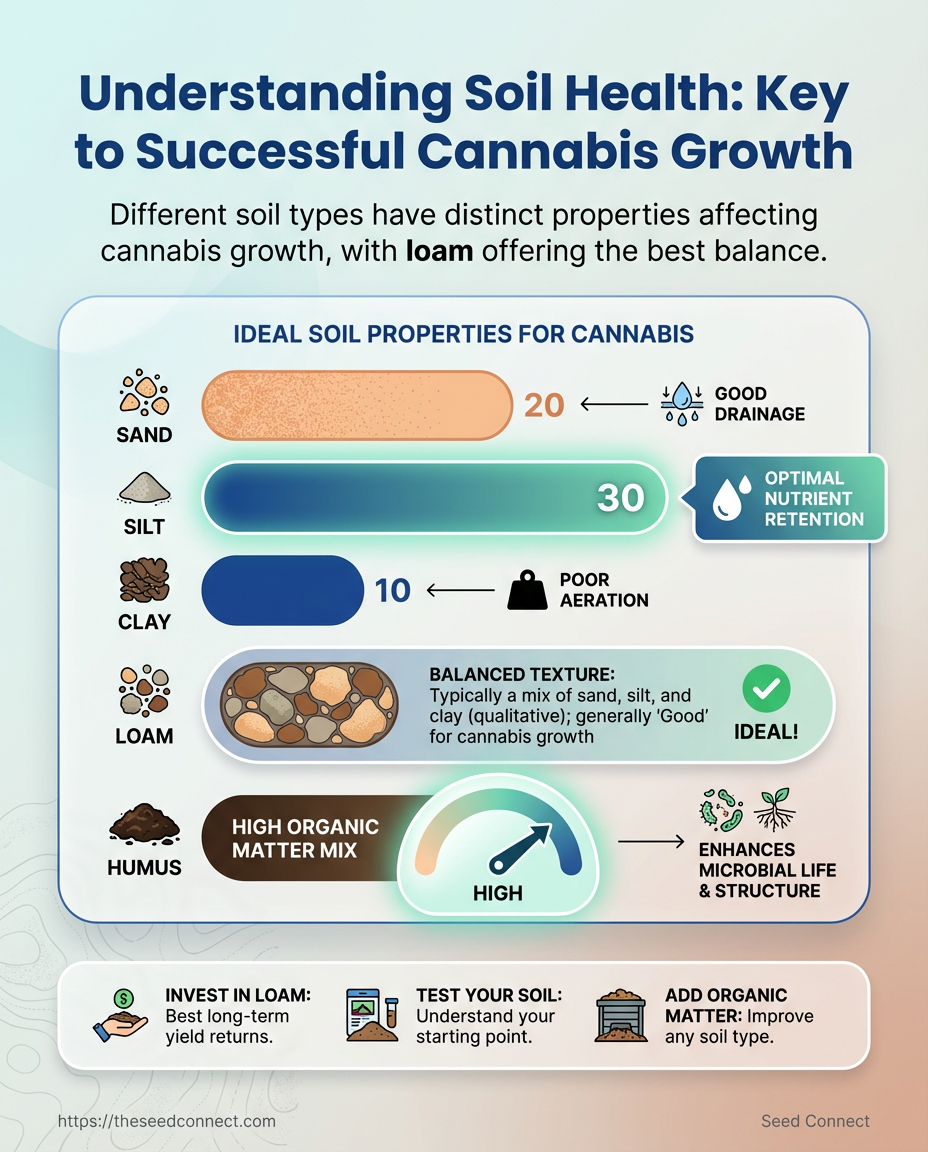
Sand: Large particles, fast drainage, low water- and nutrient-holding capacity. Silt: Medium particles, moderate water retention, feels smooth; bridges between sand and clay. Clay: Very small particles, high nutrient retention but poor drainage and low aeration; can compact and suffocate roots.
Loam: Balanced mix of sand, silt, and clay; best drainage-to-retention ratio for cannabis. High organic matter mix: Adds water-holding capacity, feeds microbes, and improves structure across textures.
What growers need to watch for is how those components influence two grow-essential processes. Roots need oxygen — excessively clayey or compacted soil reduces pore space and causes anaerobic stress. Conversely, very sandy mixes let water drain before roots can absorb nutrients, which means more frequent feeding and flushing.
Organic matter — compost, worm castings, well-aged teas — acts like a shock absorber: it increases nutrient exchange capacity and improves both wet and dry structure.
Practical signs to observe:
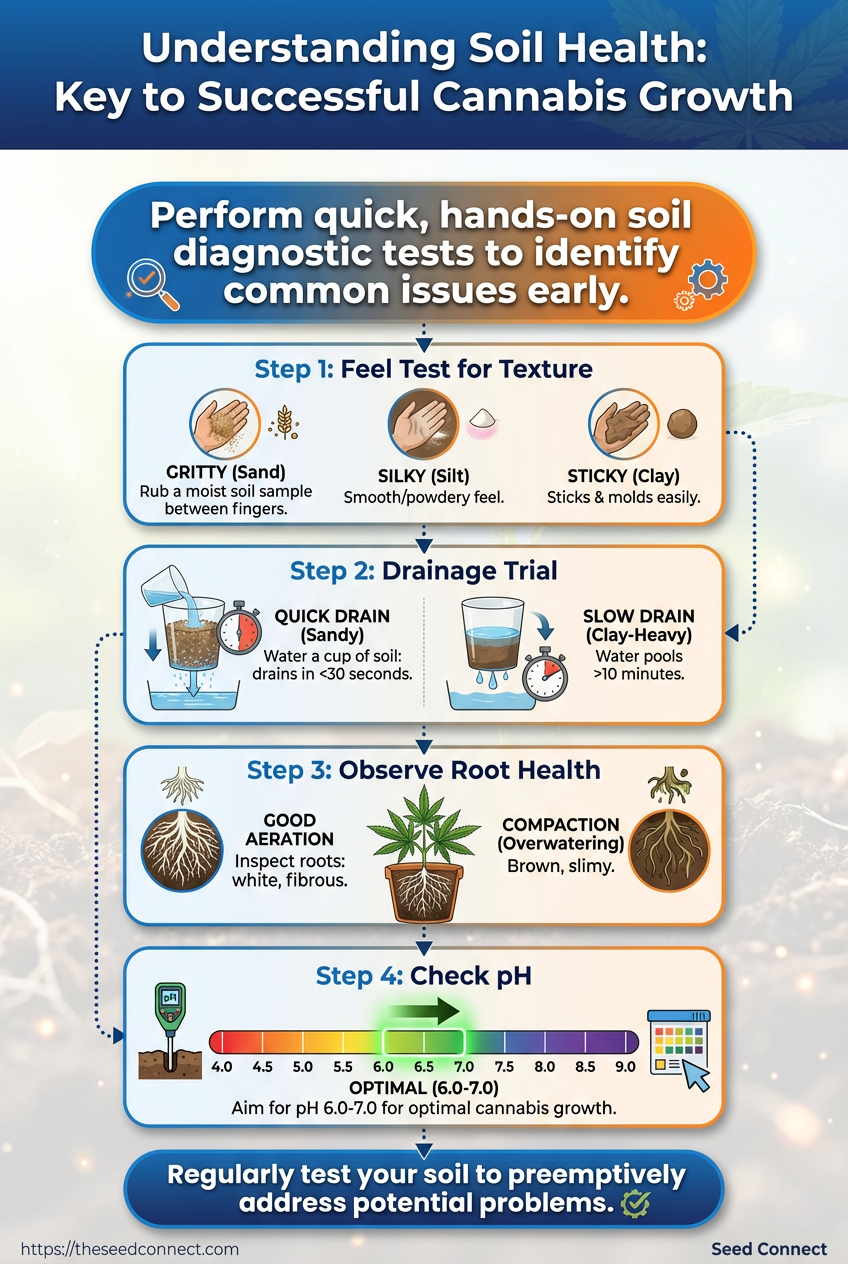
- Texture feel test: Rub a moist sample between fingers — gritty = sand, silky = silt, sticky = clay.
- Drainage trial: Water a cup of soil; if it drains in <30 seconds it’s sandy, if it pools >10 minutes it’s clay-heavy.
- Root health: White, fibrous roots indicate good aeration; brown, slimy roots point to compaction or overwatering.
Sand, silt, clay and loam side-by-side for drainage, nutrient retention, aeration and recommended fixes
Table: Understanding Soil Health Basics — Soil Type, Drainage, Nutrient Retention & more
| Soil Type | Drainage | Nutrient Retention | Recommended Fixes |
|---|---|---|---|
| Sand | Very fast; low water hold | Low; leaches nutrients quickly | Add organic matter, biochar, and coco or peat to increase retention |
| Silt | Moderate | Moderate | Blend with coarse materials (perlite) and compost to improve structure |
| Clay | Slow; poor aeration | High (binds nutrients) | Incorporate gypsum, compost, and sand in small amounts; aggressive aeration |
| Loam | Balanced | Balanced | Maintain with steady organic inputs and minimal disturbance |
| High organic matter mix | Improved across textures | Increases cation exchange capacity | Use compost, worm castings, and aged manure; avoid fresh raw amendments |
Getting soil texture right is the single best lever for predictable grows; add organic matter and a regular microbial feeding routine, and even imperfect soils become reliable.
Testing Your Soil: Quick Diagnostics
Begin by feeling and measuring. Simple hands-on checks can catch most common problems…
Testing Your Soil: Quick Diagnostics
Start by feeling and measuring the soil. Simple checks can catch most common problems before you spend money on lab testing. A few low-cost tests will reveal texture, drainage, pH, and salt buildup; reserve a professional lab when problems persist, crops scale up, or legal/traceability reasons require it.
Why this matters: Cannabis prefers slightly acidic to neutral soil; aim for pH 6.0-7.0. High soluble salts (measured as EC/TDS) or compacted texture will blunt growth and waste inputs. Quick diagnostics help you make corrections quickly.
Tools & materials
- Basic items: clear jar, clean water, spoon, small trowel
- Measuring tools: pH strips or a digital pH meter, EC/TDS meter
- Optional: soil thermometer, sieve for texture sorting
Quick hands-on checks (do these first)
- Gather a representative sample from 4–6 spots in the bed and mix them in a clean bucket.
- Jar texture test: put 1 cup soil in a jar, add water, shake, then let settle for 24 hours.
- pH check: test with strips or a calibrated meter in a 1:1 soil:water slurry.
- EC/TDS check: measure the leachate after a light watering, or mix
1:5soil to distilled water and test conductivity.
- Biological activity: look for earthworms and root fragments, or perform a simple respiration sniff test (healthy soil smells earthy, not ammonia-like).
Definitions
Jar texture test: Separates sand, silt, and clay layers to indicate drainage and compaction risk.
EC/TDS meter: Measures electrical conductivity to estimate soluble salts and fertilizer buildup.
Professional lab test: Provides nutrient profile, heavy metals, contaminants, and precise pH buffering info.
Summarize testing methods with tools needed, cost, accuracy and turnaround
Table: Testing Your Soil: Quick Diagnostics — Test, Tools Required, Estimated Cost & more
| Test | Tools Required | Estimated Cost | Accuracy/Use Case |
|---|---|---|---|
| Jar texture test | Clear jar, water, timer | $0–$5 | Low cost, good for drainage/texture; immediate |
| pH strips/meter | pH test strips or handheld meter | Strips $5–$15; Meter $30–$150 | Strips coarse, meters accurate if calibrated; same-day |
| EC/TDS meter | Handheld EC/TDS meter | $20–$200 | Good for salt/fertilizer buildup assessment; instant |
| Professional lab test | Mail-in kit, lab analysis | $40–$250+ | High accuracy for nutrients, contaminants, legal compliance; 3–14 days |
| Biological activity test | Worms check, simple respiration kits | DIY $0–$50; kits $50–$150 | Indicates microbial health; variable accuracy, useful for organic management |
When to send soil to a lab: persistent nutrient lockouts after correction, unexplained crop failures, planning a large or commercial grow, or when contamination (heavy metals, pesticides) is suspected. Short, regular DIY checks keep small grows healthy; scale and legal needs justify lab costs.
What You’ll Need / Prerequisites
Short version: reliable soil testing tools, quality amendments, a few basic hand tools, and the discipline…
What You’ll Need / Prerequisites
To get started, you need reliable soil testing tools, quality amendments, a few basic hand tools, and the discipline to measure and keep track of everything. These items keep soil chemistry predictable and give seeds the clean, stable environment they need to germinate and grow vigorously.
Tools & materials
- pH meter — for accurate soil pH readings (not paper strips).
- EC/TDS meter or strips — measures dissolved salts and nutrient strength in
ppm. - Soil test kit or lab service — baseline macro- and micronutrient analysis.
- Compost (well-aged) — bioactive organic matter for microbial life and slow-release nutrients.
- Perlite / aeration material — improves drainage and prevents compaction.
- Coco coir or quality potting base — stable, neutral medium that mixes well with compost and perlite.
- Trowel and clean bucket — for mixing batches and small potting jobs.
- Notebook or digital log — record mixes, pH/EC readings, and outcomes.
Skills & readiness
Measuring mixes: Comfortable weighing or volumetrically measuring components to consistent ratios. Reading instruments: Able to calibrate a pH meter and interpret EC/TDS values (µS/cm or ppm). Record keeping: Willing to track at least pH, EC, and amendment ratios for each batch.
Basic troubleshooting: Recognize common symptoms of nutrient imbalance and adjust pH or leach accordingly.
Difficulty level and prep time
- Gather tools and supplies.
- Calibrate meters and run an initial soil test.
- Mix a small test batch (5–10 L) and measure pH/EC, then adjust and re-test.
Typical difficulty: moderate — most of the work is measuring and patience. Typical prep time: 45–90 minutes for an initial batch test; ongoing checks take 5–10 minutes per pot or batch.
Definitions
pH: Soil acidity/alkalinity; target range for most cannabis soils is around 6.0–6.8.
EC/TDS: Electrical conductivity/total dissolved solids indicates nutrient concentration; expressed in µS/cm or ppm.
Detail tools and materials with purpose and recommended specs
Table: What You’ll Need / Prerequisites — Item, Purpose, Recommended Spec / Quantity & more
| Item | Purpose | Recommended Spec / Quantity | Estimated Cost |
|---|---|---|---|
| pH meter | Accurate soil pH measurement | Digital, calibration solutions, replaceable probe | $25–$120 |
| EC/TDS meter | Measure nutrient strength (µS/cm or ppm) |
Handheld, 0–1999 µS/cm range | $20–$80 |
| Compost (well-aged) | Organic nutrient base, microbial life | Stable, screened, no large undecomposed pieces; use 10–30% of mix | $10–$30 / 20 L |
| Perlite / Aeration material | Improve drainage and aeration | Horticultural-grade, 10–30% by volume | $8–$25 / 20 L |
| Soil test kit (kit or lab) | Baseline N-P-K and micronutrient levels | Multi-parameter kit or single lab analysis | $15–$60 (kit) / $40–$120 (lab) |
Get these tools and skills in place before you scale up; a little measurement up front saves time and plants later.
Key Takeaway: Start plants gently and build soil life before loading nitrogen. Young cannabis plants in small pots need very little soluble feed.
Feeding and Nutrient Management for Soil Grows
Start plants gently and build soil life before loading nitrogen. Young cannabis plants in small pots need very little soluble feed. The aim is to promote microbes and steady nutrient release instead of forcing rapid growth. Move from light, biologically active inputs in early weeks to denser organic amendments during stretch and bloom, and taper before harvest so the plant finishes cleanly.
Why organic schedules matter Organic feeds rely on soil biology to unlock nutrients, so timing and microbes are as important as grams per gallon. Overfeeding early causes salt buildup and root stress; underfeeding later limits yield and bud density.
Core practices
- Start slow: Use low-salt teas, minimal liquid nutrients, and gentle kelp in the first two weeks. Small pots amplify salts.
- Build soil life: Top-dress and feed compost tea to establish bacteria and fungi that mineralize amendments.
- Progressive strength: Gradually increase soluble feed rates through veg into early flower, then shift to phosphate- and potassium-rich organic inputs.
- Controlled taper: Reduce nitrogen and soluble salts in the final 2–3 weeks to improve aroma and smoke quality.
- Safe flushing: If lockout appears, lower EC and water until runoff EC approaches feed EC; then reintroduce biology rather than a high-dose chemical flush.
Definitions
PPM/EC: Parts per million and electrical conductivity — two ways to measure soluble salts; use whichever your meter supports and convert carefully.
Top-dress: Adding dry organic amendments on soil surface so microbes can break them down over time.
Lockout: A condition where roots can’t access nutrients due to pH or salt imbalance.
Creating a Simple Organic Feeding Schedule
Table: Feeding and Nutrient Management for Soil Grows — Week, Growth Stage, Feed Type & more
| Week | Growth Stage | Feed Type | Target ppm/EC |
|---|---|---|---|
| Weeks 1-2 | Seedling/early veg | Light compost tea, worm castings top-dress, kelp tonic |
100–250 ppm / 0.2–0.5 EC |
| Weeks 3-4 | Vegetative (stretch) | Fish hydrolysate, molasses once/week, starter top-dress (bone meal light) | 400–600 ppm / 0.8–1.2 EC |
| Weeks 5-6 | Pre-flower transition | Heavier top-dress (bat guano, compost), kelp, compost tea boosts | 600–900 ppm / 1.2–1.8 EC |
| Weeks 7-8 | Full flower (bloom) | High-P/K organics, molasses for microbes, fish emulsion sparingly | 800–1100 ppm / 1.6–2.2 EC |
| Weeks 9-10 | Ripening/late flush | Reduce feeds, stop heavy N, rinse with low-salt water or microbe tea | 200–400 ppm / 0.4–0.8 EC |
- Prepare a baseline soil (50/50 compost:loam or high-quality potting soil) and test runoff EC after a plain water feed to know starting salts.
- Start with the Weeks 1-2 plan; observe growth and runoff EC weekly.
- Top-dress every 2–4 weeks: apply a thin layer (0.25–0.5 in) of compost or worm castings, and lightly cultivate to mix.
- If runoff EC rises 20–30% above target, water to leach salts and give a biology-rich tea; avoid chemical flushes unless pH or salt lockout persists.
- During suspected lockout: check pH, water to 20% runoff, measure runoff EC, then reintroduce a compost tea with
EMormycorrhizaerather than high-salt corrections.
Follow the schedule but adapt to pot size, strain vigor, and climate — the plants and the soil tell you what to tweak. A slow, microbially driven approach gives steadier growth, fewer lockouts, and cleaner finished buds.
Key Takeaway: Healthy roots depend on balance: provide enough water for growth without drowning them. Match container size to the plant's stage and strain vigor.
Watering, Drainage and Potting Strategy
Healthy roots depend on balance: provide enough water for growth without drowning them. Match container size to the plant’s stage and strain vigor. Choose media that holds water well and make watering decisions based on feel, weight, and a moisture probe instead of a set schedule. Good drainage and the right pot geometry prevent root rot, encourage branching and make plants more resilient.
Choosing containers and media
Container size: Start small for seedlings (250–1,000 ml), move to medium for vegetative growth (3–7 L), and finish in a larger pot for flower based on strain vigor — compact indicas often do fine in 10–15 L, while big sativas benefit from 20 L+.
Air-pruning pots: These reduce circling roots and promote dense feeder roots. Plastic pots: Tend to retain more moisture and are fine for growers who prefer fewer daily checks. Fabric pots: Improve aeration and encourage root branching but dry faster.
Soil mix adjustment: Add perlite, pumice or coarse sand to increase drainage when media stays wet too long.
Example: A vigorous sativa in a 20 L fabric pot with 30% perlite drains faster and produces more root tips than the same plant in a 20 L plastic pot with 10% perlite.
How to water — practical approach
- Pick up the pot to learn its dry vs wet weight.
- Use a moisture probe or stick it into the root zone; don’t rely solely on surface dryness.
- Water until you see light runoff, then wait until the pot reaches the “just manageable” dry weight before next watering.
- Adjust volume and frequency when plants shift stages or temperatures climb.
Tip: Watering by schedule alone causes overwatering. Instead, use weight and probe readings to guide your watering decisions.
Simple troubleshooting and adjustments
Too wet: Increase drainage with added perlite/pumice, switch to fabric pots, reduce watering volume. Too dry between sessions: Use larger pot or increase media mix with moisture-retentive components like coco or peat. Root circling: Repot into air-pruning pots or gently tease roots at transplant to encourage outward growth.
Moisture probe: A one-time investment that cuts guesswork; learn the probe reading range for your mix and plant stage.
Good pot and watering choices pay off as stronger root systems, faster recovery from stress, and more consistent nutrient uptake. Get comfortable with pot weight and a probe — they turn watering from guesswork into repeatable practice, and that consistency shows up in yields and plant health.
Key Takeaway: When plants show stress, the soil is often the culprit — and the fastest wins come from correctly matching symptoms to cause and acting decisively. Read the signs, confirm with simple checks, then apply the fix that addresses the root problem rather…
Troubleshooting Common Soil Issues
When plants show stress, the soil is often the culprit — and the fastest wins come from correctly matching symptoms to cause and acting decisively. Read the signs, confirm with simple checks, then apply the fix that addresses the root problem rather than masking symptoms.
Diagnosing nutrient problems vs toxicity
Start by observing pattern and position of damage. Nutrient deficiencies typically show on older or newer leaves depending on the element; toxicity often looks like burned leaf tips, stalled growth, or dark, over-saturated foliage.Nitrogen deficiency: older leaves yellow uniformly from the base upward. Nitrogen toxicity: very dark green foliage, clawing, slowed flowering.
Check pH first — many “deficiencies” are actually nutrient lockout caused by incorrect pH. Use a handheld meter or cheap soil test kit to confirm pH 5.5–6.5 for most cannabis strains.
Common problems, quick fixes, and how to confirm
Compaction and poor aeration
- Remove the plant carefully. 2.
Rework the top 10–15 cm of soil, breaking hard pans and incorporating aeration material like perlite, pumice, or coarse sand. 3. Repot if roots are circling or compacted.
Success looks like faster drainage and roots moving into loosened soil within 2–3 weeks.
Root rot / foul-smelling wet soil
- Gently lift the root ball; healthy roots are white and firm. 2.
Trim brown, mushy roots with sterile scissors. 3. Re-pot into fresh, well-draining mix; treat water source and lower watering frequency.
- Consider a biological root protectant containing beneficial microbes.
If smell persists or roots fail to recover, lab testing or expert consultation is warranted.
Nutrient lockout vs toxicity
- Test
EC/PPM if available; very high values indicate buildup. - Flush with clean, pH-balanced water if salts are high.
- For toxicity, reduce strength to 25–50% and restore gradually.
When to call a lab or expert
If multiple plants across different media show unexplained symptoms, or if specific pathogens (pythium, fusarium) are suspected after root inspection, send a sample for lab diagnosis or consult an experienced agronomist.Symptom-to-cause-to-fix quick-reference table for rapid diagnosis
Table: Troubleshooting Common Soil Issues — Symptom, Likely Cause, Immediate Fix & more
| Symptom | Likely Cause | Immediate Fix | Preventive Measure |
|---|---|---|---|
| Yellowing lower leaves | Nitrogen deficiency or pH lockout | Check pH; feed balanced N if pH OK |
Maintain pH 5.5–6.5; regular feed schedule |
| Wilting despite moist soil | Root rot / poor drainage | Inspect roots; re-pot to fresh mix | Use well-draining soil; avoid overwatering |
| Brown leaf tips | Nutrient burn (toxicity) | Flush with pH-balanced water; reduce feed | Start nutrients at 25% strength; monitor EC |
| Foul-smelling wet soil | Anaerobic conditions / root rot | Remove plant, trim roots, re-pot | Improve aeration; sanitize tools and water source |
| Slow growth | Compaction, low microbes, or cold soil | Rework soil; add compost and microbes | Keep soil warm; add organic matter and aeration |
pH, smell, root color, and EC — lets most growers fix problems quickly and prevent recurrence.
Seeing the problem clearly and choosing the right corrective action saves time and plants. Small, targeted fixes to soil structure, drainage, and pH prevent most repeat issues and get a crop back on track.
Tips for Success and Pro Tips
Healthy soil is crucial for achieving consistent and resilient cannabis. Start small with habits you can repeat: track what you do, feed the soil life before you feed the plants chemistry, and intervene gently during the grow so the ecosystem stays balanced. These are practical, repeatable moves that reduce surprises and raise yield quality more reliably than chasing higher NPK numbers.
Proven habits that pay off fast
- Keep a detailed grow journal: Log
pH, electrical conductivity (EC), soil type, amendments, water volume, and visible plant responses after each change. A one-line note about weather or room temperature often explains odd results later. - Inoculate roots at transplant: Use a beneficial microbe inoculant (mycorrhizae + bacillus/streptomyces blends) when moving seedlings or clones into final pots to jump-start root-soil symbiosis.
- Top-dress, don’t overhaul: Add compost, worm castings, or a light organic granular fertilizer to the surface during veg rather than ripping apart the potting mix.
- Use slow-release organics: Choose time-release or mineralized composts that feed microbes and provide steady nutrient availability, supporting long-term biology rather than quick fixes.
Quick step-by-step for a transplant inoculation
- Wash hands and prepare a small scoop of inoculant following label rates.
- Place the seedling/cloned cutting in its new hole and sprinkle inoculant around—but not directly on—the stem base.
- Backfill gently, water lightly to settle microbes into the rhizosphere, and avoid heavy feeding for 7–10 days.
Practical examples and how to read results
Example — Journal entry: “Day 14 post-transplant: pH 6.3, EC 0.9; new root tips visible; slight yellowing on older leaves — cut foliar feed, added 1 cup worm castings top-dress.” That one line tells why yield recovered and what worked.
Top-dress routine: Apply 0.5–1 in. of composted material at start of veg and refresh every 3–4 weeks. If growth stalls, check pH and microbial activity before adding high-salt feeds.
Troubleshoot cue: Slow, pale growth + decent EC often signals biological sluggishness rather than nutrient deficiency. Boost microbes and reduce soluble fertilizer for a week.
Small, consistent habits—tracking, inoculating, light top-dressing, and relying on slow-release organics—turn soil into an ally rather than a variable to manage. Keep practicing those habits and the plants will quietly pay you back.
Monitoring, Recordkeeping and Long-term Soil Health
A repeatable monitoring routine turns guesswork into reliable progress: weekly visual and moisture checks catch stress early, monthly pH and EC/TDS tests track nutrient dynamics, and seasonal or annual lab analyses guide deeper amendments and crop planning. Keeping consistent records reveals patterns such as nutrient lockups, slow microbial recovery, or recurring pests. This way, your actions can be targeted instead of reactive. The goal is a lightweight, defensible system that fits the grow scale: simple weekly notes plus a monthly data log gives immediate benefits; annual lab data directs long-term soil-building investments.
Establishing a Soil Health Routine
- First week: set baseline measurements and an easy logging format (spreadsheet, app, or printed notebook).
- Every week: perform visual inspection, root-zone moisture check, and note crop stage and recent amendments.
- Every month: measure
pHandEC/TDSin the root zone and in runoff/ leachate where possible. Record fertilizer type and dose.
- Seasonally or annually: send a soil sample for full lab analysis (organic matter, CEC, macro & micronutrients, contaminants) and create an amendment plan based on results.
EC: Electrical conductivity; indicates soluble salt concentration and rough nutrient strength.
pH: Scale indicating soil acidity/alkalinity; affects nutrient availability.
Runoff/leachate test: Measurement of what plants are actually exposed to after irrigation.
Practical checks and what success looks like
- Weekly visual: Look for leaf color shifts, interveinal chlorosis, stunted growth — these flag nutrient or water issues early.
- Moisture consistency: Use a probe or hand-feel; consistent moisture across pots/beds prevents localized salt accumulation.
- Monthly pH/EC: Targets vary by strain, but stability matters more than one-off values; small steady changes are easier to correct.
- Annual lab: Use results to plan organic matter additions, lime/ gypsum, or targeted micronutrient supplements.
Tools & recordkeeping workflow
- Simple log: Date, crop stage, visual notes, watering volume,
pH,EC, amendments applied. - Digital option: Spreadsheet or app with columns for the above, photos attached for each inspection.
- Example entry: “Day 28 veg — slight yellowing lower nodes; moisture 20% by probe; pH 6.1; EC 1.2 mS/cm; 2 g/L liquid feed.”
Monitoring cadence table with task, frequency and tools needed
Table: Monitoring, Recordkeeping and Long-term Soil Health — Task, Frequency, Tool/Method & more
| Task | Frequency | Tool/Method | Purpose |
|---|---|---|---|
| Visual plant inspection | Weekly | Hand inspection, photos, magnifier | Detect pests, nutrient symptoms, canopy issues |
| pH test | Monthly | Handheld pH meter or strips, calibrated probe | Track nutrient availability and drift |
| EC/TDS test | Monthly | EC meter on runoff or media extract | Monitor soluble salts and feed strength |
| Soil biological activity check | Seasonal | Simple lab kits or respiration tests, earthworm counts | Gauge microbial life and decomposition rates |
| Lab soil analysis | Annual/seasonal | Accredited soil lab (full nutrient panel) | Inform amendment planning and contamination checks |
Keeping tidy records and a predictable cadence pays off: fewer emergency fixes, clearer amendment ROI, and steadily improving soil biology that supports higher-quality harvests season after season.
Conclusion
You came in noticing a weak lower canopy and left with a practical way to fix the foundation: focus on soil structure, balanced feeding, and simple diagnostics. Adjusting drainage and adding a modest layer of compost rescued one small grower’s yield within a single cycle, and switching to slower-release organics turned another tent’s nutrient swing into steady growth—both real, actionable shifts rooted in better cannabis soil health. 5.
That keeps small problems from becoming crop-wide stress.
Here are your next steps to put this into practice:
- Test your soil now (pH, EC, basic nutrient panel).
- Fix drainage and texture where water pools or compacts.
- Switch to a predictable feeding schedule and record every change.
For a quick reference on seed-to-soil steps and germination help, see the SeedConnect growing resources at The Seed Connect. Taking these three actions—test, adjust, record—will stabilize your soil for healthier plants and more consistent harvests.