
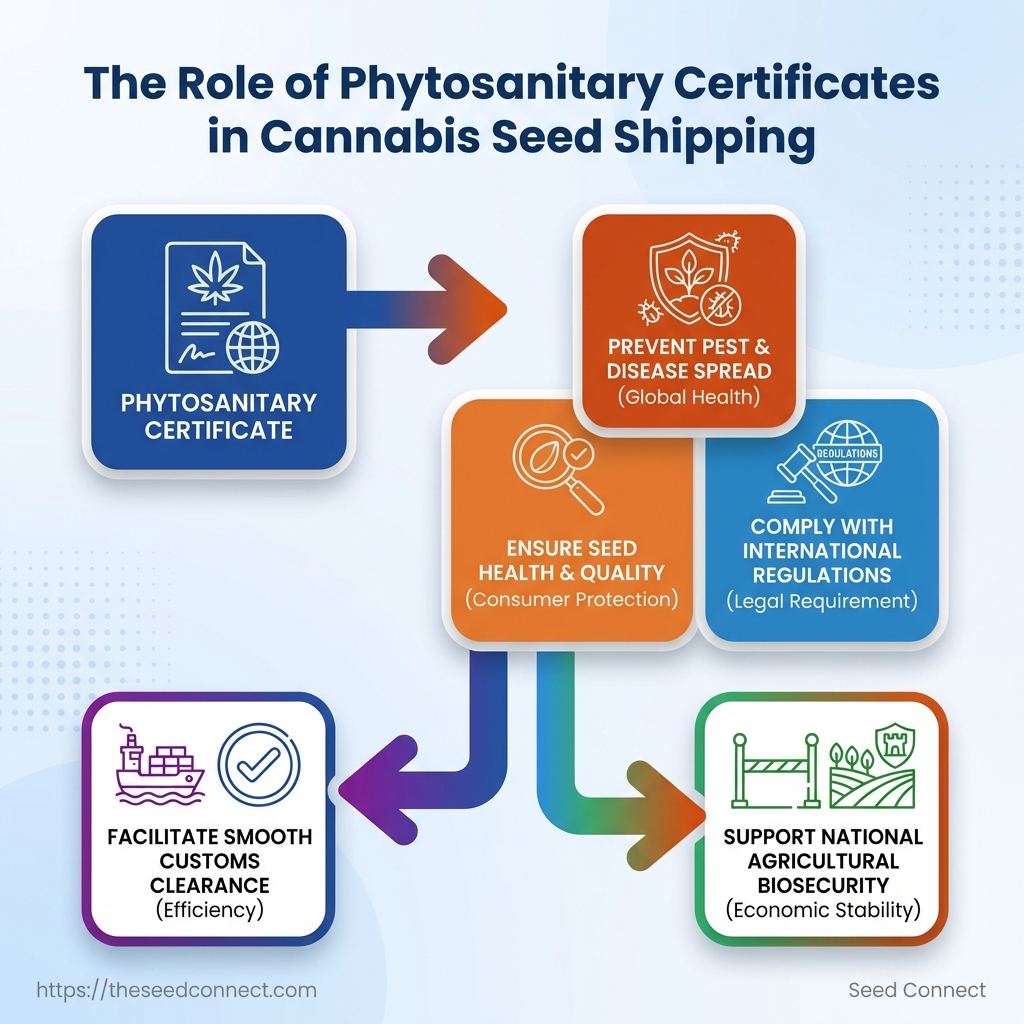
The role of phytosanitary certificates in cannabis seed shipping is to document whether a seed shipment meets the plant-health requirements of the destination country. These certificates are issued by national plant protection authorities and may confirm inspection, treatment, or other conditions required before seeds can cross certain international borders.
In this guide, The Seed Connect explains when phytosanitary certificates may be required, what information they contain, how they differ from customs declarations and import permits, and what buyers and sellers should verify before shipping cannabis seeds internationally.
Key Takeaway:
- A phytosanitary certificate is a plant-health document, not a general shipping license. It confirms that a shipment has been inspected or assessed under applicable phytosanitary rules, but it does not replace customs declarations, import permits, or cannabis-specific legal requirements.
- Requirements vary by destination country and shipment type, so exporters should check the importing country’s plant-health authority before shipping rather than assuming every cannabis seed shipment needs the same certificate or testing.
- Accurate documentation and matching shipment details are critical, because inconsistencies in botanical names, quantities, lot information, certificates, or import permits can trigger customs delays, additional inspections, or rejection.
Table of Contents
-
Why many countries require phytosanitary certificates for seeds
-
How to obtain a phytosanitary certificate for cannabis seeds
-
Practical compliance checklist for sending and receiving cannabis seeds
-
How Seed Connect helps: guarantee, documentation, and support
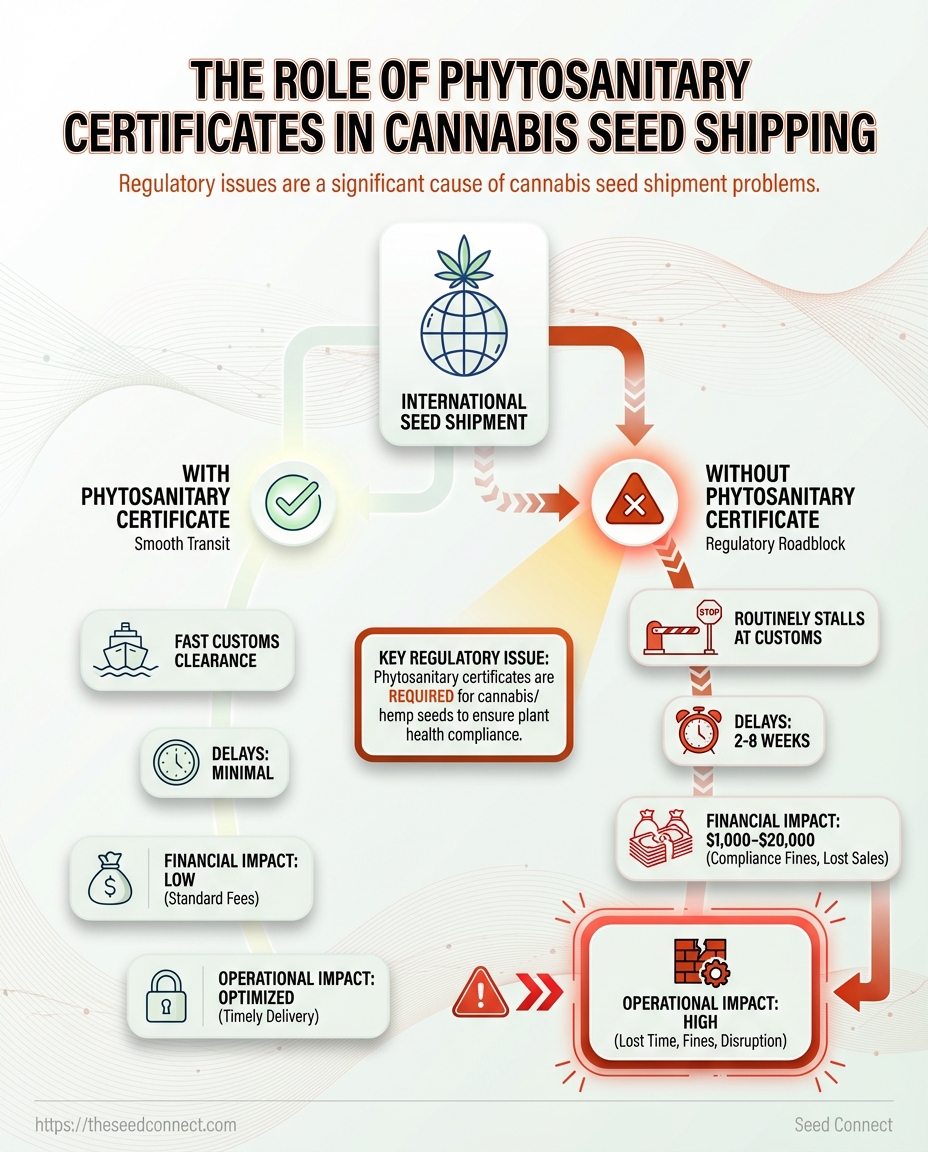
Understanding how seed health rules and paperwork work is crucial for preventing wasted time and lost confidence. Nearly half of growers encounter issues with their shipments, so knowing the requirements can save significant delays. The flowchart in this section outlines key steps in addressing and navigating customs holds effectively.
What a phytosanitary certificate is (and what it covers)
Think of a phytosanitary certificate as a passport for plant material. It’s an official document issued by a national plant protection authority that certifies the shipment was inspected and meets the importing country’s plant-health rules.
This certificate proves inspection and any required testing took place, and it’s often mandatory for moving seeds across borders. Organizations like the IPPC set international standards, while agencies such as the USDA and the CFIA issue the actual certificates in their countries.
Phytosanitary certificate: An official government document that attests a consignment of plants or plant products was inspected and is free from specified pests and diseases.
Issuing authority: National plant protection organizations — for example, the USDA in the U.S. or the CFIA in Canada — carry out inspections and sign the certificate.
Legal scope: Meant for plant-health compliance; it does not replace customs declarations or commercial invoices. Typical contents of a certificate include a mixture of identification, inspection results, and official declarations.
Below are the common elements you’ll see on valid paperwork.
Consignment details: Identifies the shipment — exporter, consignee, origin, and destination.
Botanical identification: Scientific name of the seed species and sometimes variety.
Quantity and packaging: Number of units, seed weight, and packaging description.
Inspection statement: Confirmation that an authorized inspector examined the shipment.
Treatment or test results: Notes any phytosanitary treatments (e.g., fumigation) or lab tests performed.
Official signature and stamp: Authentication by the issuing authority, plus date and certificate number.
How this differs from commercial paperwork is important to understand. The certificate speaks only to plant health, not to value, ownership, or permission to trade.
Commercial invoice: Lists price, terms of sale, and value for customs purposes — not plant-health findings.
Import permit: A pre-authorization from the importing country allowing entry under specified conditions; separate from the post-inspection certificate.
Practical steps before shipping:
Check the issuing agency (USDA/CFIA) and confirm the certificate number matches their records.
Verify the botanical name and declared treatments align with the import permit conditions.
Ensure the original signed-and-stamped certificate accompanies the shipment — photocopies are rarely accepted.
Industry friction is real: about 43% of cannabis farmers reported seed-shipment regulatory problems in 2022, so getting the certificate right saves time and money. A correct phytosanitary certificate clears the plant-health hurdle — and without it, seeds usually won’t pass inspection.
Why many countries require phytosanitary certificates for seeds
Treat seeds as more than paperwork — they’re a potential pathway for pests, diseases, and ecological disruption. That’s why many governments insist on a phytosanitary certificate before letting seed shipments cross borders.
A valid certificate signals that a competent authority inspected the lot and found it free, or managed, for specified pests and quarantine organisms. It also documents treatments, origin, and compliance with the importing country’s plant health rules.
That regulatory traceability is what allows customs and quarantine services to clear seeds quickly and confidently.
Requiring these certificates reduces risk across three linked fronts: protecting local crops, honoring international plant health rules, and managing special concerns tied to certain crops like cannabis.
Those goals drive the rules behind international seed health regulations and why exporters must meet cannabis shipping requirements to avoid delays or refusals.
Protecting local agriculture and preventing pests and diseases
Bordered ecosystems can be fragile. An introduced insect or fungal pathogen can damage staple crops, hurt local growers, and force costly eradication programs.
-
Early detection: Certificates confirm inspection and screening for known quarantine pests.
-
Targeted treatment: They record whether seed lots received approved treatments like fumigation or heat.
-
Traceability: Certificates tie a shipment back to a registered nursery or testing lab if a problem appears.
Those protections aren’t theoretical. Countries with intensive agriculture rely on plant-health checks to avoid outbreaks that would threaten food security and export markets.
International rules and the role of the International Plant Protection Convention (IPPC)
Global trade in seeds relies on shared standards. The International Plant Protection Convention provides a framework countries use to set and harmonize phytosanitary measures.
IPPC: The treaty that coordinates plant-protection standards between countries. National authorities then implement those standards. For example, the USDA issues export certificates for the United States, and the CFIA performs similar functions in Canada.
That patchwork of national rules explains why exporters must often navigate multiple procedural steps to meet import requirements.
Specific concerns for cannabis seeds versus other seeds
Cannabis seeds trigger extra scrutiny because they sit at the intersection of agricultural biosecurity and complex legal regimes. In 2022, 43% of cannabis farmers reported shipment challenges tied to regulatory issues, reflecting how compliance problems can directly impact growers.
-
Legal status checks: Some countries restrict cannabis varieties or prohibit living plant material, adding layers to inspections.
-
Seed health plus legality: Inspectors look for pests and confirm the shipment complies with controlled-substance rules.
-
Variable acceptance: Different countries have different tolerance levels for contaminants, so cannabis exporters face more varied requirements than many other seed types.
Meeting phytosanitary and legal checks prevents seizure and protects both importing agriculture and exporters’ reputations. A proper certificate isn’t just red tape — it’s the practical way countries prevent biological surprises while keeping international seed trade moving.
How to obtain a phytosanitary certificate for cannabis seeds
Getting the certificate is a procedural exercise more than a mystery. Start by identifying the national plant protection organization in your exporting country and follow their diagnostic and paperwork steps precisely. Missing a form or a lab report is the usual reason shipments stall. Inspections, sampling and lab tests are the meat of the process.
Expect seed health tests, traceability documentation, and an on-site or desk inspection before a certificate is issued. Allow time for back-and-forth with inspectors — it’s normal and necessary.
43% of cannabis farmers faced challenges with seed shipments due to regulatory issues in 2022.
Who issues certificates and what inspections are required
National plant protection organizations issue phytosanitary certificates; for example, the USDA in the United States and the CFIA in Canada. These bodies enforce the importing country’s requirements and sign the certificate once compliance is verified.
-
Visual inspection: before export, authorities may inspect seed lots for obvious pest signs.
-
Laboratory testing: common tests include seed-borne pathogens and purity checks.
-
Traceability checks: documentation proving source, cultivar identity, and chain of custody.
Step-by-step process: labs, sampling, paperwork, timelines
-
Contact the national plant protection authority and request their export seed protocol for your commodity. This tells you required tests and sampling rates.
-
Book accredited lab testing that meets the authority’s specifications. Labs will usually require a submission form and payment upfront.
-
Submit representative seed samples following the sampling protocol; improper sampling can void results.
-
Gather paperwork: invoice, packing list, cultivar declarations, and any phytosanitary request forms the authority requires.
-
Request an inspection (onsite or document review) with the plant protection organization once tests and docs are ready.
-
Pay any administrative fees the authority charges and provide shipment details for the certificate.
-
Receive the signed phytosanitary certificate; print or produce the number required by the importer before shipping.
Costs, typical turnaround, and how to prepare your shipment
Typical costs vary by country and tests required; expect lab fees plus inspection and issuance charges. Turnaround often spans 7–21 business days, but complex cases or backlog can extend that.
-
Documentation: include test reports, cultivar identity, and an export declaration.
-
Packaging: label seed lots clearly and pack to prevent contamination.
-
Pre-notify the importer: give the phytosanitary number and copies before arrival.
If your seeds come from a catalog or third-party supplier, have cultivar certificates or purchase records (for example, from Cannabis Seeds) ready to verify identity. Prepare paperwork early and schedule lab work as soon as a buyer confirms specs. That sequence minimizes delays and keeps customs smooth.
Comparing country requirements and common restrictions
Ever ordered seeds and stalled because one country’s rules don’t match another’s? Different national systems treat seed imports very differently, and that mismatch is the reason many shipments hit delays or returns.
Most importing countries expect phytosanitary certificates and proof of seed health, but what follows — extra permits, quarantine, or outright bans — varies widely.
Knowing the common checks and where friction usually occurs makes international shipping far less risky for growers and sellers dealing with cannabis shipping requirements and international seed health regulations.
Regulatory detail matters more than you think. A certificate from the exporter’s NPPO is often necessary but rarely sufficient. Import authorities will still demand specific tests, permits, or even post-entry quarantine depending on the destination. Practical preparation saves time and money.
Below is a quick comparison of representative countries and the restrictions you’re likely to face.
Quick comparison of sample countries and their seed import rules
|
Country |
Phytosanitary Certificate Required (Yes/No) |
Additional Permits/Notes |
Typical Inspection Tests |
Customs Delay Risk Level |
|---|---|---|---|---|
|
United States |
Yes |
USDA/APHIS handles phytosanitary processes; DEA considerations may apply for psychoactive cannabis varieties |
Germination rate, purity, moisture, seed‑borne pathogens, weed‑seed content |
Moderate |
|
Canada |
Yes |
CFIA issues certificates; Health Canada rules can affect cannabis seed import/possession |
Germination, purity, pathogen screening, varietal identity checks |
Moderate |
|
Netherlands |
Yes |
EU phytosanitary rules apply; intra‑EU movement uses plant passport system for further trade |
Seed health tests, variety certification, pathogen screening |
Low–Moderate |
|
Brazil |
Yes |
MAPA (Ministry of Agriculture) often requires import permit and phytosanitary compliance |
Germination, phytosanitary pathogen tests, seed purity |
High |
|
Japan |
Yes |
MAFF enforces strict quarantine; some seeds need special approvals and fumigation |
Targeted pest testing, fumigation/disinfection verifications |
Very High |
|
Australia |
Yes |
DAFF requires import permit; many seeds enter post‑entry quarantine (PEQ) |
Laboratory pathogen screening, PEQ monitoring, weed seed testing |
Very High |
These rows reflect how authorities commonly act: certificates are generally required, but the real pain points are additional permits, targeted pest tests, and PEQ requirements.
Customs delay risk reflects historical enforcement strictness and biosecurity priorities rather than a predictive score.
How to check country rules before placing an order
Start early and document everything. A short checklist reduces surprises.
-
Check the importing NPPO: Locate your destination’s national plant protection organization and confirm seed import rules and required certificates.
-
Verify species-specific rules: Some countries list Cannabis sativa under stricter controls; confirm whether seeds are allowed and under what conditions.
-
Confirm additional permits: Ask whether import permits, fumigation, or post-entry quarantine are required before shipment.
-
Request test lists from the buyer’s customs: Have the importer provide the exact inspection tests their customs typically require.
-
Match lab reports to requirements: Ensure germination and pathogen tests come from accredited labs acceptable to the destination country.
-
Allow buffer time: Add 2–4 weeks for permit approvals, testing, and potential PEQ scheduling when planning delivery dates.
Do this every time you ship, even to familiar countries. Simple diligence on rules and documentation prevents most customs holds and lost weeks of shipping time.
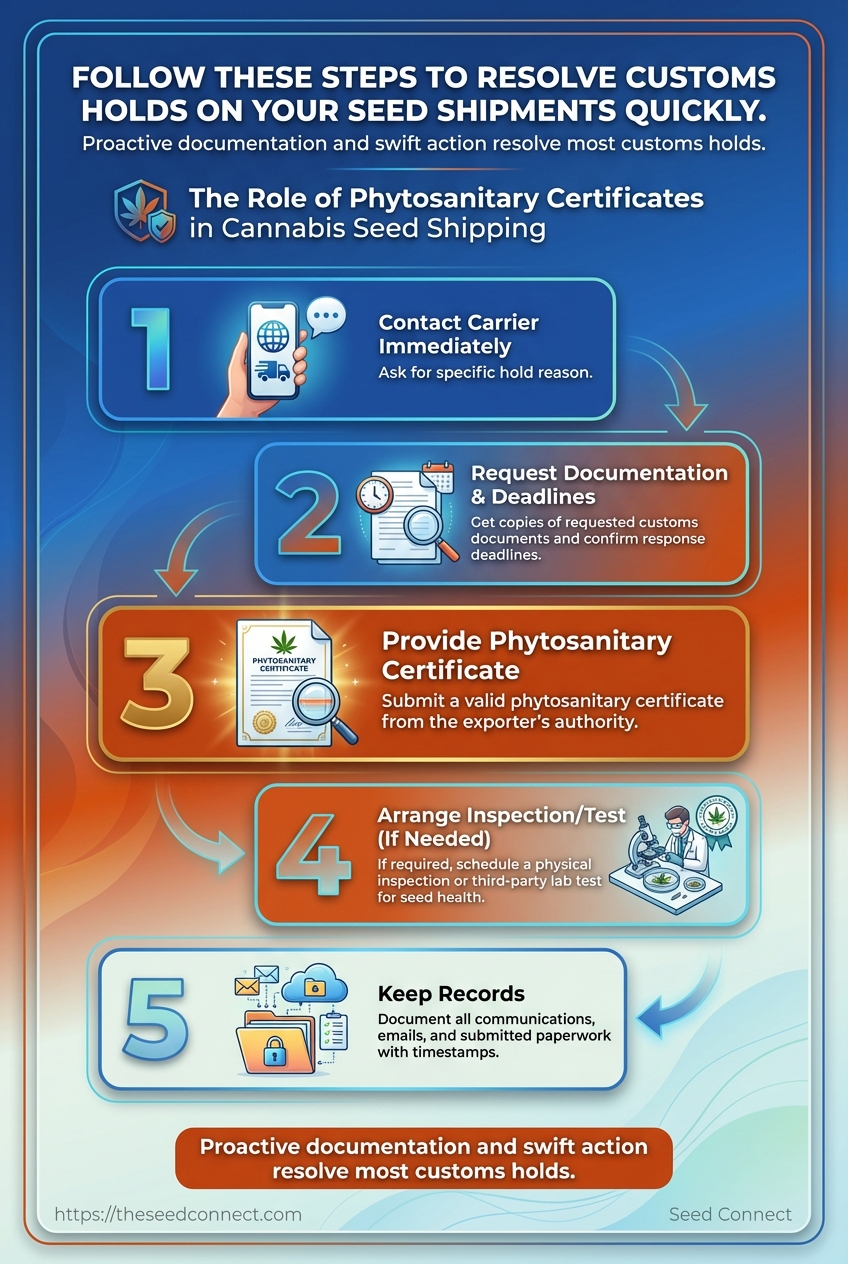
Common causes of delays or rejection at customs
Ever seen a tracking update that simply says “held at customs” and felt time stop? That pause usually signals a paperwork mismatch, a question about the contents, or a packaging problem that triggered an inspection. Most delays are avoidable once you know the common faults customs officers look for. Three issues show up again and again.
First, documentation that’s incomplete, inconsistent, or uses the wrong terminology will stop a shipment cold. Second, labeling, packaging, or declared contents that don’t match the paperwork create suspicion about what’s inside. Third, regulatory mismatches between exporter and importer rules — including specific seed health rules under phytosanitary certificate regimes — add another layer of checks.
That figure explains why attention to detail matters for international seed health regulations, particularly under frameworks like the IPPC and national authorities such as the USDA and CFIA.
Incomplete or mismatched documentation
Paperwork problems are the single biggest cause of holds.
Commercial invoice: A missing or vague invoice can prompt rejection because customs needs a clear description and value. Phytosanitary certificate: If the phytosanitary certificate data fields don’t match the invoice or airway bill, customs will flag it.
Permits and licenses: Missing import permits or the wrong permit number causes immediate delays. When documentation fields don’t line up exactly — names, addresses, HS codes, or botanical names — expect questions.
How to troubleshoot a held shipment (who to contact)
Act fast and follow a clear chain of contact.
Contact the courier’s customs clearance team to get the exact reason for the hold and required documents.
Notify the shipper/exporter so they can send corrected paperwork or additional certificates.
Hire a customs broker if the case becomes complex or requires rapid liaison with authorities.
Reach out to the national plant protection organization (USDA, CFIA, or equivalent) for advice on certificate validation.
Prepare proof of origin and seed health (photos, batch numbers, test results) in case customs requests verification.
If required, arrange re-export or sanctioned destruction through the carrier to close the case quickly.
How Seed Connect helps: guarantee, documentation, and support
Ever opened a tracking update and felt your plans collapse because a shipment was stuck at customs? Seed Connect pairs a clear germination promise with practical paperwork and hands-on support so that pause turns into a solved problem, not a lost order. The germination guarantee is backed by process, not wishful thinking.
It depends on correct preparation and valid phytosanitary certificate handling under the rules set by authorities such as the IPPC, USDA, and CFIA.
When documentation and handling meet those standards, the guarantee stays intact. Beyond paper, Seed Connect provides active support for international moves. That includes guidance on cannabis shipping requirements and international seed health regulations, help with certificate requests, and live communication when carriers or customs ask questions. The company’s approach reflects why this matters: 43% of cannabis farmers reported shipment problems tied to regulations in 2022.
Germination guarantee and documentation
Seed Connect’s germination promise covers seed viability while recognizing regulatory dependencies. If seeds are damaged by transit or fail to meet germination standards because of supplier error, the guarantee applies. Documentation affects that guarantee in three practical ways.
-
Proof of export: A valid
phytosanitary certificatemust accompany international shipments for release by many countries. -
Accurate paperwork: Incorrect labels, species descriptions, or missing invoices can void claims.
-
Traceable handling: Timely tracking and condition photos during packing help validate a claim.
Support for international shipments and certificate requests
Support begins before the package leaves the warehouse. Seed Connect helps prepare the exact documents required by importing countries and coordinates pre-shipment inspections when needed. Services offered include:
Document prep: Guidance on the specific certificate language preferred by the USDA, CFIA, or importing authority.
Agency liaison: Assistance contacting national plant protection organizations to speed certificate issuance.
Customs communication: Direct help responding to carrier or customs requests to reduce holds.
Logistics advice: Recommendations on carriers and packaging that meet international seed health regulations.
Real-world example: resolving a cross-border hold
Consider a grower who sees “held at customs” and an inspector requests a missing phytosanitary endorsement.
-
Identify the hold reason and the exact document the authority requests.
-
Pull packing photos, export invoices, and the original certificate for review.
-
Seed Connect contacts the exporter, the issuing plant protection authority, and the importer to provide clarifications or submit a corrected certificate.
-
If needed, arrange re-inspection or supervised release with the carrier.
Often the hold clears within days once the right documentation is presented, and the germination guarantee can be validated if seeds remain undamaged. This approach keeps paperwork from being an afterthought and turns bureaucratic roadblocks into solvable steps.