

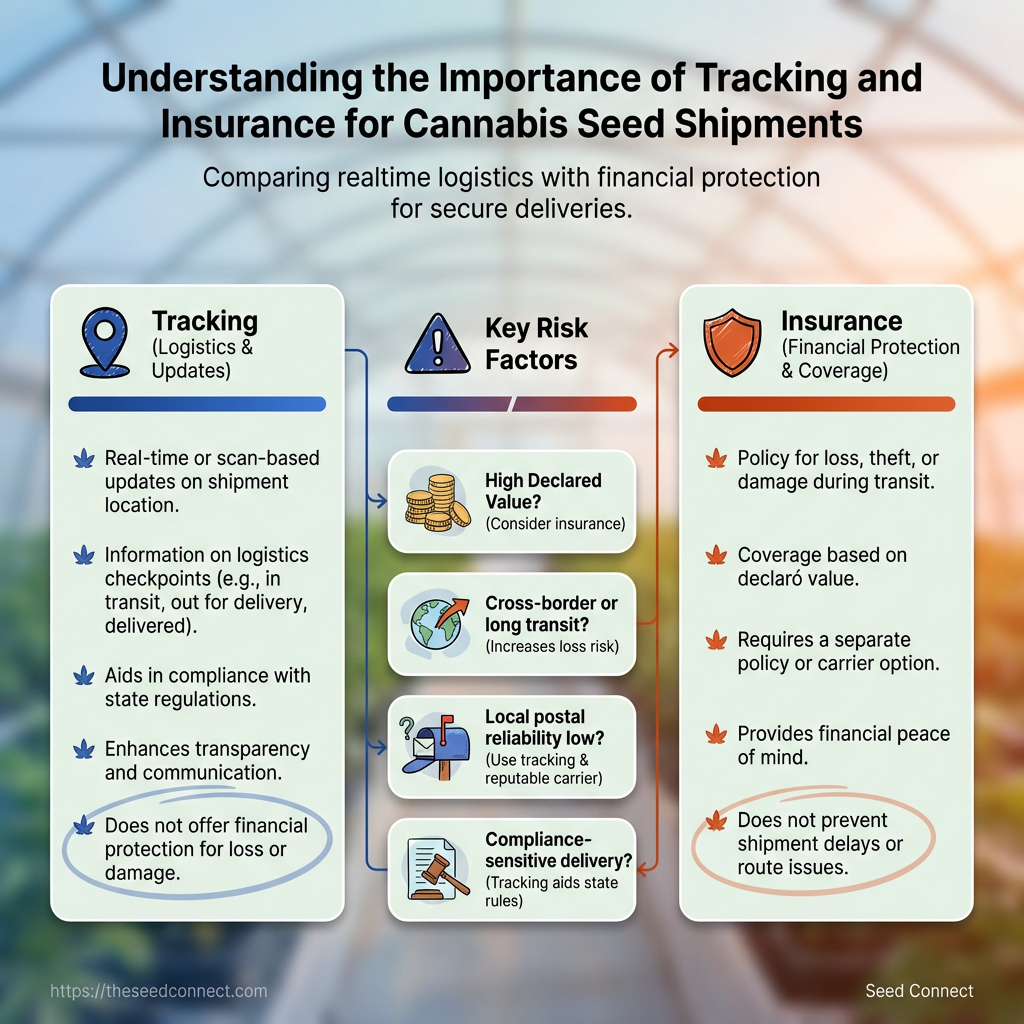
Tracking and Insurance for Cannabis Seed Shipments can reduce uncertainty when an order is delayed, damaged, or lost in transit. Tracking helps buyers follow key shipment events, while insurance or declared-value protection may provide financial recourse when a covered package does not arrive as expected.
In this guide, The Seed Connect explains how shipment tracking works, what common carrier statuses mean, when insurance may be worth considering, and what steps to take if a cannabis seed order is delayed, lost, or damaged.
Key Takeaway
- Tracking gives buyers visibility throughout the shipping process, making it easier to identify delays, delivery exceptions, and potential problems before they become harder to resolve.
- Shipping insurance or declared-value protection can reduce financial risk, especially for higher-value seed orders, but buyers should always check what the carrier or seller actually covers.
- Keeping receipts, tracking records, and photos of damaged packages improves the claims process, helping buyers provide clear evidence when requesting support, replacement, or reimbursement.
Worried your seed order won’t arrive intact or on time? That’s a common feeling among growers who ship high-value genetics or send seeds across borders. Decide based on the value at stake, the route the package will take, and how much risk you’re willing to carry. If your shipment is low value and local, unsigned shipping is often fine.
But when seeds are expensive, cross-border, or passing through unreliable postal networks, tracking and insurance become smart precautions. Overall, understanding these factors helps ensure your valuable seeds arrive safely.
How tracking works for cannabis seed shipments
Ever refreshed a tracking page and felt like the updates were written in another language? Tracking is mostly a chain of scan events recorded as a package moves through carrier systems.
Each entry is a timestamped scan, not a live GPS ping, so the status tells you which checkpoint handled the parcel and what the carrier expects next.
Several players in the industry—companies like Canopy Growth and platforms such as LeafLink—combine carrier scans with internal order systems to give fuller context around shipments.
That added context helps explain why a package can show “Arrived at facility” for hours while it’s actually en route to the next hub.
Tracking matters beyond curiosity.
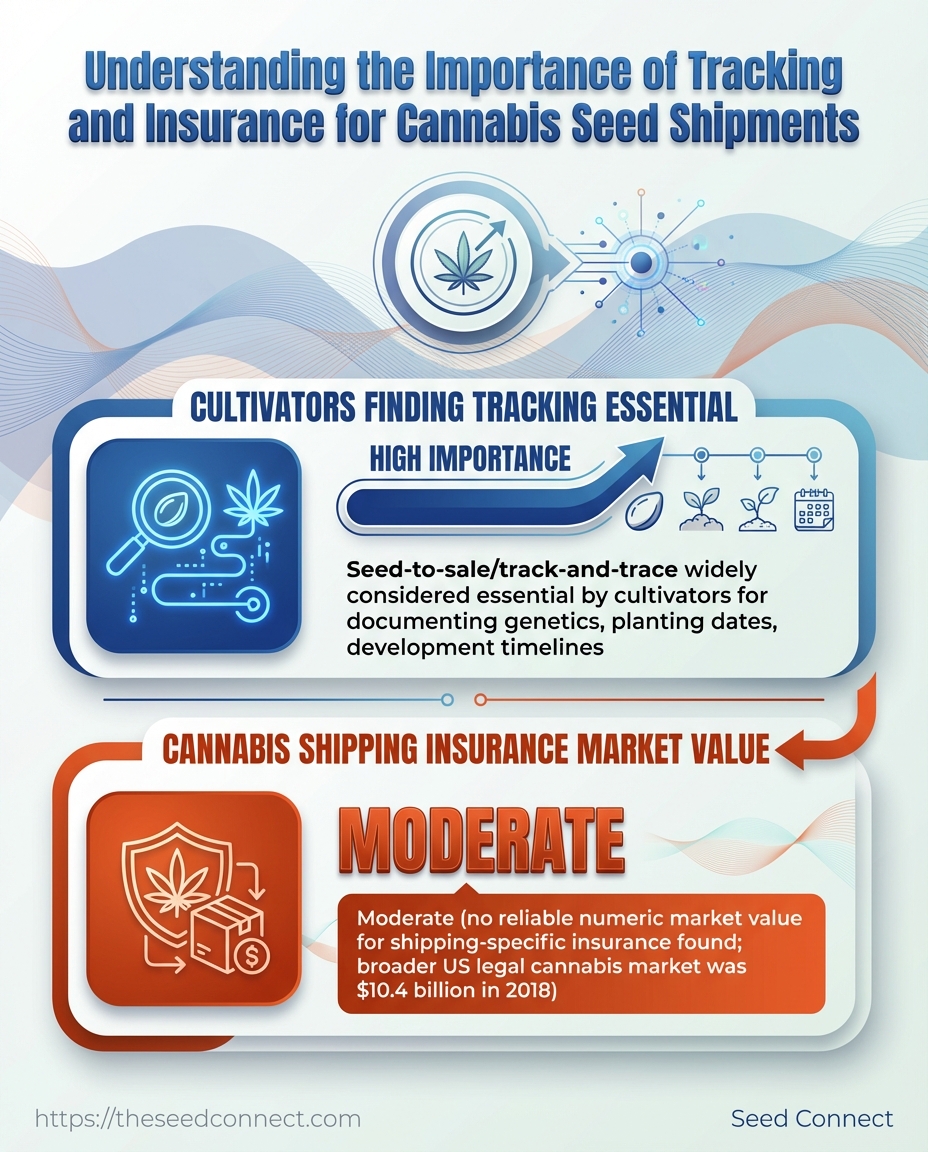
A 2025 survey found that 78% of cultivators consider shipment tracking essential for seed orders because it reduces theft and compliance headaches.
At the same time, the market for shipping protection grew, with shipping insurance valued at about $150 million in 2025, so people increasingly pair tracking with coverage.
Tracking status explained
Tracking statuses are shorthand for what happened at a checkpoint.
Some statuses mean movement, others mean a hold or an action is required.
In transit: The package is moving between facilities; expect further scans soon.
Arrived at facility: The parcel reached a hub.
It may be unloaded, sorted, or awaiting transfer.
Departed facility: The shipment left a hub and is headed to the next stop.
Out for delivery: A local driver has the package and plans to deliver that day.
Delivery attempted: A driver tried to deliver but couldn’t; look for pickup instructions.
Exception: An unexpected issue (address problems, damage, or weather) needs attention.
Customs hold: International shipments stopped for inspection or paperwork clearance.
Key tracking events to watch
Watch specific scans rather than read every line of text.
Scans to monitor are simple and predictable.
- Pick-up scan — indicates carrier accepted the parcel from the sender.
- Origin facility scan — package entered the carrier network; routing begins.
- Hub transfer/departed scans — show movement between regional centers.
- Customs release (for cross-border) — clearance or hold; delays often occur here.
- Out for delivery and final delivery scans — confirm local handling and receipt.
If a scan stalls for more than 24–48 hours at one hub, that’s the moment to act.
When to contact the carrier vs. when to contact Seed Connect
Carriers should be first contact for live location, missed delivery attempts, and changing delivery instructions.
They handle driver follow-ups and local pickup options.
Contact Seed Connect (https://theseedconnect.com) when tracking shows lost, damaged, or never-scanned packages, or when you need help with a claim under the germination guarantee.
Also reach out if you need assistance coordinating insurance with a provider like Delivra.
Tracking plus the right partner solves most problems.
Keeping an eye on key scan events and knowing who to call makes delays or losses far less stressful.
Insurance and coverage options explained
Most growers treat shipping protection like plumbing: boring until it bursts.
For seed orders, protection choices split into a few practical buckets that trade cost, speed, and paperwork.
Picking the right coverage depends on order value, destination, and how much proof you’re willing to keep on file.
Declared value and carrier-added insurance work well for low-to-moderate value packs with simple paperwork.
For higher-value seed lots, specialty providers and third-party insurers designed for cannabis offer policies that cover theft, damage, and sometimes regulatory red flags that general parcel policies exclude.
Expect a small premium relative to order value, but significant peace of mind when a rare or expensive variety goes missing.
Tracking remains helpful, but coverage closes the gap when tracking alone can’t recover loss.
The 2025 survey showing 78% of cultivators calling tracking essential reflects that trend, and the broader $150 million cannabis shipping insurance market in 2025 shows growing supply-side options.
How declared value and proof of value work for small, high-value seed orders
Declared value is the amount you tell a carrier your shipment is worth.
It sets the maximum the carrier will reimburse if the package is lost or damaged.
Declared value sometimes requires a fee based on the declared amount and carrier rules.
Proof of value is the documentation you keep: invoices, photos of the seeds and packaging, or payment records.
For small, high-value orders—like collectors buying rare genetics or specialty packs—proof of value speeds claims and prevents disputes.
Declared value: A carrier-recognized monetary amount assigned to the parcel for reimbursement calculation.
Proof of value: Supporting documents (receipt, photo, serial numbers) used to substantiate a claim.
Practical coverage choices
- Carrier-added insurance (postal): Cheaper for low values; limited by postal exclusions.
- Carrier-added insurance (express): Higher limits, faster claims, stricter paperwork.
- Declared value service: Simple, fee scales with value; reimbursement limit equals declared amount.
- Third-party parcel insurance: Broader coverage, often quicker payouts; check cannabis exclusions.
- Specialty cannabis insurers (e.g., Delivra): Policies targeted at cannabis shipments covering theft and regulatory risk.
- Marketplace/aggregator policies: One-stop shopping for multiple carriers; good for frequent shippers.
- High-value individual consignment cover: Custom policies for single, expensive seed lots.
- No insurance (tracking only): Lowest cost; no financial protection if lost.
Choosing the right carrier and shipping method
Picking the right carrier shapes almost every outcome: speed, visibility, and how you recover if something goes wrong.
Fast couriers give minute-by-minute tracking and predictable delivery windows, but they cost more and sometimes flag packages for extra inspection.
Lower-cost postal options save money but often provide sparse scan events and longer transit windows.
A safe approach balances risk and value.
For high-value genetics, prioritize carriers with detailed scans and optional declared-value protection.
Nearly 78% of cannabis cultivators in 2025 said detailed shipment tracking was essential for seed orders, and the market for shipping insurance reached about $150 million in 2025 — both signs that attention to carrier choice is mainstream now.
Expect to mix services by use case: cheap postal for low-value domestic test orders, registered or courier priority for flagship genetics and international moves.
What follows compares common tiers, then covers customs quirks and practical packaging tips that reduce delays and claims.
Fast vs. low-cost options: trade-offs for seed shipments
| Carrier / Service tier | Average transit time | Tracking detail (granularity) | International coverage (notes) | Good for |
|---|---|---|---|---|
| National postal standard (domestic) | 3–7 days | Low — origin/destination scans | Limited to domestic; some routes to nearby countries | Low-cost domestic test orders |
| National postal registered/tracked | 3–6 days | Medium — added tracking + signature option | Often available internationally with limited detail | Valuable small parcels needing proof of delivery |
| USPS First-Class | 2–5 days (domestic) | Low–Medium — basic scans | Limited international via First-Class International | Low-cost domestic/non-urgent |
| USPS Priority Mail | 1–3 days (domestic) | Medium — regular scans, tracking number | Good international options with variable detail | Faster domestic shipping with moderate cost |
| USPS Registered Mail | 2–5 days | High — chain-of-custody, signature | International availability varies; extra security | High-value domestic shipments |
| Royal Mail 2nd Class / Economy postal | 2–5 days (UK domestic) | Low | Limited international reach | Cheap domestic parcels |
| Royal Mail Signed For / Tracked | 1–3 days | Medium — signature on delivery | International tracked services available | Small high-value UK parcels |
| Express courier economy (e.g., DHL Economy) | 3–7 days | Medium — periodic scans | Global but slower routing | Cost-conscious international shipping |
| Express courier priority (e.g., DHL Express / FedEx Priority) | 1–3 days | High — detailed scan chain, real-time updates | Global door-to-door with customs handling | Time-sensitive or high-value international orders |
| UPS Standard / FedEx Ground | 2–6 days | Medium — regional scans | Good cross-border land routes | Commercial shipments with ground pricing |
| FedEx International Economy | 3–6 days | High — frequent scans, customs clearance | Global coverage with good customs support | International, moderate urgency |
| FedEx International Priority / DHL Express | 1–3 days | Very high — near real-time tracking | Full global service with fast customs clearance | Urgent, high-value cross-border shipments |
Choosing between speed and cost depends on value and risk tolerance.
Use postal registered or courier priority for flagship seeds and cheaper postal tiers for catalog testing or low-value replenishment.
International shipments and customs
Cross-border moves require paperwork and careful route selection.
Different countries treat seeds differently; some ban import, others require phytosanitary certificates or import permits.
- Documentation: Provide accurate botanical names and declared value on customs forms.
- Regulatory checks: Confirm the destination’s seed and cannabis laws before sending.
- Customs brokers: For priority couriers, brokers speed clearance and reduce hold-ups.
Canopy Growth and LeafLink use advanced logistics to manage these steps, and some insurers like Delivra factor customs exposure into coverage terms.
Packaging and labeling tips to reduce delivery problems
Packaging should protect the product and avoid unnecessary attention.
Use discreet outer packaging, an internal moisture barrier with a small desiccant, and tamper-evident seals.
- Bold label practice: Use neutral sender/return addresses and avoid explicit product descriptions on the outside.
- Bold weight control: Keep declared weight accurate to prevent surcharges or inspections.
- Bold cushioning: Small seed packets shift easily; use foam or padded envelopes to stop movement.
- Bold paperwork: Include contact info and a clean commercial invoice when required.
Test a few carriers with low-value orders, then scale to higher-value shipments once the chosen route proves reliable.
Choosing the right carrier is about matching visibility and speed to how much risk the seeds carry.
What to do when a shipment is delayed, lost, or damaged
Few things raise the heart rate faster than a tracking page that stops updating.
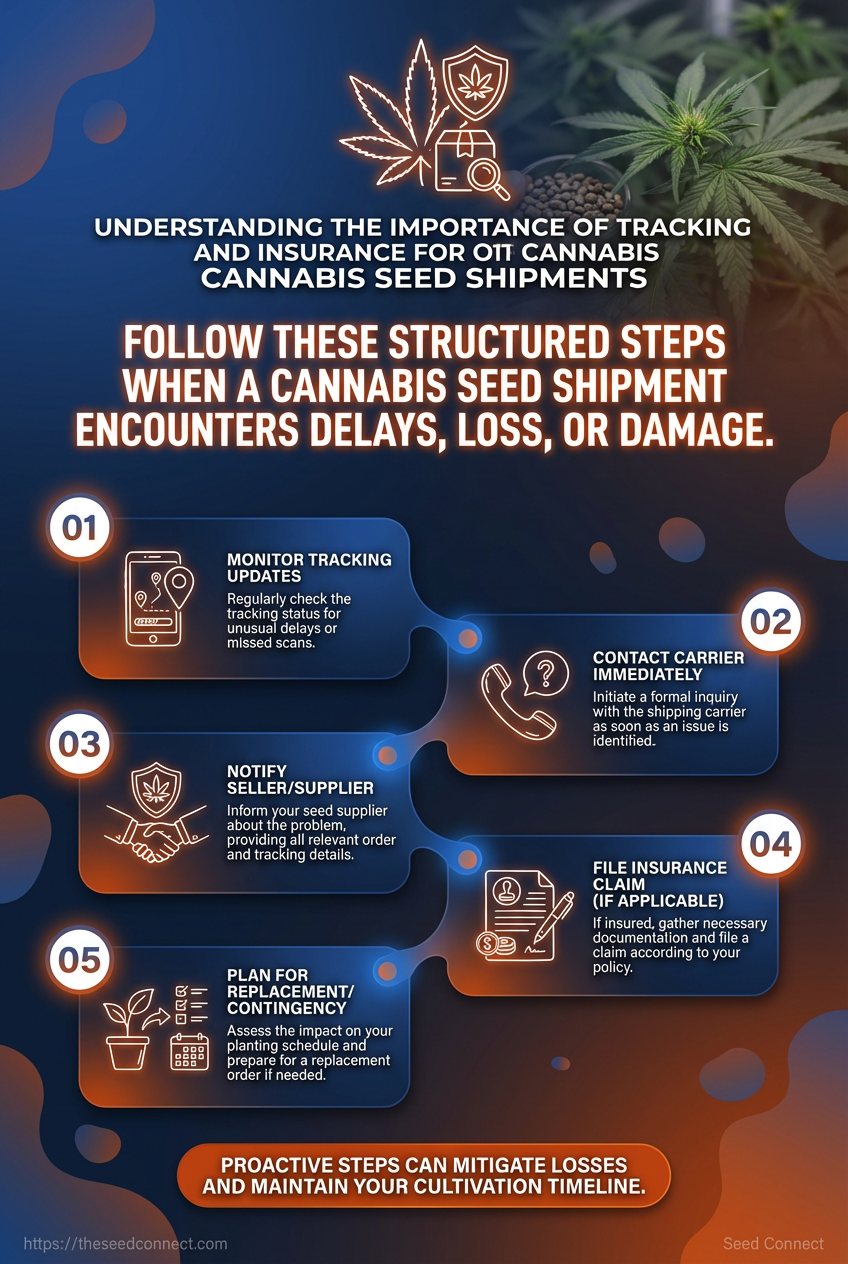
Act fast and document everything; a calm, evidence-first approach almost always leads to a faster resolution.
Start by capturing the visible record: screenshots of the tracking page, timestamps, and any delivery notices.
Then open claims with the carrier and notify the seller at the same time so parallel investigations can begin.
Beyond documentation, know your expectations.
Carriers and sellers follow different timelines and requirements; meeting both sets of requirements shortens the claims process and improves chances for replacement, refund, or an insurance payout.
Immediate steps when tracking looks wrong
When a scan goes silent, move in a specific order to preserve evidence and open the right channels.
- Check the tracking feed and take screenshots of the current status and timestamps.
- Photograph the final scan notification or the empty mailbox/door area if the package shows delivered.
- Contact the carrier’s local hub by phone and log the representative’s name, time, and any case number.
- Email the seller and attach your screenshots; ask for a case reference so both parties have the same record.
- If theft is suspected, file a police report and keep the report number — many carriers and insurers require it.
How to file a claim and timeline expectations
Claims work better when submission is complete and organized.
File with both the carrier and the seller if policies allow simultaneous claims.
Claim submission checklist
| Item | Why it matters | How to get it |
|---|---|---|
| Order confirmation/receipt | Proves purchase and declared value | Download from your account or email confirmation |
| Tracking number and status history | Shows last known location and timeline | Screenshot tracking page and export status history if available |
| Photos of damaged packaging | Visual proof required for damage claims | Photograph packaging and contents immediately with timestamps |
| Proof of value (invoice or declared value) | Needed to determine payout amount | Use order invoice or payment receipt from seller |
| Correspondence with carrier or Seed Connect | Shows attempts to resolve and case numbers | Save emails, chat transcripts, and note phone calls |
| Shipping insurance policy number | Confirms coverage and policy limits | Retrieve policy documents from seller or insurer |
| Delivery signature / proof of delivery | Disproves or proves carrier delivery claim | Request POD from carrier or view scanned signature online |
| Customs paperwork (if international) | Required for cross-border loss investigations | Export declarations and customs receipts from seller |
| Batch/lot number or seed IDs | Helps validate product identity and value | Check seed paperwork or seed packet labels |
| Police report or theft affidavit | Required for theft-related claims | File local police report and save the incident number |
Documenting each item makes claims faster and harder to deny.
Claims timelines vary by carrier and insurer; expect an acknowledgement within 24–72 hours, an investigation phase that often takes 7–21 business days, and final resolution in 30–60 days.
Some carriers close claims faster; insurance payouts may take a few additional weeks.
When Seed Connect steps in: replacements, refunds, and guarantees
Seed Connect will open its own investigation after you provide the checklist items above.
They typically request evidence within a short window after delivery or discovery, so prompt submission helps.
- Replacement: If seeds are lost or damaged and stock is available, replacement shipments are offered subject to verification.
- Refund: Monetary refunds are possible when replacement isn’t feasible; timelines follow the seller’s policy and payment processor rules.
- Germination guarantee: If seeds arrive but fail to germinate within the guarantee period, provide germination reports and photos to qualify.
For assistance, reach out through platforms like https://theseedconnect.com and include your order number and claim checklist items.
Act quickly, document everything, and run parallel claims with carrier and seller — that combination gives the best chance of a fast, fair outcome.
Reducing future risk: policies and best practices for regular buyers
Regular buyers who treat shipping as a core part of their operation stop reacting and start preventing problems.
Set clear, repeatable ordering defaults and a simple record system once, and most headaches disappear.
That steady setup makes disputes, audits, and replacements faster and less stressful.
This section lists concrete defaults to set on every order, daily record habits that pay off over months, and practical triggers for extra protection or carrier changes.
The aim is to make risk a predictable cost instead of a surprise expense.
Small choices compound.
A single default—like signature required—saves time when something goes missing.
Over several orders, those saved hours add up into reliable inventory and fewer emergency replacements.
Policy checklist: what to set as default when you order
Start by treating each order like a business transaction, not a casual purchase.
- Delivery option: Use
signature requiredor pick a locked pickup point to reduce unattended deliveries. - Declared value: Always set a realistic declared value for insurance claims and customs paperwork.
- Tracking enabled: Insist on a
tracking numberand require delivery scans at each transit hub. - Contact info: Include a direct phone and alternative email for courier notifications.
- Packaging notes: Request discreet packaging and minimal external labeling to reduce theft risk.
- Preferred carrier: Standardize on one or two carriers that match your risk tolerance and service level; list them in your vendor notes.
Record-keeping and shipping habits that cut problems over time
Build a simple, searchable log and update it every time an order moves.
- Create a single spreadsheet or cloud doc with
order ID, carrier, tracking number, declared value, and delivery confirmation.
- Photograph packing slips and the package exterior when it leaves the shipper.
- Reconcile received inventory against order records within 48 hours and flag mismatches.
- Keep communications (emails, chat logs) attached to each order entry for claims.
- Archive older records by year; keep them accessible for audits and insurance claims.
When it makes sense to buy extra coverage or change carriers
Extra protection should be a deliberate decision, not a reflex.
- High-value genetics: Buy additional insurance for premium or one-of-a-kind strains.
- Frequent incidents: If near-miss or loss rates rise, move to a carrier with better scanning and dispute support.
- Regulatory needs: When state rules tighten, prefer carriers with compliance track records.
- Volume thresholds: As monthly order value grows, shift some budget from loss replacement to formal shipping protection.
A growing operation benefits from predictable policies and tidy records; they turn shipping risk into manageable overhead.
Keep defaults consistent and adjust coverage only when data shows a need.
Keep your planting schedule, not your fingers crossed
That moment when a packet reads “in transit” and your planting window is slipping proves a simple fact: risk is manageable, not magical.
The most valuable move is to treat shipments like a small project — pick a carrier with frequent scans, verify tracking for cannabis shipments before you buy, and layer on protection so a single missed scan doesn’t ruin your schedule.
When growers followed the steps in the claims section — file quickly, preserve packaging, and escalate to the carrier — many recovered losses or received reimbursement without waiting weeks.
Make one change today that pays off next season: before placing an order, confirm whether you can get trackable scans, choose declared-value insurance or add shipping protection, and save the seller and carrier claim contacts somewhere handy.
Seed banks like TheSeedConnect can be one option for reliable sourcing and clear shipping policies.
Try placing a small, tracked, insured order this week and see how much calmer your planting plan feels — what will you change for your next order?