Efficient cannabis seed export hinges on meticulous packaging and adherence to legal requirements.
A failure in these areas often leads to complaints regarding seed viability and can severely impact your reputation.
Many jurisdictions will reject shipments due to minor mistakes in packaging or documentation.
Hence, implementing moisture control and using tamper-evident seals are paramount to maintain seed viability and meet compliance standards.
Notably, industry leaders, such as Canopy Growth and Sensi Seeds, exemplify best practices in designing packaging that not only preserves seeds but also accelerates the customs clearance process.
Understanding and applying seed labeling requirements—such as botanical names and origins—are legally imperative in numerous countries that accept seed exports.
In summary, diligent attention to packaging and labeling is critical for ensuring germination rates and mitigating costly returns.
Table of Contents
Why correct packaging and labeling matter for exported seeds
Handling and storage best practices before and during transit
Customer-facing details: how to communicate packaging and labeling to buyers
Why correct packaging and labeling matter for exported seeds
Ever had a shipment arrive soggy or opened and wondered how much damage that did to your reputation? Packaging and labeling aren’t cosmetic extras — they’re the first line of defense for seed viability, legal compliance, and customer confidence.
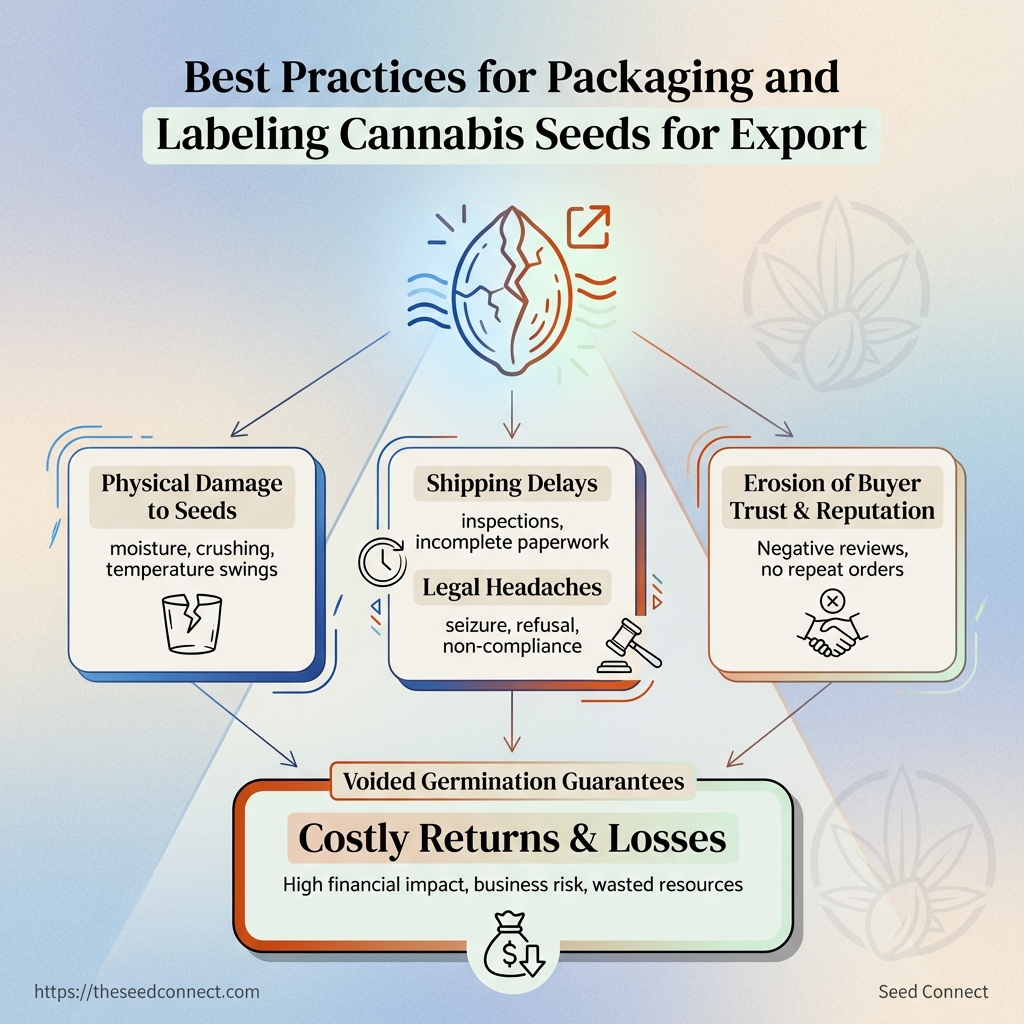
Poor packaging causes three predictable problems: physical damage, shipping delays from inspections, and legal headaches at borders.
Those outcomes can void a germination guarantee, trigger returns, and erode hard-won trust with buyers in tightly regulated markets.
This section covers the core risks exporters face, how smart packaging and clear labels protect guarantees and trust, and the practical elements to include on every parcel.
Core export risks: damage, delay, legal exposure
Exports move through many hands and climates.
Seeds can suffer moisture, crushing, temperature swings, and tampering during transit.
Regulatory checks are routine.
Shipments with incomplete or incorrect documentation get delayed or returned, which costs time and money.
Border authorities focus on accurate identification and origin.
Mislabeling or missing botanical names can trigger seizure or refusal even in places that allow seed imports. Damage: Physical harm to seeds from moisture, pressure, or pests — avoid with moisture control and protective packaging. Delay: Slowdowns caused by inspections or paperwork problems — avoid with clear labels and complete documentation. Legal risk: Non-compliance with import rules, including wrong species names or missing country-of-origin info — avoid by meeting seed labeling requirements.
How packaging and labeling protect guarantees and trust
Good packaging preserves viability.
Use moisture-absorbing materials and desiccants, rigid inner boxes or cushioning, and barrier films to block humidity.
Tamper-evident seals add a visible layer of protection that buyers and regulators respect.
Labeling must be precise.
Include the botanical name, variety, batch code, and country of origin.
That information speeds customs checks and supports any germination guarantee claim.
Companies such as Canopy Growth Corporation and Sensi Seeds set useful benchmarks here; both emphasize compliance and packaging quality when shipping seeds internationally.
Across regulated channels, properly packed and labeled seeds can be exported to about 50 countries under current rules when documentation and packaging meet local requirements.
Moisture control: use desiccants and barrier films.
Tamper-evident seals: visible protection for handlers and buyers.
Clear botanical names: essential for legal classification.
Country of origin: required by many import rules.
Traceability: batch codes and records support guarantees.
Right packaging and labels protect the product, the promise, and the relationship with buyers.
Get those basics right and most export headaches vanish.
Regulatory landscape: how to approach cross-border rules
Have you checked the legal baseline for a target country before quoting shipping times or prices? A quick yes/no can save a shipment from seizure or a customer from frustration.
Start by mapping three things: whether the destination allows seed imports at all, how varieties are classified, and what documentary evidence customs expects.
Work from regulation text where possible, and treat any ambiguous term—like what counts as a “seed” under local law—as a red flag that needs clarification.
Treat compliance as a project with milestones.
That keeps permits, classification, and declarations from becoming last-minute problems that cost time and reputation.
Key legal variables to track
Plant variety laws control which genetics can cross a border.
Some countries ban certain cultivars or require plant breeder rights documentation.
Import permits are often mandatory.
They can be general licenses, single-shipment permits, or permits tied to a research or commercial purpose.
Customs declarations hinge on correct classification.
Use the right HS code, declare origin, and attach any required phytosanitary documents. Plant variety laws: Many states restrict specific varieties or require proof of breeder rights and registration before import. Import permits: A government-issued authorization that specifies allowed quantities, purposes, and documentation for the shipment. Customs declarations: The formal paperwork declaring contents, value, origin, and classification for customs processing.
Navigating major destination regions
Regulatory approaches diverge a lot by region, so plan region-specific playbooks rather than one-size-fits-all checklists.
EU: Member states share customs frameworks but differ on plant variety and licensing; check both EU and national rules.
UK: Post-Brexit rules require separate UK declarations and sometimes different permits from EU ones.
USA: Federal restrictions are uneven; many states allow seeds, but federal import rules and
HSclassifications still apply.Canada: Federal system is clearer for commercial seed imports but requires specific documentation and traceability.
APAC (selected): Rules vary wildly—some markets are open under strict conditions, others prohibit import entirely.
Companies such as Canopy Growth and Sensi Seeds demonstrate the value of maintaining country-level compliance teams and engaging regulators early.
When to consult a customs broker or legal advisor
If the destination has unclear plant variety rules, bring in an expert.
Complex classification disputes or high-value shipments also warrant professional help.
If a country’s regulations are vague or contradictory, hire legal counsel.
If you face recurring customs holds, a customs broker can correct declaration practices.
For first-time exports to a region, use an advisor to draft permit applications and proof packages.
When moving large or proprietary genetics, protect IP with legal review.
Platforms like https://theseedconnect.com can help surface destination-specific restrictions during the planning phase.
Treat regulatory work as prevention, not paperwork.
A small investment in permits and expert advice prevents far costlier delays and preserves your reputation.
Choosing packaging materials that protect seed viability
Worried seeds will arrive damp, crushed, or dead on the other end? Packaging choices decide whether a seed stays viable for months or becomes a liability the moment it leaves your facility.
Think of packaging as a set of layered defenses.
The inner layer controls humidity and static, the mid layer blocks light and punctures, and the outer layer protects during handling and customs checks.
Each layer trades cost for protection, so match materials to the risk profile of the route and strain.
Below are the material properties and inner-format options that matter most when planning cannabis seed packaging for export.
Moisture barrier: Use materials that stop vapor transmission to prevent mold and premature germination.
Desiccants and sealed foils are the easiest solutions.
Puncture resistance: Choose tear-resistant films or rigid containers when shipments pass through rough handling.
Foam inserts help protect fragile packaging like glass vials.
Light blocking: Seeds are sensitive to UV and visible light.
Opaque materials or foil liners dramatically slow degradation.
Anti-static & handling: For growers using seed sorters or automated planters, anti-static* inner linings prevent seed clumping and friction damage.
Tamper evidence: Many markets expect tamper-evident seals for consumer trust and regulatory compliance; consider adhesive seals or heat-sealed sachets.
Inner packaging options: packets, vials, desiccants and anti-static choices
Material/Format | Protection level (moisture/light/physical) | Typical cost | Best use cases | Notes on customs inspection |
|---|---|---|---|---|
Aluminum foil sachet with heat seal | High moisture & light barrier / moderate physical | $0.06–$0.20 per unit | Bulk small lots; low weight export | Easily opened for inspection; resealable versions flagged |
Glass vial with silica gel | Excellent moisture control / good light if amber glass | $0.50–$1.50 per unit | Premium genetics, single-seed presentation | May trigger scrutiny; declare contents and origin clearly |
Tear-resistant paper envelope with inner foil | Moderate moisture/light / low physical | $0.05–$0.15 per unit | Low-cost domestic shipments | Cheap, but may be opened for inspection and appear informal |
Vacuum-sealed pouch | Very high moisture control / light blocking | $0.10–$0.50 per unit | Long storage, multi-seed packs | Often accepted; vacuum may be released at customs |
Rigid plastic tube with foam insert | Low moisture / high physical protection / light depends | $0.20–$0.80 per unit | Single premium seeds, courier handling | Durable; inspections usually quick but visible |
Mylar bag with zip + oxygen absorber | High moisture/light / moderate physical | $0.08–$0.30 per unit | Long transit, multiple seeds | Looks professional; easy to open for customs |
Blister pack with desiccant insert | Moderate moisture / good physical / light depends | $0.25–$0.90 per unit | Retail-ready packs, display | Tamper evidence built-in; clear labeling recommended |
Metal tin with gasket seal | High physical / good moisture control / light blocking | $0.80–$2.50 per unit | High-end collections, gift sets | Durable and discreet; may require extra paperwork in some countries |
Carefully match the inner format to the value of the seeds and the route’s risk.
For low-value bulk, sealed pouches or foil sachets usually suffice.
For high-value or rare genetics, invest in rigid tubes or glass vials plus desiccants.
Outer packaging and discretion also matter.
Use neutral outer boxes and robust cushioning for carriers that inspect by hand.
Discrete outer box: Plain, unbranded cartons reduce attention.
Sturdy void fill: Recycled paper or molded pulp gives shock protection without extra weight.
Clear labeling area: Leave space for legally required information like botanical names and country of origin, but avoid marketing text that draws extra attention.
Choosing the right combo keeps seeds alive and shipments smooth.
Match material properties to seed value and route, and protect the inner layer first—everything else follows.
Labeling requirements: what to include and how to format it
Have you ever opened a seed package and had to guess what was inside? Clear, compliant labels stop guesswork, speed customs checks, and protect your business from hold-ups.
Good labels answer three questions at a glance: what the seed is, where it came from, and whether it meets the buyer’s expectations.
For exporters, that clarity reduces inspection time and supports traceability if a batch has issues.
Designing the label around inspections and commercial use keeps customers happy and inspectors satisfied.
Below are the mandatory versus recommended elements, design tips that pass scrutiny, and ready-to-use wording templates you can drop in.
Mandatory vs. recommended label elements
Mandatory obligations differ by market, but some items appear across jurisdictions.
Think of mandatory as items inspectors expect to find.
Treat recommended items as insurance: they reduce questions and returns.
Botanical name and variety: Mandatory in most markets; use Latin binomial and cultivar name.
Country of origin: Mandatory for trade compliance and customs.
Batch/lot number: Mandatory/strongly recommended for traceability.
Germination guarantee statement: Mandatory when a guarantee is offered; recommended otherwise. Include percentage and testing date.
Net quantity / seed count: Mandatory in many seed-marketing laws; state weight and/or seed count.
Handling / storage instructions: Recommended; clear temp and humidity notes prevent post-arrival complaints.
Contact information & return address: Recommended and often required for consumer protection and recalls.
Phytosanitary certificate reference: Required for imports — include certificate number when applicable.
Warnings / legal statements: Required where local law restricts sale or age; include local compliance notes.
Designing labels that pass inspections: clarity, language, and symbol use
Practical formatting beats fancy design when an inspector is reading quickly.
Use short lines, plain language, and the recipient country’s official language where possible.
Symbols (e.g., fragile, keep dry) help but never replace text.
Checklist: Designing labels that pass inspections: clarity, language, and symbol use
Label Element | Required (EU) | Required (UK) | Required (USA) | Why it matters |
|---|---|---|---|---|
Botanical name and variety | Required | Required | Required | Scientific ID prevents misclassification and supports legal compliance |
Country of origin | Required | Required | Required | Customs and import controls require origin for duties and inspections |
Batch/lot number | Required/strongly recommended | Required/strongly recommended | Required for many seed categories | Enables traceability and targeted recalls |
Germination guarantee statement | Required when guarantee claimed | Required when guarantee claimed | Required when guarantee claimed | Shows expected viability and protects buyer expectations |
Net quantity/seed count | Required | Required | Required (per Federal Seed Act for many sales) | Ensures transparency in commercial transactions |
Handling/storage instructions | Recommended | Recommended | Recommended | Prevents viability loss and reduces complaints |
Contact information & return address | Often required | Often required | Often required | Required for consumer protections and returns |
Phytosanitary certificate reference | Required for imports | Required for imports | Required for imports | Confirms plant health clearance across borders |
Warnings/legal statements | Required where regulated | Required where regulated | Required where regulated | Alerts buyers to legal restrictions and age limits |
Clear labels shorten inspections and lower the chance of seizure.
Use short lines, 10–12 pt legible type, and contrast colors that don’t hide important fields.
The mockups show three templates: export-ready compliance label, retail branded pouch label, and bulk shipment pallet tag.
Each layout highlights mandatory fields and space-saving phrasing suitable for different destination rules.
Practical label wording examples and templates
Export-ready (EU import)
Front line: Cannabis sativa L. — ‘Northern Lights’
Below: Origin: Canada | Lot: NL-20250122 | Net: 100 seeds
Footer: Germination: 92% (tested 2025-01-10).
Phytosanitary cert: CAN-PHY-12345.
Retail pouch (UK consumer)
Front line: Feminized Cannabis sativa L. — ‘White Widow’
Back: Net qty: 5 seeds | Lot: WW-0425 | Store: cool, dry | Contact: [email protected]
Bulk pallet tag (USA wholesale)
Tag: Variety: Blue Dream (Cannabis sativa L.) | Lot: BD-7789 | Count: 10,000 seeds
Add: Germination guarantee: 85% for 12 months from test date. See enclosed COA.
Use these templates as starting points and adjust language to the destination’s legal needs.
Small changes save hours at border checks and improve customer confidence.
Documentation, declarations and customs-ready packaging
Ever had a shipment stalled at customs because paperwork was vague or the declaration looked like a guessing game? Clear documentation and a customs-friendly presentation cut inspection time and reduce the chance of holds or seizure.
This section lays out the actual paperwork you need, how to write a declaration that won’t trigger red flags, and exactly what inspectors will examine when they open a seed package.
Treat this as an export checklist you can copy into your pack-room routine.
Think commercial invoice, phytosanitary certificates and permits as non-negotiable items. Also remember that experienced seed houses such as Canopy Growth and Sensi Seeds follow tight documentation standards for shipments to regulated markets in roughly 50 countries, which makes their practices a useful benchmark.
What follows are step-by-step, practical items to add to every international consignment so customs officers can verify legality quickly and move the parcel on.
Essential paperwork
Commercial invoice: A complete invoice must list botanical names, precise quantities (by count), unit value, and the HS code for seeds. Phytosanitary certificate: Issued by the exporting country’s plant health authority; shows seeds meet the receiving country’s biosecurity rules. Export permit / import permit: If either country requires permits for cannabis-related material, include copies of both sides. Packing list: Detailed contents with weights and package dimensions to match the invoice and airway bill. Certificate of origin: Shows the country of origin — a legal requirement for many customs regimes and tariff rules.
You can reference a reliable seed catalogue for botanical names, for example Cannabis Seeds when preparing product descriptions.
How to prepare a customs-friendly declaration and avoid red flags
Use full botanical names and avoid slang or marketing terms.
Match every figure across invoice, packing list, and airway bill.
Include HS code and purpose of export (e.g., “research samples,” “breeding stock”).
Show unit values that reflect market norms; extreme under- or over-valuation draws scrutiny.
Attach permits and phytosanitary docs as single PDF files when uploading to carrier portals.
Add a concise statement of compliance noting inspection readiness and contact details for the exporter.
Follow these steps to reduce manual interventions and email exchanges with customs officers.
Packaging presentation for inspections: what inspectors look for
Inspectors open packages to confirm label accuracy, seed condition, and that contents match paperwork.
They check for visible moisture, tampering, and correct botanical identification.
Moisture control: Inspectors expect desiccants and inner moisture barriers to be present and intact.
Tamper-evident seals: Clear seals that show if a box has been opened in transit.
Label match: Botanical name and country of origin on the package must match the commercial invoice and phytosanitary certificate.
Accessibility of documents: Papers tucked into a clear pouch on the outside speed inspection.
This short walkthrough shows packing, labelling and document placement step by step to pass a customs inspection.
Do the paperwork right and the inspection becomes a quick verification, not a problem.
Proper documentation plus a clean, inspection-ready package keeps shipments moving and reputations intact.
Handling and storage best practices before and during transit
Have you ever packed a perfect box and still received a customer complaint about low germ rates? Proper handling and storage before and during transit are the often-overlooked steps that decide whether seeds arrive viable or arrive as a claim.
Focus on three things: rigorous pre-shipment quality checks, active control of temperature and humidity while moving, and airtight tracking plus documentation so disputes get resolved fast.
These steps make your cannabis seed packaging work as intended instead of just looking good on paper.
Market leaders such as Canopy Growth Corporation and Sensi Seeds treat handling records as part of the product.
That attention to process prevents complaints and smooths customs checks in the 50 countries that allow regulated seed exports.
Pre-shipment quality checks: moisture, germination, sealing
Start testing the lot as if you’ll be judged on the first complaint.
Run moisture checks with a calibrated meter and document the readings for each pallet or box.
Perform a germination sample test: take a representative sample (for small lots, 10–20 seeds; for larger, 1–2% of the lot), place on damp blotter or agar, and record germination at 7 and 14 days.
Compare results to your acceptance criteria and tag the lot accordingly.
Record moisture readings for each container and keep a dated log with operator initials.
Seal and code each sealed package with a lot ID and timestamp. Retain a small sealed sample from the lot for 6–12 months as a reference.
Temperature and humidity control during transit
Keep moving seeds within a controlled microclimate, not just inside a box.
Temperature swings and humidity spikes kill viability faster than slow transit.
Use active monitoring: include a
temperature loggerand humidity logger set with alert thresholds.Choose routes and carriers with climate safeguards: prefer carriers offering temperature-controlled options during heat or cold waves.
Stabilize thermal mass: add phase-change packs for long routes and avoid overnight warehouse layovers during extreme weather.
Tracking, insurance and dispute documentation
Documentation is the difference between a successful claim and a lost sale.
Capture evidence early and store it in a searchable folder. Commercial invoice: Required paperwork with declared value and HS codes. Phytosanitary certificate: Where applicable, the official plant-health record. Germination report: Lab-style result with sample size and dates. Moisture log: Time-stamped readings tied to lot IDs. Chain-of-custody photos: Seal, label, and pallet images with timestamps.
Follow this quick dispute checklist:
Gather
temperature loggerdata, photos, and the germination test for the sample.Notify the carrier and insurer within their claim window with supporting files.
Hold the remaining lot for inspection and await instructions from the carrier or customs.
Keeping tight pre-shipment checks, active climate control, and thorough records turns shipping cannabis seeds from a risk into a repeatable process.
Small upfront effort saves time, money, and your reputation.
Customer-facing details: how to communicate packaging and labeling to buyers
Ever had a customer call wondering what the label codes mean or whether their order will clear customs? Clear, upfront messaging prevents those calls and sets expectations before a seed even ships.
Good customer-facing communication explains three things simply: what you’re sending, how it’s packaged, and what the buyer should do if something goes wrong.
That means product pages, packing slips, and post‑purchase emails all carry consistent language about shipping timelines, inspection risk, and the germination guarantee.
This section gives copy you can drop into pages and slips, sample messages for common scenarios, and a practical returns workflow for germination claims. The aim is to reduce confusion, speed dispute resolution, and protect your reputation when shipping cannabis seeds internationally.
What to include on product pages and packing slips
Write product pages as the first customer contract.
Packing slips should mirror those commitments in a condensed format. Product ID and botanical name: Clear scientific name (e.g., Cannabis sativa* L.) so buyers and customs can identify contents.
Shipping expectation: Estimated dispatch and delivery windows and typical courier partners.
Inspection notice: Brief line explaining customs inspections may delay delivery and that buyers may be contacted for additional documentation.
Germination guarantee headline: One-line promise (e.g., “Germination guarantee — replacement or refund within 60 days”) with a tappable link to the full policy.
Contact and next steps: Customer support email, claim window, and required evidence (photos, lot number).
Mention platforms like https://theseedconnect.com where appropriate as a source for seed purchases and reference material.
Sample customer messages
Short, plain-language templates keep replies consistent and fast.
Order confirmation (shipping timeline): “Thanks — your order ships within 1–2 business days.
Expected delivery: 5–12 business days but may vary with customs inspections.”
Customs inspection notice: “Your package is currently undergoing a customs inspection.
This can add 3–10 days.
No action needed unless customs requests documents.”
Germination-claim reply: “Sorry to hear about germination issues.
Please send photos of the packing slip, a photo of the unopened seeds, and germination results.
We’ll respond within 3 business days.”
Handling returns, complaints and germination guarantee claims
A fast, repeatable process resolves most disputes and keeps customers calm.
Acknowledge within 24 hours: Ask for order number, photos, and the lot code from the packing slip.
Triage: If packaging shows mishandling, note courier and photos; if seeds appear intact, request germination test details.
Verify: Match claim to shipment records and seed batch. If needed, request a small seed sample for lab or internal testing.
Resolve: Offer replacement seeds or refund per the guarantee terms. Record the resolution and update batch notes.
Feedback loop: If multiple claims hit the same lot, flag quality control and pause similar shipments.
Clear, consistent communication about packaging, labeling, and guarantees reduces disputes and earns trust when shipping cannabis seeds across borders.
Keep language plain, timelines realistic, and the claims process easy to follow.
Common mistakes and quick troubleshooting
Have you ever lost a shipment over a single missing line on a label? Small errors in packaging and labeling are the ones that stop customs, sour customer trust, and force returns.
Exporters from small seed banks to larger producers can trip on the same checklist items. Companies like Canopy Growth and Sensi Seeds set high bars for compliance, and the industry now ships to about 50 countries under regulated conditions—so the margin for error is small.
When a problem appears, the fastest wins come from calm triage: confirm the paperwork, photograph everything, and get a competent customs broker or legal contact involved.
Acting quickly limits detention time and preserves germination guarantees.
What follows are the most common mistakes to watch for, clear steps to take if a shipment is detained or rejected, and simple criteria for pausing shipments to a market and re-evaluating compliance.
Top 10 packaging and labeling mistakes exporters make
Packaging and labeling mistakes are predictable.
Fixing them early prevents delays and keeps customers happy.
Missing botanical name: Labels omit the full scientific name (genus + species), causing classification disputes.
No country of origin: Failing to state the seed’s origin can trigger import refusals under trade rules.
Incorrect or vague declarations: Using phrases like “plant material” instead of
Cannabis sativa seedprompts extra scrutiny.Unreadable or tiny print: Labels that are illegible at a glance slow customs processing and increase rejection risk.
Inadequate tamper evidence: Packages without clear tamper-evident features raise trust and regulatory flags.
Mismatched paperwork: Label content that doesn’t match invoices, certificates, or
Certificate of Origininvites holds.Missing lot or batch codes: Without traceability, authorities and customers can’t verify provenance or test results.
Omitted contact details: No local importer or responsible party listed delays resolution during inquiries.
Improper language or translations: Labels not translated where required cause misunderstandings and refusals.
Failure to include required test reports: Some jurisdictions expect phytosanitary or lab certificates; not providing them risks rejection.
How to respond if a shipment is detained or rejected
Start by documenting everything immediately.
Take time-stamped photos of the sealed package and label.
Contact the customs broker or carrier and request the exact detention reason in writing.
Provide matching documentation: invoice,
Certificate of Origin, botanical names, and batch codes.Share lab test results or third-party verification if available.
Offer corrective actions: relabel, supply missing docs, or return shipment — get written approval before moving goods.
Escalate to legal counsel or a compliance specialist if the hold becomes protracted.
Log the incident, adjust your checklist, and notify affected customers with a clear timeline.
When to pause shipments to a market and re-evaluate compliance
Repeated detentions, new regulatory notices from authorities, or a single high-impact rejection are good reasons to stop sending more goods.
If more than one shipment is detained within a quarter, pause and run a market audit.
If customs starts demanding additional certificates or translations, pause until documentation and labels meet the new standard.
Pausing is a short-term cost that prevents long-term reputation damage.
Fix the root cause, update your packing and labeling checklist, then resume with proof that corrective actions are in place.
📥 Download: Download Template (PDF)
Conclusion
Make every shipment something you can be proud of
That one phone call about damp, unusable seeds is the clearest lesson: packaging and paperwork decide whether a customer opens a success story or a complaint.
Robust moisture control, the right cushioning, and cleanly formatted seed labeling requirements matter as much as genetics; they protect viability in transit and keep customs from flagging a box.
Pulling the practical threads together, a customs-ready set of documents and humidity indicators often prevent the problems described in the troubleshooting section.
Handling and storage before shipment are equally important — a perfect package leaves the warehouse in the same condition it should arrive in.
Do this today: create a one-page shipment checklist that covers packaging materials, moisture control steps, labeling fields, and required documentation for your destination markets and run a single mock shipment to yourself or a trusted tester.
If you want a reference for varieties and shipping options while you test procedures, platforms like The Seed Connect can be a useful resource.
Ready to stop answering unhappy calls and start sending seeds that arrive ready to grow?