



### Commission Rates and Cookie Durations for Cannabis Affiliate Programs
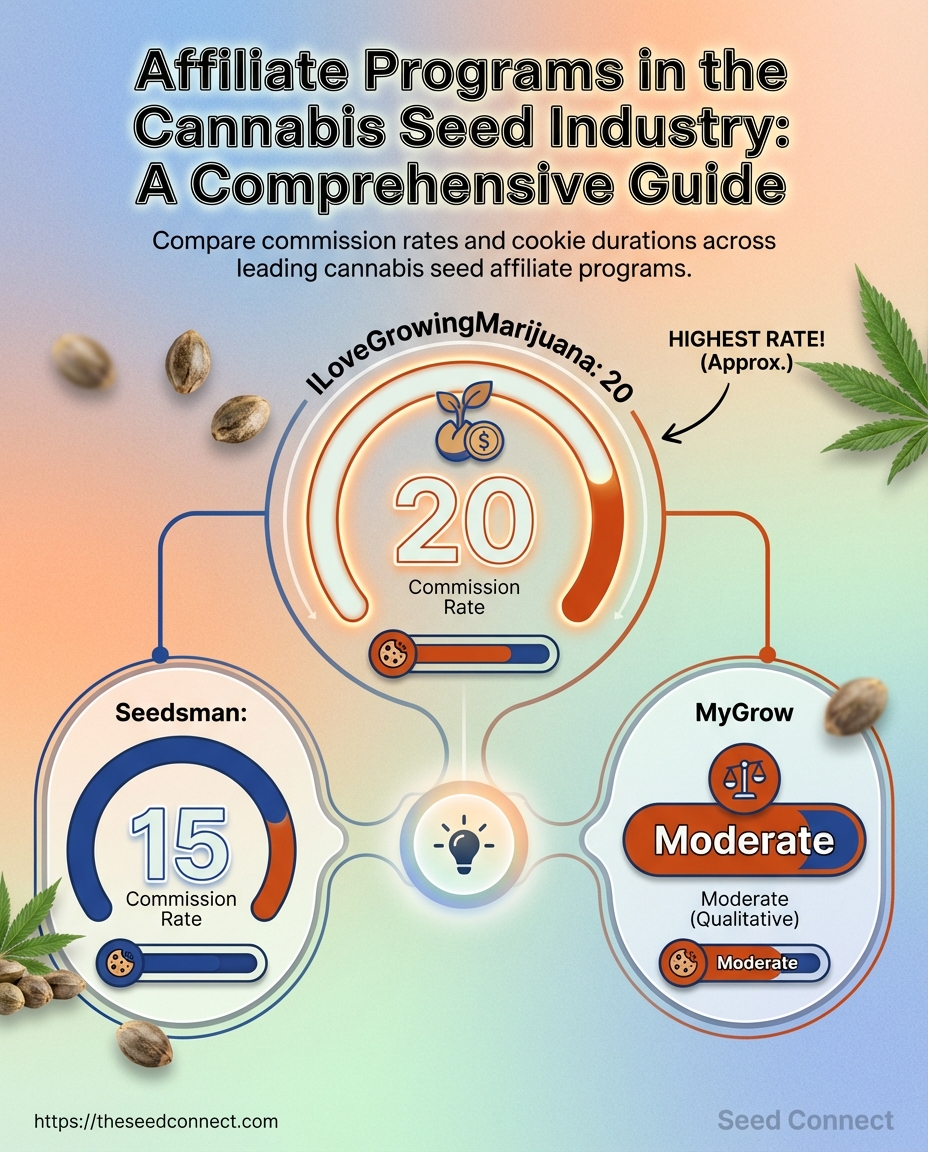
Understanding commission structures is vital for affiliate marketers. Various programs offer different rates and cookie durations: – Seedsman: Up to 30% commission with a 90-day cookie. – ILoveGrowingMarijuana: Generally 20% commission. – MyGrow: Approximately 15% commission.
This variance indicates the need to analyze which model works best for your audience and objectives, encouraging performance-oriented partnerships.
📥 Download Free Template
Get your free downloadable template.
Table of Contents
- What if affiliate marketing could solve common seed sourcing problems?
- Why affiliates are a good match for cannabis seed sellers
- Evaluating and choosing the right cannabis affiliate programs
- Compliance, shipping, and legal realities affiliates must navigate
- Promotion tactics that convert gardeners into buyers
- Tracking performance, commissions, and payment workflows
- Building long-term partnerships with seed suppliers
What if affiliate marketing could solve common seed sourcing problems?
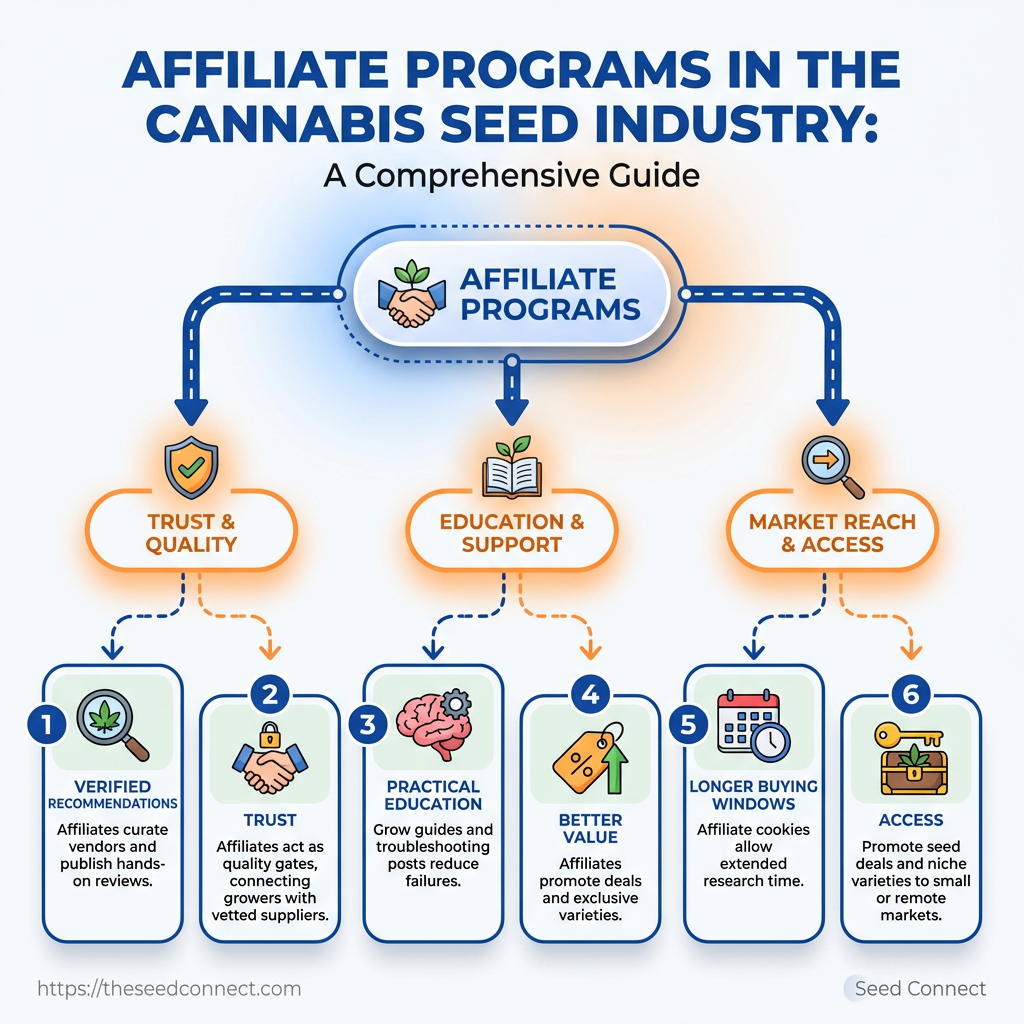
What if sourcing reliable cannabis seeds didn’t require hours of guessing and risky purchases? Imagine a network of trusted voices — experienced growers, clear how‑to content, and verified sellers — all pointing new growers toward good genetics and away from bad experiences. That shift is exactly what a smart affiliate approach delivers. Affiliate channels can act as quality gates in the seed supply chain by pairing education with vetted suppliers. Affiliates build trust through reviews, grow guides, and follow‑up support, which reduces buyer uncertainty and returns. Real programs already show how the model scales: Seedsman pays up to 30% commission with a 90 days cookie, ILoveGrowingMarijuana offers 20%, and MyGrow runs at 15% per sale.
35% — The affiliate marketing industry is expected to grow by 35% year-over-year through 2025, highlighting strong momentum for cannabis-related affiliates.
For gardeners around the world this matters for three clear reasons: trust, quality, and access. Trusted affiliates filter vendors and spotlight consistent genetics. Quality improves because sellers earn repeat business by standing behind germination and genetics. Access widens as affiliates promote seed deals and niche varieties to small or remote markets.
- Verified recommendations: Affiliates curate vendors and publish hands-on reviews that cut through vague product pages.
- Practical education: Grow guides and troubleshooting posts reduce failures and seed waste.
- Longer buying windows: Affiliate cookies (like
90 days) mean buyers can research before committing. - Better value: Seed deals promoted by affiliates often bundle discounts, points, or exclusive varieties.
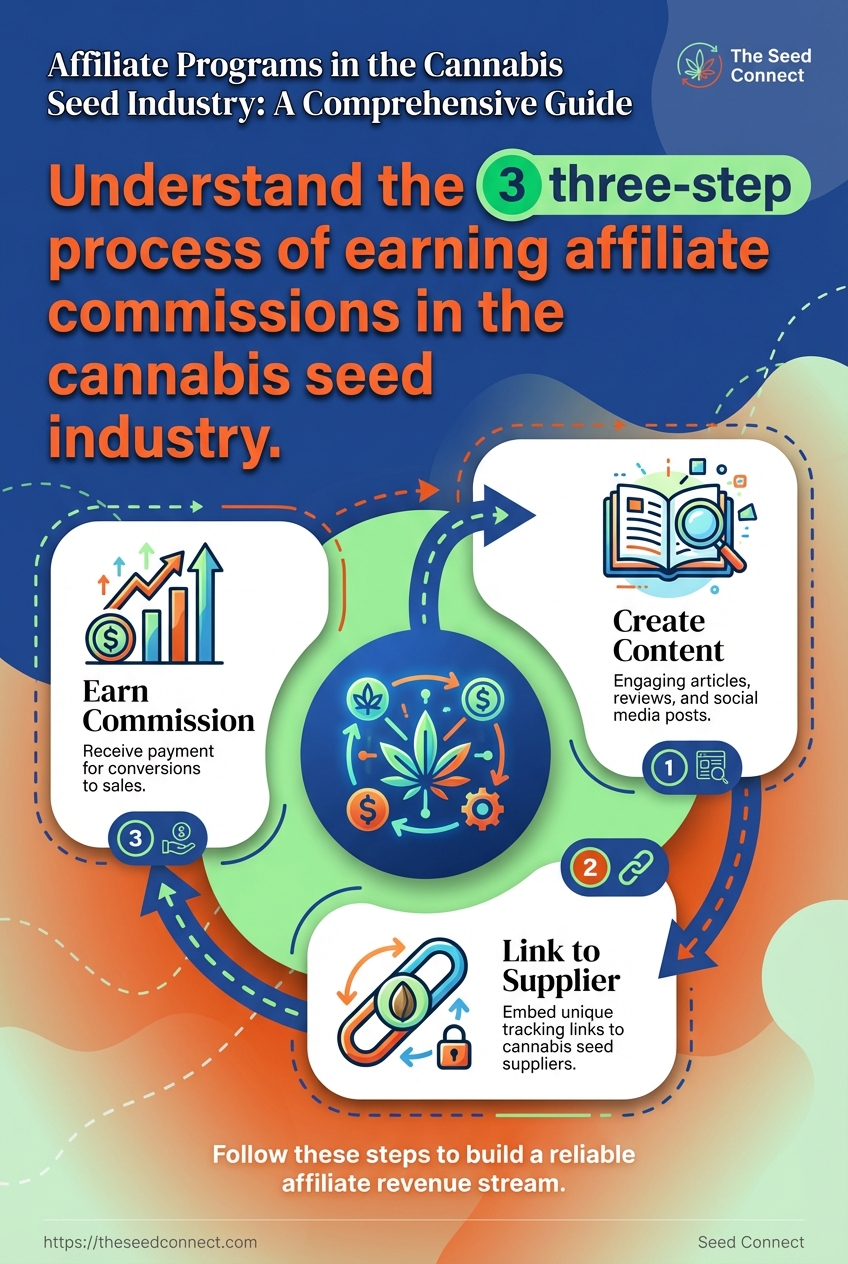
- An affiliate creates content (review, grow guide, video) that shows a real outcome.
- The content links to a vetted supplier with an affiliate tag; the supplier fulfills the order.
- The affiliate earns commission, incentivizing ongoing support and honest follow-up.
Cookie duration: How long a referral link tracks a buyer (e.g., 90 days). Commission rate: The percentage an affiliate receives per referred sale (examples above). The concept diagram maps three hubs: gardeners, educational content, and certified seed suppliers, with affiliates as the connecting nodes that build trust and encourage repeat purchases. It shows feedback loops where positive experiences amplify credibility and widen access to quality genetics. When affiliates focus on education and honest reviews, seed sourcing becomes less of a gamble and more of a predictable step in every grow. This model raises standards for suppliers and makes quality seeds easier to find worldwide.
Why affiliates are a good match for cannabis seed sellers
Affiliates fit seed sellers because they do more than refer clicks; they teach, test, and reassure buyers in a market full of uncertainty. Growers trust voices that show real results. Affiliates who publish grow guides, germination tests, and honest reviews bridge the gap between product pages and a buyer’s first successful harvest. That education angle matters because purchase decisions for seeds are research-driven. The affiliate channel is expanding fast — the affiliate marketing industry is expected to grow by 35% year-over-year through 2025 — which makes cannabis affiliate programs a timely way to reach motivated gardeners and hobby growers without heavy ad budgets. This short clip shows how a single review or how-to can boost buyer confidence. Watch to see a compact example of an affiliate turning a seed packet into a 30-second trust-building story.
Affiliates bring education, product validation, and community
Affiliates teach new growers how to succeed and document real-world results that validate products. They also build communities — forums, comment sections, and social feeds — where prospective buyers ask questions and get peer-backed answers.
- Practical education: Affiliates publish step-by-step grow guides that reduce buyer uncertainty.
- Product validation: Real germination tests and grow journals show outcomes, not promises.
- Social proof: Comments, photos, and follow-up posts create ongoing evidence of quality.
- Niche reach: Specialty affiliates connect hemp breeders, organic growers, or indoor novices to relevant seed deals.
- Sustained visibility: Evergreen content ranks in search, feeding steady traffic to cannabis marketing efforts.
These are the kinds of results that turn casual browsers into first-time buyers and repeat customers.
Germination guarantees make affiliate offers stronger
A clear germination guarantee gives affiliates concrete talking points and reduces purchase risk for readers. When an affiliate can point to an explicit guarantee, conversions rise because that reassurance lowers the mental barrier on a higher-stakes purchase like seeds. Sellers with solid guarantees become easier to promote. Platforms like https://theseedconnect.com that back their genetics make affiliate content more persuasive. Affiliates can mention guarantees alongside reviews, which shortens the path from content to checkout.
Common affiliate models — which fits seeds best?
CPA: A fixed payment per sale — good for short-term campaigns and product launches. Revenue share: Ongoing percentage of sales — ideal for seed sellers with repeat buyer potential and long-tail content. Hybrid: Combines CPA + revenue share — balances upfront incentive with long-term value. Revenue share usually fits seed sellers best because seeds lead to repeat purchases and long-term audience trust. Hybrid deals work well when launching new strains or limited seed runs; CPA can be useful for affiliates who deliver quick spikes during promotions. Affiliates turn technical product details into relatable stories, and pairing them with a reliable germination promise makes their promotions truly persuasive.
Evaluating and choosing the right cannabis affiliate programs
Picking the right affiliate program starts with a simple test: will this partner make your audience feel safer buying seeds? The best programs back product quality and testing, make shipping clear, and give affiliates the marketing tools needed to explain those strengths. If any of those areas are vague, the relationship will feel like a weak link to your readers. Affiliates should treat program selection like due diligence. Look beyond headline commission rates and scan for transparent testing, clear shipping footprints, and real support for affiliates. Those operational details determine whether your content converts and whether customers keep coming back. What follows is a practical checklist and a short vetting flow you can use when assessing cannabis affiliate programs. It covers must-have criteria, likely red flags, and the exact questions to ask suppliers so you don’t rely on assumptions.
- Product quality: Verify independent lab testing and consistent genetics.
- Transparent testing: Labs, COAs, and test dates must be public and readable.
- Shipping footprint: Confirm countries allowed and any export restrictions.
- Affiliate support: Dedicated manager, creatives, and a clear dashboard.
- Cookie & payouts:
cookie durationand payout frequency should match your marketing cycle. - Germination guarantee: Prefer partners that state guarantees in writing.
Program comparison table
Program name | Commission rate / structure | Germination guarantee | International shipping allowed (Y/N) | Marketing materials provided | Cookie duration | Payout frequency |
|---|---|---|---|---|---|---|
Seedsman | Up to 30% commission | Varies by breeder; check product pages | Y | Banners, links, promo assets |
| Monthly (typical) |
ILoveGrowingMarijuana | 20% commission | Varies; review terms per seed | Y | Blog-ready content, banners | Often | Monthly (typical) |
MyGrow | 15% commission | Depends on seller on marketplace | Y | Basic affiliate links & creatives | Typically | Monthly or threshold-based |
Typical marketplace program | 10–25% commission split | Often no single guarantee (varies) | Y | Limited; affiliates often create content |
| Monthly or biweekly |
This table emphasizes how commission alone doesn’t tell the story. Look for written guarantees and clear shipping notes before committing.
- Start by requesting the program’s terms and a sample
COAfor a popular strain. - Ask the affiliate manager about returns, replacements, and chargeback policies.
- Confirm whether creatives include region-specific messaging for shipping rules.
Watch for these red flags:
- Opaque testing claims: No COAs or vague lab names.
- Restrictive APIs or dashboards: If you can’t track clicks and conversions, expect disputes.
- Poor affiliate support: Slow responses, no dedicated rep, or dated creatives.
When vetting, ask direct questions like: “Can you share a recent COA for this strain?” and “Which countries do you block, and why?” Also ask for sample creatives and typical conversion data. If genetics are part of the pitch, consider linking to resources like learn about cannabis seed genetics to make technical claims easier for readers to verify. Choosing well means prioritizing trust over the highest commission. Programs that make testing, shipping, and support explicit deliver better long-term value for both publishers and buyers.
Compliance, shipping, and legal realities affiliates must navigate
Wanting to promote seeds is one thing; staying on the right side of customs, advertising rules, and local statutes is another. Affiliates operate across time zones and legal regimes, so a single link can trigger compliance headaches if geography and language aren’t handled carefully. Treat legal and shipping constraints as part of the product you sell. That means building copy, landing pages, and promotional tactics that change based on the visitor’s country and the seller’s terms. Small steps — clear disclosures, geo-gating, and conservative claims — remove far more risk than aggressive copy ever gains in conversions.
Top regional rules at a glance
Region | Can seeds be shipped across borders? | Promotion restrictions | Recommended affiliate practices |
|---|---|---|---|
North America (U.S., Canada) | Cross-border shipments are legally risky; domestic shipping is common but governed by federal/state laws in the U.S. and federal rules in Canada. | U.S.: avoid medical claims and youth-targeting; follow state ad rules. Canada: strict promotion limits under the Cannabis Act (no appeal to youth, no testimonials). | Use geo-targeting: show only region-appropriate offers. Age-gate pages: require age confirmation before product pages. |
European Union | Movement within the EU varies by country; seeds shipped from non-EU sellers may hit customs and national prohibitions. | Rules differ: some states tolerate seed sales, others restrict advertising or sales to residents only. | Country checks: detect visitor country and adapt messaging. Link to seller compliance: surface supplier shipping policy. |
Latin America | Patchwork landscape — domestic legality varies (e.g., Uruguay permissive), cross-border shipments typically risky. | Several countries limit promotional claims and public advertising; particulars differ widely. | Local guidance: include a clear note to verify local legality and avoid general claims. |
Asia-Pacific | Generally strict; many countries criminalize cannabis and prohibit import of seeds. Cross-border shipments frequently intercepted. | Advertising cannabis-related products often illegal or heavily restricted. | Default block: do not promote or redirect traffic from countries with strict bans. Refer queries to counsel. |
This table is a practical snapshot, not legal advice. Customs and national laws change rapidly; always verify with the seller and local authorities before promoting or facilitating shipments. How to word claims and disclosures safely
- Affiliate disclosure: “I may earn a commission on purchases made through links; please confirm local legality before buying.”
- No medical promises: “Some growers report X results” instead of “treats” or “cures.”
- Seller responsibility statement: “Shipping, returns, and legal compliance are handled by the vendor; confirm with them directly.”
- Age and geography notice: “Products shown only where legal — confirm your local laws.”
When to refer legal questions back to the supplier or counsel
- Customs seizure or cross-border shipment questions should go to the vendor and, if unresolved, to a legal professional.
- Any question about whether a specific ad copy violates a national law should go to counsel before publishing.
- Tax, licensing, or large-scale commercial distribution queries require formal legal advice and supplier coordination.
Being cautious doesn’t kill conversions; it protects your reputation and income. Keep copy conservative, route legal questions upstream, and make legality checks part of every campaign.
Promotion tactics that convert gardeners into buyers
Turning curious gardeners into paying customers depends less on shouting discounts and more on building confidence. Practical, tested content — honest reviews, step-by-step grow guides, and seed-focused case studies — does the heavy lifting. Those formats answer the exact questions a cautious buyer has: will these seeds sprout, and who will help if something goes wrong? Paid ads amplify intent; community outreach builds trust. Affiliates with clear proof points convert better when they combine informative organic content with targeted paid pushes and visible support promises like a germination guarantee and expert help.
The affiliate channel is growing fast — the industry is forecast to expand about 35% year-over-year through 2025, which makes smart promotion tactics especially valuable right now.
Content formats that actually sell
Great copy starts with specific proof and ends with a simple next step. Reviews that include germination logs, before/after photos, and harvest yields remove guesswork. Grow guides that walk a reader through weeks 1–12 with common failure modes turn interest into action.
- Review posts: Honest evaluations with
germination ratesand grow notes that answer “Will this work for my setup?” - Step-by-step grow guides: Week-by-week instructions that solve predictable problems for beginners and intermediates.
- Seed-focused case studies: Short stories showing variety → conditions → outcome, with measured metrics (height, yield, potency).
- Video walkthroughs: Short clips of germination, transplanting, and harvest increase trust more quickly than text alone.
- Comparison posts: Side-by-side testing of two strains under the same conditions helps buyers choose.
Paid vs organic: a practical budget split
Paid campaigns speed up discovery; organic content builds the permission to buy. A simple monthly split gives affiliates a repeatable framework to test and scale. The visual shows a sample monthly allocation across content, paid search, and community outreach. It highlights how steady content dollars support long-term SEO while paid spend captures ready-to-buy traffic.
- Content creation — 45%: longform guides, reviews, videos, and SEO work targeting queries like
cannabis affiliate programsandseed deals affiliate. - Paid search & social — 30%: retargeting and intent keywords aimed at buyers.
- Community & influencer outreach — 15%: forum posts, community giveaways, and trusted grower endorsements.
- Analytics & testing — 10%: tracking, A/B creative tests, and conversion optimization.
Messaging hooks: germination guarantees and expert support
Buyers worry about wasted time and money. Clear, specific claims reduce that anxiety more than generic promises. Mention the length and coverage of a guarantee, and show how expert support works in practice. Bold guarantee phrase: Germination guaranteed — we replace any non-viable seed. Process clarity: If a seed fails, email support with photos and receive replacement instructions within 48 hours. Social proof line: Real grow logs from customers with before/after timestamps. Support highlight: Access to step-by-step troubleshooting from experienced growers, no extra fee. SEO-friendly microcopy: Title idea — “Best cannabis affiliate programs for reliable seed deals” CTA that reduces friction: “Get seeds with a germination promise and expert help — review varieties” Seedsman, ILoveGrowingMarijuana, and MyGrow illustrate how commission structures vary (up to 30% for Seedsman with a 90 days cookie, 20% for ILoveGrowingMarijuana, 15% for MyGrow). Use that knowledge to prioritize partners whose commercial terms match the promotional investment required. Mix practical proof, helpful support language, and a measured paid/organic budget and gardeners will move from curious readers to confident buyers.
Tracking performance, commissions, and payment workflows
Ever wondered whether a seed-deals affiliate campaign is actually making money or just generating noise? Trackable metrics and a clear payment flow turn guesswork into predictable revenue. Start by deciding which signals matter for your niche — clicks alone lie; tracked sales, return rate, and lifetime value tell the real story. Good tracking ties affiliate IDs to orders and to refunds. That lets you compare commission structures — like Seedsman’s up-to-30% revenue share (with a 90-day cookie), ILoveGrowingMarijuana’s standard 20% rate, or MyGrow’s 15% offers — on an apples-to-apples basis. With those numbers you can build quick calculators to model expected earnings and spot which partnerships earn the best net return.
Essential metrics to monitor
Begin with a short list of metrics that answer profitability, not vanity. Track them consistently and report on the same cadence every month.
- Clicks: total incoming clicks attributed to each affiliate link.
- Conversion rate: percentage of clicks that become paid orders.
- Average order value (AOV): mean cart value for referred orders.
- Commission per sale: money paid to the affiliate for each qualifying order.
- Earnings per click (EPC):
EPC = (total commissions) / (total clicks). - Refund/chargeback rate: refunds reduce real payouts — track within the cookie window.
- Customer lifetime value (LTV): useful if affiliates earn recurring or tiered commissions.
Commission models and a sample earnings calculator
Different partners use different models. Revenue share is most common in seeds, flat-fee works for bundles, and tiered plans reward volume. Below is a simple calculator showing estimated earnings per 100 clicks for typical seed pack prices.
Commission models and a sample earnings calculator
Seed pack price | Commission model | Commission rate | Average conversion estimate | Estimated earnings per 100 clicks |
|---|---|---|---|---|
$20 | Revenue share (example: Seedsman-style) | 30% | 3.0% | $18.00 |
$60 | Revenue share (example: ILoveGrowingMarijuana-style) | 20% | 2.0% | $24.00 |
$150 | Revenue share (example: MyGrow-style) | 15% | 1.0% | $22.50 |
These estimates assume industry-average conversion differences by price point. Use the formula Estimated earnings = clicks × conversion rate × price × commission rate to test scenarios for different seed deals and traffic sources.
Payment cadence, minimums, and dispute handling
Set clear payout schedules and minimums in writing before promoting. Common approaches include monthly payouts with a minimum threshold ($50–$100) and a holding period to cover refunds and chargebacks.
- Reconcile sales at the end of each month, then apply any refund holds.
- Generate an itemized payout statement showing order IDs, dates, and deductions.
- Release payment on the agreed payout date and notify the affiliate.
For disputes, require the affiliate to provide their tracking link, order ID, and screenshots. Keep records for at least the cookie window plus one billing cycle. Faster resolution comes from shared dashboards that show the click→order chain. A disciplined tracking and payout process separates profitable cannabis marketing programs from costly experiments. Keep the rules simple, make data visible, and payments predictable.
Building long-term partnerships with seed suppliers
Some of the best affiliate relationships start with one reliable sale and grow into predictable revenue streams that both sides depend on. Suppliers want partners who reduce uncertainty — not just traffic, but clean traffic, clear reporting, and steady post-sale support that lowers returns and customer complaints. High-performing affiliates earn trust by delivering consistent volume, following approved marketing rules, and sharing outcome data. Suppliers reward that stability: for example, Seedsman offers up to 30% commission with a 90-day cookie, ILoveGrowingMarijuana pays 20%, and MyGrow lists 15% — those differences show how suppliers tier rewards for proven performance. Over time, affiliates who can prove conversions and low dispute rates move from one-off deals to exclusive programs. This section lays out what suppliers expect, a realistic roadmap for scaling an affiliate relationship, a practical launch-and-maintenance checklist, and a playbook for handling germination guarantees and returns without burning the partnership.
What suppliers want from high-performing affiliates
Suppliers want predictable, compliant promotion that protects their brand and their margins. They care about conversion quality more than raw clicks. Affiliates who can show clean audiences, repeat buyers, and low refund rates get the best opportunities.
- Reliable traffic: Send steady, relevant visitors rather than spikes of low-quality traffic.
- Conversion transparency: Share conversion rates, A/B test results, and customer intent signals.
- Brand-safe creatives: Use approved images and copy to avoid compliance problems.
- Customer-first support: Triage basic buyer questions before escalating to the supplier.
- Low dispute rates: Fewer chargebacks means higher trust and better commission terms.
Scaling from occasional deals to exclusive programs: steps and timelines
Moving from ad-hoc campaigns to an exclusive arrangement is a process with measurable milestones. Start modest, prove value, then negotiate better terms.
- Pilot phase (1–3 months): Run a limited campaign, track
cookieconversions, and stabilize CPL. - Performance validation (3–6 months): Hit agreed KPIs for volume, CR, and dispute thresholds.
- Optimization phase (6–9 months): Share tests and improvements; reduce returns and support tickets.
- Negotiation (9–12 months): Ask for higher commission tiers, longer
cookiewindows, or exclusive offers. - Exclusive program (12+ months): Consider co-branded promos, dedicated landing pages, or first access to drops.
Affiliate-supplier checklist for launch and ongoing collaboration
A clear, shared checklist prevents misunderstandings and speeds scaling.
Affiliate-supplier checklist for launch and ongoing collaboration
Item | Owner (Affiliate / Supplier) | Why it matters | Frequency / Timeline |
|---|---|---|---|
Confirm product testing and documentation | Supplier | Ensures claims about germination and genetics are accurate | Before launch; update with new batches |
Agree on commission structure and reporting | Both | Sets expectations for payout and performance metrics | At onboarding; review quarterly |
Create approved marketing creatives | Supplier | Protects brand and compliance across channels | Deliver at launch; refresh seasonally |
Set up tracking and test conversions | Affiliate | Verifies that referrals are attributed correctly | Before launch; monitor weekly |
Schedule monthly performance reviews | Both | Keeps strategy aligned and uncovers issues early | Monthly |
Agree on fulfillment & shipping rules | Supplier | Clarifies delivery times and liabilities | At onboarding; update with changes |
Define returns and germination guarantee workflow | Both | Reduces dispute friction and improves customer experience | At onboarding; review after issues |
Establish fraud and chargeback monitoring | Supplier | Protects margins and reputation | Ongoing; alert on anomalies |
Share customer insights and anonymized conversion data | Affiliate | Helps supplier optimize products and offers | Monthly or quarterly |
Plan seasonal and exclusive promotions | Both | Drives spikes while protecting margins | Plan 1–3 months ahead |
This checklist is the operational backbone for a partnership. Use it to keep accountability clear and timelines realistic.
Maintaining trust: handling germination issues, returns, and customer support
Germination problems are the single biggest threat to long-term trust. Treat every claim seriously and aim to solve issues without public friction. Suppliers with explicit guarantees and clear return workflows — and affiliates who know them — create fewer angry customers. Germination guarantee: Outline process and evidence required for a claim. Return window and proof: Specify timeframes, acceptable proof (photos, timestamps), and replacement vs refund rules.
- Fast escalation: Send suspected germination failures to the supplier within 48 hours.
- Customer guidance: Provide troubleshooting steps before initiating returns.
- Record keeping: Keep anonymized customer data for trend analysis and fraud checks.
The affiliate channel benefits when both parties minimize disputes and share remediation data.
When affiliates and suppliers agree on clear rules, reviews, and rapid problem resolution, partnerships scale naturally. Small, steady improvements in support and reporting pay off far more than chasing one-off spikes.
Conclusion
Turn clicks into steady seed revenue
The single most important idea to keep is this: paid clicks don’t build trust — consistent, compliant programs and clear tracking do. That explains why an expired cookie or a tiny payout after a celebratory referral is so frustrating; choosing programs that respect affiliates, provide transparent reporting, and honor fair cookie windows is what creates predictable income over time.
Think back to the promotion tactics that convert gardeners into buyers — honest product claims, germination guarantees, and targeted content for novice growers. Those tactics work only if your partner program supports accurate tracking, fair commissions, and shipping-compliant offers; smart cannabis marketing combines the right creative with the right operational setup. Seed deals that promise volume without the backend to support it usually leave both sides disappointed.
Take fifteen minutes today to review your top three partnerships: check cookie length, commission terms, and whether tracking pixels or UTM links are firing correctly. A small audit now can flip flaky referrals into reliable commissions — and if you need reputable inventory to promote, platforms like TheSeedConnect are one option to explore. Ready to run that audit and turn your next click into a paid sale?