



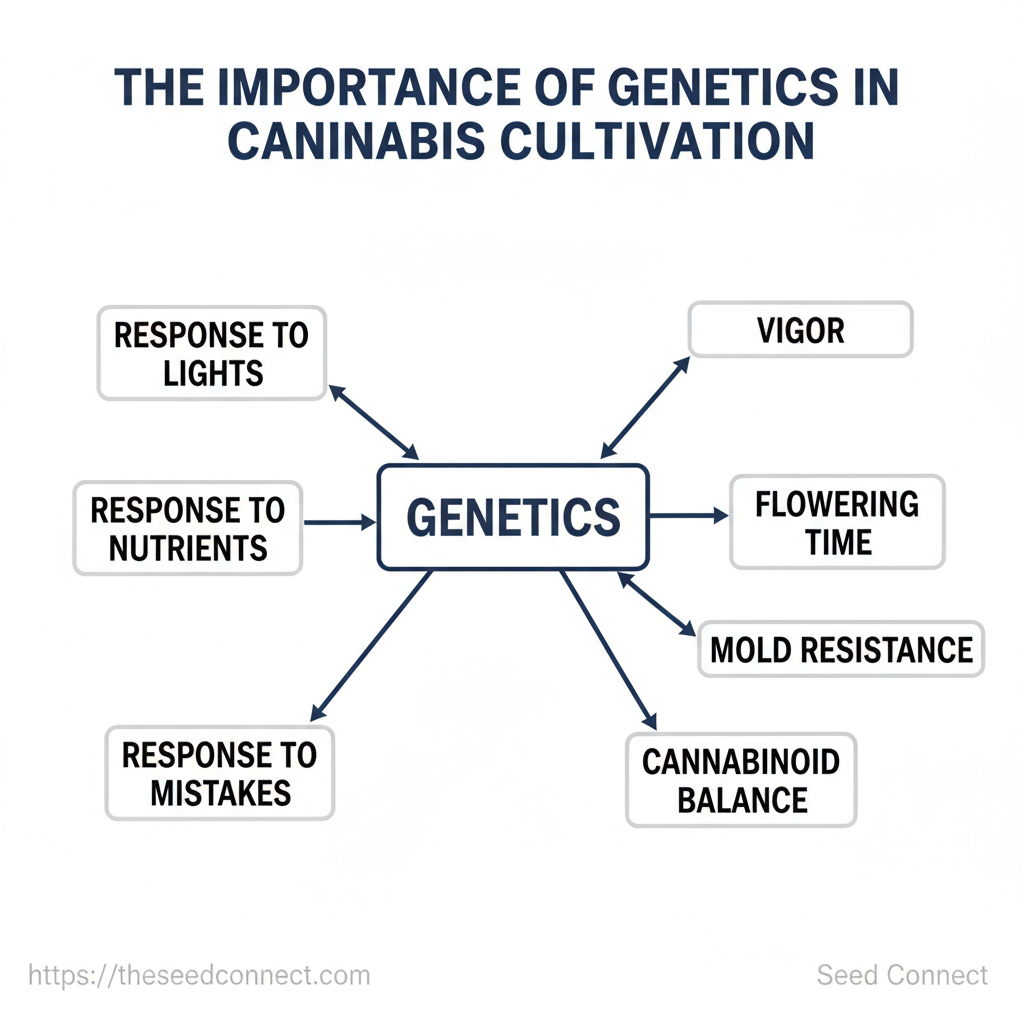
| Item | Category | Purpose | Priority |
|---|---|---|---|
| Magnifier | Observation tool | Inspect trichomes, pistils, leaf serration | Essential |
| pH meter | Measurement tool | Maintain nutrient availability, prevent lockout | Essential |
| Germination setup | Starter gear | Consistent sprouting: paper towel, humidity dome | Essential |
| Seed storage container | Storage | Maintain viability (low humidity, cool) | Essential |
| Grow journal | Documentation | Track phenotype, environment, photos | Essential |
| Document Type | Key Genetic Insights | How to Verify | Limitations |
|---|---|---|---|
| Strain Description | Growth habit, reported effects, parents | Cross-check breeder lineage pages, breeder FAQ | Marketing language; variable accuracy |
| Certificate of Analysis (COA) | THC/CBD values, terpene profile, contaminants |
Verify lab name, PDF metadata, accreditation | Single-sample snapshots; may not reflect population variance |
| Phenohunt / Grower Reports | Phenotype frequency, common issues, true flowering times | Aggregate multiple forum reports, photos, timestamps | Anecdotal bias; inconsistent testing conditions |
| Lineage / Parentage Records | Genetic ancestry, expected traits inherited | Breeder pedigree charts, seed bank catalogs | Incomplete records; naming inconsistencies |
| Breeder Stability Statement | Notes on feminization, hermaphroditism rates, selection methods | Request lot-specific data, ask breeder for historical failure rates |
| Grow Goal | Genetic Markers / Lineage Clues | Selection Tips | Common Trade-offs |
|---|---|---|---|
| High Yield | Broad-leaf indica lineage, large calyx genes | Favor vigorous veg hybrids; train canopy | Longer veg time, more space |
| High THC / Potency | Trichome-dense parents, indica-dominant hybrids | Verify breeder COAs; prioritize resinous phenotypes | Can sacrifice flavor diversity |
| Distinct Terpene Profile | Parent terpene reports (limonene, myrcene, etc.) | Use sensory notes + lab terpene profile | Lower uniformity across phenos |
| High CBD / Medicinal | CBD-rich chemovars, hemp-derived lines | Choose stabilized CBD:THC ratio lines; COA-verify | Typically lower THC, different market |
| Fast Flowering | Ruderalis crosses, early-finishing landraces | Use autoflowers or short-photoperiod strains | Often smaller yields |
| Resilience / Outdoor | Landrace hardiness traits | Select for mold and pest resistance | May have lower cannabinoid peaks |
| Uniformity / Commercial Runs | Stabilized, heavily backcrossed lines | Prioritize clones or feminized seeds | Less genetic diversity |
| Aromatic / Niche Markets | Rare terpene chemotypes | Small-batch, phenotype hunts | Higher seed/selection costs |
| CBD-dominant with Low THC | Hemp-certified lineages | Use compliant seeds; verify regulations | Market restrictions in some regions |
| Balanced Hybrid (1:1) | Dual-pathway cannabinoid lines | Good for medicinal specificity | Requires precise testing |
| Generation | Action | Duration | Expected Outcome |
|---|---|---|---|
| P (Parent selection) | Evaluate, clone, phenotype scoring | 1–3 months | Identified complementary parents |
| F1 (First cross) | Cross parents, grow F1s, evaluate vigor | 4–6 months | Uniform hybrids, dominant traits visible |
| F2 (Segregation) | Self or intercross F1, screen large population | 6–9 months | Segregation; top phenotypes emerge |
| Backcross (BC1) | Cross selected F2 back to elite parent | 4–6 months | Trait reinforced; reduced unwanted alleles |
| Stabilized Line (F4+) | Repeated selection (F3, F4+), seed increase | 12–24+ months | High phenotypic uniformity; production-ready seeds |
Troubleshooting Common Genetics-Related Issues
Genetic problems often masquerade as environmental stress, so begin by confirming whether the issue follows the plant regardless of changing conditions. A repeatable symptom across multiple grows, stable appearance in clones, or expression under ideal care usually indicates a genetics problem rather than a one-off environmental lapse.
Prerequisites and tools
- Grow history: records of phenotype, feeding, light schedule, and environment
- Clones or siblings: at least 3 plants from the same seed lot for comparison
- Magnifier and camera: inspect pistils, pollen sacs, and leaf morphology
- Basic test kit: pH meter and EC meter to rule out nutrient delivery issues
How to tell poor vigor is genetic vs environmental
- Pattern consistency: poor vigor in all siblings → genetic; scattered individuals → environmental
- Cloning test: clones that reproduce the weak phenotype confirm genetic origin
- Recovery trial: move a weak plant to optimal conditions; full recovery suggests environmental causes
Attributing trait variability to genetics
- Stable traits across generations: reproducible leaf shape, terpene profile, or flowering time imply heritable traits
- Variable traits under same environment: may be heterozygous genetics or seed lot heterogeneity
- Documented phenotype ratios: tracking percentages of traits across 20–30 plants reveals dominant/recessive patterns
Practical tips and warnings
- Use feminized seeds or stable autoflowers when consistent performance is critical; these options reduce hermaphrodite and sex-related variability.
- Avoid attributing every issue to genetics; misdiagnosis wastes time and genetic progress.
- Keep rigorous records — phenotype, environment, and interventions — to separate genetic signals from noise.
| Metric | How to Measure | Acceptable Range | Scoring (1-5) |
|---|---|---|---|
| Dry Yield (g/plant) | Individual dry weight after cure | 50–600 g/plant | 1: <50; 2:50–150; 3:150–300; 4:300–450; 5:>450 |
| THC (%) | COA cannabinoid assay | 10–30% (strain dependent) | 1:<10; 2:10–15; 3:15–20; 4:20–25; 5:>25 |
| CBD (%) | COA cannabinoid assay | 0–15% (chemotype dependent) | 1:>1 but off-target; 2:0–0.5; 3:0.5–2; 4:2–6; 5:>6 (for CBD lines) |
| Dominant Terpene (%) | COA terpene profile | 0.5–3% total terpene; dominant 10–40% of profile | 1: <0.5; 2:0.5–1; 3:1–1.5; 4:1.5–2.5; 5:>2.5 |
| Phenotype Uniformity (%) | % of sample matching target phenotype | 80–100% uniform | 1:<50%; 2:50–69%; 3:70–79%; 4:80–89%; 5:≥90% |
Conclusion
You now have the practical framework needed to turn seed selection into predictable results: assess breeder transparency, match genetics to microclimate and goals, and use simple stabilization techniques to lock in desirable traits. Concrete examples from the guide—an independent breeder who stabilized a reliable high‑CBD line through three generations, and a commercial grower who prioritized compact phenotypes for a vertical canopy—show how those steps translate into measurable yield and consistency. Expect to spend extra time on phenotype runs early; that up‑front work reduces surprises during full produces and sharpens strain selection decisions. Run a small trial, record traits, and only scale what consistently performs.
Next steps: choose 6–12 seeds representing the profiles you need, perform a short phenotype selection cycle, and document light, nutrient, and humidity settings so genetics can be judged fairly. If questions linger about vendor reliability or matching genetics to a specific room, the pattern shows that growers who consult breeder notes and peer grow reports resolve those quickly. For curated options and germination guarantees, review the TheSeedConnect seed selection guide for strains and support tailored to your goals.