


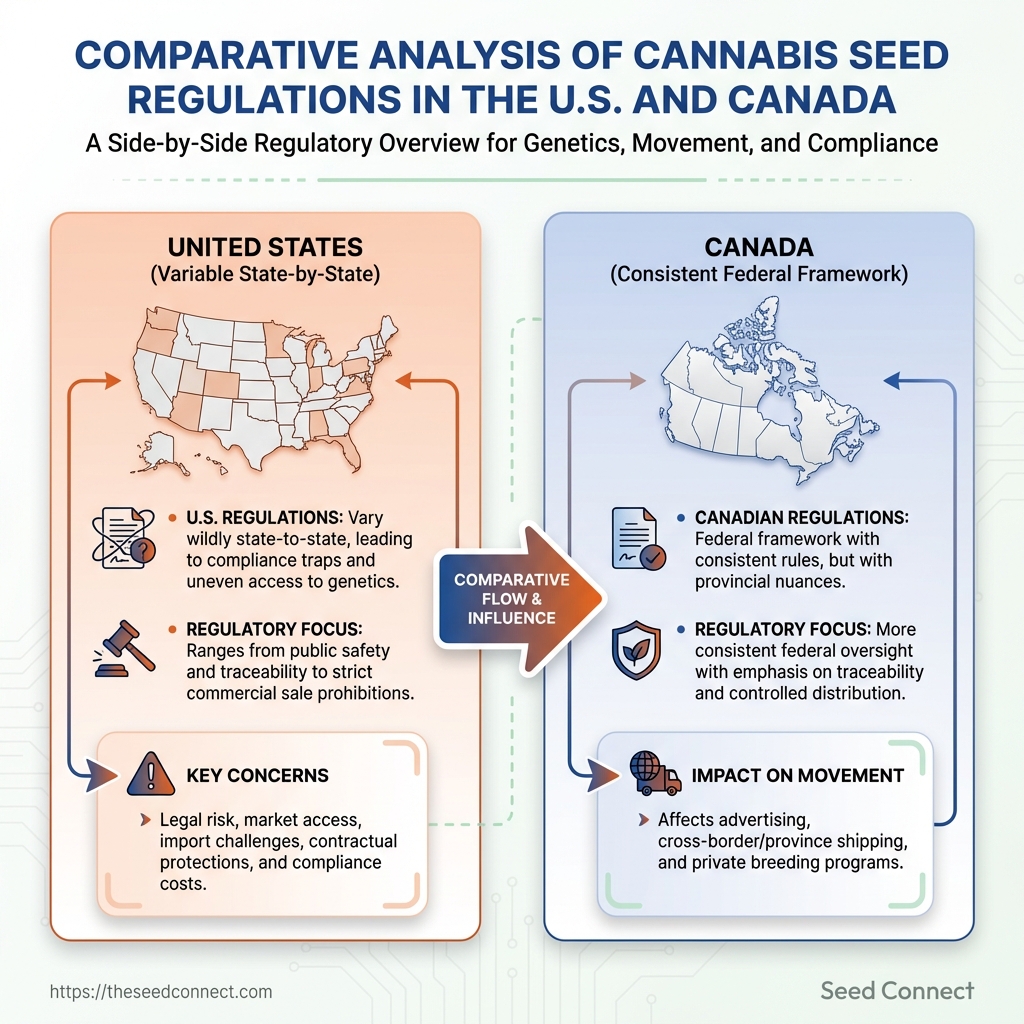
Border crossings and online seed catalogs often feel like legal obstacle courses for small breeders and home growers. The rules governing cannabis regulations in the U.S. vary wildly between states, creating real compliance traps. That unevenness can mean unknowingly breaking local law or losing access to genetics when crossing borders.
Across the border, Canada seed laws sit under a federal framework that treats seeds, distribution, and breeder licensing differently than many U.S. jurisdictions. Those contrasts affect whether seeds can be advertised, shipped across provinces or states, or kept in private breeding programs. Regulatory focus ranges from public safety and traceability to strict prohibitions on commercial seed sales.
A clear side-by-side view removes noise and helps growers, sellers, and researchers judge legal risk and market access. It also surfaces practical questions about importing genetics, contractual protections, and the costs of staying compliant. This international cannabis comparison highlights where movement of genetics is practical, risky, or outright prohibited.
The moment you click “buy” and then realize the rules change across the border
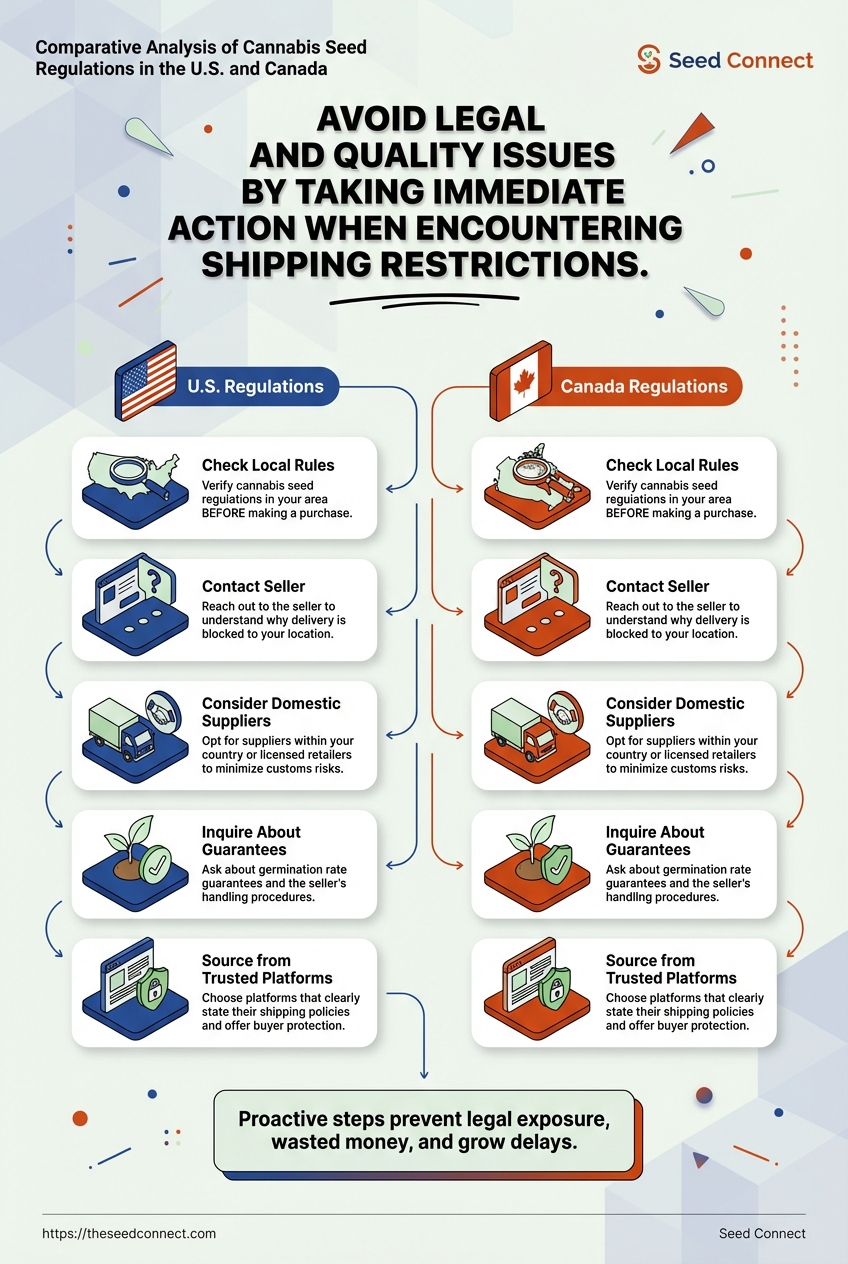
Short and sharp: clicking “buy” on a seed packet can be the start of a smooth grow or the start of a shipping, legal, and quality headache. Many growers assume online equals simple delivery, but cannabis rules differ wildly from one jurisdiction to the next. That pop-up warning—“we can’t ship to your state/province/country”—is not just an annoyance. It’s a real signal that your plan needs immediate adjustment to protect the crop, your time, and possibly your freedom.
What this looks like in practice: you pick a high-THC variety, add to cart, and a checkout warning says the seller won’t ship seeds to your address. Maybe the reason is a state-level restriction, a customs ban, or carrier policies. Ignore it and a package could be seized, refunded late, or rerouted and delivered in poor condition. Pay attention and you’ll avoid legal exposure, wasted money on seeds with low germination rate, and weeks of delay that push your grow out of season.
A familiar checkout warning
The warning often reads blandly, but its consequences are concrete. Examples: Shipping blocked: carrier restrictions or export controls prevent transit. Customs hold: seeds stopped at the border and returned or destroyed. * Delivery delay: rerouting adds weeks and harms time-sensitive starts like photoperiod seedlings.
Why it matters for your grow
Legal risk: Sending seeds across borders can violate local laws — that could mean fines or seizure. Seed quality: Longer transit or rerouting increases the chance of damage, low germination rate, and expired viability. Delays: Missed planting windows force changes to light cycles or push a harvest into worse weather.
Shipping restriction: Short explanation of why a seller blocks a destination — carrier policy, local law, or customs enforcement.
Germination rate: the percentage of seeds expected to sprout under proper conditions; declines with poor handling or time.
What to do next (quick steps)
- Check local rules for seeds in your area before purchase.
- Contact the seller to ask why delivery is blocked.
- Consider domestic suppliers or licensed retailers to reduce customs risk.
- Ask about
germination rateguarantees and handling procedures. - If uncertain, source from trusted platforms like cannabis seeds for sale that clearly state shipping policies.
Red flags to watch: Slow or vague shipping policy: no clear country list. No germination guarantee: no promise of viability. * Unclear return/refund process: poor buyer protection.
This moment of hesitation matters — it separates hopeful impulse buys from reliable, legal, and timely grows. Make the pause count.
Quick primer: key legal concepts you’ll see in this article
Many readers trip up because the same word — “legal” — means very different things depending on who’s speaking. Start by thinking in three buckets: who has authority, what activity you’re doing, and what paperwork or labels come with the seeds. Read the short roadmap below and the rest of the section will feel like common sense rather than legalese.
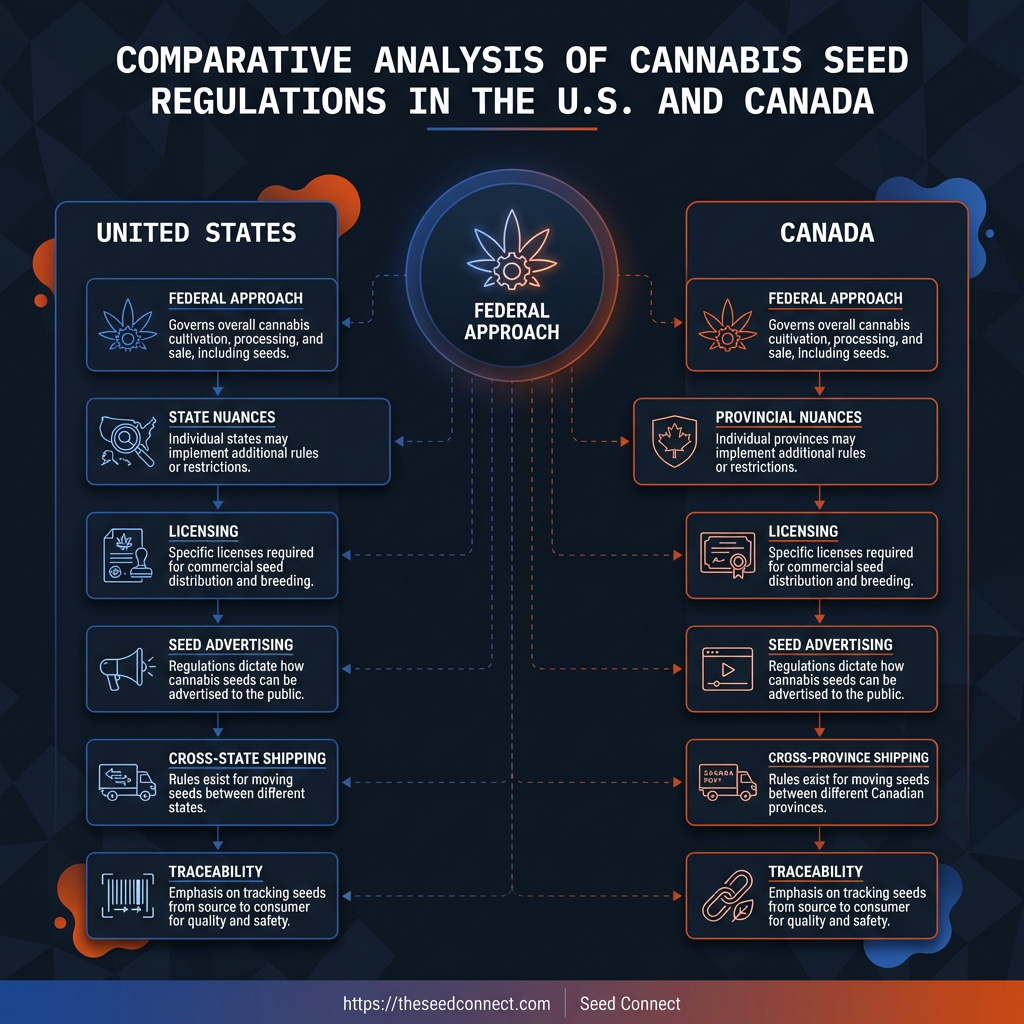
Federal vs state/provincial authority: In federal systems, a national law can set a floor (or a ceiling) for enforcement, but provinces or states often regulate day-to-day details. That means an act that’s tolerated federally might still get you into trouble locally, and vice versa. A practical approach is to treat federal rules as the baseline and local rules as the operational reality you’ll live with.
Possession vs commerce vs cultivation: Laws typically split activities into distinct categories — possessing seeds, selling or transporting them, and growing the plants. Each activity can trigger different rules, penalties, and paperwork.
Seed certification and labeling: Certified seeds and clear labels aren’t just marketing — they’re often how regulators decide whether a product qualifies as legal hemp versus illegal cannabis. Look for declared THC thresholds, origin statements, and germination guarantees.
Federal vs state/provincial authority
Federal preemption: National law that can override conflicting local laws.
Practical example: A federal hemp definition uses a THC threshold (commonly 0.3% delta-9 in many jurisdictions), but states may add licensing or tracking requirements that go beyond it.
- What to watch for:
- Who enforces: local police vs federal agencies.
- Licensing traps: states may require permits even when federal rules don’t.
- Cross-border limits: moving seeds between provinces/states can trigger different rules.
Possession, sale, transportation vs production and cultivation
Possession: Having seeds or plants on your person or property.
Sale/transportation: Commercial movement or transfer of seeds — often regulated separately from simple possession.
Cultivation: Active planting and growing — usually the most heavily regulated activity.
- Check whether possession is allowed at your destination.
- Confirm whether transport crosses legal jurisdictions that require permits.
- Verify whether cultivation needs a separate license or registration.
- Example: carrying a packet of seeds may be legal where you live, but transporting them across a border into a stricter jurisdiction can be a violation.
Seed certification, labeling, and germination guarantees
Seed certification: Third-party verification of genetics, THC level, and purity.
Labeling: Written declarations on origin, strain, THC %, and warnings.
Germination guarantee: Seller commitment that seeds will sprout under normal conditions — often tied to consumer protection rules.
- What to look for on a packet:
- Clear THC statement: declared delta-9 percentage or “hemp” designation.
- Origin info: country or state/province of production.
- Guarantee terms: what’s covered and how to claim it.
For real-world examples of labeled inventory you can inspect for these fields, see cannabis seeds for sale.
Treat these concepts as your checklist: who makes the rule, what action triggers the rule, and what paperwork proves compliance. Those three questions will guide every legal decision about buying, moving, or planting seeds.
Cannabis seed regulations in the United States — federal and state snapshot
Short answer up front: federally, cannabis remains Schedule I under the Controlled Substances Act, but the 2018 Farm Bill removed hemp from that classification when it contains THC ≤0.3% by dry weight. That split creates two very different legal tracks for seeds: seeds of hemp varieties generally fall under the hemp rules and can move in commerce if they meet the THC threshold and applicable paperwork, while seeds intended to produce higher‑THC cannabis (marijuana) sit in the more restricted federal category. States then layer their own laws on top—some follow federal hemp rules closely, others impose stricter controls, and a few still ban most forms of seed commerce or home cultivation. Sellers and buyers must therefore treat seeds not as a single commodity but as three things at once: a genetic product, a potential controlled substance, and a regulated agricultural input. Platforms like cannabis seeds for sale list varieties and usually flag hemp-eligible genetics, which helps clarify which legal track a seed might follow.
Federal classification and practical implications
Hemp: Cannabis with THC ≤0.3% by dry weight; treated as agricultural hemp under federal law.
Marijuana: Cannabis with THC above that threshold; remains controlled under Schedule I.
Seed possession: Whether a seed is lawful federally depends on its variety and intended use; seeds that will reliably produce high-THC plants risk being treated as contraband.
What this produces in practice: Interstate movement of hemp seeds is generally permitted if the seed meets hemp criteria and required documentation accompanies shipment. Mailing seeds that will likely produce marijuana carries legal risk because federal law still outlaws marijuana production and distribution. * Enforcement priorities vary; criminal risk increases when intent to cultivate high-THC plants is evident.
How state rules diverge — commercial sales vs home possession
States fall into broad groups: adult-use regulators, medical-only regimes, hemp-focused frameworks, and restrictive/ prohibition jurisdictions. Within those groups, differences commonly include licensing for commercial seed sellers, explicit allowances or bans on home seed possession, and whether imported seeds require state testing or certification.
- Check whether your state licenses seed vendors or requires a cannabis-specific nursery permit.
- Confirm any
home growlimits—some states allow seeds only for registered patients or adult-use households. - Verify labeling/testing requirements for any seeds sold commercially.
Common restrictions that affect sellers and buyers
- Age verification: Must confirm buyer meets the minimum age for purchase in many jurisdictions.
- Licensing requirement: Sellers often need a nursery or cannabis business license to list seeds commercially.
- THC threshold testing: Hemp seeds may require provenance or test results demonstrating
THC ≤0.3%.
- Shipping limits: State law can ban inbound shipments of seeds intended for high-THC cultivation.
- Labeling and traceability: Product labels and batch records are commonly required for commercial sales.
- Local ordinances: Cities or counties may add stricter limits on possession or home cultivation.
Treat seeds as both agricultural inputs and potential controlled items: read your state regulations, keep provenance and test records, and verify the buyer’s location before shipping. These steps cut legal exposure and keep transactions clean.
Cannabis seed regulations in Canada — federal approach and provincial nuances
Short answer up front: cannabis seeds sit under the federal Cannabis Act framework, so possession and sale are legal for adults, but the practical rules you actually live by are set at the provincial level. That means whether you can buy, ship, or grow seeds — and how many plants you may legally raise at home — often depends on provincial statutes and distribution systems. The federal rules create a baseline (age limits, criminal prohibitions for illicit trade, licensed commercial frameworks), while provinces add layers that affect retail supply, shipping, and home cultivation. Because those provincial layers differ sharply, anyone buying seeds should check provincial legislation, confirm the seller’s compliance, and note shipping restrictions before placing an order.
Federal framework and how seeds are treated
At the federal level, seeds are part of the regulated cannabis supply chain. The Cannabis Act establishes legal age thresholds and criminalizes unlicensed commercial activity, but it doesn’t micromanage every detail of retail access to seeds. Licensed producers and sellers must follow federal quality, packaging and advertising rules when they operate within the regulated system. What’s important is that federal law provides the legal foundation; provinces control retail models and restrictions.
Provincial differences that affect purchase and shipping
- Retail model: some provinces use Crown retailers, others allow private stores.
- Home cultivation: most provinces accept the federal
4-plant limit, while Quebec and Manitoba have restrictions that effectively ban home growing. - Shipping rules: provincial distribution frameworks may prohibit out-of-province direct sales; shipping a seed order across provincial lines can hit those constraints.
- Check the recipient province’s law first.
- Confirm the seller operates under the correct provincial retail/licensing regime.
- Verify courier and postal acceptance rules for seeds to your address.
Labeling, testing and certification standards
Labeling: federally required packaging rules apply to seeds sold as cannabis products — plain-language warning labels and THC/CBD info apply when seeds are connected to commercial flower products.
Testing: licensed producers must meet contaminant and potency testing regimes for plant material; while seeds themselves aren’t always tested the same way, reputable sellers follow germination and phytosanitary checks.
Certification: seed certification refers to traceability and quality assurance; for commercial growers, provenance and testing records matter for regulatory compliance.
For variety sourcing, tools like cannabis seeds for sale list genetics and often note compliance practices. Check provincial rules before ordering, and keep documentation with shipments — that usually prevents the most common headaches.
Cross-border shipping: what gardeners must know
Short answer up front: shipping cannabis seeds across a border turns a simple purchase into an interaction with customs, carrier rules, and plant-health regulations. Declare seeds honestly, expect inspections, and plan for refusals or seizure even where laws seem permissive. With the right paperwork and carrier, some seed shipments move legally; without that paperwork or with conflicting national rules, shipments are effectively blocked.
and tools Check laws: Confirm both origin and destination allow the specific seed type. Documentation: Gather any required phytosanitary certificate, import permit, or commercial invoice. Carrier policy: Verify the chosen carrier’s written rules for plant materials. Time estimate: Allow extra time—clearance can add days to weeks.
Customs rules: declaring seeds, inspections, and penalties
Declare: Always list seeds on customs forms with clear descriptions and scientific names where possible.
Inspection: Customs and agricultural agencies prioritize plant material to prevent pests and disease; physical inspection is common and samples may be taken.
Penalties: Outcomes range from simple seizure and return to fines or criminal charges in strict jurisdictions; repeat or commercial violations raise the stakes.
Practical, actionable moves 1. Confirm both countries’ plant-import rules on official government sites before ordering. 2. Ask the seller for phytosanitary paperwork or proof of origin if required. 3. Choose a carrier that accepts plant material and offers tracking and customs brokerage. 4. Prepare honest, itemized paperwork; vague descriptions invite inspection. 5. Be prepared to accept seizure or refusal as a real possibility.
Practical shipping barriers: carriers, documentation, and refusals Major carriers: Many have explicit bans or restrictive terms for seeds crossing borders. Customs brokerage: Some shipments need a broker; without one, customs will hold or return the parcel. Undeclared parcels: Attempting to hide seeds increases risk of legal trouble and confiscation. Return costs: If refused, sender often pays return shipping or disposal fees.
When international shipping is legal and when it’s effectively blocked Legal: Both countries permit the seed type, paperwork is complete, and a willing carrier handles clearance. Effectively blocked: One jurisdiction classifies seeds as controlled, carriers refuse, or phytosanitary rules create prohibitive delays/costs.
For domestic sourcing that avoids cross-border pitfalls, platforms like cannabis seeds for sale can reduce risk by keeping shipment within the same legal system. Treat cross-border seed orders as a legal project, not a quick click-and-ship purchase—prepare paperwork and expect friction.
How to source high-quality seeds legally — a step-by-step checklist
Short answer up front: follow a tight, five-step routine before buying. Confirm where the seller operates, insist on verifiable seed standards and a germination guarantee, check the laws applying to both your address and the seller’s base, pick a compliant shipping method and paperwork, and get expert help if anything feels unclear. Doing these five things cuts legal risk and raises the odds you’ll receive viable genetics that match the description.
- Valid ID and proof of address: ready to verify age and residency.
- A secure payment method: card or escrow-friendly service.
- Research time: 20–45 minutes per seller.
Tools you’ll need Documentation checklist: copy of seller license, lab reports, germination policy. Communication log: screenshots or saved emails. * Tracking-ready shipping option: signature and tracking.
1. Verify seller location and licensing. – Confirm the seller’s business address and legal licensing where applicable; ask for license numbers or business registration and match them to public registries where possible. – Expected outcome: you can show the seller is operating legally in their jurisdiction. Time: 10–20 minutes.
2. Confirm seed certification and germination guarantee. – Ask for lab test summaries, cultivar pedigrees, and written guarantee terms; test reports should list testing lab and date. Look for explicit refund or replacement terms if germination falls short. – Expected outcome: clear recourse if seeds don’t sprout or are misrepresented. Time: 15–30 minutes. – Example: a seller who posts a dated test report and a one-year germination guarantee is easier to hold accountable than one who only claims “high germ rate.” – For reference on varieties, check resources like cannabis seeds for sale to compare descriptions and guarantee language.
3. Check laws where you live and where the seller is based. – Verify criminal and civil rules that apply to possession, import, and mailing of seeds in both jurisdictions; don’t rely on generic statements — look for specific statutes or government FAQ pages. – Expected outcome: a clear legal risk assessment for that transaction. Time: 10–30 minutes.
4. Choose compliant shipping and prepare documentation. – Opt for tracked, signature-required shipping and retain all receipts, tracking IDs, and seller correspondence; prepare copies of licenses and purchase invoices to present to carriers or authorities if needed. – Expected outcome: shipment can be traced and verified, reducing disputes. Time: 5–10 minutes to set up per order.
5. If in doubt, consult expert support before purchasing. – Use grower communities, legal clinics, or seller support channels to confirm ambiguous points; save any written confirmations. – Expected outcome: reduced chance of costly mistakes or illegal shipments. Time: 30–60 minutes depending on complexity.
s Germination guarantee: A seller’s promise to replace or refund seeds if they fail to sprout under normal conditions.
Lab report: A document showing genetic, pesticide, or contaminant testing performed by an accredited lab.
Compliant shipping: A method that adheres to carrier rules and local law, usually tracked and signature-required.
Following these steps turns a risky impulse buy into a documented, defensible purchase with clear remedies if something goes wrong. Keep the paperwork — it’s the difference between resolving a problem quickly and getting stuck.
Risk mitigation and practical tips from experts
Short answer up front: reduce legal and logistical exposure by creating an auditable paper and digital trail, preferring domestic sources when rules are unclear, and having a clear playbook for seized shipments. Do the paperwork before you plant anything — receipts, timestamps, vendor communications and images of the packaging are the defensive basics. Practical choices matter: a local vendor cuts customs risk and speeds up support; an international breeder might offer unique genetics but brings extra regulatory friction and longer dispute timelines. Prepare for the worst so the usual small mistakes — missing an invoice, a single unlogged DM, or an untracked parcel — don’t become a formal customs headache.
What this looks like day-to-day: keep a dedicated folder for every purchase (digital and physical), insist on written vendor policies, use traceable shipping with tracking number and insurance, and set up a single email address for purchasing so every communication is searchable. If a shipment is detained, the difference between an orderly response and legal limbo is often the quality of your documentation and how quickly you respond.
How to document purchases and communications
- Create a purchase file: Save order confirmations, invoice PDFs, and payment receipts in one named folder per order.
- Capture messaging: Take screenshots of vendor chats and email threads; export timestamps where possible.
- Record shipment details: Log the
tracking number, carrier, declared contents, and declared value immediately upon purchase. - Photograph packaging: When the parcel arrives, photograph outer packaging, labels, and the seed packet before opening.
- Receipt: Proof of payment with vendor name, date, and itemized description.
- Tracking evidence: Digital record showing carrier and
tracking numberupdates.
- Vendor policy: Written shipping and refund terms saved alongside the order.
When to use local suppliers vs international sources
- Local suppliers: Lower customs risk, faster resolution, easier legal clarity — choose these when laws are borderline or when you need quick replacement or grower support.
- International breeders: Best for rare genetics or exclusive strains; only proceed if you have airtight documentation and accept longer dispute timelines.
Tools like cannabis seeds for sale can serve as domestic options that reduce cross-border complexity.
Handling seized shipments or customs inquiries
- Act fast: Contact the carrier and vendor immediately; request proof of shipment contents and insurance details.
- Document everything: Compile the purchase file, photos, and communication history into a single PDF to send to authorities or legal counsel.
- Be transparent but factual: Provide only requested documents; avoid speculative explanations or unnecessary admissions.
> “A clear, time-stamped audit trail usually shortens detentions and improves odds of release.”
This approach keeps risk manageable and makes any necessary dispute or appeal far easier to resolve.
Case studies: real-world scenarios and outcomes
Short answer up front: real people routinely run into customs holds, seizures, or multi-week delays when seeds cross borders — outcomes depend on paperwork, carrier declarations, and the receiving country’s enforcement posture. Below are two anonymized, detailed scenarios that show how things actually play out, followed by concrete steps that would have changed both outcomes. These examples highlight how small choices — a shipment declared as plant material, an absent invoice, a missed import permit — cascade into lost time, extra expense, and legal exposure. What stands out is that the same packet can be treated very differently depending on the checkpoint it hits and whether the sender took basic compliance steps.
Case A: A U.S. buyer orders from Canada — what happened
A home gardener in the U.S. ordered a mixed pack from a Canadian breeder. The seller shipped with a low-cost courier and declared the contents as seeds. On arrival the package was flagged by customs and turned over to a postal inspector.
- Outcome: Package seized and destroyed after a customs review; buyer received a notice but no fine.
- Root cause: shipment declaration and lack of supporting documentation for lawful import.
- Practical pivot that would have helped: a documented export invoice and use of a carrier experienced with agricultural imports.
Seizure: An agency action where goods are detained and often destroyed if they violate import rules.
This scenario shows how a routine purchase collides with national enforcement priorities around agricultural and controlled substances.
Case B: A Canadian grower imports seeds from a U.S. breeder
A licensed small-scale grower in Ontario ordered specialty genetics from a U.S. breeder. The breeder shipped with a full phytosanitary declaration and commercial invoice. The courier notified Canadian authorities in advance and the grower produced a provincial registration number.
- Outcome: Shipment held for three business days, then released after paperwork verification; no penalties but a delayed grow schedule.
- Root cause: paperwork mismatch between the seller’s invoice and the importer’s license details.
- Practical pivot that helped: pre-shipment confirmation of naming conventions and a digital copy of import authorization.
Import permit: Authorization some jurisdictions require before certain plant materials cross a border.
Lessons learned and practical takeaways
- Confirm documentation: match names on invoices, licenses, and customs forms.
- Declare accurately: use
plant propagation materialor the precise botanical name rather than vague terms. - Choose experienced couriers: they speed customs clearance and reduce seizure risk.
- Pre-clear when possible: contact import authorities if the genetics are regulated.
- Keep receipts and tracking: evidence matters if an appeal or recovery is needed.
- Risk management: Keep digital copies of all seller paperwork.
- Timing: Expect 3–14 days for resolution if a shipment is held.
- Alternative: Order domestically where possible — platforms like cannabis seeds for sale remove cross-border uncertainty.
Real-world outcomes hinge on paperwork and choices made before shipping; plan that part as carefully as the grow.
Resources, templates, and next steps
Start here: official rules change faster than suppliers’ product pages, so keep a compact toolkit ready — a bookmarked set of government pages, two editable templates (a compliance checklist and a sample shipping declaration), and a short action plan you can run through before every order. What follows is a practical bundle that makes it easy to verify legality, prepare paperwork that customs will recognize, and know when to pause an order. Use the templates to build an auditable trail and pair that with quick checks of customs and postal guidance before you hit “buy.”
Where to check up-to-date laws and official sources
- Federal enforcement pages: Check national customs and health agency guidance for import/export rules and policy notices.
- State/provincial statutes: Search your state or province’s official statute and regulatory database for seed- and cannabis-specific language.
- Customs notices and tariff schedules: Review your country’s customs alerts and any temporary enforcement notices before shipping.
- Postal/carrier rules: Confirm the rules of the carrier you plan to use; postal services sometimes have unique restrictions.
> Regulatory text is the final authority — read the statute, customs notice, or postal bulletin that applies to your route before shipping.
bookmark these pages and set an alert for regulatory updates.
Downloadable templates (what’s included and how to use them)
- Download
compliance-checklist.pdffor a pre-flight review: update the jurisdiction and grow/possession limits, then sign and date before each order. - Download
sample-shipping-declaration.docxand edit the consignee details, declared contents, and intended use; keep a signed copy with order records. - Save both files in cloud storage and name them with the order date (e.g.,
compliance-2026-02-01.pdf).
- Quick-use fields: bolded sections in the templates for jurisdiction, quantity, and intended use.
- Audit-ready layout: templates include a timestamp and signature block for easier proof if questioned.
personalize the templates once, then reuse them as a consistent record for every shipment.
How Seed Connect supports you
Germination guarantee: Seed Connect provides a germination guarantee that removes one common post-delivery worry and clarifies expectations if seeds arrive non-viable.
Expert help: Seed Connect offers grower support that answers technical questions about strains and handling, which can be useful when completing the shipping declaration or assessing whether a variety is appropriate for local rules.
Also see cannabis seeds for sale as a reference for strain options and descriptions.
use supplier guarantees and expert advice as part of the documentation chain.
Next practical steps (10–30 minutes each)
- Check federal and local pages for your jurisdiction (10–15 minutes). Outcome: clear go/no-go decision.
- Customize
compliance-checklist.pdffor your state/province (15–30 minutes). Outcome: reusable pre-order checklist. - Edit
sample-shipping-declaration.docxwith correct consignee/parcel details (10 minutes). Outcome: audit-ready declaration. - Place order only after ticking the checklist and saving signed templates to your records (5 minutes).
These resources keep compliance simple and repeatable; do the quick checks every time to avoid surprises.
Gentle call to action
Short answer up front: take a tiny, low-friction step that protects you legally and improves the odds of a successful grow — ask for an expert review and choose seeds with a clear germination guarantee and shipping policy. That approach reduces surprises when crossing jurisdictions, keeps paperwork tight for cannabis regulations U.S. or Canada seed laws, and gives a practical path when comparing options in an international cannabis comparison.
Why this matters: a quick expert check prevents wasted time and cost on orders that hit customs holds or arrive unsuitable for your climate. It also creates a paper trail that’s useful if questions arise about provenance or compliance. Practical example: a short message to an expert can confirm whether a chosen variety ships reliably to your region and whether the supplier documents seeds in a way that eases inspection.
Quick next steps
- Contact an expert for a pre-order review — describe destination, intended use, and any import/export concerns.
- Ask for written confirmation about shipping timelines and documentation the supplier will include.
- Choose seeds that carry a clear
germination guaranteeand have transparent return or replacement terms. - Keep screenshots and correspondence together in one folder for easy reference if customs or local authorities ask questions.
What an expert review covers
- Legal fit: Checks alignment with the relevant state or provincial rules and flags potential red flags.
- Shipping clarity: Confirms expected carrier windows like
3-5 daysand whether tracking/insurance are included.
- Documentation: Verifies the paperwork that accompanies the shipment and how it will appear to inspectors.
- Genetic suitability: Brief assessment of whether the cultivar suits your climate and growing setup.
- Risk profile: Notes likely points of friction in cross-border transit and pragmatic ways to reduce them.
Germination guarantee: A supplier promise to replace or refund seeds that fail to sprout under normal conditions.
Shipping window: The expected transit timeframe and whether the vendor provides tracking and carrier details.
When a quick check feels worth the few minutes it takes, decisions are easier and outcomes more predictable. For those ready to proceed, tools like cannabis seeds for sale list varieties alongside their guarantees and shipping guidance, which makes comparison straightforward. Take one small step now — it saves headaches later.
📥 Download Free Template
Get your free downloadable template.
Conclusion
Borders and lists of terms can feel like a maze, but a few practical habits make compliance routine: respect how cannabis regulations in the U.S. shift between federal and state law, learn how Canada seed laws layer federal rules with provincial limits, and treat cross-border shipments as a legal red flag rather than a convenience. Remember the case studies: one small breeder who lost a shipment at the border after assuming state legality would carry it, and an Ontario gardener who avoided penalties by checking provincial sourcing limits before ordering. Those examples show how small steps prevent big headaches.
Next steps that actually change outcomes: double-check state or provincial rules before you click buy, avoid sending seeds across international borders, and document the source and shipping terms for every order. For legally sourced genetics and clearer shipping policies, platforms like cannabis seeds for sale can simplify the sourcing step while backing seeds with germination guarantees. Start by auditing your local rules, pick a compliant supplier, and keep receipts and communications—those three moves turn uncertainty into a manageable routine.