



Tired of tiny discounts and convoluted point systems that rarely translate into usable rewards after repeated purchases? Many growers encounter cannabis seed loyalty programs that promise VIP perks but deliver restrictive terms and little real value, especially across international orders. Understanding how those offers actually work changes whether a program saves you money or just fills a marketing inbox or increases hassle. Points that expire quickly, rewards locked to specific strains, and high minimums are common traps for both new and experienced buyers. Headline seed discounts mean little if shipping fees, region limits, or poor reward conversion erase the savings in practice. Comparing programs by points value, redemption flexibility, and hidden costs reveals which ones genuinely benefit frequent buyers. Whether you chase rare genetics or restock staples, choosing the right program can cut annual seed costs without adding complexity. Read with an eye for practical terms: points-per-dollar, expiration policies, reward variety, and how returns and shipping affect final savings. Those details separate real bargains from clever marketing, so focus on them whenever you evaluate a loyalty offer.
Table of Contents
- Introduction — Start with the key question
- Why loyalty programs matter for seed buyers
- How we evaluated the loyalty programs
- Top 5 cannabis seed loyalty programs — individual breakdowns
- Side-by-side comparison
- Savings scenarios: how much you can realistically save
- How to maximize benefits and avoid common pitfalls
- International shipping and legal considerations
- Frequently asked questions
- Make loyalty work for your grow
Introduction — Start with the key question
Are you paying too much for seeds, or missing perks that would make growing easier? Most growers equate lowest price with best deal. That misses a lot: guarantees, grower support, loyalty rewards, and bundled discounts can change the real cost and outcome. This article shows how to judge value beyond the sticker price. It focuses on how to spot worthwhile extras like germination guarantees, loyalty points, and reliable shipping. Read it with a real order in mind and you’ll know what to look for before you click buy. New growers and longtime hobbyists both gain from a checklist that weighs perks against price. Someone buying in bulk needs a different approach than someone buying a single trial pack. Throughout the piece, the strongest offers—whether that’s seed discounts or long-term loyalty benefits—get explained in plain terms. Practical comparisons matter more than marketing lines. Below are the core factors to check when deciding if a seed deal is genuine value or a false economy.
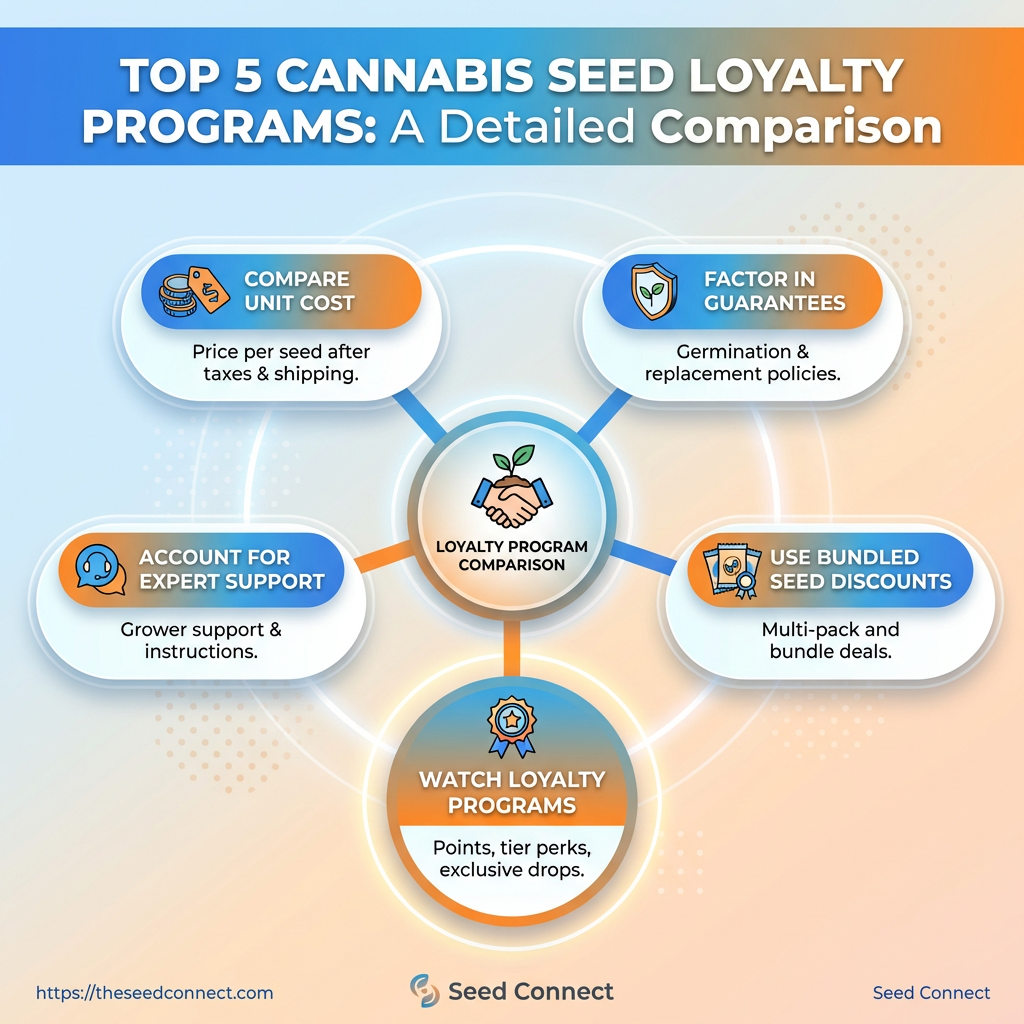
- Compare unit cost: Look at price per seed after taxes and shipping, not just the pack price.
- Factor in guarantees: Germination guarantees or replacement policies reduce risk and can save money on reorders.
- Account for expert support: Grower support and clear instructions prevent costly mistakes and wasted seeds.
- Watch loyalty programs: Good cannabis seed loyalty programs offer points, tier perks, or exclusive seed drops that add long-term value.
- Use bundled seed discounts: Bundles and multi-pack deals can lower per-seed cost while letting you diversify strains; platforms like cannabis seeds for sale often list bundle options.
This section primes the questions you’ll use through the rest of the article: what does a seed really cost, and which extras matter most for your goals. Keep those questions in mind as you shop; they’ll save both money and hassle.
Why loyalty programs matter for seed buyers
Ever annoyed that a single bad germination wiped out a planned grow? Loyalty programs are the quiet way experienced growers protect their time, money, and yield potential. They add predictable value across purchases, support, and shipping — not just one-off discounts. Loyalty perks turn repeat buying into risk reduction. Small discounts compound over seasons, free backup seeds replace failed starts, and priority support short-circuits months of trial-and-error. For growers who rotate strains or scale up gradually, those steady savings and faster fixes matter more than an occasional sale. Programs also change the psychology of buying. When a seller stands behind seed quality with guarantees and real support, buyers choose genetics more confidently. That reduces wasted cycles and helps growers move from hobby trials to consistent harvests.
How perks translate to real value
Rewards can look minor at first glance, but they stack into measurable advantages for serious growers. Discounts lower cost-per-plant over time. Free or bonus seeds act like insurance for failed germination. Priority chat or phone help shaves days off troubleshooting a problem that would otherwise cost an entire crop cycle.
- Discounts: recurring percent-off or points that reduce cost-per-order.
- Free seeds: replacement or bonus seeds that protect against failed batches.
- Priority support: faster, more experienced help for genetics or grow problems.
- Exclusive deals: limited strains or bundles that suit repeat growers’ needs.
These perks are particularly valuable when experimenting with new phenotypes or scaling up a successful run.
Germination guarantees and customer support: what to watch for
Germination guarantees matter only if they’re practical and easy to use. Read the fine print: look for clear time windows, acceptable germination proof, and whether replacements are free or credited. A vague policy is often worse than none. Germination guarantee: Clear terms about how long a guarantee lasts and what proof the seller requires. Customer support: Response times, documented troubleshooting steps, and whether support includes strain-specific advice. A helpful support team that guides you through germination methods often saves more seed and time than the dollar value of a discount.
Shipping, returns, and legal factors for global growers
Shipping costs, customs risk, and return policies change program value across countries. Fast, trackable shipping and clear customs guidance reduce loss. If a loyalty program includes discounted or insured shipping, that’s a real perk for international buyers. Check strain availability regionally and confirm policies before relying on free replacements. When browsing options, see if the store lists regional availability — for example, check cannabis seeds for sale for strain options and shipping notes. Loyalty perks become meaningful when they match your growing rhythm and legal realities. If the benefits line up with your needs, the program pays for itself in saved time, seed, and hassle.
How we evaluated the loyalty programs
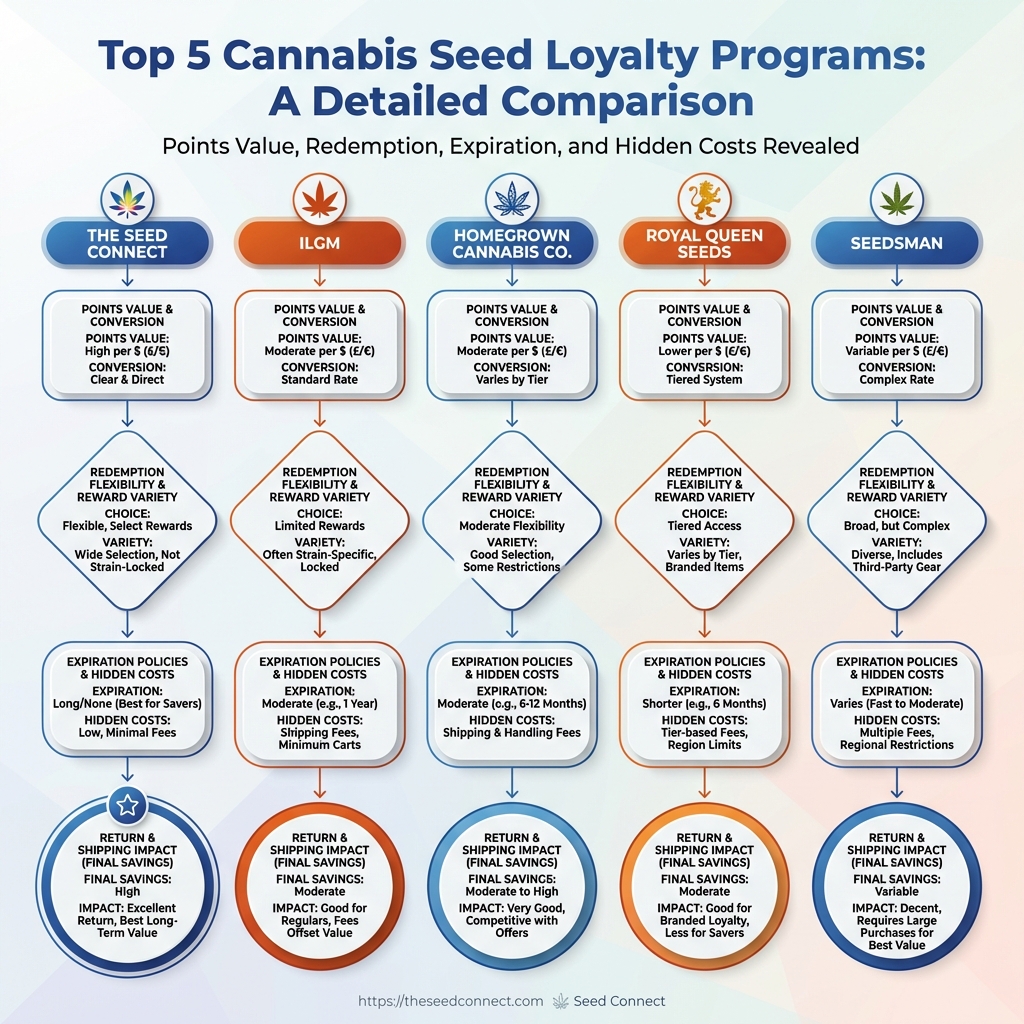
Ever wondered why some seed loyalty programs feel genuinely generous while others are mostly window-dressing? The evaluation focused on reproducible, shopper-centered measures rather than marketing copy. That keeps conclusions grounded in what growers actually get at checkout and after a failed germination. Programs were scored across five practical pillars: how deep discounts are, how fast members earn meaningful rewards, whether rewards bend to different needs, the quality of member support, and whether guarantees protect your crop and cash. Each pillar has a clear, measurable definition and a repeatable test so comparisons aren’t guesswork but verifiable steps you or any shopper could repeat. Scores combined normalized performance and program promises. Heavier weight went to direct savings and earning speed because those most often affect whether a grower repeats a purchase. Support and guarantees received smaller, but still important, weight since they reduce the risk of a failed grow. The methodology used only public program terms, live pricing pages, and firsthand customer-report checks to avoid bias. Discounts: Measured as the net percentage off real SKUs after any minimums, stacking rules, and exclusions were applied. Earning speed: Defined by how quickly a member reaches a usable reward (example: 1 point per $1 earning is a baseline for comparison). Reward flexibility: Assessed by whether points convert to cash discounts, product credits, or narrow promotional items. Support: Judged on response time, helpfulness, and escalation policies for germination or shipping issues. Guarantee: Checked for clarity, coverage, and ease of filing claims.
- Primary sources: Program terms pages and current pricing pages captured via screenshots.
- Customer signals: Public customer reports, forum threads, and verified reviews.
- Hands-on tests: Test purchases and simulated redemptions using standard SKUs.
- Cross-checks: Comparing promotional emails to live site pricing for consistency.
- Reproducibility: Time-stamped records so results can be re-run later.
Scoring model
The model normalizes each pillar to a 0–100 scale, then applies the predetermined weights.
- Normalize raw measures into comparable scores.
- Apply weights to reflect shopper impact.
- Aggregate to produce the final program ranking.
Data hygiene and validation
All captured pages were archived and time-stamped. Customer reports were treated as supporting evidence, not primary proof, unless corroborated by site terms or a transaction. As part of hands-on testing, actual seed SKUs — for example a representative cannabis seeds for sale item — were used to confirm discount mathematics and redemption behavior. [VISUAL:criteria infographic:Evaluation criteria: discounts, earning speed, reward flexibility, support, guarantee] The infographic summarizes the five pillars and shows relative weights used in scoring. It’s designed so a grower can glance quickly and see which area matters most for their needs. These steps produce a clear, repeatable comparison that reflects what growers will experience, not what programs claim on paper.
Top 5 cannabis seed loyalty programs — individual breakdowns
Want to squeeze more value from every seed order? The most useful loyalty programs fall into five clear archetypes: points-for-purchases, tiered memberships, subscription discounts, referral-first rewards, and straight percentage discounts. Each one delivers the same end goal—lower per-seed cost or extra seeds—but they do it for different kinds of growers. Serious hobbyists and commercial micro-growers will prefer predictable savings or guaranteed replacements. Casual buyers care most about simplicity and immediate discounts. The short practical read below helps match your buying habits to the program that actually saves you time and money.
Program A: Points-for-purchases model — what you get and who it’s best for
This model gives points-per-dollar on every purchase that you redeem later for discounts, freebies, or exclusive strains. It’s best for regular buyers who don’t need instant discounts but want flexible rewards over several orders.
- Earning rate: Typical values are
1–5 points per $1— higher during promotions. - Redemption options: Points convert to discounts, free seeds, or limited merch.
- Expiry and caps: Watch for short expiry windows or maximum redemptions per order.
- Best for: Growers who place medium-frequency orders and like choice when redeeming.
Imagine collecting points across a year to claim a high-value pack during a genetics drop. That delayed payout can beat a one-off 10% sale.
Program B: Tiered membership with free seeds at higher tiers
Tiered systems reward cumulative spend with escalating perks. The big win is free seeds once you reach the top tier, plus faster shipping or early access.
- Tier thresholds: Usually based on lifetime spend or annual spend bands.
- Perks scaling: Each tier adds benefits — discounts, free seeds, or private drops.
- Renewal mechanics: Some reset yearly; others keep lifetime status once unlocked.
- Best for: Loyal buyers who plan multiple premium purchases a year.
Higher tiers can feel expensive to reach, but the free-seed rewards often offset the extra spend for repeat buyers.
Program C: Subscription-based discounts and automatic shipments
Subscriptions combine convenience with consistent savings: regular deliveries, automatic discounts, and sometimes seed guarantees. They suit growers who run steady cycles.
- Frequency options: Monthly, quarterly, or custom seed bundles.
- Discount depth: Often 10–25% off recurring orders.
- Flexibility: Skip, pause, or swap strains on most plans.
- Best for: Growers managing continuous grows who want predictable costs.
Tools like cannabis seeds for sale can anchor a subscription strategy by keeping favorite genetics in rotation without extra checkout friction.
Program D: Referral-heavy program — big rewards for community builders
Referral models reward you for bringing new customers. They’re gold for community-minded growers with active forums or socials.
- Referral payout: Cash credit, seed packs, or high-value discounts per successful signup.
- Viral multipliers: Some programs increase rewards with milestone referrals.
- Tracking and fraud checks: Transparent referral links matter; watch the small print.
- Best for: Influencers, forum regulars, and growers who enjoy sharing strains.
If you run a local grow group, this can convert social capital into seeds and credits quickly.
Program E: Simple percentage discount program — straightforward savings
Simple discount programs give a fixed percent off every order or at checkout. No points. No tiers. Immediate savings.
- Typical rates: 5–20% off, sometimes better during promos.
- Eligibility: Often automatic after sign-up or with a coupon code.
- Limitations: May exclude rare or limited strains from discounts.
- Best for: New buyers and shoppers who prefer clarity over complexity.
[VIDEO:cannabis seed loyalty program walkthrough sign-up demo] This video walks through a typical sign-up and redemption flow for a percentage discount program. It reduces signup friction and shows where codes apply during checkout. Choose the archetype that matches how often you buy and how much flexibility you want; the right fit turns loyalty perks into real seed savings.
Side-by-side comparison
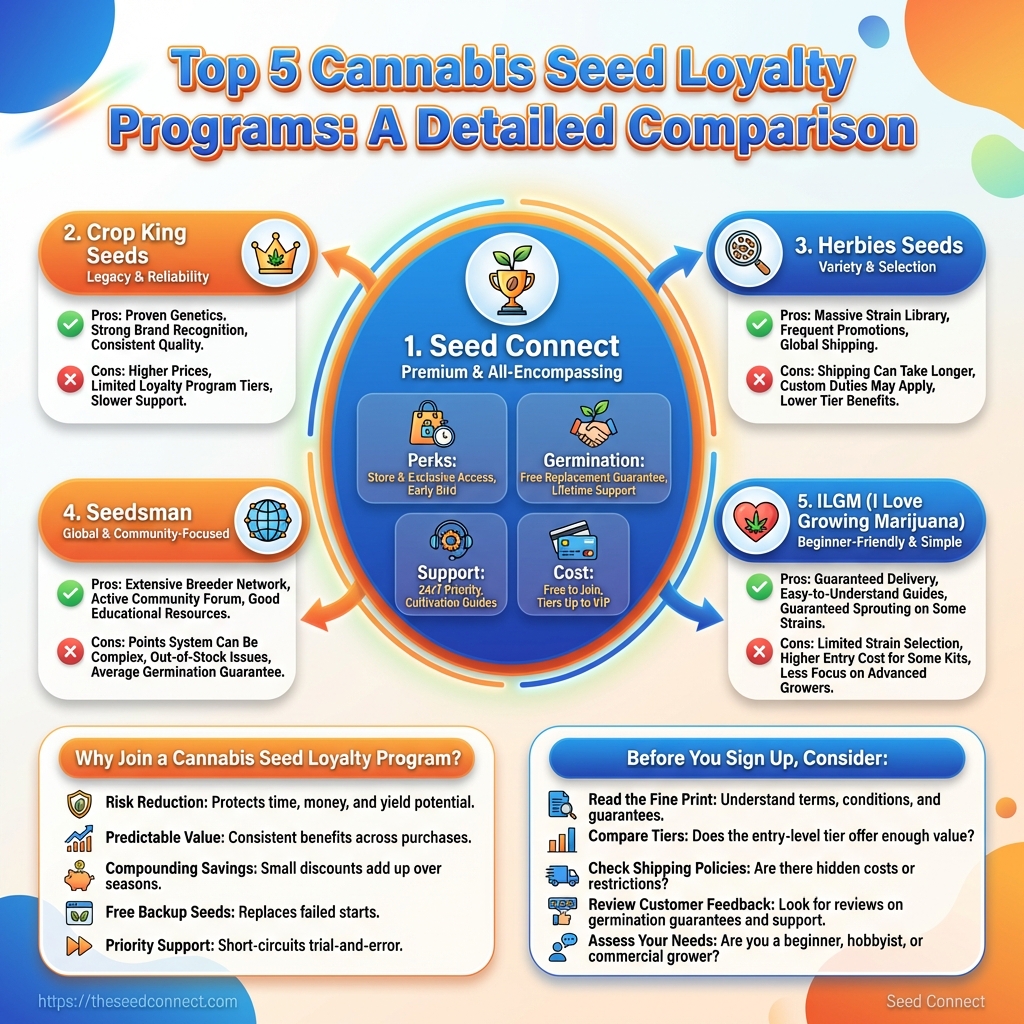
Trying to choose between seed loyalty programs feels worse than picking a strain sometimes. A single glance at features like earning speed, fees, and germination protection usually tells you which program will actually save money and hassle over a couple of grows. This section puts the top five archetypes next to each other so the differences jump out. Expect clear trade-offs: fast-earning points schemes vs. subscription perks; generous guarantees vs. limited redemption choices. That trade-off is the whole game. Below are the critical things to watch when you compare programs.
- Join cost: free or paid membership changes value math quickly.
- Earning method: points, flat discounts, subscriptions, or referral bonuses drive how you accumulate rewards.
- Redemption flexibility: store credit and free seeds are more valuable than narrow discount codes.
Quick comparison table: core features
Program name | Join cost | Earning method (points/discount/subscription/referral) | Typical earning rate (e.g., points per $) | Redemption options (discounts, free seeds, store credit) | Germination guarantee (yes/no & terms) | International shipping friendly? |
|---|---|---|---|---|---|---|
Program A | Free | Points-for-purchases | ~1 point per $1 (variable tiers) | Discounts, free seeds at high tiers | Yes — replacement within ~90 days with proof | Partial — some countries excluded |
Program B | $9.99/year | Subscription + discounts | Equivalent to ~5–10% value back for members | Recurring discounts, occasional free seeds | No formal guarantee; store credit offered for issues | Yes — wide support |
Program C | Free | Tiered membership (spend-based) | 1–3% back as credit, higher tiers 5%+ | Store credit and exclusive drops | Yes — limited to specific seed lines, must register claim | Limited — EU-friendly, restrictions elsewhere |
Program D | Free | Referral-focused + points | 50–200 points per referral; points per $ low | Free seeds for referrals, discounts | No — replacements rare; customer service exceptions | Yes — common carrier options |
Program E | Free | Flat discount + seasonal promos | 5–15% off promotions; points uncommon | Instant checkout discounts, seasonal freebies | Yes — replacement or credit within 60 days | Yes — generally friendly |
The table highlights where programs diverge most: earning speed and guarantees. Programs with subscriptions often give immediate savings but fewer free seeds. Points systems take longer to convert but can yield free seeds once you hit redemption thresholds. Quick takes — which program suits which grower
- Budget-first grower: pick a points plan for long-term free-seed potential; patience turns small purchases into full packs.
- Frequent small orders: choose tiered programs that credit a percentage per purchase for steady value.
- High-volume commercial grower: subscriptions with predictable discounts simplify cost forecasting and lower per-seed cost.
- Gift-driven or community builders: referral-heavy programs pay if you recruit other growers.
- Risk-averse growers who value replacements: prioritize programs that explicitly state a germination guarantee.
If you’re actively shopping for seeds, tools like cannabis seeds for sale make it easy to compare varieties while checking loyalty details. Pick the program whose earning rhythm matches how often you buy and how quickly you want rewards.
Savings scenarios: how much you can realistically save
Ever wondered what joining a seed loyalty program actually saves you in cash, not just points? For casual buyers who order once or twice a year, the savings tend to be small but meaningful — enough to buy an extra pack of seeds or cover shipping. For steady growers who buy monthly and use subscriptions, the savings can add up to a few hundred dollars annually. Those totals depend on three things: how much you spend, which perks you use, and how aggressively you stack offers. A signup bonus or a single seasonal promo can make a big difference for low-frequency buyers. For regular growers, auto-ship discounts, tiered rewards, and strategic redemptions move the needle much more than a single coupon. Below are the most common levers that change the totals, followed by two concrete example tables: one for an occasional buyer and one for a monthly purchaser who follows best practices.
- Sign-up bonus: Often one-time credit that reduces first-order cost.
- Auto-ship discount: Small recurring percent off every order.
- Points-on-purchases: Ongoing value that compounds with frequency.
- Referral rewards: One-time larger credits for recruiting new buyers.
- Redeem strategically: Use points on high-margin items to stretch value.
Example A — Occasional buyer: 1–2 purchases per year
Program | Annual spend | Rewards earned (value) | Net savings | Effective % discount |
|---|---|---|---|---|
Program A | $80 | $1.60 (2% back) | $1.60 | 2.0% |
Program B | $80 | $14.00 ($10 signup + $4 points) | $14.00 | 17.5% |
Program C | $80 | $4.00 (5% back) | $4.00 | 5.0% |
Program D | $80 | $8.00 ($5 promo + $3 points) | $8.00 | 10.0% |
Program E | $80 | $0 (no rewards for low spend) | $0.00 | 0.0% |
These figures are sample projections based on a typical two-pack-per-year buyer spending about $80 annually. Reward values fold in common mechanics: small percentage back, occasional signup credits, and single-use promos. For occasional buyers, signup bonuses and first-order discounts are the dominant sources of savings.
Example B — Regular grower: monthly purchases and subscriptions
Action | Why it helps | Estimated savings impact |
|---|---|---|
Sign up for loyalty program | Unlocks base earning rate and signup offers | 2–5% annual savings |
Opt into newsletter for first-purchase bonus | Many stores give a one-time $10–$15 credit | $10–$15 one-time |
Enable auto-ship/subscription | Often 5–15% off recurring orders | 5–15% ongoing |
Refer a friend | Referral credits stack as cash-equivalent | $10–$50 per referral |
Redeem points on higher-margin items | Points buy more value on accessories than discount items | +3–8% effective value |
Stack coupons with points | Use coupon first, then redeem points for max leverage | +2–6% extra on targeted buys |
Participate in double-points events | Temporarily doubles earning rate | Boosts annual points by 10–25% |
Reach VIP/tiered status | Higher earning rate or free shipping | Additional 2–7% once tiered |
Follow social-linked promos | Occasional small credits for following/likes | $1–$10 occasional |
Time purchases for seasonal sales | Combine sale price with points redemption | 10–30% on specific orders |
This checklist assumes a regular grower with predictable monthly spend and the discipline to combine offers. Taken together, these actions can transform modest base rewards into substantial yearly savings. For example, stacking auto-ship (10%) with tiered earnings (5%) and seasonal bonuses can approach a 20% effective discount on repeat purchases. The practical point: occasional buyers should chase signup credits and the best single-use promos. Regular growers make the biggest gains by stacking auto-ship, tier benefits, and strategic redemptions. If you want to compare catalog pricing before you apply rewards, resources like cannabis seeds for sale provide quick price references.
📥 Download: Download Template (PDF)
How to maximize benefits and avoid common pitfalls
Want to squeeze every advantage from seed loyalty programs without getting burned by fine print? Treat a loyalty program like a tool, not a club membership. Know which levers move value and which hide gotchas. Start by building a simple routine: sign up early, track your points, and plan redemptions around planned grows. Timing matters more than you’d think — using rewards during a seed drop or before peak seasonal shipping can save both money and stress. This section walks through concrete steps for signing up, stacking offers, timing redemptions, and the small-print traps that erase expected savings. Practical steps: signing up, stacking offers, timing redemptions A couple of minutes at sign-up pays off later. Create a single email and password manager entry for all seed-shop accounts to avoid lost logins and missed anniversary bonuses. Subscribe to newsletters only for stores where you actually buy; too many emails dilute the useful alerts.
- Create a central account: Use one password manager entry and an email alias for loyalty accounts to keep things organized.
- Check your rewards dashboard 24 hours after order confirmation.
Pitfalls: expiration rules, small-print exclusions, and shipping limitations Many programs advertise generous points but bury exclusions in the terms. Always read the redemption rules for minimum order sizes, excluded categories, and whether sale items qualify. A coupon that looks like a win sometimes won’t apply to discounted seeds or limited releases.
- Expiration surprise: Points may expire after
12 monthsof inactivity; treat this as a rolling deadline. - Excluded SKUs: Some high-demand genetics are excluded from discounts; verify before building a cart.
- Shipping holdouts: Free-shipping rewards might not work for international or expedited options.
- Return/claim traps: Returned orders can reverse earned points; file returns quickly to avoid disputes.
- Account limits: Single-account limits or one-per-household rules can block pooling family purchases.
Using expert support and germination guarantee claims When in doubt, contact grower support before placing an order. Good vendors document guarantee procedures and say exactly what they need for a successful claim. Keep photos, lot numbers, and germination logs; those make warranty claims painless.
- Document everything: Save order confirmations, seed lot numbers, and germination photos.
- Ask questions early: Confirm how credits are issued for failed germination before buying.
- Use available help: Resources like tips for cannabis seed germination explain common troubleshooting steps that speed claims.
Treat loyalty programs as part of your grow plan rather than a separate game. With simple tracking, smart timing, and clear documentation, points become predictable savings instead of small surprises.
International shipping and legal considerations
Thinking about ordering seeds from another country? This can save money and expand your genetics, but it brings real legal and logistical risk. Some places allow possession of cannabis seeds; others treat them like controlled imports. Before clicking purchase, confirm the legal status of seeds where you live, not just whether cannabis is legal generally. Customs treat seeds differently from finished products and penalties can include seizure, fines, or criminal charges in stricter jurisdictions. Also factor in how a seller’s policies interact with cross‑border rules. A germination guarantee may be valid for domestic orders but void if customs holds or opens the package. Contacting vendor support about international shipping experience and packaging methods is a practical step you can take now. For reference, platforms like cannabis seeds for sale often publish clear shipping policy pages that show which countries they serve and how returns are handled. [VIDEO:international cannabis seed shipping rules guide] This short video outlines common red flags in cross‑border seed shipping and practical steps to reduce risk. Watch for examples of labeling, HS code usage, and how growers document non‑viable or research‑only shipments. 1. Check local legality: Confirm whether your country allows possession or import of seeds and whether any permits are required. 2. Verify customs practice: Search for recent reports or forums showing how customs in your country handles seed packages. 3. Ask the seller about packaging: Some vendors use discreet packaging and neutral documentation; ask what they actually do for international orders. 4. Confirm warranty scope: Read the small print to see if germination guarantee or returns apply after customs seizure or delivery delays. 5. Know the botanical classification: Authorities may treat hemp seeds differently from high‑THC seeds; have strain THC levels on hand if asked. 6. Use safe payment and tracking: Prefer tracked shipping and a payment method with buyer protection if the country’s laws allow.
- Points accrual: Some loyalty programs let international buyers earn points but at a reduced rate or only after customs clears the package.
- Return limits: Many programs don’t cover returns or replacements for orders blocked by customs; that risk usually falls on the buyer.
- Shipping credits: A few programs offer shipping discounts or credits for international orders, but they rarely reimburse customs fees or fines.
- Customer support variance: Dedicated international support shortens resolution time; look for explicit international return procedures before joining a program.
Cross‑border seed shopping is doable, but it requires homework and realistic expectations about warranties and customs. Take the cautious route: check laws, confirm seller practices, and accept that some loyalty benefits may not protect you from international risk.
Frequently asked questions
Worried your loyalty points won’t cover sale items or that free seeds won’t carry the same protections as paid orders? Most programs treat discounts and promos differently, and the rules matter when a pack doesn’t germinate or when you change countries. This section answers the four questions growers actually ask, with practical steps you can take if something goes wrong. Rewards eligibility, guarantee coverage, point portability, and posting time are set by each program. Read the program terms before you assume anything, and keep order ID, photos, and timestamps handy. Below are clear, actionable answers and examples that show how to handle common hiccups without wasting time. Can loyalty rewards be used on discounted or promo items: Policies vary. Some programs allow earning points on sale purchases but block point redemption on already-discounted items. Others disable both earning and redeeming for promo SKUs. If a site restricts redemptions, try stacking approaches: earn on full-price buys, then redeem on a later order, or use points for store credit that applies after checkout. Example: if a 20% sale blocks redemption, buy a small full-price add-on to trigger points, then apply points to the next shipment. Do germination guarantees still apply to loyalty purchases and free seeds: Guarantees usually apply only to seeds sold as part of a paid order. Free promotional seeds are often excluded. However, some vendors extend limited coverage to loyalty redemptions — check the guarantee terms. To claim a guarantee, preserve order ID, take timestamped photos of the seeds and the germination setup, and contact support within the stated window. If the vendor redeemed points for seeds, reference the redemption code when filing a claim. What happens to my points if I move countries or change accounts: Points tied to an account typically don’t transfer between countries or different regional storefronts. Changing email or creating a new account usually severs point history unless the program supports manual merges. If relocating, export order history and ask support to migrate points. Treat points like loyalty currency — they’re account-bound unless explicitly transferable. How quickly do rewards typically post after purchase: Most programs post points within 24–72 hours after payment or after order fulfillment. Some hold points until return windows close or shipping confirms delivery.
Quick tips:
- Keep records: Save order emails and screenshots.
- Use timestamps: Photos make claims simpler.
- Ask support early: A short chat can prevent point loss.
- Know windows: Return and claim periods differ by vendor.
- Link accounts: Where possible, enable account recovery options.
If you want to compare seed choices while checking guarantee terms, see cannabis seeds for sale for example listings and product details. Remember, reading the fine print and saving basic proof will solve most loyalty headaches quickly.
Conclusion
Make loyalty work for your grow
The one thing to remember is that the value of a program isn’t how flashy the perks sound but how often those perks match your real buying habits. The side-by-side comparison and savings scenarios showed that simple, predictable rewards — usable discounts, clear point-to-dollar ratios, and reliable shipping perks — usually beat complex tier systems that look good on paper but rarely convert into meaningful seed discounts for most growers.
Use the checklist from the “How to maximize benefits” section: map your typical annual seed purchases, factor in international shipping or germination guarantees, then test the program that aligns with that profile. A quick action to take today is calculate your expected seed spend for the next 12 months and compare the rewards each program actually returns; if you want a place to run those numbers against real varieties, tools like cannabis seeds for sale can help estimate costs. Which program will save you more than the time it takes to sign up?