



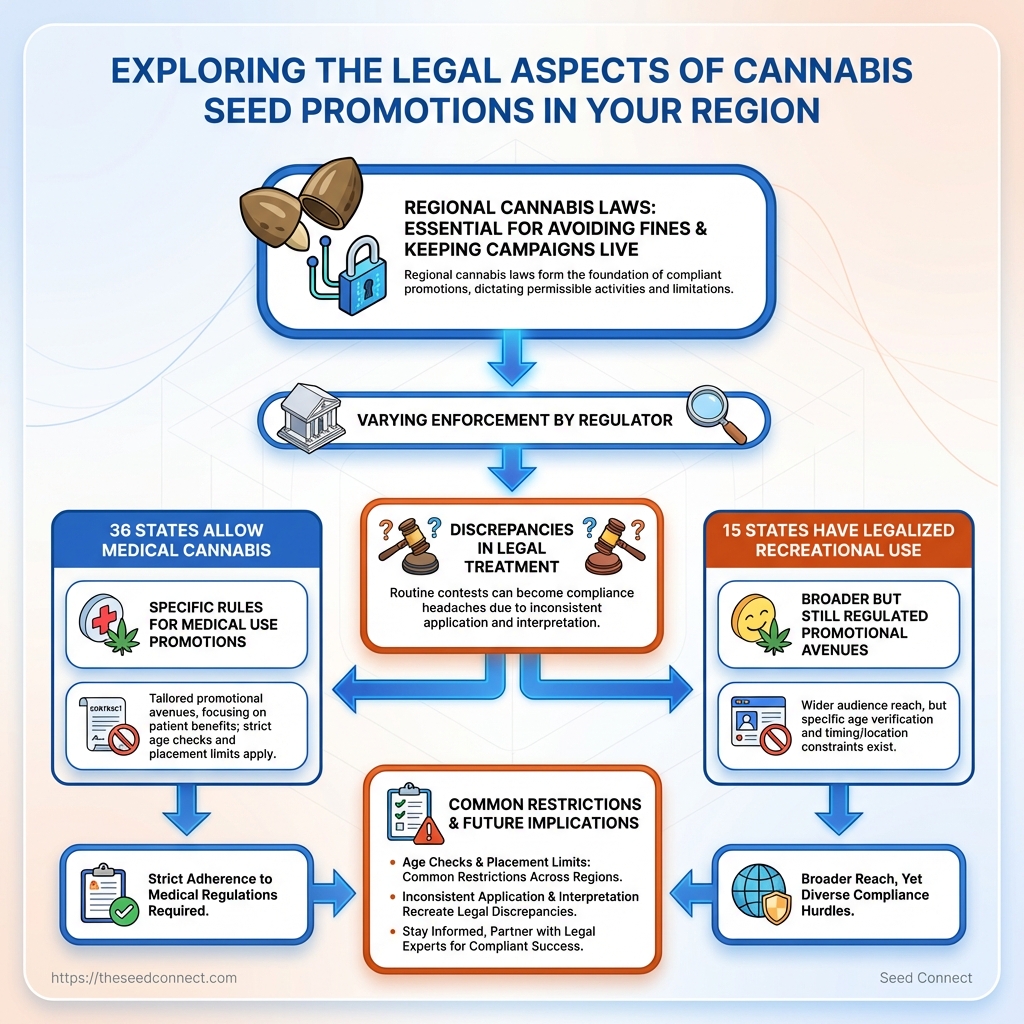
Posting a seed giveaway and watching the post get flagged is a stomach‑drop moment every cannabis marketer knows. Across states and platforms, a simple promo can collide with inconsistent rules about who can enter and where ads can run. The patchwork matters: 36 states allow medical cannabis and 15 have legalized recreational use. Those numbers directly shape local cannabis seed regulations, from licensing to which advertising channels are permitted. Age checks and placement limits are common, but enforcement still varies by regulator. Discrepancies in how legal promotions cannabis are treated turn routine contests into costly compliance headaches. Understanding regional cannabis laws is the quickest way to keep a campaign live and avoid fines.
Table of Contents
- Opening scenario: a promotion on the line
- How cannabis seed regulations affect promotions: the essentials
- Running compliant promotions by channel
- Cross-border promos and shipping: what to check before you send
- Creating legally sound promotional copy and offers
- Common pitfalls, enforcement examples, and how to respond
Opening scenario: a promotion on the line
You just built a clean landing page, picked the strains to highlight, and scheduled the email blast. The marketing team asks for a discount code and a shareable contest. Then someone drops the question everyone dreads: “Is this legal here?” That split-second of doubt matters more than the size of the discount. Promotions that ignore regional rules expose sellers to fines, forced takedowns, and damaged customer trust. Gardeners who buy into a promotion that later gets pulled can feel misled, and that spreads online faster than a promo code ever could.
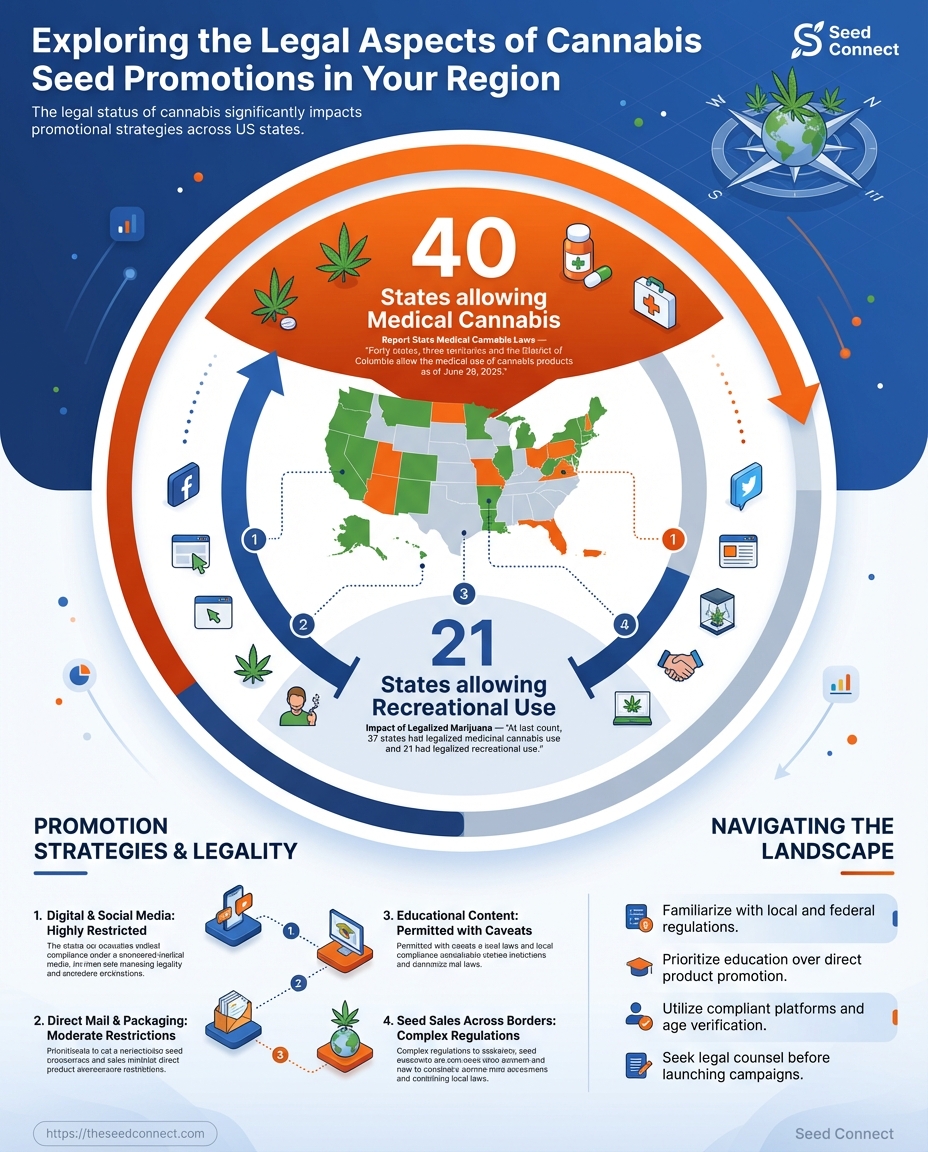
36 states have legalized medical cannabis and 15 states have legalized recreational cannabis — that patchwork shapes what you can and can’t do with promotions.
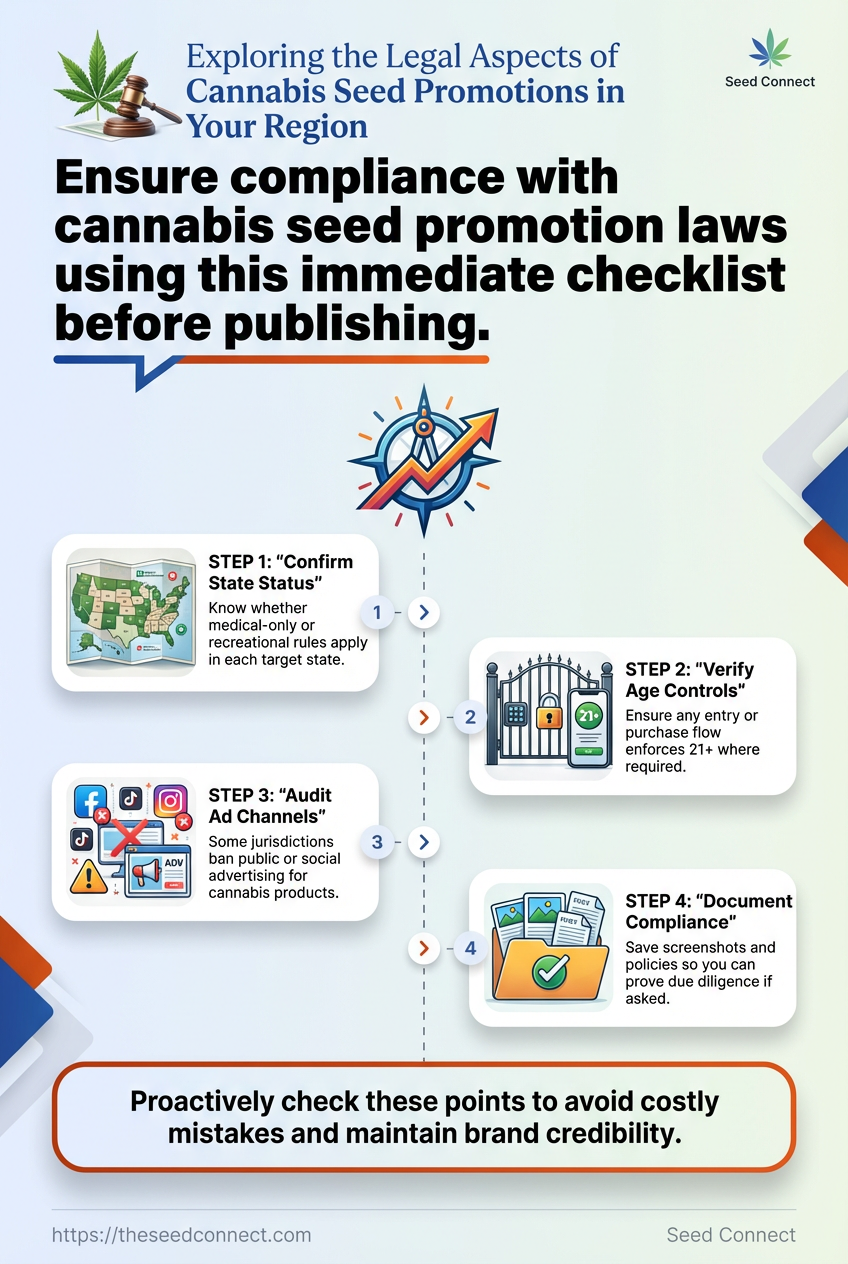
Immediate checklist before you hit publish
Start by confirming the basics before any creative work goes live. A short, systematic check prevents costly mistakes and keeps the brand credible.
- Confirm state status: Know whether medical-only or recreational rules apply in each target state.
- Verify age controls: Ensure any entry or purchase flow enforces
21+where required. - Audit ad channels: Some jurisdictions ban public or social advertising for cannabis products.
- Document compliance: Save screenshots and policies so you can prove due diligence if asked.
Age restriction: Many regions require promotions to limit participation to 21+ and demand reliable age verification and record-keeping. Advertising limitations: Some regulators disallow paid social, billboard, or influencer promotions that target the general public or minors.
Real risks for sellers and gardeners
Regulators like the Cannabis Control Commission and the California Bureau of Cannabis Control have clear rules that can include fines or product removal for non-compliant marketing. Large operators and consultancies, including industry leaders such as Tilray Brands, stress cautious, documented promotion practices in regulated markets. For a seller, the practical harms are legal exposure, lost listings, and reputational damage. For gardeners and buyers, torn expectations and canceled orders erode trust and increase customer service friction. Tools and product pages such as cannabis seeds for sale can help standardize how offerings are presented, but they don’t replace legal checks. A single compliance step now saves headaches later. Double-check the rules in every market before a promotion goes live, and keep proof that you did.
How cannabis seed regulations affect promotions: the essentials
Promotions that push seeds live or online sit at the intersection of criminal law, commerce rules, and platform policy. Depending on whether the market is adult-use, medical, or decriminalized, states and agencies treat seeds differently. This distinction means that a discount code permissible in one state could trigger penalties or blocked ads in another. Regulators set practical limits on who you can target, what channels may be used, and how buyers must be verified. It is crucial for marketers to understand the legal landscape and note the disparities across jurisdictions to avoid compliance headaches.
Running compliant promotions by channel
Treat each channel as its own legal ecosystem. Website pages, emails, and social platforms carry different rules from state law, platform policy, and payment processors. Running promotions successfully means matching creative to the strictest rule that applies and documenting why each asset is allowed. Start by mapping what you intend to say (discount, germination guarantee, strain details) to three checks: age restriction enforcement, permissible content (no consumption or medical claims), and permitted ad placements. Use the Massachusetts Cannabis Control Commission and the California Bureau of Cannabis Control as reference points when state rules conflict. Tilray Brands, Inc. offers useful industry guidance on conservative marketing practices that reduce platform pushback. What follows are specific, actionable requirements and examples for the three primary channels you’ll use.
Website and SEO-friendly product pages
Product pages must present seeds as retail items, not consumption products. That means clear product descriptions, genetics and cultivation notes, and a visible age statement restricted to 21+ where required.
- Bold disclaimers: Show age restriction and legal jurisdiction on the landing page.
- Bold prohibited claims: Avoid health or therapeutic language that implies consumption benefits.
- Bold transactional clarity: Make shipping, return, and germination guarantee terms explicit.
Practical SEO tip: focus on cultivation intent keywords and neutral product metadata. That reduces the chance of being flagged by search engines for promoting consumption. For a product reference, tools like buy marijuana seeds online can show how to structure seed listings without consumption language. clean, neutral product pages built around genetics and shipping rules keep organic and paid channels safer.
Email and direct marketing: permissions, content restrictions, and age gating
Email requires explicit permission and strict age gating. Maintain auditable opt-in records and include unsubscribe links. Never send promotional content to lists lacking documented consent from recipients aged 21+. The visual shows a compliant product page mock-up and a promotional email. Callouts highlight an age gate, the germination guarantee language, mandatory unsubscribe link, and a neutral subject line that avoids consumption claims.
- Verify opt-in: Confirm timestamped consent and age at signup.
- Age gate on click-through: Require date-of-birth capture before coupon reveal.
- Content checklist: No consumption imagery, no medical claims, and include jurisdictional disclaimers.
track consent, gate content, and keep copy factual.
Social media and third-party marketplaces
Platform rules often ban seed advertising even where state law permits it. Instagram and Facebook commonly restrict cannabis ads, and many marketplaces disallow seed listings entirely. When in doubt, remove promotional links and use neutral informational posts that drive traffic to an age-gated page.
- Bold platform audit: Check each platform’s ad policy before posting.
- Bold geo-targeting: Restrict paid reach to legal states only.
- Bold marketplace compliance: Confirm the marketplace’s seed policy before listing.
Running compliant promotions takes channel-specific rules and a conservative approach to content. Keep documentation for every campaign and err on the side of restriction when platform policy conflicts with regional cannabis laws.
Cross-border promos and shipping: what to check before you send
Ever had a promotion perform better than expected and then realize half the orders can’t be fulfilled? International and interstate shipments are where promos break down fastest. Customs rules, carrier policies, and foreign plant-health laws create a tangled web that turns a simple discount into legal risk and unhappy customers. Regulatory patchwork matters here: 36 states allow medical cannabis and 15 allow recreational use, and federal and foreign rules can still block seed movement. Agencies like the Cannabis Control Commission and the California Bureau of Cannabis Control set state-level marketing and shipping expectations, while global players such as Tilray Brands, Inc. publish best-practice guidance on compliant distribution. Below are clear, practical steps for the campaign phase and the checkout-to-delivery flow. Follow them before you send any email or activate a promo code so the orders you generate can actually be completed. Communicating shipping limits clearly Start promotional copy with the restriction, not buried at the footer. Put the most important shipping rules in the headline or first sentence of any offer. Use plain language and repeat limits at checkout.
- Lead with restrictions: Put country/state shipping limits in the subject line preview or first line of the page.
- Show an eligibility widget: Use a small
zip/countryinput that blocks checkout if shipping isn’t allowed. - Repeat at checkout: Restate the rule and ask a buyer to confirm their location before payment.
- Offer alternatives: If cross-border shipping is blocked, link to local retailers or a resource page like cannabis seeds for sale for educational context.
Checklist for cross-border campaigns (customs rules, documentation, carrier policies)
Check item | Why it matters | Action to take | Red flag indicators |
|---|---|---|---|
Confirm destination country seed legality | Laws vary; some countries ban seed import entirely | Verify destination plant-import rules on government customs or agriculture sites | Country explicitly bans any cannabis plant material |
Carrier accepts seeds | Many carriers refuse plant material or seeds | Check carrier policy pages and get written confirmation for the service level | Carrier terms exclude “plant material”, “seeds”, or “agricultural products” |
Customs declaration accuracy | Misdeclared goods can be seized and fined | Use correct HS codes and honest descriptions; include invoices | Customs requests, holds, or seizure notices |
Required permits or phytosanitary certificates | Some countries require official plant health certificates | Apply for permits early via exporting country agriculture department | Permit denial or long lead times from authorities |
Payment processing and fraud checks | Cross-border orders have higher fraud risk | Apply stricter AVS/CVV checks and manual review for flagged orders | High chargeback rate or sudden order spikes from one region |
Age restrictions at destination | Many jurisdictions require age 21+ confirmation | Implement age-gating and ID verification where required | Orders from under-age profiles or missing verification |
Packaging and labeling requirements | Some countries require specific labels or warnings | Update packaging templates to meet destination rules | Returned shipments for improper labeling |
Prohibited cultivars/strains | Certain genes or high-THC varieties may be banned | Maintain list of restricted cultivars per destination | Customs flags for controlled varieties |
Tracking, insurance, and delivery confirmation | Proof of delivery and insurance reduce disputes | Use trackable services and insure higher-value shipments | Lost-in-transit claims or no delivery scans |
Return and contingency policy | Cross-border returns are expensive and regulated | Publish a clear returns policy and contingency plans | Multiple return requests or refusal to accept returns |
This table is an operational checklist you can run against each destination before the promo launches. Cross-check carrier pages, destination customs sites, and international plant-health guidance as you complete each row. Good copy and technical controls prevent most problems. If a destination fails any of the checklist items, pause promotional activity there until you can confirm legal, carrier, and customs compliance.
Creating legally sound promotional copy and offers
Promotional language for cannabis seeds must do two things at once: attract customers and keep the business inside legal lines. Write copy that is clear about who can participate, what’s actually on offer, and any limits or conditions. That clarity reduces disputes and keeps state regulators—from bodies like the Cannabis Control Commission to the California Bureau of Cannabis Control—happy when they review materials. Start with plain statements that cover age, geographic limits, and an exact description of the offer. Avoid broad health or potency promises. Where you provide a warranty or guarantee, make the scope, exclusions, and remedies explicit. Small changes to phrasing can change risk exposure dramatically, so craft offer text with the same care given to terms and shipping policies. Keep promotional mechanics simple. A short-term store-credit promotion with clear expiration and defined exclusions often creates less legal friction than an open-ended discount tied to unverifiable potency claims. When in doubt, prefer precise, measurable language over marketing adjectives.
Writing compliant offer language: disclaimers, guarantees, and age statements
Begin offers with an obvious age gate and geographic restriction. Use short, unambiguous sentences so the restriction reads clearly at a glance. Age statement: Must be clear and visible — e.g., “Offer valid to purchasers 21+ in states where private possession of cannabis seeds is legal.” Geographic restriction: List excluded states or say “Not available where prohibited by law.” Disclaimer for claims: Use plain terms — e.g., “Results vary. Not a medical claim. See full terms.”
- Bold eligibility text: Place eligibility and blackout states next to the code or button.
- Clear expiration: State the exact end date and time in local time.
- Simple redemption steps: One-line instructions to redeem reduce confusion and disputes.
Structuring promotions to reduce legal exposure
Structure the offer to limit open-ended promises and cap liability. Start with a short procedural checklist, then follow the decision steps below.
- Confirm legal coverage: Verify the promotion runs only to addresses in states allowing seed sales.
- Choose the mechanic: Prefer store credit or shipping discounts over percentage-off coupons when potency or germination could be contested.
- Set limits: Cap redemptions per customer and add a per-order item limit.
- Draft warranty language: State remedies (refund, replacement, store credit) and a time window clearly.
The flowchart maps how to pick a promotion based on regional rules and your risk tolerance. It guides you from “Is the product shipped to the buyer’s state?” to “Choose store credit or direct discount” and suggests warranty templates based on exposure.
Handling claims about germination guarantees, genetics, and potency responsibly
Claims about seeds need careful qualifying language. Use germination guarantee in precise terms: note the test period, required proof (photos, failed attempts), and the remedy (replacement or store credit). Avoid absolute language like “100% germination.” Germination guarantee: Define timeframe, proof required, and what qualifies as failure. Genetics claims: Use neutral phrasing such as “predominantly indica-leaning genetics” rather than guaranteed expression. Potency statements: Reference ranges or averages only when lab-tested; cite testing dates if available. When pointing customers to product options or background resources, link naturally to helpful pages such as learn about cannabis seed genetics. Industry practices from companies like Tilray Brands also show that careful, documented claims and lab testing reduce regulator scrutiny. Write each offer line to answer the likely legal question before it’s asked: who, where, what, and how. That habit turns marketing copy into a compliance tool that still sells.
📥 Download Free Template
Get your free downloadable template.
Common pitfalls, enforcement examples, and how to respond
Promotions for cannabis seeds often fail not because the product is illegal, but because the campaign ignored small, enforceable rules. Overbroad claims, weak age-gating, and careless shipping language are the three mistakes that show up most often in compliance notices. Fixing them quickly usually prevents escalations; ignoring them invites fines, takedowns, or halted shipments. This section explains the common traps, describes enforcement patterns regulators follow, and lays out a clear, documentable response process to use if a regulator or platform flags a promotion. Expect practical, step-by-step actions you can take mid-campaign and a checklist for how to keep an audit trail that holds up if questioned. Regulatory bodies vary. Agencies such as the Cannabis Control Commission and the California Bureau of Cannabis Control routinely assess marketing for age controls and accurate product claims. Companies that lead the market, including Tilray Brands, have invested in compliance workflows to reduce enforcement risk. Those examples matter because regional differences in cannabis seed regulations and legal promotions cannabis create real exposure for multi-state campaigns.
Typical mistakes we see
Common errors tend to be simple but serious. Fixing them means tightening copy and controls before launch.
- Overbroad claims: Vague promises about therapeutic or illegal uses — remove medical or health claims unless expressly allowed.
- Poor age controls: Weak or absent verification — require
21+gating and log checks. - Careless shipping notes: Suggesting cross-border or out-of-state shipment — explicitly state shipping limits and residency requirements.
- Unclear offer mechanics: Ambiguous discounts or codes that imply irresponsibility — document terms and limits.
If you list strains or examples in marketing, link examples to neutral product pages such as discover popular marijuana strains for factual reference rather than making medical claims.
36 states have legalized medical cannabis and 15 states allow recreational use — that patchwork drives how strictly promotions are policed.
Real enforcement patterns and lessons learned
Regulators typically escalate in three stages: notice, demand for correction, then penalty if ignored. Notices often cite specific advertising language or failure of age-restriction mechanisms rather than product legality. When agencies flag a promotion, rapid correction and proof of remediation usually reduce penalties. Lesson: treat every notice as time-sensitive and evidentiary. Keep records of what changed, when, and who approved it.
If you get a compliance notice — immediate steps and how to document the response
Act fast, stay factual, and create a traceable record.
- Acknowledge receipt within 24–48 hours and assign a response owner.
- Quarantine the offending creative or page; take it offline if required.
- Capture screenshots, pull server logs, and export marketing schedules showing targeting and sends.
- Make the corrective change and timestamp the update in your CMS or version control.
- Draft a short factual report: what happened, root cause, corrective steps, and preventive actions.
- Submit your response and supporting evidence to the regulator; request confirmation of closure.
This short walkthrough shows tightening a live promotion and packaging your remediation evidence. Watch it to see a sample response packet and the exact logs to export. Responding well turns a compliance headache into a defensive advantage. Document everything, move quickly, and avoid repeating the same communication mistakes.
Conclusion
Stay one step ahead of flags and fines
That giveaway getting flagged is more than a bad day on social — it’s the clearest signal that platform rules, local statutes, and promotion language need to be mapped before you post. The most valuable insight to hold onto is this: consistent compliance comes from checking three layers every time — platform policy, local law, and shipping rules — because a single mismatch (like a cross‑border seed giveaway) can undo weeks of work. Remember the enforcement examples earlier; those were all failures to reconcile those layers before launch.
Practical fixes today will pay dividends tomorrow. Run a quick three‑point pre‑publish checklist: confirm the promotion fits platform ad and giveaway policies, verify regional cannabis laws and cannabis seed regulations where you operate and ship, and rewrite copy to avoid prohibited claims or incentivized offers. That one routine would have prevented the flagged post in the opening scenario and keeps legal promotions for cannabis from turning into enforcement headaches.
Treat this as a habit, not a one‑off. Update your next promo using the checklist, test it on a single channel, and iterate based on results — and if you want an example of how product pages can clarify legality and shipping, look at The Seed Connect cannabis seeds listings for phrasing ideas. Want a challenge? Rework one active promotion today using the checklist and see how many compliance issues disappear.