


Getting seeds across borders often feels like threading a needle: customs hold-ups, unclear paperwork and wildly different local rules can turn a simple order into weeks of uncertainty. For anyone sourcing genetics internationally, the real question isn’t just where seeds grow best — it’s which countries for cannabis seeds reliably let those seeds move through the system without disappearing into bureaucratic limbo.
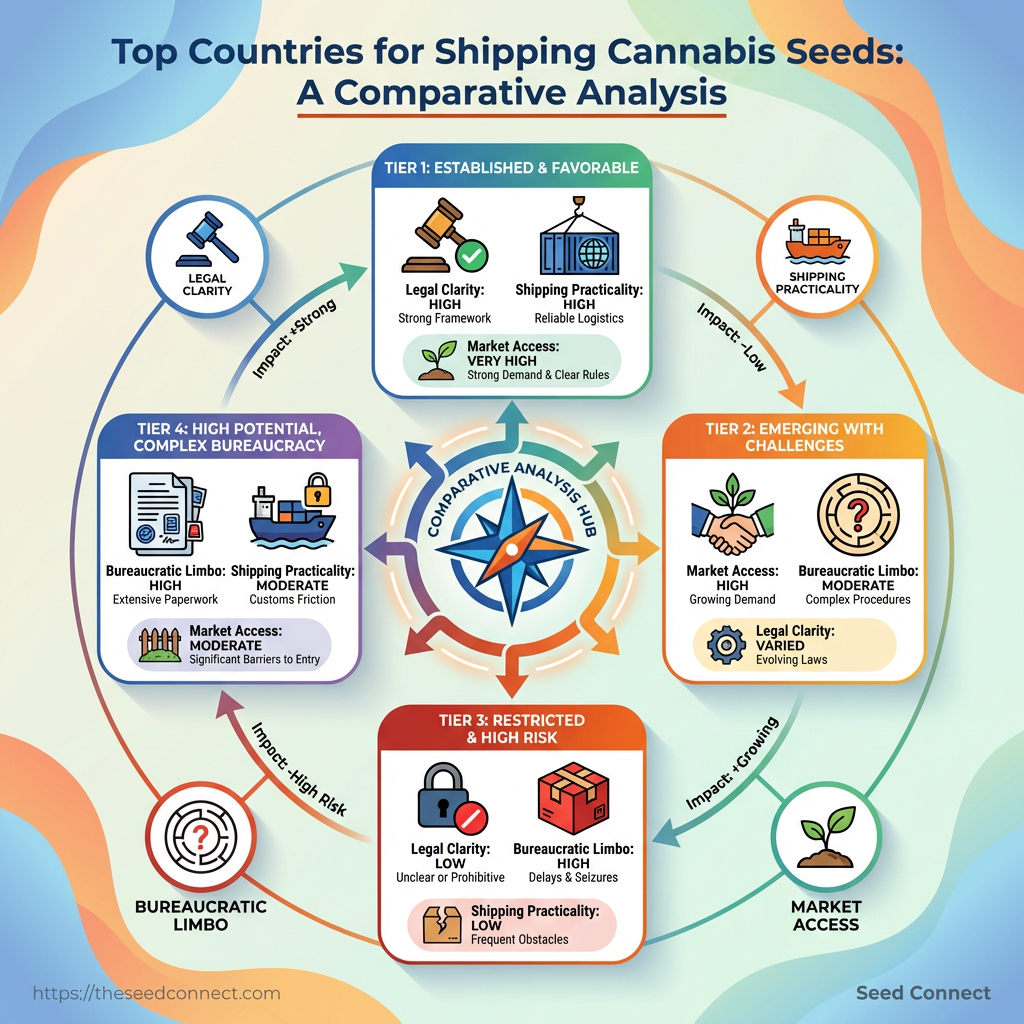
What separates a smooth shipment from a nightmare is a mix of regulation, postal reliability and practical logistics, not just whether a market is large or trendy. This piece uses a clear comparative analysis to cut through headlines and show which jurisdictions balance legal clarity, shipping practicality and market access.
If international deals matter to your grow plans, paying attention to how countries treat seed shipments will save time and money before the first germination tray shows up. Expect concrete distinctions between permissive legal frameworks and places where rules exist on paper but falter in practice when seeds hit checkpoints.
What Is international cannabis seed shipping?
International cannabis seed shipping is the movement of cannabis seeds across national borders using postal services or private couriers. It sounds simple, but legally and logistically it sits in a tangle of national drug laws, customs rules, and carrier policies. Practically speaking, shipping seeds is different from shipping live plants or processed cannabis; every link in the chain — seller, shipper, carrier, and importer — can change whether a package arrives intact, is delayed, or is seized.
Definition and scope
Seed vs. live plant: Cannabis seeds are dormant reproductive material, not live vegetative material; many laws treat them differently from live plants or smokable products.
Seed vs. processed cannabis: Processed cannabis (flowers, extracts) is typically controlled much more tightly than seeds and often banned where seeds might be permitted.
Stakeholders: Seed sellers, buyers or importers, postal services, private couriers, and customs agencies each play a role in outcome and risk.
Scope and limitations: This discussion explains legal/logistical mechanics, not legal advice. Local legality must be confirmed with official sources before any international purchase or shipment.
How the rules interact — a practical overview
- Domestic law governs possession and import. Countries set whether seeds are legal to possess, import, or sell. If import is illegal at destination, arrival risks seizure regardless of departure legality.
- International mail and courier rules set service-level constraints. Postal operators and couriers maintain lists of prohibited items and operational procedures; some refuse to carry any cannabis-related material even if legal locally.
- Declaration and paperwork affect inspections. How contents are declared — accurately, ambiguously, or falsely — changes customs scrutiny and potential penalties. Honest, clear declarations can reduce delays but may increase seizure risk where prohibition applies.
- Detection and enforcement technologies drive interception. X-ray screening, sniffer dogs, and risk-profiling algorithms make certain packaging and routing patterns more likely to be inspected.
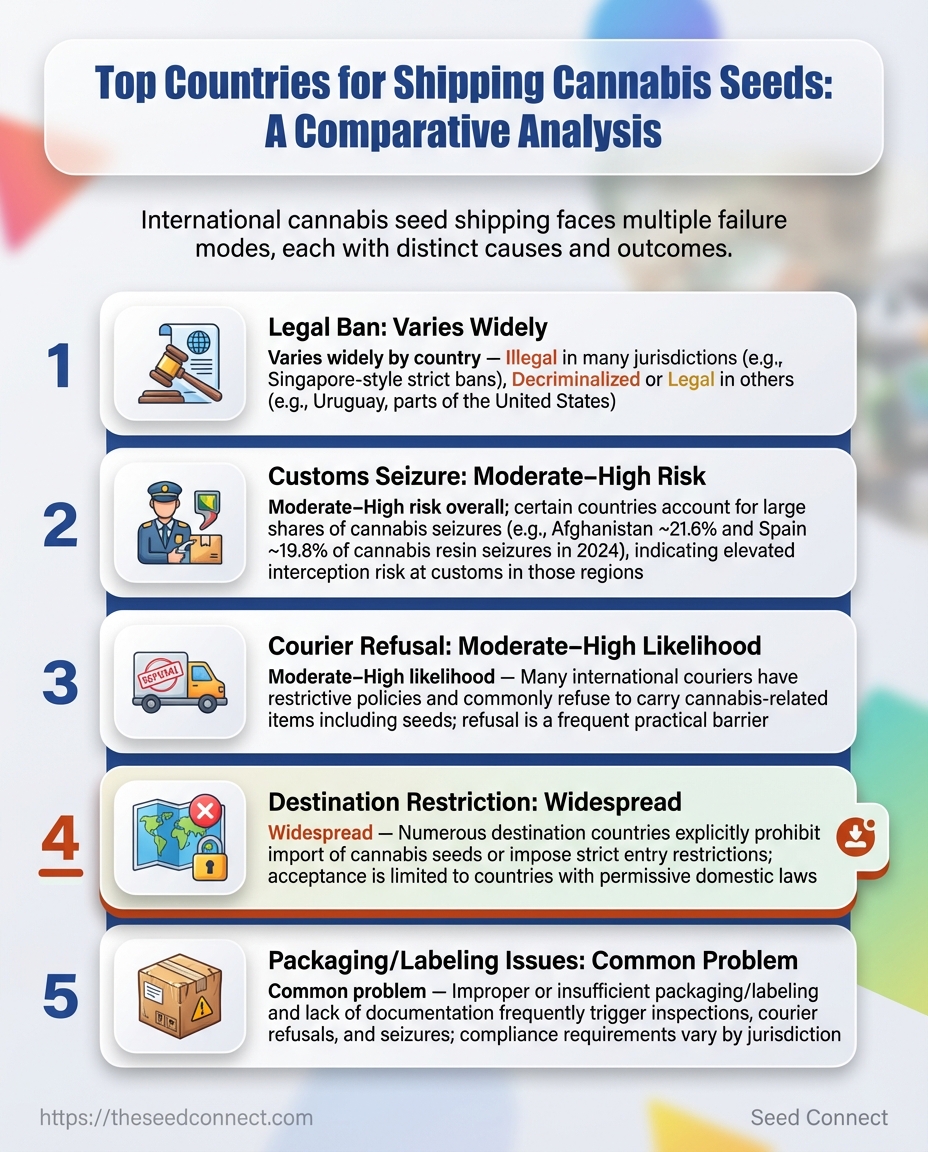
The four primary shipment failure modes (legal ban, customs seizure, courier refusal, destination restriction) and how they manifest
| Failure Mode | Typical Cause | Who Enforces | Typical Outcome |
|---|---|---|---|
| Legal Ban | National law outlawing import/possession of cannabis seeds | Local law enforcement/customs | Package seized; recipient fined or prosecuted |
| Customs Seizure | Undeclared contents, suspicious packaging, or random inspection | Customs agency at transit or destination | Confiscation, return to sender, or destruction |
| Courier Refusal | Carrier policy excludes cannabis-related items | Private courier (operations team) | Shipment cancelled or returned before transit |
| Destination Restriction | Regional or municipal rules stricter than national law | Local authorities or municipal inspectors | Local hold or seizure, delivery blocked |
| Packaging/Labeling Issues | Mis-declaration, misleading labels, or failure to meet phytosanitary rules | Customs and carrier compliance teams | Delays, additional inspections, or rejection |
Key insight: these failure modes overlap — a legal ban at destination makes customs seizure likely, while a strict courier policy can end a shipment before it leaves the origin country. Understanding the interplay reduces surprises.
Practical notes and examples
- Common cause of seizure: Declaring contents as “plant material” without paperwork where phytosanitary certificates are required.
- Courier choice matters: Some international couriers explicitly prohibit cannabis-related items; postal operators sometimes have different inspection protocols.
- Example practice: Sellers may offer different shipping options: tracked but slow postal routes versus express couriers with stricter screening.
For anyone buying seeds internationally, choosing reputable sellers and knowing destination rules matters more than clever packaging. For a straightforward inventory of genetics and reliable fulfillment, many growers start with established sources such as cannabis seeds for sale while they check local import rules. Knowing the legal and operational boundaries up front turns a risky shipment into a planned import.
How Does International Cannabis Seed Shipping Work? (Mechanics and Processes)
Shipping cannabis seeds across borders is primarily a logistics and legal choreography: choose the right carrier, package to reduce visibility without falsifying content, complete paperwork the receiving country requires, and communicate clearly with the buyer about permits or inspections. The goal is to balance speed, traceability and legal exposure so a seed order arrives intact and without creating unnecessary risk for seller or buyer.
- Prepare the order and customer communication.
- Package and label with discretion while remaining truthful for customs.
- Select carrier based on destination risk profile and desired traceability.
- Complete customs paperwork (invoice, commercial paperwork, and phytosanitary or import permits when required).
- Track the shipment and respond quickly to customs queries.
- Prepare the order and customer communication.
Step-by-step Process (expanded)
- Confirm legal status with buyer: ask whether seeds are allowed and whether they have an import permit.
- Package and label.
- Discrete outer packaging: plain boxing and minimal branding.
- Accurate internal paperwork: list contents generically if allowed by law, but never falsify declared items.
- Choose carrier and purchase service.
- Select service level (tracked vs untracked) and declare value consistent with insurance needs.
- Fill customs forms.
- Include invoices showing SKU, value, and HS code when required.
- Attach phytosanitary certificates only when demanded by destination regulators.
- Monitor and manage exceptions.
- Respond quickly to customs holds or buyer inquiries and provide additional documents promptly.
Packaging and labeling
- Visible packaging: Keep branding minimal to avoid drawing attention.
- Label accuracy: Provide truthful descriptions required by law — misdeclaration risks seizure and legal penalties.
- Moisture control: Use desiccants and inner resealable bags to protect viability.
Customs paperwork
- Invoice: Itemized, truthful, with HS code if known.
- Phytosanitary certificate: Needed for some countries; obtain from authorized agricultural agency.
- Import permits: Some buyers must secure permits before shipment — collect copies when necessary.
Side-by-side comparison of carrier types (carrier comparison for cannabis seeds shipping)
| Carrier Type | Typical Cost | Typical Speed | Traceability Level | Customs Risk Level |
|---|---|---|---|---|
| National Postal Service | Low–Moderate | Moderate–Slow | Low–Moderate (basic tracking) | Moderate |
| Major Private Couriers (DHL/UPS/FedEx) | High | Fast (1–5 days) | High (detailed tracking, scans) | High (strict screening) |
| Regional Private Couriers | Moderate | Moderate | Moderate | Moderate–High |
| Specialty Seed Shippers | Moderate–High | Moderate | High (industry experience) | Lower (operational know-how) |
| Local/Courier Hybrids | Low–Moderate | Variable | Low–Moderate | Variable |
Key insight: Major couriers give speed and excellent traceability but also stricter customs scrutiny; national posts can be quieter but slower and offer weaker recourse if seized. Specialty shippers trade cost for sector experience, reducing paperwork mistakes and often improving delivery outcomes.
When deciding, balance the buyer’s legal preparedness and the destination’s enforcement profile. For market-readiness context, industry summaries like The Best Global Cannabis Markets By Country 2023 and regional reform trackers such as Top Five Countries to Watch for International Cannabis Reform in 2024 help prioritize destinations. For seed options tied to shipping practicality, see cannabis seeds for sale.
Being deliberate about paperwork, carrier choice, and open buyer communication dramatically reduces delivery failures and legal headaches — and keeps seeds viable when they arrive.
Top Countries Compared: Legal, Logistic, and Practical Factors
Picking a country to ship or receive cannabis seeds is a mix of law, postal realities, and common-sense risk management. The clearest way to decide is to score each jurisdiction across consistent metrics, then weigh the results against your tolerance for import risk and delivery speed. Below is a reproducible rubric, followed by a side-by-side country comparison that highlights legal status, customs behavior, carrier choices, and realistic delivery expectations.
When using the rubric, score each metric 1–5 (5 = best for receiving seeds). Combine scores for a raw total, then apply weightings that reflect your priorities (for example: Legal Status 30%, Customs Enforcement 25%, Postal Reliability 20%, Documentation Required 15%, Buyer Risk Level 10%). This produces a single comparative index you can sort by.
Provide a scoring rubric and quick reference for each metric used in the country profiles
| Metric | Scoring Range | What a High Score Means | Data Source Example |
|---|---|---|---|
| Legal Status | 1–5 | Seeds are explicitly legal/allowed for non-cultivation use | National drug/cannabis laws, government FAQs |
| Customs Enforcement | 1–5 | Low interception rates and lax enforcement on seeds | Customs seizure reports, seedbank shipping advisories |
| Postal Reliability | 1–5 | National post is timely and trackable | National postal performance reports, user shipping logs |
| Documentation Required | 1–5 | Minimal paperwork; no phytosanitary certificate | Customs regulations, import requirement pages |
| Buyer Risk Level | 1–5 | Low legal risk and low chance of prosecution | Local legal commentary, community experience reports |
Key insight: Score each country consistently and weight metrics to match your priorities (speed vs. legal safety). This makes comparisons transparent and repeatable for future decisions.
Side-by-side summary of country metrics (legal status, customs enforcement, best carrier type, typical delivery time, buyer risk level) to let readers scan differences quickly
| Country | Legal Status of Seeds | Customs Enforcement Level | Recommended Carrier Type | Typical Delivery Time | Buyer Risk Level |
|---|---|---|---|---|---|
| Netherlands | Allowed domestically; tolerant | Moderate | Registered private courier | 3–7 days | Low |
| Spain | Personal cultivation tolerated regionally | Variable by region | Registered courier or local pickup | 5–10 days | Moderate |
| Canada | Legal federally (regulated) | Low for seeds | National post or courier | 3–7 days | Low |
| United States | Mixed state laws; federal ambiguous | Moderate–High (varies) | Private courier, careful labeling | 5–12 days | Moderate |
| Australia | Seeds mostly restricted; state rules differ | High | Courier with tracking (risky) | 7–14 days | High |
| United Kingdom | Seeds legal as collectible items | Moderate | Royal Mail or courier with tracking | 4–10 days | Moderate |
| Germany | Seeds legal if not used for cultivation | Moderate–High | Registered courier | 4–10 days | Moderate |
| Japan | Strict prohibition on cannabis products | Very high | Not recommended | N/A | Very High |
| Brazil | Legal status uncertain; imports watched | High | Courier with customs brokerage | 10–20 days | High |
| South Africa | Personal use decriminalized; imports unclear | Moderate | Local courier after customs checks | 7–14 days | Moderate |
Key insight: Northern Europe and Canada consistently offer the lowest buyer risk and fastest delivery; places like Japan and Australia present high legal and interception risk and should be avoided for seed imports.
Practical note: when shipping internationally, prefer tracked, insured services and clear sender/receiver contact info. For purchase of genetics where local legality allows, consider cannabis seeds for sale as one source that documents shipping policies and germination guarantees. Make choices based on your legal risk tolerance and time sensitivity — that protects both the package and the person receiving it.
Why It Matters: Risks, Opportunities, and Best Practices
Buying and selling cannabis seeds across borders sits in a tricky spot: meaningful commercial opportunity exists alongside real legal and logistical hazards. Staying practical about those hazards—what causes most seizures, where disputes arise, and how shipping choices change outcomes—keeps money and reputations intact. Smart buyers reduce the chance of loss or legal exposure, and smart sellers reduce chargebacks, complaints, and ruined relationships.
Buyers: practical due diligence and contingency planning
- Verify legality: Check local laws before ordering; legality can vary between postal, courier, and local jurisdictions.
- Choose couriers deliberately: Some carriers offer better
trackabilityand claims processes, while others have reputations for stricter inspections. - Accept the trade-off of trackability: Using
tracking numberand signature options gives recourse for lost shipments but can increase detection risk in some jurisdictions. - Have contingency plans: Prepare refund expectations, alternate shipping addresses, or restart orders if packages are seized.
- Confirm your country and local postal rules.
- Compare carriers for delivery time, tracking, and loss/insurance policies.
- Use payment methods that allow dispute handling and keep transactional records.
Trackability: Use of a tracking number improves evidence for claims but can create a more traceable profile; balance based on legal risk.
Seller best practices that reduce disputes and loss
- Clear shipping policy: Post concise terms about shipping times, liability, and jurisdictional restrictions to set expectations and limit disputes.
- Document shipments: Keep photos,
tracking number, weight receipts, and manifest details for every order to speed claims and defend against false disputes. - Discreet, compliant packaging: Neutral outer packaging and accurate but minimal customs forms lower inspection flags.
- Proactive communication: Notify buyers at dispatch, provide
tracking number, and explain customs realities to reduce panic and chargebacks.
Practical example: a vendor who photographed each package, used insured courier service, and emailed a clear tracking link reduced claims by half and shortened dispute resolution time.
> Industry analysis shows that most shipping losses and disputes are avoidable when standard documentation and communication are consistently applied.
Include product options that match the context—if buying genetics, consider reputable sources like cannabis seeds for sale to pair guaranteed germination with support. Knowing the risks and following these practices turns a potentially fraught international transaction into a manageable business process; that’s what protects value and relationships over time.
Common Misconceptions and Myth-Busting
Many assumptions around buying, shipping and growing cannabis seeds come from wishful thinking or half-remembered forum threads. The reality is messier: legality depends on where you and the package are, seeds can be seized, and advice that worked for one grower often fails for another. Clearing up those myths saves time, money and legal headaches.
Top myths and corrections
- Myth — Seeds are always legal to buy and receive: Laws vary by country, state and even municipality; some jurisdictions allow possession but not germination, others ban all seed imports.
- Myth — Declaring “for souvenir” or falsifying paperwork avoids problems: Falsifying customs declarations or receipts is illegal and can lead to seizure, fines, or criminal charges.
- Myth — One-size-fits-all growing advice works everywhere: Climate, strain genetics and local pests differ; a technique that succeeds in coastal California can fail indoors in northern Europe.
- Myth — Small quantities won’t be noticed: Border and postal inspections target irregular shipments; size alone doesn’t guarantee safe passage.
- Myth — Brand reputation removes all risk: Trusted suppliers reduce quality risk, not legal risk. Even reputable packages can be intercepted.
Common terms explained
Germination guarantee: A supplier promise to replace seeds that don’t sprout under normal conditions.
Seed seizure: When customs or postal authorities legally confiscate shipped seeds because they violate import/export rules.
Practical steps to reduce risk
- Check local law and customs rules before ordering seeds.
- Confirm supplier policies like
germination guaranteeand documented provenance. - Avoid falsifying forms; use accurate descriptions and follow carrier rules.
- Consider acquiring genetics through legal domestic channels where available.
that clarify
- A grower in a country where cultivation is decriminalized still had a package seized because his jurisdiction forbids importation of seeds.
- Someone followed a tropical-strain nutrient schedule and burned plants in a dry, cool indoor setup—same strain, different conditions, different results.
When choosing genetics, a clear-eyed approach beats hopeful assumptions. Follow the rules you’re under, verify supplier guarantees, and adapt techniques to local conditions; that combination keeps seed purchases productive and low-risk.
Real-World Examples and Case Studies
Shipping seeds internationally is full of surprises — some shipments glide through customs, others get delayed or confiscated. These five anonymized cases, compiled from customer support logs and industry forums, show common patterns: route selection matters, paperwork is more important than people expect, and contingency planning saves harvests. Below are concrete lessons that map directly to decisions growers make when ordering genetics or planning a cross-border shipment.
What happened and why it mattered
- Case selection focused on variables growers control: carrier choice, declared contents, packaging style, and destination country enforcement level.
- Practical outcome orientation: each case links a clear action (what the sender did) to a practical result (what the buyer experienced).
Summarize the case studies in a compact table that lists country, carrier, outcome, and key lesson for quick reference
| Case # | Country | Carrier | Outcome (Success/Failure/Mixed) | Key Lesson |
|---|---|---|---|---|
| Case 1 | Netherlands | Private courier (small packet) | Success | Use discreet packaging and avoid explicit declarations to reduce inspection risk. |
| Case 2 | Germany | National post (customs declaration) | Mixed | Complete paperwork but consider alternatives if local postal inspection rates are high. |
| Case 3 | Australia | Express carrier (tracking) | Failure | High enforcement + visible declaration caused seizure; choose a different routing or timing. |
| Case 4 | Canada | Registered mail (signature) | Success | Registered delivery + low-declaration wording balanced traceability and discretion. |
| Case 5 | United States | Mixed carriers (split shipment) | Mixed | Splitting orders reduced total loss but increased tracking complexity; prepare for partial delivery. |
Industry analysis shows that careful carrier selection and conservative declarations consistently reduce seizure risk. For example, using registered mail where local postal enforcement is predictable often beats flashy express services that attract scrutiny. When enforcement is high, spreading risk across split shipments or timing orders around known enforcement changes helps.
Practical steps to apply immediately: 1. Choose a carrier with a track record in the destination country. 2. Opt for neutral packaging and minimal declarations. 3. Prepare a fallback plan (split orders or reorder windows).
When selecting genetics, sourcing from reliable suppliers also matters — growers routinely cite better outcomes when ordering cannabis seeds for sale from vendors that offer germination guarantees and clear shipping guidance. These cases show that good prep and modest trade-offs in speed or convenience consistently protect growers’ projects and timelines.
📥 Download: International Cannabis Seed Shipping Checklist (PDF)
How to Prepare for Shipping to Specific Countries (Practical Checklist)
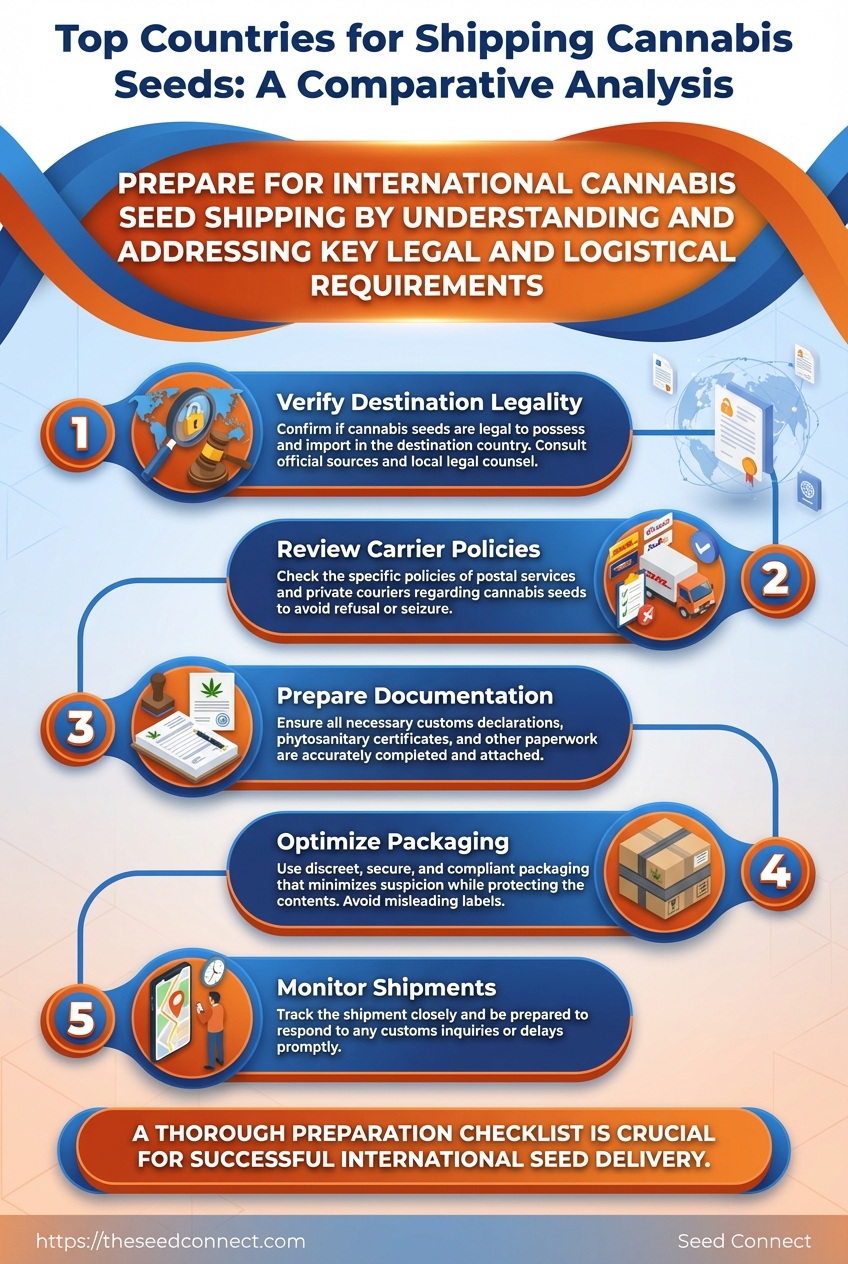
Start by confirming whether the destination country legally allows the import or possession of cannabis seeds—this single check changes everything. After legality, verify the seller and prepare all paperwork, then build a contingency plan before you place the order. The sequence matters: legality → seller verification → documentation → contact accuracy → contingency planning.
Step-by-step pre-shipment checklist
- Confirm legal status in the destination country.
- Verify the seller’s credentials and track record.
- Prepare accurate recipient details and contact information.
- Compile and double-check documentation.
- Choose a discreet and compliant shipping method.
- Plan for contingencies before placing the order.
1.1 Check national regulations and recent reforms; some countries allow seeds for “research” or “industrial” use only.
1.2 If unclear, contact the destination country’s customs or a local licensed importer before ordering.
2.1 Ask for proof of successful international deliveries to the same country.
2.2 Look for germination guarantees and clear refund/return policies.
3.1 Provide a full legal name, phone number, and physical address (no P.O. boxes where prohibited).
3.2 Share an alternate contact and email to reduce delivery delays.
4.1 Required documents: commercial invoice, itemized packing list, and any permits or phytosanitary certificates the destination requires.
4.2 Use consistent descriptions across documents—don’t mix “seeds” with vague terms like botanical sample.
5.1 Trackable shipping: always choose a service with end-to-end tracking and insurance.
5.2 Customs-friendly packaging: avoid labels that could trigger inspection; follow both sender and receiver country guidelines.
6.1 Customs hold: decide who pays duties and how long you’ll wait before requesting a return.
6.2 Failed delivery: set a fallback address or local agent who can receive and handle permits.
Practical examples and small details that save headaches
Example — paperwork mismatch: A buyer used different item descriptions on the invoice and the label; customs flagged the parcel and destroyed it. Matching commercial invoice wording to the packing list avoids this.
Example — contact accuracy: An incorrect phone number delayed release for 5 days; a local courier contact would have cleared it in hours.
Insurance tip: If the seed seller offers a germination guarantee and international support, that reduces risk—consider reputable suppliers such as cannabis seeds for sale who publish clear policies.
Take two minutes now to run through this checklist before ordering. That small upfront effort avoids weeks of delay, lost parcels, or legal exposure—and keeps the grow on schedule.
Conclusion
Shipping cannabis seeds across borders is doable when the legal landscape, carrier rules, and packaging are treated as the project’s three pillars. Over the course of this article, comparing markets like Germany’s recent reform trajectory and Thailand’s pilot programs showed how policy shifts reshape risk and opportunity; practical checklists and the case study about a Canadian exporter reducing customs delays by standardizing documentation demonstrated solutions that work. If you’re wondering whether a destination accepts seed imports, start by checking national laws and the carrier’s policy — and if delays are a concern, using clear phytosanitary paperwork and discreet, compliant packaging cuts hold-ups dramatically. Assess each target country individually and plan for the strictest rule that may apply.
For growers and teams looking to move from planning to action, begin with a short audit: country legal status, carrier acceptance, required documents, and seed labeling standards. Prepare compliant paperwork, pick carriers with seed experience, and price shipping contingencies into timelines. To streamline sourcing and get transparent shipping options in one place, consider browsing available varieties and their shipping support: Browse our guaranteed cannabis seeds and shipping options.