



You scroll a forum or social feed and spot a flashy post promising premium genetics at half price. Those too-good-to-be-true offers are often fake cannabis promotions, engineered to bait impulse buyers and collect payments without delivery. They show up everywhere — DMs, seed forums, and classifieds — and often target new growers who value price over provenance. Scammers copy breeder photos, invent glowing reviews, and push scam seed deals that require instant payment through obscure channels like cryptocurrency or gift cards. Often they promise fast shipping or a germination guarantee, borrowing logos from real breeders to look credible. The red flags can be subtle, which makes vigilance essential. A few simple checks separate legitimate sellers from fraudsters. Spotting blurred details, inconsistent pricing, or fake tracking numbers makes it much easier to avoid fraudulent offers. Learning a few verification habits protects cash and saves months of disappointment.
Table of Contents
- Recognizing the problem: a vivid scenario
- Common red flags in fake seed promotions
- Step-by-step checks before you click or pay
- Real-world signs from product pages and reviews
- What to do if you suspect a scam
- Where to buy with confidence
Recognizing the problem: a vivid scenario
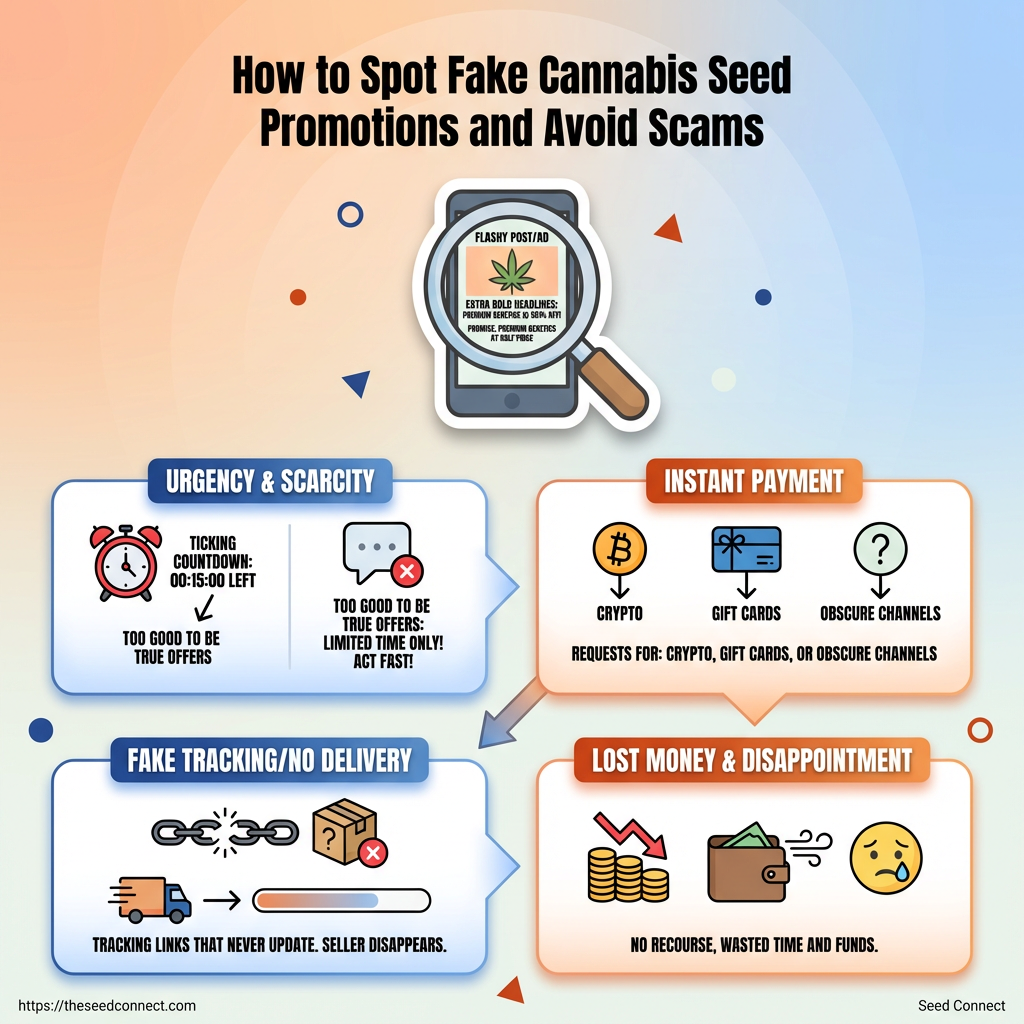
Have you ever clicked an ad that seemed tailor-made for your wishlist and felt a small thrill? Maybe it promised ten seeds for the price of two, glowing photos, and a ticking countdown that screamed urgency. That rush is exactly what scammers design for — a fast decision before doubts form. Imagine paying with a credit card, getting a receipt, and then a tracking link that never updates. Weeks pass. Messages go unanswered. The seller disappears and your money vanishes with the promise of plants. This scenario is painfully common and easy to miss when the offer looks flawless and the price is irresistible. A single click can spiral into lost time, money, and frustration. The technical trick is simple: scammers copy real storefronts, fake testimonials, and push scarcity to force a snap buy. When the checkout feels rushed, phishing and fake tracking can follow, leaving buyers without recourse. A single click, and the trap closes This usually starts with a polished ad on social media or a search result. The site looks legitimate at first glance, complete with glossy strain photos and stock reviews. Before buying, compare the deal against known sellers. Platforms like cannabis seeds for sale show typical price ranges and product descriptions you can use as a baseline.
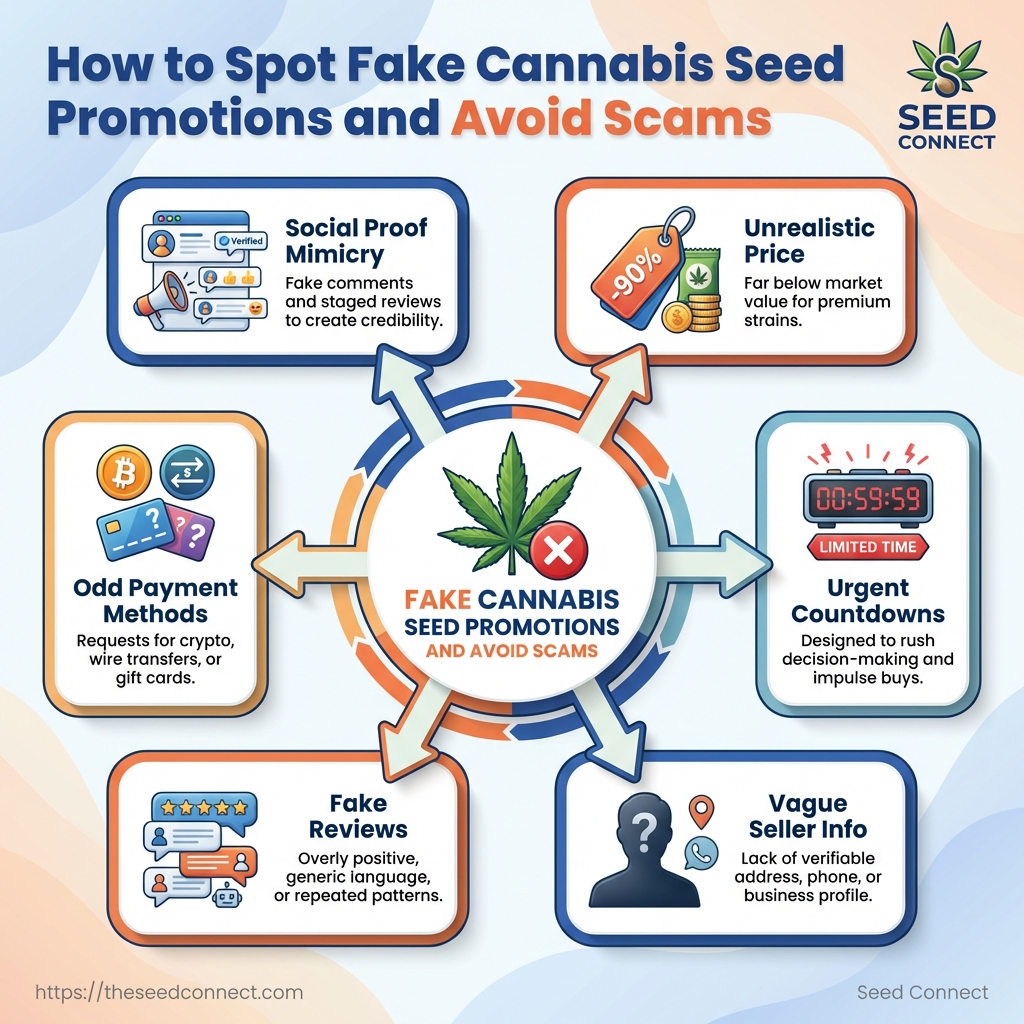
- Unrealistic price: An offer far below market value for high-THC or rare strains.
- Urgent countdowns: Timers designed to rush decision-making.
- Vague seller info: No verifiable address, phone, or public business profile.
- Fake reviews: Overly positive testimonials with generic language or repeated patterns.
- Odd payment methods: Requests for wire transfers, crypto-only, or gift cards.
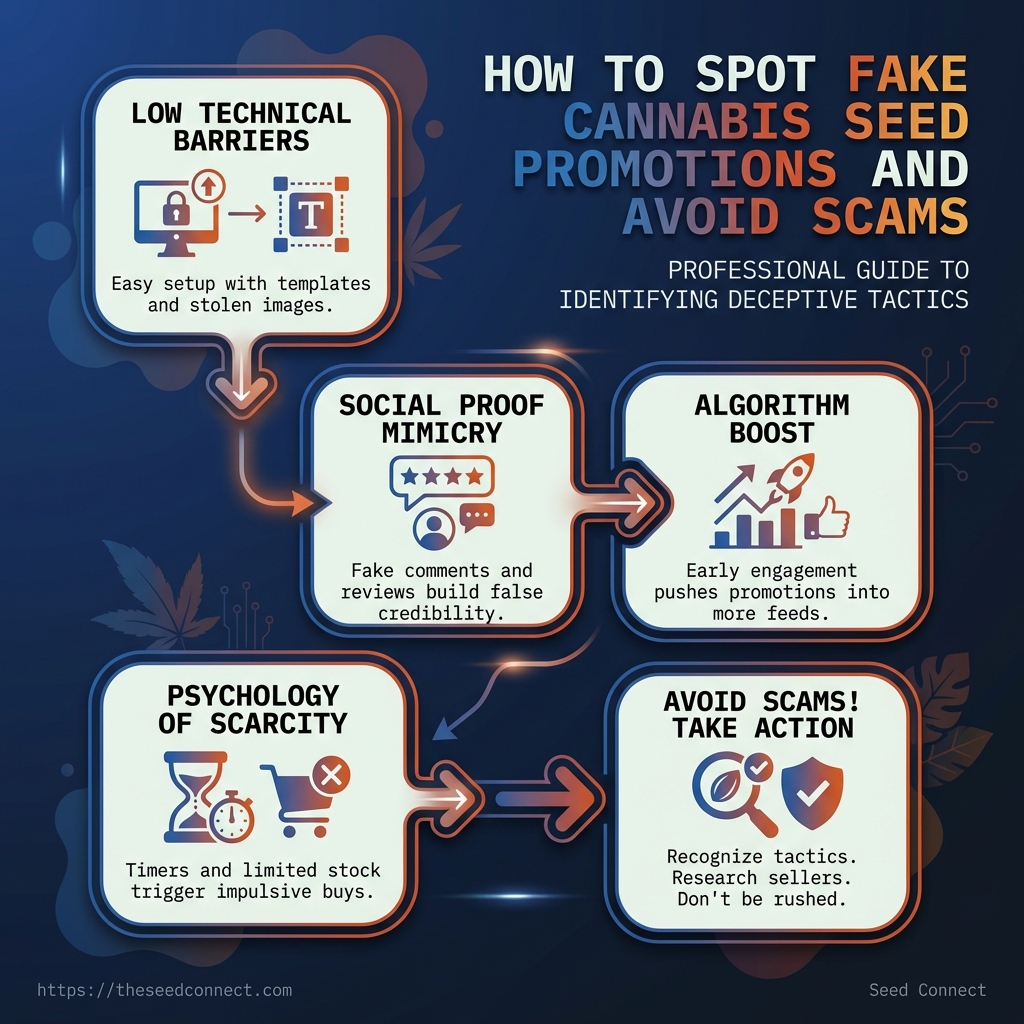
The screenshot highlights three red flags to watch: unusually low price, an aggressive countdown, and a seller name that doesn’t match any business listing. Use this as a checklist when scanning offers. Why fake promotions spread so fast These scams scale because they require little upfront cost and can be automated. Fake sites and ad accounts multiply quickly, then vanish when flagged. Social proof plays a big role. Scammers replicate comments and use affiliate networks to seed the offer across forums and groups. Algorithms amplify posts that get quick engagement, so a few early clicks make the scam look popular.
- Low technical barriers: Templates and stolen images make setup easy.
- Social proof mimicry: Fake comments and staged reviews create credibility.
- Psychology of scarcity: Timers and limited-stock claims trigger impulsive buys.
- Algorithm boost: Early engagement pushes the promotion into more feeds.
Spotting these patterns early saves money and stress. Trust instincts when something feels rushed or too good to be true.
Common red flags in fake seed promotions
Fake seed promotions usually hide in plain sight. They pair excitement with pressure: jaw-dropping prices, urgent timers, and shiny badges that look official. When those elements appear together, it’s a red flag worth pausing for a closer look. Experienced growers learn to sniff out patterns. Scammers recycle stock photos, paste generic badges, and copy glowing reviews from other sites. Cross-checking a suspicious listing against established catalogs, such as learn about cannabis seed genetics, helps reveal inconsistencies fast. Below are the most common giveaway signals and practical checks you can run in under a minute.
- Bold, impossible prices: If a premium strain is listed at an absurdly low price, the math rarely works out for a reputable seller.
- Overdone bulk deals: Claims like “500 seeds for $20” with no purchase limits usually mean low-quality or non-existent stock.
- Fake badges and awards: Generic “Trusted Seller” graphics with no links are easy to paste. Verify badges by clicking them.
- Copied reviews and stock photos: Identical customer quotes across unrelated pages or reversed-image stock photos are big warnings.
- Suspicious domains and handles: Random strings, extra hyphens, or social accounts created days ago suggest a fly-by-night operation.
- Weird payment methods: Requests for gift cards, cryptocurrency, or direct wire transfers instead of card/paypal are riskier.
- No verifiable contact info: Listings with only a chat widget and no physical address or reachable email are a problem.
Pricing and offers that sound impossible
Ad element | What scammers often show | What a legitimate seller shows | Quick check |
|---|---|---|---|
Price per seed | Extremely low unit price (e.g., cents per seed) | Realistic pricing reflecting strain and rarity | Compare against several reputable catalogs |
Bulk discounts | Massive discounts for huge packages with no limits | Tiered, transparent bulk pricing with clear stock notes | Check terms and reported stock levels |
Time-limited countdown | Persistent countdowns reset on refresh | Genuine limited-time deals with archive or announcement | Refresh page; look for cookie-based timers |
Free shipping claims | “Free worldwide shipping” for all orders | Shipping tiers by region and weight | Calculate expected shipping costs separately |
Guarantee wording | Vague “satisfaction guaranteed” with no details | Clear germination guarantees and return policy | Request written guarantee terms |
Shipping timeframe | Promises of next-day international dispatch | Realistic 3–21 day shipping windows with tracking | Ask for tracking number after purchase |
Payment methods | Only gift cards or crypto accepted | Standard card processors, PayPal, or reputable gateways | Avoid non-refundable payment requests |
Contact information | No address, transient email, or only chatbots | Full contact details and customer support hours | Verify address with a map search |
Reviews & badges | Reused quotes, anonymous 5-star blitz | Mixed reviews, verifiable customer accounts | Reverse-search review snippets and images |
Stock photos | Generic plant or seed bank stock images | Photos of actual product packaging or live grows | Do a reverse image search on photos |
Scammers rely on emotional triggers: urgency, scarcity, and social proof. Running the quick checks in the table usually exposes the gaps. A few simple habits — pause on extreme offers, verify badges, check domain age, and demand traceable payment options — will save time and money. Trust your instincts; if something looks too good to be true, it usually is.
Step-by-step checks before you click or pay
Ever feel a rush when a deal looks too good to be true? Slow down for sixty seconds. Small checks now save hours of headache and lost money later. These steps are practical and repeatable. Treat them like a short pre-flight checklist before handing over payment or personal data.
Verify the seller’s identity and history
Trustworthy sellers leave a trail. Look beyond the product page: check the domain age with a WHOIS lookup, scan their social profiles for consistent branding, and confirm a working phone number and physical address on the site. Read several recent customer reviews on independent forums, not just on the vendor’s site. If a vendor refuses to share basic business details or their history feels thin, treat that as a red flag. For reference on how established vendors present guarantees and contact info, compare listings for cannabis seeds for sale.
- Domain check: Confirm domain age and registration details via a
WHOISlookup; very new domains merit caution. - Contact test: Call the listed phone number and email a question; slow or nonfunctional replies are suspicious.
- Reputation scan: Search for forum threads and third-party reviews mentioning delivery quality and dispute resolution.
Payment and shipping red flags to watch for
Payment and shipping are where scams convert curiosity into loss. Use secure payment methods that offer buyer protection and demand traceable shipping with valid tracking numbers. Below is a practical checklist showing safe indicators, risky signs, and what to do if you spot them.
Payment and shipping red flags to watch for (checklist)
Check | Safe indicator | Risky indicator | Action if risky |
|---|---|---|---|
Unsecured checkout |
| Checkout page loads | Do not enter card details; contact support and verify certificate |
Payment method | Credit card or trusted processors with disputes | Only accepts bank wire or untraceable crypto | Use payment with buyer protection or cancel purchase |
Request for wire transfer/crypto | Optional alternative, but not required | Insists on wire/crypto only | Refuse payment and choose another seller |
Fake escrow services | Third-party escrow with verifiable URL | Escrow email or link that mimics real services | Verify escrow domain independently; call escrow company |
Lack of tracking number | Carrier and tracking provided immediately | No tracking or generic “shipped” notice | Demand tracking before payment or refuse order |
Ambiguous customs documentation | Clear customs paperwork and item description | Vague paperwork or misdeclared contents | Ask for exact documentation; refuse if unclear |
No returns policy | Clear, written returns and replacement terms | “No returns” or no policy page | Avoid buying; require written guarantee |
Unrealistic low price | Price aligns with market and variance explained | Far below market without explanation | Treat as bait; verify seller credentials |
No physical address | Full address verified on multiple pages | Only PO box or no address listed | Request full address or avoid purchase |
Discrepant shipping origin | Matches seller’s stated location | Origin changes with each order | Ask for consistent shipping origin or walk away |
This checklist turns vague instincts into specific actions. If multiple risky indicators show up, the safest choice is to pause and verify further.
Confirm germination guarantees and support options
A real germination guarantee is specific. Good guarantees state exact replacement terms, required proof (photos, germination logs), and a clear timeline for claims. Beware vague promises like “we guarantee quality” with no follow-up steps. Check available support channels: email, phone, live chat, and after-sale help from experienced growers. If a seller won’t document their guarantee or refuses to explain how claims are processed, that’s a practical reason to look elsewhere. Do these checks every time. A quick verification habit will filter out most scam seed deals before they cost anything.
Real-world signs from product pages and reviews
Have you ever read a product description that felt suspiciously perfect and wondered what it was hiding? Product pages and reviews carry tiny tells. Learn to read them like a detective instead of a trusting shopper. A genuine listing answers basic grower questions clearly. It names variety lineage, expected flowering time, THC/CBD ranges, and any guarantees like germination guarantee. If those basics are missing or deliberately vague, treat the listing as low trust. Reading product descriptions for authenticity Start by checking whether the description explains why the strain behaves a certain way, not just claims. Authentic pages include specifics: parent strains, typical yields, environment preferences, and honest caveats about variability. Generic copy full of hype and stock photos is a red flag.
- Check the specifics in order:
- Lineage listed: Parent strains and cross details present.
- Growing metrics: Flower time, yield, and common issues included.
- Guarantees and terms: Clear
germination guaranteetext and return policies. - Original photos: Multiple photos showing plants at different stages.
- Lineage clarity: Look for parent names and breeding notes; vague lineage often signals copied descriptions.
- Real metrics: Expect numeric ranges (e.g., 8–10 weeks flowering). Blank or overly optimistic numbers are suspect.
- Policy transparency: A clear shipping and refund policy reduces the risk of scam seed deals.
Compare listings to reputable references. For a sanity check, look up similar varieties on trusted vendor pages such as learn about cannabis seed genetics. Seeing consistent metrics across reputable sites is reassuring. Spotting fake reviews and manipulated ratings Review fraud often follows patterns. Fake clusters use similar language, repeat the same phrases, and flood ratings within a short time window. Genuine reviews show a spread of experience levels, dates, and specific grow details.
- Timestamp clusters: Many 5-star reviews posted the same day — suspicious.
- Language repetition: Near-identical sentences across several accounts.
- Profile thinness: Reviewers with zero other activity or brand-new accounts.
- Overly generic praise: No details about growth, smell, or yield.
The visual above contrasts genuine review behavior with fake clusters, showing timestamp patterns, repeated phrasing, and profile age differences. Use that chart when scanning new listings to spot inauthentic patterns quickly. Small checks on descriptions and review patterns stop most scam seed deals before payment. Trust listings that provide verifiable details and a trail you can follow.
What to do if you suspect a scam
Noticing a suspicious ad or deal can feel small at first, but acting quickly makes recovery far more likely. Start by treating every interaction as evidence: screenshots, emails, timestamps and payment records are the currency you’ll need if you challenge a charge or report the seller. Remain calm when contacting anyone involved. Clear, factual messages with specific details get faster responses from banks, marketplaces, and fraud teams. Keep a running log (date, time, platform, what you clicked, who you paid) so nothing gets missed later. If you want a quick reference to legitimate seed offerings while you verify a seller, compare suspicious listings with catalogs like discover popular marijuana strains to see obvious mismatches in pricing, SKU formats, or product names.
Immediate steps: documentation, chargebacks, and reporting
- Capture proof: Save screenshots of the ad, product page, confirmation emails, and payment receipts.
- Record details: Note the
transaction ID, the seller’s email, invoice number, and any chat logs. - Pause other payments: Stop any pending recurring payments or saves of card data on that platform.
- Contact the seller: Politely request a refund and a cancellation confirmation in writing. Keep that reply.
- Open a dispute: If payment was by card or processor, file a dispute/chargeback with your bank. Include the proof you collected and a short timeline.
- Notify the payment service: Report fraud to the payment provider (PayPal, Stripe, card issuer). Ask for the merchant’s acquiring bank details if available.
- Keep copies: Export PDFs of everything and back them up in cloud storage or an encrypted folder.
How to escalate: platforms, payment providers, and consumer registries
- Marketplace reporting: Report the listing to the site or ad network—use their “report fraud” option and attach screenshots.
- Payment provider escalation: Ask your card issuer for a provisional credit and
chargeback reason codeguidance if the first dispute stalls. - Social platforms: Flag the ad or seller account on Facebook, Instagram, or other sites where the promotion ran.
- Consumer registries: File a complaint with national consumer protection agencies or your country’s fraud reporting center to add official documentation.
- Law enforcement: For larger losses, file a police report and include your documentation packet.
Acting fast and keeping everything organized increases the odds of reversing payments and stopping further scams. If you suspect fraudulent seed offers, move from suspicion to structured action right away.
📥 Download: Download Template (PDF)
Where to buy with confidence
Choosing a seller is as important as choosing genetics. A reliable source protects your time, your investment, and your harvest expectations. Treat the purchase like a small project: scope the seller, confirm protections, and keep records of the transaction. Most buyers do better if they prioritize a few trust signals before they hit “buy.” That saves back-and-forth with dodgy merchants and reduces the chance of lost packages or useless seeds. Below are quick priorities to use when you’re scanning options.
- Start with guarantees: prefer sellers that clearly state a
germination guaranteeor replacement policy. - Verify clear logistics: look for explicit shipping, customs, and delivery guidance for your country.
- Confirm live support: choose sellers with reachable email, chat, or phone support during buying hours.
- Require secure payments: sites that accept cards or well-known processors show better fraud protection.
Checklist for choosing a trusted seed seller
Trust feature | Why it matters | How to verify |
|---|---|---|
Germination guarantee | Protects you if seeds fail to sprout | Look for written guarantee terms and a clear claims process on the product page |
Clear shipping & customs guidance | Prevents surprises and lost packages | Check country-specific shipping notes and delivery timelines in checkout or FAQ |
Transparent contact/support | Lets you resolve issues quickly | Find working email, phone, or chat; send a question and note response time |
Third-party reviews / press coverage | External validation reduces risk | Search independent forums, review sites, and press mentions for consistent feedback |
Secure payment options | Reduces fraud and chargeback problems | Ensure |
Detailed strain genetics & lineage | Sets realistic expectations for growers | Review strain descriptions, lineage, and breeder notes for transparency |
Clear return/refund policy | Shows commitment to customer satisfaction | Read return policy for seeds, timelines, and required proof for claims |
Physical business address & registrations | Adds legitimacy and accountability | Look for a verifiable address, company name, or business registration details |
Sample grow guides & expert support | Helps translate seeds into results | Check for downloadable grow guides or available grower consultations |
The table compresses what to look for and practical verification steps so you can compare sellers quickly. Use it as a pre-purchase checklist and keep screenshots or saved pages when you buy.
How Seed Connect backs purchases and where we can help
Seed Connect offers a clear germination guarantee and dedicated grower support that handles replacement questions and basic troubleshooting. Their product pages include strain details and shipping guidance so buyers can make informed choices before checkout. For readers who want one place to start researching reputable providers, consider The Seed Connect cannabis seeds as an example of a seller that publishes support and guarantee information alongside product specs. That transparency is what separates predictable purchases from risky ones. Buying from a seller who documents guarantees, shipping rules, and support saves headaches later. Keep this checklist handy next time you’re comparing offers.
Conclusion
Spot the scam before it costs you
Seen a flashy post promising premium genetics at half price? Those too-good-to-be-true bait ads are the single best signal that something’s off. The most valuable thing to hold on to is this: slow down and check the basics — price realism, seller traceability, honest photos, and a clear germination promise — before you click or pay.
Remember the example about a forum post with stock photos and contradictory reviews; those are exactly the real-world signs that expose fake cannabis promotions and other scam seed deals. Learning to read product pages and review patterns makes it easy to identify fraudulent offers without expert tools. When details don’t add up, treat the listing like a red flag and move on.
Do one concrete thing today: run a five-minute seller audit — reverse-image the photos, scan reviews for repetition, verify contact info, and confirm a germination guarantee. If you want an easy comparison point, platforms like buy marijuana seeds online list vendors with clear guarantees and transparent pages. Try that audit on the last seed ad you saw and see what turns up — it’s the habit that saves money and disappointment.