


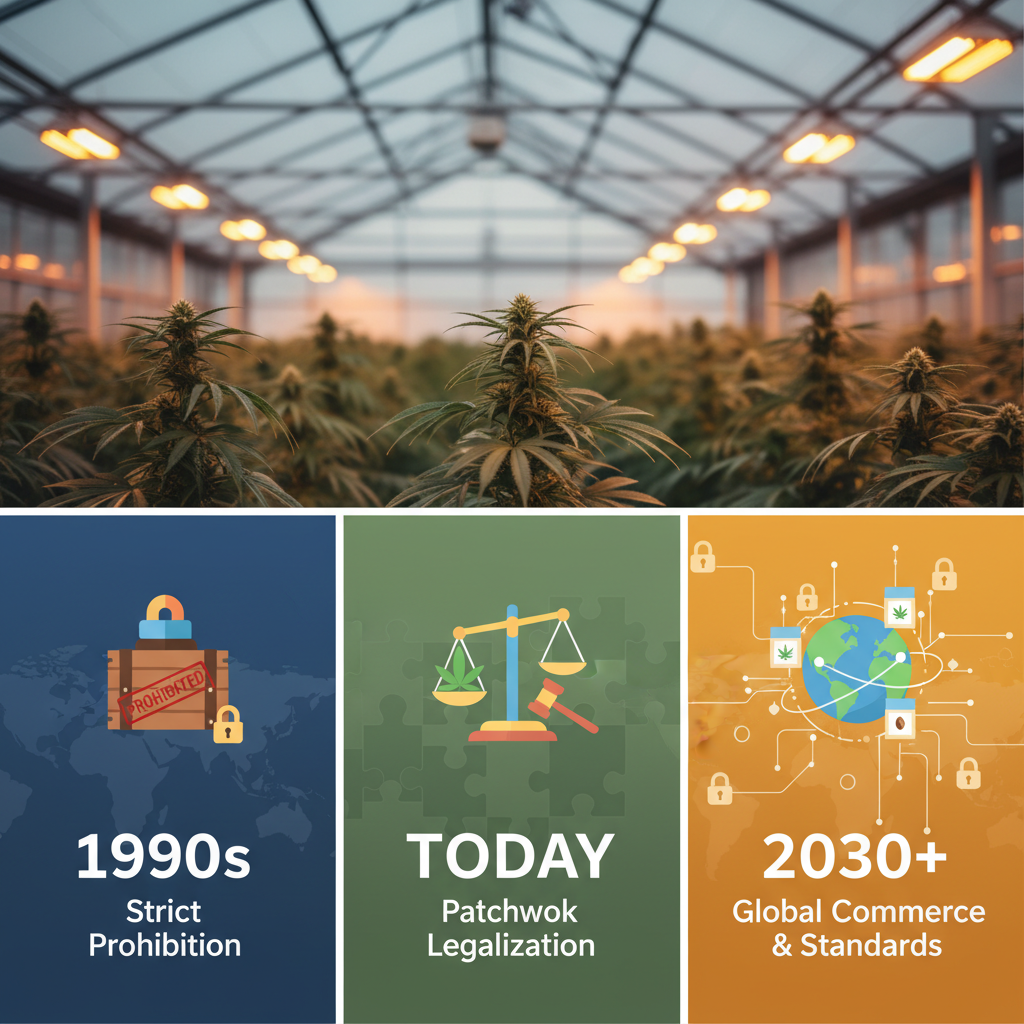
For breeders and mail-order growers, sending seeds across state lines often feels like navigating a legal minefield.
Packages delayed, reclassified, or returned after weeks is a familiar frustration for anyone chasing consistent genetics.
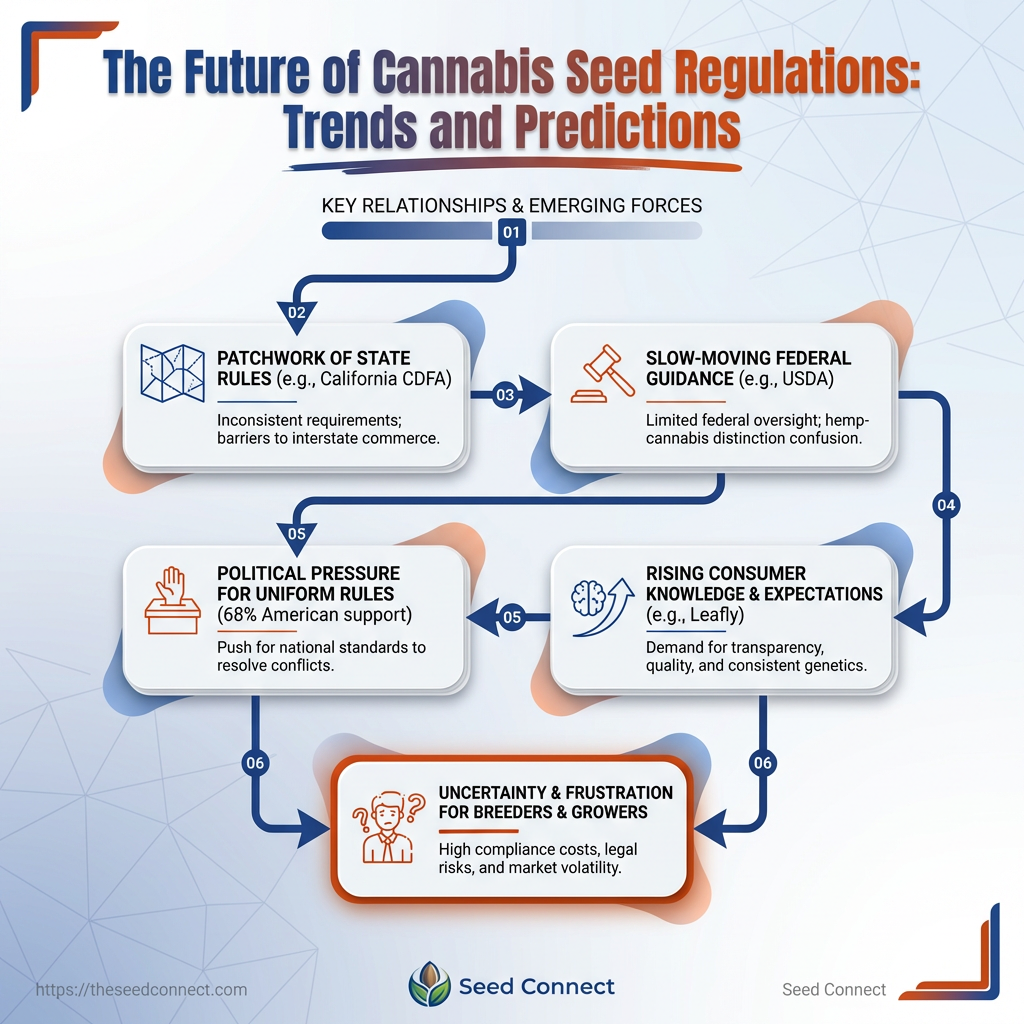
A patchwork of state rules sits beside slow-moving federal guidance from the USDA, leaving uncertainty about future cannabis regulations.
California’s CDFA has already set detailed seed testing and labeling rules, showing how states frequently write the playbook before federal clarity arrives.
Rising consumer knowledge is a central force behind modern cannabis law trends.
Platforms such as Leafly amplify strain data and buyer expectations, nudging regulators toward transparency, testing, and genetic verification.
With roughly 68% of Americans supporting legalization, political pressure for uniform rules will increase.
That shift underpins sensible seed shipping predictions: smoother interstate commerce, clearer labeling, and standardized germination and testing requirements.
Table of Contents
- Why seed regulations matter for growers now
- Current global landscape: snapshot of laws that influence seed shipping
- Regulatory trends shaping the next 3–10 years
- Predictions specifically for seed shipping and cross-border commerce
- How growers and sellers can prepare today
- Policy watch: who to follow and signals to monitor
- How to stay ahead as seed rules keep shifting
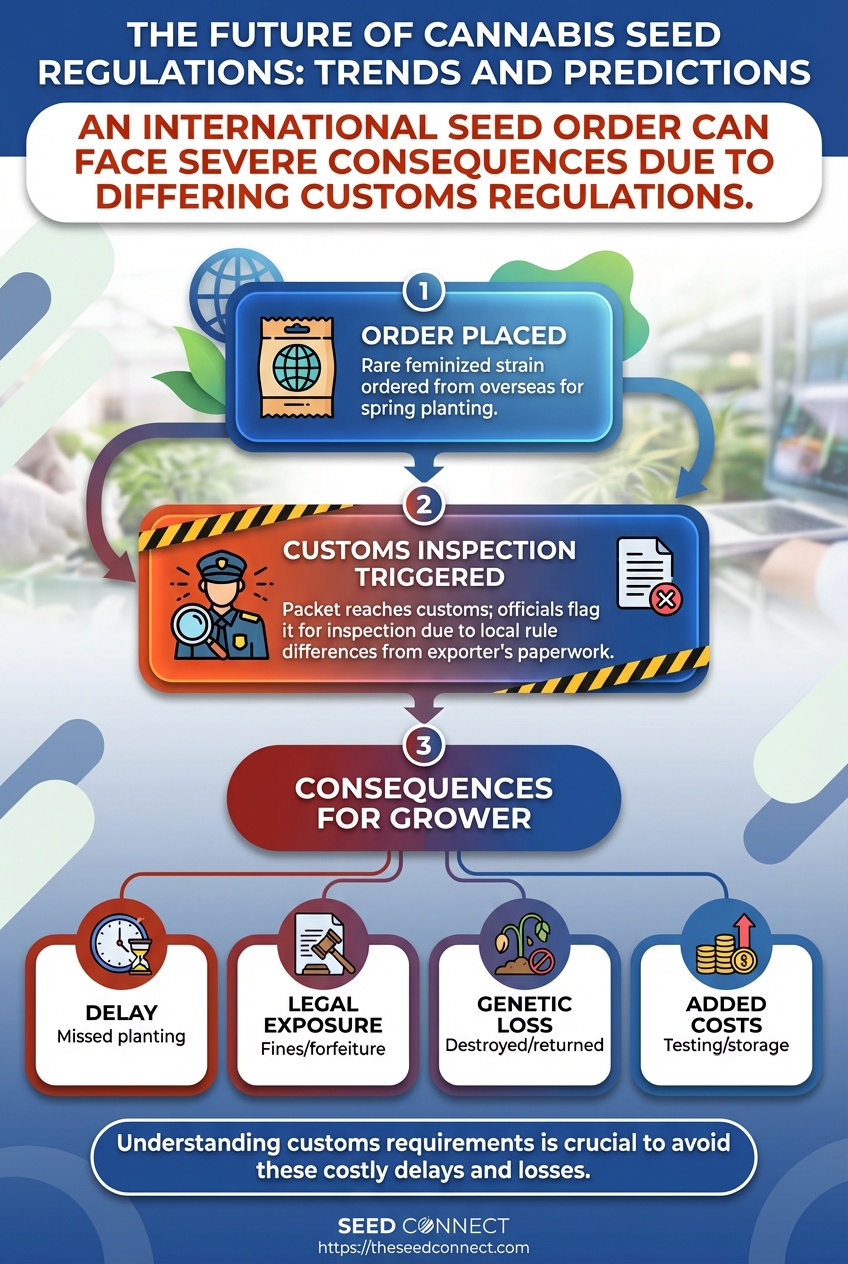
Have you ever pictured a packet of prized genetics sitting in a customs warehouse while a season slips away? The scenario is becoming all too common as regulations shift. Small growers are particularly hard-hit by these changes. As public opinion increasingly favors legalization, with a significant proportion of Americans supporting clearer regulations, agencies like the USDA and state bodies such as the California Department of Food and Agriculture are working to clarify guidance affecting seed movement and testing. These overlapping regulations dictate how quickly seeds arrive at farms and the proof required to move them, often leading to longer lead times and increased paperwork.
Current global landscape: snapshot of laws that influence seed shipping
How far you can send a packet of seeds depends almost entirely on the jurisdiction(s) it crosses.
National and subnational rules now determine whether a shipment is routine, held for inspection, or seized — and those rules are changing as public opinion and policy shift.
In North America, federal, provincial/state, and local rules sit on top of one another.
The USDA and state agencies like the California Department of Food and Agriculture (CDFA) set practical pathways for hemp seed movement, while federal scheduling of cannabis creates legal friction for non-hemp varieties.
Across Europe, Latin America, Asia-Pacific and Africa the picture is patchwork: some countries allow regulated seed sales, others permit private cultivation, and many still classify seeds as prohibited imports.
Expect more change as public support — driven in part by shifting attitudes reported in surveys such as Pew’s finding that 68% of Americans favor legalization — pushes lawmakers toward clearer national frameworks.
That momentum feeds into future cannabis regulations and seed shipping predictions, especially around standardized paperwork and testing requirements.
Common permit types and customs practices that impact seeds
Region | Typical classification of seeds | Common permit/document required | Typical customs outcome (release, hold, seizure) |
|---|---|---|---|
United States (federal) | Hemp seeds generally allowed if ≤0.3% THC; non-hemp cannabis seeds face legal restrictions |
| Domestic hemp shipments often released; international inbound shipments commonly held or seized without proper paperwork |
United States (California) | State-regulated cannabis seed market under CDFA oversight for commercial activity | CDFA registration or state cannabis business license for sellers | In-state shipments usually released; shipments crossing state lines risk hold due to federal/state conflict |
Canada | Cannabis seeds legal domestically and regulated under federal law | Licensed seller documentation; import requires Health Canada authorization | Domestic releases routine; international imports subject to denial without federal authorization |
European Union (Germany) | Seeds treated variably; medicinal frameworks influence enforcement |
| Customs may hold for verification; seizures possible if classified as controlled |
European Union (Netherlands) | Tolerant retail market for certain seed sales; national laws still apply |
| Many retail sales allowed domestically; cross-border shipments face holds or seizure |
Latin America (Uruguay) | Regulated domestic production and sales in Uruguay; progressive policies in some countries | National cannabis authority permits or import/export licenses | Domestic releases common in regulated markets; regional imports vary widely |
Latin America (Mexico) | Legal landscape in flux; state and federal rules evolving | Import permits or health authority approvals when allowed | Outcomes range from release in regulated channels to seizure where prohibited |
Asia-Pacific (Thailand) | Recent decriminalization led to complex transitional rules | Health ministry notifications or special permits in many cases | High risk of hold or seizure in neighboring countries still prohibiting seeds |
Asia-Pacific (Australia) | Medicinal and research frameworks allow licensed seed import | Import permit, | Licensed imports are released; unlicensed shipments seized or returned |
Africa (South Africa) | Private cultivation permitted; commercial frameworks variable | Import permits and health/cannabis authority approvals where commercial activity exists | Domestic private movement often tolerated; international imports commonly held or seized without permits |
The table shows consistent patterns: paperwork matters, and classification drives outcomes.
Papers like phytosanitary certificates and national licenses are the most common items customs expect. Practical red flags to watch for before shipping seeds:
- Missing
phytosanitary certificate: Customs commonly demands this; absence often leads to holds or rejection. - Seller lacks local license: If the vendor can’t show a business or cultivation license, expect scrutiny.
- Country-specific bans: Some nations explicitly prohibit cannabis seed imports; shipments there face high seizure risk.
- Mislabeling varieties or THC content: Declaring seeds as a different species or misreporting THC levels can trigger legal penalties.
- Cross-border paperwork mismatch: State-level permissions don’t always protect international transit; multiple permits may be required.
Regulatory friction will keep changing, and tracking national policy updates is essential for accurate seed shipping predictions.
Staying current with agencies like the USDA and state regulators such as the CDFA reduces surprise holds and costly seizures.
Regulatory trends shaping the next 3–10 years
How will the rules that govern seeds and shipping actually change while growers plan seasons and source genetics? Expect an uneven but decisive shift: more places will loosen criminal penalties and regulate retail, while enforcement at borders and for traceability will tighten.
Federal guidance and state agencies like the USDA and CDFA will steer technical standards even as consumer pressure reshapes market expectations.
Policy will move in two directions at once.
Domestic retail and licensing regimes will broaden access and standardize testing, driven partly by public support (about 68% of Americans favor legalization).
At the same time, customs, plant health authorities, and international mail rules will impose stricter controls focused on genetics and provenance.
Trend 1 — gradual decriminalization and its limits
Many jurisdictions will decriminalize possession and retail sale, but that won’t erase regulatory baggage for seeds.
States are likely to expand licensing, seed testing, and labeling requirements while still restricting interstate commerce.
Federal agencies such as the USDA may publish guidelines that harmonize definitions for hemp versus cannabis genetics, but federal law changes will be gradual and conditional.
Expect expanded legal markets, paired with continued limits on cross-border movement of germplasm.
Trend 2 — tighter cross-border controls focused on genetics and traceability
Border agencies will shift from random inspections to intelligence-driven screening that flags high-risk shipments based on genetic markers and documentation.
That raises the bar for lawful international shipping.
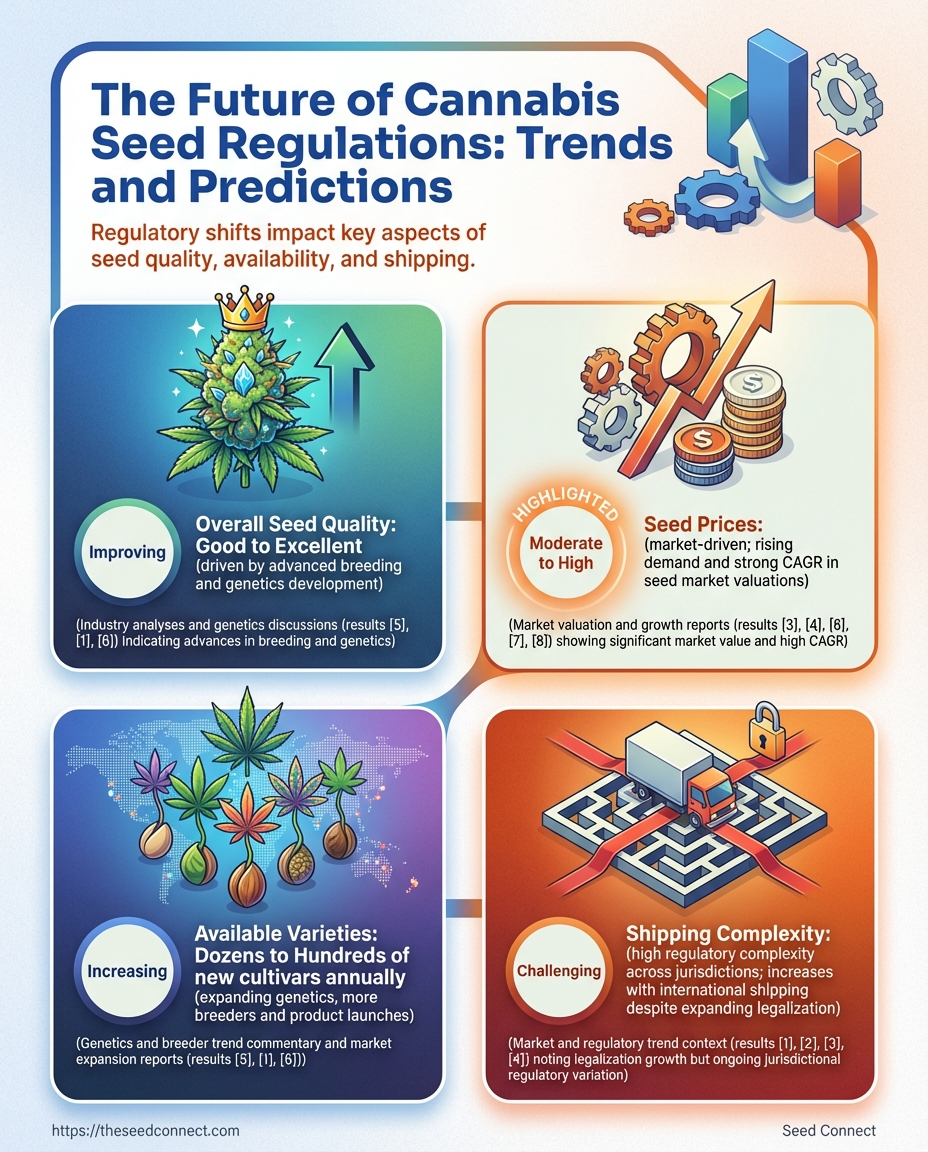
The timeline shows likely milestones: stepped-up domestic licensing, phased adoption of genetic traceability, major court rulings clarifying transport rules, and eventual international agreements on seed movement.
The visual highlights how regulation intensifies before any reconciliation of cross-border rules.
Trend 3 — increasing use of DNA/QR traceability to verify seed provenance
Lab-grade DNA barcoding and QR-enabled chain-of-custody will become common for premium genetics.
Retailers and breeders will use these tools to prove origin, fight fraud, and meet buyer expectations.
- Verification: DNA barcodes tied to batch records will prove a seed’s lineage.
- Consumer access: QR codes let buyers check lab reports and grower notes instantly.
- Adoption path: testing labs, registries, and retailers will integrate traceability systems over several years.
For growers curious about genetics and provenance, a practical resource is learn about cannabis seed genetics.
Trend 4 — divergence between domestic retail laws and international shipping rules
Domestic law liberalization will outpace changes to international shipping protocols.
Countries may allow broad retail sales while still prohibiting import/export of viable seeds without permits or phytosanitary certificates. s matter here. Traceability: The documented chain linking seed to breeder and test results. Provenance: The verified geographic and genetic origin of a seed. Decriminalization limits: Legal retail does not equal free cross-border movement.
Regulatory change will create opportunity and friction at once.
Growers who track provenance and build compliant supply chains will navigate the next decade far more easily than those relying on informal channels.
Predictions specifically for seed shipping and cross-border commerce
Want to know where a packet of seeds will actually get delayed or cleared over the next decade? Enforcement will stay clustered, but the tools used to judge shipments will change fast.
Expect more checkpoints tied to paperwork and machine-verifiable proofs rather than just physical inspection.
Growers and exporters should budget for new document types and short windows for compliance.
That matters because a late certificate or missing digital token can turn a same-day courier into a three-week customs backlog.
Meanwhile, buyers will demand traceable genetics.
As consumers read more about strain lineage on sites like Leafly and as state programs such as those run by CDFA emphasize lab testing, seeds that carry verifiable provenance will command smoother entry.
Short-term (1–3 years): enforcement hotspots and compliance windows
Customs and plant-health agencies will focus enforcement where legal frameworks are ambiguous and trade volumes are high.
Ports with mixed cargo and states with active domestic markets will be hotspots.
- High-risk route monitoring: Expect more targeted checks on packages routed through jurisdictions lacking clear seed policies.
- Tight compliance windows: Shipments may require certificates issued within narrow timeframes—often days, not weeks.
- Paper-first inspections: Physical documents and lab reports will still trigger holds more than blockchain receipts.
Consider the USDA and state departments like CDFA as the practical gatekeepers in the U.S., with their timelines shaping whether a planting season is lost or saved.
Medium-term (3–6 years): technology-driven compliance and new document standards
Compliance will shift from paper to digital proofs.
Expect standardized digital phytosanitary documents, machine-readable genetic tags, and pre-clearance APIs shared between customs and agriculture agencies.
These tools will speed clearance when implemented, but they also create a new set of rules exporters must follow.
Accredited labs and customs portals will become central hubs.
Automation will cut average hold times for compliant shipments, but verification fees and scanning requirements will add predictable costs.
Technology & document features likely in use
Medium-term (3–6 years): technology-driven compliance and new document standards
Feature/Document | What it proves | Who issues it | Impact on shipping time/cost |
|---|---|---|---|
Digital phytosanitary certificate | Plant health status and freedom from regulated pests | USDA APHIS or state agriculture departments (e.g., CDFA) | Speeds clearance if valid; modest issuance fees |
Genetic traceability QR tag | DNA match to declared cultivar | Accredited genetic testing lab or certified seed vendor | Faster identity checks; lab costs increase unit price |
Importer authorization letter | Local importer has legal right to receive seeds | Licensed importer/consignee | Prevents seizures; minimal cost, but missing letters cause delays |
Automated customs pre-clearance | Pre-validated customs risk assessment | National customs agency (e.g., CBP) or digital customs portal | Reduces inspection holds significantly; setup fees for integrations |
DNA-backed origin report | Proven geographic and breeder origin | Accredited genetic testing lab | Strong provenance reduces rework; adds testing time/cost |
Accredited lab test report (pathogen/pesticide) | Absence of regulated pathogens/chemicals | Accredited analytical laboratory | Required in many markets; adds days and lab fees |
Chain-of-custody electronic manifest | Handling history from seed bank to shipper | Freight forwarder or third-party logistics provider | Lowers disputes; minor added admin cost |
Electronic airway bill (e-AWB) | Shipment booking and carrier acceptance | Airline/carrier systems | Speeds carrier processing; no extra cost beyond normal freight |
SPS risk assessment summary | Aggregate sanitary/phytosanitary risk score | National plant protection organization or certifying body | May trigger expedited checks or full inspection; variable cost |
Third-party compliance audit certificate | Exporter processes and record-keeping standards | Independent compliance provider | Reduces future inspections when valid; recurring audit fees |
These features shift friction from random inspections to predictable fees and timelines.
Prepare for higher up-front verification costs that lower unexpected delays.
Long-term (6–10 years): scenarios — harmonized frameworks vs. fragmented patchworks
Two plausible futures will shape flows.
One path moves toward harmonized digital standards across major trading partners, driven by federal moves and international trade bodies.
That scenario reduces uncertainty and makes cross-border seed commerce routine.
The other path fragments into jurisdictional stacks: states and nations build bespoke digital rules, forcing exporters to maintain multiple compliance tracks.
That raises operational costs and favors larger suppliers who can absorb bureaucracy.
Either way, genetics and traceability will determine who wins smooth access.
Growers who invest in tested, well-documented seed lots will outcompete those who rely on informal transfers.
For practical sourcing and guaranteed germination, tools such as https://theseedconnect.com can simplify access to tested varieties and documentation when shipping gets complex.
Small changes to paperwork today pay off as electronic proofs become the standard.
How growers and sellers can prepare today
Most sellers and growers who want predictable seasons and fewer headaches treat preparation like an investment.
Start with clear paperwork, reliable partners, and traceable seed records so a single shipment doesn’t cost an entire crop window.
Taking a few practical steps now will reduce legal risk and speed clearance when laws shift.
Documenting what you sell—where genetics came from, batch tests, and the terms of any germination guarantee—cuts disputes before they start.
That documentation also makes it easier to work with customs brokers, carriers, and counsel when questions arise.
Immediate pre-order/shipping checklist
Every order should pass a quick compliance triage before payment or posting.
Below is a practical checklist buyers and sellers can run through to minimize customs delays and legal exposure.
Checklist: immediate steps before ordering or shipping seeds
Action | Who should do it (buyer/seller) | Why it matters | Estimated time/cost |
|---|---|---|---|
Verify destination country’s seed classification | Buyer | Avoids illegal-import surprises and returns | 1–3 hours; free–$50 for research |
Obtain required import permits or letters | Buyer | Many jurisdictions require permits to clear customs | 3–14 days; $0–$200 depending on authority |
Ensure clear, accurate labeling and paperwork | Seller | Proper labels reduce hold times and fines | 1–2 hours; negligible |
Choose carriers experienced with agri-shipments | Seller | Experienced carriers know routing and documentation | 1–2 days to vet; $25–$100 premium per shipment |
Retain germination guarantee and clear return policy | Seller | Reduces disputes and supports customer claims | 1–3 hours to draft; legal review $200–$800 |
Pre-clear with a customs broker or consultant | Seller/Buyer | Speeds release and flags permit issues early | 1–7 days; $75–$400 per clearance |
Document provenance and testing (batch numbers, lab notes) | Seller | Proof of source and quality supports compliance claims | 1–4 hours per batch; lab tests $50–$300 |
Limit shipment value and quantity per parcel | Seller | Smaller parcels lower inspection risk in some routes | Prep time minimal; may increase per-unit shipping cost $5–$30 |
Insure shipments and enable full tracking | Seller/Buyer | Protects high-value genetics in loss or damage incidents | 1 hour; insurance 1–3% of declared value |
Prepare compliant invoices with HS codes and descriptions | Seller | Correct tariff codes avoid misclassification and delays | 1–2 hours; free–$100 for broker assistance |
This checklist combines practical company policy steps, carrier guidance, and basic customs practice to form a rapid-prep workflow.
Document provenance and germination guarantees
Provenance: Record seed origin, breeder, batch ID, and any lab results.
Germination guarantee: State precise terms — percentage, testing method, and time window.
Keep photos, timestamped videos, and test logs.
They make returns and disputes straightforward.
When to seek legal counsel or expert support
Reach for counsel if the destination’s rules are unclear, the shipment is high-value, or permits are required.
Consult a customs broker before first international shipments and a cannabis-focused attorney for cross-border or ambiguous cases.
Best practices for international shipping and packaging
Use discreet, moisture-controlled packaging with tamper-evident seals.
Work with carriers familiar with agricultural protocols and prepare clear, honest invoices that match permits and paperwork.
Pick partners who know state-level specifics—remember the USDA and California Department of Food and Agriculture influence how seeds are treated, and consumer demand for genetics is changing how documentation is evaluated.
Follow these steps now and you’ll avoid most common shipping headaches while keeping options open as cannabis law trends evolve.
📥 Download: Download Template (PDF)
Policy watch: who to follow and signals to monitor
Missing a single vote or court hearing can derail a season.
Track the institutions that set rules, the legal fights that reinterpret them, and the early warnings that show momentum shifting.
Staying ahead isn’t about reading every memo — it’s about filtering the right signals and getting notified the moment they matter.
A practical approach focuses on three things: the agencies that write and enforce rules, the courts that reinterpret them, and the fast-moving indicators that predict change.
Below I name the specific bodies and the alerts that reliably precede policy moves, then show how growers can receive those alerts without drowning in noise.
Start by following the right sources and automating notifications.
That combination turns reactive scrambling into predictable planning.
Who shapes seed policy
- USDA: Federal guidance often frames interstate and agricultural rules for hemp and related products.
- State agriculture and cannabis regulators (example: CDFA): State departments handle licensing, seed standards, and enforcement at the local level.
- State and federal courts: Appellate and supreme courts change how statutes and regulations apply in practice through written opinions.
- Trade associations and industry working groups: These bodies lobby, publish model language, and coordinate legal challenges that shift policy over time.
- Major market platforms and information hubs (example: Leafly): Market trends and consumer demand reported here influence political pressure and regulator priorities.
Alerts and indicators that predict policy shifts
Watch votes, hearings, and formal notice periods first.
A committee vote or a published notice for public comment typically precedes a regulation change by weeks or months.
Court dockets and oral argument calendars are leading indicators.
When a seed-related case reaches an appeals court, enforcement and compliance guidance often follows.
Treaty talks and international norm shifts matter for cross-border rules.
Monitor diplomatic announcements and international commission meetings for upstream pressure on domestic law.
68% of Americans support legalizing cannabis, according to the Pew Research Center — public opinion like this increases political incentives to revisit laws and regulations.
How Seed Connect tracks changes and how to subscribe
Seed Connect monitors rulemaking and case law with a three-layer system: automated feeds from regulator notices, manual review of court dockets, and curated summaries from industry groups.
- Visit https://theseedconnect.com and sign up for alerts to receive curated policy bulletins.
- Choose regional filters (state, federal, international) and signal types (votes, notices, court rulings).
- Opt into SMS or email for time-sensitive items like emergency orders or customs notices.
Seed-level alerts mean you won’t miss a deadline or a sudden reclassification.
Staying subscribed turns surprise legal shifts into manageable planning.
Conclusion
How to stay ahead as seed rules keep shifting
The single most important idea to hold onto is adaptability: growers who build simple, repeatable compliance habits will avoid most shipment headaches.
Delays, reclassifications, and returned packages aren’t just annoying—they’re symptoms of weak documentation and unclear carrier choices, which the article showed with real-world shipping snags.
Treat those incidents as warning lights, not one-off bad luck.
Watch the policy signals that matter most: hemp definition changes, interstate commerce opinions, and testing/labeling standards — those drove the seed shipping predictions we discussed.
Following cannabis law trends closely gives you time to adjust packaging, paperwork, and where you sell before regulators tighten rules.
That forward focus is what separates reactive operators from steady sellers.
Start with one concrete step you can finish today: update your shipping SOP to include clear cultivar names, origin paperwork, and a carrier policy checklist. Then subscribe to a few regulator feeds and the sources named in the policy-watch section, and run a single test shipment to validate the new process.
For practical seed sourcing or shipping resources, platforms like TheSeedConnect can be a helpful reference as you tighten operations.