



Patches of yellowing leaves despite regular feeding, compacted soil that dries like concrete, and unpredictable yields are common frustrations in every garden and field. Understanding how organic fertilizers behave in soil, and why their effects differ from synthetic nutrients, clarifies why a single application rarely solves chronic nutrient problems. Growers who move beyond “more equals better” gain steadier plant health and measurable yield improvements.
Knowing the main types of organic fertilizers—from compost and manures to mineral-rich rock powders and concentrated seed meals—changes how nutrient plans are built. Timing matters as much as choice: the method for applying organic fertilizers influences release rates, microbial activity, and nutrient availability during critical growth stages. This introduction frames those practical differences so readers can match amendments to crop needs and soil realities.
What Is Organic Fertilizer?
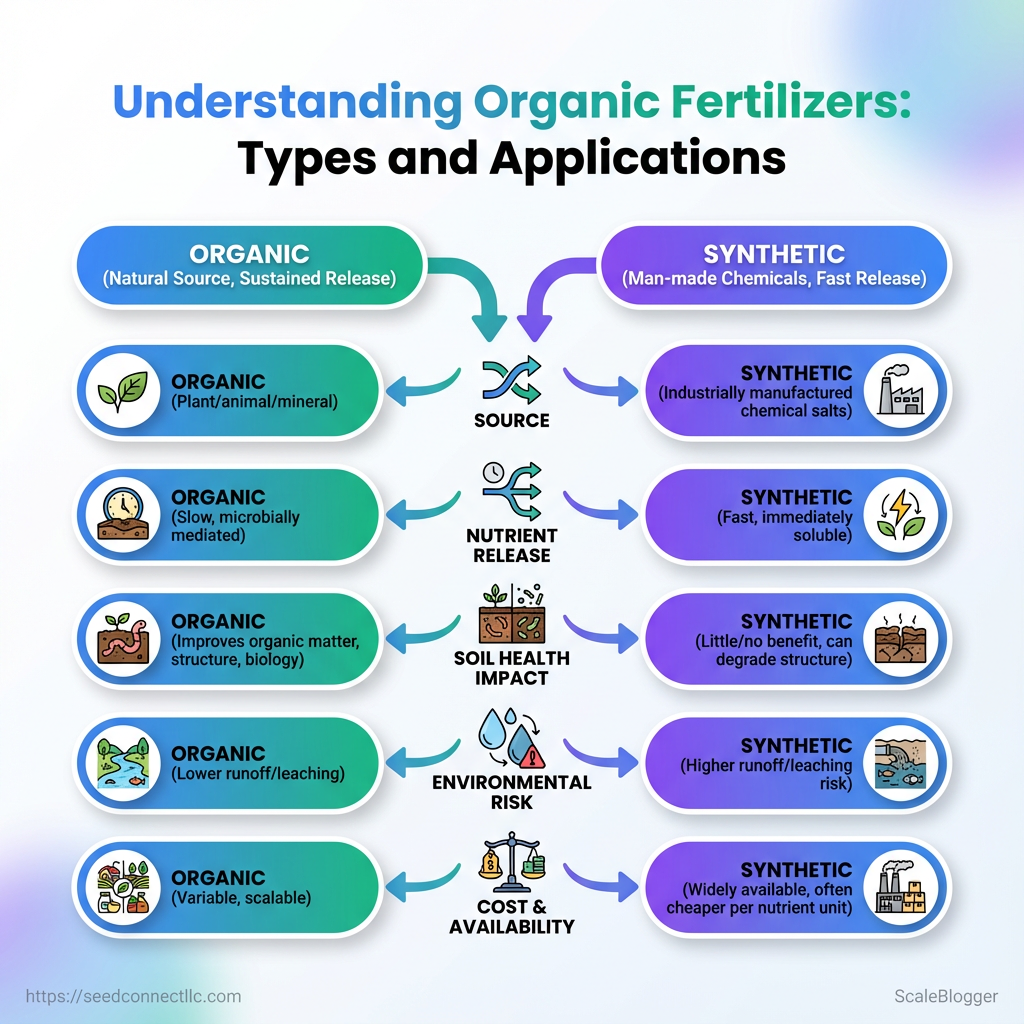
Organic fertilizer is any soil amendment sourced from plant, animal, or mineral matter that supplies nutrients while feeding the soil’s living community. Rather than delivering nutrients in immediately soluble chemical forms, organic fertilizers release nutrients through biological decomposition and mineralization by microbes, fungi, and soil fauna. That biological activity is the defining characteristic: organic fertilizers improve nutrient availability over time while building soil structure and resilience.
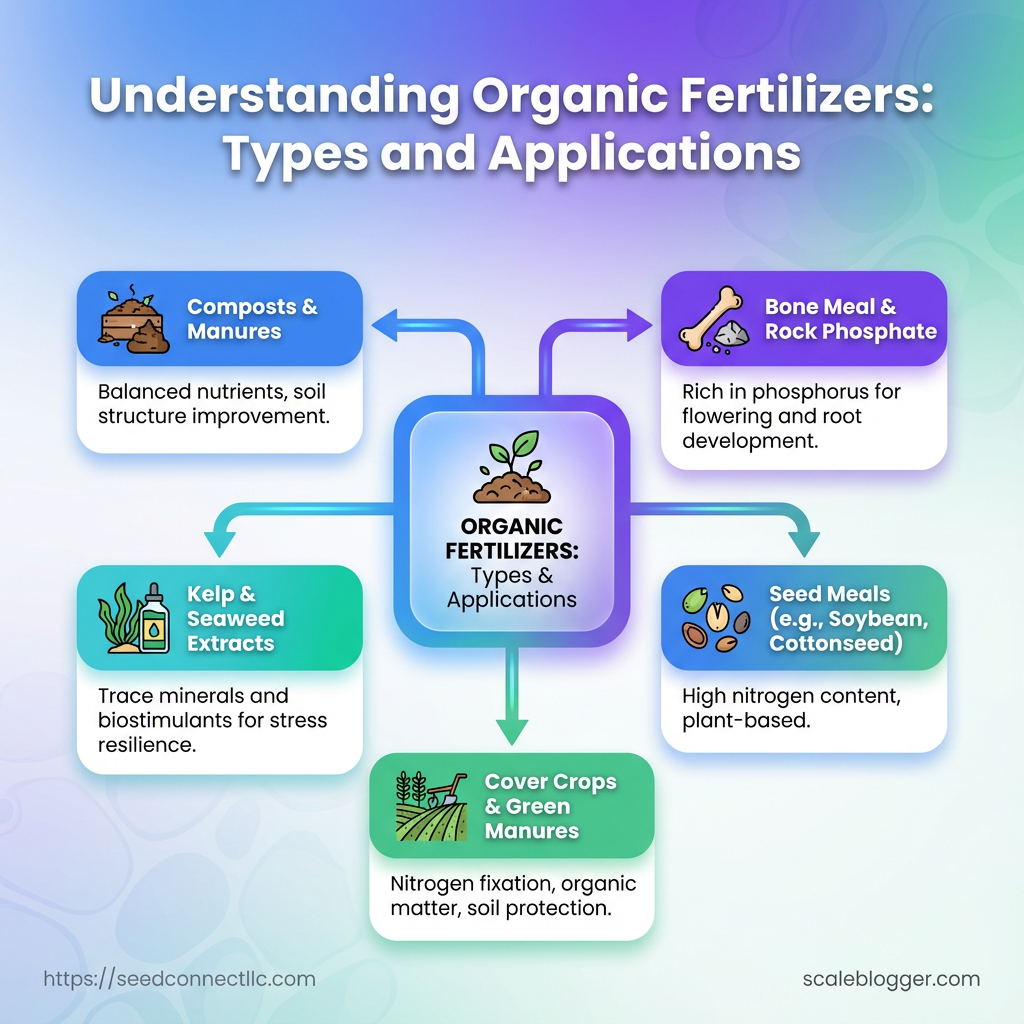
Definition: Organic fertilizer refers to nutrient sources derived from natural materials—composts, manures, bone meal, rock phosphate, kelp, and seed meals—that feed both plants and soil organisms.
Contrast with synthetic fertilizers: Synthetic fertilizers supply nutrients as water-soluble salts (e.g., ammonium nitrate, monoammonium phosphate), offering fast, predictable nutrient uptake but minimal soil organic matter benefits and little direct microbial stimulation.
Common features of organic fertilizers include: Slow-release nutrient delivery: Nutrients become plant-available as microbes break down organic compounds. Soil-building properties: Organic inputs increase soil organic matter, aggregate stability, and water-holding capacity. Microbial stimulation: They provide carbon and micronutrients that feed beneficial bacteria and mycorrhizal fungi. Lower leaching risk: Because nutrients are tied to organic matter or released slowly, runoff and groundwater contamination are reduced.
Practical examples growers use: Compost and compost tea: Balanced, multi-nutrient input that improves texture and biology. Well-aged manure: High in nitrogen and phosphorus when properly composted to avoid pathogens. Bone meal and rock phosphate: Phosphorus-rich mineral sources suited for flowering and root crops. Kelp and seaweed extracts: Trace minerals and biostimulants that support stress resilience. * Seed meals (e.g., soybean, cottonseed): Nitrogen-rich plant-based fertilizers that also suppress some soil pathogens when used appropriately.
Side-by-side comparison of organic vs. synthetic fertilizers to highlight differences in source, nutrient release, environmental impact, and suitability for organic gardening
| Feature | Organic Fertilizer | Synthetic Fertilizer | Implication for Gardeners |
|---|---|---|---|
| Source | Plant/animal/mineral matter (compost, manure, bone meal, kelp) | Industrially manufactured chemical salts | Choose organic to build soil; synthetic for targeted nutrient dosing |
| Nutrient Release | Slow, microbially mediated; variable N-P-K ratios | Fast, immediately soluble; precise N-P-K formulations | Organic favors long-term fertility; synthetic for quick correction |
| Soil Health Impact | Improves organic matter, structure, and biology | Little to no organic matter benefit; can degrade structure long-term | Organic supports resilient soils and yields over seasons |
| Environmental Risk | Lower runoff/leaching when managed; supports biodiversity | Higher leaching/runoff risk; potential eutrophication | Organic reduces pollution risk but requires volume and time |
| Cost & Availability | Often locally sourced; variable cost; scalable | Widely available, standardized, often cheaper per nutrient unit |
Organic may cost more up-front but returns soil capital
Key insight: organic fertilizers prioritize soil biology and long-term fertility, while synthetics deliver rapid, measurable nutrient correction; selecting between them depends on timelines, crop needs, and ecological goals.
Understanding these differences lets teams plan fertility strategies that match production targets without sacrificing soil health and future yields. When adopted thoughtfully, organic fertilizer practices create a more resilient growing system that compounds benefits season after season.
How Do Organic Fertilizers Work?
Organic fertilizers deliver nutrients indirectly: they rely on soil biology to break down complex organic molecules into the simple mineral forms roots can absorb. Microbial decomposition and subsequent mineralization are the controlling processes, while temperature, moisture, and carbon-to-nitrogen balance determine how fast those nutrients become available. The practical implication is that organic amendments act as a nutrient bank—slower to feed plants but far more effective at rebuilding soil structure and long-term fertility.
The biological mechanism at work
Microbial decomposition: Soil bacteria and fungi colonize organic matter, secreting enzymes that fragment proteins, carbohydrates, and fats into smaller compounds.
Mineralization: Microbes convert organic nitrogen, phosphorus, and sulfur into inorganic NH4+, NO3-, and PO4^3- that plant roots take up.
Immobilization: When microbes encounter high-carbon, low-nitrogen material they temporarily lock up nitrogen inside their biomass, delaying plant availability.
- Rate control: Temperature and moisture strongly influence microbial activity; warm, moist soils speed release.
- Substrate quality: Finely textured, nitrogen-rich amendments mineralize faster than woody, carbon-heavy materials.
- Soil biology: A diverse microbial community unlocks nutrients more efficiently than biologically impoverished soil.
Step-by-step nutrient release process
- Organic amendment is incorporated into the soil.
- Microbes colonize the material and produce extracellular enzymes.
- Complex molecules are depolymerized into soluble compounds.
- Mineralization transforms organic-N and -P into plant-available ions.
- Nutrients are taken up by roots or further cycled within the soil food web.
Common terms defined
Mineralization: Conversion of organic nutrients into inorganic ions that plants can absorb.
Immobilization: Microbial uptake of inorganic nutrients, temporarily making them unavailable to plants.
C:N ratio: Carbon-to-nitrogen ratio of an amendment; low ratios favor release, high ratios favor immobilization.
Typical nutrient release timelines and relative speed for common organic amendments (e.g., compost, manure, blood meal, bone meal, green manure)
| Amendment | Primary Nutrients Provided | Typical Release Timeframe | Best Use Cases |
|---|---|---|---|
| Compost | Balanced N-P-K, micronutrients | Weeks to months (slow, steady) | Soil conditioning, top-dressing, potting mixes |
| Aged Manure | N-rich, some P and K | Weeks to months (moderate) | Vegetable beds, bulk fertility build-up |
| Blood Meal | High N | Days to 4 weeks (fast) | Quick leafy growth, pre-plant boosts |
| Bone Meal | High P, some Ca | Months to a season (slow) | Root crops, flowering and fruiting crops |
| Green Manure (cover crop) | N (if legumes), organic matter | Weeks to months after incorporation | Soil building, erosion control, nitrogen fixation |
Key insight: Fast-release organics (blood meal) correct short-term deficits, while slow-release materials (bone meal, compost) sustain long-term fertility and improve soil physical health.
Understanding these dynamics lets growers match amendment choice and timing to crop needs rather than chasing quick fixes. Applied with attention to soil conditions, organic fertilizers transform short-term feeding into durable soil productivity.
Types of Organic Fertilizers
Organic fertilizers fall into distinct categories that differ by nutrient profile, how quickly plants can access those nutrients, and their best-use scenarios. Knowing which category to use narrows the choice to what the crop needs now versus what the soil needs long term. For annuals and fast-feeding vegetables, faster-release organics or a combination with soluble amendments work best. For orchards, perennial beds, and soil-building goals, slow-release sources that feed soil biology are preferable. Below are the common categories, practical pros and cons, and where each fits into a realistic fertility plan.
Common categories and practical guidance
Compost: Nutrient-balanced, slow-release, and excellent for structure; not a high-analysis fertilizer so combine with targeted amendments for deficiencies.
Primary benefit: builds soil organic matter and microbial life. Practical use: top-dress beds, incorporate before planting, potting mixes.
Manure: Good source of N-P-K plus micronutrients; variability and potential salts/pathogens mean composted forms are safer.
Primary benefit: provides moderate nutrients and organic matter quickly when well-composted. Practical use: pre-plant soil amendment, heavy feeders like corn/tomatoes.
Bone Meal / Blood Meal: Concentrated single-nutrient inputs for targeted correction—bone meal for phosphorus and blood meal for nitrogen.
Primary benefit: corrects specific deficiencies without excess bulk. Practical use: fruiting trees (bone meal), leafy growth boost (blood meal) applied at planting or as side-dress.
Seaweed / Kelp: Low in N-P-K but rich in micronutrients, hormones, and stimulants that support stress tolerance and root growth.
Primary benefit: biostimulant effects, spray- or drench-compatible. Practical use: foliar sprays during transplant and stress periods; drench for root stimulation.
Rock Minerals (rock phosphate, greensand): Very slow-release mineral sources that supply phosphorus, potassium, and trace elements over seasons.
Primary benefit: long-term mineral replenishment and pH-neutral options. Practical use: fall incorporation, perennial beds, soil remineralization projects.
Application considerations
- Match nutrient timing to crop stage: apply high-nitrogen options for vegetative phases and phosphorus-rich amendments at root or bloom initiation.
- Test soil to prioritize amendments; avoid blanket applications that raise salts or unbalance
N-P-K. - Layer strategies: use compost as a base, add targeted meals or mineral dusts for deficits, and employ kelp for plant vigor.
Quick-reference comparison of organic fertilizer categories to help readers choose based on nutrient needs, speed of release, and safety considerations
| Category | Examples | Primary Nutrients | Release Speed | Best For |
|---|---|---|---|---|
| Compost | Yard compost, vermicompost | Broad micronutrients, low N-P-K |
Slow | Soil building, seedbeds, potting mixes |
| Manure | Composted cow, chicken, horse | Moderate N-P-K, organics |
Moderate | Pre-plant amendments, heavy feeders |
| Bone/Blood Meal | Bone meal, blood meal | Bone: P; Blood: N | Moderate-Fast (blood), Slow (bone) | Fruit trees (bone), leafy crops (blood) |
| Seaweed/Kelp | Liquid kelp, powdered seaweed | Micronutrients, hormones | Fast (foliar), slow (drench) | Transplants, stress mitigation |
| Rock Minerals | Rock phosphate, greensand | P, K, trace elements | Very slow | Long-term remineralization, perennials |
Key insight: each category fills a different role—compost for structure and biology, manures and meals for available macronutrients, kelp for stimulants, and rock minerals for slow replenishment—so combine them according to crop timing and soil test results.
Understanding these categories simplifies decision-making in the field and helps align amendments with both short-term yield goals and long-term soil health.
When and How to Apply Organic Fertilizers
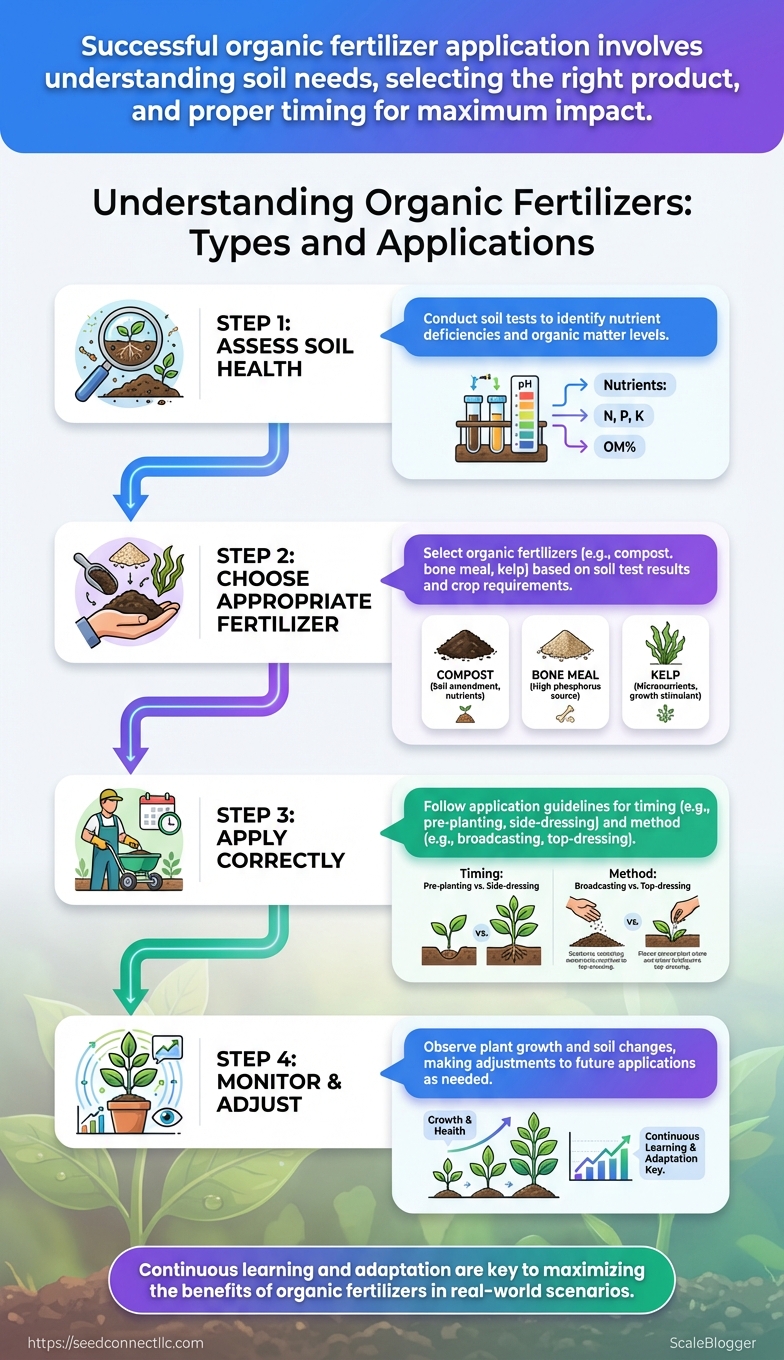
Start with a soil test and let results drive timing and method. Knowing baseline pH, organic matter, and available N-P-K tells whether to correct acidity, add slow-release nitrogen, or top up phosphorus for root development. Application method should match the crop’s growth stage, root architecture, and the fertilizer form—powdered compost, pelleted amendments, compost tea, or incorporated manures each behave differently in the soil and plant canopy.
Choosing method by crop and product
- Match root depth: Deep-rooted perennials benefit from incorporated or banded amendments; shallow-rooted vegetables respond well to top-dressing and foliar feeds.
- Respect release rates: Composted materials release nutrients slowly; blood meal and bone meal act faster.
- Consider pathogen risk: Only use fully composted manures; avoid fresh manure on crops eaten raw without a withholding period.
- Foliar vs. soil: Use foliar sprays or compost tea for quick micronutrient correction; rely on soil amendments for bulk nutrition and structure.
Practical timing and frequency
- Perform a soil test at least once per year, ideally in fall.
- Pre-plant: incorporate aged manure or compost two to four weeks before planting.
- Early growth: side-dress with higher-nitrogen organics when vegetative growth is needed.
- Mid/late season: top-dress with compost or apply
comfreyorseaweedteas for bloom and fruit set support. - After harvest: plant cover crops or incorporate residues to rebuild organic matter.
Safety, pathogen mitigation, and withholding
- Composting standard: Use only well-composted manures (thermophilic composting to >55°C for several days) to reduce pathogens.
- Withholding periods: Allow at least 90–120 days between raw manure application and harvest of crops eaten raw; longer if climate is cool.
- Recordkeeping: Track source, date, and method of organic inputs to manage traceability and food-safety audits.
Map application methods (top-dress, side-dress, incorporation, foliar/tea) to use cases, pros/cons, and timing recommendations
| Application Method | Best For | Pros | Cons | Timing |
|---|---|---|---|---|
| Top-dressing compost | Vegetable beds, established perennials | Builds organic matter, slow release | Slow nutrient availability | Early spring, mid-season |
| Side-dressing with blood meal | Rapid leafy growth (greens, brassicas) | Quick N boost, easy to apply | Can burn if overapplied | At active vegetative growth |
| Incorporation of aged manure | Pre-plant soil building | Bulk nutrients, structure improvement | Potential salts if not aged | 2–4 weeks before planting |
| Compost tea/foliar spray | Micronutrient correction, disease suppression | Fast uptake, flexible | Short-lived effects, variable quality | During active growth, avoid midday heat |
| Cover crop incorporation | Off-season soil rebuild | Nitrogen fixation, erosion control | Requires extra labor/time | After flowering of cover crop |
Key insight: Choose a method that aligns with the crop’s nutrient demand curve and the fertilizer’s release profile; combine quick-release organics for short-term need with slow-release composts for long-term soil health.
Understanding the timing and method for organic fertilizers makes nutrient programs predictable and efficient. Applied with a soil-test backbone and safe handling, these practices improve yield while preserving soil biology and food-safety integrity.
Common Misconceptions about Organic Fertilizers
Organic fertilizers are often misunderstood; many assume they’re either too weak or inherently unpredictable. In practice, organic inputs provide reliable, long-term nutrient supply when matched to crop needs and soil biology. Organic materials work through biological processes — mineralization, microbial interactions, and improved soil structure — so their timing and effects differ from synthetic salts. Recognizing that difference turns perceived drawbacks into management advantages: slower release reduces leaching, and improved soil health raises nutrient-use efficiency over seasons.
Why the confusion persists
- Historical comparisons: Early organic amendments were low-quality or unbalanced, leaving a legacy belief that organics underperform.
- Different metrics: Growers used to immediate tissue response from soluble fertilizers expect the same from organics.
- Label ambiguity: “Natural” and “organic” are used loosely in markets, conflating safe, nutrient-dense inputs with inert or inconsistent products.
Practical corrective actions
- Test your soil before switching — baseline nutrient and pH data guide appropriate organic choices.
- Match product to need — choose high-nitrogen organics (e.g., blood meal) for quick N, or compost for longer-term supply.
- Use
C:N ratioand compost maturity as decision criteria — immature compost can temporarily immobilize nitrogen. - Track plant response over weeks, not days, and layer inputs (starter soluble where permitted + organic top-dress) for both immediate and sustained nutrition.
Common operational tips
- Start small: Trial organics on a representative bed to gauge release patterns.
- Combine practices: Pair organics with cover crops and reduced tillage to amplify benefits.
- Record outcomes: Yield, tissue tests, and soil organic matter trends show cumulative gains.
Contrast common myths about organic fertilizers with facts and actionable recommendations
| Myth | Fact | Why It Matters | What to Do |
|---|---|---|---|
| Organic fertilizers are too slow to be useful | Organics release nutrients gradually through microbial activity; some products (fish emulsion, blood meal) act faster | Slow release reduces leaching and supports soil health; timing must match crop demand | Time applications earlier, use faster-acting organics for early growth, combine with soluble starters when necessary |
| All natural inputs are automatically safe | Natural doesn’t equal safe; improperly composted manures can contain pathogens or salts | Safety and crop phytotoxicity affect marketability and human health | Use mature compost, source-tested manures, and follow label/application rates |
| Organic means low-yield | Properly managed organic systems can match conventional yields over time due to improved soil resilience | Short-term yield dips often reflect transition period, not an inherent limit | Plan a 1–3 year transition, build organic matter, and monitor nutrient availability |
| You can’t measure nutrient content in organics | Nutrient analysis is possible; guaranteed analysis and lab tests quantify available nutrients | Measurable inputs allow precision management and budgeting | Request lab reports, use product guaranteed analysis, and perform tissue tests during the season |
Key insight: These contrasts show that most objections to organic fertilizers stem from management gaps rather than product limitations. Adopting measurement, timing, and source-quality practices closes the performance gap and leverages long-term soil benefits.
Understanding these distinctions lets teams adopt organics confidently while avoiding common pitfalls. When applied with measurement and intent, organic fertilizers become a predictable tool for both short-term growth and long-term soil productivity.
Real-World Examples and Case Studies
Successful use of organic fertilizers ties clear goals to repeatable methods. The examples below show how gardeners and small farmers translated inputs into measurable gains—higher yields, improved soil organic matter, and reduced synthetic inputs—by matching the right organic inputs to timing and crop needs. Each case gives practical steps and results so the same approach can be adapted to similar scales and climates.
Common features across these cases: Soil test first: baseline nutrients and pH guided amendments. Diverse inputs: compost, well-cured manure, bone meal, kelp, and legume cover crops. Timing aligned to crop demand: pre-plant blends, mid-season side-dress, and post-harvest soil-building. Measurement: yield per square foot or acre, soil organic matter (SOM) percentage, and reduction in purchased synthetic fertilizers.
Soil test: Obtain lab analysis for N-P-K, organic matter, and pH before changes.
Basic toolkit: compost thermometer, scale for inputs, soil probe, and simple yield log.
Practical implementation (step-by-step for a backyard bed) 1. Test soil and calculate N-P-K deficit. 2. Apply 2–3 inches of mature compost, work into top 6 inches. 3. Side-dress with composted poultry manure at 0.5–1 lb per 10 sq ft at flowering. 4. Mulch and monitor moisture; re-test SOM after one season.
Summarize case studies so readers can quickly compare goals, inputs, methods, and outcomes
| Scenario | Primary Input(s) | Method & Timing | Outcome | Key Takeaway |
|---|---|---|---|---|
| Backyard vegetable bed | Compost, composted poultry manure | Pre-plant 2–3″ compost; side-dress at bloom | Yield +25–40% per bed; SOM +0.5% in 1 season | Boosting biology with compost lifts short-term yields and soil health |
| Small organic farm rotation | Cover crops (peas, vetch), compost tea | Winter cover, incorporate spring; foliar compost tea mid-season | Rye cover reduced erosion; corn yield +15% vs. bare fallow | Rotation + legumes supplies N and reduces input needs |
| Orchard soil building | Composted manure, rock phosphate, mulches | Annual top-dress late fall; mycorrhizal inoculants at planting | Fruit size up 10%; tree vigor improved; less fertilizer needed | Long-term mineral and biology focus improves perennial productivity |
| Container gardening | Premium potting mix, slow-release organic granules | One-time potting mix; granules at planting | Consistent harvests; fewer nutrient burn incidents | Right initial medium reduces need for mid-season corrections |
| Community garden compost program | Municipal food waste compost, leaf mulch | Monthly compost additions to shared beds | Plot yields stabilized; volunteer satisfaction up | Centralized composting scales benefits across many plots |
Key insight: matching input type and timing to crop growth stages consistently produces measurable improvements in yield and soil metrics, while reducing reliance on synthetics.
Understanding these case studies helps teams tailor inputs to goals and scale, making organic fertilizer strategies both practical and impactful.
📥 Download: Organic Fertilizer Application Checklist (PDF)
How to Choose the Right Organic Fertilizer for Your Needs
Choosing an organic fertilizer begins with matching plant needs, soil conditions, and management style. Start by diagnosing what your crop actually requires—deficiency-driven additions perform far better than routine blanket feeding. From there, select an input that supplies the required nutrients in forms your soil biology can make available, at the timing that supports the plant’s growth stage.
Practical decision framework
- Assess soil and crop needs.
- Decide on release profile: slow-release (microbial/compost-based) versus quicker-acting (liquid kelp, compost tea).
- Check nutrient ratios and complementary micronutrients; prefer products with clear
N-P-Kvalues and guaranteed analyses for micronutrients. - Match form to application method: granular for pre-plant incorporation, liquid for foliar or quick uptake.
- Evaluate sourcing and certification: organic certification, feedstock transparency, and absence of contaminants.
Buyer’s checklist for evaluating products
- Ingredient transparency: Lists feedstocks (e.g.,
bone meal,feather meal,kelp) and their nutrient contributions. - Guaranteed analysis: Shows
N-P-Kand key micronutrients per weight. - Release characteristics: States whether nutrients are immediately plant-available or microbially mediated.
- Application guidance: Includes rates for common crops and safety precautions.
- Certifications and testing: Organic certification and heavy-metal testing preferred.
- Physical form: Matches intended use—pellet/granular, powder, or concentrated liquid.
- Sourcing traceability: Country of origin and processing method disclosed.
Matching crop groups to practical inputs
Match crop groups to suggested organic inputs and timing to simplify selection for readers
| Crop Group | Common Nutrient Needs | Recommended Organic Inputs | Best Application Timing |
|---|---|---|---|
| Leafy Greens | High nitrogen, steady water | Blood meal, well-composted manure, liquid fish emulsion | Pre-plant sidedress and every 3–4 weeks during rapid growth |
| Fruiting Vegetables | Balanced N, higher P & K for fruit set | Bone meal, rock phosphate, kelp extract, compost tea | Pre-plant phosphorus, bloom-time kelp/seaweed foliar |
| Root Crops | Moderate N, low P relative, steady K | Compost, wood-ash (small amounts), potassium sulfate (organic) | Incorporate before planting; light side-dress mid-growth |
| Ornamentals | Balanced NPK, micronutrients for color/flowering | Compost, fish hydrolysate, micronutrient mixes | Early season and at first bud/flowering |
| Lawns & Turf | High N, slow-release required | Compost top-dress, feather meal, slow-release granular organic N | Early spring and late summer/early fall applications |
Key insight: Choosing inputs by crop group simplifies decisions—use quick N sources for leaf growth, P/K-rich materials for flowering and fruiting, and slow-release organics for lawns to avoid flushes and leaching.
Practical examples: a market garden grows spinach with compost plus two light fish-emulsion feeds per season; a tomato grower adds bone meal at transplant and kelp foliar at first fruit set. These small adjustments yield measurable vigor without over-applying nutrients.
Understanding these principles reduces waste and improves plant performance, allowing growers to pick inputs that fit both crop timing and the biological rhythm of their soil.
Conclusion
Gardens that struggle with yellowing leaves, hard-packed soil, or inconsistent yields respond when nutrient strategy shifts from quick fixes to ecosystem thinking. Remember that organic fertilizers feed soil life first, release nutrients more slowly, and build structure over seasons; choosing between compost, manure, bone meal, or kelp depends on crop needs, soil test results, and timing. In practice, that meant a community-supported vegetable plot moving from synthetic feeds to a compost-plus-cover-crop regimen and seeing both water retention and yields improve, and an urban grower correcting compacted beds with bulky compost and targeted microbial inoculants to revive root growth. Those examples show how matching the right product to the problem changes outcomes faster than repeating the same application schedule.
Take three concrete next steps: test your soil and note pH and nutrient gaps, select the type of organic fertilizers that match those gaps, and time applications to crop growth—feed early for roots, side-dress during rapid vegetative phases. For seed sourcing and organic inputs tailored to performance, explore planting-grade options at Seed Connect’s catalog: Seed Connect — organic seed and input resources. If questions remain about timing or choosing between amendments, start with a small trial bed and monitor changes over a season; this practical iteration is the quickest path from confusion to consistent, healthy yields.