


Nothing ruins a promising grow faster than fat colas going airy or resin refusing to develop.
Often, the issue is simple: fluctuating heat stress or consistently warm nights.
Managing temperatures isn’t just a luxury; it’s vital for determining your yield and potency.
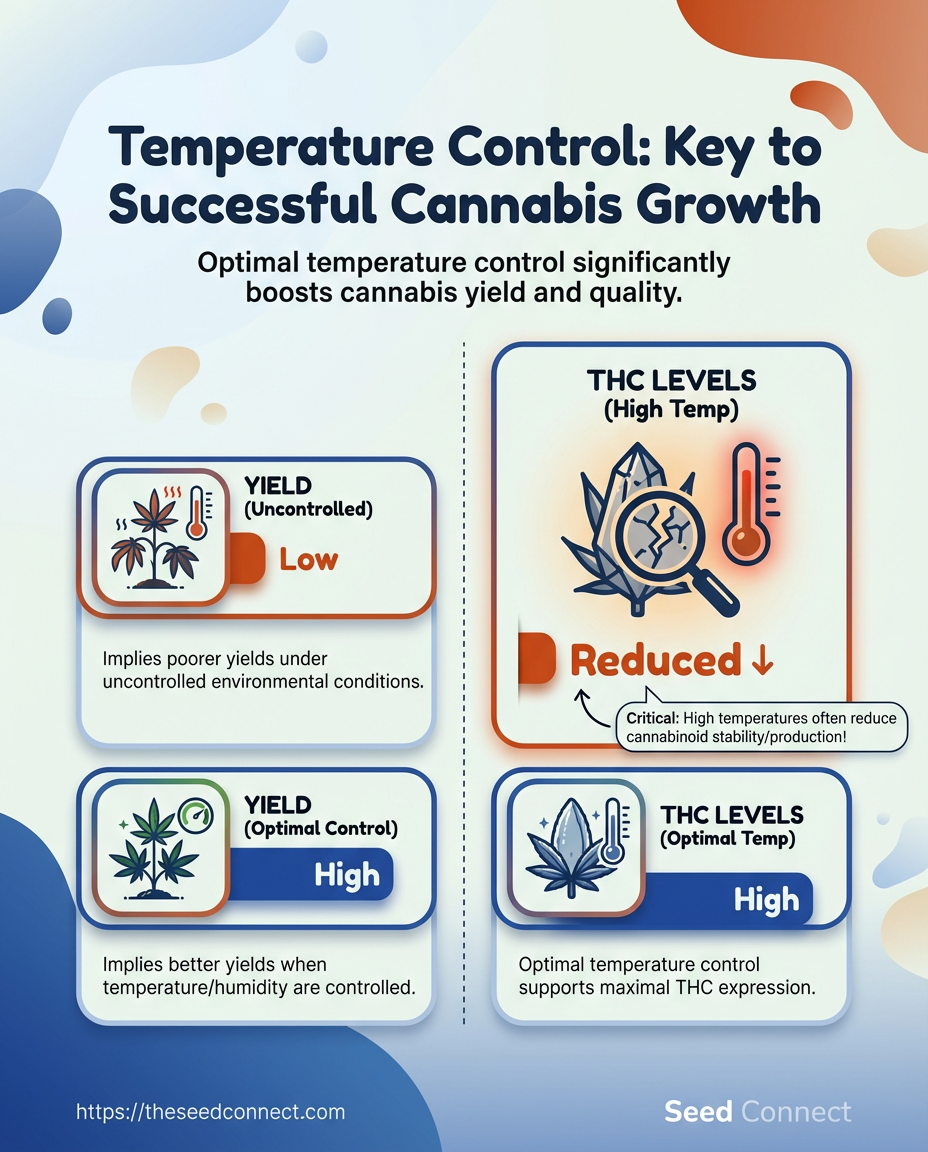
Studies from 2025 suggested that controlling temperatures well can boost yield by about 30% compared to uncontrolled settings.
That difference shows up as bigger buds and more consistent cannabinoid profiles.
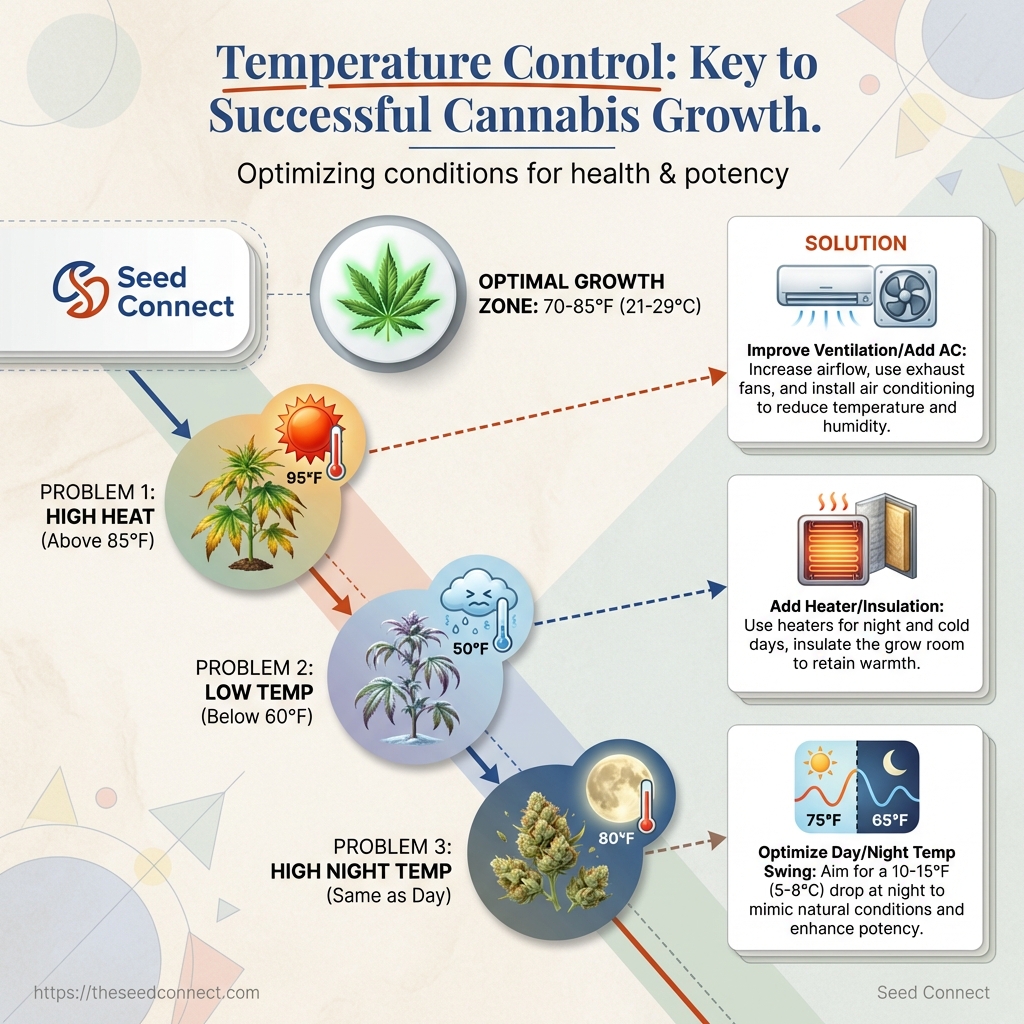
For cannabis growth, a temperature change of 10–15°F between day and night often increases cannabinoid production.
By contrast, sustained highs above 85°F have been linked to lower THC and stressed plants in lab testing from 2025.
Most home and small-scale setups create microclimates growers don’t catch.
Learning to read canopy thermals and aim for steady ranges is the fastest way to improve outcomes.
Automated climate control has shifted from luxury to baseline in commercial grows.
Companies like Canopy Growth and systems from Hortimax show how tight regulation of heat and humidity yields more consistent crops.
Why temperature matters for cannabis growth
Temperature is one of the most important factors for cannabis growth.
It significantly affects enzyme activity, photosynthesis rates, and how well plants move water and nutrients.
These processes shape growth rate, bud density, and cannabinoid profiles.
It’s not merely a comfort issue; poor temperature control shifts metabolic priorities.
Consistent, optimal management is crucial, as research indicates that effective climate control can greatly influence production.
Day/night swings and brief temperature extremes matter alongside average conditions.
Ideal temperature ranges by growth stage
Temperature habits shape the plant’s metabolism and the profile of its flowers.
Align the temperatures with your plant’s growth stages for faster growth, better structure, and more consistent cannabinoids.
Below are practical targets that fit both home and professional setups.
These ranges are based on industry standards.
Findings from 2025 indicated that strict climate control could raise yields by about 30% compared to uncontrolled settings.
Remember three rules: keep daytime temperatures warm, lower nighttime temperatures for the plants, and avoid sustained temperatures above 85°F (about 29.5°C), which can lower THC and stress plants.
Germination and seedling temperature targets
| Growth stage | Day temperature (°C / °F) | Night temperature (°C / °F) | Relative humidity (%) | Why this range matters |
|---|---|---|---|---|
| Germination | 22–25°C / 72–77°F | 22–24°C / 72–75°F | 70–90% | Stable warmth and high humidity speed imbibition and radicle emergence. |
| Seedling | 20–24°C / 68–75°F | 18–20°C / 64–68°F | 60–70% | Slight night drop encourages root vigor while leaves harden off. |
| Vegetative | 24–28°C / 75–82°F | 14–20°C / 57–68°F | 50–70% | Warmer days boost photosynthesis; cooler nights trigger stomatal recovery. |
| Early flower | 20–26°C / 68–79°F | 15–19°C / 59–66°F | 40–50% | Moderated temps reduce stretch while protecting terpene development. |
| Late flower | 18–24°C / 64–75°F | 13–18°C / 55–64°F | 30–40% | Cooler nights and lower RH lower bud rot risk and favor resin retention. |
Use 24–28°C daytime in veg to push growth, then pull back roughly 6–10°C at night to create a 10–15°F differential shown in 2025 research to improve cannabinoid production.
How temperature needs change from veg to flower
Vegetative growth prioritizes leaf area and stem strength.
That means slightly higher daytime temperatures and broader RH to keep stomata active and encourage lateral branching.
Flowering shifts priorities toward resin, terpene preservation, and disease prevention.
Lower daytime highs and reduced humidity keep trichome chemistry stable and cut the risk of bud rot.
- Warm days, cool nights: Maintain a
10–15°Fdaytime-to-nighttime swing to support cannabinoid biosynthesis. - Avoid prolonged heat: Sustained temps above
85°F(≈29.5°C) can depress THC levels and stress plants. - Use climate control cannabis tools: Automated systems from greenhouse tech providers, and practices used by growers like Canopy Growth and Hortimax, give repeatable environments that drive consistent yields.
Practical example: a grower who shifts from 26°C day/18°C night in veg to 22°C day/16°C night in late flower often sees denser colas and fewer mold issues, provided RH is reduced proportionally.
Keep temperature changes deliberate and gradual; abrupt swings cause stress.
Following these stage-specific targets makes the most of climate control and helps convert good genetics into predictable harvests.
Measuring and monitoring temperature effectively
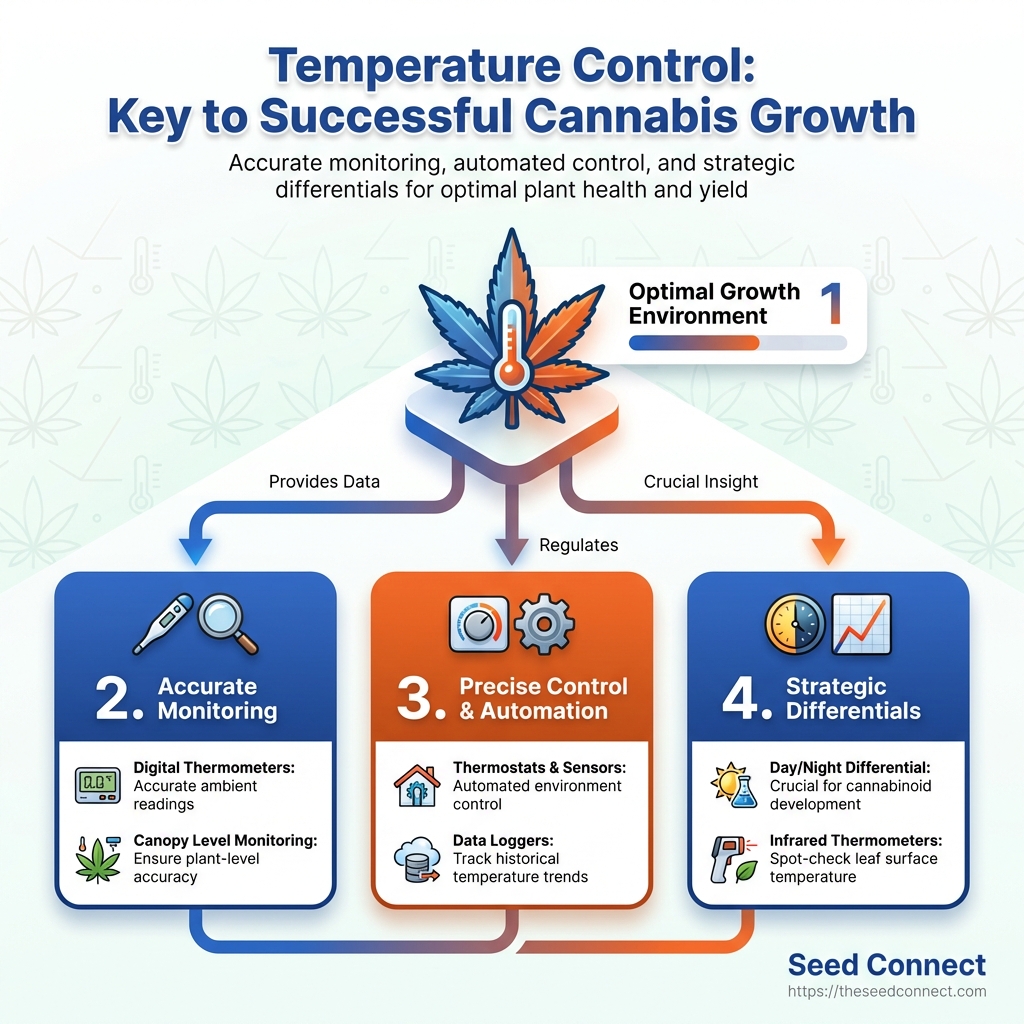
Good monitoring starts with a clear plan: multiple sensors, frequent reads, and rules for when to act.
Place sensors where the plants actually feel the air and soil, log continuously, and use simple alerts so small swings never become crop problems.
This approach changes temperature control from guesswork to a reliable practice that helps maintain cannabinoids and yields.
Most commercial growers now use a mix of fixed probes and portable handheld meters to cross-check readings.
Automated climate control systems from industry players — including Canopy Growth Corporation and specialized vendors like Hortimax — show how integration between sensors, controllers, and ventilation prevents the sorts of swings that cut potency and yield.
As of 2025, studies suggested that consistent, controlled environments could improve yield by approximately 30% compared to uncontrolled conditions.
What that requires in the grow room are the right sensor types, smart placement, sensible logging intervals, and alert thresholds tied to plant-stage priorities rather than to a single number.
Essential sensors and placement tips
Place sensors where they measure the plant microclimate, not the equipment surface.
A single thermostat on a wall will miss canopy hot spots and root-zone departures.
- Air at canopy: Mount a sensor 2–4 inches above the canopy center to track the temperature plants actually experience.
- Return air / exhaust: Put a sensor near the exhaust to detect heat buildup before it reaches plants.
- Root-zone probe: Insert a soil or substrate probe near representative pots to catch cold-root events.
- Near vents and lights: Keep a sensor within 6–12 inches of light fixtures and vent outlets to spot equipment-driven spikes.
- Portable spot-check meter: Use a handheld infrared or probe meter for quick verification across the room.
This short walkthrough shows sensor locations for tents, rooms, and greenhouses and how to interpret live readouts.
Watch it to match sensor placement to your exact layout.
Using data logs and alerts to prevent swings
Continuous logging makes problems obvious rather than surprising.
Set your system to record at least once every 5–15 minutes; tighter cycles (1–5 minutes) help spot rapid swings near lights or during HVAC cycles.
- Calibrate sensors monthly and cross-check with a portable meter so data stays trustworthy.
- Create an alert band using a
deadbandof±1°F–2°Faround your set point to avoid nuisance alarms while catching real events. - Log both air and root-zone temps and set dual alerts (air OR root) so either triggers corrective action.
- Use rolling averages (e.g., 30-minute average) to filter short-lived blips and act on sustained deviations.
- Automate responses where possible: link alarms to fan speed changes, heater override, or temporary light adjustments.
Large operators use integrated controllers to prevent frequent cycling; small setups can get big wins by combining a cheap data logger with clear alert rules.
Remember that a 10°F–15°F day/night difference can be beneficial, but temperature spikes above 85°F hurt THC and plant health, so catch those fast.
Consistent measurement and simple alert rules save time and protect potency.
Small monitoring upgrades pay off quickly in steadier growth and fewer surprises.
Practical ways to control temperature in any grow space
Temperature control begins with small choices that add up, such as where to place lights, how to seal the room, and if to use active equipment.
A few smart passive moves often cut heating and cooling needs by half.
That saves money and makes active devices more effective when you do need them.
Active systems complete the process.
Heaters, air conditioners, inline fans and climate controllers give precise control when passive measures aren’t enough.
Automated systems are now common in commercial grows, because they reduce human error and improve consistency—research from 2025 found that stronger temperature control can increase yields by about 30% (2025).
For practical work on the bench or in a garage, pair passive tactics with at least one active control and a simple timer or controller.
That combination keeps swings small, protects cannabinoids from heat stress above 85°F, and lets growers target 10°F to 15°F day/night differences when desired.
Passive methods: insulation, placement, thermal mass
Passive moves cost little and reduce how often active gear must run.
- Insulate walls and ceilings: Covering exposed surfaces with foam board or radiant barrier reduces heat gain and loss.
- Place your tent/room strategically: Avoid external walls and direct sun; interior spaces hold temperature more stably.
- Use thermal mass: Water barrels, sealed jugs, or ceramic tiles store heat and dampen swings.
- Reflective vs. absorptive surfaces: Use reflective white paint to reduce daytime heat, dark surfaces to hold heat at night.
- Seal air leaks: Weatherstrip doors and duct seams to prevent drafts and wasted HVAC cycles.
Active methods: heaters, AC, ventilation and timed control
Control becomes precise when you add equipment.
Start with the right tools and match them to the room size and thermal load.
Active methods comparison
Active methods: heaters, AC, ventilation and timed control
| Method | Typical cost range | Response time | Maintenance needs | Best for |
|---|---|---|---|---|
| Portable ceramic heater | $30–$150 | Minutes (rapid) | Low — dust and tip-sensor checks | Small tents, spot heating |
| Oil-filled radiator | $60–$250 | 15–45 minutes (steady) | Low — occasional cleaning | Quiet night-time warmth |
| Propane heater (vented) | $150–$600 | Minutes (fast) | Medium — fuel checks, venting | Uninsulated garages, backup heat |
| Window air conditioner | $200–$700 | 10–30 minutes (rapid) | Medium — filter cleaning, coil care | Small rooms with window access |
| Portable AC | $300–$900 | 10–40 minutes | Medium — condensate management | Flexible setups, rentals |
| Mini-split AC | $1,500–$5,000 | 5–20 minutes (very responsive) | Medium-high — professional install, annual service | Dedicated grow rooms |
| Inline exhaust fan + ducting | $100–$800 | Minutes (venting) | Medium — fan bearings, duct leaks | Odor control and heat extraction |
| Variable-speed inline fan | $200–$1,000 | Seconds to minutes | Medium — controls & bearings | Fine-tuning airflow and temp swings |
| Climate controller / thermostat | $150–$800 | Immediate (automation) | Low — sensor calibration | Automating heaters/fans/AC |
| Dehumidifier with heater function | $400–$1,200 | 10–45 minutes | Medium — coil cleaning, drains | Humid, cold rooms where combined control helps |
Mini-splits and climate controllers are standard where consistency matters most; they match the automated climate trends seen in commercial operations like Canopy Growth and greenhouse solutions from Hortimax.
- Start by sizing: calculate the room volume and the expected heat load from lights and equipment.
- Add passive fixes first to shrink the load.
- Choose an active device sized slightly above the calculated need, then add a climate controller with simple rules (setpoints, hysteresis).
- Test across several days and adjust timers or PID settings for smooth transitions.
A small investment in insulation and a sensible controller prevents most temperature problems.
Consistency beats extremes; keep swings tight and the plants will reward that steadiness.
Daily and seasonal temperature strategies
Daily temperature swings are a tool, not a nuisance.
Managing a deliberate day–night differential can nudge plants toward higher resin and terpene production, while seasonal plans protect yield when outdoor conditions shift.
The smart approach is a predictable, controlled rhythm that the plant can trust.
Good growers treat temperature like a daily script.
Morning and afternoon settings support growth and photosynthesis, then controlled cooling at night signals the plant to invest in flower chemistry.
Across seasons, that same script needs small adjustments so heat waves or cold snaps don’t force emergency responses from equipment or the crop.
What follows lays out practical, repeatable tactics to control daily differentials and adapt plans for summer and winter without rehashing basic ideal ranges.
Managing day-night differentials
Begin with a defined night offset and make it reliable.
Research shows a 10–15°F day-night difference can enhance cannabinoid production, so use that window to your advantage rather than letting temperatures drift randomly.
Schedule setpoint ramps rather than abrupt jumps.
Change HVAC or heater setpoints in steps of 1–3°F per hour when transitioning between day and night.
That reduces plant stress and short-circuits pests that exploit sudden microclimate changes.
Keep environmental changes synchronized with the light cycle.
If lights switch at 7:00, start the first ramp 30–60 minutes beforehand so leaf temperatures and transpiration align with the new regime.
- Night delta control: Use
10–15°Ftarget differentials for resin-building nights. - Gradual ramps: Shift setpoints at
1–3°F/hourto reduce shock. - Sensor zoning: Place one sensor in the canopy and one at canopy top for accurate day-night reads.
- Automation: Automated climate control systems cut human error and improve consistency—commercial growers use them now as standard practice.
The infographic maps daytime vs nighttime profiles and shows how a 10–15°F delta correlates with terpene and resin increases.
It also highlights the timing of gradual setpoint ramps and ideal sensor placement for accurate feedback.
Adapting temperature plans for summer and winter
Start each season by stress-testing systems a month ahead.
Run AC and heating cycles on a schedule that mirrors expected extremes so the equipment and plants acclimate.
- Pre-season calibration: verify sensor accuracy, run alarms, and perform a controlled heat or cold cycle.
- Seasonal setpoint offsets: modestly raise cooling setpoints in summer to avoid constant AC cycling; slightly lower heat setpoints in winter to reduce fuel use.
- Emergency buffers: add short-duration backup cooling or heating triggers at ±3–5°F from the main setpoint to catch sudden swings.
Canopy Growth and suppliers of greenhouse controls like Hortimax illustrate how automated systems and pre-season commissioning reduce failures and maintain stable microclimates.
The payoff is measurable—studies from 2025 show that tight temperature control can lift yields by about 30% compared with uncontrolled environments.
> Studies from 2025 indicate that optimal temperature control can lead to a 30% increase in yield compared to uncontrolled temperature environments.
> Lab testing in 2025 also found sustained highs above 85°F can depress THC concentrations and stress plants.
A steady daily rhythm plus a simple seasonal checklist keeps plants productive and equipment efficient.
Small, predictable changes beat emergency responses every time.
Troubleshooting temperature-related problems
Heat and cold can show up as similar-looking symptoms, and that’s why a clear, methodical approach wins every time.
A burnt leaf tip looks like heat stress one hour and nutrient burn the next.
Treating symptoms without checking the environment often wastes time and plants.
This section shows how to triage temperature-driven issues fast, and how to separate pure temperature problems from ones where light, humidity, or nutrients are the real culprit.
Expect practical checks, a step sequence you can run in ten minutes, and a quick-reference checklist for common scenarios.
Here are fast field checks to run before changing anything in the room.
- Check ambient vs. canopy: Compare the room sensor reading with one at canopy level; a 3–5°F difference is common.
- Time-of-day snapshot: Note whether symptoms appear only at peak light or overnight.
- Inspect roots and medium: Cool roots feel slow and wet; hot roots dry and show tip browning.
- Leaf surface test: Scorch confined to top leaves usually points at light/heat; whole-plant wilting suggests root or air temperature.
- Look for compound clues: Bud rot during cold nights or purple stems with slow growth often indicate temperature interacting with humidity or genetics.
Run this short diagnostic sequence when symptoms appear.
- Measure canopy, ambient, and substrate temps and log values for 24 hours.
- If high or low temps are confirmed, isolate an affected plant in a controlled zone to test recovery.
- Adjust temperature by small increments (
2–3°F) and watch changes over 48 hours. - If no improvement, test humidity, light intensity, and pH/nutrient EC before further temperature changes.
Recognizing heat stress and cold damage — quick triage checklist
| Symptom | Likely temperature cause | Immediate action | Preventive step |
|---|---|---|---|
| Leaf curling and burnt tips | High canopy temps and hot light spectrum | Lower light height/Reduce PAR for a test cycle | Increase air movement; raise lights slightly; add reflective distance |
| Slow growth and purple stems | Cold roots or nightly lows slowing metabolism | Warm root zone with heating mat or increase room temp 3–5°F |
Insulate pots; maintain steady night temps |
| Bud rot risk during cold nights | Cold nights plus high humidity condensing on flowers | Increase night temp, improve airflow around colas | Keep night temp above dew point; use dehumidifiers |
| Stunted stretch in veg | Night temps too low limiting cell expansion | Raise night temp 2–4°F temporarily |
Maintain proper veg temp window; consistent temps |
| Midday wilting, recovery at night | High day temps causing transient transpiration stress | Shade or pulse fans during peak heat | Use light scheduling or thermal buffering |
| Interveinal bronzing on leaves | Prolonged heat stress plus nutrient uptake issues | Cool canopy and flush only if EC elevated | Keep temps stable; monitor EC and root health |
| Brown pistils and terpene loss | Repeated daytime spikes above 85°F |
Lower daytime temps immediately | Avoid prolonged >85°F during flowering |
| Frost-like necrosis on edges | Rapid drops near freezing overnight | Move plants to warmer area; protect buds | Prevent exposures below 50°F at night |
| Pale, slow buds in late flowering | Night temps too high reducing cannabinoid synthesis | Reduce night temps 3–6°F if possible |
Implement controlled day/night differential |
| Leaf tip charcoal spots | Heat combining with low humidity | Cool canopy and slightly raise humidity | Even temperature and humidity control |
Use it as a triage sheet during hourly checks and hand it to helpers so responses are consistent.
> Studies from 2025 found that optimal temperature control can increase yield by about 30% compared to uncontrolled environments (2025).
When temperature is only part of the problem (light, humidity, nutrients)
Temperature often amplifies other stresses rather than acting alone.
For example, high heat raises transpiration and can make an otherwise adequate nutrient regimen look deficient.
The same high humidity that hides heat stress during the day can turn cold nights into bud-rot events.
Separate the factors by changing one variable at a time and watching for a 48–72 hour response window.
If raising temps doesn’t help after 48 hours, the next likely suspects are light intensity, VPD-driven humidity issues, or root-zone problems.
- Check light overlap: High PAR + high temp: dim or increase distance to test recovery.
- Check VPD: Low VPD + cool nights: risk of condensation and rot — adjust RH or night temp.
- Check root environment: Cold substrate: heat root zone, not just air, before changing ferts.
- Check EC/pH: Locked-out nutrients can mimic temp stress; test and correct before major temp shifts.
A calm, single-variable approach stops cascading fixes that stress plants more than the original problem.
Temperature diagnostics become much more reliable when humidity, light, and nutrients are tested alongside it.
Linking temperature control to seed selection and expert help
Imagine picking a high-THC strain because the breeder’s notes looked impressive, then watching heat spikes blunt those cannabinoids during bloom.
Choosing seeds that fit the actual temperature conditions in your space helps avoid wasting time and money.
Match genetics to what your room or greenhouse can realistically hold.
Research from 2025 found that consistent, well-managed environmental control can increase yield by about 30% compared with uncontrolled environments.
That same work shows a 10–15°F day/night difference raises cannabinoid production, while sustained temperatures above 85°F harm THC levels (2025).
Commercial growers hiring climate systems, like the ones from Hortimax, and large operators such as Canopy Growth, treat genetics and climate as a single decision.
If your control system can’t reliably hold target temperatures, choose genetics that tolerate wider swings or shorter seasons instead of chasing peak lab numbers.
Choosing seeds for your climate and schedule
Start with a clear statement of what your space can maintain over a full grow cycle.
If daytime peaks, nighttime dives, or HVAC instability are regular, pick genetics that are forgiving of those patterns.
Consider the length of your schedule.
Faster finishes reduce exposure to late-season heat or cold.
Autoflowers and fast-finishing feminized varieties are practical choices when climate control is limited.
- Strain tolerance: Select strains known for thermal resilience rather than only headline THC numbers.
- Maturation speed: Favor faster-finishing genetics when seasonal windows or unstable HVAC threaten late-stage stress.
- Humidity-temperature pairing: Match strains to the humidity you can hold alongside temperature to reduce mold and terpene loss.
- Photoperiod vs. autoflower: Use autoflowers to avoid long veg periods where inconsistent temps cause sex or growth delays.
- Genetic history: Prefer lines with documented performance in similar climates or in controlled environments run by companies like Canopy Growth.
When to contact Seed Connect expert support
Reach out before you buy seeds if your climate control plan is still flexible.
A quick consult can steer you toward genetics that fit your actual temperature bandwidth and schedule.
Contact support when you change one major variable: new HVAC, new light array, or a move to a greenhouse.
Automated climate control systems are common in commercial grows; if you plan to add one, ask about strains that respond best to tighter day/night differentials.
- If yield or THC drops coincide with unexplained temp swings, share sensor logs and photos.
- If you’re upgrading to automated systems (Hortimax-style), ask about strains that exploit tighter control.
- If you’re picking seeds for a short season or a backyard greenhouse, request recommendations based on your historical temps and timeline.
Have sensor logs, target harvest dates, and photos ready when you contact support.
That makes advice precise and actionable.
Pairing seeds with achievable temperature control avoids predictable losses and speeds progress toward reliable, high-quality harvests.
Nail the temperature, save the harvest
Few variables matter more than steady heat and cool cycles when the goal is dense colas and thick resin.
For temperature in cannabis growth, stage-specific targets and small night drops are the difference between sugary trichomes and airy buds.
That point was illustrated earlier when cooler nights during flower improved resin and color on sensitive strains.
Begin with a quick 48-hour check: record canopy and ambient temperatures, assess sensor placement, and observe fluctuations throughout the light cycle.
Set and hold a clear target temperature range for each growth stage.
If genetics matter to your microclimate, learn about cannabis seed genetics and pick strains that match your climate; then tonight, log temps and change one control — fan speed, vent timing, or a thermostat — to erase the largest swing and see how growing temperature for cannabis improves by morning.