


Shipping cannabis seeds internationally is fraught with potential errors.
From legal pitfalls to packaging mistakes, understanding what can go wrong is the first step to ensuring a successful delivery.
In this guide, we will explore common mistakes gardeners make when sending or receiving cannabis seeds across borders and how to avoid them.
When you open the mailbox and the seeds aren’t there: the real pain of shipping mishaps
You pull open the mailbox, feel the familiar flutter of expectation, and there’s nothing but bills and junk.
That missing package is suddenly very personal.
The shake of disappointment hits fast—especially when those seeds were the start of a planned grow cycle.
Calling support is the next moment that stings.
There’s hold time, scripted responses, and the slow realization that time has slipped away.
For small-scale growers, a delay of days can mean missed windows for germination schedules or crop rotations.
A missing shipment doesn’t just cost seeds.
It costs trust, planning, and momentum.
When orders vanish or get confiscated, relationships with suppliers, carriers, and even local regulators can fray quickly.
70% of international shipping errors for cannabis seeds stem from improper labeling.
Over 40 countries had legalized cannabis in some form by 2023, so shipping rules vary widely between borders.
Common sense plus a few careful steps prevents most disasters.
Wrong paperwork: Missing or incorrect documents → confirm
phytosanitary certificateand customs forms before shipping.Poor labeling: Mislabelled parcels attract seizure → use precise, compliant descriptions and avoid vague terms.
Unreliable carrier choice: Picking a cheap, inexperienced shipper → choose carriers with seed-handling experience.
Weak packaging: Damaged or obvious parcels → pack discreetly and use moisture-proof liners.
No tracking or insurance: No trace if something goes wrong → always get tracking and consider declared value or insurance.
Crop King Seeds and Royal Queen Seeds both emphasize careful compliance and carrier selection when shipping internationally. Their approach shows how attention to paperwork and choice of service reduces risk.
Imagine the call to support: you give your order number, explain the timeline, and learn the package was held for improper labeling.
That’s lost time, possible replacement costs, and a trust gap with your supplier.
This guide will walk through the five most costly mistakes and what to do instead.
Follow those steps and the next time you open the mailbox, there’ll be exactly what you ordered.
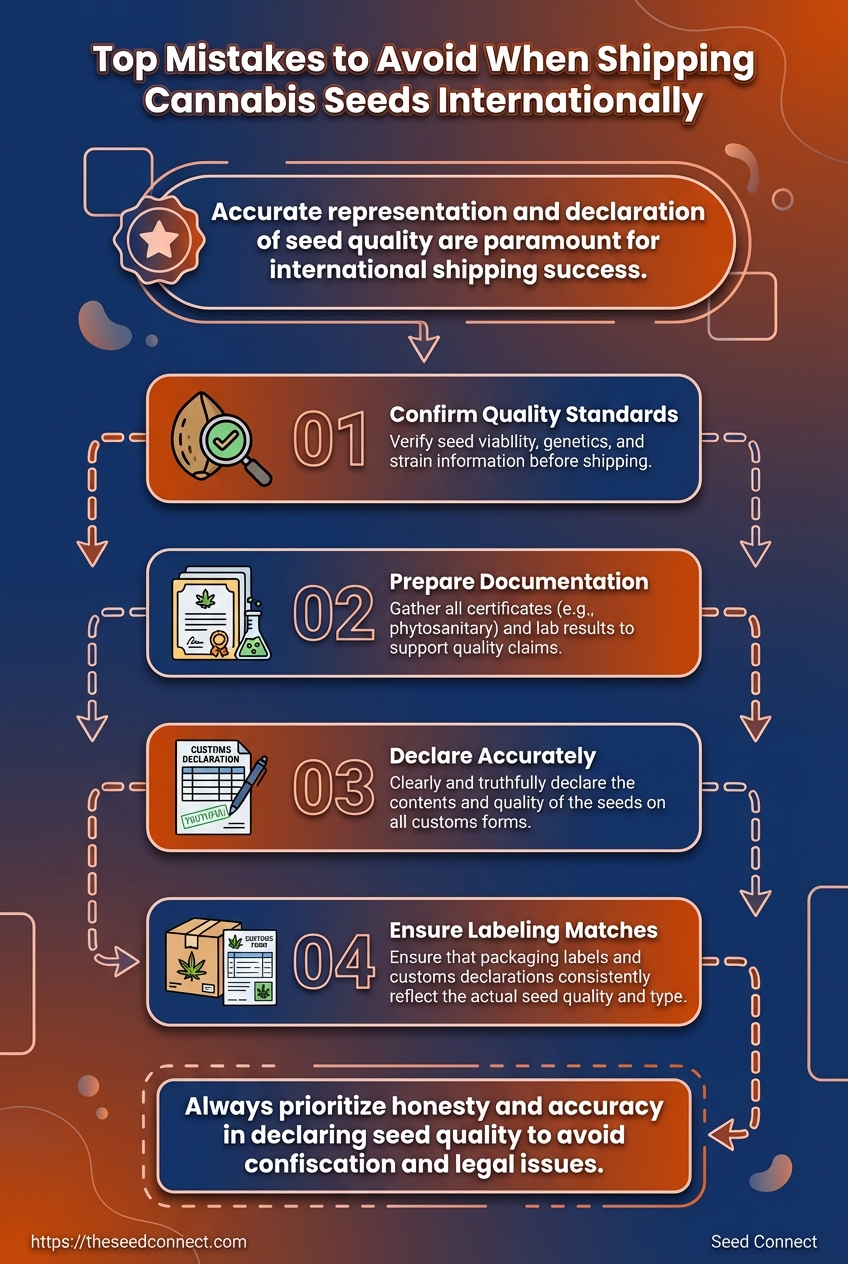
Mistake 1 — Ignoring local laws and destination rules
Think a small packet of seeds won’t draw attention? Many growers assume seeds are low-risk, and that’s the exact blind spot that causes problems. Laws differ wildly between origin and destination, and treating them as identical invites confiscation, fines, or worse.
Across the globe, over 40 countries have legalized cannabis in some form, yet that patchwork creates sharp edges for shipping.
What follows is practical guidance for avoiding common legal missteps when sending or receiving seeds, drawn from industry practice and real-world patterns.
Getting the rules wrong is one of the most common cannabis shipping mistakes.
An estimated 70% of international shipping errors stem from improper labeling, but labeling is only one piece of the compliance puzzle.
Common legal pitfalls for senders and receivers
Senders often misdeclare contents or skip required paperwork, thinking discretion means omission.
That mistake can trigger seizure and regulatory action in the recipient country.
Receivers can also be liable if they accept prohibited imports, or fail to understand local possession rules.
Even if seeds arrive, local law may ban germination or possession, creating legal exposure.
Mislabeling: false or vague descriptions that don’t meet customs rules.
Missing paperwork: absent phytosanitary certificates or import permits.
Assuming legality: thinking one country’s law applies to another.
Ignoring carrier rules: shipping with a courier that refuses seed shipments.
How to check country-specific restrictions before you ship
Start with the official agriculture or customs website for the destination country and read their plant import rules.
Government pages list permitted items, required certificates, and quarantine rules.
Cross-check with reputable industry resources.
Companies like Crop King Seeds and Royal Queen Seeds publish practical shipping advice and can point to common pitfalls in Canada and Europe respectively.
Contact the carrier and ask three specific questions: do they accept cannabis seeds; what labeling is required; and what documentation speeds customs clearance.
Get answers in writing whenever possible.
Practical steps to verify import rules and penalties
Search the destination’s official customs or plant health pages for “seeds” and “phytosanitary certificate.”
Confirm whether an import permit is required and the application process timeline.
Request carrier shipping policies in writing and confirm refusal or acceptance of seed shipments.
Prepare accurate labeling and gather all certificates before dispatch.
Keep records of correspondence, permits, and tracking to prove due diligence.
Phytosanitary certificate: Official document certifying plant material meets health standards. Import permit: Government authorization to bring plant materials into a country.
Ignoring local rules is avoidable with a few minutes of targeted research and a quick call to the carrier.
That small effort prevents most seed export errors and keeps both sender and receiver out of trouble.
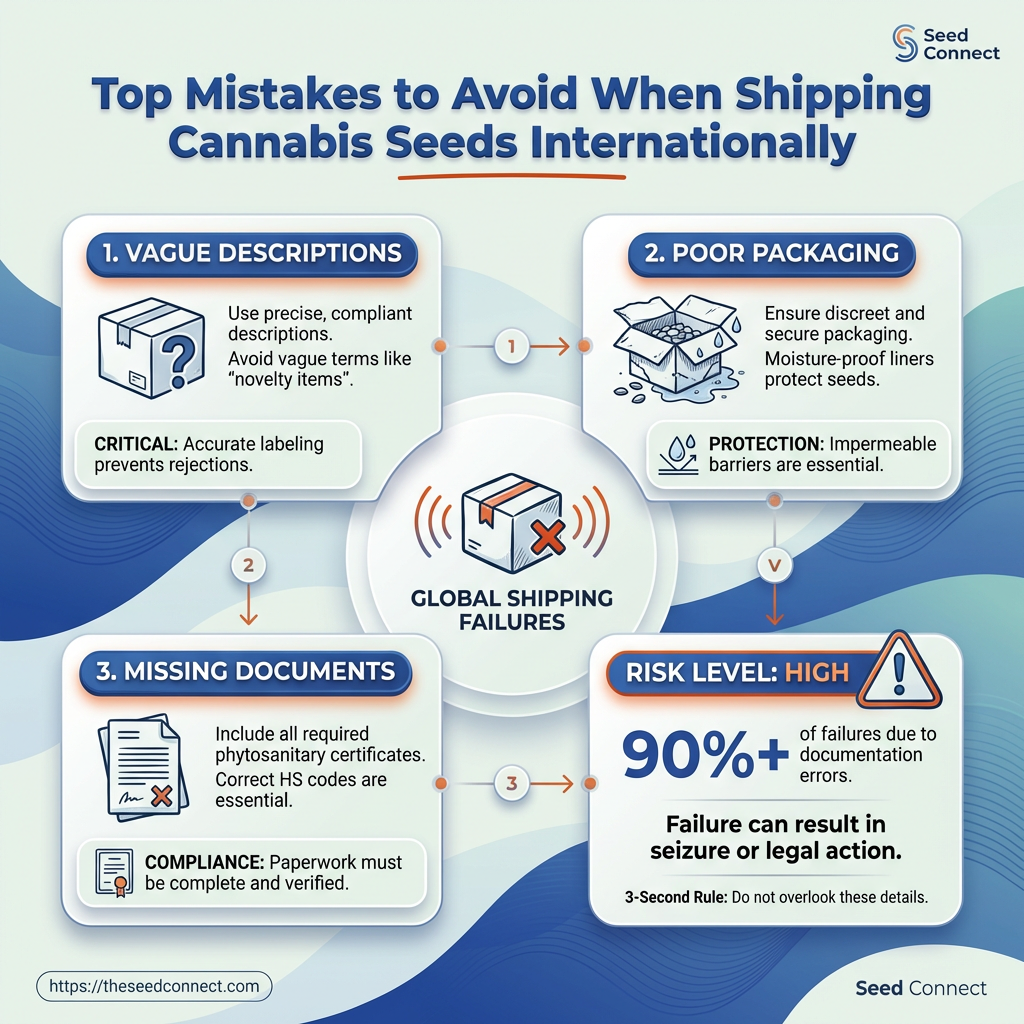
Mistake 2 — Bad or misleading packaging and labeling
Most shipping problems start long before a carrier scans a barcode.
Sloppy labels, contradictory paperwork, or packaging that screams “sensitive contents” trigger inspections, delays, and confiscations.
An estimated 70% of international shipping errors for cannabis seeds come down to improper labeling, so this is where attention pays off.
You need packaging that protects the seeds and paperwork that accurately reflects what’s inside.
That means being discreet without being deceptive, and consistent across the parcel, invoice, and any certificates.
Companies like Crop King Seeds and Royal Queen Seeds are examples in the industry that focus on careful, compliant practices for international shipments. Inconspicuous packaging: a plain, secure outer package that doesn’t advertise contents. Compliant labeling: accurate, country-appropriate descriptions and supporting documents that match each other. What not to do: risky packaging choices we see often
Bold outward branding: Don’t use obvious cannabis logos or strain names on outer packaging.
Mismatched paperwork: Never describe contents differently across customs forms, invoices, and internal packing slips.
Overly vague labels: “Botanical samples” without a species or HS code invites scrutiny.
Deceptive labeling: Misrepresenting contents to avoid checks is both illegal and a fast route to seizure.
Poor sealing: Thin envelopes, single tape strips, or exposed inner bags allow moisture and detection.
Packing checklist: materials, sealing, and concealment best practices
Use a sturdy, plain outer box or padded mailer.
Include internal cushioning so seeds can’t shift or break.
Place seeds in a moisture-resistant inner bag (vacuum or heat-sealed plastic).
Add a desiccant pouch to control humidity.
Tape all seams with strong, tamper-evident tape and reinforce corners.
Fragile labels should be interior and exterior when required.
Match the description on the commercial invoice, customs form, and any phytosanitary certificates exactly.
Include botanical name and quantity.
Avoid explicit strain or brand names on the outside.
Use neutral phrasing and correct HS codes when customs requires them.
Choose a carrier experienced with sensitive shipments and confirm their documentation checklist before sending.
If you ship samples such as Cannabis Seeds, make sure the seed bag label, invoice, and any export paperwork all use the same terminology and counts.
Consistency reduces the chance of a customs hold.
The visual above shows a step-by-step packing flow: inner bag and desiccant, reinforced sealing points, neutral outer labeling, and a checklist for matching paperwork.
Use it while you pack to avoid the common slipups that slow or stop shipments.
Careful packaging and honest, consistent labeling won’t guarantee zero problems, but they cut the biggest sources of export errors.
Small efforts when packing save long headaches and lost seeds down the line.
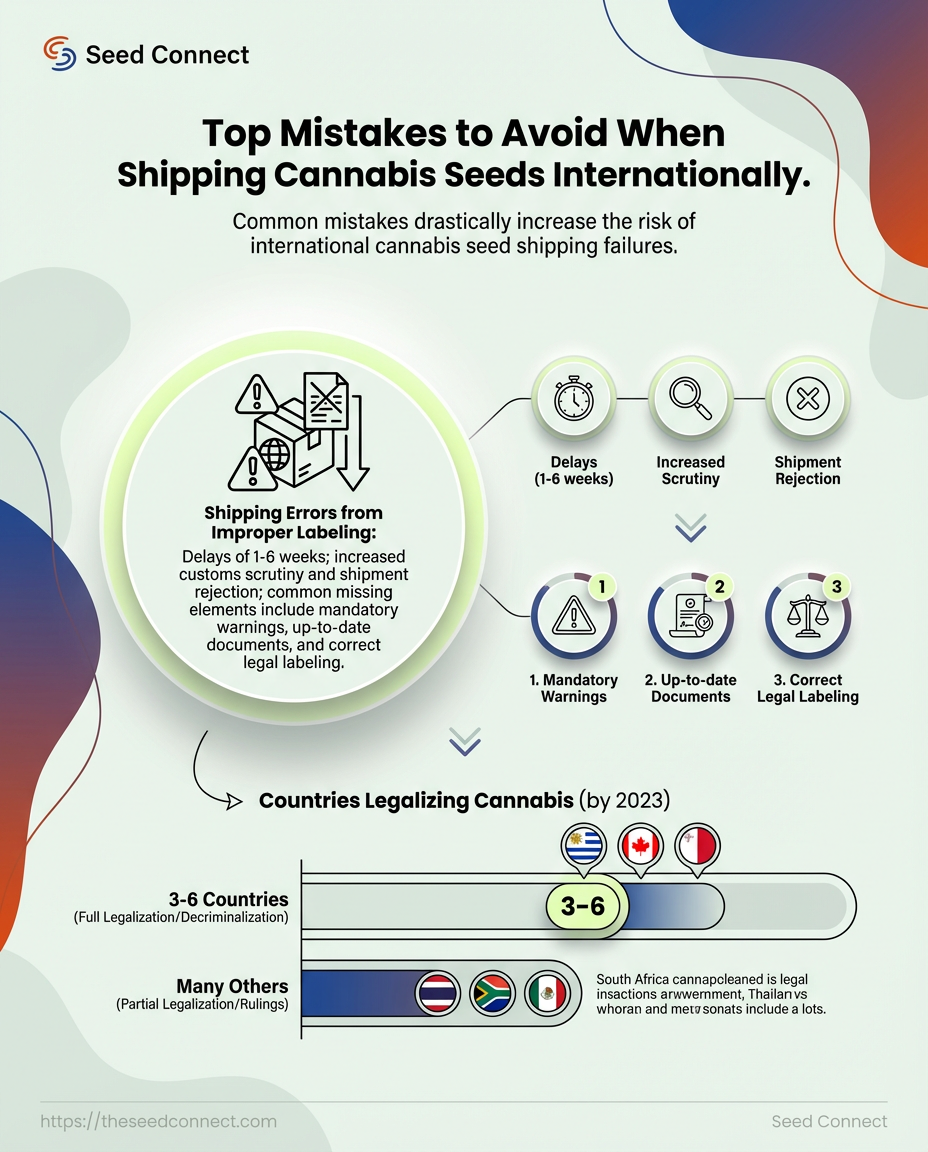
Mistake 3 — Incomplete or incorrect customs documentation
About 70% of international shipping errors for cannabis seeds trace back to improper labeling or paperwork.
That statistic explains why a perfectly packed order can still stop at the border.
More than 40 countries have some form of cannabis legalization, which creates wildly different import rules.
Companies like Crop King Seeds and Royal Queen Seeds emphasize that paperwork mistakes—not just laws—are the most common cause of seizure or delay.
It gets expensive and time-consuming when customs asks for missing paperwork, or worse, destroys the shipment.
Why customs will flag or seize a seed shipment
Customs officers look for mismatches between what’s declared and what’s inside the package.
If descriptions, declared values, or HS codes conflict with the contents, that raises an automatic red flag.
Seeds can be treated as agricultural imports, so authorities often require phytosanitary checks to prevent pests.
Missing health certificates or permits makes a shipment look risky and likely to be detained.
Previous alerts, suspicious routing, or incomplete sender/recipient contact details increase the chance of a seizure.
Some countries also ban certain strains or all viable seeds, so missing declarations can look like concealment.
Key documents you must include
Accurate documentation is the fastest way to avoid seizure.
Big seed banks make this a routine step; you should too. Commercial invoice: A customer-facing bill that lists item descriptions, quantities, unit values, and total value.
It must match other forms exactly. Customs declaration: The official form filed with the carrier or customs authority.
Include the correct HS code, clear description, and origin country. Phytosanitary certificate: A plant health certificate issued by agricultural authorities when required.
It proves the shipment meets the recipient country’s plant health rules. Import permit: Some destinations require prior approval for plant material.
Without it, customs can refuse entry. Packing list: Breaks down package contents and is useful when customs inspects without opening boxes. Certificate of origin: Shows where the seeds were grown; useful for tariff or regulatory checks.
How to fill forms without common errors
Start by using exact, consistent wording across every document.
Ambiguous terms like “botanical sample” invite inspection.
Confirm the recipient’s import rules before shipping—some countries require pre-issued permits.
Use the correct
HS codefor plant seeds and match it on the invoice and declaration.Declare the true commercial value; under- or over-valuing triggers reviews.
Provide full sender and receiver contact details, including phone and address.
Attach any required phytosanitary certificates and reference their issuance details on the invoice.
If language could be a barrier, include an English translation of key fields.
Common errors to avoid:
Wrong HS code: causes automatic reclassification and inspection.
Value mismatch: differing invoice and declaration values prompt audits.
Vague descriptions: terms like “goods” or “samples” lead to holds.
Missing contact info: customs needs someone to call for quick clearance.
This short walkthrough shows a real customs invoice example and the fields that most shipper’s get wrong.
Watch it before you prepare paperwork for your next international order.
Complete, consistent paperwork prevents most delays and seizures.
A few extra minutes filling forms correctly saves days or weeks at the border.
Mistake 4 — Choosing the wrong carrier or service level
Pick the wrong carrier and your seeds can stall in transit, get returned, or be seized by customs. Carriers differ wildly on whether they accept plant material, how they handle customs, and what routes they route through.
That mix directly changes delivery time, visibility, and the legal risk.
Route choice matters as much as the carrier.
A short transit time via an express courier may mean excellent tracking but also stricter item screening.
Slower postal routes may be more permissive but increase chance of loss, damage, or inspection.
Companies like Crop King Seeds and Royal Queen Seeds recommend matching carrier choice to both the origin and destination rules, not just price.
Thinking only about cost is a common shipping mistake that creates bigger headaches downstream.
How carrier policies and route choices affect seed shipments
Carrier rules determine whether your package is accepted, what documentation is needed, and who pays for clearance delays.
Service level shapes the physical route and number of handoffs, which affects inspection likelihood.
Express services typically clear customs faster but may refuse plant material outright.
Postal networks often defer to destination customs and accept shipments more frequently, yet they can be slower and have patchy tracking.
Red flags in carrier terms and what to ask customer support
Carriers hide policy risks in their fine print.
Before you ship, read terms and then call. Restricted-items clause: Ask whether seeds or plant reproductive material* are permitted for your origin–destination pair.
Declared contents rules: Confirm if
CN22/CN23or phytosanitary certificates are acceptable and where they must be attached.Return and seizure policy: Ask who bears cost and responsibility if customs seizes or returns the parcel.
Route transparency: Request the likely transit hubs and whether the carrier uses subcontractors abroad.
Insurance and claims: Verify coverage for loss or confiscation related to customs actions.
Comparison: carrier traits that matter for cannabis seeds
Carrier trait comparison table
Carrier | International reach | Seed/plant policy (allowed/conditional/blocked) | Customs documentation support | Tracking granularity | Typical transit time |
|---|---|---|---|---|---|
National postal services (general) | Global via postal networks | Conditional — depends on destination country rules | Basic sender-facing forms; limited proactive clearance | Varies from basic to detailed | 7–21 days |
USPS (United States Postal Service) | Major international network | Conditional — agricultural restrictions apply by destination | Supports | Varies by service (Priority tracked) | 6–14 days |
Royal Mail | Europe-focused global reach | Conditional — defers to destination import rules | Supports required customs paperwork | Good for international services | 3–10 days |
Canada Post | Global | Conditional — seeds allowed with destination restrictions | Provides customs forms and guidance | Good tracking on most services | 4–14 days |
DHL Express | Global | Blocked/conditional — many express carriers restrict plant material in some lanes | Strong express customs clearance and brokerage | High-resolution, real-time tracking | 2–7 days |
FedEx | Global | Blocked/conditional — strict screening on plant material | Robust customs brokerage options | Granular tracking and alerts | 2–7 days |
UPS | Global | Blocked/conditional — restrictions vary by route | Comprehensive customs support | Detailed tracking, proactive notifications | 2–8 days |
Specialty seed freight forwarder | Targeted/global via partners | Allowed with correct paperwork | High support — phytosanitary assistance available | Moderate to good, depends on provider | 5–20 days |
Economy international services (ePacket/China Post) | Wide reach, lower cost | Conditional — limited acceptance and documentation | Minimal customs support | Limited tracking or partial updates | 10–30 days |
Consolidators / 3PL (regional) | Regional to global | Conditional — depends on specialization | Strong if 3PL specializes in agricultural goods | Varies; often consolidated tracking | 4–18 days |
Shipping through express couriers gives the best tracking and fast customs clearance, but they often have the strictest prohibitions on plant material.
Postal networks are more tolerant in many lanes but trade that ease for slower transit and variable tracking.
Specialty forwarders or seed-focused 3PLs are the best compromise when you need paperwork help like phytosanitary certificates.
Choose carriers by matching their documented policies and service routes to the legal requirements of both countries.
A thoughtful carrier choice prevents most seed export errors and saves time and money in the long run.
📥 Download: Download Template (PDF)
Mistake 5 — Misrepresenting seed quality and declarations
Claiming seeds are “elite,” overstating germination rates, or omitting origin details might feel like a shortcut to a sale.
It’s not.
Those small misrepresentations quickly become big headaches when packages are inspected, customers file disputes, or a germination guarantee is challenged.
Customs officers, carriers, and buyers all rely on the paperwork you submit.
When declarations don’t match the physical product or the documentation, shipments get held, returned, or destroyed.
That’s costly and bad for reputation.
Honest declarations protect delivery and preserve guarantees.
Accurate labelling and transparent quality documentation cut dispute time, speed resolution, and keep legal exposure lower.
Why overstating or hiding seed details backfires
Misrepresentations create three practical failure modes: a customs hold that destroys the order, customer returns and chargebacks, and voided warranty or guarantee claims. Each one hits margins and trust.
An estimated 70% of international shipping errors for cannabis seeds are due to improper labeling.
False claims: Advertising a higher germination rate than tested invites returns when buyers run a germ test.
Hidden origin: Failing to note country or generation of genetics raises red flags in import checks.
Vague descriptions: Using terms like “medicinal” or “industrial” without specifics increases scrutiny.
Incomplete paperwork: Missing batch identifiers or test dates slows customs and claim processing.
Honest declaration tactics that protect delivery and the germination guarantee
Transparent language reduces friction and preserves guarantees.
Use simple, factual phrases and back every claim with documented evidence.
Write concise descriptions: state strain name, generation (F1, stabilized, etc.), and confirmed germination percentage with test date.
Include
batch numberon both packing slip and online order record for cross-reference.Declare contents plainly on customs forms—avoid jargon or promotional adjectives.
Attach a one-line seller statement when permitted: “Seed sample tested at X% germination on YYYY-MM-DD.”
If a germination guarantee applies, note the exact claim and the process for submitting a germination failure claim.
How to document quality: photographs, batch numbers, and germination data
Good documentation turns disputes into quick resolutions.
Photos, simple lab notes, and dated batch IDs are the evidence customs and customers want to see.
Photographs: Include clear macro shots of 10–20 seeds from the batch, with a dated timestamp.
Batch number: Boldly print
batch numberon the packet and in the order system for traceability.Germination data: Keep a short test log: sample size, germinated count, method, and date.
Storage records: Note humidity/temp and storage duration if queried.
Third-party checks: When available, a brief lab or third-party confirmation reduces friction (many businesses, like Crop King Seeds and Royal Queen Seeds, emphasize documented compliance).
Platforms like https://theseedconnect.com often support guarantees when sellers provide this exact paperwork.
Honesty saves time and money.
Accurate declarations and simple documentation keep shipments moving and guarantees enforceable.
Mistake 6 — No tracking plan and poor recipient communication
How much does silence cost? When a shipment goes off-script, the first thing customers notice is the lack of updates.
That silence turns small delays into support tickets, chargebacks, and lost repeat business.
The real cost shows up in three places: direct expenses (reships, refunds, carrier fees), time drain (support hours chasing answers), and reputation damage (negative reviews and reduced lifetime value).
With cannabis seeds, those costs compound because every delayed or seized package triggers extra compliance checks and anxious customers.
Build a tracking plan before the label is printed.
Companies such as Crop King Seeds and Royal Queen Seeds treat tracking as part of the product experience, not an afterthought.
Their playbook: make every scan event visible, decide which events trigger customer messages, and automate the routine updates so humans only handle exceptions.
Recommended tracking and notification workflow Start with short prose explaining the workflow choices and why they matter.
Automation reduces repetitive questions.
Human touch matters when things deviate.
Order confirmation: Send order + expected window and
pre-shipmenttracking number within 24 hours.Pickup confirmation: Notify when carrier picks up and include the first
scan event.In-transit milestones: Provide updates at origin departure, international handoff, and destination arrival.
Customs/hold alerts: Immediately notify the recipient if a customs or carrier hold appears, with action steps and expected timelines.
Delivery attempt and resolution: Inform on delivery attempts, signature requirements, or pickup instructions.
Two-way channel: Offer a direct reply path (email, secure chat, or ticket ID) and estimated response SLA.
Handling a seized, delayed, or returned shipment: step-by-step guide
Verify the
current statusin carrier tracking and note the timestamp and scanning hub.Contact the carrier immediately and request written evidence for seizure or return reason.
Notify the recipient with plain language, next steps, and expected timelines.
Pull the order file: invoice, paperwork, declarations, and any phytosanitary documents.
Escalate to compliance or legal if seizure cites regulatory concerns.
File an insurance or carrier claim where applicable and attach carrier evidence.
Offer the customer choices: reship (with corrected docs), full refund, or hold for return — document their selection.
After resolution, run a root-cause check and update templates, labels, or workflows so the same error doesn’t repeat.
A proactive tracking plan reduces costs and calms customers fast.
Communicating early and often turns anxious waits into manageable, solvable incidents.
Support systems: using guarantees, insurance, and expert help
Problems in transit happen.
When seeds arrive damaged, fail to germinate, or never show up, a layered support approach — guarantee, insurance, expert help — is the fastest way back to growing.
This section explains when to trigger each tool and exactly what to prepare so support teams can act without delay.
Seed Connect’s germination guarantee covers seeds that physically arrive but don’t sprout under reasonable conditions.
That guarantee is meant as the first line of recovery for growers who followed basic germination practices.
For lost or intercepted shipments, insurance and claims processes take over.
Knowing which path to choose saves time and prevents disputes.
An estimated 70% of international shipping errors for cannabis seeds trace back to improper labeling, so good documentation reduces friction when a claim starts.
When to file a germination claim (and how the guarantee applies)
File a germination claim after you’ve run a repeatable, documented germination test and failed to reach a reasonable germination rate for the variety.
Reasonable usually means matching the vendor’s stated rate within normal variance.
Collect
ORDER ID, batch number, and date received.Photograph unopened packets and opened seeds on plain background.
Record step-by-step germination conditions (temperature, medium, days to check).
If seeds arrived intact but won’t sprout, submit those items. Seed Connect’s germination guarantee will typically offer replacements or credit once evidence shows correct technique and failed outcome.
When to buy shipment insurance and what it actually covers
Insurance protects against loss, damage, and sometimes delay-based replacement costs.
Buy insurance when shipping internationally or when a package contains high-value genetics. Recommended coverage: choose a policy that covers loss and damage* rather than only declared value.
When it helps: lost-in-transit, theft, carrier mishandling, or physical damage preventing germination.
When it doesn’t: regulatory seizure in countries where seeds are illegal is often excluded.
Purchase insurance at checkout if the route crosses multiple jurisdictions or if the seeds are rare and costly.
Working with Seed Connect support: evidence and timeline expectations
Start with the support portal and include ORDER ID, clear photos, and germination logs.
Label files clearly and attach timestamps or video where possible.
Expected first response: within 48–72 hours during business days.
Escalation: if a claim requires lab verification or phytosanitary checks, expect additional 7–21 day processing.
Crop King Seeds and Royal Queen Seeds demonstrate industry best practice by combining clear return policies with proactive customer advice; Seed Connect follows similar principles.
Collecting the right evidence and choosing insurance wisely cuts resolution time and protects your crop plans.
The right support system gets you back to growing, not arguing about paperwork.
Conclusion
Make Every Seed Shipment Count
One mislabeled customs form or a missing phytosanitary certificate can turn an ordinary order into a legal headache and a lost customer.
Remember that opening example: the seeds never arrived because one field was wrong on the paperwork.
That moment shows the single most valuable insight from this guide — paperwork and clear communication matter more than clever packaging or a fast carrier.
Common cannabis shipping mistakes usually trace back to the same handful of failures: incomplete customs documentation, incorrect declarations, and silence after dispatch. Those familiar seed export errors are fixable with basic international shipping tips — confirm destination rules, use correct HS codes and certificates, pick a carrier that handles agricultural exports, and keep the recipient informed with tracking updates.
Small steps here prevent big problems later.
Do one practical thing today: create a one-page pre-shipment checklist and run it every time before you hand a parcel to the carrier — double-check customs entries, certificates, product descriptions, and tracking settings.
If you want a supplier that supports growers through that process, platforms like TheSeedConnect can be a helpful resource.
Ready to send the next batch with confidence?