



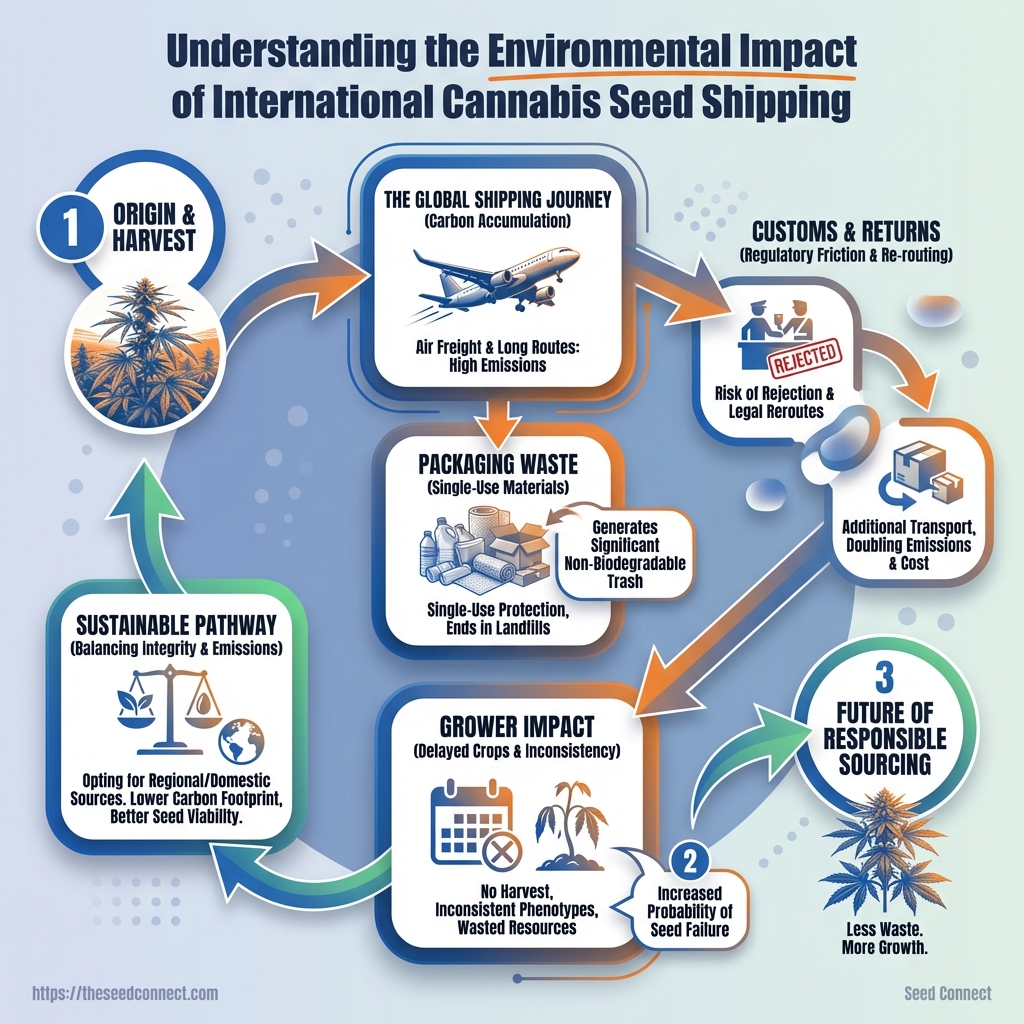
When a tiny padded envelope arrives with seeds, it’s easy to think only about genetics and germination. But the same package conceals a broader environmental impact—a chain of transport, packaging, customs, and returns that accumulates carbon, waste, and regulatory friction. Thinking small feels harmless, but multiplied across thousands of international orders those impacts become significant. Air freight, long multimodal routes, and single-use padding all add to the ecological footprint of a single shipment.
Legal reroutes, rejected parcels, and temperature-sensitive handling intensify those effects, so shipping choices matter as much as seed genetics. Packaging materials, customs processing, and return logistics often get overlooked in sustainability calculations. For growers, breeders, and small vendors, understanding cannabis seed shipping sustainability is practical: it reveals where emissions and waste can be cut without compromising quality. Recognizing those unseen costs makes smarter ordering, consolidated shipments, and supplier selection clearer.
Understanding trade-offs helps balance seed integrity with lower emissions and less waste.
Table of Contents
-
Choosing carriers and routes with environmental impact in mind
-
Real-world lifecycle example: a shipment from Europe to North America
Are tiny seeds doing big harm? Framing the question
Start with a blunt thought: moving a packet of seeds from one backyard or breeder to another seems harmless, but the full costs ripple far beyond a single grower’s table. Sending seeds across borders raises questions about genetic integrity, legal risk, carbon emissions from courier networks, and waste from protective packaging. Those are the stakes growers actually care about: plant quality, reliable access to genetics, and responsibility to the environment and local communities. What’s the true cost of getting seeds across borders?
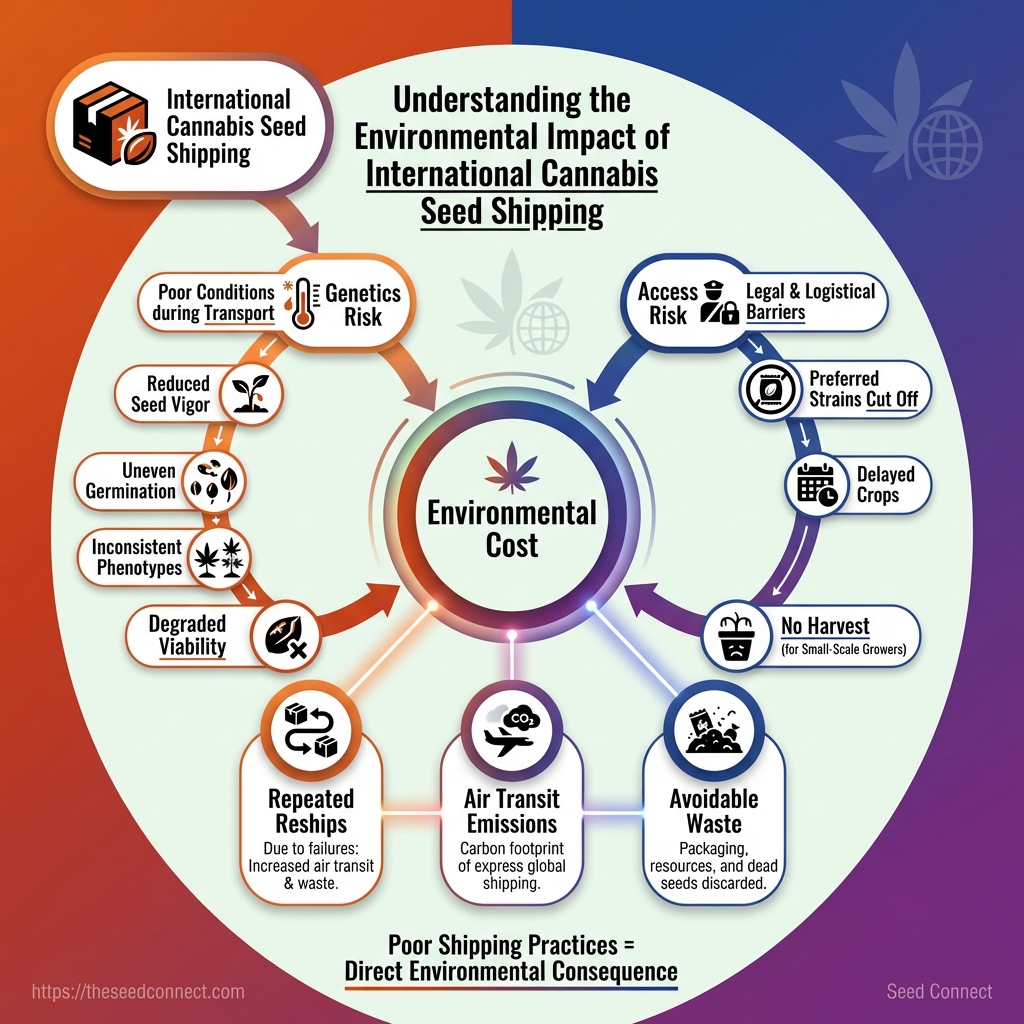
It isn’t just customs fees or the occasional lost parcel. There’s degradation risk when seeds sit in transit in extremes of heat or humidity; there’s the environmental impact of expedited air shipping and single-use protective wraps; and there’s regulatory fallout when seeds trigger inspections or confiscation. These translate to delayed crops, inconsistent phenotypes, and sometimes no harvest at all for small-scale growers relying on rare genetics. Genetics risk: seeds exposed to poor conditions lose vigor, producing uneven germination and weaker plants. Access risk: legal or logistical barriers can cut growers off from preferred strains, pushing them to inferior or untested options. Environmental cost: repeated reships and air transit increase the ecological footprint of cannabis seeds and contribute to avoidable waste.
Why growers should care
-
Quality first: Poor transit degrades viability, so a packet of premium seeds can arrive effectively worth less.
-
Access matters: Reliable shipping preserves relationships with breeders and keeps unique genetics circulating.
-
Environmental duty: Choosing lower-impact logistics reduces the broader ecological footprint of cannabis seeds and supports sustainability in the community.
What this section examines
-
Transport pathways and how each affects seed viability and emissions.
-
Packaging choices that protect seeds without producing excess waste.
-
Regulatory traps to watch for and practical compliance steps.
-
Simple fixes that growers and sellers can adopt today.
Practical example: a small breeder switching from overnight air to tracked ground shipping cut missed deliveries and reduced transit heat exposure, improving germination consistency. Thinking about these trade-offs helps growers make smarter choices about sourcing genetics. For a practical reference on varieties and sourcing, consider browsing [cannabis seeds for sale](http://theseedconnect.com/marijuana-seeds/).
How shipping creates an environmental footprint
Shipping turns a small, light product into a surprisingly complex emissions problem. Air, road, and sea transport each burn different amounts of fuel per mile and per kilogram, so the same packet of seeds can have a tiny or a large carbon bill depending on how it moves. Adding in warehousing, returns, customs holds, and packaging multiplies those emissions in ways that rarely show up on the checkout page. What matters most is the ratio between the parcel’s weight and the transport mode’s fuel intensity.
A lone seed packet sent by air concentrates emissions into a tiny unit of mass, while the same packet consolidated with other orders on a truck or ship spreads the impact across many items. That basic arithmetic—distance, mode, and load factor—drives the ecological footprint of cannabis seed shipping.
Transport modes and their emissions profiles
The dominant contributors are threefold: air, road, and sea, each with predictable profiles that affect small shipments differently.
-
Air freight: Very high emissions per ton-mile; fastest transit and usually used for urgent or long-distance small parcels.
-
Road transport: Moderate emissions per ton-mile that vary with vehicle type and load efficiency; common for last-mile delivery.
-
Sea freight: Low emissions per ton-mile for bulk cargo, but slower and involves additional port handling emissions.
These profiles mean that shipping method choice is often the single biggest lever in the footprint equation.
Hidden impacts: warehousing, returns, and customs delays
Warehousing adds heating, lighting, and handling energy while inventory sits waiting. Long storage times or repeated handling (pick, pack, repack) increases emissions beyond the pure transport leg. Returns are particularly harmful for tiny, low-value items because the transport emissions for return trips can exceed the emissions for delivery. Customs delays also matter: goods held in bonded warehouses or rerouted by carriers incur additional storage and handling energy.
-
Inventory handling: Repetitive handling multiplies emissions for a single order.
-
Packaging waste: Extra protective packaging raises both material and disposal footprints.
-
Return logistics: Reverse transport often doubles per-item emissions.
Measuring footprint per seed: a practical approach
Start by breaking the calculation into three parts and keeping the math transparent.
-
Calculate
transport_emissions = distance mode_intensity parcel_weight_share. -
Add
storage_emissions = days_in_warehouse * daily_energy_rate / items_in_batch. -
Combine
total_emissions = transport_emissions + storage_emissions + return_probability * return_emissions.
Using parcel_weight_share acknowledges that a tiny packet is often responsible for only a fraction of a vehicle’s load—unless it ships alone, in which case its per-gram footprint spikes. For real-world planning, test calculations with both consolidated and single-item scenarios. Mentioning product context helps: a small, single-packet order of [cannabis seeds for sale](http://theseedconnect.com/marijuana-seeds/) behaves very differently from a bulk breeder shipment when these formulas are applied. Shipping choices and operational details create the ecological picture; understanding the pieces lets a seller or buyer make smarter trade-offs when moving even tiny items.
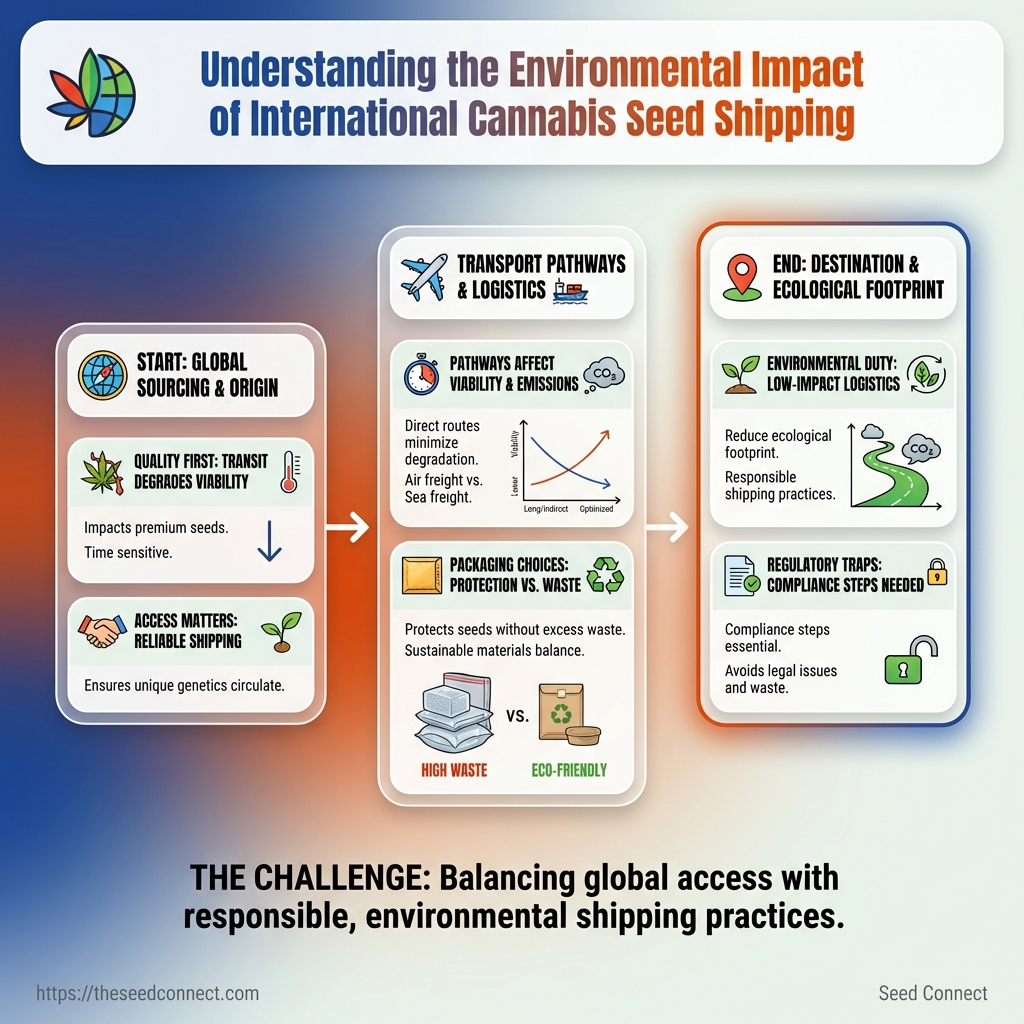
Packaging, materials, and waste from seed shipments
packaging choices matter as much as transport when it comes to the environmental impact of sending seeds. Small items often arrive wrapped in layers designed to protect humidity, prevent smell, and satisfy compliance — and each layer adds material, disposal burden, or recycling complexity. Practical design balances three needs: keep seeds viable, meet legal/labeling rules, and cut unnecessary waste. Most seed shipments use combinations of inner packets, cushioning, and an outer mailer.
Inner packets protect against moisture and light; common options range from cheap plastic zip pouches to glassine paper or heat-sealed foil. Outer mailers vary from padded poly bags to plain kraft envelopes. The waste profile depends on material type, recyclability, and whether buyers can or will reuse or compost it.
Common packaging choices and their trade-offs
-
Glassine or paper envelopes: Thin, breathable, and compostable in many systems; offers modest moisture protection.
-
Mylar or foil-lined pouches: Excellent barrier properties — low germination risk — but mixed-materials make recycling difficult.
-
Zip-lock plastic bags: Cheap, resealable, often reused by growers; persistent in landfill if not reused.
-
Padded poly mailers: Lightweight and protective for transit, but generally not recyclable curbside.
-
Corrugated boxes or kraft mailers: Heavier footprint per unit but widely recyclable and sturdy for bulk orders.
Single-use plastics, padded envelopes, and biodegradables: pros and cons
Single-use plastic: Durable and cheap, often the default. It protects seeds well but contributes to persistent waste unless reused. Padded envelopes: Great for preventing crushing; their insulation often combines paper and bubble wrap, which complicates recycling. Biodegradable or compostable mailers: Better end-of-life in theory, but effectiveness depends on commercial compost access and label clarity; some are only industrially compostable, not home-compostable.
Design choices that reduce waste without risking germination or compliance
-
Prioritize moisture-barrier inner packets that are either recyclable or clearly compostable.
-
Use minimal outer packaging sized to the order to avoid excess air and material.
-
Choose single-material mailers (paper-only or single-poly type) to simplify recycling.
-
Replace bulky cushioning with shredded paper or recyclable inserts when possible.
-
Include small, reusable humidity controls or advise customers on safe reuse/disposal.
Retailers and breeders already experimenting with these choices show that modest changes — smaller mailers, paper inner envelopes, and clearer disposal instructions — cut waste without harming seeds or breaking rules. For a practical reference on varieties and typical packaging formats, see [cannabis seeds for sale](http://theseedconnect.com/marijuana-seeds/). Smart packaging reduces trash and keeps seeds viable; thoughtful choices make small shipments far less wasteful.
Regulatory friction and its environmental consequences
Regulatory delays add invisible mileage. When customs, inspections, or ambiguous legal classifications hold a small packet of seeds, the shipment often gets rerouted, re-inspected or returned — and every extra leg means extra fuel burned, extra packaging changes, and more courier sorting emissions. This matters because those emissions are preventable in many cases. A single customs query can turn a same-week delivery into a multi-week journey that hops between warehouses and modes of transport; that converts a light, low-impact item into a surprisingly carbon-intensive one.
Tightening paperwork and clearer supplier signals reduce those redundant movements. Beyond emissions, regulatory friction increases waste and administrative overhead. Returned shipments are more likely to be repackaged or discarded, inspectors may require additional certificates, and businesses respond by overpacking to preempt inspections — which all increases material use and the ecological footprint of shipping seeds.
How customs procedures and inspections raise emissions
Customs holds and phytosanitary inspections often force reroutes and slowdowns. That creates extra sorting steps, transcontinental back-and-forths, and sometimes air-forwarding to meet new deadlines — all higher-emission options than the original route. What usually triggers these events are ambiguous declarations, missing HS code entries, or unclear country-of-origin paperwork. When a package lacks clear traceability, carriers default to safer (and longer) routing.
The result: extra kilometers and fuel without any change to the actual product.
Country-by-country examples of hold-ups
-
Australia and New Zealand: Strict phytosanitary checks commonly cause detentions for seeds arriving without explicit health paperwork.
-
Several EU members: Different interpretations of seed legality can trigger stops at internal borders, producing unpredictable delays.
-
Some North American postal services: Packages flagged for legal review may be held while courts or agencies clarify classification, then rerouted.
These are illustrative patterns rather than exhaustive legal statements, but they show how variability across jurisdictions creates excess transit.
Cut needless trips with clearer documentation and supplier transparency
Clear paperwork prevents extra legs. Practical steps shipments can follow:
-
Standardize
HS codeand descriptions: Make sure line-item codes match the importing country’s accepted entries. -
Attach traceability docs: Batch numbers, germination guarantees, and supplier details reduce inspector queries.
-
Pre-declare phytosanitary status: Where relevant, include certificate summaries in the electronic manifest.
-
Batch-level transparency: When suppliers publish exact batch and testing details, inspections are less likely to require additional handling.
-
Consistent labeling: Simple, consistent product descriptions cut customs ambiguity.
-
Digital records: Machine-readable manifests speed processing and lower query rates.
Platforms and catalogs that include clear batch and origin details — for example, sources like [cannabis seeds for sale](http://theseedconnect.com/marijuana-seeds/) — can reduce back-and-forths by giving customs the information they need up front. Clear documentation doesn’t eliminate checks, but it turns many detentions into routine passes and keeps shipments on the shortest, lowest-emission route.
Choosing carriers and routes with environmental impact in mind
Choosing a carrier and routing strategy should start with a simple tradeoff: how much speed does the shipment actually need versus how much extra carbon it will incur. Faster options—expedited air, dedicated couriers, or multiple short hops—often multiply emissions per small item. Slower, surface-based choices or consolidated batches shrink the per-seed footprint substantially, especially for light, low-value items like packets of seeds. Look at shipments as a service-level decision, not just a logistics task.
For routine orders that can tolerate a few extra days, pick ground or multi-day sea legs and carriers that publish modal emissions or offer carbon-aware routing. For urgent orders, prefer the least carbon-intensive fast option (for example, express ground over air where that’s feasible) and offset the higher footprint with consolidation elsewhere in the network.
When faster shipping equals higher emissions
Faster modes concentrate energy use in short timeframes: air moves and premium same-day couriers burn more fuel per kilogram-mile than consolidated ground or sea. Choosing speed for convenience alone amplifies the environmental impact of cannabis seed shipping, especially at scale. What to watch for:
-
Volume vs. urgency: prioritize speed only for truly time-sensitive orders.
-
Modal swaps: see if overnight needs can be met with next-day ground instead of air.
Practical criteria for selecting carriers and routes that reduce impact
-
Evaluate published modal emissions and published sustainability commitments; prefer carriers with transparent reporting and measurable targets.
-
Favor multi-stop routes that minimize empty return miles and support
LTLor shared-truck networks. -
Compare transit time windows against customer expectations to find opportunities for slower, greener service tiers.
Use this quick checklist when vetting carriers:
-
Transparency: carrier reports emissions data or participates in industry measurement programs.
-
Route efficiency: carriers that optimize backhauls and use hub consolidation.
-
Capacity options: availability of
LTL/shared services rather thanFTLsolo moves. -
Modal choice: surface-first options for non-urgent deliveries.
How consolidation and batch shipping lower per-seed emissions
Consolidation reduces fixed emissions across many items, so a single truckload or pallet move divided by thousands of packets dramatically shrinks the per-seed footprint. Practically, group orders by region, use scheduled pickup days, and hold low-urgency items for batch dispatch. For inventory examples, vendors of [cannabis seeds for sale](http://theseedconnect.com/marijuana-seeds/) often structure SKUs and fulfillment cycles to make consolidation feasible without harming availability. Consolidation also unlocks cheaper, slower modal choices and simplifies carrier routing—both win for the environment and the bottom line.
Choosing routes and carriers with emissions in mind pays off when scaled across many small shipments.
Best practices Seed Connect and customers can apply today
Start by treating each order as two problems: keep seeds viable, and keep the shipment light and low-impact. Standardize a simple handling SOP that protects germination with minimal materials—think a breathable inner envelope, a small humidity packet, and a low-volume outer mailer made from recycled fiber. Pair that with a single-step documentation checklist so packages move through customs quickly and avoid re-routing that adds miles. What follows are practical, ready-to-run practices covering packaging, paperwork, and small operational shifts that cut emissions without slowing fulfillment.
Seed handling and packaging standards that protect germination and the planet
-
Clean inner envelope: Use paper seed envelopes or
tyvekalternatives to reduce moisture exchange and contaminants. -
Controlled micro-environment: Include a single small desiccant packet and a humidity indicator card to prevent over-drying or mold while keeping materials minimal.
-
Minimal padding: Opt for thin recycled fiber mailers sized snugly to the packet so void fill isn’t needed.
-
Labeled storage rotations: Commit to
FIFOhandling and store outgoing inventory at stable room temps to avoid surprises during transit.
Seed envelope: Use a breathable paper packet to isolate seeds from adhesives and plastics while letting humidity equalize gently. Practical example: pack seeds in a paper envelope, slip a single 1g desiccant and a humidity strip, then seal inside a tight recycled mailer—no bubble wrap, no oversized boxes.
Documentation templates and labeling tips to reduce customs delays
-
Standard fields: Sender: full name & license; Botanical name: Latin cultivar; Quantity: seed count; Batch: internal code; Origin: breeder country.
-
Consistent strain names: Always match the cultivar to the name used on product records—this prevents queries when customs cross-checks listings like those on product pages such as [cannabis seeds for sale](http://theseedconnect.com/marijuana-seeds/).
Clear purpose line: Add short descriptors like research sample or personal genetic backup* if regulations allow. Include a printed manifest inside and a concise label on the outside referencing the batch code so lost paperwork can be reassembled quickly.
Small operational changes that cut emissions — batching, route planning, and carrier selection
-
Consolidate orders into fixed daily or bi-weekly departure windows to increase load factor.
-
Group destinations by geographic corridor before choosing carriers.
-
Match carrier SLA to urgency—use economy lanes for non-urgent mail and reserve premium lanes for true rushes.
-
Track dwell time and aim to reduce manual interventions that create reroutes.
-
Consolidation window: Set one or two daily cutoffs to avoid ad-hoc air upgrades.
-
Carrier alignment: Choose carriers with strong last-mile networks in target markets to avoid redelivery loops.
These steps protect seed viability, smooth customs processing, and shave unnecessary travel from each package—small changes that add up quickly. Keep the SOPs tight, the paperwork consistent, and the packing minimal; those moves preserve germination and the planet at the same time.
Measuring impact and credible offsetting options
Start by measuring before spending on offsets: a rough shipments-level carbon estimate is fast to run and gives a clear decision point for whether an offset purchase is proportionate. The simplest reliable method treats freight as a tonne-kilometre problem — convert the packet weight to tonnes, multiply by the shipping distance in kilometres, then apply an emission factor appropriate to the transport mode. That gives a first-pass result in kilograms of CO2-equivalent, which is enough to compare shipping options, test consolidation strategies, or decide whether an offset purchase is meaningful for a given order. Once that number exists, compare it to operational levers you can pull (consolidation, routing, local inventory) and to the cost and quality of offsets.
The smartest programs pair a reduction-first plan with carefully vetted offsets when emissions can’t be eliminated.
Calculating emissions for a seed shipment
-
Convert weight to tonnes:
weight_t = weight_kg / 1000. -
Calculate tonne-kilometres:
tkm = weight_t * distance_km. -
Apply an emission factor:
Emissions_kgCO2e = tkm * emission_factor.
Example: a 10 g packet (weight_kg = 0.01) shipped 2,000 km by road with an illustrative emission factor of 0.1 kg CO2e/tonne-km yields: weight_t = 0.01 / 1000 = 0.00001 tkm = 0.00001 * 2000 = 0.02 Emissions = 0.02 * 0.1 = 0.002 kg CO2e (about 2 grams CO2e). This example is illustrative; emission factors vary by mode and geography, but the calculation steps remain the same. Use this to compare routes and to scale up from single packets to monthly volumes.
When offsets make sense and how to pick legitimate projects
Carbon offset: a quantified reduction or removal of greenhouse gases credited to compensate emissions elsewhere.
-
Additionality: Projects must prove the reduction wouldn’t have happened without the funding.
-
Verification: Prefer projects validated by recognized standards and third-party auditors.
-
Permanence: Avoid projects with high reversal risk (temporary carbon sinks).
-
Transparency: Clear documentation of baseline, monitoring, and registry entries.
Choose projects with measurable co-benefits (community, biodiversity) and traceable registry records. Prefer smaller, local investments only when they meet the same rigor.
Alternatives to offsets: reducing emissions at the source
-
Order consolidation: Combine multiple strains into single shipments to lower per-seed emissions.
-
Regional stocking: Hold small inventory in regional hubs to cut long-distance freight.
-
Shipping policy nudges: Offer incentives for slower, lower-carbon shipping options.
-
Network changes: Invest in route optimization and shared distribution with partners to lower empty runs.
-
Product grouping: Encourage customers to choose multiple varieties in one order—platforms like [cannabis seeds for sale](http://theseedconnect.com/marijuana-seeds/) can make consolidation easy.
Run the simple calculation first, apply feasible reductions, then use high-quality offsets only for the remaining unavoidable emissions. That sequence keeps spending efficient and climate action credible.
Real-world lifecycle example: a shipment from Europe to North America
A small packet of seeds moves through a surprising number of stages between the breeder and the grower, and each stage adds either emissions, waste, or delay. Picture a 20–50 g order leaving a European packer, riding consolidation, crossing an ocean, clearing customs, then finishing on a local courier for last-mile delivery. The quickest choices—express air plus heavy protective packaging—shrink transit time but amplify the ecological footprint; consolidated sea and local pickup lower emissions but raise transit time and, occasionally, the risk of inspection-related delays. This example breaks the journey into practical stages and shows trade-offs in packaging, routing, and handling.
It uses illustrative ranges rather than precise accounting: the goal is to reveal which decisions drive most of the impact and where growers can change behavior to reduce per-seed footprint without sacrificing viability.
Step-by-step profile: packaging, transit, customs, and delivery
-
Pickup and packing: seeds sealed in a moisture pouch, placed in a mailer with
desiccantand a small cardboard support. -
Domestic consolidation: shipments grouped into pallets or bags for international forwarding; handling can add protective wraps.
-
Ocean or air transit: cargo moves on sea container or airfreighter depending on service level and cost.
-
Customs and inspection: paperwork checks or physical inspection may hold parcels for days, sometimes requiring re-packaging.
-
Last-mile delivery: national courier sorts and delivers; express couriers add speed but higher per-parcel emissions.
Estimated emissions and waste for common shipping choices
Economy sea + road: Low emissions, moderate transit time.* Waste per packet typically includes a small paper envelope and a moisture pouch — often 5–25 g of material. Emissions per packet are comparatively low because of heavy consolidation on long-haul sea legs. Standard airmail: Moderate emissions, faster transit.* Packaging is usually lightweight but consolidated in air networks; per-packet emissions rise because air freight has much higher emissions per tonne-kilometre than sea. Express air courier: High emissions, fastest delivery.* Protective bubble mailers and extra cushioning increase waste; per-packet CO2-equivalent can be orders of magnitude higher than sea consolidation depending on routing.
What the numbers mean for growers choosing where and how to buy seeds
When ordering, think in per-seed terms: a larger bulk order divided into many seeds lowers emissions per seed compared with many tiny orders. Choosing slower, consolidated shipping, simpler packaging, or regional suppliers significantly reduces the ecological footprint. Tools like inventory planning or ordering from regional catalogs — or using platforms that consolidate orders such as cannabis seeds for sale — can shift impact away from high-emissions options. Small choices at packing and routing scale up quickly; shifting to consolidation and minimal packaging often gives the biggest wins for the least risk.
📥 Download: Download Template (PDF)
Practical tips for gardeners buying internationally
ask precise questions, plan orders with other growers, and keep seeds in controlled local storage so shipments become rare rather than routine. Before clicking buy, treat the purchase like a small logistics problem — confirm seller commitments, estimate how the order will be packaged and routed, then decide whether to join a group order or hold off until you can combine shipments. The practical payoff is twofold: fewer shipments lower the ecological footprint and cost per viable seed, and better on-arrival handling increases germination odds. Below are concrete questions to ask sellers, a simple process for pooled ordering, and storage practices that reduce repeat purchases and improve success rates.
Ask the right questions before you buy
Shipping policy: Ask where the seller ships from, which carriers they use, and whether tracking/insurance is included. A straightforward answer prevents surprise reroutes or returns. Packaging specifics: Request a description of the outer and inner packaging and whether they use minimal or reusable materials. This helps anticipate waste and customs scrutiny. Germination guarantee: Clarify what the guarantee covers (percentage, time window, proof required) and how replacements or refunds are handled. Look for clear, written terms on seller pages such as cannabis seeds for sale.
Coordinate orders with friends or clubs to cut per-seed impact
-
Map demand: list strains and quantities each person wants, then identify overlap.
-
Choose a single trusted sender to receive the master shipment and repackage locally.
-
Split costs and responsibilities upfront: who handles customs, who repackages, who pays final-mile postage.
-
Document the plan in a simple shared note so everyone knows timelines and accountability.
Pooling reduces duplicate packaging and often unlocks lower international postage tiers.
Storing seeds locally to avoid repeat shipments
-
Cool storage: Keep seeds in a refrigerator at about
4°Cin an airtight container. -
Low humidity: Add fresh silica gel to keep relative humidity near
20–30%where practical. -
Labeling and rotation: Label: date and strain; Rotate: use oldest seeds first to avoid loss of viability.
-
Freezer caution: Freezing can work for long-term storage but only if seeds are thoroughly dry and sealed; moisture causes damage during thawing.
Small steps in storage habits reduce the need to rebuy, and they increase the odds that that carefully sourced seed actually becomes a plant. Store smart, coordinate your buying, and make each international order count for more.
Frequently asked environment-focused shipping questions
first: each concern has a practical fix rather than a simple yes/no. Compostable packaging can be safe for seeds if the design controls moisture and physical abrasion. Shipping delays usually raise environmental cost when they cause reorders, returns, or require climate-controlled storage; occasional delays that simply slow delivery are less damaging than forced reshipments. Buying local seeds reduces transport emissions and often gives better adaptation to local climates, but it can limit genetic options and resilience. What matters most is how the seed is protected during the whole journey — moisture control, physical cushioning, and a dry, cool microclimate inside the packet.
Testing before scaling is the pragmatic route: small germination checks, simple humidity indicators, and a handful of control samples.
Will certified compostable packaging harm seed viability?
Compostable materials often have weaker moisture and oxygen barriers than plastic films. That matters when seeds spend days or weeks exposed to humid climates, because moisture uptake can reduce germination.
-
Short protection: Use a thin barrier layer or
desiccantpouch inside compostable mailers for long routes. -
Mechanical protection: Add a small cardboard stiffener to prevent crushing.
-
Test before rollout: Run germination checks after simulated transit conditions (heat + humidity).
-
Place sample seeds in candidate packaging.
-
Expose to warm, humid conditions for 7–14 days.
-
Perform standard germination test and compare to controls.
Do shipping delays increase risk or environmental cost more?
Delays themselves are a time cost; the environmental cost rises when delays trigger second actions: replacements, returns, or long-term refrigerated storage. A delayed package that arrives and is used has a smaller marginal ecological footprint than a delayed package that gets replaced and resent.
-
Avoid duplicate shipments: Confirm delivery before automatically reshipping.
-
Use consolidated scheduling: Group orders to reduce single-item air shipments.
Is it better to buy local seeds even if variety choices are limited?
Local seed sources usually offer strains adapted to regional pests, frost dates, and daylight. That can reduce resource inputs (less water, fewer interventions) and improve success rates.
-
Genetic trade-off: Local adaptation versus specialist traits (e.g., exotic aroma or very high THC).
-
Mix approaches: Buy a core of locally adapted seeds and add one or two diverse varieties online for experiments.
Platforms like cannabis seeds for sale can help find specific genetics when local options don’t cover a desired trait. Think of shipping choices as a set of small design decisions: pick packaging that protects seeds under realistic conditions, avoid automatic reships after delays, and prioritize locally adapted genetics when sustainability and success matter most.
Conclusion
Make each seed order count
Remember this above everything: the tiny weight of a seed doesn’t mean a tiny environmental cost. The lifecycle example of a Europe-to-North America shipment showed how choice of carrier, routing and packaging can multiply the ecological footprint of cannabis seeds far beyond the seed itself, turning a simple purchase into a chain of emissions and waste. Keeping that chain short and simple is the single most effective way to shrink impact.
Practical choices matter: prefer consolidated or ground shipments when timing allows, opt for minimal recycled packaging, and favor carriers that publish route-level emissions. Regulatory delays and circuitous routing were a surprising driver of extra emissions in the real-world example, so prioritizing suppliers who handle paperwork cleanly reduces both headaches and carbon. Measuring shipping impact first makes any offsetting or mitigation actually meaningful.
Today’s action: consolidate orders and choose slower, lower-carbon shipping routes when possible — this reduces per-seed emissions immediately. If sourcing internationally, consider buying from local or transparent sellers, or explore reputable options like cannabis seeds for sale that list shipping practices up front.