


When a small packet of seeds sits under a customs officer’s microscope, excitement can flip into real legal trouble.
The different cannabis seed laws in each country make even simple orders hard to predict.
These contradictions create real legal challenges for anyone moving seeds across borders.
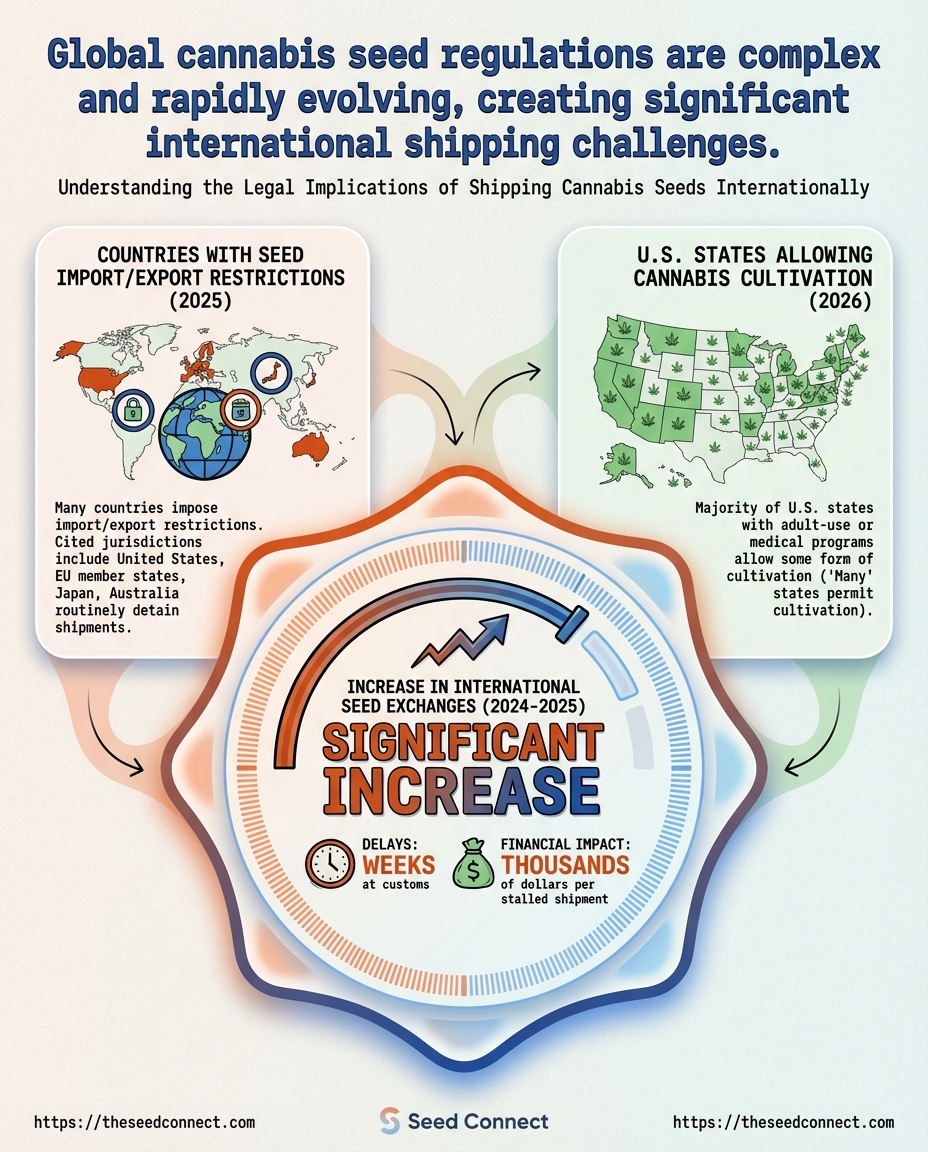
As of 2025, approximately 90% of countries worldwide had some form of restriction on importing or exporting cannabis seeds.
At the same time, 37 U.S. states allow legal cultivation of cannabis seeds as of 2026, which complicates cross-border rules.
Global demand is increasing.
International seed exchanges grew by about 20% from 2024 to 2025.
That growth collides with patchy regulations, creating real risk for hobby growers and small suppliers.
As a result, questions about international shipping legality aren’t academic—they determine whether a shipment arrives or is seized.
Grasping how laws differ is the practical first step toward avoiding fines, lost inventory, and needless legal headaches.
Start here: Is it legal for you to import or export cannabis seeds?
Many people think this question has a simple yes-or-no answer.
It rarely is.
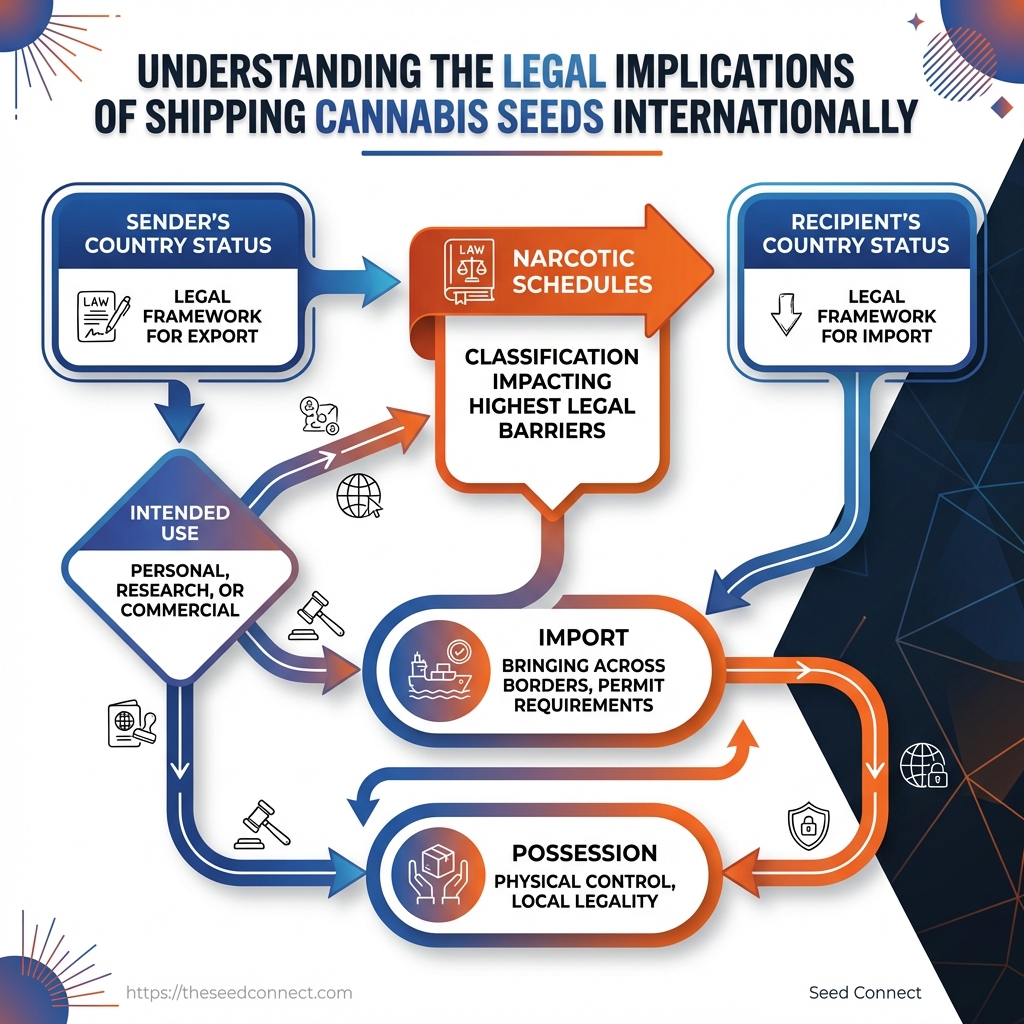
You can send or receive seeds based on three factors: the sender’s country, the recipient’s country, and how the seeds will be used (personal, research, or commercial).
International rules are patchy and strict.
As of 2025, over 90% of countries had legal restrictions on importing or exporting cannabis seeds.
So, assuming you can freely move them is risky.
In the U.S., for example, 37 states allow cultivation of cannabis seeds for recreational or medical use as of 2026, but federal and international rules still affect cross-border shipping.
Treaties and national lists matter more than common sense.
Countries bound by agreements like the Single Convention on Narcotic Drugs often place seeds under regulated plant material or narcotic schedules, and that classification can make international shipping illegal even if local possession is allowed.
Decide first whether you’re sending or receiving, and where you are both located.
The flowchart maps three quick checkpoints: sender country status, recipient country status, and intended use.
Run through it before you buy or prepare a shipment.
Quick primer: legal terms you’ll see
Most legal texts use a handful of repeat terms.
Knowing them keeps decisions practical instead of panicked.
Possession: Physical control of seeds in a country; some places criminalize simple possession regardless of origin.
Import: Bringing seeds into a country across its border; often requires permits or is banned outright.
Plant material: A regulatory category that can include seeds, cuttings, and live plants; classification determines permitted transport rules.
Narcotic schedules: National lists tied to international treaties; if seeds are scheduled, import/export often faces the highest legal barriers.
How criminal vs civil rules change the stakes
Criminal rules mean potential arrest, prison time, and a criminal record.
Civil rules typically bring fines, confiscation, and administrative blocks.
- Criminal penalties: Felony or misdemeanor charges, possible jail time, and lasting records in countries treating seeds as illegal narcotics.
- Civil penalties: Fines, seizure of shipment, and business licensing consequences when seeds fall under agricultural or customs violations.
- Practical example: Imagine a seed packet sent from Canada (permitted) to a country that bans import; the sender might be fine locally, but the recipient risks seizure and criminal charges.
Start every cross-border seed plan with the route and use in mind.
Checking both sides of the transfer often prevents costly legal surprises.
How cannabis seed law varies by country and region
Maps of cannabis seed legality look like a patchwork quilt: some places sell seeds openly, others allow possession but not germination, and many still treat seeds as contraband.
Over 90% of countries had some form of legal restriction on importing or exporting cannabis seeds as of 2025, so assuming free cross-border movement is risky.
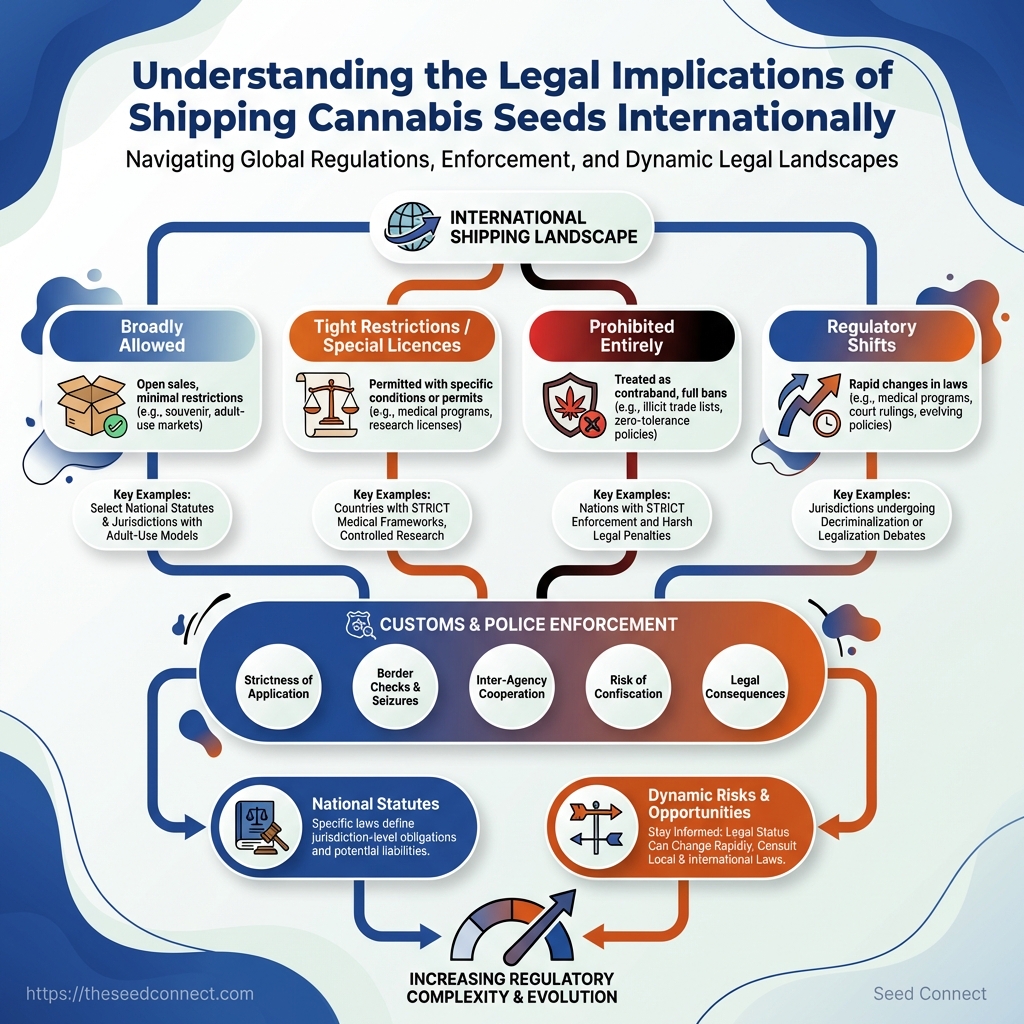
Laws can be grouped into three categories: countries that generally allow seeds, places with strict rules or special licenses, and regions that ban seeds completely.
The legal implications for a seller or buyer depend on both national statutes and how strictly customs and police enforce them.
Regulatory shifts happen fast.
Changes in medical programs, court rulings, and international treaty interpretations can alter whether seeds can be shipped, sold, or cultivated — sometimes within months.
Staying current matters for anyone handling seeds across borders because the international shipping legality question can flip without much notice.
Overview of the three legal categories
Countries where seeds are allowed typically permit sale and import of seeds, often with limits on THC content or licensing for commercial growers.
Countries with restricted regimes allow possession but ban germination, require licences for sale, or permit only hemp varieties; these rules often create narrow exceptions for research or medical programs.
Countries that prohibit seeds treat them like controlled substances, criminalize import/export, and may impose seizure, fines, or prison for violations.
Representative country snapshots and common exceptions
Below is a comparison to help spot patterns and enforcement risk across key markets.
Country snapshots table
| Country/Region | Legal status of seeds (possession/import) | Typical restrictions (germination, sale, medical use) | Penalties for violation | Notes (customs enforcement level) |
|---|---|---|---|---|
| Netherlands | Seeds generally legal to buy and possess | Germination tolerated for small-scale personal use; commercial production requires licence | Confiscation and fines for large-scale cultivation; prosecution possible | Customs cooperation with EU; enforcement moderate |
| United Kingdom | Seeds legal to possess and sell as novelties | Germination and cultivation illegal without Home Office licence | Fines, seizure, possible criminal charges for supply with intent to grow | Customs actively intercepts imports flagged for germination intent |
| United States (federal vs state) | Federal law treats cannabis as controlled; states vary — 37 states allow cultivation as of 2026 | State licensing for sale/cultivation where legal; federal restrictions on interstate/international shipping | Federal seizure and prosecution risk for cross-border shipments; state penalties vary | Customs enforces federal law; state enforcement varies widely |
| Canada | Seeds legal under federal Cannabis Act since 2018 | Licensed producers for commercial sale; limits on cross-border export/import | Seizure, fines, criminal charges for illegal import/export | High enforcement at border for international shipments |
| Australia | Import largely restricted; domestic rules vary by state | Many states require licences; hemp exceptions for low-THC seed | Seizure, fines, and possible criminal charges | Strong customs screening; strict quarantine rules |
| Japan | Seeds effectively prohibited in practice | No legal framework permitting cultivation; strict penalties for use | Severe penalties including imprisonment and heavy fines | Very high enforcement and strict customs controls |
| Germany | Seeds permitted for hemp/industrial varieties; medical framework for cannabis | Recreational cultivation largely restricted; licences for commercial production | Confiscation, fines, criminal charges for illegal cultivation | Customs aligns with EU rules; enforcement moderate-high |
| India | Mixed: traditional uses tolerated regionally; national restrictions on commercial cultivation | State-by-state regulations; licences for hemp and research in some states | Fines and potential imprisonment depending on intent and scale | Enforcement uneven; customs restrict international shipments |
| Brazil | Seeds restricted; medical program exceptions | Limited medical/clinical authorizations; hemp pilot programs | Confiscation, fines, possible criminal charges for illegal imports | Customs enforcement active; evolving regulatory landscape |
Watch for conditional allowances that look permissive but carry strict limits on germination or export.
Where to check primary sources and why laws change fast
Official government customs pages, agriculture ministries, and controlled-substance agencies are the definitive sources for current import/export rules.
Those pages often include licence forms, permitted THC thresholds, and quarantine requirements — and they change after new legislation or court rulings.
Industry associations and regional regulators (for example, the Hemp Industry Association or European Union legal summaries) can flag upcoming changes and interpret complex rules.
Use them as a guide, not a substitute for government text.
- Government customs page: Check for import permits, declaration rules, and seizure policies.
- Ministry of health/agriculture: Look for licensing pathways and permitted uses.
- Industry association updates: Good for practical guidance and alerts on regulatory shifts.
Regulatory status moves quickly; confirm rules before shipping or planting to avoid costly legal implications or problems with international shipping legality.
Common legal risks when shipping seeds internationally
Shipping seeds across borders carries more risk than many growers expect.
Rules look simple on paper, but enforcement varies wildly and consequences can escalate fast.
That mismatch between law and practice is the main reason international seed shipments repeatedly land in trouble.
Customs agents pay attention to the intent and paperwork just as much as the item being shipped.
Even a single misdeclared envelope can trigger civil fines, seizure, or criminal investigation, depending on local laws and how authorities interpret your actions.
The practical risk picture depends on three things: the destination’s laws, the carrier’s internal policies, and how clearly the shipment is described.
Those variables create a small set of recurring legal hazards any shipper must anticipate.
> As of 2025, approximately 90% of countries worldwide had some form of legal restriction on the import or export of cannabis seeds.
Customs seizure, criminal charges, and civil penalties
Customs seizure is the most immediate problem.
Shipments can be held, destroyed, or retained as evidence, and tracking the chain of custody becomes essential if the sender or recipient wants the goods returned.
- Seizure: Authorities can confiscate packages without immediate charges — holding them while investigations proceed.
- Criminal charges: If officials suspect intent to distribute or to cultivate in a prohibited jurisdiction, charges may follow.
- Civil penalties: Fines and administrative sanctions are common and can be levied even when criminal prosecution is not pursued.
- Carrier penalties: Couriers may refuse to transport seeds or close accounts if a pattern of risk appears.
How intent and labeling can affect outcomes
Intent matters legally.
Describing seeds as “souvenirs” or “non-viable” won’t protect a shipper if inspection shows otherwise, and aggressive packaging that hides contents looks suspicious.
- Accurate labeling: Honest declarations reduce the chance of escalation but do not guarantee passage.
- Documentation: Permits and correspondence from import authorities can change an outcome quickly when present.
- Patterns of behavior: Repeat shipments to a single address draw more scrutiny than occasional mailings.
Real-world examples and case studies
Consider regulatory context: the European Union sets frameworks while member states set specifics, so a seed shipment legal in one EU country may be illegal in another.
Imagine a small vendor who sent seeds to a state that allows cultivation (37 U.S. states as of 2026) but shipped to a buyer overseas where import is banned.
The package was seized; the vendor faced administrative fines and had to hire counsel to recover customer data and contest the seizure.
If your shipment is seized, practical steps help: 1.
Contact legal counsel experienced in local cannabis seed law and international shipping legality. 2.
Preserve all transaction records, tracking numbers, and communications. 3.
Notify the carrier and request formal chain-of-custody documentation.
Legal exposure isn’t theoretical; it’s a predictable pattern based on destination law, declaration practices, and shipment history.
Stay cautious and document everything — that record often makes the difference between a returned package and long-term legal trouble.
Regulatory triggers that often matter more than the plant itself
Which part of an international seed shipment actually sets off enforcement: the seed, the box, or the paperwork? Regulators rarely act on the plant alone.
They react to triggers in the shipment profile that suggest risk.
Customs and agricultural agencies use a handful of signals to decide whether to inspect, detain, or destroy a parcel.
Those signals are administrative and procedural: missing documents, suspicious declarations, large commercial volumes, or an origin country with strict biosecurity measures will attract attention faster than the seeds’ genetics.
This section walks through the regulatory triggers that commonly matter most, explains the paperwork that usually wins or loses you safe passage, and shows how enforcement changes when a parcel looks commercial instead of personal.
The diagram shows where customs, agricultural inspection, and biosecurity rules overlap.
It highlights phytosanitary certificate checks, border inspections, and where invasive-species rules can cause immediate refusal.
Below the diagram is a short explanation of how each inspection point connects to documentation and declaration fields.
Common enforcement triggers
- Missing or incorrect documentation: A parcel without a
phytosanitary certificateor with incomplete declarations is far more likely to be inspected or seized. - Declared value and quantity: Large quantities or high commercial value prompt commercial-import procedures, not a casual personal parcel review.
- Origin flagged for pests or disease: Shipments from regions with known pests move to the top of agricultural inspection lists.
- Misdeclared HS codes or descriptions: Using generic codes or lying about contents invites scrutiny and possible penalties.
- Unusual routing or frequent small shipments: Multiple small parcels from the same sender can be treated as commercial imports.
s that matter
Phytosanitary certificate: An official government document confirming a shipment meets plant-health requirements and is free from specified pests.
Biosecurity: Measures designed to prevent introduction of pests, pathogens, or invasive species through imported plant material.
Commercial shipment: Any parcel intended for sale or distribution that exceeds national thresholds and requires importer licensing.
Personal parcel: Small-quantity shipments intended for individual use, often subject to lower thresholds but still needing correct declarations.
Practical examples and thresholds matter.
Over 90% of countries had restrictions on import/export of cannabis seeds as of 2025, so paperwork matters more than ever.
In the U.S., 37 states allowed legal cultivation of seeds as of 2026, but federal and interstate rules still affect international shipping.
- Check whether the destination requires a
phytosanitary certificate. - Keep quantities clearly within personal-use thresholds or comply with commercial import rules.
- Declare HS codes and contents accurately and include origin details.
Regulators notice paperwork before genetics.
Get your declarations and certificates right and most shipments clear without a second glance.
Practical steps to reduce legal risk
Reducing legal exposure for an international seed shipment starts with deliberate, documented choices.
Take measurable steps before you pack anything and you cut the odds of a costly enforcement action.
Using a short checklist and keeping consistent paperwork reduces risk more than trying to hide things.
Small habits—clear labeling, carrier compliance checks, and a basic response plan—are what prevent surprises.
Treat legal review as part of the shipping workflow, not an afterthought.
That mindset makes international shipping legality manageable rather than stressful.
Pre-shipment checklist: questions to answer before you send
| Checklist item | Why it matters | Action to take |
|---|---|---|
| Confirm legal status in sender country | Export controls or criminal rules can prohibit shipping seeds out even if recipient law is permissive | Verify national statutes and customs guidance; contact local agricultural or customs office in writing when unclear |
| Confirm legal status in recipient country | Import rules and penalties vary; some countries criminalize seed arrival or germination | Check recipient customs regulations and national statutes; obtain written confirmation from recipient when possible |
| Decide declared contents and descriptions | Misdeclaration triggers inspections, seizure, and severe penalties | Plan truthful, specific descriptions (e.g., “non-germinating botanical seeds”) and document the decision in shipment records |
| Check carrier policies and customs rules | Carriers may refuse transport or report shipments to authorities | Read carrier terms and contact their compliance desk; choose carriers with explicit policies for botanical materials |
| Consider phytosanitary or other required certificates | Some countries require plant health certificates or permits for biological imports | Contact the sending country’s agricultural department and obtain required documents before shipping |
| Assess commercial vs personal classification | Commercial shipments typically face stricter controls than personal parcels | Classify shipments correctly on customs forms and maintain invoices or declarations matching that classification |
| Understand potential penalties and response plan | Knowing fines, seizure procedures, or criminal exposures reduces panic if something goes wrong | Create an incident plan with contacts, insurance info, and a drafted response letter for customs |
Keep dated copies of statutes, carrier emails, and permits in both digital and printed form.
When multiple jurisdictions are involved, document the chain of advice and decisions so you can show due diligence if queried.
Packaging, labeling, and declaration best practices
Treat packaging as a compliance document as much as a protection layer.
Use discreet, secure internal packaging to protect seeds from damage.
Use outer packaging that accurately reflects contents without provocative language.
Use customs_description that is precise and consistent across the invoice and the airway bill.
- Secure inner packaging: Use sealed, tamper-evident pouches to keep contents intact and traceable.
- Accurate outer description: Use neutral botanical terms, matching the customs invoice exactly.
- Consistent paperwork: Ensure invoice, AWB, and any certificates use the same descriptions and HS codes.
- Carrier alignment: Confirm the carrier accepts botanical seed shipments and note policy reference numbers.
- Record retention: Keep copies of all shipment documents for at least two years or as required by sender/recipient law.
For clarity on strain names and genetics that might appear on paperwork, consult resources like Cannabis Seeds as a reference for official naming conventions.
When to get legal advice and what to ask a lawyer
Get legal help before the first international shipment if one of the following applies: the destination country has unclear rules, the shipment is high-volume or commercial, or you face unusual regulatory triggers like treaty obligations.
Ask for written, jurisdiction-specific guidance and a short actionable memo you can include with the shipment file.
- Jurisdiction check: Ask which specific statutes, codes, or treaty obligations apply in the sender and recipient countries.
- Classification advice: Request help determining whether the shipment will be treated as commercial, research, or personal.
- Declaration wording: Request exact wording to use on invoices and customs forms to minimize ambiguity.
- Penalty exposure: Ask for likely penalties, timelines, and recommended immediate steps if customs seizes the shipment.
- Incident response: Ask the lawyer to draft a short, on-file response letter and a contact list of authorities to call.
When in doubt, a one-hour consult can save weeks of risk.
Organizations like the Hemp Industry Association and regional rules from the European Union can be useful references for bigger regulatory questions.
Small, consistent precautions cut most legal risk and keep shipping practical rather than perilous.
Stay methodical, document every decision, and build a short legal playbook before you press “ship.”
Safer alternatives and business considerations
Shipping seeds internationally is just one way to obtain genetics, and it’s often the riskiest option for a business.
With most countries having import or export restrictions on cannabis seeds, many companies are discovering safer ways to source and secure their supply chains.
Choosing domestic options or digital-first strategies can cut regulatory exposure while preserving access to quality genetics.
This reduces the friction that comes with customs checks, uncertain enforcement, and evolving cannabis seed law in multiple jurisdictions.
There are practical trade-offs: local partners cost more up-front but save headaches later, and digital alternatives shift risk from physical transport to contract and IP protection.
Consider those trade-offs before committing to international shipments.
Work with local partners and licensed distributors
A local distributor with the right paperwork keeps shipments inside a single regulatory regime.
That matters especially in places where the European Union or national regulators enforce strict controls on seed movement.
Licensed distributors often handle compliance, testing, and documentation.
They also provide a commercial layer—returns, replacements, and warranties—that individual cross-border sellers may not offer.
- Risk transfer: Use licensed partners to offload customs and compliance responsibility.
- Traceability: Require batch IDs and test results from domestic suppliers.
- Contract terms: Insist on written warranties and dispute clauses for domestic fulfillment.
Digital alternatives: consultations, genetics information, and local sourcing
When physical seeds are impractical, information and services can substitute.
Digital consultations, detailed genetic profiles, and local propagation partners let growers reproduce desirable genetics without international shipping.
Market signals support that approach.
International exchanges rose about 20% from 2024 to 2025, which means more breeders are sharing genetics data and licensing rather than moving seed lots.
- Genetics reports: Purchase genotype/phenotype sheets and photos instead of seed lots.
- Remote consulting: Hire a genetics consultant to assess local propagation feasibility.
- Local propagation: Contract local nurseries or tissue-culture labs to produce plants domestically.
How Seed Connect’s germination guarantee and expert support fit
Seed Connect’s germination guarantee and expert grower support serve as a practical risk-reduction layer for buyers choosing to purchase seeds rather than rely solely on alternatives.
Their support can clarify strain suitability for local climates and point toward compliant domestic fulfillment options.
This clip explains how the guarantee reduces buyer risk and what to check before ordering.
Germination guarantee: A promise that viable seeds will sprout under normal conditions, plus replacement terms.
Licensed distributor: A domestically registered seller that handles compliance, testing, and documentation for seed sales.
Choosing local partners or digital substitutes lowers international shipping legality exposure while keeping access to strong genetics.
It’s a small shift that often saves time, money, and legal headaches.
Responding to a legal problem: what to do if a shipment is seized or questioned
If a package is stopped, your main goal is to get clear answers: find out who has it, why it was stopped, and what their next steps will be.
Do not admit intent, do not alter or discard records, and treat every interaction as part of a formal record that could be used later.
Act fast and methodically.
Contact the carrier and the customs office shown on your tracking number to get the seizure or inspection notice in writing.
At the same time, preserve everything related to the shipment — labels, photos of packaging, export/import paperwork, and the original order record.
The legal implications are real: over 90% of countries had restrictions on importing or exporting cannabis seeds as of 2025, so expect regulators to follow established procedures rather than make on-the-spot judgments.
In the United States, 37 states allowed cultivation of cannabis seeds as of 2026, which affects domestic handling but not international enforcement.
Immediate steps: contact carrier and customs
- Call the carrier listed on your
tracking numberand request the exact status and any official reference or case number. Ask for an email or PDF confirmation.
- Contact the customs office or border agency that issued the hold and request a written seizure or detention notice. Record the officer’s name and badge if provided.
- Do not sign statements that admit intent or misrepresent facts. If asked to consent to disposal or testing, request the procedure in writing first.
- Inform your insurer and any logistics partners. Early notification preserves claims and creates additional documentation.
- If the shipment contained commercial invoices or Certificates of Origin, ask whether those documents will be returned, retained, or copied.
Documenting evidence and preserving records
- Photograph everything: Take dated photos of the sealed package, labels, and any damage.
- Save digital records: Keep emails,
tracking numberlogs, payment receipts, and the web order page as PDFs.
- Preserve chain of custody: Record every transfer, handler, and time stamp in a single file.
- Secure originals: Keep the original purchase invoice and correspondence in a safe place.
When to contact legal counsel or consular services
If customs issues a seizure notice, charges, or a formal investigation, consult an attorney experienced in cannabis seed law and cross-border disputes immediately.
If the shipment involves another country, contact your country’s consular services for guidance on local procedures and translation help.
If criminal charges, fines, or potential business license risks appear, escalate to counsel without delay.
Legal advice changes how you respond to written notices and whether you invoke diplomatic channels.
Act quickly, document everything, and get specialist legal help early so the situation is controlled rather than reactive.
One simple rule before ordering seeds across a border
Imagine a customs officer turning a palm-sized envelope under a light; the difference between a routine release and a seized shipment is often paperwork and jurisdictional labels rather than the genetics inside.
The legal implications and international shipping legality hinge on how a country classifies seeds, whether permits or phytosanitary certificates are required, and which regulatory triggers—declared intent, THC thresholds, or commercial quantity—apply.
That mismatch between declaration and regulation was the same cause behind the seizure example earlier, not the specific strain.
Treat risk reduction like a short checklist before you buy: confirm local cannabis seed law, ask a customs broker or your carrier about import rules, and prefer suppliers who ship from within your legal jurisdiction.
Tools like The Seed Connect can be a practical option if you need a US-based source with clear shipping policies.
Do one thing today: visit your customs authority’s website, search for “seeds” import guidance, and save a screenshot of the rule you find — ten minutes of checking often prevents weeks of legal hassle.