



There are nights when everything looks right on paper but the plants tell a different story: leaves limp, buds slow to fatten, and the room feels muggy despite the thermostat.
Those small failures add up faster than most growers realize.
Good outcomes come down to one thing: the right cannabis cultivation tools in the right place.
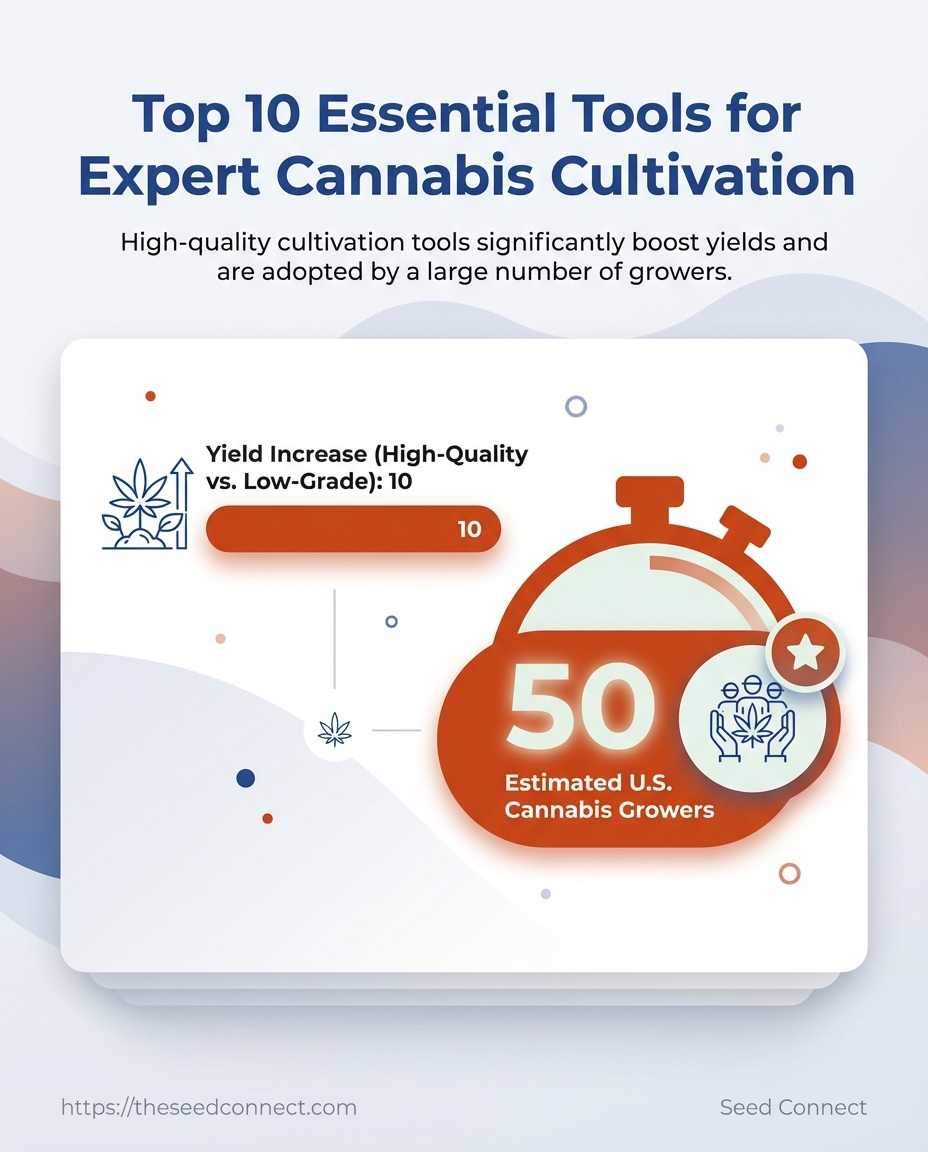
With roughly 90,000 growers in the U.S. and better gear often boosting yields by 20–30 percent, equipment choice isn’t cosmetic—it’s central.
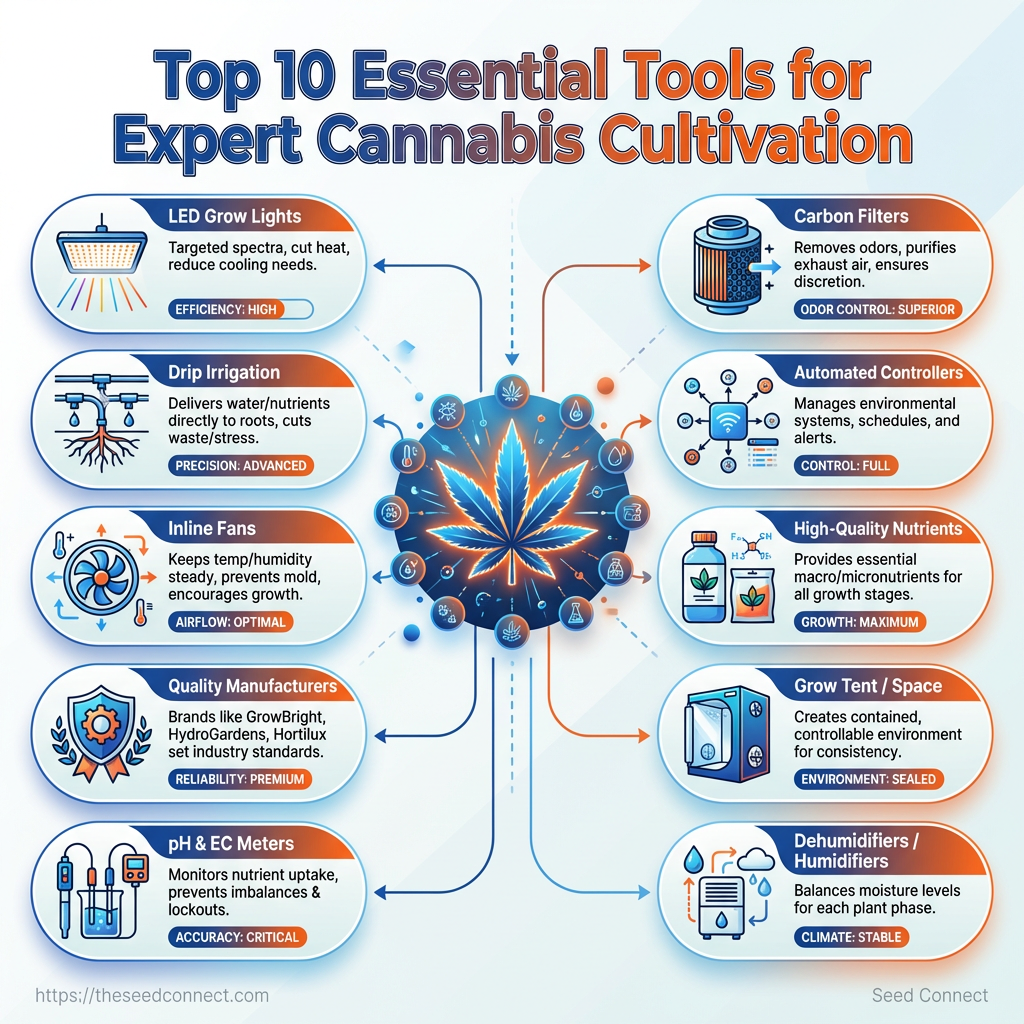
Simple hardware solves common problems. LED grow lights give targeted spectra while cutting heat and cooling needs. Drip irrigation delivers water and nutrients straight to roots, cutting waste and stress. Inline fans keep temperature and humidity steady, which prevents mold and encourages steady growth.
Manufacturers matter too; companies like GrowBright, HydroGardens, Hortilux and EcoPlus pushed many of today’s standards for lighting, hydroponics and ventilation.
Their gear illustrates how proper tools change outcomes without complicated tricks.
These opening pages focus on the practical, no-fluff equipment that turns guesswork into reliable harvests.
Table of Contents
What if the right tools could remove guesswork from your grow?
Picture a grower who used to pace the grow room at night, guessing when to water or tweak the lights.
With the right equipment, those nights become routine check-ins instead of stress marathons.
High-quality tools translate plant needs into clear data.
That means fewer surprises, steadier growth, and better use of time.
Reliable tools don’t replace skill.
They amplify it.
When lights, irrigation, and ventilation are tuned to the genetics, technique wins more often.
Why choosing the right tools matters more than you think
Picking better equipment is one of the fastest ways to raise yields and cut failures.
Using top-tier gear can boost harvests by 20–30% versus lower-grade setups, so the investment often pays for itself within a season.
There are roughly 90,000 cannabis growers in the U.S., and many of the most consistent operations pair quality seeds with purpose-built tools.
Brands like GrowBright and Hortilux specialize in lighting, while HydroGardens builds reliable hydro systems and EcoPlus covers pumps and fans.
90,000 — Estimated number of cannabis growers in the U.S. as of 2023.
-
Lighting:
LEDarrays or quality HPS bulbs tuned for each growth phase. -
Irrigation: Drip systems that deliver water to roots precisely.
-
Ventilation: Inline fans and ducting to control humidity and temp.
-
Environmental controllers: Sensors and controllers that automate adjustments.
How tools interact with seeds, environment, and technique
Seeds set the genetic ceiling.
Tools shape whether that ceiling is reached.
A vigorous cultivar needs matching light intensity, accurate nutrient delivery, and stable humidity to express full potential.
For example, pairing genetics from platforms like https://theseedconnect.com with a drip system from HydroGardens prevents overwatering and improves germination consistency. Seed quality: High germination rates reduce wasted space and time. Light spectrum: The wrong spectrum delays flowering or stretches plants. Airflow: Poor ventilation invites mold and stresses plants, undoing other investments.
What success looks like: consistent germination, predictable yields, less stress
Success looks like trays with uniform sprout rates, plants that fatten on schedule, and harvests you can forecast to the week.
It also looks like fewer emergency trips to fix pH swings or heat spikes.
When tools and technique align, growers stop reacting and start planning.
That’s how a hobby room becomes a dependable production space.
Pairing the right equipment with good seeds and steady practices turns guesswork into repeatable results.
Top 10 tools every expert grower depends on
Imagine a toolbox that removes guesswork from every stage of the grow.
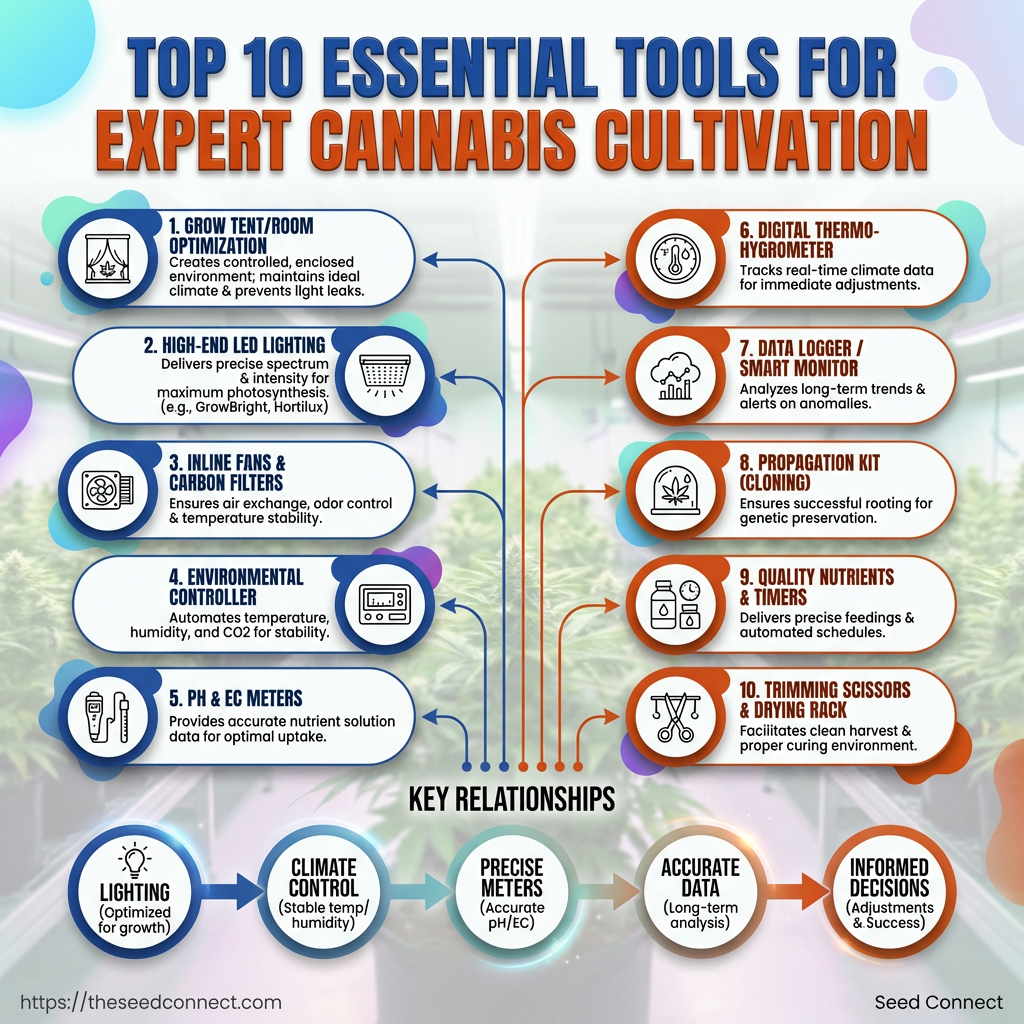
The ten items below are the ones professionals reach for when they need consistent, repeatable results—lighting, stable climate control, precise meters, and clear records.
With the right selection, many growers see measurable improvements; industry estimates suggest using high-quality equipment can raise yields by 20–30% compared with lower-grade gear.
These tools aren’t fancy toys.
They solve practical problems: avoiding heat stress, delivering nutrients without waste, catching pests early, and giving you data you can act on.
Real brands show the point: GrowBright for LED fixtures, Hortilux for HPS/MH lamp options, HydroGardens for hydro systems, and EcoPlus for pumps and fans.
Below are the ten essentials and why each matters in a modern cannabis setup.
-
LED and HPS/MH grow lights: Choose LED for energy efficiency and spectrum control; pick HPS/MH (Hortilux) for proven high flower-stage output.
Match light type to room size and heat budget.
-
Inline fans, exhausts, and controllers: Good airflow prevents mold and evens temperature.
Use variable-speed inline fans with controllers to react to changing loads.
-
Environmental sensors and CO2 monitors: Monitor temperature, relative humidity, and CO2 to maintain stable VPD and growth rates.
Wireless sensors make multi-room setups manageable.
-
pH and EC meters: Accurate pH and
ECreadings protect root health.Carry a handheld meter for reservoirs and a slurry tester for media.
-
Dosing pumps and reservoirs: Automated dosing delivers nutrients consistently and reduces human error.
Pair pumps with well-sized reservoirs and routine calibration.
-
Pots, trays, and drainage systems: Choose pots that balance root space with watering frequency.
Proper trays and drainage avoid standing water and root rot.
-
Pruning shears, scissors, and trellis supplies: Sharp scissors and flexible trellis netting speed canopy management.
Replace blades regularly and label tools to prevent cross-contamination.
-
Pest and disease detection tools: Sticky cards, hand lenses, and regular leaf-scanning apps help catch issues early.
Consider a simple microscope for spore and mite ID.
-
Drying racks and curing jars: Controlled drying rigs and airtight jars with humidipacks preserve terpene profiles.
Temperature and RH control here is as important as during flower.
-
Record-keeping and grow-management apps: Digital logs tie environment data to outcomes, so you can repeat wins and avoid mistakes.
Choose apps that accept CSV exports and sensor integrations.
Grow lights: when to pick each
LEDs work best in tight spaces and where heat control is limited. GrowBright LEDs offer spectrum tuning and lower running costs.
HPS/MH (Hortilux) still shine for high-intensity flower rooms where cooling systems can handle extra heat. match light type to your room’s cooling capacity and budget.
Climate and dosing in practice
Use EcoPlus pumps for circulation and HydroGardens-style reservoirs in hydro setups to maintain steady nutrient delivery.
Automated fans plus inline controllers cut manual adjustments and keep humidity swings small.
The graphic shows a compact room layout with each tool placed where it typically fits — lights above canopy, sensors at canopy height, inline fan in the exhaust, reservoirs near the workbench, and a phone/tablet station for the grow app. It helps visualize how tools interact and where to prioritize upgrades.
Good record-keeping turns hardware into repeatable results.
Spend as much time refining data practices as you do buying gear.
Comparing tool tiers: budget vs prosumer vs commercial
What if a single gear choice could change how much time and money a grow eats each season? Choosing the wrong tier turns small problems into recurring headaches.
Choosing the right tier keeps work predictable and lets you focus on plants.
For most hobbyists, a budget setup covers learning and small runs.
Serious enthusiasts benefit from prosumer gear that raises reliability, repeatability, and energy savings.
Commercial operations need industrial-grade parts for uptime, regulatory compliance, and lower long-term cost per pound.
Use three lenses when deciding: available capital, how consistent you need results, and how many plants you plan to run.
About 90,000 growers in the U.S. show there’s a wide spectrum of needs — pick the tier that matches your goals, not your ego.
How to decide the right tier for your goals
|
Feature / Metric |
Budget (home hobbyist) |
Prosumer (serious enthusiasts) |
Commercial (scale & reliability) |
|---|---|---|---|
|
Typical price range |
$50–$500 per item |
$500–$3,000 per item |
$5,000–$50,000+ per system |
|
Expected lifespan |
1–3 years |
3–7 years |
7–15 years (with service) |
|
Light output / coverage |
~100–300 µmol/m²/s; small fixtures |
~300–800 µmol/m²/s; medium fixtures |
800–1500+ µmol/m²/s; large-area fixtures |
|
Energy efficiency |
~1.5–2.7 |
~2.7–3.2 |
~3.2–3.7+ |
|
Maintenance requirements |
Occasional cleaning, easy swaps |
Scheduled maintenance, occasional parts |
Proactive service contracts, redundant parts |
|
When to upgrade |
If yields, pests, or time become problems |
When scaling or chasing consistency |
When uptime, compliance, or contracts demand it |
|
Build quality / materials |
Plastic housings, consumer drivers |
Metal housings, better thermal design |
Industrial housings, sealed connectors |
|
Control / automation features |
Basic timers |
Digital controllers, remote monitoring |
Full facility automation, API/SCADA integration |
|
Warranty / support |
~1 year limited |
2–5 years with tech support |
5–10 years; dedicated accounts |
|
Scalability / modularity |
Limited |
Rack-compatible, modular add-ons |
Designed for rooms/facilities, easy replication |
|
Initial setup complexity |
Low — plug-and-play |
Medium — tuning and calibration |
High — professional install and commissioning |
|
ROI timeframe |
Months to 1 year |
1–3 years |
1–5 years depending on contracts |
This table shows trade-offs clearly: budget gear lowers entry cost but raises long-term labor and replacement frequency.
Prosumer gear often hits the best compromise for yield gains and energy savings.
Commercial systems demand upfront capital but minimize per-unit costs and downtime.
When it’s worth upgrading a single piece of kit
If one weak link is limiting your whole operation, upgrade it.
A single better component can unlock consistent yields and save labor without replacing an entire room.
-
Lights: Swap a budget unit for a prosumer LED from a reputable maker when canopy uniformity or heat is the limiting factor.
GrowBright-style fixtures show big improvements in coverage and efficiency.
-
Irrigation: Move from hand-watering to a drip system when water consistency or nutrient control affects plant uniformity.
HydroGardens-style systems reduce waste and cut labor.
-
Ventilation: Replace an undersized exhaust with a higher-capacity inline fan when humidity or odor control fails.
EcoPlus-style fans improve air exchange and reduce mold risk.
-
Flowering bulbs: Upgrade to higher-performance HPS/MH bulbs from a trusted brand like Hortilux when you need denser flowers and proven spectral performance.
-
Environmental control: Add a digital controller when timing, CO₂, or multi-zone control consistently drifts; automation buys reliability and frees time.
When one upgrade pays for itself: you’ll see fewer losses, fewer corrective interventions, and in many cases the yield bump will match the 20–30% improvement possible with better equipment.
Pick the upgrade that removes your current single biggest pain point, then measure results and iterate.
Choosing the right tier is a practical decision, not a status move.
Spend where it fixes the real constraints and let results guide your next upgrade.
How to buy quality tools (and avoid common traps)
Most buying mistakes happen fast: impulse grabs, price-only comparisons, or trusting an unknown seller because the product picture looks fancy.
The right approach slows the purchase down and focuses on measurable specs, warranties, and shipping details that actually affect your season’s results.
High-quality growing equipment can raise yields by 20–30% versus low-end gear, and with roughly 90,000 U.S. growers in 2023, competition for reliable suppliers is real.
That makes it worth learning which specs matter, how to vet a seller, and what paperwork to expect when you ship across borders.
This section shows the concrete checks to run before you click buy, common red flags to avoid, and the shipping rules that trip up international growers most often.
Key specs to check by category
When evaluating gear, focus on measurable performance and compatibility rather than marketing language.
-
Lighting — PAR/PPFD: Look for rated
PPFDvalues at your intended hanging height and a spectrum chart. -
Irrigation — flow rate and emitters: Verify liters/gallon per hour and emitter spacing for even root-zone delivery.
-
Ventilation — CFM and static pressure: Match CFM to room volume and check static pressure for duct runs.
-
Pumps — head height and efficiency: Confirm maximum head and expected run-hours before maintenance.
-
Environmental controllers — sensor accuracy: Check specs for sensor tolerances (±°C or ±%RH).
-
Electrical — surge protection and plug type: Ensure voltage compatibility and whether a grounded plug is included.
What you measure matters more than brand names.
Warranty, returns, and vetting sellers
Warranty: Most reputable manufacturers list a warranty period and what it covers; prioritize parts-and-labor coverage over limited replacement. Return policy: Look for at least a 14–30 day return window and clear restocking fees before buying. Seller reputation: Read product reviews, check for repeated complaints about DOA (dead on arrival) items, and prefer sellers who publish repair centers or local support.
-
Check multiple review sources and look for repeat buyers, not one-off five-star posts.
-
Confirm a business address and phone number; call if anything feels off.
-
Ask about warranty fulfillment and where repairs are handled.
-
Save receipts, serial numbers, and warranty paperwork immediately on arrival.
This short walkthrough shows how to verify a seller, interpret warranty language, and spot shipping clauses that matter for seeds and equipment.
Shipping and compliance considerations for international growers
Shipping tools and seeds across borders brings two separate problems: customs legality and hardware compatibility.
Some countries restrict seeds or require phytosanitary certificates.
Always check local rules before ordering.
Electronics may need different mains voltage or plug adapters.
Confirm the product supports your local voltage or that a local repair network exists for brands like GrowBright or Hortilux.
Packaging and declared value matter for customs. Ask the seller how they label shipments and whether discreet packaging or additional documents are provided.
Slow or hidden fees are a common trap; confirm total landed cost before paying.
Buy the spec sheet, a sensible warranty, and clear shipping terms — then buy the tool that meets those standards.
Maintenance routines that protect your investment
What if the single best way to guard your harvest isn’t new gear but a few disciplined routines? Regular maintenance keeps lights, pumps, and controllers running at peak efficiency and prevents small failures from becoming season-ending disasters.
Start with predictable rhythms: short daily checks, focused weekly tasks, and deeper monthly services.
Those rhythms catch drift in pH and EC, stop buildup in reservoirs, and extend the life of expensive items like drivers and pumps.
When calibration, cleaning, and spare-part planning are part of the workflow, a broken pump becomes a minor hiccup instead of a crop risk.
Calibration and cleaning deserve separate attention because they silently affect yield quality.
Calibrate pH meters with pH 4.0 and pH 7.0 buffers weekly, and rinse EC probes after each use.
Wipe LEDs and glass every week with a lint-free cloth; for HID bulbs, inspect lamp hours and sockets monthly.
Inline fans and filters need weekly visual checks and a monthly deep-clean or media replacement.
-
Calibrate meters:
-
Rinse probe in distilled water.
-
Soak in
pH 7.0thenpH 4.0buffers and adjust per the meter manual. -
Record calibration date and drift in a log.
-
Daily visual sweep: quick leak, noise, or alarm check.
-
Weekly sanitation: wipe fittings, clean strainers, and empty scum in reservoirs.
-
Monthly overhaul: deep-clean tanks, replace worn seals, and test backup systems.
Build a small spare-parts kit before it’s urgent.
-
Spare pump: one inline or submersible pump matched to system head.
-
Replacement filters: at least one carbon filter and one pre-filter.
-
Extra probes:
pHand EC probes or a calibrated backup meter. -
Fan blade set or motor: quick swap parts for inline fans.
-
Lighting parts: spare ballast/driver and a HID bulb (Hortilux bulbs are a commonly used option).
Daily, weekly, and monthly checklists for key gear
|
Tool |
Daily task |
Weekly task |
Monthly task |
|---|---|---|---|
|
Lights (LED/HID) |
Visual check for flicker and odd noise |
Wipe lenses/reflectors; check mounting hardware |
Inspect bulbs for hours; check drivers/ballasts for heat |
|
Ballasts / Drivers |
Confirm steady power and no error lights |
Clean vents and check connectors |
Load-test under nominal conditions; firmware update if applicable |
|
Fans / Exhaust |
Listen for unusual sounds; verify airflow |
Clean fan blades and check belt tension |
Deep-clean housing; inspect motor bearings |
|
Filters (carbon/pre-filter) |
Check airflow restriction visually |
Replace pre-filters; vacuum carbon housing exterior |
Replace carbon media or record remaining life |
|
Timers / Controllers |
Confirm schedules running |
Test override functions; check backups |
Battery replacement; firmware and configuration audit |
|
pH / EC meters |
Quick rinse and visual check |
Calibrate |
Replace probes showing drift; full meter inspection |
|
Reservoir / pumps |
Check levels and leaks |
Clean strainers and tubing; flush lines |
Disinfect tank; inspect pump impeller and seals |
|
Sensors and controllers |
Verify readings match manual checks |
Recalibrate temperature/humidity sensors |
Sensor cross-check and replacement if drift exceeds tolerance |
|
CO2 systems |
Confirm setpoint and no alarms |
Inspect solenoid and tubing |
Leak test; refill or service cylinder/regulator |
|
Humidifier / Dehumidifier |
Verify setpoints and drainage |
Clean water trays and wipe sensors |
Replace desiccant or clean coils; service compressors |
|
Trimmers / Pruners |
Visual safety check |
Sharpen blades and lubricate |
Replace worn blades and service motors |
A quick analysis: this table compresses routine actions so maintenance becomes habit, not an emergency.
Daily checks catch immediate failures; weekly work prevents buildup; monthly tasks extend life and reveal creeping problems. Use a dated log for calibrations and part swaps so patterns become visible.
Keeping a small inventory and a simple log changes maintenance from reactive to preventive.
That discipline saves time, reduces replacements, and protects your seasonal investment.
Sourcing high-quality seeds and expert support
Choosing the right seeds matters as much as picking lights or pumps.
The right genetics match your environment, equipment, and growing goals.
Get those three aligned and you avoid months of wasted effort.
High-quality seeds cut out guesswork.
They arrive with predictable vigor, stable traits, and fewer surprises during veg and flowering.
With nearly 90,000 U.S. growers today, small advantages in genetics and support separate frustrating grows from reliably good ones.
Good equipment can boost yields by roughly 20–30% when paired with top-tier genetics and proper technique.
That makes seed sourcing and expert support a strategic decision, not just a shopping choice.
How equipment choices change which seeds you buy
If your grow uses LEDs like those from GrowBright, you’ll see cooler canopies and specific light spectra.
That often favors dense, compact strains that respond well to the LED light spectrum.
Using hydroponic systems (HydroGardens-style) shifts the equation toward vigorous, fast-rooting varieties.
Plants that tolerate higher nutrient flow and quicker feeding cycles perform best in those systems. If your room depends on Hortilux HPS/MH bulbs or vintage HID setups, expect more heat and different light intensity.
Choose strains known for heat tolerance and slower stretch to avoid canopy problems. If ventilation is limited and you rely on EcoPlus fans and basic circulation, pick strains with lower humidity risk—ones less prone to bud rot or tight, moisture-trapping flowers.
What to expect from Seed Connect: germination guarantee and expert help
Seed sources should offer clear guarantees and accessible advice.
With platforms like https://theseedconnect.com you get a germination promise and grower support that answers setup-specific questions.
Expect support to cover: strain selection for your lights and irrigation, troubleshooting germination failures, and guidance on stretch, training, and feeding schedules tailored to your equipment. Autoflower: Flowers on a timer; good for short cycles and simple light schedules. Photoperiod: Needs a light schedule change to flower; offers more yield control and choice of finishing time.
Practical checklist before buying seeds
-
Grow space check: Confirm height, light type, and ventilation before choosing a strain.
-
System match: Match seeds to your irrigation—soil, drip, or hydroponic—because roots behave differently.
-
Heat tolerance: If using older HID bulbs, prioritize strains rated for higher canopy temperatures.
-
Support access: Choose sellers that provide real grower support and a germination guarantee.
This short video shows how to pair indica, sativa, hybrids, autoflower, and photoperiod genetics with different lights and room setups.
Watch it to see side-by-side examples and practical setup tips.
A thoughtful seed choice tuned to your tools saves time and raises success rates.
Good genetics plus reliable support makes every season easier and more productive.
📥 Download: Download Template (PDF)
Instead of asking questions to engage the reader, start by presenting a scenario: ‘Imagine you’re faced with multiple signs of trouble—flickering lights, over-saturated soil, or unyielding pH levels. Instead of panicking, having a strategic approach can help you tackle these issues one by one. A focused triage process not only saves time but also ensures your plants remain healthy. Begin by isolating each variable in your system; treat one factor at a time while documenting your changes.
Most chronic problems stem from sensor failures, power interruptions, or fluid management issues rather than plant health. By measuring conditions before executing replacements, you can swiftly identify the root cause of 80% of common equipment-related issues, minimizing downtime and improving the overall output of your operation.
Cost planning: build a reliable setup without surprises
Pretend the money sheet for your grow is a map, not a mystery.
Plan for durable gear up front and predictable monthly costs, and you’ll avoid last-minute replacements that eat margins and patience.
A sensible budget splits one-time capital purchases from recurring operating costs.
That separation makes it easy to compare a budget LED against a higher-end GrowBright fixture and see long-term savings in reduced cooling and energy bills.
Expect better equipment to pay back through efficiency and higher yields — studies in the industry suggest quality gear can boost output by 20–30% versus low-end tools.
Build with realistic ranges, plan for hidden line-items, and use a checklist so nothing important slips through.
Budget tiers: realistic starting ranges
Here are three practical setups and what they cover.
-
Beginner — $600–$1,500: Basic LED or secondhand Hortilux lamp, small tent, inline fan, simple drip kit, basic meters, and seeds.
-
Intermediate — $1,500–$4,000: Mid-range GrowBright LED, better ventilation, timed irrigation, environmental controller, quality nutrients, and sanitization supplies.
-
Expert/prosumer — $4,000–$12,000+: Full multi-light GrowBright rigs, zoned HVAC or aggressive inline fans, backup systems, advanced hydroponic gear from HydroGardens, and monitoring sensors.
Hidden recurring costs to plan for
Monthly expenses often surprise growers more than capital buys.
Energy, consumables, and small replacements add up and vary widely with scale and local electricity prices.
-
Energy bills: Heating/cooling and lights are the biggest ongoing costs; LEDs cut heat and can lower cooling needs.
-
Replacement parts: Hortilux bulbs and worn fans or pumps from brands like EcoPlus need periodic replacement.
-
Consumables: Nutrients, pH buffers, filters, and media are steady line items during every cycle.
-
Water & waste: Increased water use, runoff treatment, and disposal materials can be overlooked.
-
Monitoring & backup: Batteries, sensors, and a UPS for controllers keep runs stable but cost extra.
Buying checklist for your first complete grow-room
Start with essentials and avoid impulse buys.
Follow this ordered checklist while comparing models and warranties.
-
Lights: Choose efficiency-first (LED or Hortilux where appropriate).
-
Ventilation: Inline fan, ducting, and carbon filter sized for your room.
-
Irrigation: Drip or HydroGardens-style hydro system plus reservoir and pump.
-
Environmental control: Controller, thermostats, and a UPS for critical systems.
-
Meters & sensors: pH, EC/TDS, humidity, and temperature monitors.
-
Consumables kit: Nutrients, media, spare filters, and a bulb or pump replacement.
-
Genetics: Secure seeds from platforms like https://theseedconnect.com to match your setup.
Start with honest ranges and a checklist rather than sticking to sticker shock.
A little planning up front keeps the run predictable and the surprises pleasant.
Conclusion
Make your grow room predictable tonight
There’s one idea that matters more than any gadget: reliable environmental control removes almost all guesswork.
When leaves droop, buds lag and the room feels muggy despite the thermostat, it’s usually a measurement or maintenance failure—not the plants.
Spending on precise sensors, a good dehumidifier and regular maintenance protects your harvest more than chasing exotic strains.
Do a practical check tonight: inspect your hygrometer, clean or replace intake filters, verify airflow paths, and confirm light schedules against your controller.
Then start a 72-hour environment log with a datalogger or smart controller so you can see temperature and RH trends instead of guessing.
If genetics are also a question, look into vetted options like cannabis seeds for beginners once your environment is stable.
Fix the measurements first, and the rest—the right cannabis cultivation tools, growing equipment and cultivation supplies—become investments that actually pay off.