

The Impact of Genetics on THC Levels in Cannabis Seeds begins with the DNA inherited from both parent plants. Genetics help determine whether a plant has the biological potential to produce higher levels of THCA, while environmental factors such as light, nutrition, plant health, and harvest timing influence how much of that potential is ultimately expressed.
In this guide, The Seed Connect explains how THC-related genetics work, why seeds from the same strain can still produce different results, and what growers should look for when evaluating high-THC seed genetics.
Key Takeaway
- Genetics set THC potential, not a guaranteed percentage.
- THCAS-related genes influence cannabinoid pathways.
- Seeds from the same strain can express differently.
- Environment affects final THC expression.
- Breeder data matters more than strain-name hype.
Why do two cannabis seeds from the same strain produce different THC levels?
Ever seen two seeds from the same strain grow into very different plants? That happens because cannabis genetics set the range, not a fixed number.
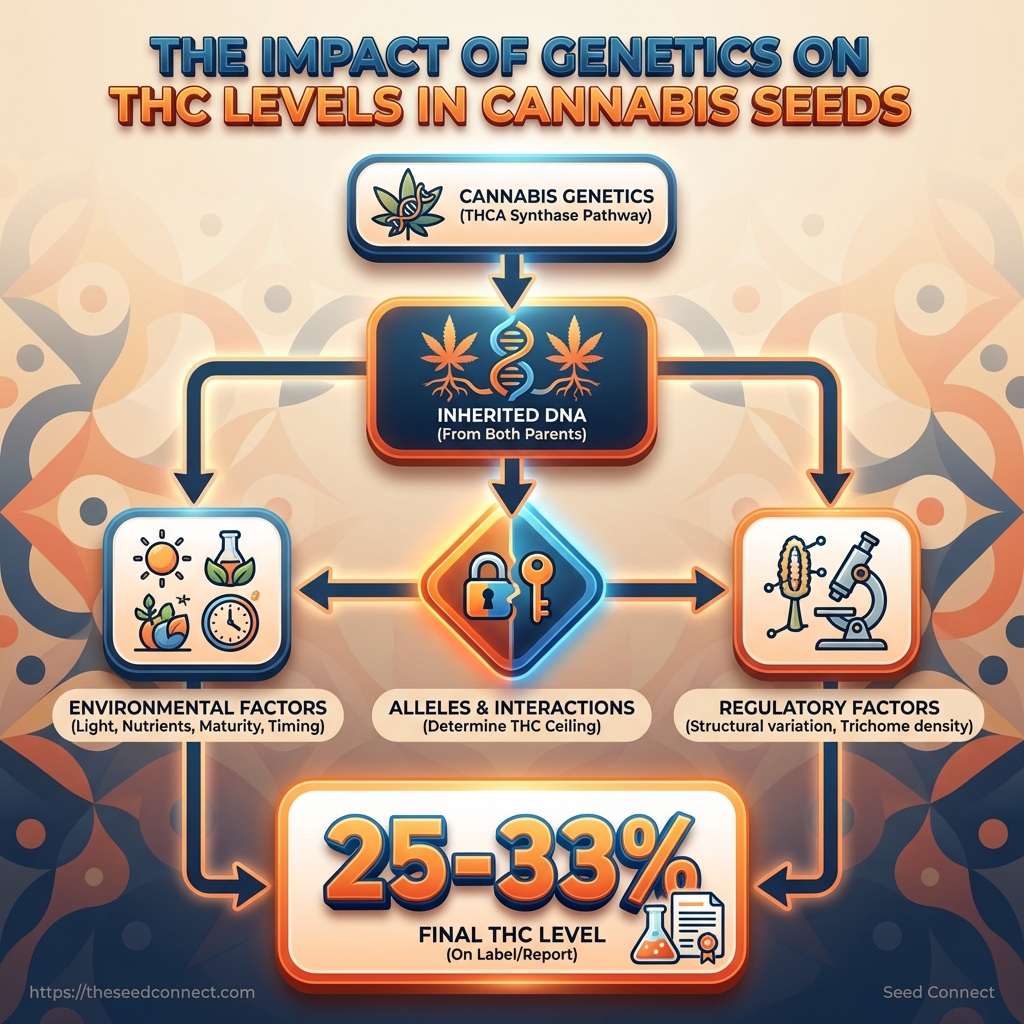
A seed carries a mix of traits from both parents, and the biggest one for THC is whether the plant inherited working THCAS-related genes.
Those genes help push cannabinoid production toward THCA, which later becomes THC after decarboxylation.
THC genetics is a ceiling, not a promise
In practical terms, THC genetics tell you what a plant is capable of producing, not the exact result at harvest.
A seed with strong high THC seed genetics may still finish lower if it gets poor light, stress, a rushed harvest, or weak trichome development.
That is why two plants from the same strain can look close on paper and still test differently.
The genetic script is similar, but the final performance changes with the room, the timing, and the grower’s hands.
Why seed-grown plants drift apart
Seed-grown plants are not clones.
Each one is a unique genetic shuffle, even inside a carefully bred line, so small differences in cannabinoid-synthase genes and regulatory regions can change THC output.
The variation usually comes from a few places at once:
- Different gene combinations: One seed may inherit more favorable THCAS-linked alleles than another.
- Regulatory differences: Some plants switch cannabinoid pathways on more strongly than others.
- Trichome density: More resin glands often means more room for THCA accumulation.
- Environment and timing: Light, nutrition, maturity, and drying all shape the final THC number.
If you want the cleanest mental model, think of cannabis genetics as the blueprint and the grow as the build quality.
The blueprint matters a lot, but the finished house still depends on the crew.
That is also why breeders and growers care so much about stable parents and repeatable seed lines.
When people browse Cannabis Seeds, they are really comparing probabilities, not guarantees.
The useful part is simple: the seed gives you potential, and the grow decides how much of that potential shows up.
That gap is where most THC surprises live.
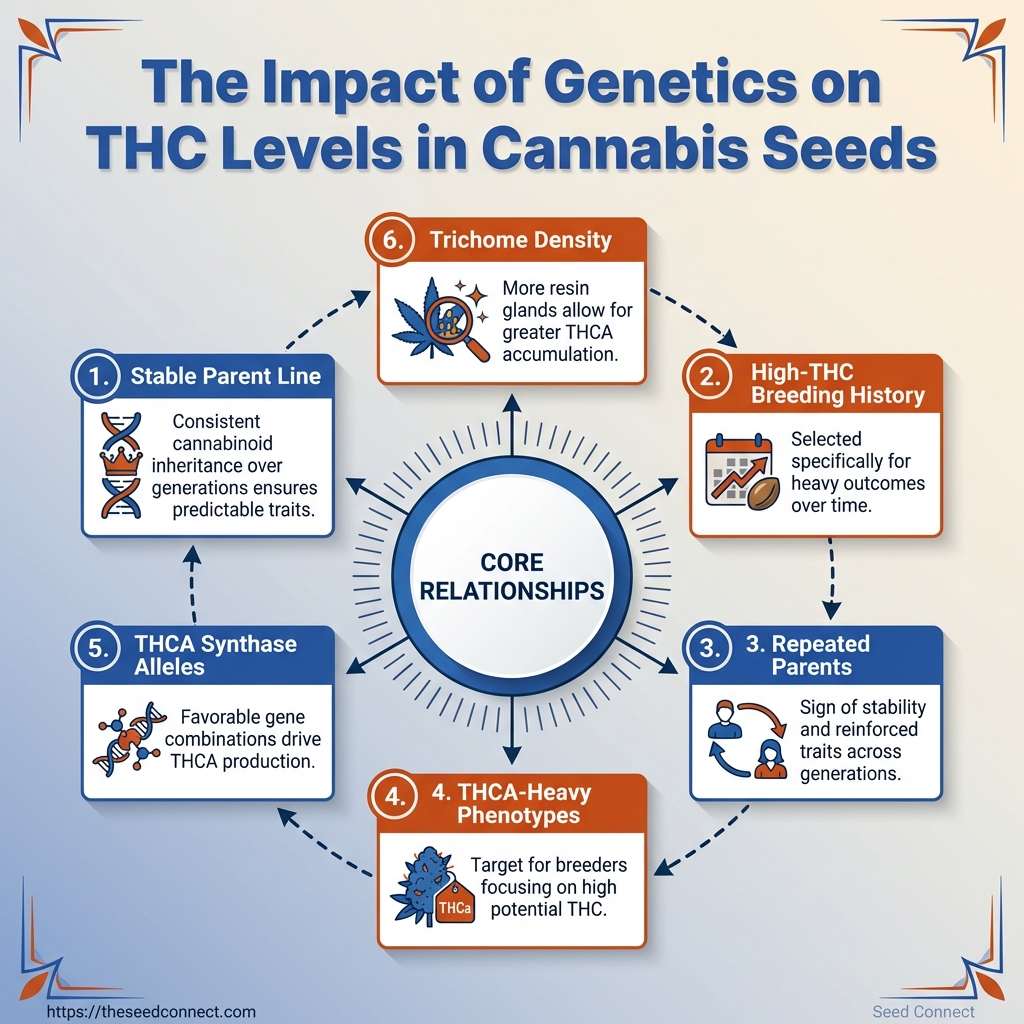
How cannabis genetics influence THC production
A seed line with strong THC genetics is a bit like a recipe with a very specific ingredient list.
The plant still has to cook in the right conditions, but the genetic instructions decide whether it is even capable of making much THCA in the first place.
That starts with the parents.
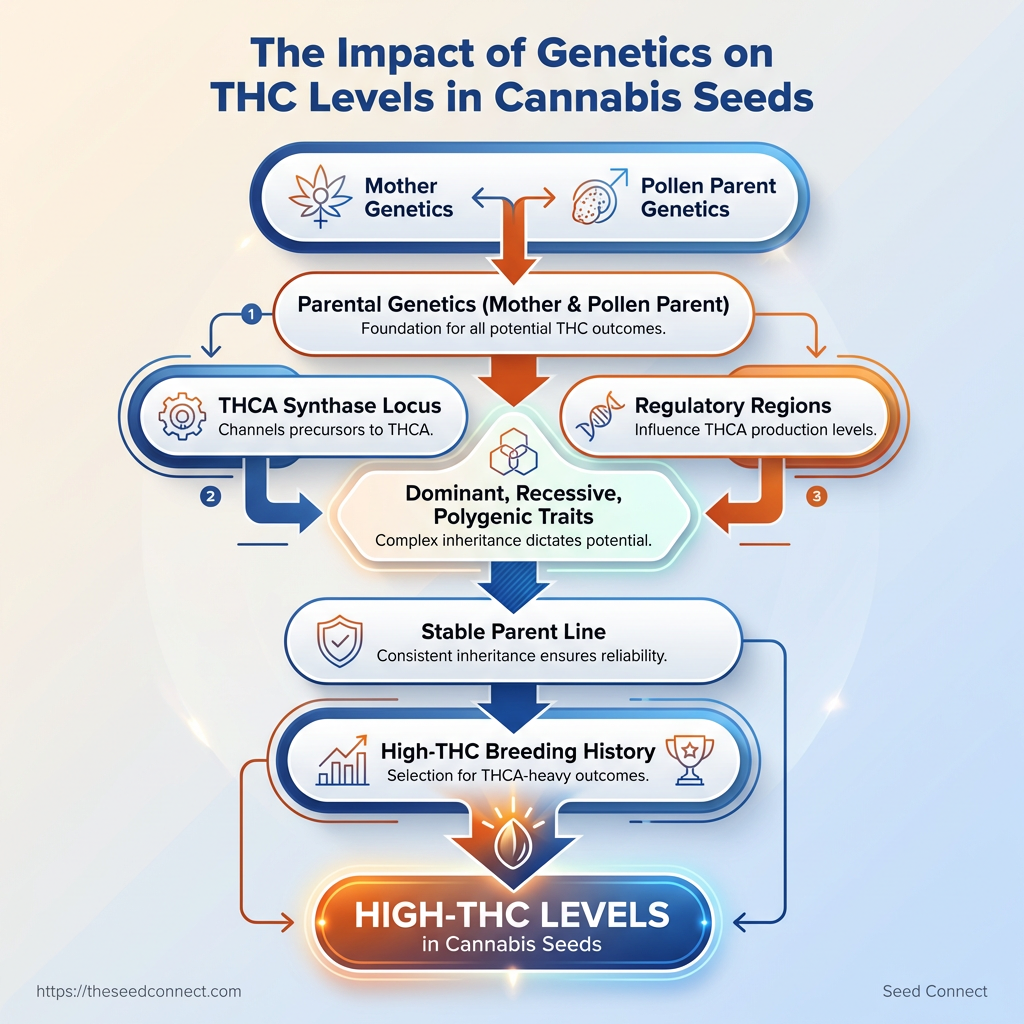
The seed gets one set of chromosomes from the mother and one from the pollen parent, so both sides shape the cannabinoid path the offspring can follow.
In practice, the THCA synthase locus and nearby regulatory regions matter a lot, because they help determine whether the plant channels precursor compounds toward THCA rather than CBD-rich outcomes.
The story gets messier fast, though.
Some traits behave in a straightforward way, but THC output is not controlled by a single switch. Dominant, recessive, and polygenic traits all play a part, which is why two lines can share a strain name and still perform differently in the field.
Genetics signals that hint at THC potential
| Genetics signal | What it can mean for THC potential | What to ask or look for | Buyer takeaway |
|---|---|---|---|
| Stable parent line | More consistent cannabinoid inheritance across offspring | Are the parents repeated across generations? | Stability usually beats hype. |
| High-THC breeding history | Greater chance the line was selected for THCA-heavy expression | Has the breeder worked high-THC lines before? | Past selection often predicts present potential. |
| Lab-tested parent or phenotype data | Better evidence that the line actually expresses THC-heavy traits | Are cannabinoid results published for parents or winners? | Real data is stronger than labels. |
| Clear breeder notes on cannabinoid intent | Shows whether the line was built for THC, CBD, or balance | Does the breeder state the target chemotype? | Intent matters when reading seed listings like Cannabis Seeds. |
| Vague strain labeling | Often signals weak traceability or recycled branding | Is the lineage described clearly? | Vague names hide weak genetics. |
| No cannabinoid evidence | Leaves you guessing about the plant’s chemical profile | Are there any test results or grow records? | No evidence means more risk. |
| Unknown parentage | Makes offspring traits harder to predict | Is the cross documented? | Mystery crosses are a gamble. |
| Marketing-only THC claims | Often inflates expectations without genetic proof | Are claims backed by breeding notes or lab data? | Big numbers without proof are just noise. |
Breeder selection matters because the strain name only tells part of the story.
A good breeder selects for structure, cannabinoid balance, and repeatable expression, while a flashy name can hide sloppy genetics.
Cannabis genomics work using repositories such as NCBI and ENA, plus sequencing tools from Illumina and Oxford Nanopore Technologies, keeps showing the same thing: the underlying genome tells the real story.
A simple rule works well here.
Read the breeder first, then read the strain name second.
THC production starts with inherited capability, not wishful thinking.
Once you learn to spot the parent line, the breeding record, and the evidence behind the claim, high THC seed genetics become a lot easier to judge.
What affects THC levels after the seed sprouts?
Why does a plant with strong THC genetics sometimes finish mild? Because the seed only sets the ceiling.
After sprouting, the plant’s environment decides how close it gets to that ceiling.
Think of it like a race car with a powerful engine sitting on a wet track.
The engine matters, but traction, timing, and driver skill still decide the result.
That is why genotype and phenotype are not the same thing.
A plant can carry the right cannabinoid-synthase traits, including THCAS-associated alleles, and still finish with lower THC if growth conditions hold it back.
Light, feeding, and stress shape expression
Light is usually the biggest dial after germination.
Strong, even light helps cannabis build more energy for flower development and trichome production, while weak or uneven light often leaves buds airy and less resinous.
Nutrition matters too, but more is not better.
Balanced feeding supports healthy leaf growth, root function, and flower formation, while heavy stress from overfeeding or shortages can slow the whole plant down.
A few other factors matter just as much:
- Light intensity: Better light usually supports stronger flower development and more resin.
- Nutrient balance: Too little or too much feeding can reduce plant performance.
- Stress load: Drought, heat swings, pests, and rough handling can all cut THC expression.
- Harvest timing: Picking too early often misses peak trichome maturity.
- Post-harvest handling: Drying, curing, and decarboxylation affect the THC measured in finished material.
Why strong genetics can still fall short
Even high THC seed genetics cannot force a plant to perform in poor conditions.
If a crop stays stressed, stunted, or underlit, the plant often puts energy into survival instead of cannabinoid production.
This is where breeding and growing meet.
The genetics may be excellent, but the plant still needs stable conditions to express that potential fully.
Researchers using resources like NCBI and sequencing platforms from Illumina or Oxford Nanopore Technologies have helped show how cannabinoid-related regions and structural differences shape potential.
The field keeps pointing to the same practical truth: genetics set the range, and cultivation decides where inside that range the plant lands.
A well-grown plant with solid cannabis genetics usually outperforms a stressed one every time.
That gap is often bigger than people expect.
How to read seed descriptions for signs of high THC potential
Ever notice how two seed listings can both scream “potent” and still tell you almost nothing useful? That usually means one seller is talking about THC genetics, while the other is just tossing around shiny words.
The useful descriptions get specific.
They talk about cannabis genetics, not vague hype.
They mention whether the line is built around a functional THCAS-leaning profile, whether it comes from a known breeder, and whether the seed stock has any supporting data behind it.
A good listing also gives you clues beyond the headline.
If a breeder says the line was selected for strong resin production, consistent flowering traits, or a clear chemotype, that is at least a real starting point.
If the page only says “extreme potency,” “super fire,” or “next-level gas,” you are mostly reading marketing copy.
The strongest descriptions usually include some mix of breeder notes, lab results, or terpene detail.
Breeder notes can tell you what was actually selected for, such as THC-heavy offspring or stable expression across generations.
Terpene profiles do not prove THC percentage, but they do help you judge whether the line has the flavor and aroma pattern you would expect from a potent plant.
- Helpful labels: “high THC,” “THC-dominant,” “THCAS-associated,” “tested lineage,” and “breeder-selected.” These at least point to a real genetic or testing angle.
- Mostly marketing: “ultra-potent,” “insane fire,” “maximum strength,” and “top-shelf killer.” Fun words. Weak evidence.
- Useful breeder notes: Look for comments about parent stock, selection goals, stability, and whether the line was bred from known high-THC parents.
- Useful lab data: Search for cannabinoid results tied to actual batches, not generic claims with no sample date or source.
- Useful terpene detail: A real profile lists dominant terpenes and concentrations, which helps you spot whether the description is grounded in testing.
- Red flags: No breeder name, no testing details, copied strain text, and descriptions that avoid genetics entirely.
A clean listing does not need to sound scientific to be credible.
It just needs to show its work.
That is why seed pages with specific lineage notes and measurable data deserve more trust than the ones loaded with fireworks and zero substance.
When THC potential matters, the best descriptions act like a map, not a billboard.
Choosing high THC seed genetics with more confidence
A good seed supplier makes decisions easier before the package even arrives.
The best ones are boring in the right way: clear about genetics, clear about policies, and clear about what happens if a seed never wakes up.
That matters because high THC seed genetics is partly a trust exercise.
You are not just buying a label.
You are buying the supplier’s consistency, breeding standards, and willingness to stand behind the lot.
Look for suppliers that say more than “potent” or “premium.” Solid listings usually explain the seed type, the breeding direction, and how they handle failed germination.
A shop like Supplier signals that actually matter
The first thing to check is whether the seller talks about lot consistency. If every batch sounds identical but nothing is explained, that is a yellow flag. Good suppliers know that cannabis genetics are only useful when they are stable enough to breed from and grow from. You also want clear support channels. Expert help is not fluff when a seed tray stalls or a seedling behaves oddly. A fast answer can save a week of frustration and a lot of second-guessing. A germination guarantee does more than replace duds. It tells you the supplier expects its seed handling and storage to hold up under pressure. Expert support matters just as much. A buyer with a strong starting line still needs help when a tray is uneven, and that kind of advice often separates a smooth run from a messy one. A simple way to think about it: if the seller backs the seed and answers questions like a real grower, the purchase feels less like a gamble and more like a measured choice. That is the real filter. The strongest high THC seed genetics still deserve a supplier that behaves like it cares about the outcome, not just the checkout page. Two seeds can share a strain name and still land in different THC territory. That is the part most growers miss. Cannabis genetics set the ceiling, but they do not guarantee identical results from every seed in the packet. The useful habit is to read seed descriptions like a clue sheet, not a promise. When a breeder gives lab data, parent lines, or clear notes about THC genetics, that tells you far more than flashy strain names ever will. If you want more confidence in high THC seed genetics, check the breeder’s data first and treat grow conditions as the second half of the story. That mindset saves a lot of frustration. A seed with strong potential still needs the right light, feeding, and timing to show it, which is why two plants from the same strain can finish differently.
Why guarantees change the purchase
Why the Same Strain Still Splits on THC