

If you’ve ever grown cannabis, you know it can be frustrating when plants behave differently in a small tent versus full sun. Often, this comes down to the genetics of the cannabis plant rather than just nutrients or light.
If you’ve ever grown cannabis, you know it can be frustrating when plants behave differently in a small tent versus full sun. Often, this comes down to the genetics of the cannabis plant rather than just nutrients or light.
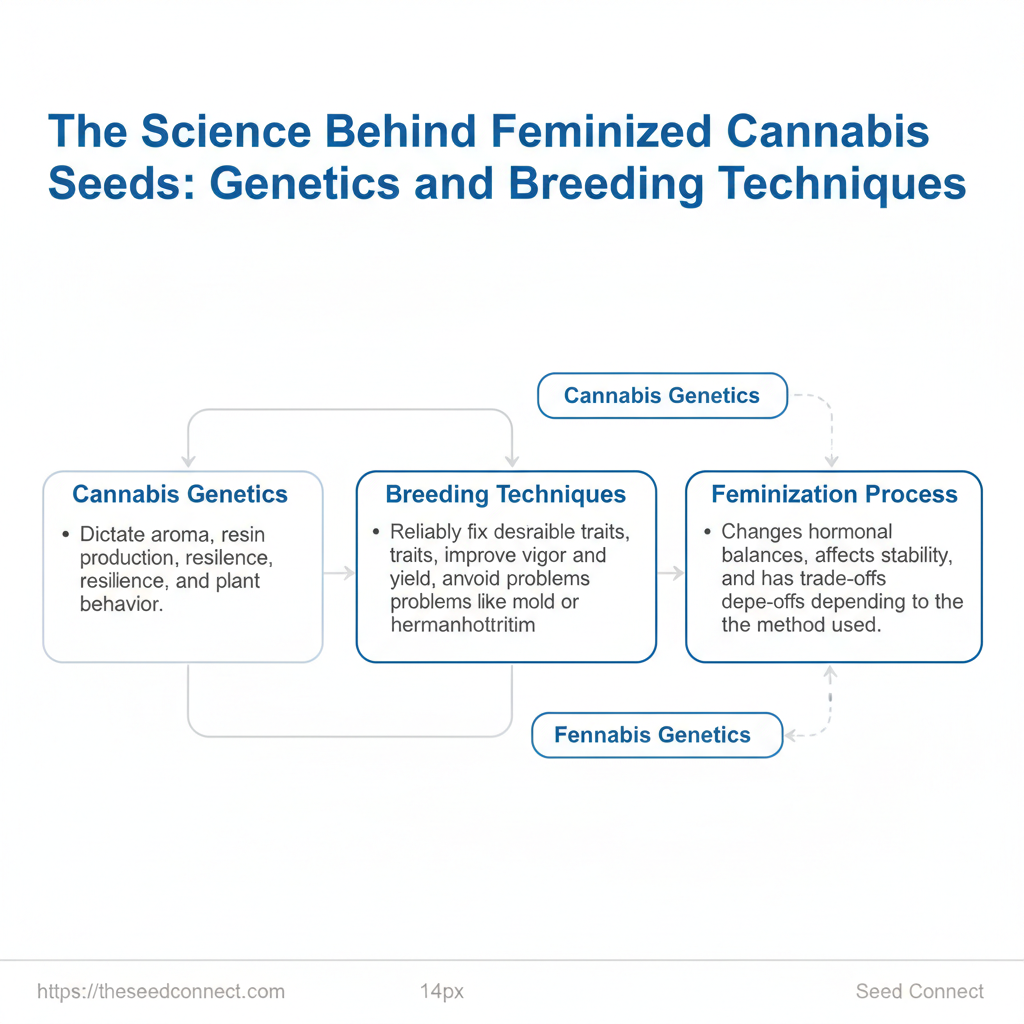
Small genetic differences can change the aroma, resin production, and stress tolerance of plants. Identifying these genetic traits early can save time. It also stops you from wasting time and money on plants that won’t thrive in your setup. Understanding effective breeding methods helps you make smarter decisions.
Aim to maintain desirable traits while avoiding hidden issues with your techniques. Careful breeding can increase growth and yield. In contrast, careless methods might cause mold or hermaphroditism. By understanding how to select parents, backcross, and choose phenotypes, you gain control over your outcomes instead of relying on luck.
Many growers see the feminization process as a mystery, believing it simply produces female plants. In reality, feminization methods change hormonal balances and carry trade-offs that affect stability across generations. Knowing when to use methods like chemically induced feminization, colloidal silver, or natural breeding is crucial for short-term crop uniformity and long-term genetic health.
Table of Contents
What Is Feminized Cannabis Seed?
Feminized cannabis seed refers to a seed that has been bred or treated so it will grow into a female plant almost exclusively. Female plants are the ones that produce the resinous buds growers want; male plants produce pollen and can pollinate females, which reduces bud quality. Feminized seeds remove the uncertainty of sex, letting growers focus on producing flowers rather than culling males.
Biology in simple terms: cannabis sex is chromosomal. Female plants are XX, males are XY. Feminization flips the usual odds by forcing a genetically female plant to produce pollen, which contains only X chromosomes; when that pollen fertilizes other females, the resulting seeds inherit XX and grow female. Think of it like producing only blue marbles from a jar by coating the red ones so they behave like blue — the components are the same, but the outcome is controlled.
How feminized seeds are made (common breeding techniques)
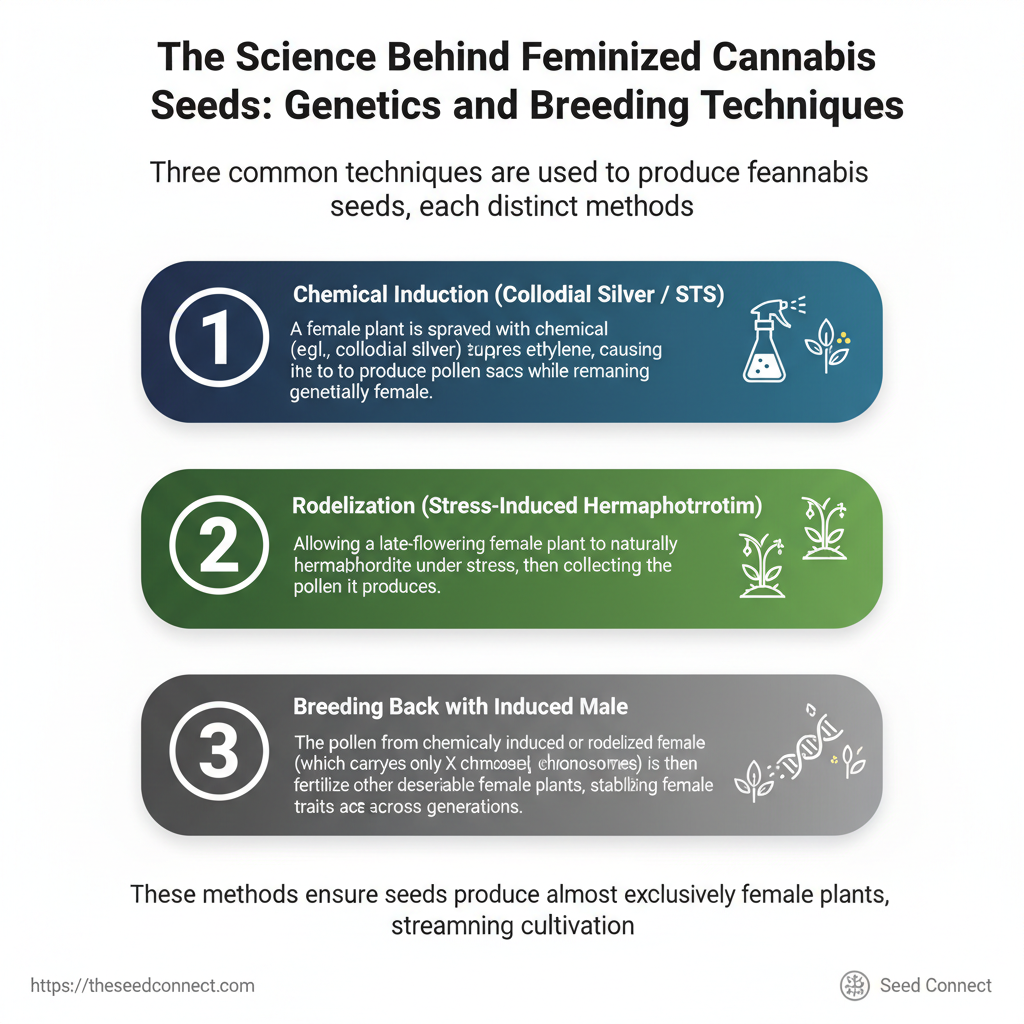
Chemical induction (colloidal silver / silver thiosulfate): A female plant is sprayed with a chemical that suppresses ethylene, causing it to produce pollen sacs while remaining genetically female.
Rodelization (stress-induced): Allowing a late-flowering female to naturally hermaphrodite under stress, then collecting her pollen.
Breeding back with an induced male: Crossing the resulting pollen with desirable females to stabilize traits.
Key features and benefits of feminized seeds:
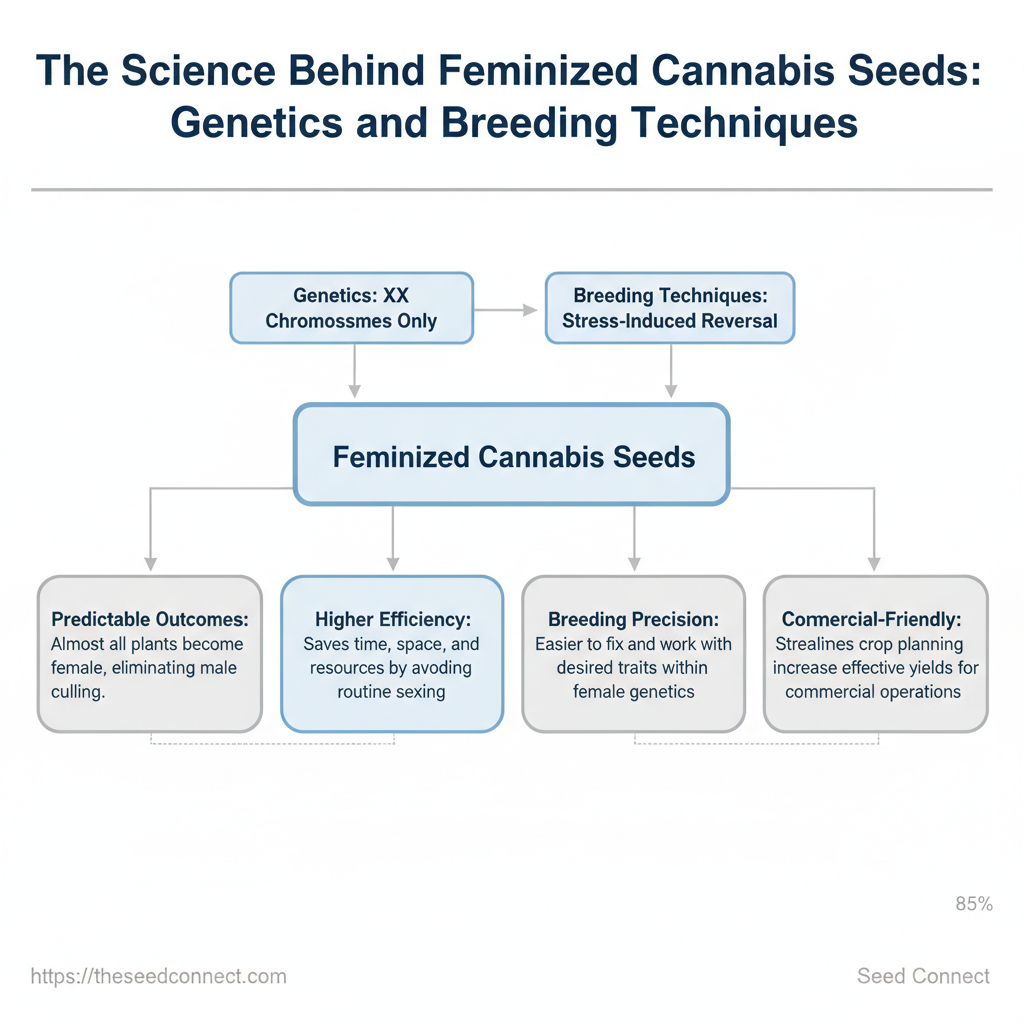
Predictable outcomes: Almost all plants become female, reducing lost space and time.
Higher efficiency: Growers avoid routine sexing and removal of males.
Breeding precision: Easier to fix desired traits when working within female genetics.
Commercial-friendly: Retail and commercial growers crop planning and yields.
Practical example: a small indoor grower using feminized seeds can fill all four pots for flower from day one rather than starting six pots and discarding males, saving light and nutrient costs while increasing effective yield.
A note on quality and sourcing: not all feminized seeds are equal — look for suppliers that document breeding techniques and back seeds with germination guarantees. TheSeedConnect supplies feminized cannabis seeds alongside detailed lineage and a germination guarantee for growers who want reliable genetics.
Understanding how feminized seeds are produced and why they matter makes planning grows and breeding projects far more efficient and predictable. When used thoughtfully, feminized genetics simplify operations and let growers concentrate on optimizing environment and cannabinoids rather than sexing plants.
How Does the Feminization Process Work? (Mechanism Explanation)
Feminization works by forcing a genetically female cannabis plant to produce viable pollen — pollen that carries only X chromosomes — so that when it fertilizes a female flower the resulting seeds inherit two X chromosomes and grow as females. The process exploits the plant’s hormonal and developmental pathways: suppress male-suppressing signals or artificially induce male organs on a female plant, harvest pollen, and use that pollen to pollinate female plants. This lets breeders fix desirable traits while avoiding the 50:50 sex split of regular seed production.
Mechanisms and biological details
Hormonal signaling and the role of ethylene
Ethylene is a plant hormone central to sex expression in cannabis. Female development is promoted by ethylene signaling; reducing ethylene activity or blocking its synthesis shifts development toward male flower formation.
Ethylene suppression: Treatments like
silver thiosulfate (STS)andcolloidal silverinterfere with ethylene receptors, preventing the female-promoting signal and allowing staminate (male) flowers to form on a female plant.Gibberellic acid and growth regulators: Some growers use
gibberellic acid (GA3)or other hormones to modify flowering and sex expression, but results are more variable than silver-based methods.Stress-induced (rodelization): Letting a female mature past optimal harvest can trigger self-pollination via hermaphroditic flowers; this leverages developmental stress rather than targeted hormonal blocking.
Practical sequence breeders follow
Select a vigorous, true-female mother plant.
Apply the chosen feminization treatment during early flowering.
Wait for male flowers to mature and release pollen.
Collect pollen and pollinate target female flowers.
Harvest seeds and test resulting population for female stability.
Industry breeders report that silver-based methods can yield nearly exclusively female seed lots when applied correctly.
Safety and contamination caveats
Methods that use silver compounds leave residues on plant tissue and require careful handling and PPE; any plant treated must never be used for consumption. Stress or genetic methods avoid chemical residues but produce less predictable feminization rates and may carry unwanted hermaphroditic tendencies into offspring.
This mechanistic approach lets breeders create predominantly female seed lines while controlling genetics and phenotype. For practical implementation, balance efficacy against safety and long-term genetic stability when choosing a feminization method. Internal link opportunities: breeding techniques, cannabis genetics, germination guarantee.
Common Breeding Techniques to Produce Feminized Seeds
Feminized seeds are produced by forcing a female plant to express male flowers, then using the pollen from those male flowers to fertilize another female. That’s the practical objective: produce seed that will almost exclusively grow into female plants, eliminating time wasted on male removal. Two reliable approaches dominate commercial and home-breeding work — chemical induction (typically using silver-based agents) and natural stress methods such as rodelization — each with distinct trade-offs in reliability, genetics, and safety.
Chemical induction gives predictable, high-fidelity feminization when done correctly, while rodelization and stress-driven hermaphroditism are low-tech and lower-yield options that can be useful for specific selections but carry genetic risks. Understanding when to use each method, what success looks like, and how to manage safety and genetic integrity is essential for any breeder working with cannabis genetics and the feminization process.
Chemical induction: STS and colloidal silver
What it is: Silver compounds block ethylene signaling, provoking female flowers to produce viable pollen without introducing male genetics. Common agents include
STS(silver thiosulfate) andcolloidal silver.When and how applied: Treatments are applied to a selected flowering female during early bloom; timing matters — apply before pistils fully mature so pollen develops on induced male flowers.
Visible signs of success: Flowers develop anther-like structures releasing pollen; look for thickened anthers and dusty pollen sacs.
Safety and contaminant considerations: Silver residues can persist on plant tissue; avoid using sprayed plants for consumption. Always handle chemicals with gloves and proper PPE, and isolate treated plants. Allow washout or discard treated biomass per safety best practices.
Rodelization and stress methods
Definition: Rodelization is letting a female flower past maturity naturally self-pollinate under stress (light leaks, nutrient stress, age).
When it occurs naturally: Late-season outdoor plants or neglected indoor plants often show rodelization as a last-chance reproductive strategy.
Reliability and genetic drawbacks: Rodelization is unpredictable and tends to select for hermaphroditic-prone genetics, increasing the chance of unstable offspring. Use it only when hunting for rare traits, not for broad production.
Practical example: one breeder used chemical induction to quickly fix a rare terpene trait, then backcrossed induced-female pollen to stabilize expression — a workflow that balances speed and genetic control. Reputable seed providers and in-house labs help validate results when scaling feminization for commercial runs. Understanding these methods shortens development time while protecting long-term genetic quality.
Why Feminized Seeds Matter: Benefits and Use Cases
Feminized seeds reliably produce female plants, which makes them the practical choice for most growers who want bud-producing cannabis without wasting time and space on male plants. For home growers, commercial cultivators, and anyone managing limited grow-room resources, feminized genetics simplify planning, reduce labor, and increase the percentage of harvestable plants. Breeders still use regular (mixed-sex) seed for crossing and preserving genetic diversity, but for production runs the advantages of feminized seed are hard to beat.
Practical benefits across grow styles
Space and resource savings: Feminized seeds eliminate the need to allocate space for plants that will be culled, increasing canopy efficiency.
Predictable scheduling: With fewer unknowns, flowering schedules and harvest windows become easier to plan and scale.
Lower labor for sexing: Reduced need for early sex checks and removal of males saves labor and reduces plant stress from handling.
Higher usable yield per seed: More seeds reliably become bud-bearing plants, improving seed-to-harvest efficiency.
Simplified automation: Automated watering, lighting, and nutrient schedules are easier when nearly every plant follows the same developmental path.
Use cases by grower type
Hobbyist / small-scale indoor growers: Prioritize space efficiency and fewer surprises; feminized seeds reduce the learning curve and time spent sexing plants.
Commercial operations: Require predictability for batch scheduling, consistent canopy utilization, and minimized crop loss; feminized seeds support higher throughput and tighter production planning.
Stealth / limited-space growers: Every plant counts; feminized genetics lower the chance of accidental male plants that can ruin small, discreet grows.
Breeders and geneticists: Prefer regular seeds for controlled crosses and maintaining genetic diversity; feminized lines are used when the goal is production rather than new crosses.
Technical note on the feminization process
Feminization techniques—such as applying colloidal silver or using Rodelization—force a female plant to produce viable pollen, creating seed that produces predominantly female offspring. These breeding techniques are part of modern cannabis genetics and are distinct from regular cross-breeding methods used to develop new strains.
Regular (mixed-sex) seeds vs feminized seeds across practical metrics relevant to growers
Regular (mixed-sex) seeds vs feminized seeds across practical metrics relevant to growers
Metric | Regular (mixed-sex) seeds | Feminized seeds | Practical impact for grower |
|---|---|---|---|
Expected % female plants | ~50% female / 50% male | ~95–99% female | Feminized dramatically increases harvestable plants per seed purchased |
Need for early sexing | Yes — sex checks required | No / Minimal — rarely needed | Saves labor and reduces risk of missed males |
Space efficiency | Lower — must reserve cull space | Higher — nearly all canopy productive | More usable canopy per square foot with feminized seed |
Time to final harvest (on average) | Adds ~1–3 weeks overhead for sexing/culling | Matches genetic flowering time | Faster effective time-to-yield with feminized seed |
Suitability for commercial runs | Low — unpredictable ratios | High — predictable yields and scheduling | Feminized seeds enable consistent batch production |
Best for breeding | Yes — required for new crosses | No — not ideal for making stable hybrids | Breeders use regular for genetic work, producers use feminized |
Risk of hermaphrodites | Standard risk depending on genetics | Slightly higher if feminization technique abused | Choose reputable suppliers to minimize hermaphrodite risk |
Initial cost per seed | Typically lower per-seed | Typically higher per-seed | Cost offset by higher usable plant rate |
Germination rate variability | Varies by batch and genetics | High when from reputable breeders | Germination guarantees greatly improve value |
Labor intensity (sexing & culling) | High | Low | Lower ongoing labor with feminized genetics |
Key insight: Choosing feminized seed turns variable plant sex ratios into a predictable production input, improving space utilization and scheduling while reducing labor. For production-oriented growers, the higher per-seed cost is usually offset by the increased percentage of harvestable plants and simpler operations.
Understanding these trade-offs helps align seed choice with grow objectives—whether optimizing a small home grow, scaling a commercial operation, or preserving genetics for breeding. When used appropriately, feminized genetics cultivation and let growers focus on maximizing plant health and yield.
The TRUTH about Feminized Seeds & Herms – LAZY Breeders & Ethics in Cannabis Seed Production
Common Misconceptions and Risks
Feminized seeds significantly increase the probability of producing female plants, but they are not a magic bullet that removes all biological variability or breeding challenges. Growers often conflate feminization with guarantees about potency, uniformity, or long-term stability. The truth: feminization addresses sex expression, while potency and genetic stability are products of underlying cannabis genetics and the breeding techniques used to create a strain. Understanding the distinction prevents costly surprises during a grow or while developing new lines.
What feminized seeds actually guarantee — and what they don’t
Feminized seeds are bred so the vast majority of resulting plants express female reproductive organs, eliminating routine sexing in the vegetative stage. That solves a practical problem: fewer males to cull, more canopy dedicated to bud development. However, several limits remain.
Guaranteed outcome: High female-to-male ratio under normal conditions — most reputable feminized batches will produce >95% female plants.
Not guaranteed: Absolute resistance to hermaphroditism — stressors can trigger male flower production on female plants.
Not guaranteed: Consistently uniform potency or cannabinoid profile — potency is determined by genetics and phenotype expression, not feminization itself.
Not guaranteed: Long-term genetic stability — small breeding populations and repeated selfing can produce genetic drift and inbreeding effects.
Common risks and real-world examples
Stress-induced hermaphroditism: Heat spikes, light leaks, or irregular light cycles can cause genetically female plants to produce pollen. A grower who moved plants under an uncovered lamp during a 12/12 cycle lost several plants to self-pollination—feminized seed or not, stress caused male flowers to appear.
Inbreeding depression: Excessive backcrossing of a small parent pool concentrates deleterious alleles, reducing vigor and yield over generations. Commercial breeders manage this by outcrossing and maintaining larger breeding populations.
Genetic drift: Over multiple seed generations without rigorous selection, subtle traits shift—potency, terpene balance, and growth habit can change. This is why responsible seed producers document phenotypes and keep breeder lines separate.
Misattributing potency to feminization: Potency follows the genetics encoded by parental strains and selection practices. Expect variability within any seed line unless the breeder has stabilized the chemotype through rigorous selection.
Practical safeguards for breeders and growers
Maintain genetic diversity: Include multiple parent plants when breeding to avoid narrowing the gene pool.
Control environmental stress: Stabilize light, temperature, and humidity to reduce hermaphrodite triggers.
Rigorously select phenotypes: Choose plants consistently expressing desired potency and terpenes over multiple generations.
Use reputable sources and guarantees: Buy from breeders who provide germination guarantees and transparent lineage information so problems can be traced and addressed.
Industry analysis shows that preserving genetic diversity and careful selection are the primary defenses against inbreeding and drift.
A practical step for growers is to test a small sample run of any new feminized line before committing a full crop, treating the first run as a phenotype audit rather than a production harvest. When breeders and growers align expectations—recognizing what feminization fixes and what it doesn’t—decisions about sourcing, breeding techniques, and environmental control become far more productive. Understanding these limitations keeps projects moving while protecting yield and quality.
Real-World Examples and Case Studies
Three concise case studies illustrate how breeding techniques and clean genetics translate into predictable grower outcomes. Each example focuses on a breeder workflow, measurable outcome in the grow room, and a short breeder takeaway that other seed producers can apply.
Case 1 — Speed-selected autoflower for uniform harvests
A breeder prioritized rapid phenotyping and selection on F1 × autoflower backcrosses to stabilize flowering time within a 3–4 day window.
Outcome for growers: Consistent canopy timing allowed synchronized nutrient cycles and a single harvest window for multiple tents.
Breeder takeaway: Prioritize early-marker selection for flowering genes to compress phenotypic spread; small initial investments in controlled environment phenotyping save time downstream.
Case 2 — Feminization process refinement to reduce hermaphroditism
A commercial program tightened stress-testing during the feminization process, introducing mild heat/light-stress assays and tracking hermaphrodite incidence across three generations.
Outcome for growers: Lower end-user losses and fewer rogue males in breeding nurseries.
Breeder takeaway: Standardize a stress-assay protocol that mimics common grow-room mistakes; identify lines that tolerate stress without shifting sex expression.
Case 3 — High-THC stable line with improved terpene retention
Selective backcrossing prioritized cannabinoid and terpene profiles, while testers recorded post-harvest terpene decline under different curing regimes.
Outcome for growers: Clear guidance on curing produced repeatable aroma and potency, raising product premium for boutique growers.
Breeder takeaway: Include post-harvest protocols in strain documentation — genetics alone aren’t enough to guarantee end-user experience.
Practical workflow steps breeders use to validate a line:
Rapid phenotyping: 4–6 week early screens under controlled light/temperature.
Stress assays: Apply heat/light fluctuation to reveal sex stability and resilience.
Chemical profiling: Run cannabinoid/terpene checks at harvest and post-cure.
Actionable tip growers and breeders can try: run a small 3×3 micro-trial — three maternal lines × three stress conditions — and track hermaphrodite rate, flowering spread, and terpene retention. That one experiment reveals a disproportionate amount about genetic stability and post-harvest requirements.
These examples show how deliberate breeding steps convert into predictable, sellable outcomes in the grow room and marketplace. Understanding and documenting those steps accelerates decision-making and reduces downstream variability.
Best Practices for Buyers and Growers
Start by treating seed selection, the grow environment, and monitoring as a single continuous workflow: choices at purchase influence how plants respond to stress, which in turn determines whether breeding techniques like feminization work as intended. Experienced growers think ahead — they buy genetics that match their environment, set rooms to minimize stress that triggers hermaphroditism, and monitor for early warning signs so interventions are fast and decisive.
Buying: questions to ask seedbanks and what to verify
Genetic stability: Ask if the line has gone through multiple stable generations and what performance variability to expect.
Pedigree transparency: Request information on parent strains and any known breeding techniques used, especially the feminization process.
Germination policy: Confirm germination guarantees and replacement procedures for failed seeds.
Phenotype guidance: Ask for descriptions of common phenotypes and grower notes on nutrient or climate sensitivity.
Lab testing: Verify whether the seedbank provides cannabinoid/terpene profiles or disease-resistance notes.
Growing: environmental controls to reduce hermaphroditism
Maintain consistent light cycles — especially during flowering; avoid unexpected dark interruptions and use timers with battery backup.
Control temperature and RH — keep daytime temps 22–26°C and
RH 40–50%in late flower to reduce stress.Stable nutrients and pH: Keep root-zone pH around
6.0–6.5for soil-less mediums; sudden EC swings often trigger stress responses.Gentle training only: Use low-stress training first; reserve high-stress techniques like aggressive topping until plants are and genetics are known.
Pest prevention: Implement quarantine procedures and routine scouting to prevent infestations that cause hormonal stress.
Monitoring and immediate actions if hermaphrodites appear
Early identification: Inspect pre-flowers daily from week 3 of flower for mixed-sex organs.
Isolation: Immediately isolate suspected plants to prevent pollen spread.
Removal vs. remediation: Remove plants showing obvious male pollen sacs; if hermaphroditism is limited (single banana pistil) and genetics are valuable, consider removing affected branches only.
Record and adjust: Log strain, environment, and recent changes; adjust lighting, temp, or feeding that correlate with the event.
Breeding consideration: If the goal is seed production, proceed only with deliberate, controlled crosses and full documentation of the feminization process used.
Practical example — a decision path
Find a reputed seedbank with a germination guarantee and phenotype notes (consider high-THC feminized or autoflower seeds if that matches goals).
Run a 2-week acclimation in a stable veg environment before switching to flower.
If a hermaphrodite shows, isolate and decide: prune branch and monitor still-valuable genetics, or remove to protect the crop.
Industry analysis shows that consistent environment and transparent genetics are the two most reliable levers for reducing undesired sex reversal. Understanding these principles lets growers protect crop integrity while making smarter purchases. When implemented correctly, these practices reduce surprises and keep breeding or harvesting goals on track.
📥 Download: Feminized Cannabis Seeds Checklist (PDF)
Regulatory, Safety, and Ethical Considerations
Start by checking local law: whether cultivation, breeding, transfer of genetics, or possession of seeds is permitted where you operate. Compliance dictates what breeding techniques and scale are available, and influences everything from chemical use to record‑keeping. Treat legality as the foundation for any breeding program; ignore it and the rest of your work becomes high risk.
Legal and regulatory foundation
Local legality first: Verify municipal, state/provincial, and national rules before acquiring seed stock or performing crosses.
Licensing and reporting: Commercial breeding often requires permits, track-and-trace compliance, and testing; plan for administrative overhead.
Transport restrictions: Moving genetics across borders can trigger customs and controlled-substance laws — use only permitted channels.
Safe chemical and facility practices
Proper PPE: Use gloves, respirators, and eye protection when handling fertilizers, pesticides, or solvents.
Approved inputs only: Prefer products labeled for cannabis use or those with clear safety data; avoid persistent organochlorine or unregistered pesticides.
Storage and disposal: Keep chemicals in labeled, locked storage and dispose of waste per hazardous-waste rules to limit environmental contamination.
Genetic stewardship and ethics
Protect genetic diversity: Avoid narrowing gene pools through repeated backcrossing without introducing new alleles; diversity mitigates disease and environmental vulnerability.
Document lineage: Maintain clear records of parentage, phenotype notes, and seed batch IDs — use
BreedID_YYMM_Projectstyle naming for traceability.Responsible feminization: Feminization processes are powerful but can reduce diversity if overused; rotate breeding methods and keep male lines preserved in cold storage or tissue culture when possible.
Intellectual property and consent: Respect breeders’ rights and germplasm agreements; do not distribute proprietary lines without documented permission.
Practical steps before starting
Confirm local statutes and obtain necessary permits.
Audit chemical inventory and PPE, and establish disposal procedures.
Create a breeding ledger with parentage, methods (e.g., feminization process used), and germination outcomes.
Implement genetic diversity checkpoints every 3–5 generations.
Example notation (simple pedigree):
P1: Skunk#1 (♀) x P2: Haze#3 (♂)
F1A: progeny IDs 001–020 F2 select: 003, 007 retained; store male pollen as Pollen_202507
Understanding these responsibilities reduces operational risk and preserves the long-term value of breeding programs. When ethics, safety, and law are integrated into routine practice, breeding efforts scale more sustainably and with far less friction.
Conclusion
Plants that flip sex under different light or stress conditions usually reflect underlying cannabis genetics as much as environment; understanding the feminization process and common breeding techniques clarifies why some seeds perform consistently while others don’t. Breeders that use stable pollen-induction methods produce lines that reduce the chance of hermaphroditism—one commercial case reduced male plants from 8% to under 1% by switching to well-tested feminization protocols—while home growers report fewer wasted weeks and more predictable harvests when they start with quality feminized seed stock. Common misconceptions—like expecting absolute 100% female outcomes or ignoring environmental stressors—still cause preventable losses, so weigh breeder reputation, documented lineage, and cultivation conditions together when choosing seeds.
For practical next steps:
Start with certified, documented genetics and confirm breeder testing.
Prioritize stress-free growing practices to preserve feminized outcomes.
Compare breeder methods (chemical vs. colloidal silver vs. colloidal copper) and ask about stability data.
If ready to act, explore the feminized seed selection at The Seed Connect for verified genetics and germination support. For questions about choosing the right line or optimizing for outdoor sun vs. tent grows, request strain performance details from your breeder and run a small test batch before scaling.