



A cannabis garden can look healthy one week and get chewed up the next.
Aphids, spider mites, tired soil, and dry patches often show up together, which is why so many growers start looking at companion planting cannabis instead of fighting each problem alone.
The idea is simple: certain beneficial plants for cannabis can help shape the whole grow space.
Some bring in helpful insects, some make pests less comfortable, and others support the soil or hold moisture a little better around the roots.
That is why old-school growing tips cannabis fans keep returning to often turn out to be the quiet, practical ones.
It also changes how a grow smells and behaves.
Companion planting treats the garden like a living system, not a row of isolated plants, so the mix around your cannabis can affect pest pressure, soil life, and even the way nearby plants interact through scent and root activity.
The tricky part is that not every plant helps, and the wrong match can create more work than it saves.
That balance is what makes this topic worth knowing well.
Quick Answer: Companion planting with cannabis helps most when you treat it like targeted problem-solving—pairing specific plants with a real bottleneck such as pest pressure, tired soil, or a microclimate that swings too much. Choose companions based on your grow conditions (especially space and airflow). In cramped, poorly ventilated setups, added plants can become extra competition for light and moisture rather than a benefit. Your decision check is simple: will the companion stay in its job (attract beneficial insects, add nitrogen support, improve soil structure, or buffer the canopy), without shading the main plants or making the grow harder to manage?
Quick check — is companion planting right for your grow?
Are you trying to fix pests, weak soil, or a grow space that feels a little too tight? That question matters more than any plant list, because companion planting cannabis works best when it solves a real problem instead of decorating a garden.
A cannabis garden behaves like an ecosystem.
The Cannigma put it plainly in its 2026 explainer: insects, pests, and airborne compounds all shift when other plants are nearby, which is why companion planting can change the whole feel of a grow space.
Humboldt Seed Company also notes that diverse planting can improve pest pressure, soil biology, water handling, and even terpene expression through plant and microbial communication.
So the first check is simple: are you looking for fewer pests, better soil, or a steadier microclimate? If the answer is yes, then companion planting may be worth the effort.
If your grow is already crowded, hard to ventilate, or tightly controlled, the same approach can become a headache fast.
Companion planting makes the most sense when the space can handle a few extra roots and a little experimentation.
Outdoor grows usually benefit the most, greenhouse setups come next, and indoor rooms need the most restraint because airflow, humidity, and floor space get crowded quickly.
The useful question is not “what plants sound good,” but “which beneficial plants cannabis can actually support without creating new problems?”
- Outdoor grow with pest issues: Good fit, especially if aphids, thrips, or poor soil are part of the picture.
- Greenhouse with mixed pressures: Often a strong fit, since you can shape the microclimate more easily.
- Indoor grow with limited space: Possible, but only if containers, airflow, and light spread stay under control.
- Tight legal plant limits: Be careful, because companion plants can still add complexity even if they are not cannabis.
- Low-maintenance setup: Not ideal if you want a simple room with almost no variables.
A few practical clues help.
Cannabis Workforce Initiative highlights dill, cilantro, parsley, and nitrogen-fixing plants as useful helpers for pest management and soil enrichment in 2023.
And one grower account from justcannabisseed.com described aphids dropping within two weeks after marigolds and sweet alyssum were added as a border.
If your grow needs support rather than simplicity, companion planting is probably a fit.
If your space is already on the edge, plain old growing tips cannabis discipline may matter more than adding another layer.
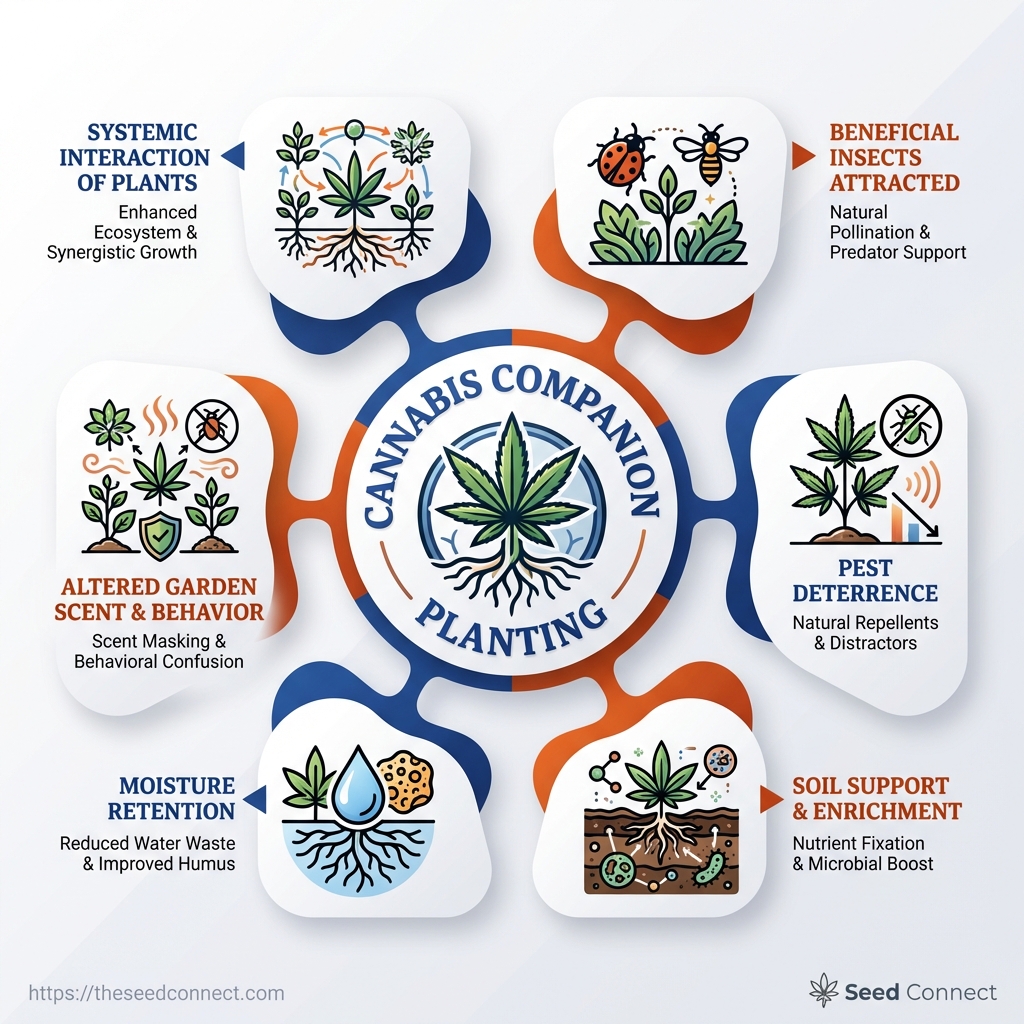
Why do some cannabis gardens seem calmer, cleaner, and easier to manage? Companion planting usually helps most when it improves the conditions around your cannabis—so pests are less comfortable, the soil works better, and plants experience less stress.
Project CBD and The Cannigma both describe companion planting as a way to encourage more beneficial interactions in the garden, and Humboldt Seed Company’s companion-plant guidance highlights practical outcomes like improved soil biology and more stable water behavior.
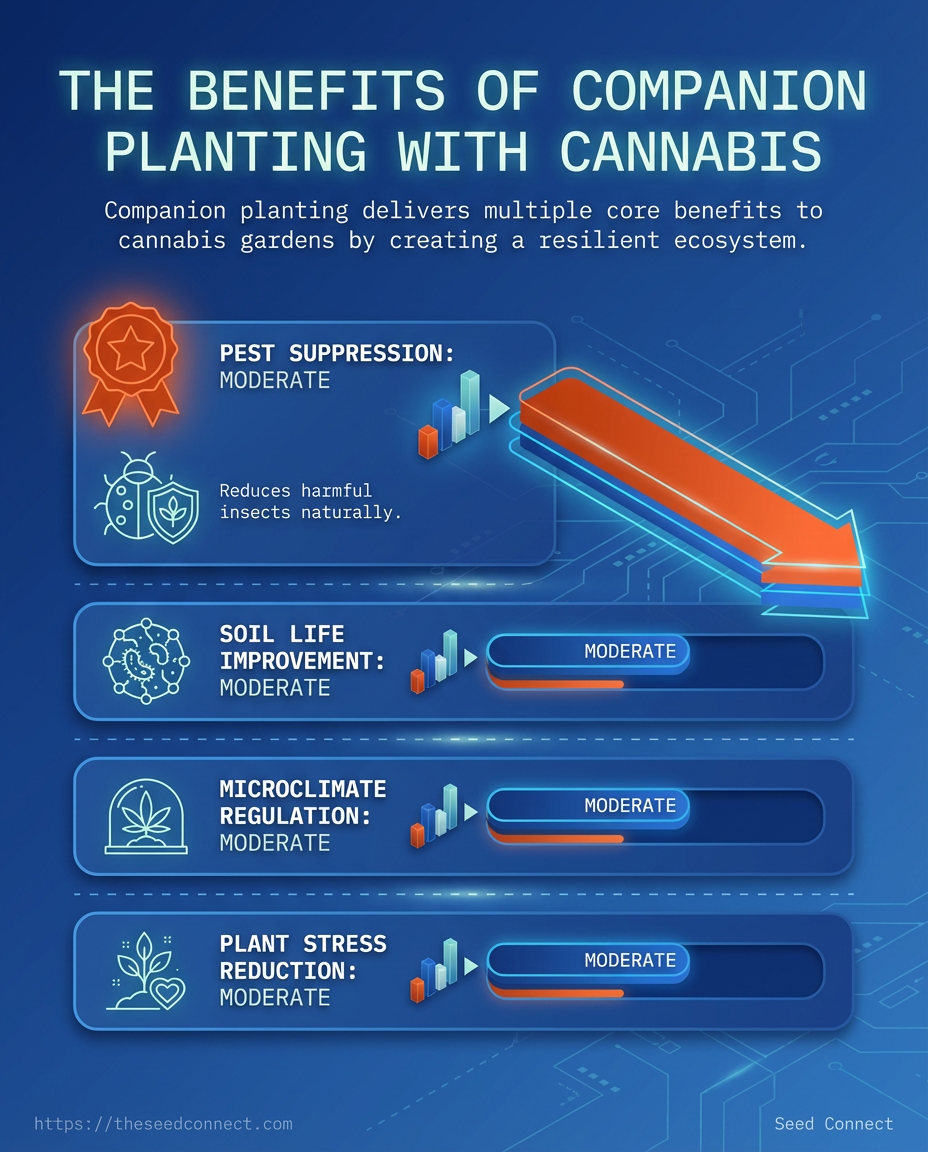
The biggest gains typically show up in four areas: pest pressure, soil life, microclimate, and plant stress.
How the main benefits usually show up
| Benefit | How it works | What to expect | Best companion examples |
|---|---|---|---|
| Pest suppression | Aromatic plants can confuse pests, while nectar-rich companions bring in predators like ladybugs, hoverflies, and parasitic wasps. | Lower pest pressure, fewer aphids and thrips, and less need for emergency sprays. | Dill, cilantro, basil, peppermint, lavender, marigolds, sweet alyssum |
| Attracting pollinators | Flowers with nectar and pollen support a more active beneficial insect community at the garden edge. | More beneficial visitors around the grow boundary and surrounding beds. | Sweet alyssum, phacelia, dill, lavender, cilantro |
| Nitrogen fixing | Legumes form root nodules that host bacteria converting atmospheric nitrogen into plant-usable forms. | Better nitrogen availability in lean soil, especially during active growth stages. | Beans, peas, clover, lentils, yarrow |
| Wind and sun protection | Taller borders and dense companion layers can buffer airflow and shade the soil, reducing stress and moisture loss. | Less stress from hot afternoon sun, slower moisture drying, and steadier canopy conditions. | Sunflowers, rosemary, lavender, buckwheat |
| Soil structure improvement | Living roots and root exudates feed microbes and help build soil aggregates over time. | Better infiltration, less compaction, and a healthier root environment as the system matures. | Clover, alfalfa, buckwheat, chamomile |
The realistic win is steadier growth with fewer “surprise” setbacks—because you’ve improved the background conditions while you dial in cultivation inputs.
Best companion plants and what they do for cannabis
A good companion plant does one job well.
Some pull in helpful insects.
Some mask scent.
Some feed the soil, which matters more than most growers admit.
That mix is why companion planting cannabis feels less like decoration and more like garden management.
In 2026, The Cannigma described it as a practical way to shape which insects visit, which pests linger, and which compounds move through the canopy, while Humboldt Seed Company points to soil biology, nitrogen fixing, and water retention as major wins from mixed planting. The Cannigma’s 2026 companion planting explainer and Humboldt Seed Company’s guide to cannabis companion plants both frame the garden as a living system, not a row of isolated pots.
The easiest way to think about beneficial plants cannabis growers use is by job.
Herbs like basil, cilantro, and dill help with scent and insect traffic.
Flowers like marigold, nasturtium, and calendula add nectar and act as decoys, while cover crops such as clover and rye keep living roots in the soil when the main crop is not using the bed.
Cannabis Workforce Initiative’s guide to dill, cilantro, parsley, and nitrogen fixers is especially useful on the insect side of that equation.
Companion plants at a glance
| Companion plant | Primary benefit to cannabis | Planting notes (timing/spacing) | Indoor/Outdoor suitability |
|---|---|---|---|
| Marigold | Helps confuse pests and supports border biodiversity | Plant around bed edges after transplanting; keep it from shading the canopy | Outdoor best, indoor only in large spaces |
| Nasturtium | Acts as a trap crop for aphids and whiteflies | Place nearby, not crowded into the root zone; works well as a perimeter plant | Better outdoors and in greenhouse-style grows |
| Calendula | Brings in pollinators and beneficial insects | Sow early and let it flower near the edge of the bed | Outdoor best; indoor only with strong light |
| Basil | Aromatic cover that can discourage some pests | Tuck into containers or bed corners once cannabis is established | Both, as long as airflow stays open |
| Cilantro | Helps attract ladybugs and hoverflies; can repel mites | Best in cooler periods; re-sow often because it bolts fast | Both, especially spring and fall |
| Dill | Pulls in predatory insects like parasitic wasps and hoverflies | Plant near the garden edge so it can flower without crowding | Outdoor and greenhouse grows |
| Borage | Supports pollinators and can improve soil life | Give it room; it gets large quickly and can lean | Mostly outdoor or large indoor spaces |
| Clovers | Living ground cover and nitrogen support | Sow after seedlings are established or between runs | Outdoor beds and larger containers |
| Garlic/Alliums | Strong scent can help confuse pests | Plant as a border or between larger pots, not packed tight | Both, especially around bed edges |
The Cannabis Workforce Initiative notes that dill attracts ladybugs, parasitic wasps, and hoverflies, while cilantro can repel aphids and spider mites and still draw in beneficial insects.
Basil is less about drama and more about steady pressure on pests, which is often exactly what a grow room needs.
Rye and clover are the quieter helpers.
Clover works well once plants are established, because it keeps soil covered without stealing the show, while rye makes more sense as a fall-sown cover crop outdoors, cut back before it gets woody or seeds itself everywhere.
Avoid anything that turns the bed into a wrestling match.
Mint spreads too fast unless it stays in a pot, fennel can bully nearby plants, and bulky heavy feeders like tomatoes or potatoes can crowd a small cannabis space and complicate pest control.
A tight garden needs neighbors, not roommates who hog the fridge.

Practical planting plans, spacing, and timing
Trying to fit companion plants into a grow space without turning it into a jungle is mostly about restraint.
One main plant, a few supporting plants, and clear airflow usually beats a crowded mix every time.
That lines up with how Project CBD’s companion planting handout frames the practice: a mixed garden works best when it behaves like an ecosystem, not a packed salad bowl.
Humboldt Seed Company makes the same point from another angle, noting that diverse planting can support soil structure, biology, and water movement.
Simple layouts that stay manageable
A balcony setup is the easiest place to overdo it.
Keep the cannabis plant in the largest container, then place just one or two smaller companions nearby so leaves do not overlap too much.
Backyard beds give more room, but the trick is still spacing.
Put the cannabis plant where it gets the cleanest light, then use lower companions along the edge so you can reach everything without stepping into the bed.
Greenhouses ask for even more discipline because humidity hangs around.
The Cannigma’s 2026 companion planting guide treats the garden as a living system, and that idea works well here: keep the center open, push companions toward the borders, and leave a path for pruning and inspection.
- Balcony: Use containers of different sizes and avoid crowding the railing zone.
- Backyard bed: Stagger plants so taller species do not shade the canopy too early.
- Greenhouse: Keep companions near edges or aisles so air can move freely.
When to sow companions
Fast-growing companions usually perform best when they start a little earlier than cannabis.
That gives roots time to settle before the main plant starts taking over the space.
If you want pest-management helpers, sow those early too.
Cannabis Workforce Initiative highlights dill and cilantro for attracting beneficial insects, while beans and peas need time to form nitrogen-fixing nodules.
Water, feed, and seed choices
Mixed plantings get awkward when one plant wants a dry pot and another wants a steady drink.
Group plants with similar thirst, and separate the extra-needy ones into their own containers when possible.
When we source our own cannabis seeds, we look at plant size and finish time first, then match the companions around that rhythm.
Our Cannabis Seeds page is the starting point when the main crop needs to fit the rest of the plan.
A good layout saves more trouble than any rescue fix later.
Get the spacing right, and the watering and timing side becomes much easier to manage.
Troubleshooting common issues and practical tips
A basil border can look harmless on Monday and start causing trouble by Friday.
If the cannabis slows down, the companion mix has stopped acting like support and started competing for space, light, or water.
That usually shows up as tighter spacing, thirsty soil, or pest pressure that shifts instead of fading.
The Cannigma describes a cannabis garden as an ecosystem, so every extra plant changes which insects visit, which pests persist, and how the canopy breathes The Cannigma’s 2026 companion planting explainer.
Companion planting cannabis works best when the extra plants stay useful without becoming needy.
If you feel like you are babysitting the companions more than the crop, the setup needs a reset.
- Growth stalls: New leaves stay small, internodes stretch, or the main plant stops pushing upward.
- Soil dries too fast: The companion mix is drinking more than the root zone can comfortably spare.
- Pests change targets: Aphids, mites, or other troublemakers stop clustering on one plant and start spreading.
- Canopy gets crowded: Airflow drops, leaves overlap, and shaded spots linger after watering.
- Companions look stressed first: Yellowing, drooping, or floppy stems usually mean the support plant is overmatched.
Light and nutrient balance matter just as much as plant choice.
Humboldt Seed Company notes that companion planting can improve soil biology and water management, but only when the root zone has room and the mix stays balanced Humboldt Seed Company’s companion plants guide.
When a companion keeps pulling the garden off track, remove it before the problem spreads.
- Cut it cleanly: Remove the plant at the base and check whether roots have invaded the main plant’s space.
- Replace with restraint: Swap in a smaller, slower companion or simply leave the gap open for airflow.
- Watch for a week: If pest pressure drops and the canopy opens up, the problem was crowding, not bad luck.
International growers need one more layer of caution.
Seed laws, import rules, and customs treatment vary by country, so checking local rules before ordering is the safest move.
At our shop, we keep shipping fast and secure within 3–5 days for eligible U.S. orders, and our support team can help when a grow plan needs a cleaner fit.
That matters most when you are comparing practical growing tips with the reality of what can legally move across a border.
A companion plant should make the garden calmer, not busier.
When it does the opposite, the fix is usually simple: prune, replace, or remove it and give the main crop room to breathe.
What are the best companion plants for cannabis?
The best companion plants for cannabis are the ones that address a specific issue in your grow—rather than adding extra species “for decoration.” In practice, that usually means choosing plants that (1) encourage beneficial insects, (2) disrupt pest-friendly conditions, and/or (3) improve soil biology and water behavior around the root zone.If you’re unsure where to start, pick one bottleneck first (pests, soil fertility, or humidity/airflow comfort) and then choose companions that support that goal.
Which companion plants help with pest control in a cannabis garden?
Companions can help with pest control in two main ways: they attract beneficial insects (predators/parasitoids) or they make the environment less comfortable for pests. For example, nectar- and pollen-rich flowers can bring in helpful insects that patrol the garden edge, while aromatic or border plants can reduce how easily pests locate or settle on cannabis.Aim for a setup where the companion plants stay functional and don’t crowd cannabis—crowding is a common reason “helpful” companions stop feeling helpful.
Do companion plants improve cannabis soil health or terpene production?
Companion planting can improve cannabis soil health by boosting soil biology and creating more stable moisture conditions in the root zone. Better root-zone conditions often translate into steadier growth, which can indirectly affect overall plant performance.As for terpene/aromatic expression, outcomes depend heavily on your grow fundamentals (light, nutrition, genetics, and curing). Still, companion planting can influence how the garden smells and how plants interact through root and microbial activity—so it may affect aroma indirectly under the right conditions.
Can you companion plant cannabis indoors or in greenhouses?
Yes, but only with restraint. The practice works best when airflow and spacing stay controlled. Use the “one main plant + a few supporting companions + clear access” approach, and avoid setups where extra plants reduce ventilation, complicate watering, or shade the canopy.Which nitrogen-fixing plants work best alongside cannabis?
Nitrogen-fixing companions work best when they support fertility without aggressively competing for light, water, or container space. Common choices include clovers and other legumes, but the key is matching the plant’s growth habit to your cannabis spacing and timeline.If your mix becomes crowded, the support effect disappears—so keep nitrogen-fixers to appropriate volumes and positions (often edges, trellised areas, or dedicated ground/bed space).
The Right Neighbors Make the Whole Garden Easier
The smartest thing to remember about companion planting cannabis is that no single plant has to do all the work.
The best beneficial plants for cannabis each solve a small problem: one helps with pests, another supports the soil, and another softens harsh conditions around the canopy.
That is why marigolds, clover, basil, and other support plants keep showing up in serious grow plans.
They do not replace good light, watering, or genetics, but they make those growing tips for cannabis work better in the real world.
A healthier edge around the plant usually means fewer surprises inside the canopy.
Start with one problem, not ten. If your last run dealt with aphids, pick a companion that helps confuse or repel them.
If the soil looked tired, add a plant that feeds the bed instead of draining it, then build from there on your next cycle.
For a fresh run, our cannabis seeds are one place to begin with a cleaner foundation.