


Picture this: your thriving crop starts showing yellow leaves and tiny holes. Your first thought might be to grab chemicals.
Picture this: your thriving crop starts showing yellow leaves and tiny holes. Your first thought might be to grab chemicals. Instead, take a closer look at your garden. Look for patterns, the local climate, and nearby plants.
Experienced growers use companion planting as an early warning system. They plant types of plants that keep pests away or bring in helpful predators. This way, problems can be noticed before they grow out of control.
Sustainable systems prioritize preventing pest outbreaks rather than merely reacting to them. That’s why sustainable practices such as building soil, promoting diversity, and minimizing disturbance are more important than any one chemical treatment. Effective pest control in these systems combines careful observation, managing the environment, and targeted actions. This approach protects beneficial insects and soil organisms.
This approach minimizes unexpected issues, conserves resources, and ensures consistent yields while protecting quality.
Table of Contents
What Is Companion Planting?
Companion planting is a deliberate approach to planting different species near one another so they provide mutual benefits — for example, reducing pests, improving pollination, or enhancing nutrient cycling. At its core it’s an ecological strategy: instead of fighting the garden, the grower arranges plants so natural interactions do useful work. Companion planting: A cultivation technique where plant species are sited to provide protective, nutritive, or structural benefits to one another. Primary goals: Pest suppression, soil health improvement, pollinator attraction, and microclimate moderation to boost overall crop resilience and yield. Place within sustainable cultivation practices: A low-input, biodiversity-focused tactic that reduces reliance on synthetic pesticides and synthetic fertilizers by leveraging biological relationships. How it works, in practice
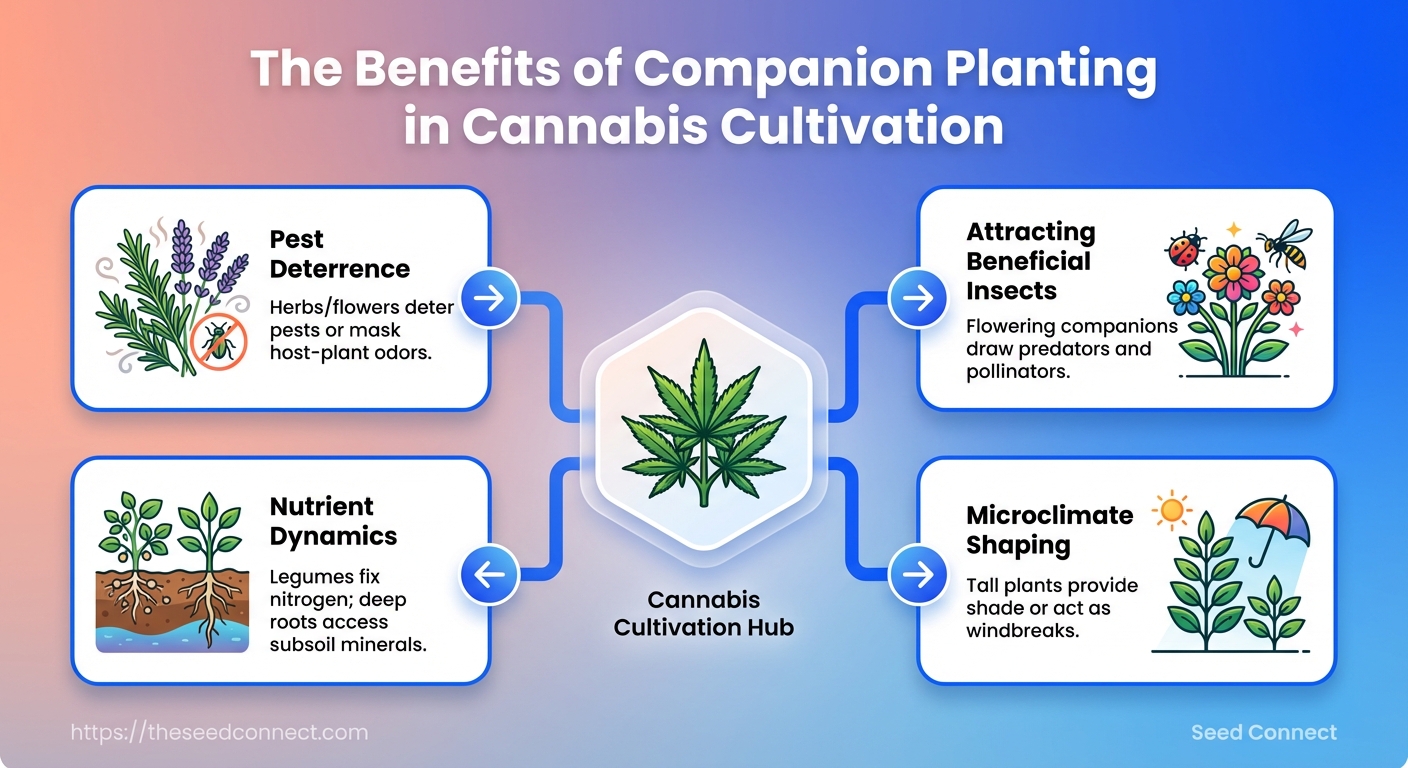
Pest deterrence: Certain herbs and flowers emit volatiles or mask host-plant odors, making it harder for pests to find target crops.
Attracting beneficial insects: Flowering companions draw predators and pollinators that keep pest populations in check and improve fruit set.
Nutrient dynamics: Legumes fix atmospheric nitrogen; deep-rooted species pull up minerals from subsoil layers for shallower roots to use.
Microclimate shaping: Tall plants provide shade for shade-tolerant neighbors or act as windbreaks in exposed plots.
Practical examples relevant to cannabis cultivation
Plant marigolds near cannabis: marigolds are commonly used to repel certain nematodes and whiteflies.
Interplant basil or lavender: these aromatic herbs can reduce aphid pressure and draw predatory wasps.
Use clover as a living mulch: fixes nitrogen and suppresses weeds while conserving soil moisture.
Grow nasturtiums as sacrificial plants: they attract aphids away from high-value plants.
Implementation checklist for a small plot
Start small: test one companion pairing in a single bed before scaling.
Observe and adapt: track pest counts and plant vigor on a weekly schedule.
Rotate and diversify: change companion groups seasonally to prevent pest build-up.
Combine with soil practices: pair companion planting with compost and cover-cropping for best results.
Companion planting isn’t a quick fix; it’s a design principle that rewards observation and iteration. When integrated with good seed selection and reliable genetics, it becomes a powerful tool for growers seeking more resilient, lower-input systems.
How Companion Planting Works
Companion planting operates through a handful of predictable biological interactions: plants alter their immediate environment with physical structure, chemical signals and root-driven changes in soil biology, and those alterations change pest behavior, nutrient availability and microclimate. Understanding these mechanisms makes companion choices intentional rather than accidental — plant selection becomes a tool for pest control, soil health and steady yields.
Primary mechanisms: physical and chemical interactions
Companion effects arise from both visible structure and invisible chemistry.
Physical barrier and shading: Taller or denser companions provide shade, reduce soil evaporation and create a cooler, more humid microclimate that can benefit sensitive crops.
Volatile-mediated behavior change: Many aromatic herbs emit volatile organic compounds (`VOCs`) that mask host-plant cues or repel specific insects; others attract beneficial predators by mimicking prey odors.
Trap cropping / sacrificial plants: Certain plants draw pest attention away from the main crop, concentrating pests where they can be managed mechanically or biologically.
Root exudate chemistry: Roots release sugars, acids and secondary metabolites that shift microbial communities and can suppress soil-borne pathogens.
Examples: planting basil near tomatoes reduces thrips and whiteflies pressure through `VOC` masking; nasturtiums act as trap crops for aphids.
Soil, roots and microbial interactions
Roots are the conversation layer beneath the soil surface. Legume nitrogen fixation: Legumes house `Rhizobium` bacteria in root nodules that convert atmospheric nitrogen into plant-available forms, boosting soil N for subsequent crops. Mycorrhizal partnerships: Mycorrhizal fungi extend root surface area, improving phosphorus and water uptake, particularly valuable in drought-prone or low-P soils. Cover crops and green manures: These plants protect against erosion, build organic matter when incorporated, and stabilize soil structure for stronger root development. Root architecture effects: Deep-rooted companions like comfrey or daikon break compacted layers, bring up nutrients from subsoil and make them available in the surface horizon when their biomass decomposes.
Practical setup steps
Select a companion category based on the desired function (nitrogen, pest masking, trap cropping).
Match phenology — ensure overlap in active growth periods.
Monitor and remove sacrificial plants before they become pest reservoirs.
### Root/soil effects of common companion categories (legumes, deep-rooted, aromatic herbs, cover crops) to help plant selection
Companion category | Primary soil/root effect | Typical examples | Best use with cannabis |
|---|---|---|---|
Legumes | Biological N fixation; increases available N | Clover, vetch, beans | Use in rotation or as intercrop before feeding-heavy cannabis cycles |
Deep-rooted plants | Soil decompaction; nutrient mining from subsoil | Comfrey, daikon, chicory | Plant in adjacent beds to loosen subsoil and recycle minerals |
Aromatic herbs | VOC emissions alter insect behavior; minor antimicrobial exudates | Basil, rosemary, mint | Border or interplant to repel pests and attract pollinators |
Cover crops | Erosion control; organic matter addition when tilled in | Rye, oats, buckwheat | Use off-season to rebuild soil structure and SOM before planting cannabis |
Green manures | Rapid biomass for soil incorporation; nutrient immobilization then release | Sudan grass, mustard, phacelia | Grow then incorporate 2–4 weeks before transplanting to avoid N tie-up |
Key insight: Choosing companions is a functional decision — legumes for nitrogen, deep-rooted plants for structure, aromatics for pest dynamics, cover crops for carbon and erosion control. Combining categories across a season yields compounding benefits. Applied thoughtfully, companion planting reduces inputs and stabilizes yields while building long-term soil resilience. When companions are selected for clear functions and timed to crop needs, they become a reliable part of a sustainable pest control and soil management strategy.
Why Companion Planting Matters for Cannabis
Companion planting reshapes a grow from a single-crop system into a functioning micro-ecosystem that reduces pest pressure, conserves resources, and builds long-term soil fertility. When implemented deliberately—placing nectar sources, trap crops, and nitrogen-fixers in the right spatial relationship with cannabis—companion plants cut the need for synthetic inputs, increase beneficial insect activity, and improve water efficiency through living mulches and groundcovers. The practical result is healthier plants, lower recurring costs, and a more resilient garden that requires less heavy-handed intervention. How this works in practice
Pest suppression through attraction and distraction: Nectar-rich flowers draw predator insects such as ladybugs and lacewings, while trap crops distract chewing pests away from cannabis.
Fewer chemicals: Increased predator populations and localized repellents reduce reliance on broad-spectrum pesticides and fungicides.
Soil and water benefits: Nitrogen-fixing plants and deep-rooted companions recycle nutrients and improve structure; groundcovers and mulches reduce evaporation and encourage infiltration.
Practical deployment — step-by-step
Decide objectives: pest control, soil building, or water conservation.
Map beds: position nectar sources on windward edges to draw beneficials into the canopy.
Plant trap crops (e.g., nasturtium) 1–2 rows outside the main canopy to intercept pests.
Sow nitrogen-fixers (clover, vetch) in rotation beds or interrows early in the season.
Monitor weekly: count predator presence, note pest hotspots, and adjust plantings seasonally.
Checklist for deployment and monitoring
Plant diversity: Ensure at least three functional groups (nectar plants, trap crops, nitrogen-fixers).
Spatial planning: Put trap crops downwind and beneficial flowers on perimeter.
Timing: Stagger bloom periods so nectar is available throughout vegetative and flowering stages.
Monitoring cadence: Inspect once weekly, more often during pest surges.
Record-keeping: Track pest counts, predator sightings, and any interventions.
Examples and concrete returns
Attracting lacewings with buckwheat during early flowering reduces aphid outbreaks without sprays.
A clover understory cut and left as mulch supplies slow-release nitrogen and improves soil tilth year over year.
Nasturtiums as trap crops limit flea beetle entry into young plants, saving seedlings.
Companion plants that attract predators vs repel pests to help growers choose species
Companion plant | Pests repelled / predators attracted | Planting notes | Timing with cannabis lifecycle |
|---|---|---|---|
Marigold | Repels nematodes / attracts hoverflies | Plant at bed edges; tolerate compacted soil | Plant early in veg; replace as blooms fade |
Basil | Repels thrips, some aphids / attracts bees | Interplant among rows; harvest regularly | Start during veg; keep through early flower |
Yarrow | Attracts ladybugs, lacewings | Perennial; trim to encourage blooms | Maintains nectar through veg and early flower |
Nasturtium | Attracts aphids (trap crop) / deters whiteflies | Sow as border trap crop; remove before seedset | Best in seedlings → early veg stages |
Buckwheat | Attracts parasitoids, pollinators | Fast-growing; sow in short windows | Plant 2–4 weeks before expected pest flush |
Key insight: Selecting companions based on function (attract, repel, fix nitrogen, cover soil) and timing them to the cannabis lifecycle delivers the biggest reductions in chemical use and measurable gains in soil health. Understanding these relationships lets a grower design plantings that pay dividends season after season.
Designing a Companion Planting Plan for Cannabis
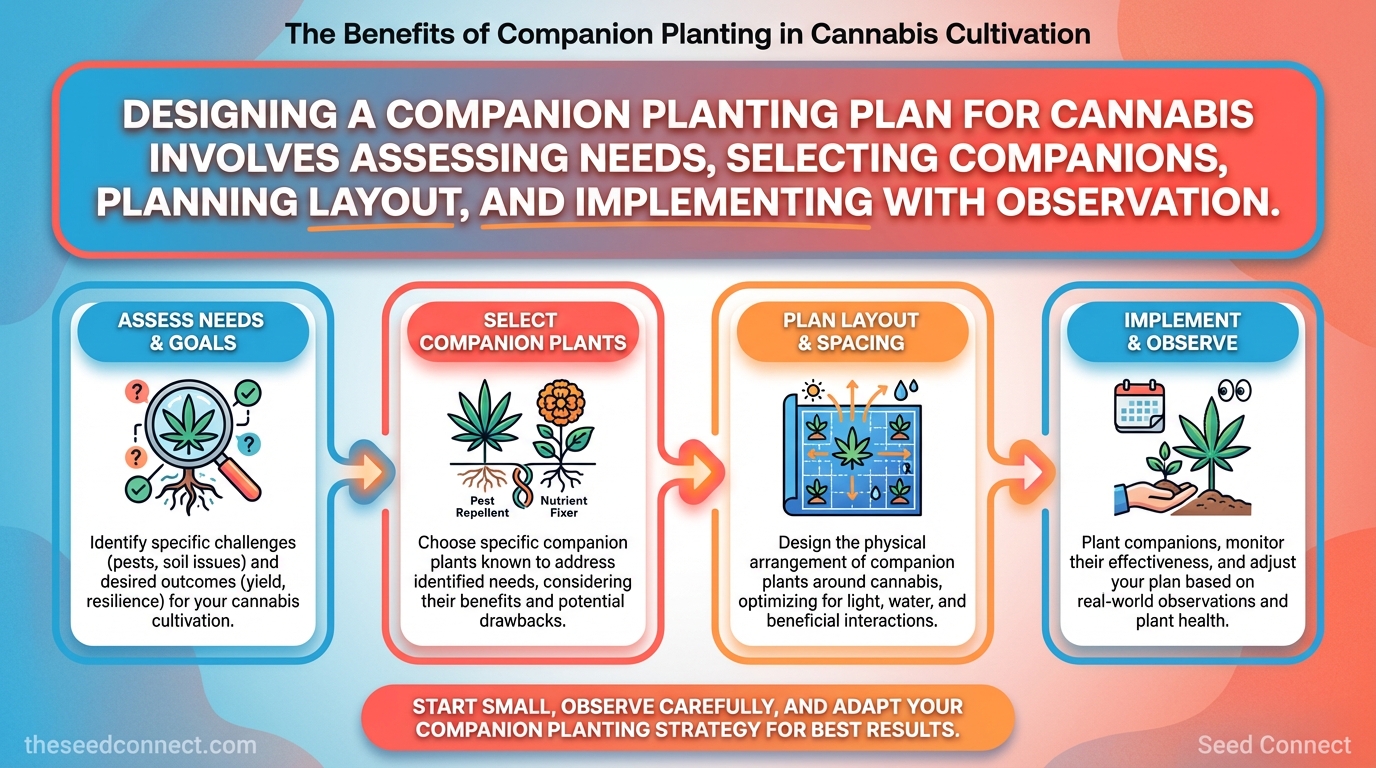
Design the plan around site realities and a clear handful of objectives: pest control, pollinator support, or soil building. Start by mapping the grow space and listing pressure points — shade, wind, drainage, dominant pests — then choose companions that address the highest-priority issues. This approach keeps the scheme practical rather than decorative, and makes scheduling predictable across vegetative and flowering windows.
Assess site and pests
Identify sun patterns, prevailing winds, soil texture, drainage, and recurring pest or disease problems. Photograph the plot and make a simple `grid: sun/shade/drainage` map for reference.
Define primary goals
Decide whether the focus is pest control, pollinator habitat, soil fertility, or a mix. Limit to 1–2 primary goals for a single season to avoid conflicting plant demands.
Select 3–5 companions
Choose a core set of companions that meet the goals and match site conditions. Balance functional roles: attractants, deterrents, soil builders, and trap crops. Prioritize species with overlapping windows of activity.
Schedule planting and succession
Time plantings so companions are functional during cannabis vegetative growth and early flowering when pest pressure is highest. Stagger seeding for continuous canopy cover and bloom.
Monitor and adapt
Track pest incidence, flowering visits by pollinators, and soil tests. Replace or reorder companions next season based on measured performance. Practical companion selection principles
Attractant plants: Draw beneficials and pollinators during cannabis flowering.
Repellent plants: Reduce pest landings but rarely eradicate; use with monitoring.
Trap crops: Sacrifice a peripheral row to intercept pests away from cannabis.
Soil builders: Legumes and deep-rooted species improve fertility and structure.
Example layouts and spacing
Layout patterns by benefit, recommended companions, and best-use scenarios to help growers choose an approach
Layout pattern | Primary benefit | Recommended companions | Best for (small/large/garden/field) |
|---|---|---|---|
Border/perimeter | Pest interception and visual screening | Marigold, nasturtium, basil | Small/large/garden |
Interplanting | Microclimate modulation, pest confusion | Clover, chamomile, dill | Small/garden |
Trap row | Concentrated pest diversion | Sunflower, mustard, radish | Field/large |
Companion strips | Pollinator corridors and soil building | Phacelia, borage, vetch | Garden/large |
Key insight: Choose a pattern that matches labor and scale — borders and interplanting work well for limited-space growers; trap rows and strips scale to larger fields while simplifying monitoring. Practical schedule template Week 0: Soil cover/green manure (vetch) Week 2: Border herbs (marigold, basil) Week 4: Interplant clover between rows Week 8: Flowering attractants (borage, phacelia) Designing a companion plan is iterative: plant intentionally, measure results, and refine species or timing each season so the system becomes progressively more resilient. When choices align with site realities and clear goals, companion planting reduces inputs while improving ecosystem services.
Common Misconceptions and Risks
Companion planting can be a powerful component of sustainable pest control, but it’s not a magic fix — it reduces pressure, it rarely eliminates problems entirely. Many growers assume a few aromatic herbs or marigolds will make crops pest-free; reality is more nuanced. Companion strategies work best as part of an integrated approach that includes monitoring, targeted interventions, and cultural practices. Competing myths and the practical realities
Myth — Companions eliminate pests: Companion plants can repel or confuse some pests and attract predators, but they rarely eradicate infestations on their own. Expect reduced pest pressure, not guaranteed elimination.
Myth — All companions are harmless neighbors: Some companion plants compete for light, water, or nutrients and can reduce yields if poorly matched.
Myth — Planting more diversity always helps: Higher diversity can support beneficial insects but may also increase habitat for herbivores or humidity-loving pests in dense plantings.
Common risks and how they play out
Competition for resources: Fast-growing companions like buckwheat can shade smaller seedlings and steal moisture. Match growth habit and rooting depth to the target crop.
Attracting the wrong insects: Sweet alyssum attracts beneficials but can also host aphids in some regions — monitor early and prune if colonies build.
Microclimate changes: Dense groundcovers increase humidity, which favors fungus gnats and powdery mildew in greenhouse or indoor settings.
False security: Relying solely on companions delays needed corrective action, allowing pest populations to reach damaging levels.
Practical mitigation steps
Choose complementary growth habits: pair deep-rooted plants with shallow-rooted companions.
Stagger planting times: establish companions a few weeks before or after the main crop to avoid early competition.
Monitor regularly: inspect foliage weekly and keep `trap counts` (sticky cards) to detect shifts.
Remove problem plants: if a companion becomes a pest reservoir, pull it promptly.
Example companion layout (simple template) Row A: Main crop (wide spacing) Row B: Low, nectar-rich flowers for predators Inter-row: Fast-decaying mulch crop for soil Perimeter: Repellent herbs (mint kept in pots) Definitions Companion planting: Growing multiple species nearby to provide pest suppression, pollinator habitat, or nutrient benefits. Integrated pest management (IPM): A layered approach combining cultural, biological, and chemical tactics only when necessary. Understanding these trade-offs lets growers design companion schemes that lower pest pressure without creating new problems. When planned and monitored, companion planting becomes a reliable tool in a broader pest-control strategy.
Real-World Examples and Case Studies
Using companion plants around cannabis beds reduces pest pressure, improves soil function, and often increases harvest consistency—when implemented with clear intent and measurable goals. Below are concrete scenarios encountered by experienced cultivators, with planting arrangements, what was tracked, and the observable outcomes. These examples focus on practical decisions growers can replicate: which companion species to use, spatial layout, timing, and metrics to monitor. Practical scenario examples
Urban rooftop micro-garden — pest suppression and pollinator attraction
Context and constraint: Eight 15-gallon fabric pots on a 10 m² rooftop with limited water and moderate wind exposure. Companion species and arrangement: Marigold planted in 1-gallon edge pots around each cannabis container; basil interplanted in alternating containers. Measurable outcomes: Weekly counts of aphid presence, bloom visits by bees (visual tally), and a 10-week yield per plant. After two cycles, aphid sightings dropped ~60% and beneficial insect visits increased, correlating with a 7–10% yield consistency improvement.
Indoor greenhouse canopy — integrated pest control and odor masking
Context and constraint: 200-plant greenhouse with IPM protocol; strict odor management. Companion species and arrangement: Nasturtium on perimeter rows and clover as a walkway groundcover. Measurable outcomes: Frequency of whitefly outbreaks, number of pesticide interventions, and ambient terpene readings. Whitefly outbreaks were less frequent and pesticide interventions fell by half season-over-season.
Regenerative outdoor field — soil building and nitrogen management
Context and constraint: 0.5 acre outdoor field transitioning from conventional to regenerative practices. Companion species and arrangement: Buckwheat as a quick green manure between rows; clover in fall for nitrogen fixation. Measurable outcomes: Soil organic matter (%), available nitrogen tests, and plant vigor scores. Over one year, soil organic matter rose measurably and leaf tissue nitrogen stabilized within target ranges. What growers tracked (suggested metrics)
Pest counts: weekly visual surveys.
Beneficial insect visits: timed 5-minute observations.
Yield and quality: dry weight per plant and cannabinoid/terpene lab results where available.
Soil health: organic matter and available N tests every 3–6 months.
Quick reference of companion plants, their main benefits, and planting notes to serve as an at-a-glance selection tool
Companion plant | Primary benefit | Best planting time | Notes for cannabis growers |
|---|---|---|---|
Marigold | Pest deterrent (nematodes, some insects) | Spring/after last frost | Plant at edges; tolerates dry conditions |
Nasturtium | Trap crop for aphids, whiteflies | Late spring to summer | Sow along borders; edible flowers attract pollinators |
Basil | Repels thrips and mosquitoes; enhances aroma | After seedlings establish | Interplant in pots or beds; harvest to encourage growth |
Clover | Nitrogen fixer, soil cover | Spring or fall | Use as understory or walkway cover; mow before seed set |
Buckwheat | Quick bloom for pollinators; weed suppression | Early summer | Sow between rows; flail and incorporate as green manure |
Key insight: Selecting companion plants depends on specific constraints—space, water, and pest pressure—and should be tied to measurable targets like pest incidence and soil tests. When planned deliberately, companion planting becomes a repeatable, low-cost tool that reduces interventions and supports healthier crops. Understanding these case studies helps growers design companion planting plans that produce predictable benefits without adding complexity. Implemented thoughtfully, these approaches reduce reactive treatments and improve system resilience.
Casey O’Neill: Cannabis Companion Cropping – Benefits, Best Practices & Strategies / Ganjier
Maintenance, Monitoring and Troubleshooting
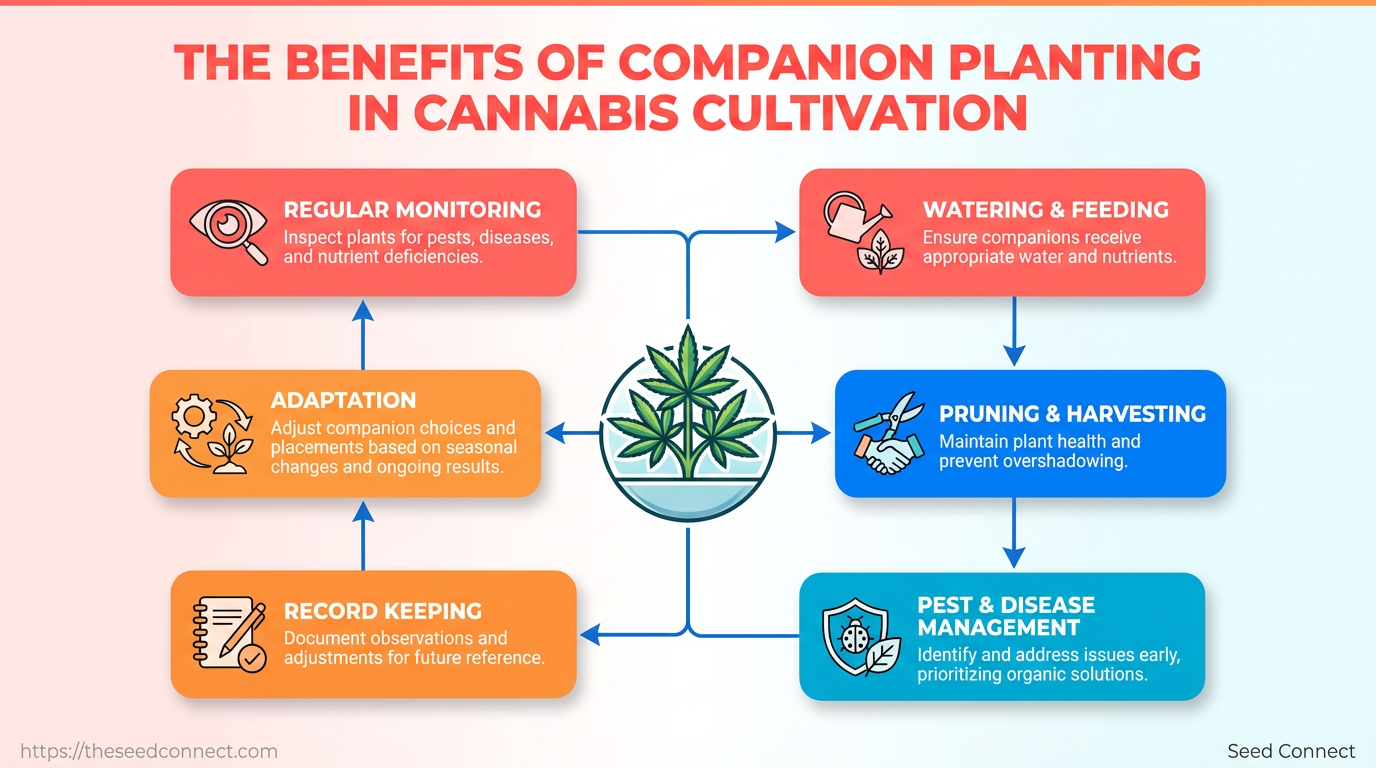
Consistent inspection and quick corrective action keep a crop healthy far more effectively than rare, dramatic interventions. Walk the grow every week with specific checks, log what you find, and apply small fixes immediately so problems don’t compound during sensitive phases like flowering. Weekly monitoring checklist and quick fixes
Inspect undersides of leaves: Look for early signs of mites, aphids, or eggs; fix by isolating affected plants and applying a neem or insecticidal soap spray to contact areas.
Check soil surface: Observe moisture, fungus gnats, and mold; remedy overwatering by increasing drainage and letting the top 2–3 cm dry before the next water.
Track flowering progress: Note bud set, trichome development, and any uneven flowering; correct nutrient imbalances or light penetration issues that cause patchy development.
Monitor nectar resources for beneficials: Keep flowering companions or banker plants to sustain predators like lacewings and parasitic wasps; replace blooms that decline mid-run.
Adjust canopy density: Thin crowded growth to improve airflow and light; remove small, shaded companions that harbor pests or rob resources.
Step-by-step troubleshooting for common issues
Identify the symptom and isolate one plant for testing.
Confirm environment: measure `pH`, `EC`, temperature, and relative humidity.
Rule out nutrient lockout or salt buildup; flush with appropriate volume if `EC` is high.
Treat the immediate pest or disease with a targeted contact or systemic control; follow with cultural changes (airflow, spacing).
Monitor daily for a week, adjusting the approach if symptoms persist.
Practical examples and small-data checks
Example — underside inspection: A weekly magnifier check revealed early spider mite eggs on the third node; a spot treatment plus increased airflow prevented an outbreak.
Example — companion removal: Removing a low-vigor companion plant reduced localized powdery mildew spread and improved the main plants’ yield per square meter.
Industry practice shows early detection reduces crop loss far more than late-stage treatments.
Tools, checklists and assets to keep on-hand
Pocket magnifier, `pH` meter, handheld `EC` reader, and a weekly log template.
Link-worthy assets: a printable germination & monitoring checklist, companion planting calendar, and troubleshooting flowchart.
Understanding these routines turns maintenance from reactive firefighting into predictable, low-overhead upkeep; that reliability preserves yield and quality through the most vulnerable stages of the grow.
📥 Download: Companion Planting Checklist for Cannabis Cultivation (PDF)
Next Steps and Resources
Begin with a controlled, measurable experiment: run one bed or five pots as your pilot, treat it like a small lab where every decision and outcome gets recorded. This reduces risk, accelerates learning, and makes it straightforward to translate successes to larger grows. Start here: set up the pilot, record baseline observations (especially pests and plant vigor), run a full cycle, then review and adapt. Use simple logs, photos, and dates so comparisons between cycles are meaningful—this is the fastest path from theory to reliable, repeatable practice.
Set up a pilot grow
Prepare a single bed or five pots in your preferred medium.
Plant seeds with your chosen genetics and label each plant with strain and date.
Keep environmental controls consistent (light schedule, `EC`/pH, temperature).
Maintain a daily 60–90 second check for pests, runoff pH, and obvious stress.
Record baseline pest observations
On day zero, document presence/absence of common pests, beneficial insects, and nearby host plants.
Use photos and simple notes: location, pest signs (chewed leaves, webbing), and any initial treatments.
Continue weekly checks and timestamped photos for comparison.
Evaluate and adapt after each cycle
At harvest, compare yield, potency observations, pest pressure, and labor time against your baseline.
Make one change at a time—different soil, a new companion plant, or an adjusted nutrient schedule.
Repeat the cycle, documenting results so decisions are evidence-based.
Practical tools and checklists to implement immediately:
Daily grow log: Short-entry template capturing water, feed, pests, and anomalies.
Photo timeline: Weekly images per plant for visual trend analysis.
Pest ID cheat sheet: Common pests and organic countermeasures (sticky traps, neem oil alternatives).
Companion planting plan: Select 2–3 companions per bed based on pest attraction or repellent traits.
Germination guarantee checklist: Steps to validate germination claims and document failures.
Definitions for quick reference: Companion planting: Strategic placement of non-cannabis plants to deter pests, attract beneficial insects, or improve microclimate. Germination guarantee: Vendor promise to replace or refund seeds that fail to sprout when proper germination procedures are followed. Pest control: Integrated approach combining monitoring, cultural controls, biologicals, and targeted treatments. Example log template (use as `grow_log.csv`): date,plant_id,stage,water_ml,feed_type,ec,pH,pest_signs,notes,photo_filename 2025-06-01,A1,seedling,50,none,0.6,6.2,none,first true leaves,photo01.jpg Industry analysis shows gradual, documented iteration leads to the biggest gains in consistency and yield. Include your supplier’s germination guarantee and expert support when choosing genetics—those safety nets matter during early experiments. Start small, log everything, and scale only once the data supports the change; that approach shortens the learning curve and improves outcomes.
Conclusion
Reading the garden like a clinician pays off: companion planting reduces pest pressure, supports soil biology, and smooths nutrient dynamics so problems show up earlier and respond to gentler fixes. Practical insights from the article—pairing aromatic herbs with cannabis to mask scent, using flowering strips to boost beneficial insects, and rotating legume companions to rebuild nitrogen—are tactics proven by small commercial growers to lower pesticide use while improving vigor. If you wonder whether companion plants invite more pests, the pattern shows they more often divert or concentrate pests away from the crop; if you ask how quickly benefits appear, expect visible changes in pest control and pollinator activity within a growing season. And yes, occasional targeted interventions remain part of an integrated approach.
Start with three concrete steps: map microhabitats in your plot, choose complementary companions based on flowering time and root habits, and monitor weekly for pest and beneficial insect trends. For seed sourcing and strain advice that aligns with sustainable practices, explore Seed sourcing and strain guides at The Seed Connect. Those looking to scale can adopt pest control thresholds from the troubleshooting section and iteratively adjust companion mixes next season. These actions turn the clinic-like reading of plants into a resilient, low-chemical system that rewards patience and observation.