

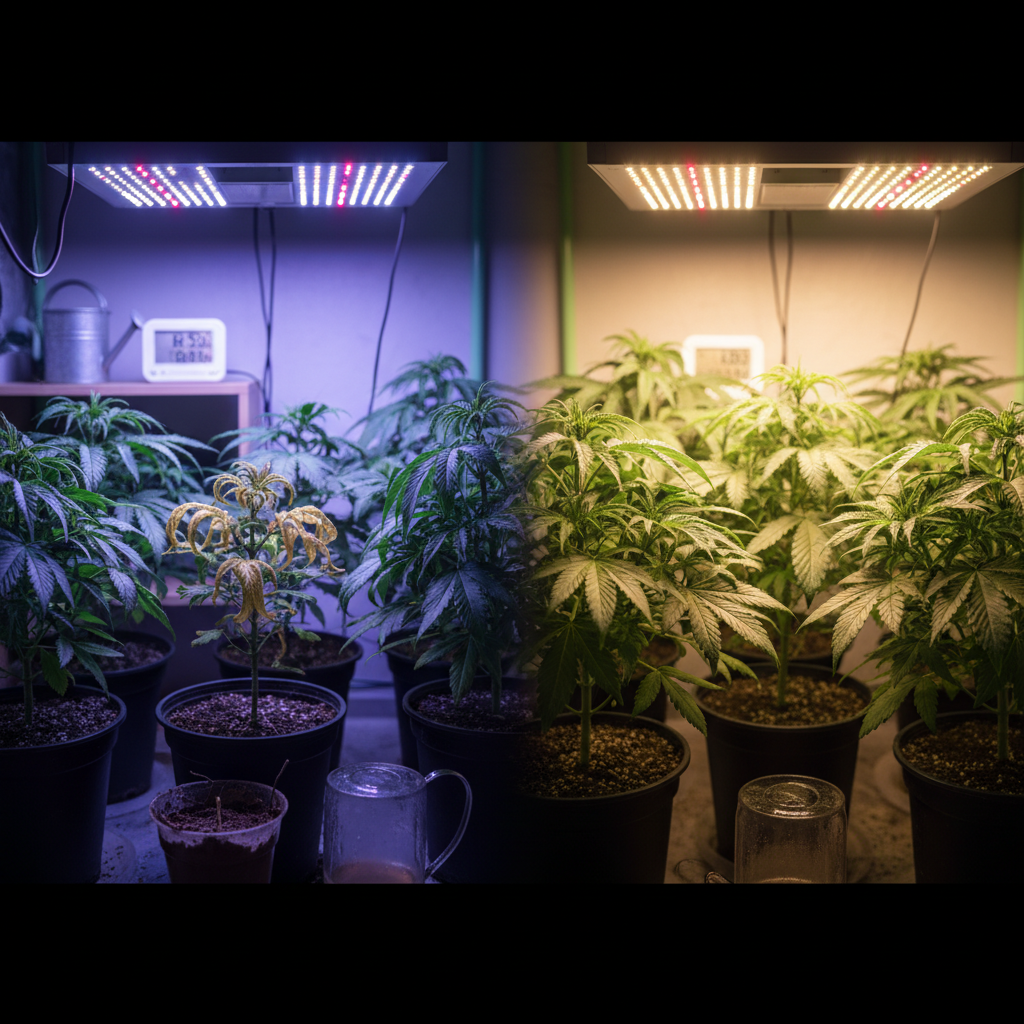
Have you ever noticed your yields slipping away before pests even get a chance to show up? Early mistakes, like inconsistent lighting and poor humidity control, add up over a crop cycle. This can turn promising plants into disappointing harvests.
These cannabis cultivation mistakes are usually easy to fix once you know what they are.
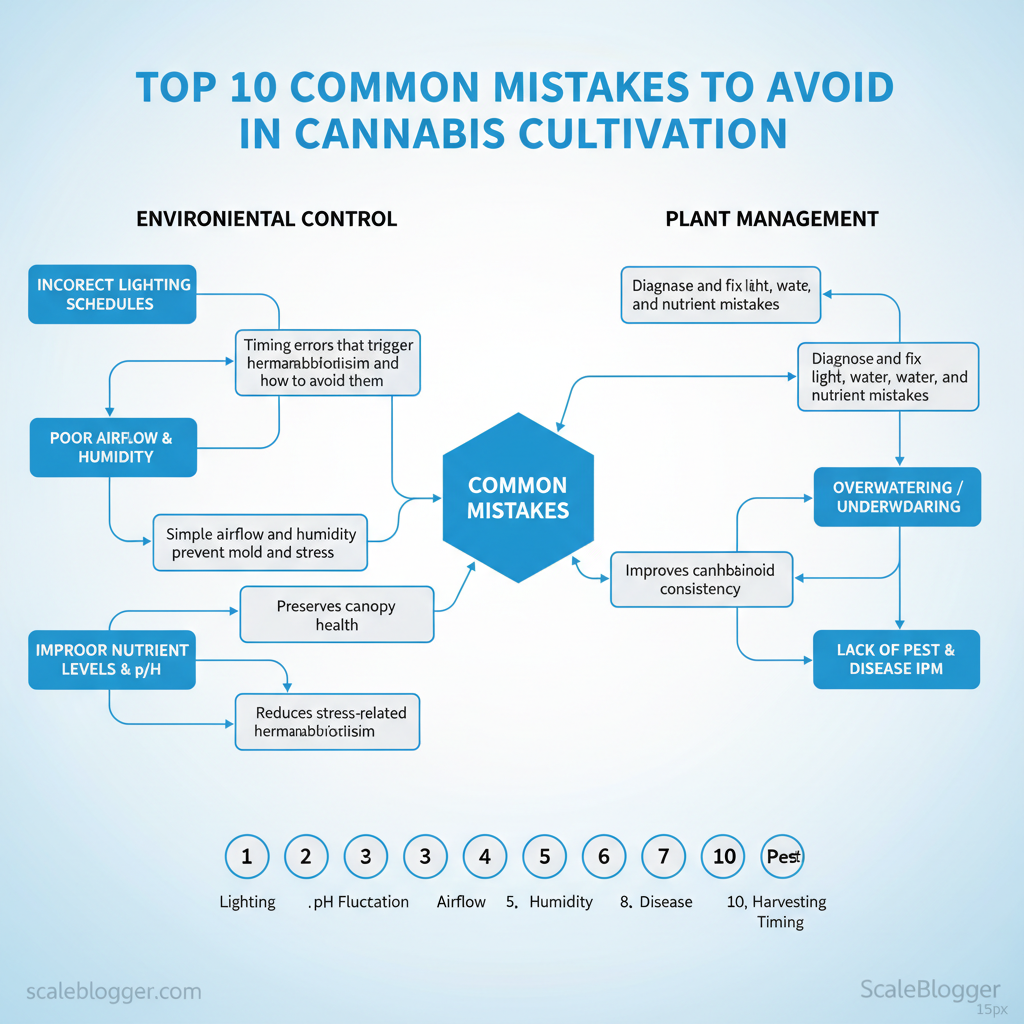
Fixing common problems early keeps your plants healthy. It also reduces stress-related hermaphroditism and improves cannabinoid consistency in each harvest. Simple changes in watering, airflow, and nutrient schedules can greatly improve plant health and bud quality.
Picture a home grower who corrected light distance and recovered a stalled flowering room within two weeks.
Readers will learn actionable, experience-based guidance on avoiding the most frequent growing cannabis errors, with clear signs to watch for and fast remedies to apply. Expect straightforward checks that fit into any grow schedule and techniques that scale from a single tent to a commercial room.
- How to diagnose and fix light, water, and nutrient mistakes
- Simple airflow and humidity practices that prevent mold and stress
- Timing errors that trigger hermaphroditism and how to avoid them
- Practical monitoring tips using
ppfd,EC, and temperature ranges like20–28°C - Quick recovery steps for common transplant and pH problems
The list that follows pinpoints the ten mistakes that cost time and crop value, and explains precise steps to prevent or correct each one.
> Key Takeaway: ## Use this guide as your roadmap. Use this guide as your checklist and decision map.
Use this guide as your roadmap.
Use this guide as your checklist and decision map. It assumes you understand basic plant life stages (vegetative and flowering) and helps you make choices about equipment, setup, and troubleshooting.
Read the prerequisites and tools list first, then follow the sequential sections when you’re ready to set up a seed-to-harvest cycle.
The layout is intentionally stepwise so each chapter adds a concrete skill or measurement you can apply immediately.
What to expect and how to move through the content
- Read the Prerequisites and What You’ll Need checklist to confirm you have basic knowledge and the right tools. 2.
Use the equipment table to choose a starter spec—buying to these minimums avoids common early failures. 3. Follow the step-by-step setup instructions in order: germination → veg → flower → harvest.
- Refer to measurement and diagnostic pages when a plant shows stress; those pages assume you’ve already learned
pHandECbasics here. 5.
Use the troubleshooting appendix when a problem persists; it’s organized by symptom for quick diagnosis.
Prerequisites (what to know before you begin)
- Basic plant life cycle: Vegetative growth favors leaf and node production; flowering triggers bud formation and changes light schedules.
- Reading plant signs: Learn to identify nutrient burn, deficiencies, and pests by leaf color and growth rate.
- Simple measurements: Understand
pHranges and howEC/TDSreflects nutrient concentration.
Practical usage tips
- Start small: Set up one or two plants to practice measuring
pHandECbefore scaling. - Record everything: Track light hours,
pH,EC, and feed volumes in a simple log. - Bench-test new equipment: Calibrate a new pH meter and check a fan’s airflow before it’s critical.
Quick checklist of essential tools, why they’re necessary, and recommended specs for beginners
Quick checklist of essential tools, why they’re necessary, and recommended specs for beginners
| Tool/Item | Purpose | Recommended Spec/Range | Beginner Buy Tip |
|---|---|---|---|
| pH meter | Measure nutrient solution acidity | 0.00–14.00 range; ±0.1 accuracy | Buy a replaceable-electrode model with calibration buffers |
| EC/TDS meter | Measure nutrient strength | EC 0.0–3.0 mS/cm or TDS 0–2000 ppm | Choose automatic temperature compensation (ATC) |
| Grow light | Provide photosynthetic light | LED 300–600 µmol/m²/s PPFD for small grows | Look for full-spectrum LEDs, 400–600 W equivalent |
| Ventilation fan & filter | Control temp, humidity, and odor | Fan CFM sized to room; carbon filter matched to CFM | Buy a speed-controlled inline fan and pre-filter |
| Pruning scissors | Trim and harvest cleanly | Stainless steel, 5–6 inches, replaceable blades | Pick ergonomic scissors; sterilize with isopropyl alcohol |
Understanding these prerequisites and matching gear to the recommended specs prevents early losses and lets experience focus on growing technique rather than emergency fixes. When equipment, measurements, and basic plant biology are aligned, the rest of the guide becomes instantly actionable.
> Key Takeaway: ## Overwatering and Poor Drainage
Overwatering causes significant plant problems: roots suffocate, beneficial microbes die, and plants droop, turn yellow, and grow slowly as if they’re starved for nutrients. Diagnose by checking actual root-zone moisture, not surface wetness; fix by improving drainage, adjusting watering cadence, and rescuing waterlogged plants without adding more stress.
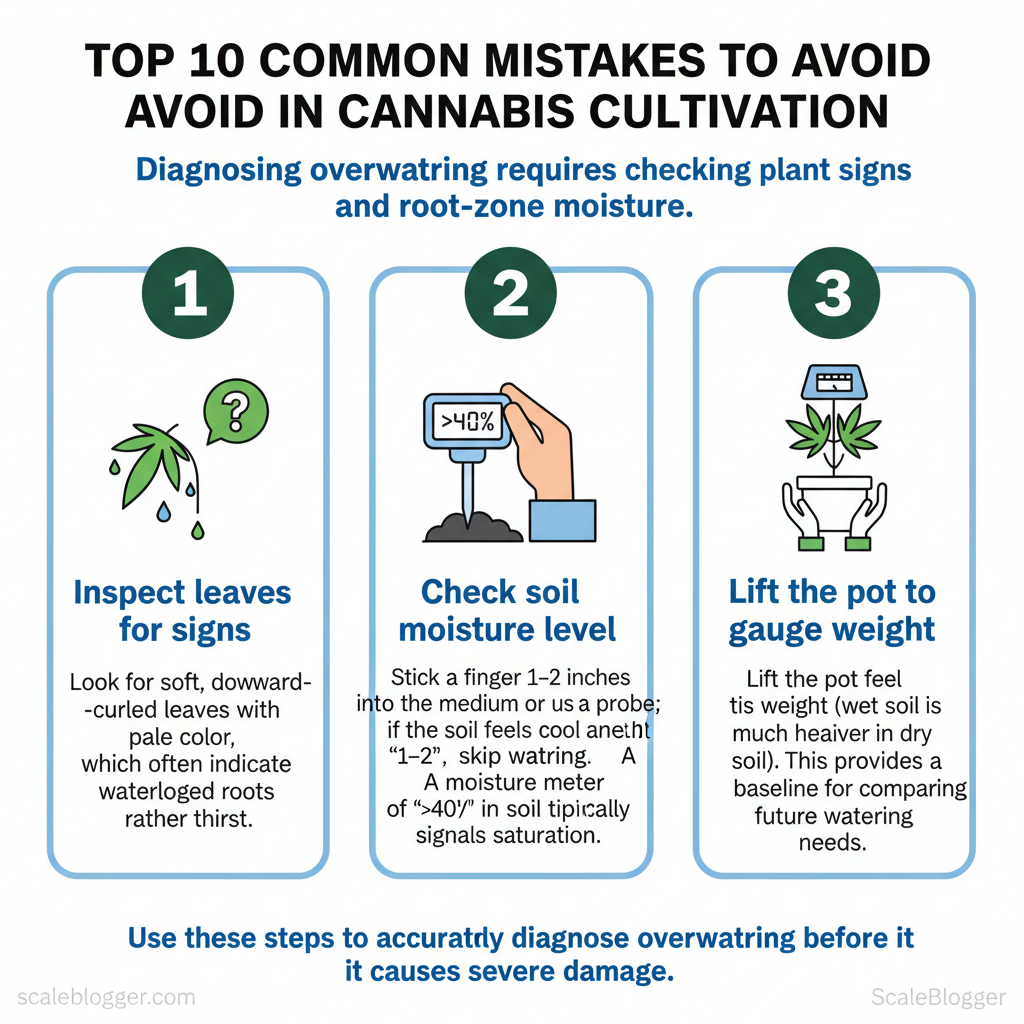
How to diagnose overwatering (5–10 minutes)
- Inspect leaves: soft, downward-curled leaves with pale color often indicate waterlogged roots rather than thirst. 2.
Check soil moisture: stick a finger 1–2 inches into the medium or use a probe; if the soil feels cool and wet at 1–2", skip watering. Research from cannabisbusinesstimes.com shows that a moisture meter reading of >40% in soil typically signals saturation. 3.
Lift the pot: a heavy pot after watering means the media is still holding water; dryness significantly reduces weight. 4. Look at root signs: if repotting reveals dark, slimy roots and a sour smell, root rot may be present.
- Observe growth rate: slow internode stretch and stalled new growth often follow chronic overwatering.
Step-by-step: fix overwatering without stressing the plant (time estimate: 1–7 days for immediate fixes; 2–6 weeks for full recovery)
- Stop watering immediately and allow the top
1–2"to dry (typical wait: 2–5 days depending on pot size and environment). 2.
Improve air flow & temps: raise temps 2–4°C and increase airflow to speed evaporation and raise oxygen at the root zone. 3. Increase drainage: if plants are potted, gently tip and inspect drainage holes; clear blockages and raise pots on saucers or pot feet.
- Repot when necessary: for severe saturation or root rot, remove the plant, trim dead roots, and transfer into fresh, well-draining media. This is stressful—do it during the vegetative phase when recovery is fastest.
- Use beneficials: add mycorrhizae or aerobic microbes to restore a healthy rhizosphere once the medium is stable. 6.
Adjust watering schedule: water deeply but infrequently; allow near-dryness between cycles.
Practical soil amendments and setup tips
- Perlite adjustment: add 20–40% perlite to heavy soils for faster drainage. Fabric pots: use 5–15 gallon fabric pots for better air pruning and drying. Soilless mixes: coco + perlite 70/30 drains faster than straight soil.
- Avoid over-dense potting soil: choose mixes labeled lightweight or drainage-enhanced.
Drainage media and pot types for various grow setups (soil, coco, hydro)
Drainage media and pot types for various grow setups (soil, coco, hydro)
| Media/Pot Type | Drainage Characteristics | Ideal Use Case | Pros/Cons |
|---|---|---|---|
| Fabric pot + amended soil | Fast surface drying, high air exchange | Veg/flower in small-to-medium rooms | Pros: air-pruning, reduces waterlogging; Cons: dries fast, needs frequent watering |
| Hard plastic pot + soil | Moderate drainage; relies on hole size | Budget grows, outdoor containers | Pros: durable, affordable; Cons: can hold perched water, root circling |
| Coco coir in pots | Excellent drainage when mixed with perlite | Hydro-like soil runs, fast growth | Pros: inert, repeatable feed; Cons: requires calcium/magnesium management |
| Hydroponic net pots | Exceptional drainage and oxygenation | DWC, RDWC, ebb-and-flow systems | Pros: rapid growth, high O₂; Cons: technical, root exposure risk |
| Raised beds / in-ground | Natural drainage depends on soil texture | Outdoor/large-scale grows | Pros: stable environment, less watering frequency; Cons: hard to control pH/nutrients |
Troubleshooting common issues
- If leaves stay limp after drying: check roots for rot and consider repotting.
- If plants recover but slow: supplement with root stimulants and avoid heavy nutrients for 1–2 weeks.
- If using large pots: expect longer dry-down times—adjust schedule rather than pot size mid-cycle.
Understanding moisture dynamics and matching pot/media to your workflow prevents repeated overwatering and saves time and plants. When drainage and watering rhythm are right, plants recover quickly and grow with far less stress.
> Key Takeaway: ## Mistake 2 — Incorrect Nutrient Management (Under/Overfeeding)
If your plants are stunted, showing yellow leaves or burnt tips, poor nutrient management might be the culprit. Managing electrical conductivity (EC/ppm) and pH during each stage…
Mistake 2 — Incorrect Nutrient Management (Under/Overfeeding)
If your plants are stunted, showing yellow leaves or burnt tips, poor nutrient management might be the culprit. Managing electrical conductivity (EC/ppm) and pH at each stage prevents nutrient lockout and toxicity. Below is a practical, stage-by-stage chart to diagnose where a plant sits and a clear, step-by-step correction workflow — including how to perform a controlled flush and how to transition safely back to the correct feed strength.
Provide numeric EC/PPM and pH target ranges by growth stage
| Growth Stage | EC (mS/cm) | PPM (ppm scale specified) | pH Range |
|---|---|---|---|
| Seedling (0–2 weeks) | 0.2–0.6 | 100–300 (ppm = EC × 500) | 5.8–6.2 |
| Early Veg | 0.6–1.0 | 300–500 (EC×500) | 5.8–6.2 |
| Late Veg | 1.0–1.6 | 500–800 (EC×500) | 5.8–6.2 |
| Early Flower (weeks 1–3) | 1.4–1.8 | 700–900 (EC×500) | 5.8–6.2 |
| Late Flower / Ripening | 1.6–2.2 | 800–1100 (EC×500) | 5.8–6.2 |
EC × 500 ppm scale and maintain a slightly acidic root zone to keep N-P-K and micronutrients available. Seedlings need very low EC; flowering tolerates higher salts but watch for tip burn and slowed uptake.
Diagnosing nutrient stress (step-by-step)
- Brown tips and crisp edges usually indicate overfeeding; pale interveinal yellowing starting at lower leaves suggests underfeeding or N deficiency. 2.
Compare feed EC to run-off EC; a run-off EC significantly higher than feed indicates salt build-up. 3. High VPD or heat increases uptake and can mimic deficiencies; confirm temps and humidity before changing nutrients.
Correcting overfeeding (controlled flush)
- Replace with plain water at target pH. 2.
Perform a controlled flush: run 2–3× container volume of pH-balanced water through the medium slowly, measuring run-off EC until it drops toward target EC for the stage. 3. Allow a 24–48 hour recovery with plain water; observe leaf response.
Transitioning back to correct nutrient levels
- Begin at 50% of the target EC for the growth stage (use the table above). 2.
4 mS/cm steps every 2–3 days while monitoring for symptom recurrence. 3. 2 and test run-off EC twice weekly until plants normalize.
> Overfeeding commonly manifests first as leaf-tip necrosis and long-term yield loss if not corrected quickly
Troubleshooting tips: if symptoms persist despite correct EC/pH, consider micronutrient lockout from high calcium or iron chelate issues, and inspect root health for root rot. Keep a simple log of EC, pH, and visual notes — it speeds diagnosis.
Understanding these measurable targets and a disciplined flush-and-reload routine prevents chronic salt buildup and gets plants back to vigorous growth without guesswork.
Mistake 3 — Poor Light Management
> Key Takeaway: Plants respond to light quantity, quality, and timing. Manage those three factors deliberately: set the right PPFD for each stage, hang fixtures at an appropriate distance and adjust by leaf response or a PAR meter, and switch spectra/schedules…
Plants respond to light quantity, quality, and timing. Manage those three factors deliberately: set the right PPFD for each stage, hang fixtures at an appropriate distance and adjust by leaf response or a PAR meter, and switch spectra/schedules gradually to avoid stress. Correct light management increases yield, improves bud density and terpene development, and prevents stretch, bleaching, or light burn.
Prerequisites
- Tools needed: PAR/Ppfd meter (recommended), digital lux meter (budget), adjustable rope hangers, timer, hygrometer/thermometer.
- Materials: grow light (LED/HPS/CMH/T5), reflective tent or paint, safety gloves.
- Time estimate: initial setup 30–60 minutes; weekly checks 10–20 minutes; major adjustments during transitions 1–2 hours.
Step-by-step: Light Distance, Schedule, and Spectrum
- Measure baseline PPFD. Use a PAR meter at canopy level, map the canopy across 3–5 points to find averages and hotspots.
Target 300–600 µmol·m⁻²·s⁻¹ for vegetative growth and 600–900 µmol·m⁻²·s⁻¹ for flowering (advanced grows may push toward 900–1,200 µmol·m⁻²·s⁻¹ with proper cooling). 2. Set hanging height by light type.
Start conservative and lower until target PPFD achieved without leaf bleaching (see table below for starting distances). Record the height for repeatability. 3.
Establish schedule and transition gently. Use 18/6 or 24/0 for veg; switch to 12/12 for flower. Reduce photoperiod in 24–72 hours window — don’t chop the dark period abruptly mid-cycle.
If plants show stretch after switch, lower lights slightly or increase PPFD within safe range. 4. Manage spectrum across stages.
Use blue-rich spectrum (short wavelengths) for compact veg and red/far-red emphasis for flower to increase bud set. Many full-spectrum LEDs allow switching spectrums or dimming channels. 5.
Monitor plant signals and environment. Leaves curling up = heat/light stress; bleaching = excessive PPFD or spectrum imbalance; stretching = insufficient PPFD or too much far-red.
Common troubleshooting
- Uneven canopy: raise/reposition light, add supplemental side lighting, use defoliation to expose lower nodes.
- Light burn: raise light 10–20% or reduce output; check leaf tips for white/yellow patches.
- Insufficient flower density: increase PPFD in flower by 100–200 µmol·m⁻²·s⁻¹ over 7–10 days, watch trichome development.
Common lighting types (HPS, MH, LED) for intensity, spectrum, heat output, and suitability
| Light Type | Typical Spectrum | Heat Output | Best Use Case |
|---|---|---|---|
| High Pressure Sodium (HPS) | Strong red/orange (flower-biased) | High — significant ambient heat | Large flower rooms, retrofit ops |
| Metal Halide (MH) | Blue-heavy (veg-biased) | High — similar to HPS | Veg tents, early-stage growth |
| Modern Full-Spectrum LED | Tunable full spectrum (B–R–FR channels) | Low to moderate — efficient | All-round grow, tight spaces |
| Fluorescent (T5/CF) | Cool white to warm white (limited red) | Low — minimal heat | Seedlings, clones, small veg racks |
| CMH / LEC | Broad spectrum with UV/near-IR | Moderate — less than HPS | Balanced veg/flower, terpene development |
Understanding these principles lets teams tune light like another nutrient — predictable, measurable, and repeatable — so plants hit their potential without trial-and-error burnouts. When light is managed precisely, other variables (nutrition, humidity, genetics) compound into consistent harvests.
Mistake 4 — Inadequate Ventilation and Airflow
> Key Takeaway: Poor ventilation quickly leads to pests, mold, and low yields. For cannabis grows, ventilation controls temperature, CO2 renewal, and relative humidity (RH) — three variables that directly drive plant respiration, transpiration, and resin production.
Poor ventilation quickly leads to pests, mold, and low yields. For cannabis grows, ventilation controls temperature, CO2 renewal, and relative humidity (RH) — three variables that directly drive plant respiration, transpiration, and resin production. Calculate exhaust needs from your space volume, place circulation fans to avoid stagnant pockets, and target RH bands that change between vegetative and flowering stages.
Follow the step-by-step method below to size equipment, set layout, and maintain air quality.
Step-by-step: Create Proper Ventilation and Maintain Air Quality (how to calculate and implement)
- Measure volume and choose exchange rate — Convert cubic meters to cubic feet (
1 m³ = 35.3 ft³). Pick an air changes per hour (ACH) target: 20–30 ACH for tents/rooms with lighting and heat; increase toward 30–60 ACH when lights run hot or CO2 enrichment is used. - Calculate exhaust CFM — Use the formula
CFM = (Volume ft³ × ACH) / 60. This yields the approximate exhaust fan capacity needed. - Add headroom for filters, ducting, and temperature — Multiply the calculated CFM by 1.25–1.5 to compensate for inline carbon filters, bends, and hot days.
- Select circulation fans and placement — Use at least one oscillating fan per small tent or one per 1–2 m² in larger rooms. Place fans to create gentle laminar flow across canopy tops; avoid blasting leaves directly (causes windburn).
- Set RH targets and control — Vegetative: 40–60% RH. Flowering (weeks 2–end): 40–50% RH, lowering to 38–45% in late flower to prevent bud rot. Use humidifiers/dehumidifiers sized to the room and run them with a dedicated hygrostat.
- Tune and monitor — Measure temp/RH at canopy and near floor, check VPD (vapor pressure deficit) if aiming for precision. Increase ACH or dehumidification when RH spikes.
> Industry practice shows that modest over-sizing prevents most environmental failures because filters and ducting reduce actual airflow.
Practical placement and oscillation tips
- Fan placement: Top intake for exhaust, low exhaust for heat-heavy setups. Keep circulation fans at canopy height angled slightly down. Oscillation: Slow sweep (10–30°) to avoid constant leaf thrashing; use variable-speed controllers.
- Intake location: Passive intake low (tents) or active intake with filtered fan for larger rooms to control odor.
Quick reference for fan sizing and RH control equipment for common grow tent sizes
| Grow Space Size | Recommended Exhaust CFM | Recommended Circulation Fans | RH Control Recommendation |
|---|---|---|---|
| 0.5 m³ tent (≈17.5 ft³) | 50–120 CFM (calc: 17.5×20/60 → ~6 → ×10 headroom) | 1 small clip fan (10–20 W) | Humidifier 0.5–1 L/day or small 30–50 pint dehumidifier |
| 1 m³ tent (≈35 ft³) | 100–250 CFM | 1–2 clip/oscillating fans | Small humidifier; 30–70 pint dehumidifier |
| 3 m³ room (≈106 ft³) | 300–700 CFM | 2–3 oscillating fans (6–16″) | Portable dehumidifier 50–90 pints/day |
| 10 m³ room (≈353 ft³) | 1,000–2,500 CFM | 3–5 floor/box fans with controllers | Commercial 90–150+ pint dehumidifier or HVAC dehumidification |
| Outdoor greenhouse (~open 10–50 m³) | Use ventilation sizing: 2,000–10,000+ CFM (varies) | Large oscillating fans & roof vents | Natural ventilation + industrial dehumidifier when sealed |
Troubleshooting common airflow problems
- Problem: Hot canopy despite rated CFM —
Understanding and applying these principles prevents the most common environment-driven losses and keeps plants in the optimal zone for growth and resin production. When airflow and RH are dialed in, crop health becomes far more predictable and controllable.
Mistake 5 — Neglecting Pest and Disease Prevention
> Key Takeaway: Ignoring routine scouting and layered prevention turns small problems into crop‑threatening infestations. Scout intentionally, prevent with integrated pest management (IPM) measures, and treat using a clear escalation ladder: mechanical → biological…
Ignoring routine scouting and layered prevention turns small problems into crop‑threatening infestations. Scout intentionally, prevent with integrated pest management (IPM) measures, and treat using a clear escalation ladder: mechanical → biological → targeted organic products. This approach minimizes chemical use, preserves beneficial organisms, and keeps flower quality high.
Prerequisites
- Grower knowledge: Familiarity with common pests and disease life cycles. Baseline environment: Stable temperature, RH control, and good air circulation. Tools/materials needed: magnifying loupe (30–60x), pH meter, moisture probe, sticky traps, beneficial insects (predatory mites,
Amblyseius cucumeris), neem oil,Bacillus subtilisspray, isopropyl wipes.
- Time estimate: Daily quick scout (5–10 minutes); weekly deep scout (30–45 minutes).
Daily/weekly scout checklist (practical)
- Daily: walk the canopy edge for chewing or stippling; check top and underside of 10–20 random leaves. 2.
Weekly: lift lower canopy, inspect soil surface and new growth with a loupe; count sticky traps and note trend. 3. Record: pest presence, percent leaves affected, and any abnormal odors or discoloration in a simple log.
IPM options for indoor grows
- Cultural controls: Sanitation — remove dead plant material; sterilize tools; quarantine new plants. Environmental controls: Humidity management — keep relative humidity 40–50% in flowering to suppress mildew. Physical controls: Sticky traps and
yellow/bluecards to monitor and reduce flying pests.
- Biological controls: Predatory mites and parasitic wasps for thrips and whiteflies; microbial products like
Beauveria bassianafor soil pests.
Safe treatment escalation
- Mechanical: prune infected tissue, increase air exchange, wash leaves with water and gentle surfactant. 2.
, Beauveria) timed to life cycle. 3. Targeted organic products: apply oils (neem, horticultural), sulfur or potassium bicarbonate for powdery mildew, always spot‑test and follow label limits.
Expected outcomes and troubleshooting
- Success looks like: fewer trap counts week-over-week, no new symptomatic leaves after one life cycle.
- If counts rise: re-evaluate humidity and crop density; escalate to biological agents; consider short quarantine and culling for Botrytis.
- Resistant genetics: choosing strains with known disease resistance reduces pressure — options include certain autoflower and feminized genetics tailored for indoor resilience (see cultivar specs).
Common pests/diseases, diagnostic symptoms, and recommended immediate actions
| Pest/Disease | Key Symptoms | Immediate Action | Prevention |
|---|---|---|---|
| Spider mites | Fine webbing, stippled yellow speckling | Isolate affected plants, blast with water, release predatory mites | Lower RH, increase airflow, monitor with sticky cards |
| Thrips | Silvering of leaves, black frass specks | Remove damaged leaves, release Orius or predatory mites |
Sticky traps, avoid over-fertilizing, introduce predators |
| Powdery mildew | White powdery patches on leaves and buds | Prune infected tissue, apply K bicarbonate spray |
Maintain RH <50%, increase light penetration |
| Botrytis (bud rot) | Soft brown/grey mold inside buds, musty odor | Remove and destroy infected buds, dehumidify immediately | Proper spacing, lower RH in late flower, airflow through canopy |
| Root aphids | Stunted growth, sticky root surfaces, yellowing | Repot if severe, apply beneficial nematodes or Beauveria |
Sterile medium, avoid overwatering, monitor runoff |
Understanding and applying these prevention steps maintains crop health and preserves flower quality — a small daily investment that prevents costly outbreaks.
Mistake 6 — Improper Pruning, Training, and Plant Support
Pruning and training are plant physiology tools, not stylistic choices; done correctly they redirect energy, improve light penetration, and increase yield without stressing plants. Start pruning and training after plants have a stable root system and at least 4–6 true nodes; that timing prevents recovery delays and avoids stunting vegetative growth. Implement low-stress techniques first, escalate only when plants show vigor, and install supports before flowers become heavy so branches never bend past their breaking point.
Prerequisites and tools
- Soil/root stability: Wait until transplants or seedlings show steady new growth (typically 2–3 weeks).
- Tools needed: sharp bypass pruners, plant ties (soft garden tape), flex wire, trellis net or SCROG screen, bamboo stakes, rubbing alcohol for tool sterilization.
- Time estimate: 10–40 minutes per plant depending on technique and plant size; expect a 7–10 day recovery period after major cuts.
Step-by-step: Prune and train without stressing plants
- Inspect the plant and count nodes; only top when plant has
4–6true nodes for topping, or5–7nodes for FIM to maximize branches. 2.
For topping: sterilize pruners, remove the main shoot 1–2 nodes above the highest fully formed node, leave at least one healthy leaf pair to feed recovery. 3. For FIM: pinch or cut ~75% of the new tip using clean scissors to leave some meristem tissue; monitor for multiple new leaders.
- For LST: tie the main stem gently to the side with soft tape, loosen ties every 3–5 days as stems thicken; bend gradually over 1–2 weeks to avoid snapping. 5.
For SCROG: install the screen at early vegetative stage, weave branches horizontally under the screen as they grow, maintain 1–2” spacing between colas. 6. Install supports (stakes, cages, netting) as soon as bud sites form; add extra supports before wet/dense flowers develop.
Practical cues and tips
- Watch leaf reaction: temporary droop followed by perk-up in 48–72 hours is normal; prolonged wilting signals over-pruning.
- Slow is safer: bend stems gradually; if a stem tears, tuck the torn tissue and support it with splinting and tape.
- Recovery feeding: apply a light feed with balanced NPK within 24–48 hours after major cuts to support regrowth.
Training techniques (topping, FIM, LST, SCROG) including ideal timing and pros/cons
| Technique | Ideal Timing | Primary Benefit | Risk/Notes |
|---|---|---|---|
| Topping | 4–6 true nodes | Promotes multiple main colas | Moderate stress; 7–10 day recovery |
| FIM | 5–7 true nodes | Can produce 3–8 leaders from one tip | Unpredictable split; less recovery than topping |
| Low Stress Training (LST) | Early veg, flexible stems | Increases canopy evenness, low recovery | Time-consuming; must adjust ties regularly |
| Screen of Green (SCROG) | Early veg to pre-flower | Maximizes light use and uniform bud sites | Requires screen and patience for weaving |
| Supercropping | Mid-veg when stems flexible | Thickens stems, redirects growth to lower nodes | High stress if done incorrectly; risk of tearing |
Understanding these principles reduces broken branches and lost yield, letting plants focus energy on flowers rather than repair. When pruning and training are timed and executed properly, they become points for cleaner canopies and larger, more uniform colas.
Mistake 7 — Harvesting Too Early or Too Late
Wait for the trichomes, not the calendar. Harvest timing hinges on trichome appearance and consistent sampling; get it wrong and potency, terpene profile, and mouthfeel suffer. Use a loupe to inspect at least three representative bud sites, target trichome ratios to match the desired effect, and follow a tight post-harvest timeline for drying and curing to preserve cannabinoids and terpenes.
- Determine the harvest window (step-by-step)
- Inspect multiple sites: use a 60–100x jeweler’s loupe and check the top colas and a few mid-canopy buds.
- Interpret trichomes: clear = immature (harvest too early), milky/cloudy = peak THC, amber = oxidized THC → more sedative effects.
- Target ratios by effect:
- Energetic / cerebral: aim for ~70–90% milky, 10–20% amber.
- Balanced / full-spectrum: aim for ~50–70% milky, 20–35% amber.
- Relaxing / couch-lock: aim for ~40–60% milky, 30–50% amber.
- Sample without damage: snip a
1–2 gsugar leaf or a tiny bud tip, examine immediately, then return to plant decisions — avoid cutting main colas until ready. - Lock a harvest window: once desired ratio appears consistently across sampled sites, plan harvest within 48–72 hours.
- Handle post-harvest: drying and curing that preserve aroma and potency
- Initial dry environment: maintain
60–65°Fand45–55% RH; hang trimmed branches or whole plants for7–14 daysuntil stems snap rather than bend. - Curing (first 2 weeks): place cured buds in airtight jars at
60–70°Fand stable58–62% RH; burp jars daily for the first week, then every few days. - Long-term cure: store in a cool, dark place at
60–70°Fand58–62% RHfor2–6 monthsto smooth harsh chlorophyll flavors and develop terpene complexity.
Common troubleshooting
- If buds dry too fast: increase RH by placing a small humidity pack or reducing airflow; overly brittle buds signal terpene loss.
- If mold appears during dry: discard affected material and lower RH + increase airflow next crop.
- If THC feels “green”: likely harvested too early — consider waiting for more cloudy trichomes on the next run.
Timeline for harvest decisions and post-harvest steps with target environmental conditions
Timeline for harvest decisions and post-harvest steps with target environmental conditions
| Stage | Key Action | Target Environment | Duration |
|---|---|---|---|
| Final 2 weeks before harvest | Flush/monitor trichomes daily; reduce nitrogen | 68–78°F, 40–50% RH |
7–14 days |
| Harvest day | Sample multiple sites; cut at planned time | 65–75°F, 40–45% RH (stable) |
1 day |
| Initial dry | Hang branches or trimmed buds until stems snap | 60–65°F, 45–55% RH, low airflow |
7–14 days |
| Curing (first 2 weeks) | Jar buds; burp daily first week | 60–70°F, 58–62% RH |
14 days |
| Long-term cure | Store jars in cool dark place; occasional burps | 60–70°F, 58–62% RH |
2–6 months |
Understanding these details reduces variability between runs and helps preserve the strain-specific effects and aromas. When timing and post-harvest care are done properly, the final product reflects the genetics and effort invested during the grow.
Mistake 8 — Ignoring Environmental Monitoring and Record-Keeping
Environmental monitoring and a disciplined grow log are the single most effective defenses against invisible, slow-moving problems. When teams skip regular measurements or see logs as optional, small changes in temperature, humidity, pH, or light can lead to nutrient lockouts, pest problems, and reduced yields. Accurate monitoring turns guesswork into action: trends reveal what’s trending wrong before plants show stress.
- Set up monitoring: hardware and placement
- Choose sensors: buy reliable units for temperature, relative humidity (RH), pH, EC/PPM and PPFD. Place sensors at canopy height and at root zone for fluids.
- Calibrate regularly: follow manufacturer steps for
pHandECprobes; recalibrate environmental probes quarterly. - Network and backup: use Wi‑Fi or local logging with cloud backups and redundant sensors in different grow zones.
- Define thresholds: set upper/lower alarm limits for each metric and automate alerts to phones or SMS.
- Start the log: create a daily entry template capturing observations, set changes, and corrective actions.
Daily vs weekly recording: what to capture
- Daily — environmental snapshot: record temperature, RH, PPFD, pH (root runoffs), and EC/PPM; note any abnormal smells, pests, or leaf symptoms.
- Weekly — trend and treatment log: average min/max values, nutrient changes, flushing events, trimming, pest treatments, and growth-stage notes.
- Event-driven entries: after power outages, irrigation failures, or corrective actions, log timestamped details and follow-up checks.
How to use logs to detect slow-developing problems
- Trend detection: look for drift in nightly lows or rising EC over several weeks — these often precede nutrient imbalances. Cross-reference events: match symptom onset with recent changes (new nutrient batch, lamp replacement, HVAC tune). Control charts: plot weekly averages with control bands to visualize deviations that human memory misses.
, RH and mold signs), prioritize environmental fixes before changing nutrients.
Starter monitoring checklist and suggested recording frequency
Grow log template, monitor cannabis grow
| Metric | Ideal Range | How Often to Record | Recommended Tool |
|---|---|---|---|
| Temperature | 20–26°C (veg), 18–24°C (flower) | Daily (min/max) | Aptus/Inkbird thermistor, HOBO data logger |
| Relative Humidity | 40–70% (veg higher), 40–50% (late flower) | Daily (snapshot + nightly low) | Sensirion probes, Inkbird humidity sensors |
| pH | 5.8–6.5 (soil), 5.5–6.0 (hydro) | Daily for runoffs / weekly for reservoirs | Bluelab pH Pen, Hanna pH meter |
| EC/PPM | EC 0.8–2.2 (depends on stage); PPM 200–1400 | Daily in reservoir; weekly runoffs | Bluelab Combo Meter, HM Digital EC meters |
| Light PPFD | 300–600 µmol/m²/s (veg), 600–900 µmol/m²/s (flower) | Weekly grid readings; daily schedule check | Apogee MQ-500, Sekonic/Lux meters |
Understanding how to instrument a room and keep a clean log saves time and prevents stress. When monitoring becomes routine, anomaly detection moves from reactive firefighting to straightforward maintenance, letting teams focus on optimizing yield and quality.
📥 Download: Cannabis Cultivation Mistakes Checklist (PDF)
Troubleshooting Common Issues
Troubleshooting starts with symptoms, not guesses. Watch what the plant is doing, then check water, light, nutrients, and the environment. A consistent symptom-to-action flow reduces wasted interventions and prevents moving from a recoverable problem to a lost plant. Use systematic checks, treat conservatively first, and remove affected tissue only when it’s clearly necrotic or spreading.
Symptom-based triage: step-by-step
- Inspect visually and under magnification for pests, mold, and nutrient signs (5–10 minutes per plant). 2.
Check substrate moisture with a probe and measure runoff pH and EC/PPM (2–5 minutes). 3. Adjust one variable at a time (light, water, nutrient) and wait 24–72 hours for a response before next change.
- If the issue worsens after corrective action, stop and escalate.
When to prune vs treat in place
- Prune damaged tissue: remove leaves or buds that are >50% necrotic or covered in rot to stop spread.
- Treat in place: minor nutrient spots, early pest traces, or single-leaf damage — treat the whole plant only if signs multiply.
- Sanitation rule: sterilize tools between cuts; infected material should be removed from the grow room immediately.
When to call an expert or replace plants
- Call an expert when problems cross systems (roots + canopy failure) or if diagnostics (lab or extension) are needed; expert support can prevent repeat issues.
- Consider replacing when roots are slimy and brown throughout the rootball, or when systemic pathogens (wilt + internal browning) are confirmed; replacement may be faster and cheaper than prolonged remediation.
5` for soil-less runs often resolves micronutrient lockouts within 3–7 days. Flush cautiously: a single flushed volume of clean water can remove salts; repeated flushes risk nutrient deficiency if not followed by rebalancing. Isolate affected plants: slows pest/pathogen spread; expected outcome is reduced outbreak severity within one growth cycle.
- Document changes: take photos and notes; this speeds diagnosis if you consult support.
Symptom-to-action matrix for quick troubleshooting
Table: Section Content — Symptom, Likely Cause(s), Immediate Action & more
| Symptom | Likely Cause(s) | Immediate Action | When to Escalate |
|---|---|---|---|
| Yellowing older leaves | Nitrogen deficiency, natural senescence | Increase nitrogen or adjust feed; confirm pH |
If new growth is yellowing, escalate after 7 days |
| Interveinal chlorosis | Magnesium or iron lockout, high pH |
Check pH; foliar Mg/Fe or Epsom salt soak |
If foliar treatment fails in 5–7 days, escalate |
| Wilting/drooping | Under/overwatering, root rot | Check moisture; gently tug pot; correct irrigation | If stems collapse or roots smell, escalate immediately |
| White powder on leaves | Powdery mildew (fungus) | Remove affected leaves; apply contact fungicide | If spread to buds or humidity >70%, escalate |
| Brown/grey buds (rot) | Botrytis (bud rot) | Remove infected buds; lower humidity | If spread widely or buds are internally brown, escalate |
| Sticky webbing (mites) | Spider mites | Wash with water; apply miticide/biocontrol | If heavy infestation after two treatments, escalate |
| Roots slimy/brown | Pythium/root rot | Remove plant, inspect rootball; reduce water | If >50% root mass lost, replace plant |
| Stunted internode growth | Light stress, genetics, low P | Raise light or correct P levels | If no stretch after one week, escalate |
Understanding and applying these checks prevents small problems from becoming catastrophic and saves time compared with trial-and-error. When expert diagnostics or replacement is the faster path, choosing that route preserves crop schedule and reduces downstream losses.
Tips for Success and Pro Tips from Expert Growers
Think prevention first: catching problems early can make your grow more productive. Small, low-cost actions, like routine inspections, basic environmental controls, and a reliable seed source, greatly reduce failure rates. Use a systematic approach to inspections and maintenance so human errors become exceptions rather than causes of crop loss.
High-impact preventive practices
- Daily walk-throughs: 5–10 minutes each morning to check runoff, leaf color, pests, and equipment sounds.
- Environmental guards: tighten humidity and temperature swings with simple controllers and
±2°C / ±5% RHtolerances. - Quarantine new plants: isolate new entrants for 7–10 days to catch pest and disease introductions early.
- Create a routine inspection schedule:
- Morning (daily): check canopy, run-off EC, and irrigation pressure.
- Midday (3× week): inspect under-leaf surfaces and new growth for mites or thrips.
- Weekly: test
pHand EC of media and runoff; calibrate meters. - Monthly: service fans, filters, and light mounts; update logs.
Practical micro-investments that reduce risk
- Good meters: spend on one reliable pH and EC meter rather than multiple cheap ones.
- Backup power: a small UPS for controllers prevents crop shock during brief outages.
- Trusted seeds: starting with stable genetics lowers variability; a germination guarantee removes a major early-failure risk (consider suppliers that back their seeds with support).
Pro tips from commercial growers
- Staggered cycles: run crops on overlapping timelines to avoid total loss from a single contamination event.
- Photoperiod buffer: maintain a one-week light schedule buffer so accidental interruptions don’t flip flowering prematurely.
- Record micro-changes: note not only values but actions — “adjusted feed +10% day 21” — this turns intuition into reproducible protocols.
Example schedule template
Day 0: Seed (soak 12–24h) → plant Day 7: First true leaves → reduce humidity 5% Day 14: Transplant if needed → flush media check Day 21: Begin full feeding schedule Weekly: pest scan, pH/EC log, equipment check
Common pitfalls: neglecting early inspections, cutting calibration corners, and treating seeds as commodities rather than controlled inputs. Investing time in inspection routines and reliable inputs pays back in consistency and predictability. Understanding and applying these practical practices will keep operations resilient and make problem-solving efficient and predictable.
Conclusion
Now that we’ve tackled early-stage mistakes like uneven light cycles and humidity issues, you can set a clear path to healthier, faster-yielding plants by fixing these conditions early and keeping your routines simple and consistent. Growers who switched to timed, uniform lighting and stabilized humidity in the first three weeks reported steadier root development and fewer stretch issues; another small indoor operation cut early losses by standardizing their transplant schedule and saw more uniform canopy fill. If you’re unsure whether to change one variable or overhaul everything, start with the weakest link—usually humidity or light.
Make that change and let it run for one growth cycle before making another adjustment.
Take these next steps now:
- Stabilize your light schedule and monitor PAR daily.
- Lock in humidity and temperature ranges for the seedling stage.
- Document one procedural change per cycle and measure outcomes.
For professional seeds and germination support, explore the Seed Connect germination guarantee and growing guides as an option to reduce early-stage risk. With these focused adjustments and a disciplined checklist, avoidable losses become wins—more predictable plants, faster timelines, and better final yields.