

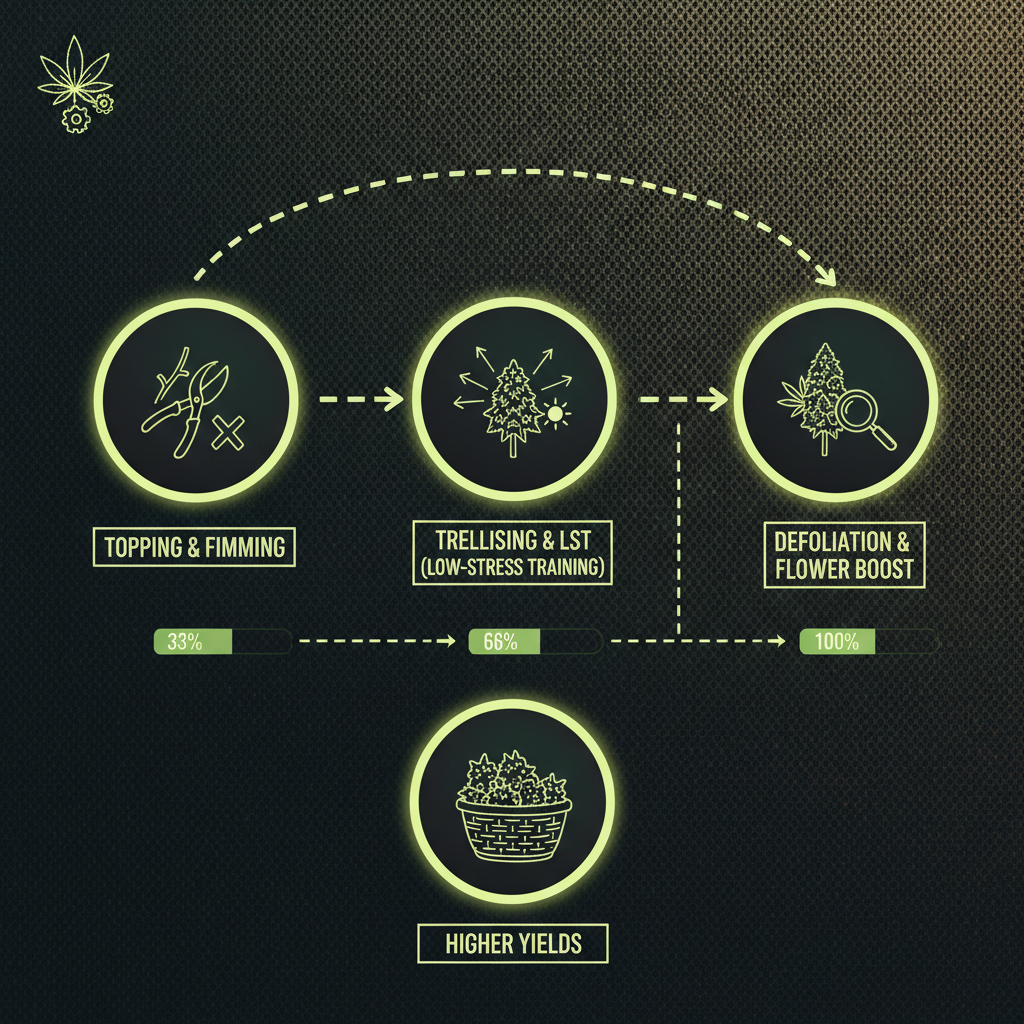
What if pruning was the difference between average and standout harvests?
A crowded canopy can look productive and still underperform.
A few smart cuts often matter more than adding another feed or another week of veg.
That is why cannabis pruning techniques deserve more respect than they usually get.
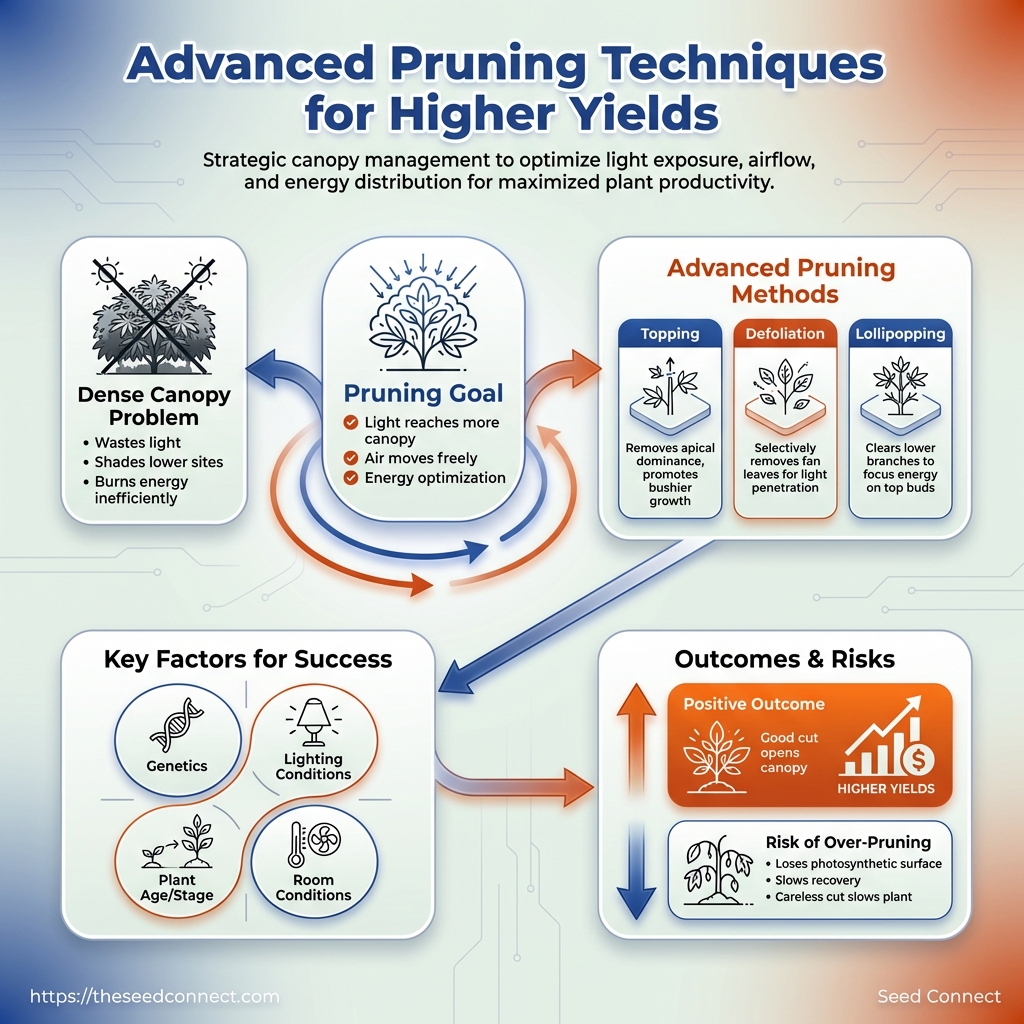
In controlled growing, pruning changes how light moves through the plant, how air sits inside the canopy, and where the plant spends its energy.
UC Davis canopy management work and Colorado State University Extension-style guidance both point to the same basic idea: prune to improve light and airflow, but stop before you strip away too much leaf area.
That balance decides whether pruning for yield helps or hurts.
Light exposure is the big one.
When lower leaves stop shadowing healthy sites, the plant can put more energy into productive tops instead of weak interior growth.
Air movement comes next.
Better airflow can reduce humid pockets inside dense foliage, which matters in any tight indoor room.
Buds still need enough leaf mass to power growth, though, so more air is not always better.
Bud development responds to both.
Open canopies often give more even flower sites, but aggressive cuts can slow recovery and leave the plant with less fuel than it needs.
- Pruning helps when the canopy is too dense. Light cannot reach the lower sites, and airflow feels stale.
- Pruning helps when weak lower growth steals energy. Removing those sites can push resources upward.
- Pruning slows plants when leaf loss is too heavy. Fewer leaves mean less photosynthesis and slower rebound.
- Pruning slows plants after sudden, harsh exposure changes. Shaded tissue can get stressed when it is blasted with new light.
The practical rule is simple: use pruning to shape the plant, not punish it.
In advanced pruning cannabis setups, the best cuts usually improve structure without forcing a long recovery.
A grower running even lighting and healthy airflow may need only light cleanup.
A grower dealing with a jungle-like canopy usually gets more from selective thinning and careful top control.
The plants will tell on you fast.
Balanced cuts improve the whole room; heavy-handed cuts usually announce themselves a week later.
Know the plant before you make a cut
A plant does not care about your pruning plan.
It only cares whether it has enough leaf, root mass, and recovery time to handle the cut.
That is why cannabis pruning techniques change with age, strain, and stage.
A young plant can react very differently from a mature one, even under the same lights.
A vigorous, stretchy cultivar may also tolerate shaping that would stress a compact, fast-finishing plant.
The safest way to think about pruning for yield is to match the cut to the plant’s job at that moment.
Early on, the plant is building structure.
Later, it is trying to turn light into flowers, and heavy cuts can slow that down fast.
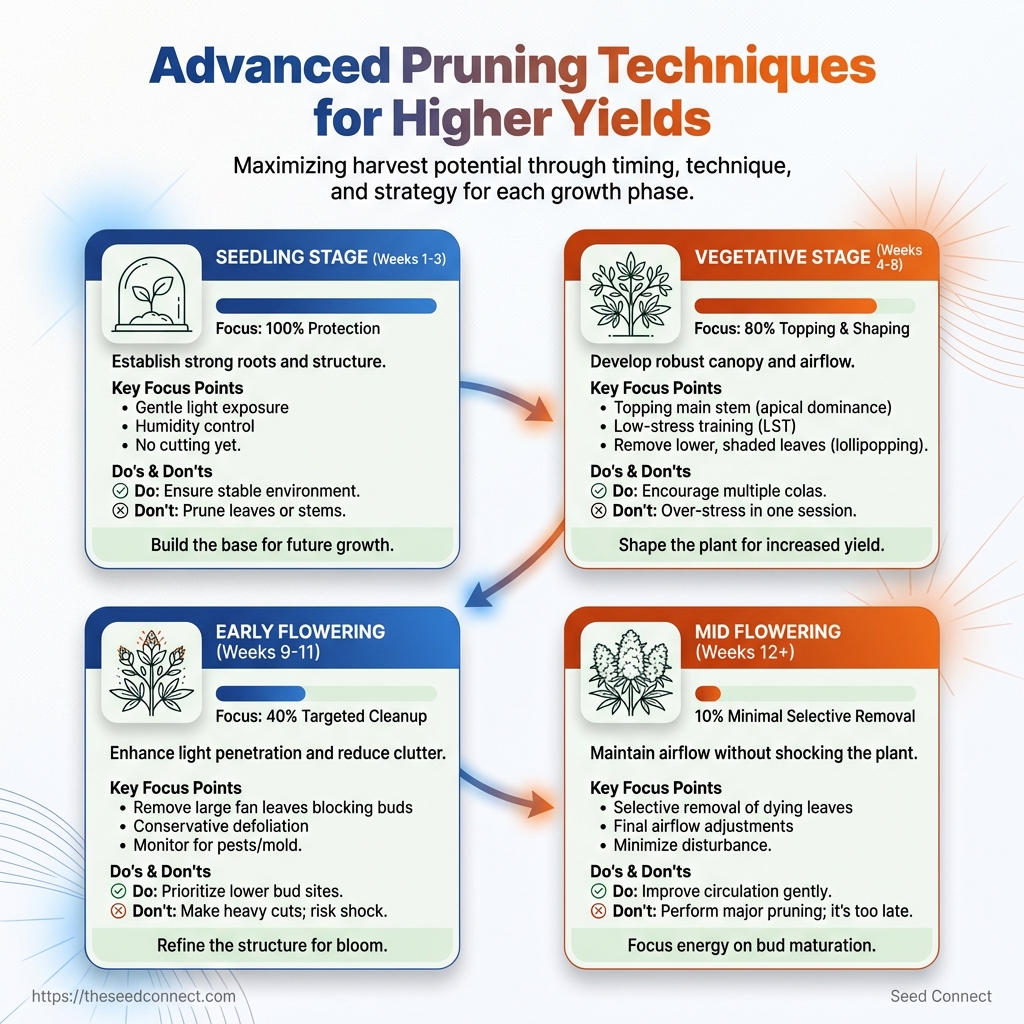
Growth stage and pruning choice
| Growth stage | Best pruning method | Main goal | Risk level | Notes |
|---|---|---|---|---|
| Seedling | None or very light removal of damaged tissue | Protect early root and leaf development | High | Seedlings need leaf area to power growth; heavy cuts can stall them. |
| Vegetative | Topping, selective leaf removal, or light shaping | Build a wider canopy and improve future light spread | Moderate | Strong, healthy plants recover best here. |
| Early flowering | Small, targeted cleanup only | Improve airflow without shocking the plant | Moderate to high | Keep cuts conservative; the stretch phase is not the time for big experiments. |
| Mid flowering | Minimal selective removal | Reduce shade and remove weak lower growth | High | Only cut what blocks light or traps moisture. |
| Late flowering | Avoid major pruning | Protect ripening flowers and preserve energy | Very high | Heavy cuts now often cost more than they give back. |
A plant is usually ready for more advanced pruning when it shows steady growth, thick stems, and clean internodes.
Leaves should look healthy, not pale or clawed, and the plant should already be recovering well from lighter training.
If a stem bends, snaps, or droops for days after minor work, it is not ready for more aggressive advanced pruning cannabis methods.
Signs the plant can handle more
- Strong new growth: Fresh shoots appear quickly after light training.
- Firm stems: The plant holds shape without collapsing.
- Even color: No major nutrient stress or patchy yellowing.
- Active root-zone response: Water use stays consistent, not erratic.
When to back off
- Seedlings and clones: They need recovery time, not drama.
- Recently transplanted plants: Roots are busy establishing.
- Heat-stressed or thirsty plants: Cutting only adds another problem.
- Late-flowering plants: Yield often drops when you remove too much leaf mass.
UC Davis and Colorado State University Extension both emphasize the same old garden truth: pruning works best when it supports light distribution without stripping away too much living tissue.
In practice, that means reading the plant first, then making the cut.
That habit saves more harvests than any fancy tool ever will.
Advanced pruning cannabis growers use to shape stronger plants
A tall plant is not always a better plant.
In a fixed indoor space, the real win often comes from shaping the canopy so light hits more of the useful growth at the same time.
That is where advanced pruning cannabis methods earn their keep.
The best cannabis pruning techniques do not just remove growth.
They steer the plant into a structure that handles light, airflow, and recovery better than a crowded, uneven shape.
Topping and FIMing
Topping removes the main tip and breaks apical dominance, so the plant stops pushing one strong vertical leader.
That usually shifts growth into side branches and gives you a wider canopy, which is handy when you want a flatter top under LEDs or in a tent.
FIMing is the messier cousin.
Instead of removing the entire tip, you pinch or cut part of it, and the plant may respond with several new tops.
It is less predictable, but it can create more branching if you want a bushier plant without a full reset.
- Topping: Best when you want structure and symmetry.
- FIMing: Best when you want to experiment with more tops from one cut.
- Both: Work best early, when the plant can recover fast.
A grower using Cannabis Seeds for a compact, branchy cultivar will usually get more value from these cuts than someone growing a naturally lanky plant.
Lollipopping
Lollipopping clears out weak lower growth that will never see strong light.
Those shaded sites still spend energy, but they rarely repay it with meaningful bud production.
Think of it like pruning a fruit tree so the plant stops feeding tiny interior branches.
The goal is not emptiness.
The goal is to move energy toward the top and middle sites that are actually in the light.
- Remove weak lower shoots: Cut the growth that stays buried in shade.
- Keep the productive top: Leave the sites that get direct light.
- Match the cut to the plant: Sparse genetics need less cleanup than dense ones.
Selective defoliation
Selective leaf removal is about opening the canopy without stripping it bare.
UC Davis and Colorado State University Extension both frame pruning this way in general horticulture: improve light and airflow, but do not trade away too much leaf area.
Before the cut, a dense canopy can trap shade and moisture inside.
After a careful pass, the same plant often looks less crowded, with clearer light paths and better air movement between branches.
The trick is restraint.
Remove a few blocking fan leaves, then wait and watch for response instead of chasing an extreme clean-up job.
The growers who get this right are usually shaping the plant, not punishing it.
That difference shows up later in the canopy, where the light lands evenly and the plant spends less time recovering.
A simple pruning workflow that keeps stress under control
A clean pruning job starts before the scissors open.
Dry blades, dull blades, and a crowded work area are how small mistakes turn into messy recovery.
The best cannabis pruning techniques follow one rule: remove only what you can justify in the moment.
UC Davis canopy work and CSU Extension-style guidance both point to the same balance — improve light and airflow, but never strip so much leaf that the plant loses its engine.
Prep the workspace first. Wipe tools with alcohol, keep a waste tray nearby, and check the plant under the same light it will grow under.
That last part matters because shadows can hide weak spots and encourage overcutting.
- Clean snips: Use sharp, sanitized pruners for smooth cuts.
- Plain targets: Mark dead, shaded, or crowded growth before you cut.
- Light check: Look at the canopy from above and the side.
First, remove broken, yellowing, or clearly unproductive tissue.
Those cuts are easy wins, and they help you settle into a calmer rhythm.
Then work from the outside in.
In advanced cannabis pruning, that usually means thinning the most crowded leaf clusters before touching healthy top growth.
- Start with damaged material. Cut only what is already failing or blocking obvious light paths.
- Open the middle slightly. Remove a few leaves or side shoots that are creating heavy shade.
- Pause and reassess. Step back, check the silhouette, and stop before the plant looks “clean” in a way that is actually too bare.
That pause is the whole game.
A plant that still looks full usually recovers faster than one that has been cosmetically stripped.
Recovery care decides whether pruning for yield pays off or backfires.
Keep light intensity steady for the next day or two, avoid extra stress from feeding changes, and watch the cut sites and new leaves for a normal rebound.
The clip below shows the same workflow in a real grow setup, with a close look at tool handling and post-pruning care.
It is a useful visual if you want to see how a light hand keeps the canopy productive without shocking the plant.
A steady hand beats a dramatic cut every time.
Keep the workflow simple, and the plant usually tells you within a day whether you got the balance right.
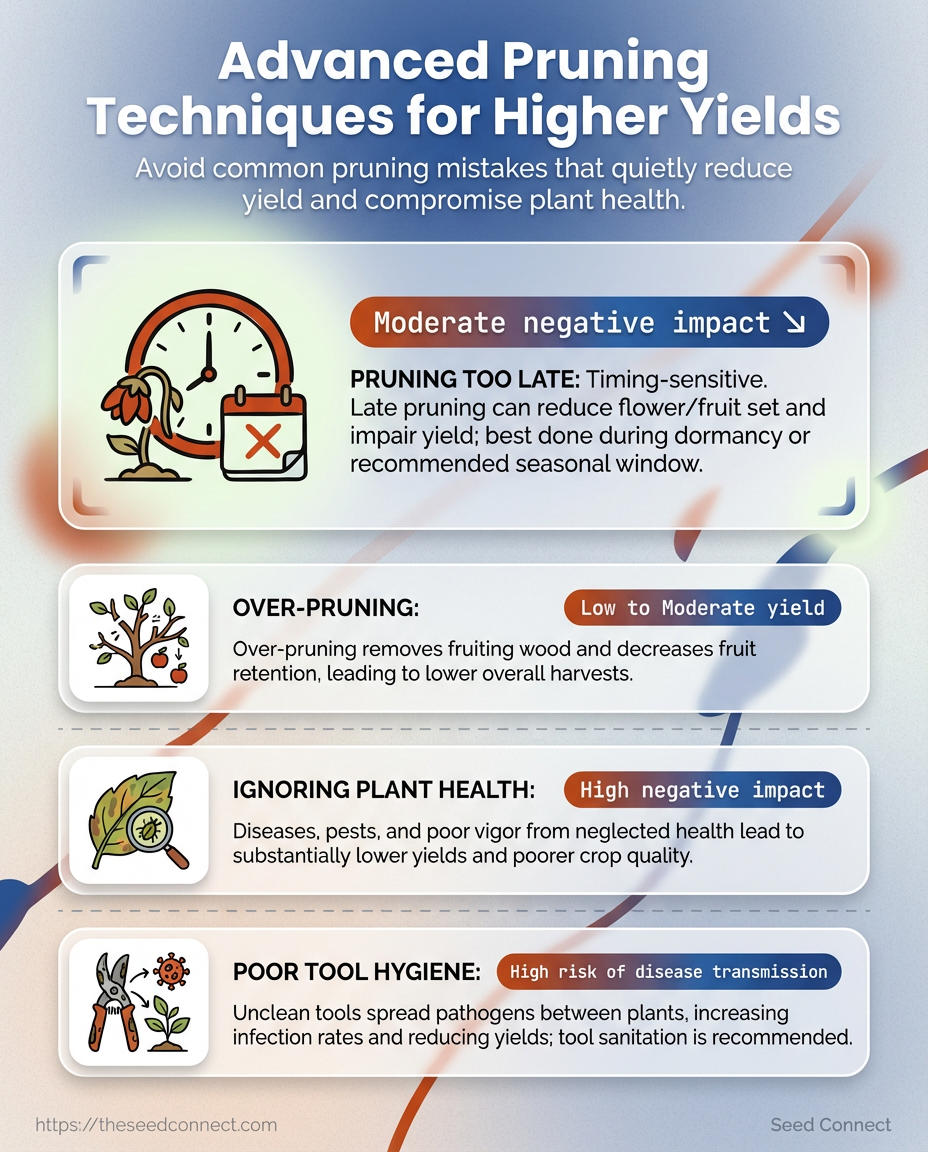
Avoid the mistakes that quietly reduce yield
A plant can look perfectly fine after a heavy cut and still lose ground for weeks.
That is the trap with cannabis pruning techniques: the damage is not always loud, but the yield hit often is.
The biggest mistakes usually come from timing and pressure, not from the scissors themselves. Pruning for yield only works when the plant has enough strength, enough time, and enough genetic potential to turn the cut into better growth.
Over-pruning and the signs of recovery stress
Heavy leaf loss can backfire fast.
When too much leaf area disappears, the plant has less surface to power new growth, and that slows recovery instead of speeding it up.
Watch for leaves that curl, droop, or look flatter than usual after the cut.
Slow new growth, pale tips, and a canopy that stops reaching for light are also classic signs that the plant is spending energy on repair, not production.
- Flat, tired leaves signal reduced vigor.
- Slower shoot extension often means recovery is lagging.
- Patchy color changes can show the plant is under strain.
Pruning too late in flowering
Late flowering is a bad time for major reshaping.
By then, the plant has already committed most of its energy to building the final structure, so big cuts can interrupt the finish.
That matters even more in advanced pruning cannabis setups, where timing is everything.
UC Davis horticulture work and CSU Extension guidance both point to the same basic idea across crops: remove enough to improve light and airflow, but not so much that you strip away productive leaf area or trigger avoidable stress.
A safe rule is simple.
If a branch or leaf is no longer helping the canopy, fine.
If you are making large structural changes late in bloom, you are probably trading future yield for a cleaner-looking plant.
The hidden cost of weak starting stock
Poor genetics and weak seedlings make every pruning decision worse.
A plant that already grows unevenly, stretches hard, or recovers slowly has less margin for error, and pruning exposes that weakness.
Think of it this way: strong stock can forgive a moderate mistake.
Weak stock turns the same cut into a longer stall, thinner flower sites, and more uneven development.
Good starting material gives pruning room to work.
Weak starting material turns every cut into a gamble, and that is usually where yield quietly slips away.
A careful grower spots these issues early and adjusts before the canopy starts asking for mercy.
That saves time, keeps the plant moving, and makes the whole pruning plan look a lot smarter.
How stronger pruning results start before the first cut
What if the best pruning decision happens at seed selection, long before scissors ever touch the plant? That is the part many growers miss.
The plant’s structure, recovery speed, and branching habits are largely written into the genetics.
That matters because pruning for yield is not just about removing growth.
It is about working with a plant that can respond well to cannabis pruning techniques without stalling out.
When the growth habit is predictable, advanced pruning cannabis becomes much easier to time and much easier to trust.
For growers comparing starting material, support from places like Cannabis Seeds can help narrow the field before the room gets crowded.
The useful question is simple: will this seed line produce a shape that fits the training style, or fight it the whole way?
Genetics and yield planning
| Selection factor | Why it matters for pruning | What to look for | Yield impact |
|---|---|---|---|
| Growth pattern | Determines how fast the plant fills space after topping or other canopy cuts | Even branching, manageable stretch, and a structure that does not get leggy too fast | Better light capture and a more usable canopy |
| Branch spacing | Affects whether lower growth can reach light after shaping | Moderate internode spacing and side shoots that do not cluster too tightly | More productive sites and less wasted lower growth |
| Vigor | Shows how well the plant rebounds after stress | Strong early growth, healthy leaf color, and steady new shoot development | Faster recovery and less downtime after pruning |
| Flowering behavior | Sets the time window for training and cleanup | Predictable finish time and a clear shift from vegetative growth into bloom | Better timing for pruning without slowing flower development |
| Resilience | Tells you how much stress the plant can handle | Stable performance after environmental swings and a history of handling training well | Lower risk of stalled growth after canopy work |
The real value in this table is not picking the “best” trait in isolation.
It is matching the trait to the job.
A plant that stretches hard might fit one room, while a tighter, more compact line may suit another.
Expert seed support fits right here.
A grower can ask whether a line is known for strong lateral growth, whether it behaves well under topping, and whether it tends to recover quickly after selective leaf removal.
That kind of guidance saves time later, because the plant starts closer to the shape you actually want.
For a practical example, think of two seed lines in the same tent.
One opens up with training and holds a clean canopy; the other stays stubborn and crowded.
The first one usually makes pruning for yield feel controlled, while the second one turns every cut into a guessing game.
Good genetics do not replace good cuts.
They make the whole job easier to read, and that is where stronger results usually begin.
The Cut That Lets Light Pay Rent
The part worth remembering is simple: pruning only helps when every cut gives more light, more airflow, or more energy to a better site.
That is why solid cannabis pruning techniques matter so much; they turn a crowded plant into one that spends its effort on bud sites that can actually finish well.
When people talk about pruning for yield, they are really talking about choosing the right leaves and lower growth to remove before the plant wastes time feeding them.
The example from the canopy section says it all.
A plant can look lush and still hide its best potential under a pile of shade, which is where advanced pruning cannabis growers get paid back for being patient and selective.
Start with the lowest growth that never sees strong light, then make one clean change and watch how the plant responds over the next few days. Cut less than you think you should on the first pass.
If there is one move to make today, walk your plants and mark the growth that blocks light instead of guessing in the moment.
That habit does more for results than any flashy trick, and it keeps stress low enough for the plant to keep moving forward.
If you are planning the next run, even your seed choice matters, and cannabis seeds from theseedconnect.com can be a practical place to start with genetics that fit the shape you want.