

Choosing the best rooting hormone products for cannabis cuttings is not about buying the strongest formula on the shelf. The better choice depends on the type of cutting, the rooting medium, how much control you want over concentration, and whether you prefer a gel, powder, or liquid formula.
For cannabis propagation, one of the most important ingredients to understand is indole-3-butyric acid (IBA), a rooting auxin commonly used in commercial propagation products. Research on cannabis cuttings suggests that IBA can improve root development, although the final result still depends heavily on cultivar, cutting health, environment, sanitation, and propagation technique.
In this guide, we compare the most useful rooting hormone options, explain who each product is best for, and show how to choose between gels, powders, and liquid concentrates without relying on exaggerated success claims.
Key Takeaway
- IBA-based rooting products are among the most practical options for cannabis cuttings, but concentration matters. A stronger formula does not automatically mean faster or better rooting.
- Gels, powders, and liquid concentrates suit different growers. Gels are convenient, powders are economical and easy to store, while liquid concentrates offer more control over dilution.
- Rooting hormone cannot compensate for poor cloning conditions. Healthy mother plants, clean tools, stable humidity, suitable temperature, airflow, and a well-managed rooting medium remain essential.
Best Rooting Hormone Products at a Glance
| Product | Type | Active Ingredient | Best For |
|---|---|---|---|
| Clonex Rooting Gel | Gel | IBA | Best overall for simple application |
| Hormex Rooting Powder | Powder | IBA | Best for choosing different strengths |
| Garden Safe TakeRoot | Powder | 0.1% IBA | Best budget option |
| Dip ’N Grow | Liquid concentrate | IBA + NAA | Best for adjustable concentration |
| Rootech Cloning Gel | Gel | 0.55% IBA | Best high-strength gel option |
| RootBoost | Powder | IBA | Best simple powder alternative |
| No-hormone method | None | None | Best control/comparison method |
1. Clonex Rooting Gel — Best Overall for Ease of Use
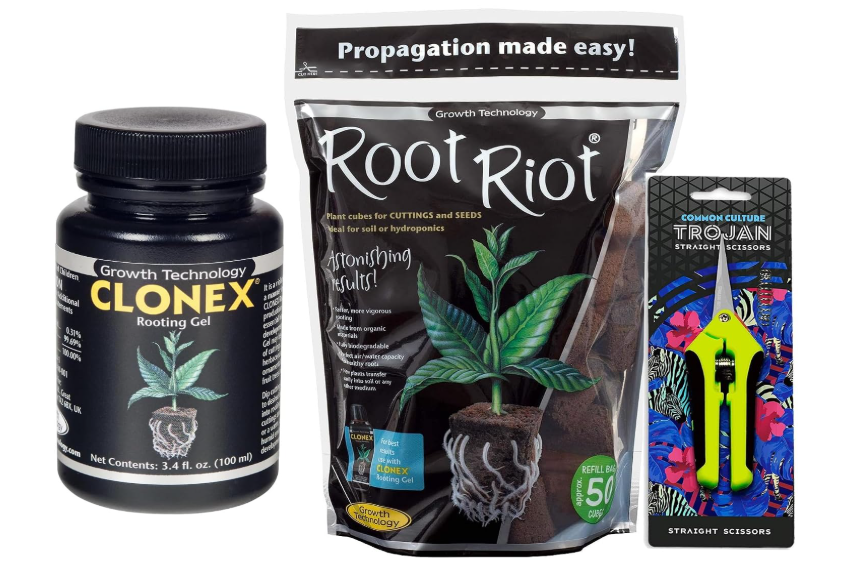
Clonex Rooting Gel is one of the most recognizable propagation products for plant cuttings. Its gel formulation makes it easy to coat the basal end of a cutting without the powder rubbing off during insertion.
The main advantage of Clonex is convenience. Growers do not have to calculate dilution rates or mix a solution before each cloning session.
The manufacturer positions Clonex specifically for vegetative propagation from cuttings.
Best for:
- beginners
- small to medium clone batches
- growers who want a ready-to-use formula
- rockwool, plugs, and similar propagation media
Pros:
- easy to apply
- gel stays on the cutting
- little preparation required
- widely available
Cons:
- usually more expensive per cutting than powder
- contamination is possible if cuttings are dipped directly into the main container
Best practice: Pour a small amount into a separate clean container before dipping cuttings.
2. Hormex Rooting Powder — Best for Choosing Different IBA Strengths
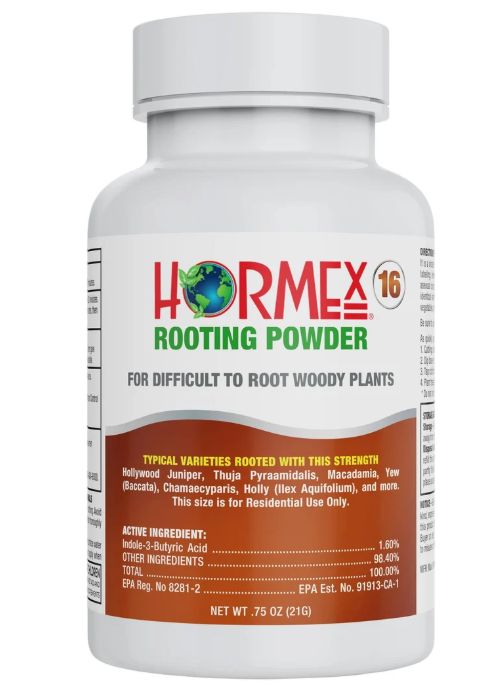
Hormex is especially useful for growers who want more control over rooting hormone strength.
Hormex currently offers several IBA concentrations, including 0.10%, 0.30%, 0.80%, and 1.60%, with different strengths intended for cuttings that vary in rooting difficulty.
That flexibility makes Hormex different from many one-strength rooting powders.
Best for:
- growers propagating multiple plant types
- users who prefer powder
- growers who want concentration options
- longer-term storage
Pros:
- multiple IBA strengths
- easy to store
- no mixing required
- works with several propagation media
Cons:
- choosing the wrong strength can lead to unnecessary over-application
- powder may rub off while the cutting is inserted
Important: Do not assume the strongest Hormex powder is automatically the best option.
3. Garden Safe TakeRoot — Best Budget Rooting Powder
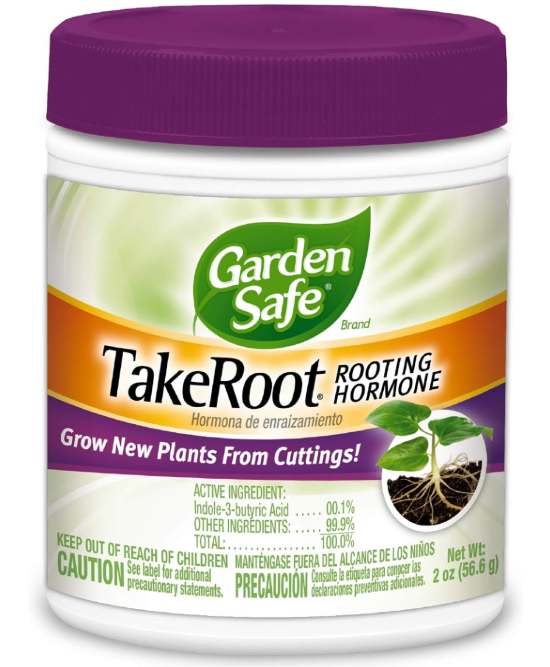
Garden Safe TakeRoot is a simple, inexpensive rooting powder containing 0.1% IBA.
The label instructs users to slightly moisten the cutting, dip the cut end into the powder, remove excess product, and then place the cutting into the rooting medium.
For occasional cloning, this simplicity can be an advantage.
Best for:
- hobby growers
- occasional propagation
- growers on a budget
- users who prefer straightforward powder application
Pros:
- affordable
- simple application
- widely available
- low IBA concentration
Cons:
- less flexibility than a liquid concentrate
- powder can rub off
- not designed specifically for cannabis
4. Dip ’N Grow — Best Adjustable Liquid Concentrate
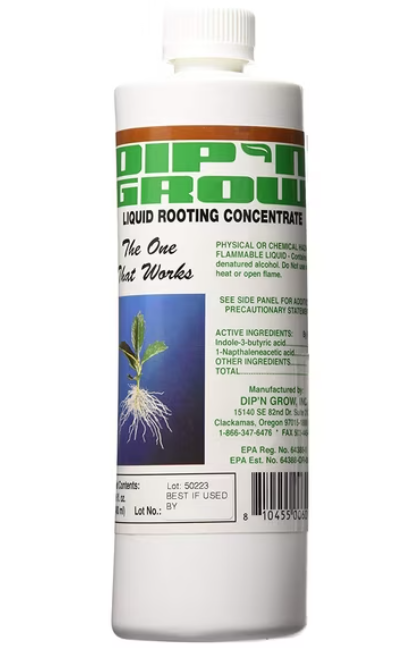
Dip ’N Grow is different from the other products on this list because it uses a liquid concentrate containing both IBA and NAA, two auxins used in plant propagation.
Its biggest advantage is adjustability. The concentrate can be diluted to different strengths depending on the plant and type of cutting.
That makes it particularly attractive for experienced propagators who want more control than a ready-to-use gel or powder provides.
Best for:
- experienced growers
- larger clone batches
- growers who want adjustable concentrations
- commercial-style propagation workflows
Pros:
- adjustable dilution
- combines IBA and NAA
- suitable for batch propagation
- economical at larger scale
Cons:
- requires accurate measurement
- easier to misuse than a ready-to-use product
- unnecessary complexity for small clone batches
Always follow the current product label rather than using a generic dilution ratio from a blog or forum.
5. Rootech Cloning Gel — Best High-Strength Gel
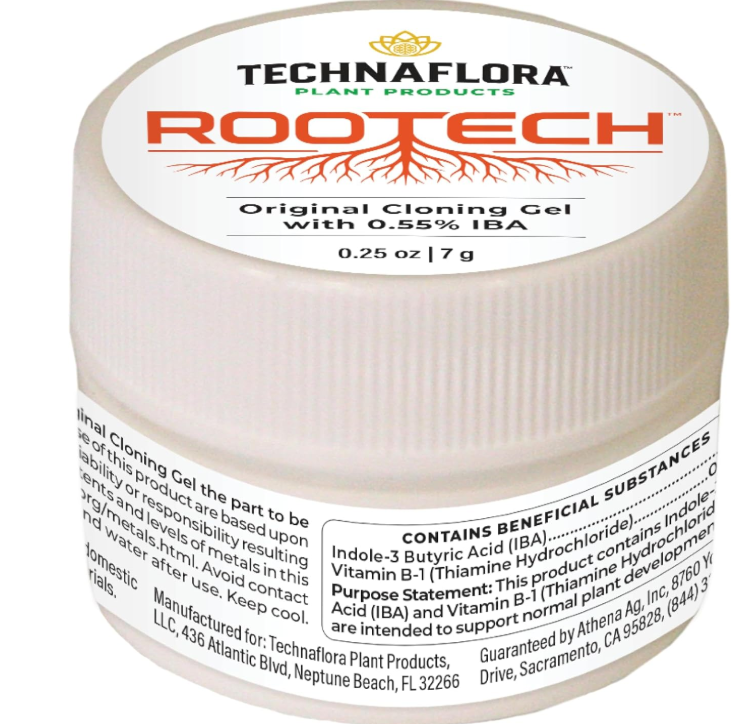
Rootech is a thick cloning gel containing 0.55% IBA. Technaflora describes it as a ready-to-use rooting gel designed for vegetative propagation and harder-to-root cuttings.
Its thick consistency helps it cling to the stem during propagation.
Best for:
- growers who prefer gel
- harder-to-root cuttings
- growers wanting a higher-concentration gel
- propagation machines when used according to manufacturer directions
Pros:
- 0.55% IBA
- thick consistency
- easy to apply
- available in several package sizes
Cons:
- higher hormone strength may be unnecessary for some cuttings
- more expensive than basic powders
Rootech should not be presented as providing guaranteed rooting success. Results still depend on the cutting and propagation environment.
6. RootBoost Rooting Powder — Best Simple Powder Alternative
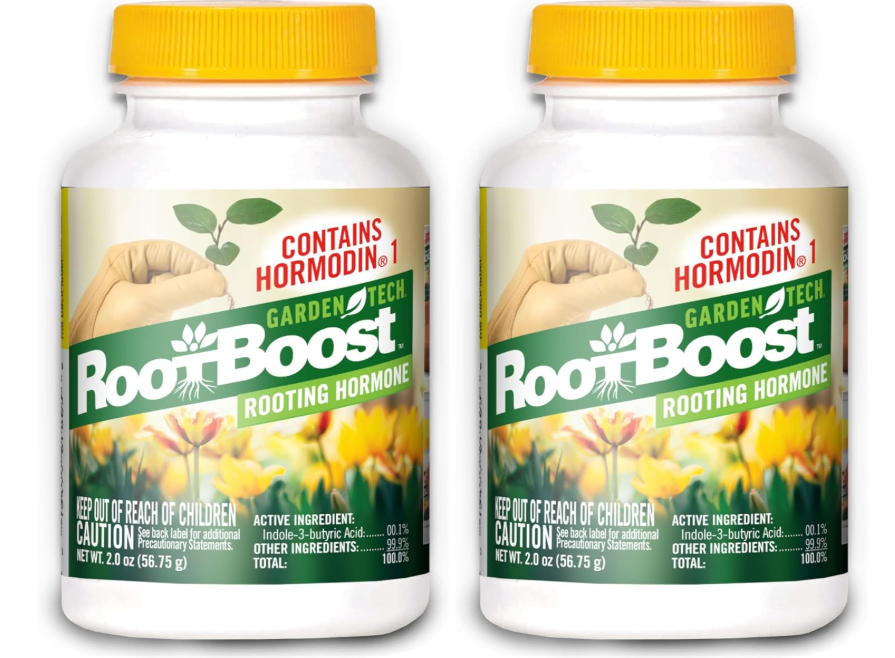
RootBoost is another powder-based rooting option for growers who want a basic dip-and-plant workflow.
Its main value is simplicity rather than advanced concentration control.
Best for:
- growers who prefer powder
- small propagation setups
- users who want minimal preparation
Pros:
- easy application
- convenient storage
- no mixing required
Cons:
- less control than a liquid concentrate
- powder application can be inconsistent if too much or too little is used
Before publishing exact active-ingredient percentages, make sure the current product label matches the specific RootBoost product being linked.
7. Can Cannabis Cuttings Root Without Rooting Hormone?
Yes.
Cannabis cuttings are capable of forming roots without a commercial rooting hormone when environmental conditions are favorable.
Rooting hormones are better viewed as a tool that can improve consistency, speed, or root development, rather than something absolutely required for every cutting.
This distinction matters because many product pages imply that rooting hormone alone determines success.
It does not.
A healthy cutting in a stable propagation environment can outperform a poorly handled cutting that has been coated in an expensive rooting product.
Gel vs Powder vs Liquid Rooting Hormone
Choosing a format is often more important than choosing a brand.
| Format | Main Advantage | Main Drawback | Best For |
|---|---|---|---|
| Gel | Sticks well to the cutting | Higher cost | Beginners and small batches |
| Powder | Affordable and shelf-stable | Can rub off | Occasional propagation |
| Liquid | Adjustable concentration | Requires accurate mixing | Experienced or high-volume growers |
Choose a gel if:
You want the simplest possible workflow.
Choose a powder if:
You want an affordable product that stores well.
Choose a liquid concentrate if:
You want control over hormone concentration and propagate larger numbers of cuttings.
What Should You Look for in a Rooting Hormone?
Before buying a rooting product, compare more than just the brand name.
Active ingredient:
- Look for products that clearly state the rooting hormone being used.
- IBA and NAA are common auxins used in commercial plant propagation.
Concentration:
- More is not always better.
- Products such as Hormex are available in different strengths specifically because different types of cuttings can respond differently to hormone concentration.
Formulation
Consider whether gel, powder, or liquid is easier for your propagation workflow.
Ease of use: A product that requires careful dilution may be excellent for a commercial propagator but unnecessarily complicated for someone taking six cuttings at home.
Label directions: Always prioritize current manufacturer instructions over dilution rates copied from forums or old blog posts.
Storage:Powders generally store easily, while gels and liquids may require more attention to storage conditions and contamination.
Does More Rooting Hormone Mean Faster Roots?
No.
Using a stronger concentration than necessary does not guarantee faster rooting.
Rooting hormones act within biological limits, and excessive concentrations can inhibit root formation or damage plant tissue.
The goal should be to use an appropriate concentration, not the maximum concentration available.
This is one reason products such as Hormex offer different IBA strengths for different rooting situations.
How to Apply Rooting Hormone More Cleanly
Good sanitation matters during cloning.
A simple workflow is:
- Take a healthy cutting using a clean, sharp blade.
- Pour a small amount of rooting hormone into a separate clean container.
- Apply the product according to the label.
- Insert the cutting into the prepared rooting medium.
- Discard unused hormone from the working container.
- Do not pour used hormone back into the original bottle or jar.
This reduces the chance of contaminating the main product container.
Common Rooting Hormone Mistakes
Using too much hormone: Excess product does not automatically improve rooting.
Dipping directly into the original container: Repeated dipping can introduce plant material or contaminants.
Ignoring the rooting environment: Rooting hormone will not fix poor moisture control, extreme temperatures, dirty tools, or unhealthy cuttings.
Using the wrong concentration: A hormone strength intended for difficult woody cuttings may not be appropriate for every cannabis cutting.
Changing several variables at once: If you change hormone strength, rooting medium, humidity, temperature, and lighting at the same time, it becomes difficult to identify what actually improved or harmed rooting.
What About Willow Water and Honey?
DIY rooting alternatives are common online, but growers should be careful about treating them as equivalent to standardized commercial products.
Homemade willow preparations can vary considerably in concentration, preparation method, and plant material used.
Honey is sometimes used because of its antimicrobial properties, but it does not provide the same standardized auxin treatment as an IBA-based rooting hormone.
If you want to experiment with natural alternatives, treat them as a separate propagation experiment rather than assuming they will perform like a commercial rooting product.
Which Rooting Hormone Is Best for Beginners?
For most beginners, a ready-to-use gel or low-strength powder is easier than a concentrated liquid product.
A gel minimizes measuring and mixing, while a powder such as Garden Safe TakeRoot offers a straightforward and inexpensive workflow.
Experienced growers who want greater control over hormone concentration may prefer Dip ’N Grow or different Hormex strengths.
Which Rooting Hormone Is Best for Larger Clone Batches?
Liquid concentrates become more attractive as propagation volume increases because they allow growers to prepare a working solution for multiple cuttings.
Dip ’N Grow is particularly suited to this type of workflow because it is sold as a concentrated formulation designed for dilution.
For small batches, however, that extra flexibility may not justify the additional measuring.
Our Picks by Use Case
Best overall for beginners: Clonex Rooting Gel
Best budget option: Garden Safe TakeRoot
Best powder with multiple strengths: Hormex Rooting Powder
Best adjustable liquid: Dip ’N Grow
Best high-strength gel: Rootech Cloning Gel
Best for growers who want minimal equipment: standard rooting powder
Final Verdict
There is no single best rooting hormone product for every cannabis grower.
If ease of use matters most, a ready-to-use gel such as Clonex is a strong starting point.
If cost and storage matter more, an IBA powder such as Garden Safe TakeRoot or Hormex may make more sense.
For growers who propagate larger batches and want precise concentration control, Dip ’N Grow offers more flexibility.
The most important point is that rooting hormone is only part of the cloning process. Healthy cuttings, clean tools, appropriate moisture, stable temperature, and a suitable rooting medium are just as important as the product you choose.
FAQs
What is the best rooting hormone for cannabis cuttings?
IBA-based gels, powders, and liquid concentrates are commonly used for vegetative propagation. The best choice depends on your experience level, batch size, and whether you want a ready-to-use or adjustable product.
Is Clonex better than rooting powder?
Not necessarily. Clonex is convenient because the gel adheres to the cutting, while powder is usually cheaper and easier to store. Both can work when used correctly.
Is rooting gel better than liquid rooting hormone?
Gel is generally easier for small batches, while liquid concentrates provide greater control over concentration and can make more sense for larger propagation programs.
Can too much rooting hormone damage cuttings?
Yes. Excessive concentrations can inhibit root development or damage sensitive tissue. Always follow the label and avoid assuming that stronger means better.