

If you’ve ever tried growing cannabis indoors, you know lighting can feel like a science experiment gone wild—so many options, so many bulbs, and a whole rainbow of colors to choose from.
But here’s the deal: understanding the cannabis light spectrum is your secret weapon to unlocking your plants’ full potential at every growth stage.
From wondering about the perfect grow light spectrum for cannabis seedlings, to which light spectrum for cannabis flowering buds will pack the biggest punch, getting your spectrum right can make all the difference.
In this guide, we’ll demystify what the light spectrum really means, why it matters, and how to choose the best full spectrum grow light setup tailored for each phase of your cannabis grow—so you can boost growth, increase yields, and harvest buds that’ll wow every time.
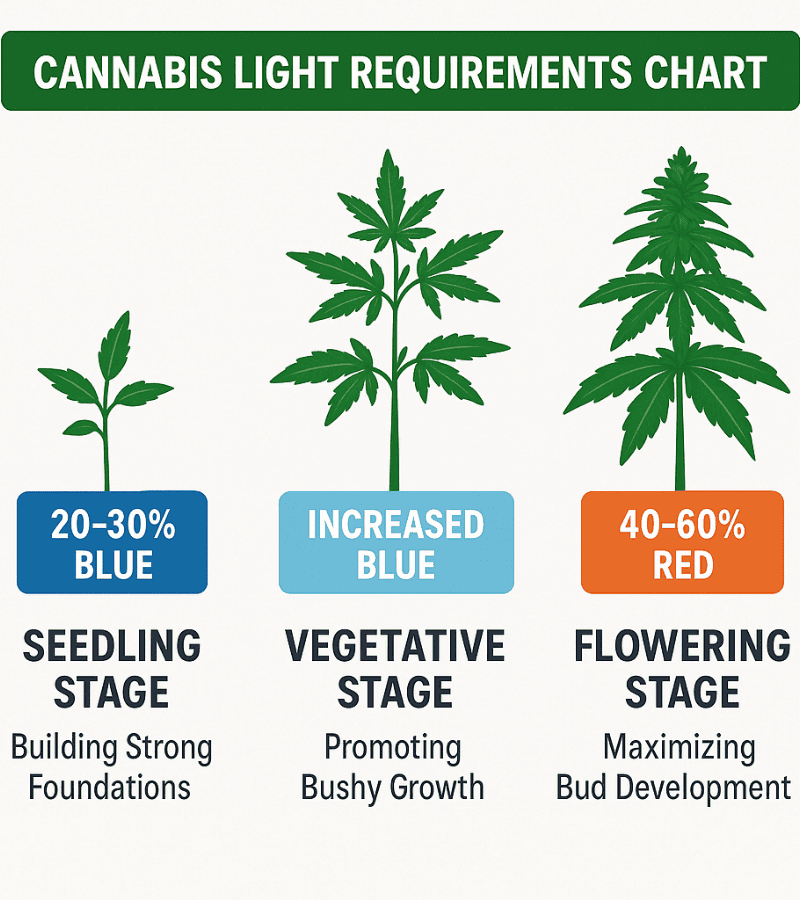
- Seedling Stage: Use 20–30% blue light for strong roots and healthy growth.
- Vegetative Stage: Focus on blue light to promote compact, bushy plants.
- Flowering Stage: Shift to 40–60% red light for bigger buds, resin, and THC.
Quick Comparison: LED vs. HPS Lights
| Factor | LED Lights | HPS Lights |
|---|---|---|
| Spectrum Control | Fully adjustable for all growth stages | Fixed red-heavy spectrum (flowering) |
| Energy Efficiency | 44% less power usage | Higher energy consumption |
| Heat Output | Low | High, requiring more cooling |
| Lifespan | 50,000+ hours (~10 years) | 8–12 months per bulb |
| Yield Efficiency | Up to 1.16g per watt | ~0.5g per watt |
| Upfront Cost (20 units) | ~$13,000 | ~$6,000 |
| Annual Savings | $5,430–$6,230 | None |
Why LEDs Are Better
LEDs are more efficient, last longer, and produce higher-quality yields with better THC and terpene levels.
While HPS lights are cheaper upfront, their high energy and maintenance costs make LEDs the smarter long-term choice.
For home growers, smaller LED setups like the Spider Farmer SF-1000 are affordable and effective.
Commercial growers benefit from high-output LEDs like the HLG Scorpion Diablo, which maximize yields and minimize costs.
Bottom Line: Tailor your light spectrum to each stage for better growth, and switch to LEDs for higher yields, lower costs, and superior quality.
Overview of the Effects of Cannabis Light Spectrum Effects on Production
Cannabis Light Spectrum Requirements by Growth Stage
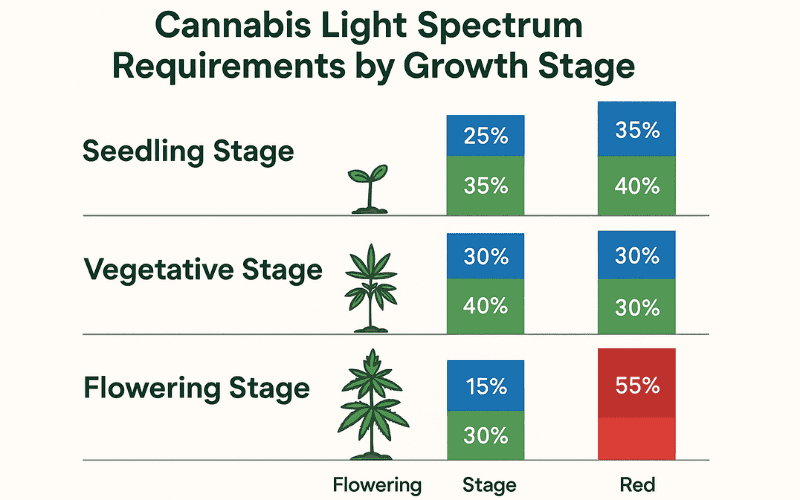
Cannabis plants have specific cannabis light spectrum needs that evolve throughout their life cycle.
Knowing these requirements and how different lighting technologies meet them is key to ensuring healthy growth and high-quality harvests.
Seedling Stage: Building Strong Foundations
In the seedling stage, marijuana thrive under a balanced cannabis light spectrum with a higher percentage of blue light (20–30%).
This blue-heavy spectrum supports strong root development and early growth while preventing seedlings from stretching excessively toward the light source.
LED grow lights are ideal at this stage because they can be fine-tuned to deliver the precise blue light ratio required.
On the other hand, traditional HPS lights, which are typically red-heavy, can overstimulate elongation, making them less suitable for seedlings.
Vegetative Stage: Promoting Bushy Growth
During the vegetative stage, cannabis plants benefit from an increased ratio of blue light, which encourages compact, bushy growth and improved leaf development.
At this phase, the plant focuses on expanding its structural framework and leaf surface area to maximize photosynthesis.
Historically, growers relied on traditional fixtures with blue-heavy spectrums for this phase.
However, modern tunable LED systems allow for precise spectrum adjustments, ensuring plants receive the ideal light mix as they grow.
This flexibility enables growers to use a single lighting system throughout the entire growth cycle, reducing labor and minimizing plant stress during transitions.
As the plants mature, their light needs shift again, particularly in the flowering stage.
Flowering Stage: Maximizing Bud Development
When plants enter the flowering stage, their cannabis light spectrum needs shift significantly toward red wavelengths.
A spectrum with 40–60% red light is essential during this phase to promote bud formation, resin production, and cannabinoid synthesis.
Red light stimulates flowering hormones, driving robust bud development, while far-red light (700–800nm) helps initiate flowering and adjusts the plant’s response to photoperiod changes.
HPS lights, with their naturally red- and far-red-rich spectrum, have long been a favorite for flowering rooms.
However, their fixed spectrum limits the ability to fine-tune light conditions for specific strains or environments.
This is where tunable LED systems stand out, offering growers the ability to match cannabis light spectrums precisely to their plants’ needs.
The LED Advantage: Precision Control
Tunable LED systems provide growers with unmatched control over cannabis light spectrums, enabling them to adjust wavelengths based on the plant’s growth stage.
This precision maximizes photosynthesis, encourages vigorous growth, and boosts flower production – all without the compromises of fixed-spectrum lighting.
Modern LED grow lights can mimic the spectrum of HPS fixtures while offering additional features like customizable red or UV light during specific phases of the growth cycle.
This level of control helps growers fine-tune their lighting strategy to optimize plant development.
| Growth Stage | Optimal Cannabis Light Spectrum | LED Advantage | HPS Limitation |
|---|---|---|---|
| Seedling | 20–30% blue light dominant | Precise control | Excessive red causes stretching |
| Vegetative | Higher blue light ratio | Tunable spectrum adjustment | Fixed spectrum not optimal |
| Flowering | 40–60% red light focus | Customizable red/far-red ratios | Inflexible spectrum |
With the ability to adjust LED spectrums throughout the growth cycle, growers can ensure their plants receive exactly the right light at the right time, avoiding the limitations of one-size-fits-all lighting solutions.
Energy Use and Operating Costs
When deciding between LED and HPS lighting systems, it’s important to look beyond the upfront cost.
The energy consumption and operational expenses tied to these technologies can have a major impact on your finances, whether you’re tending a small home garden or managing a commercial grow operation.
Power Consumption and Efficiency
LEDs are far more efficient at converting electricity into usable light, with about 50% efficiency, compared to 30% for HPS lights.
This efficiency gap allows a 720W LED to outperform a 1000W HPS light while using 30% less electricity.
To put this into perspective, running a 450W LED for a year costs about $496.32, while a 1000W HPS system racks up around $986.40 annually – almost double the expense.
“When growers switch from HPS lights to Fluence LEDs, they can see energy savings of up to 40-50%. When you factor in HVAC reductions, the overall savings can be even greater. In some cases, the return on investment can be achieved in less than a year.” – Taylor Kirk, Expert in Lighting Economics
Heat Output and Cooling Costs
The heat generated by your lighting system can lead to additional cooling expenses, and this is where LEDs shine again.
HPS lights release about 55% of their energy as radiant heat, while LEDs emit only around 27%. This means LEDs produce nearly 40% less heat than a 1000W HPS light.
For growers with a 20-light setup, this reduced heat output translates to significant savings in cooling costs.
Annual air conditioning expenses drop from about $3,800 with HPS systems to $2,500 with LEDs – a 35% reduction.
“Growers must consider power distribution, fixture mounting, and HVAC recalibrations. LEDs produce significantly less heat than HPS fixtures, which means HVAC systems must be adjusted to maintain optimal growing conditions.” – Franz Josef Sima, Industry Expert
Initial Investment vs. Long-Term Savings
While LEDs have a higher upfront cost, the operational savings quickly make up for it.
For example, a 20-light setup with VOLT Grow® FL-1 LEDs costs around $13,000, compared to $6,000 for 1000W HPS lights. However, the yearly savings are substantial.
- Electricity: $7,570 (LEDs) vs. $10,500 (HPS)
- Cooling: $2,500 (LEDs) vs. $3,800 (HPS)
- Lamp Replacement: $0 (LEDs) vs. $1,200–2,000 (HPS)
The total annual savings range from $5,430 to $6,230, as shown below:
| Cost Category | LED (20 Lights) | HPS (20 Lights) | Annual Savings |
|---|---|---|---|
| Electricity | $7,570 | $10,500 | $2,930 |
| Cooling (AC) | $2,500 | $3,800 | $1,300 |
| Lamp Replacement | $0 | $1,200–2,000 | $1,200–2,000 |
| Total Annual Savings | $5,430–6,230 |
Scale Considerations
For home growers, even small-scale LED setups can make a noticeable difference.
A single 450W LED running for 12 hours daily costs about $27.54 per month, while also avoiding the heat issues associated with HPS lights.
Commercial growers stand to benefit even more.
Large operations can often take advantage of utility rebates that cover 20-70% of the upfront LED costs, making the transition more affordable.
Over a five-year period, LEDs can reduce total operational costs by around 30%, thanks to energy savings, lower cooling needs, and the elimination of frequent bulb replacements.
The financial and operational advantages of LEDs make them a smart choice for growers looking to optimize their setup.
These benefits set the foundation for a closer technical comparison of LED and HPS systems in the next section.
sbb-itb-5407682
Plant Yield and Quality Results
The type of lighting system – LED or HPS – plays a major role in determining both the yield and quality of cannabis plants.
LED lights can produce up to 1.16 grams per watt, significantly outpacing HPS systems, which average around 0.5 grams per watt.
Yield Performance Comparison
By 2025, advancements in LED grow lights are projected to boost cannabis yields by 30% or more compared to older LED models.
This leap forward places LEDs far ahead of traditional HPS systems, thanks to features like precise spectrum control and reduced heat stress on plants.
HPS lighting tends to promote taller plants with less compact growth, whereas LEDs encourage denser, more space-efficient bud formation.
This not only improves yield efficiency but also enhances cannabinoid production.
Cannabinoid and Potency Differences
LED lighting doesn’t just increase yields – it also enhances potency. Studies consistently show that cannabis grown under LEDs contains higher levels of THC and CBD compared to HPS-grown plants.
Controlled tests have documented a 1.3 percentage point increase in THC with LED lighting.
“Studies comparing the impact on Cannabis grown under LED or high pressure sodium (HPS) lights, found LED-treated plants were shorter and compact with higher CBD and THC content.” – Karla Garcia, Hort Americas
The key lies in heat management. HPS systems emit significant infrared radiation above 780nm, which heats the upper canopy beyond room temperature.
This excess heat can cause cannabinoids and terpenes to evaporate, reducing the potency of the harvest.
Terpene Profile Enhancement
LED lighting has a notable edge when it comes to terpene production. Cannabis grown under LEDs consistently shows up to 35% higher terpene levels compared to HPS systems, depending on the cultivar.
“Modern LEDs not only produce comparable yields, but also increased THC and overall bud quality in some cases.” – Nebula Haze, Grow Weed Easy
In a North American commercial trial, cannabis grown under the Solray385 spectrum demonstrated a 14.7% increase in terpene concentration compared to a competitor’s white LED spectrum.
This improvement stems from LEDs’ ability to fine-tune light wavelengths, directly influencing terpene biosynthesis.
However, balance is critical. For instance, studies reveal that increasing blue light from 4% to 20% led to a 12.3% reduction in flower yield. This underscores the importance of optimizing spectrum ratios rather than focusing on any single wavelength.
Spectrum Control Benefits
LEDs offer growers unmatched control over cannabis light spectrums, enabling them to fine-tune cannabinoid and terpene production.
By manipulating specific wavelengths, such as red and far-red light, growers can influence key metabolic pathways like Geranyl pyrophosphate (GPP), a precursor in cannabinoid and monoterpene biosynthesis.
This precision allows cultivators to unlock the full genetic potential of their plants.
“LEDs are changing the way cultivation companies operate. As growers become more sophisticated, they can dispel anecdotal beliefs by using data and the granular control of microclimates around plants. It just isn’t possible with HPS lighting.” – Travis Merchant of Indica Consulting
| Quality Factor | HPS Lights | LED Lights |
|---|---|---|
| Yield Efficiency | 0.5g per watt | Up to 1.16g per watt |
| Plant Structure | Taller, higher stem weight | Shorter, more compact |
| THC/CBD Content | Lower due to heat stress | Higher concentrations |
| Terpene Production | Reduced by heat | Up to 35% higher |
| Spectrum Control | Fixed yellow-orange | Fully customizable |
While HPS lights can still deliver acceptable yields, LEDs provide growers with a higher level of precision and control.
The ability to enhance cannabinoid profiles, boost terpene production, and improve overall yield efficiency makes LEDs the go-to choice for cultivators aiming to maximize both the therapeutic and commercial value of their harvests.
LED vs HPS Comparison
The decision between LED and HPS lighting impacts not just your upfront investment but also energy consumption, plant growth, and long-term profitability.
Each option comes with its own set of advantages and drawbacks when it comes to efficiency and plant development.
Spectrum Flexibility
HPS lights are known for their fixed yellow-orange spectrum, which is effective during the flowering stage but lacks the blue wavelengths that encourage robust vegetative growth.
On the other hand, LED systems offer full-spectrum customization, with many models featuring dedicated modes for vegetative and flowering stages.
This flexibility allows growers to adjust light wavelengths to suit plants’ needs at every growth phase, building on earlier findings about optimizing light for each stage of plant development.
Energy Efficiency and Heat Management
LEDs are significantly more energy-efficient, consuming 44% less energy than HPS systems, according to Wageningen University.
Some studies, like those by MIGRO Light, even suggest LEDs can achieve nearly three times the efficiency of HPS lights.
This energy savings translates to lower electricity bills and reduced cooling costs, as LEDs generate far less heat. In contrast, HPS fixtures emit substantial heat, often requiring larger HVAC systems to manage the temperature.
Beyond cost savings, this efficiency contributes to better plant health and higher-quality yields.
| Factor | HPS Lights | LED Lights |
|---|---|---|
| Spectrum Control | Fixed yellow-orange spectrum | Fully customizable (veg and bloom modes) |
| Energy Efficiency | Standard baseline | 44% lower energy use; nearly 3x efficiency |
| Upfront Cost (20 units) | ~$6,000 | ~$13,000 |
| Heat Output | High infrared radiation | Significantly reduced heat generation |
| Lifespan | 8–12 months per bulb | 50,000+ hours (around 10 years) |
Plant Development and Yield Outcomes
Lighting choice doesn’t just affect costs – it also shapes plant growth and cannabinoid production.
HPS lights are associated with taller plants and heavier stems, while LEDs encourage compact growth and enhance cannabinoid levels.
For example, a European grower reduced energy costs by 22% and added an extra half-cycle per year by switching to LEDs.
Research using optimized spectrums, such as Valoya’s Solray during flowering, revealed up to a 133% increase in dry flower yield.
The same spectrum also boosted THC levels by 26–38% and CBD levels by 29–40% compared to HPS lighting.
“LEDs allow for greater control over the cannabis light spectrum, which can be optimized for different growth stages. We’ve seen growers increase their cannabinoid content and improve overall plant morphology simply by adjusting their lighting strategy for different stages of plant growth.” – Taylor Kirk, Expert in Lighting Economics
Return on Investment and Operational Considerations
While HPS systems are less expensive upfront, LEDs quickly make up for their higher initial cost through energy savings, reduced cooling requirements, and the elimination of frequent bulb replacements.
MIGRO Light estimates that the additional investment in LED systems can be recovered in under a year. Utility rebates, which range from 20% to 70% for LED purchases, further enhance their financial appeal.
HPS setups, however, come with ongoing costs, including annual bulb replacements and the need for more robust HVAC systems to handle excess heat.
LEDs, in contrast, require minimal maintenance and offer better control over environmental conditions.
“With increasing electricity prices LED grow lights now payback the additional investment in less than a year.” – MIGRO Light
For growers with the budget to handle a higher upfront cost, LEDs provide clear advantages in energy efficiency, yield quality, and operational simplicity.
However, for those working with tighter budgets, HPS systems remain a feasible option, albeit with higher ongoing expenses.
Conclusion
Choosing the right cannabis light spectrum is key to improving yield quality, energy efficiency, and profitability.
Modern LED systems provide the flexibility to fine-tune spectrums for every growth stage – from nurturing strong seedlings to boosting flowering with precise adjustments that enhance both yield and quality.
For smaller setups, home growers can rely on options like the Spider Farmer SF-1000 (priced around $150) for 2′×2′ spaces or the SF-2000 ($230) for larger areas.
These models are energy-efficient, produce minimal heat, and offer customizable spectrums to promote healthy plant growth without inflating electricity costs.
On the commercial side, high-output LED systems like the HLG Scorpion Diablo ($1,300) or the HLG 350R Quantum Board ($550) deliver consistent light intensity and advanced spectrum control.
These systems are designed to support higher yields and better-quality crops, making them a solid choice for professional growers.
When paired with sound cultivation practices, these lighting solutions ensure every phase of plant growth benefits from optimal spectrum management.
LEDs also excel in early growth stages by fine-tuning spectrum ratios. Balanced spectrums encourage healthy root systems, while warmer, red-heavy spectrums are ideal for flowering, maximizing plant development and cannabinoid production.
The combination of optimized lighting and premium genetics can make a noticeable difference. High-quality seeds from Seed Connect are an excellent match for advanced lighting setups.
Their feminized, autoflower, and high-THC strains thrive under proper spectrum management, unlocking the plants’ full genetic potential.
With a germination guarantee and expert grower support, Seed Connect ensures that your investment in lighting is paired with top-tier genetics.
The synergy between full-spectrum LED technology and superior genetics can significantly boost your results.
While the initial investment in quality lighting may seem steep, the long-term benefits – lower energy costs and higher-quality harvests – make it a worthwhile choice for any grower.
FAQs
What is the best cannabis light spectrum for each stage of cannabis growth?
The cannabis light spectrum is a game-changer for cannabis growth, with different wavelengths playing specific roles at each stage of development.
During the seedling stage, blue light (400–500 nm) is a must-have. It helps build strong roots and encourages compact, sturdy growth.
Blue light also boosts chlorophyll production, which is essential for photosynthesis – the process that fuels plant energy.
When plants enter the vegetative stage, they still rely heavily on blue light to maintain dense, bushy growth.
But as they shift to the flowering stage, red light (600–700 nm) takes center stage.
Red light stimulates bud formation, enhances resin production, and can even improve potency.
Far-red light (700–800 nm) also plays a supporting role here, helping with flower initiation and speeding up maturation for better yields and quality.
If you’re aiming for healthy plants and impressive results, dialing in the right cannabis light spectrum for each phase is critical.
Not sure where to start? Seed Connect offers premium cannabis seeds and expert guidance to help you grow with confidence.
What are the cost-saving benefits of switching from HPS to LED lights for growing cannabis?
Switching from High-Pressure Sodium (HPS) lights to LED systems for cannabis cultivation can lead to notable savings over time.
LED lights are highly energy-efficient, consuming 30–60% less electricity than HPS lights.
This reduction in power usage directly translates to lower energy bills, a significant benefit for growers.
Plus, LEDs generate much less heat, which means you’ll spend up to 35% less on air conditioning to keep your grow room at the ideal temperature.
Another major perk is their impressive lifespan. While HPS lights typically last around 24,000 hours, LEDs can keep shining for up to 50,000 hours.
Fewer replacements mean reduced maintenance costs and less hassle.
For commercial growers, the upfront cost of installing LEDs is often offset quickly, making them a practical and cost-effective option for cannabis cultivation.
What is the best cannabis light spectrum for maximizing cannabis growth and quality during each stage?
To achieve optimal growth and quality, selecting the right cannabis light spectrum for each development stage is key.
In the vegetative stage, blue light (400–500 nm) promotes sturdy stems and compact, healthy growth.
When the plant enters the flowering stage, increasing red light (600–700 nm) supports cannabinoid production, including THC and CBD.
Introducing a small dose of ultraviolet (UV) light during flowering can also enhance terpene production, which contributes to the strain’s aroma and flavor.
Adjusting the light intensity and spectrum to match the plant’s specific needs throughout its growth cycle can result in better yields and a higher-quality final product.