


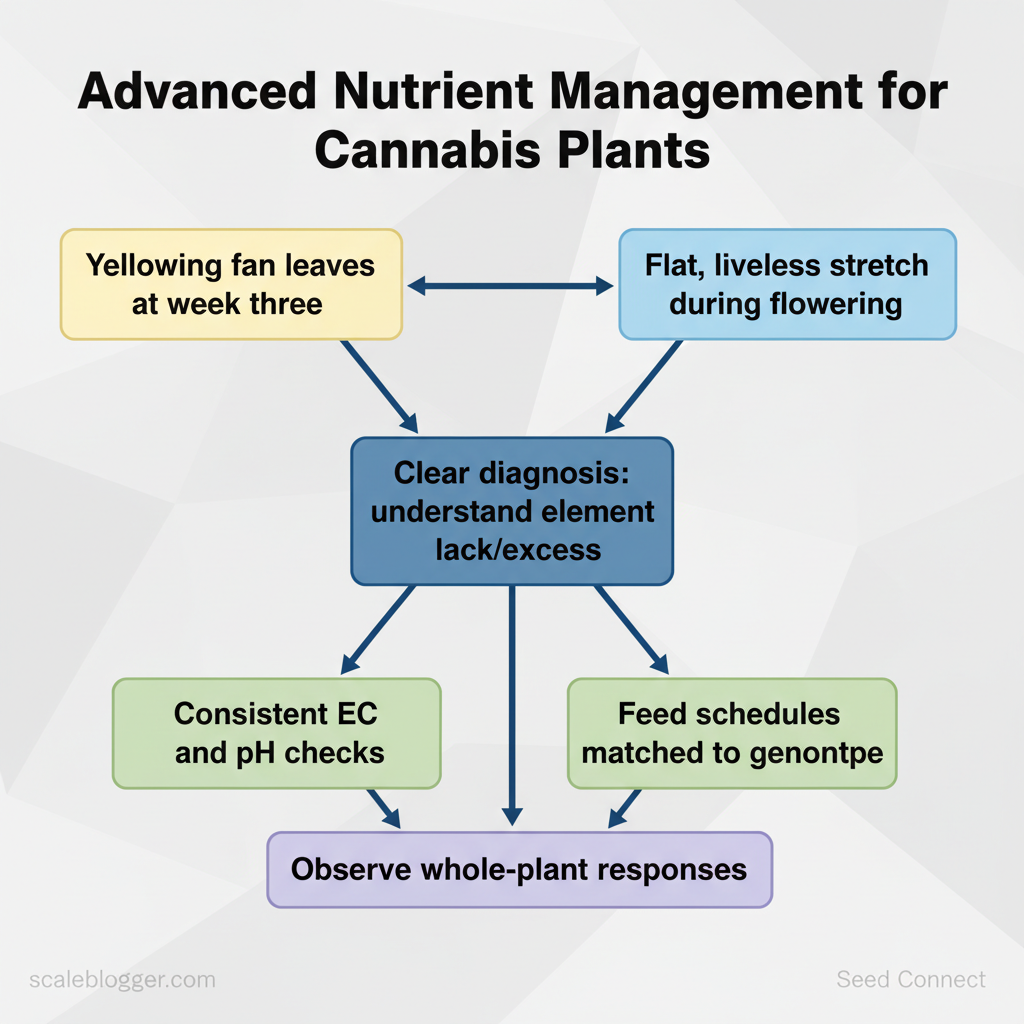
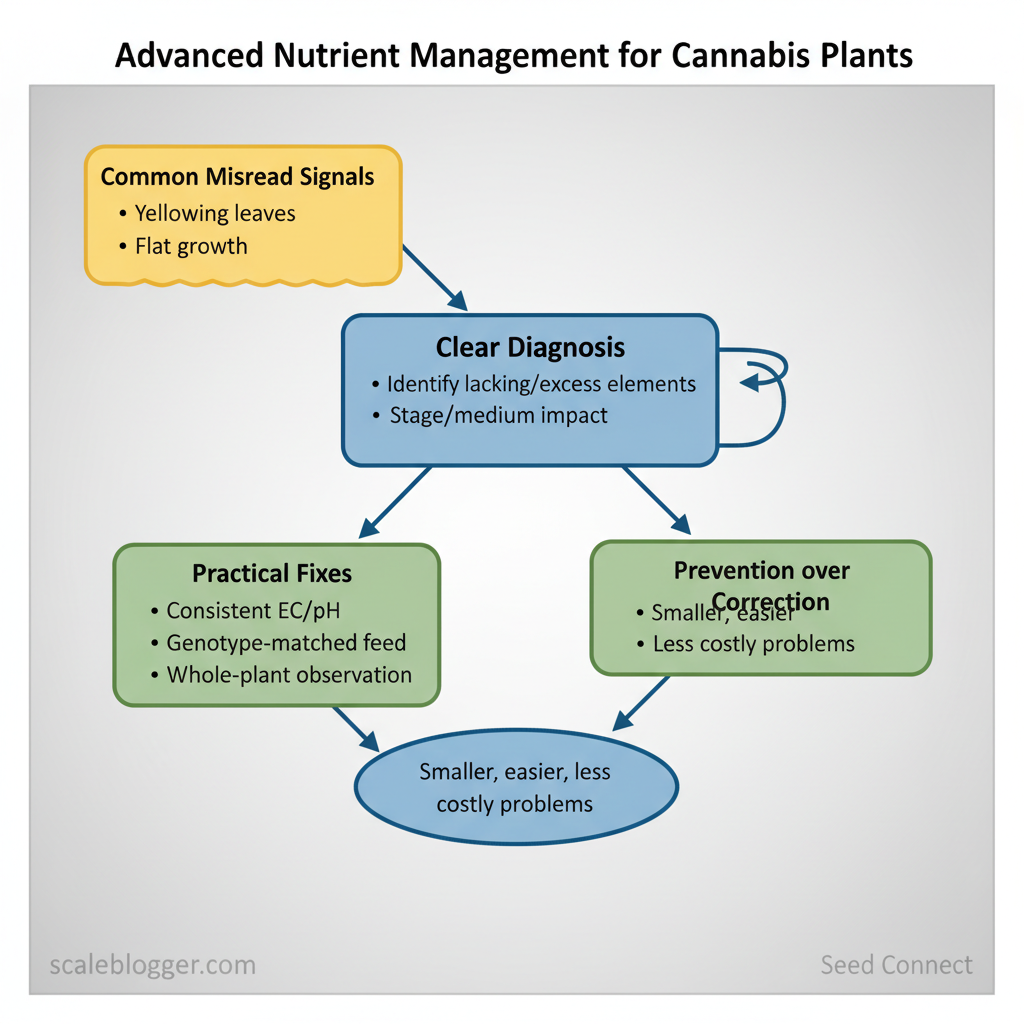
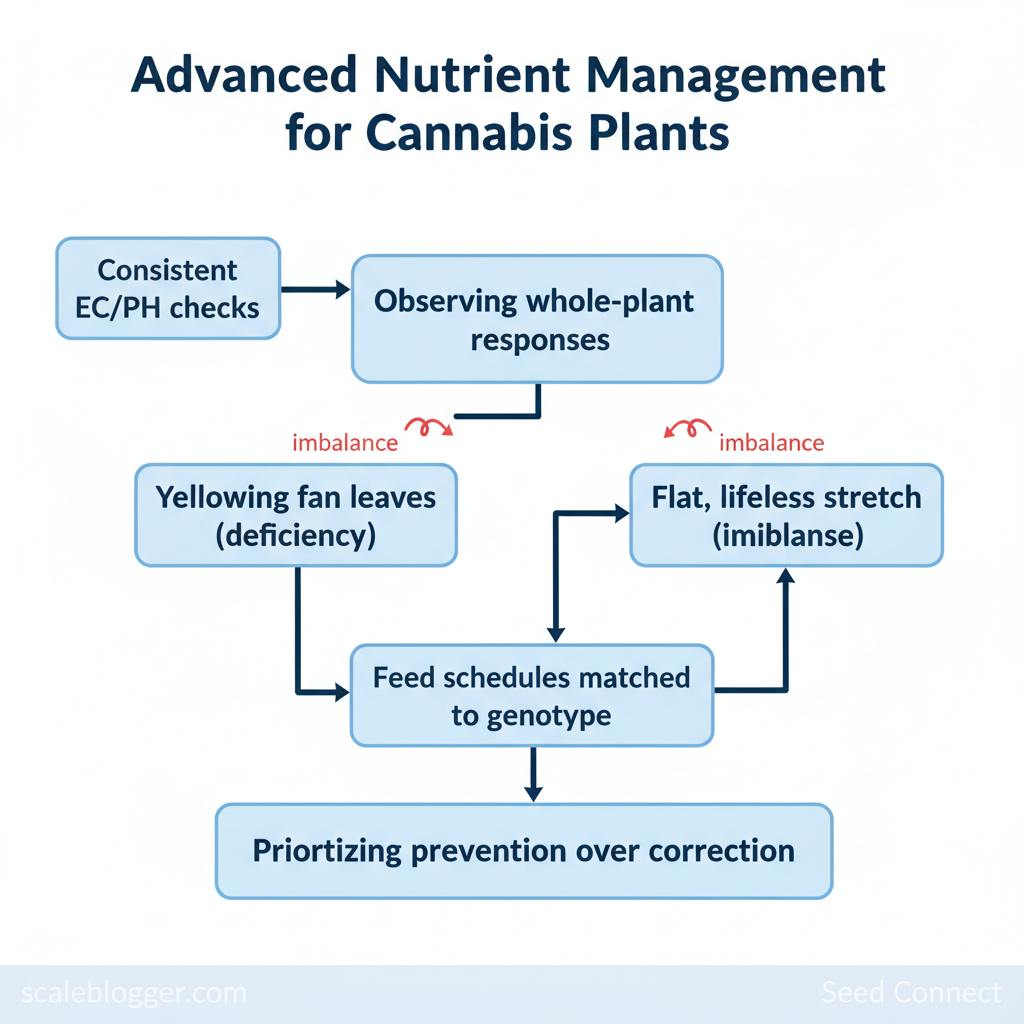
Common signs include yellowing fan leaves by week three and a flat stretch during flowering. You might misinterpret these signs until it’s too late. To diagnose issues, start with cannabis nutrient management.
This means knowing which nutrients are missing and which are excessive. It also includes understanding how these imbalances change during the plant’s growth stage and its medium.
Practical solutions come from small, consistent habits. Regular EC and pH checks are important, as well as feeding schedules that match the plant’s genetics. Observe the entire plant’s responses rather than just individual leaves. These nutrient tips from seasoned growers prioritize prevention over correction, so problems are smaller, easier to reverse, and less costly in yield.
Prerequisites and What You’ll Need
Getting your plants off to a successful start relies on the right equipment and a few essential skills. Begin by gathering accurate measurement tools, a…
Prerequisites and What You’ll Need
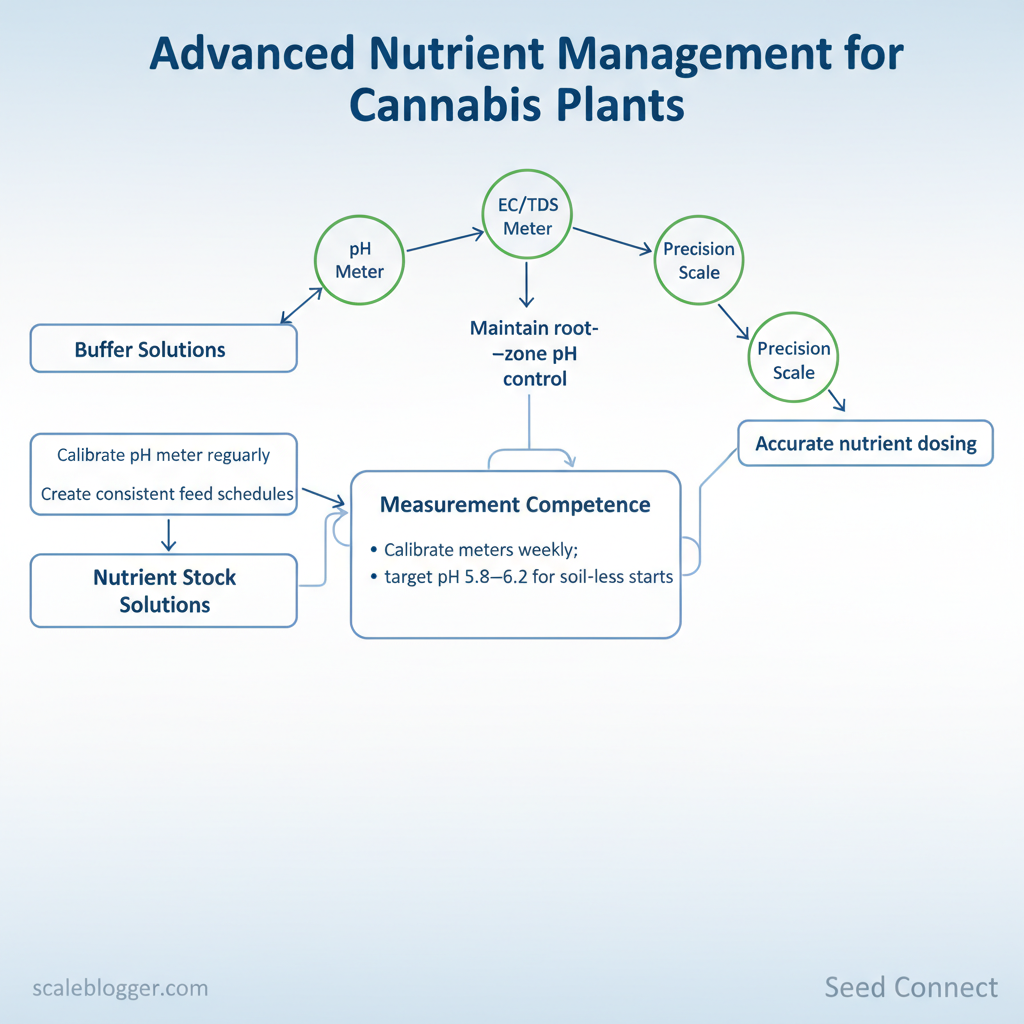
To start your plants off well, you need the right equipment and some essential skills. First, gather accurate measurement tools, a reliable nutrient baseline, and ensure your workspace complies with legal and safety rules. Without accurate pH/EC control and proper dosing, even high-quality seeds struggle—so prioritize measurement accuracy and repeatable routines before planting.
Essential physical tools and supplies
- pH meter — handheld or bench unit with calibration capability. EC/TDS meter — for monitoring nutrient concentration in
mS/cmor ppm. 1 g readability for nutrient mixing.
01 if hydroponic). Nutrient stock solutions — base NPK formula and micro/mineral supplements. * Containers & media — seedling trays, rockwool or peat alternatives, labeled pots.
- Clean water source — filtered or low-ppm municipal water; know your starting ppm.
Baseline nutrient products to have on hand
- Base nutrient (vegetative): balanced N-P-K formulation suitable for seedlings at 1/4–1/2 strength. 2.
Micronutrient supplement: chelated iron, zinc, manganese in liquid form. 3. pH adjusters: pH Up (potassium carbonate) and pH Down (phosphoric or citric acid).
- Root stimulant: beneficial microbes or
humic/fulvicadditions for early root development.
Required skills, safety and legal notes
- 2` for soil-less starts. 2.
Dosing discipline: mix by weight using a scale, follow EC/ppm targets, avoid incremental guesswork. 3. Sanitation practices: sanitize trays and tools with food-grade disinfectant between batches.
- Legal compliance: verify local regulations for seed possession and cultivation; keep records as required.
> Many growers report that meter calibration and consistent mixing reduce early losses by preventing nutrient lockout and pH drift.
Table: Prerequisites and What You’ll Need — Item, Minimum spec, Purpose & more
| Item | Minimum spec | Purpose | Notes |
|---|---|---|---|
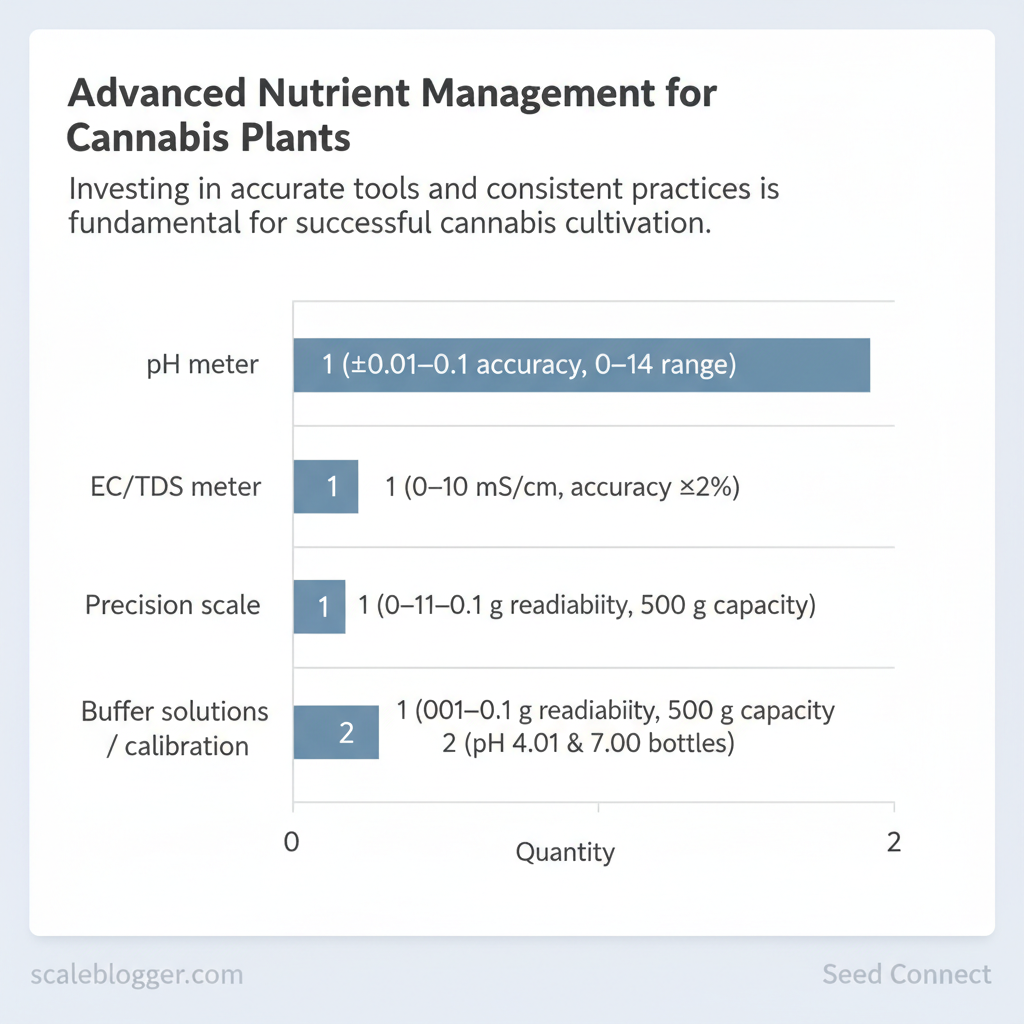
| pH meter | ±0.01–0.1 accuracy, 0–14 range | Maintain root-zone pH control | Look for replaceable probe, automatic temp compensation |
| EC/TDS meter | 0–10 mS/cm, accuracy ±2% | Monitor nutrient strength | Preferable: temperature compensation, ppm/mS toggle |
| Precision scale | 0.01–0.1 g readability, 500 g capacity | Accurate nutrient dosing | Use for concentrate weighing and supplements |
| Buffer solutions / calibration | pH 4.01 & 7.00 bottles (250 mL) | Calibrate pH meter regularly | Replace monthly or per manufacturer |
| Nutrient stock solutions | Concentrates for veg & micro supplement | Create consistent feed schedules | Store labeled, cool, dark; note expiry dates |
Baseline Assessment: Water, Media, and Plant Status
First, establish a clean, measurable baseline. Test the water, identify the growing medium, and check the health of…
Baseline Assessment: Water, Media, and Plant Status
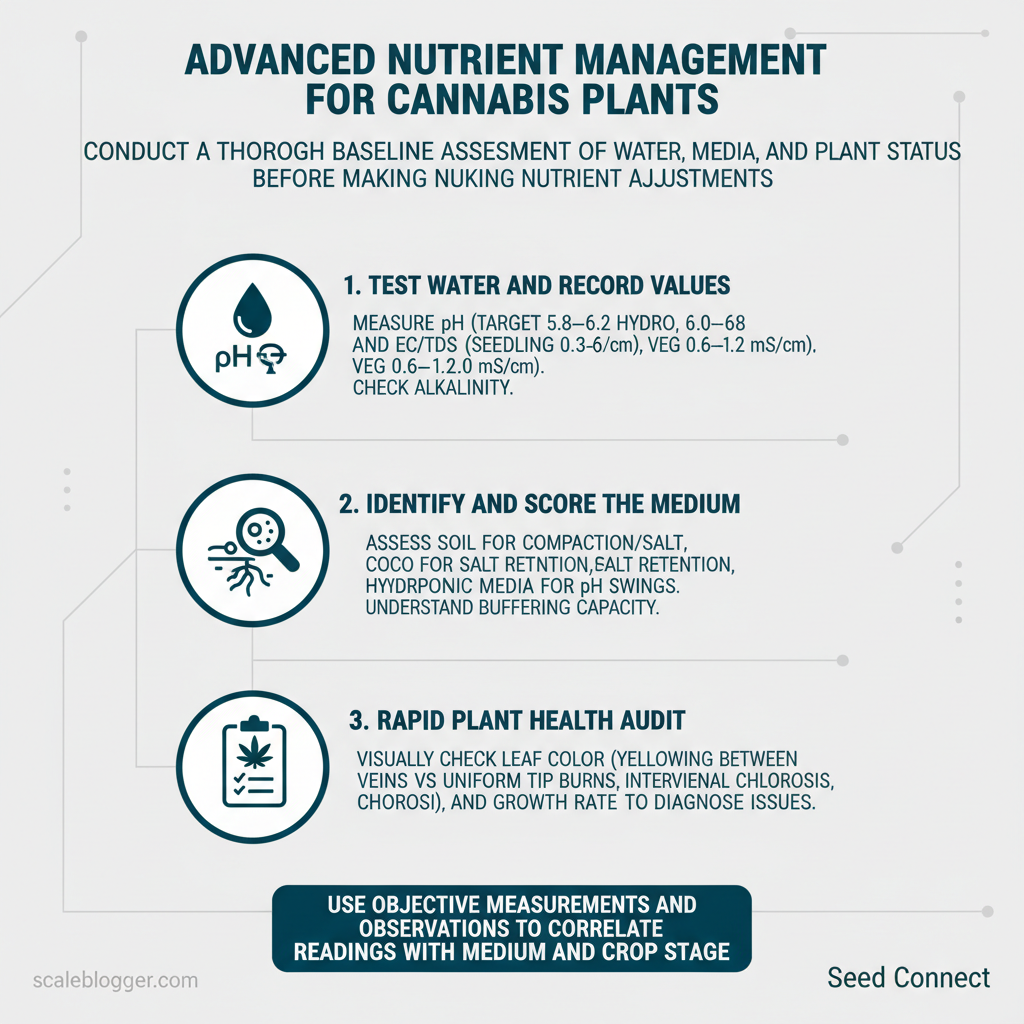
First, establish a clean, measurable baseline. Test the water, identify the growing medium, and check the health of the plants. These three inputs determine how nutrients behave and what corrective actions are safe.
Begin with objective measurements — pH, EC (or TDS), and visible plant symptoms — then correlate those readings with the medium and crop stage before changing anything.
- Test water and record values
- Measure pH using a calibrated handheld meter or high-quality test strips; record the reading at reservoir temperature. Target:
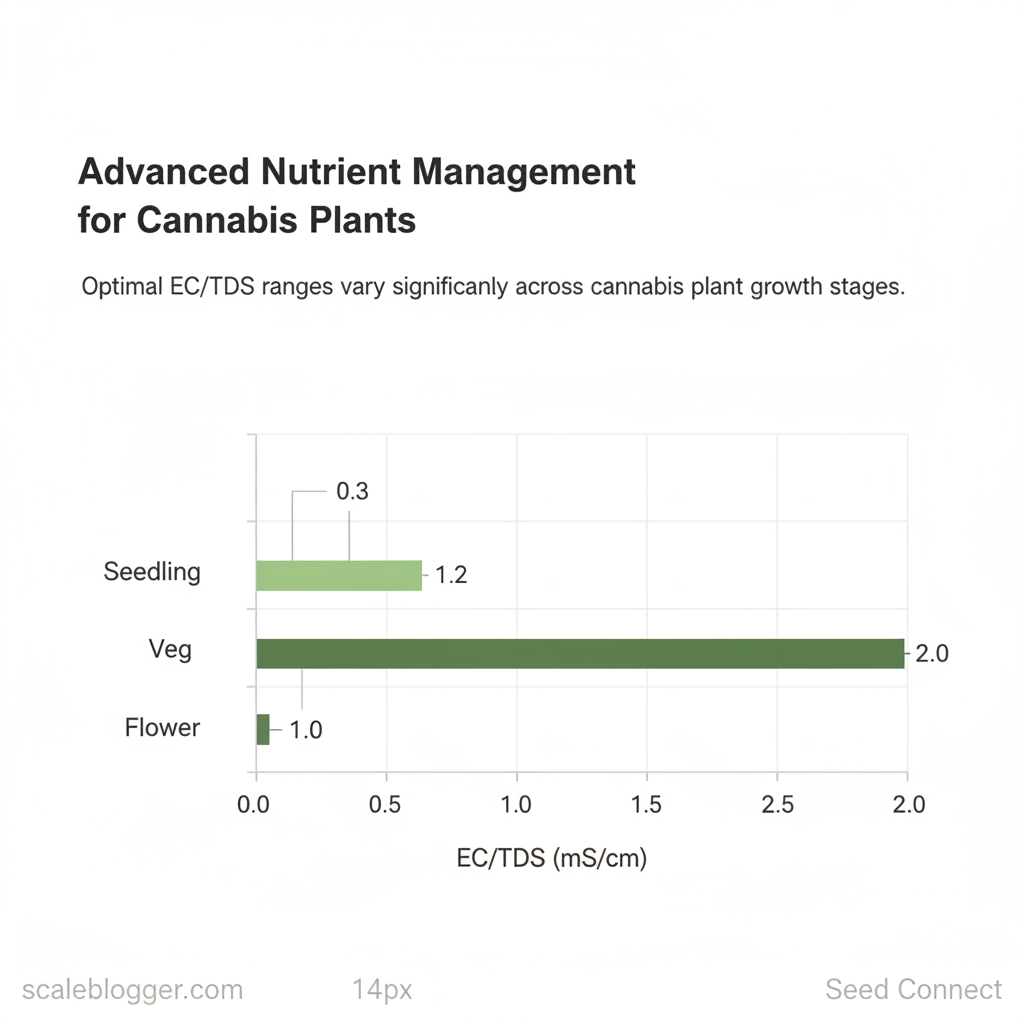
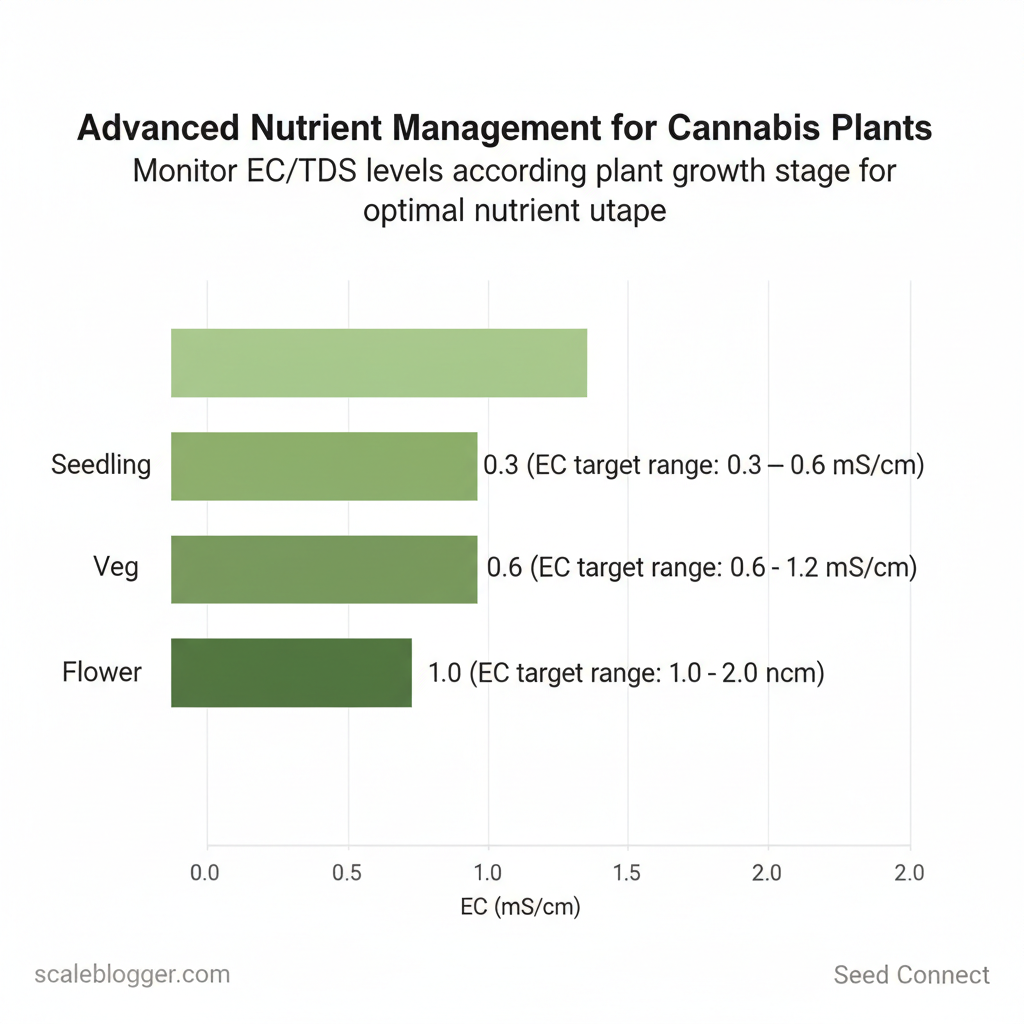
5.8–6.2for hydroponics,6.0–6.8for soil,5.8–6.3for coco. - Measure EC/TDS with a reliable meter; record as mS/cm or ppm. Target EC ranges:
- Seedling:
0.3–0.6 mS/cm - Veg:
0.6–1.2 mS/cm - Flower:
1.0–2.0 mS/cm(adjust by genetics and medium)
- Check alkalinity / carbonate hardness if municipal or well water is used; high alkalinity buffers pH and requires stronger acid dosing to adjust.
- Identify and score the medium
- Soil: high buffering capacity; correct pH drift slowly. Look for compacting, slow drainage, or salt crusting on the surface.
- Coco/coir: neutral buffering but retains salts; flush and leach more frequently.
- Hydroponic media (rockwool, clay pebbles): low buffering, pH swings happen fast; maintain tight monitoring.
- Rapid plant health audit (do this visually and by touch)
- Leaf color: pale yellow between veins suggests iron or manganese deficiency vs uniform yellow suggests nitrogen shortage.
- Tip burns or brown margins: often salt overload or high EC.
- Interveinal chlorosis with purpling: could be phosphorus lockout from low pH or genetic expression; check recent temps and pH.
- Slow growth with dark green leaves: likely overfeeding or root restriction.
Practical example: A hydroponic veg crop showing tip burn and EC at 1.8 mS/cm — drop EC to 1.2–1.4, flush reservoir, check pH (should be 5.8–6.2), and inspect roots for browning. If pH is >6.5, expect micronutrient lockout; acidify slowly while monitoring alkalinity.
Tools and checklist suggestions
- Essential tools: portable pH meter, EC meter, alkalinity test kit, hand lens, moisture probe.
- Quick checklist: record water source,
pH,EC, reservoir temp, medium type, recent feed events, and a 5-point plant health score.
When baseline values fall outside ranges, change only one variable at a time and recheck within 24–48 hours to isolate effects. Understanding these starting points prevents overcorrection and keeps plants on a predictable recovery path.
Designing a Phase-Based Feeding Plan
Begin with clear and realistic goals for each growth phase and type of medium. Then, convert manufacturer instructions into consistent mixes that meet those goals. A phase-based plan prevents nutrient shock, avoids salt build-up, and makes it simple to know when to add supplements like Cal-Mag or bloom boosters. Below are practical EC/PPM ranges and nutrient emphasis for common media, followed by step-by-step mixing rules and scheduling guidance.
Side-by-side EC/PPM and nutrient emphasis targets for different media and growth phases
| Growth Phase | Soil EC/PPM Target | Coco EC/PPM Target | Hydro EC/PPM Target | Nutrient Emphasis (N/P/K/CaMg) |
|---|---|---|---|---|
| Seedling | EC 0.4–0.8 (200–400 ppm) | EC 0.6–0.9 (300–450 ppm) | EC 0.8–1.0 (400–500 ppm) | Low N, moderate CaMg, trace P/K |
| Vegetative | EC 1.0–1.4 (500–700 ppm) | EC 1.0–1.6 (500–800 ppm) | EC 1.2–1.8 (600–900 ppm) | High N, moderate P/K, CaMg maintenance |
| Early Bloom (transition) | EC 1.2–1.6 (600–800 ppm) | EC 1.4–1.8 (700–900 ppm) | EC 1.8–2.0 (900–1000 ppm) | Balanced N/P/K, raise P slightly |
| Mid Bloom (ripening) | EC 1.4–1.8 (700–900 ppm) | EC 1.6–2.0 (800–1000 ppm) | EC 1.8–2.2 (900–1100 ppm) | Lower N, higher K, add bloom boosters |
| Late Bloom / Flush | EC 0.6–1.0 (300–500 ppm) — flushing to <0.4 | EC 1.2–1.4 (600–700 ppm) — reduce gradually | EC 1.2–1.4 (600–700 ppm) — reduce to flush | Reduce N, stop heavy supplements, final CaMg check |
1.0 EC ≈ 500 ppm (NaCl) for quick conversions when meters differ.
- Convert manufacturer directions into a baseline mix:
- Take the recommended feed at full strength and measure its EC.
- If full strength exceeds your phase target, calculate dilution:
desired EC / measured EC = dilution ratio. - Prepare a small test batch, measure EC, then adjust water volume or product dose to hit the target.
- Create mixing rules:
- Start 25% lower than target for sensitive seedlings and young transplants.
- Increase EC in 10–20% increments over days when moving phases; never jump >0.4 EC at once.
- Add
Cal-Magwhen signs of deficiency show or when using reverse-osmosis water; aim for 50–150 ppm CaMg depending on phase. - Scheduling supplements and checks:
- Introduce bloom boosters at Early Bloom once plants show pistils; add in small increments and watch EC rise.
- Check runoff EC and pH weekly in soil, daily in hydroponics; adjust feed or flush if runoff EC exceeds reservoir EC by >0.5.
- Flush 5–10 days before harvest (longer for large soil runs) by using water at EC <0.4 to clear salts.
- Practical monitoring routine:
- Daily: reservoir EC/pH (hydro), visual plant checks.
- Weekly: runoff EC/pH (soil/coco), reservoir nutrient top-off and partial change.
- Per phase change: measure feed EC after mixing and log results.
Warnings: over-reliance on manufacturer full-strength mixes causes salt build-up; always confirm with your meter. When using RO or very soft water, compensate with baseline Cal-Mag to avoid blossom disorder.
Follow these rules to turn vague feeding charts into consistent, repeatable mixes that align with plant needs and media behavior. Implementing phase targets and strict mixing discipline reduces variability and makes nutrient troubleshooting deterministic rather than guesswork.
> Key Takeaway: Start by treating your nutrient reservoir as a precision system: correct order-of-addition, accurate meters, and consistent records prevent lockouts, precipitates, and…
Mixing, Measuring, and Record-Keeping Best Practices
Start by treating your nutrient reservoir as a precision system: correct order-of-addition, accurate meters, and consistent records prevent lockouts, precipitates, and variable plant performance. Mix to target EC/TDS and pH, calibrate instruments daily, and log each reservoir change so the next run is predictable and repeatable.
- Prepare the reservoir (order-of-addition)
- Fill reservoir with clean, room-temperature water (20–24°C).
- Add macros first: calcium and magnesium products before other minerals; they stabilize ionic balance.
- Add base nutrients (N-P-K concentrates) next, mixing thoroughly.
- Add micro-nutrients and chelates last to avoid precipitation with calcium/magnesium.
- Adjust pH slowly with
pH DownorpH Upto target range5.5–6.5(soil mixes may target6.0–6.8). - Top up to final volume and measure EC/TDS after 10–15 minutes of mixing to allow salts to equilibrate.
- Why this order: Adding Ca/Mg first prevents them from reacting with phosphates, sulfates, or chelators and forming insoluble precipitates.
- Practical example: When mixing a 100 L reservoir, dissolve 1L of Ca/Mg solution, then 2L of base nutrient, then 100 mL of micro mix; wait 10 minutes and re-check EC.
Calibration and meter use
- Daily calibration: Calibrate pH probes in
pH 4.00andpH 7.00buffers each day of operation. - EC/TDS verification: Use a two-point EC standard (e.g.,
1.41and2.76mS/cm) weekly to confirm linearity. - Probe care: Rinse probes with deionized water and store pH probes in storage solution; avoid leaving EC probes dry.
Record-keeping template and rationale
- Essential fields: Date/time, reservoir ID, operator, water temp, starting and final volume, product names and batch numbers, amounts added, initial and final
pHandEC, adjustments made, top-up history, visual notes. - Why log this: Records reveal trends—when a cultivar shows nutrient stress correlating with a supplier lot, the log identifies the root cause quickly.
- Template example (CSV):
csv date,time,reservoir_id,operator,water_temp_C,start_vol_L,product,batch,amount,final_vol_L,initial_pH,final_pH,initial_EC_mS_cm,final_EC_mS_cm,notes 2025-06-01,08:15,R1,A.Smith,21,100,CaMg,CM-204,1L,100,6.8,6.0,0.45,1.25,Top-up after 48h> A pH drift of 0.5 often correlates with reduced uptake of micronutrients and can be the earliest sign a reservoir needs attention.
Maintain a simple dashboard (spreadsheet or small database) and review weekly for patterns. Understanding these practices reduces surprises and makes each reservoir change predictable and accurate.
> Key Takeaway: Begin by observing patterns and then confirm with tests before making changes. Visual symptoms can be helpful but are often misleading.
Diagnosing and Correcting Deficiencies and Toxicities
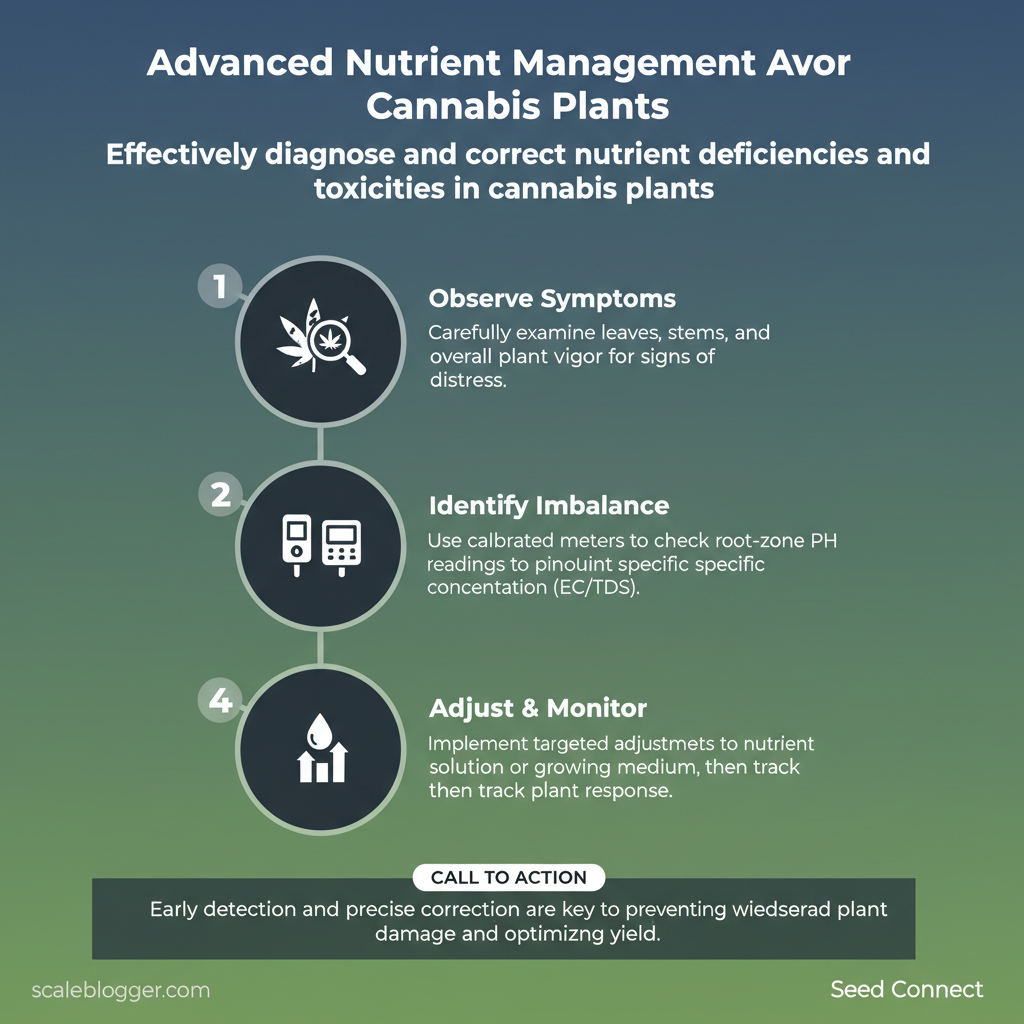
Begin by observing patterns and then confirm with tests before making changes. Visual symptoms can be helpful but are often misleading. For example, yellowing leaves can indicate nitrogen starvation, root oxygen stress, or overwatering. The correct approach is a quick triage (observe → test → correct conservatively) combined with a monitoring cadence so corrective actions can be measured and reversed if necessary.
Prerequisites
- Healthy baseline: recent nutrient schedule, EC/PPM and pH logs, and irrigation frequency.
- Tools: handheld pH meter, EC/ppm meter, magnifying loupe, soil/tissue sampling kit, and access to a tissue or substrate testing lab.
- Time estimate: initial assessment 20–40 minutes; corrective actions 10–60 minutes depending on treatment.
How to assess symptoms
- Visually map symptoms from newest to oldest growth and from top to bottom of the canopy. 2.
Use pH and EC/ppm meters to check root-zone conditions immediately. 3. Collect a small tissue sample from symptomatic and healthy leaves for lab or DIY slurry tests.
Precise corrective dosages and safety margins
- Conservative correction: when in doubt, correct at
25–50%of manufacturer’s recommended concentration and observe 48–72 hours. - Flush guidance: for suspected salt/toxicity, flush with
2–3x substrate pore volumeof clean, pH-balanced water and retest EC after 24 hours. - Nutrient boost: for clear deficiency (confirmed by tests), apply a targeted supplement at
25–50%labeled strength, then increment after 3–5 days if improvement noted.
Monitoring schedule after correction
- Day 0: take
pHandEC/ppmbefore and 1 hour after treatment. 2.
Day 2–3: visual check and pH/EC. 3. Day 7: tissue test if no improvement.
- Ongoing: log changes weekly until full recovery.
Practical example Yellow lower leaves + low EC and low leaf nitrogen — confirms nitrogen deficiency. Apply a soluble nitrogen feed at 25% strength, monitor for new growth color within 3–7 days; expect root-zone EC to rise modestly.
Diagnostic quick-reference: symptoms, probable nutrient issues, confirmation tests, immediate corrective action
| Symptom | Likely Deficiency/Toxicity | Test to confirm | Immediate corrective action | Expected response time |
|---|---|---|---|---|
| Yellowing of lower leaves | Nitrogen deficiency | Tissue N test; low EC | Apply N-rich feed at 25–50% strength |
New growth 3–7 days |
| Purpling of stems/veins | Phosphorus deficiency or genetics | Tissue P; check temps | Apply P source at 25%; raise root-zone temp slightly |
Leaf color shift 7–14 days |
| Tip burn and leaf curl | Nutrient burn (toxicity) | EC high; foliar salts | Flush 2–3x substrate pore volume; reduce strength 50% |
Curl reduction 2–5 days |
| Interveinal chlorosis | Magnesium or iron deficiency | Tissue Mg/Fe; pH check (Fe locked out if pH>6.8) | Foliar Mg sulfate or chelated Fe at low rate | Yellowing halts 3–7 days |
| Dark, brittle leaves | Potassium toxicity or calcium imbalance | Tissue K/Ca ratio | Reduce K inputs; add Ca/Mg supplement at low rate | Texture improvement 5–10 days |
pH/EC and tissue tests, then correct conservatively and monitor on a tight schedule. This method prevents overcorrection and speeds reliable recovery. Understanding these steps reduces costly mistakes and gets plants back to productive growth.
> Key Takeaway: Foliar sprays, biostimulants, and microbial inoculants are precise tools. When used correctly, they can speed up growth, fix minor deficiencies, and boost stress resistance.
Advanced Techniques: Foliar Feeding, Biostimulants, and Microbial Management
Foliar sprays, biostimulants, and microbial inoculants are precise tools. When used correctly, they can speed up growth, fix minor deficiencies, and boost stress resistance. However, if used incorrectly, they may waste resources or damage the plant. Start with conservative concentrations, always patch-test, and plan applications around the plant’s nutrient uptake rhythm so foliar work complements, not competes with, root feeding.
When to use each tool
- Foliar sprays: Best for quick correction of micronutrient deficiencies or transient stress (heat, early bud set). Use during vegetative stage and early flower only; avoid heavy foliaring in late bloom to prevent bud moisture.
- Biostimulants: Use throughout lifecycle to improve vigor and stress tolerance — apply as a regular soil or foliar program when plants show slow growth or recovery is needed.
- Microbial inoculants: Apply at transplant, during substrate refreshes, or when switching systems (soil → coco → hydro) to establish beneficial populations.
Patch testing and concentration rules
- Patch test first: Spray a single leaf (underside and topside) at the chosen concentration and wait 24–48 hours for leaf damage or phytotoxicity.
- Start low: For foliar nutrient mixes begin at
25–33%of the manufacturer’s recommended strength; for biostimulants start at50%. - Increase slowly: If no damage after two applications, raise to
50–75%for foliar andfullfor non-phytotoxic biostimulants.
Integration by media and system
- Soil: Apply microbes at transplant and with every potting; foliar feeds 1–2× weekly during veg, stop heavy foliaring in weeks 4–6 of bloom.
- Coco: Use beneficial microbes and humic acids to stabilize cation exchange; foliar feeding helps because coco can lock micronutrients.
- Hydroponics: Rely more on root-zone management; apply microbes in reservoir only with compatible strains; foliar sprays used sparingly to avoid reservoir contamination.
Compatibility and timing with feeding schedule
- Don’t overlap pH-sensitive inputs: Apply foliar sprays mid-light cycle or early evening, separate from root feeds by 12–24 hours to prevent nutrient uptake competition.
- Sequence for a day: 1. Flush spray residue if present, 2. Root feed, 3. Wait 12–24 hours, 4. Foliar spray (if needed).
- Watch EC/PPM: Avoid adding foliar nutrient equivalents on top of high-salt root feeds; this raises overall nutrient stress.
Troubleshooting tips: if leaves bronse or curl after foliar application, reduce concentration and increase interval; if microbial inoculant causes foaming or turbidity in reservoirs, switch to a non-foaming strain or use in drench-only. Create a simple checklist (patch test, concentration, interval, environmental humidity <60%) before every foliar application.
Understanding and sequencing these practices reduces risk while extracting measurable gains in vigor and recovery—small, disciplined adjustments here produce disproportionate improvements in canopy health.
Flushing, Ripening, and Late-Stage Nutrient Strategies
Late bloom is when cannabinoid and terpene synthesis accelerate and plant appetite drops. Choose a nutrient taper that favors resin and flavor development over raw weight: a gradual taper preserves yield while improving smoothness; a full flush before harvest pushes sugars and terpenes to peak but can slightly reduce final dry weight. Decide based on strain goals and market: premium-flavor craft buds tolerate a fuller flush; bulk producers may prefer partial taper to maximize grams.
How to choose between partial taper and full flush
- Assess strain maturity: Check pistil color and trichome clarity; if mostly cloudy with some amber, a full flush will accentuate flavor.
- Define product goal: If selling high-end flower, prioritize terpene clarity via fuller flush. If selling by weight, favor a conservative taper.
- Check plant vigor: If plants show nutrient deficiency signs or slow uptake, avoid abrupt changes; a partial taper reduces stress.
According to recent research, partial taper retains 5–12% more dry weight; full flush often improves smoke quality and smoothness noticeably.
Practical flush and taper protocol (example timeline)
- Two weeks before target harvest: Begin nutrient taper.
- Week -14 to -10: Reduce nitrogen by 30% and PK by 10%. Maintain pH and EC monitoring. (Time estimate: 4 days to adjust, ongoing checks.)
- One week before harvest: Decide flush vs. taper finish.
- Partial taper: Continue weaker feedings at
EC 0.6–0.8and stop heavy PK. - Full flush: Run plain pH-balanced water until runoff EC ≤
0.3–0.4.
- Final 48–72 hours: Cease feeding and maintain environment for ripening (lower humidity, stable temps).
Practical EC/runoff thresholds to watch
- Leaf uptake target: Keep solution EC in late bloom at
0.8–1.0for conservative taper. - Flush trigger: Aim for runoff EC ≤
0.3–0.4for a complete flush before harvest. - Warning zone: If runoff EC >
1.2, plant salts are high — extend flushing or perform partial resupply with corrected nutrients.
Troubleshooting common issues
- Slow runoff EC drop: Increase flush volume to 3–5× pot volume and repeat; ensure even watering.
- Premature yellowing: If leaves yellow dramatically during taper, back off reduction rate and restore mild feed at
EC 0.6. - Flavor loss after harvest: Drying too fast or too hot will damage terpenes; target 55–62% RH and 18–21°C.
Tools and checks to add
- EC meter and pH pen for every runoff measurement.
- Runoff log: record input EC, runoff EC, days since taper.
- Quality checklist: trichome density, terpene aroma, leaf color.
When properly staged, a measured late-stage taper or flush refines smoke and aroma without unnecessary yield loss, letting the cultivar express its genetics at harvest. This reasoning speeds decision-making in the final weeks and improves market consistency.
Troubleshooting Common Issues
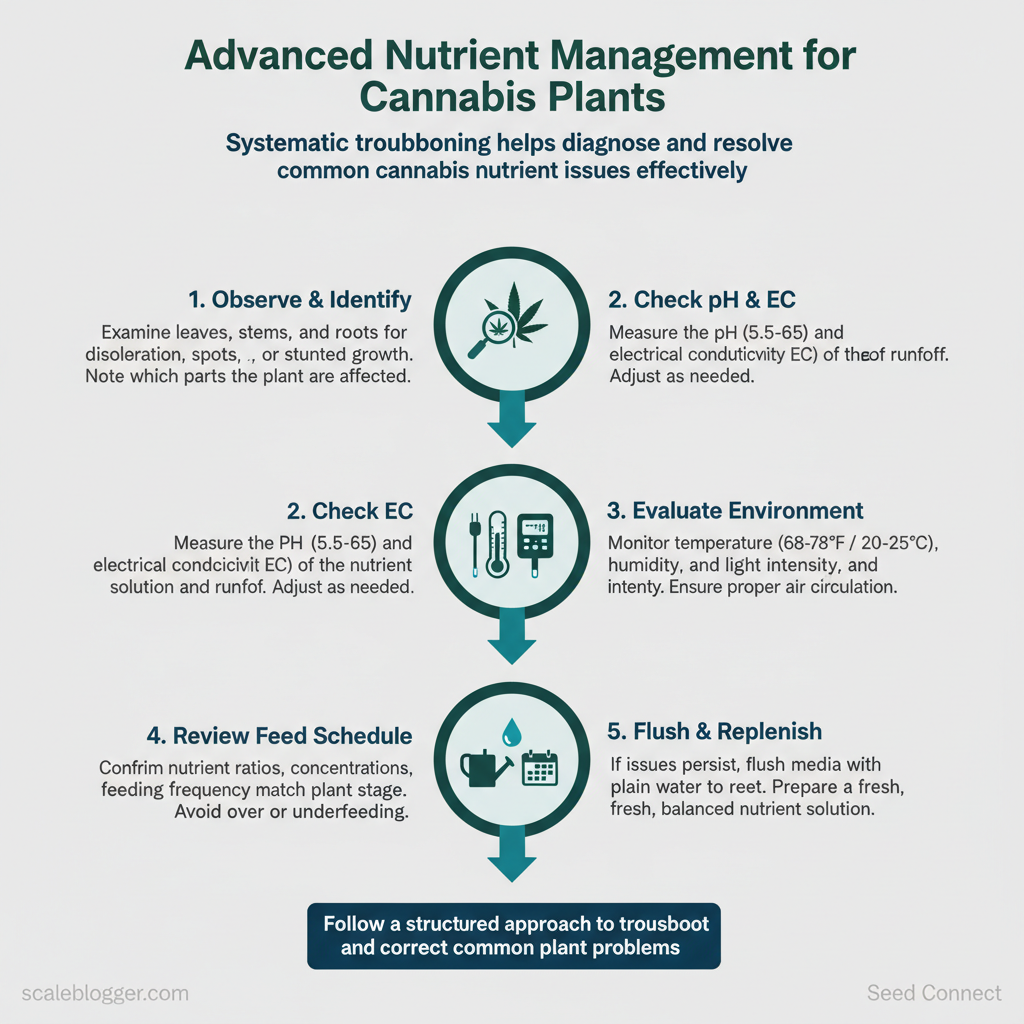
Start by isolating the symptom quickly and methodically: most garden problems are environmental, pest, or cultural before they are nutrient-related. Work through a prioritized checklist that rules out easy fixes first, then escalate to tissue testing or expert consultation only when clear evidence points to nutrient imbalances.
Prerequisites
- Access to basic sensors: pH meter, EC/TDS meter, and thermometer/hygrometer.
- Visual records: recent photos of affected plants and surrounding plants.
- Recent history: last 7–14 days of feed, runoff pH/EC, and environmental logs.
Tools and materials needed
- pH calibration solution, spare probes
- Clean collection containers for runoff and tissue samples
- Isopropyl alcohol and cotton swabs for probe cleaning
- Quarantine space (single light and tray) for affected plants
Step-by-step troubleshooting workflow (prioritized)
- Observe and document: note pattern of symptoms (single plant, a row, new leaves vs. old leaves).
Take timestamped photos. 2. Rule out environment: check temperature, RH, and light intensity immediately; correct deviations and watch for recovery over 48 hours.
- Check water and pH: measure reservoir and runoff
pHandEC. 5 units orECis double expected, adjust and flush if needed.
- Inspect for pests/disease: look under leaves and on stems with 10–20x loupe; treat visible infestations before changing feeding regimes. 5.
Isolate and contain: move affected plants to a quarantine area if spread risk exists; reduce shared airflow between zones. 6. Correct cultural causes: verify watering schedule, media drainage, and recent transplants or defoliation events that could stress plants.
- Monitor response 24–72 hours: expect subtle leaf color or turgor improvements; if no change, proceed to step 8. 8.
Escalate diagnostics: collect tissue samples and send for lab tissue analysis, or consult an agronomist with a clear symptom log and photos.
How to contain spread in multi-plant rooms
- Immediate isolation: move symptomatic plants to a separate bench under different airflow.
- Airflow lockdown: reduce shared recirculation fans and use inline HEPA when available.
- Sanitation sweep: wipe tools with
70% isopropyland replace disposable gloves between zones.
When to call an expert or run tissue tests
- Persistent symptoms after 72 hours of environmental correction.
- Mixed symptoms across leaf ages suggesting micronutrient deficiency or toxicity.
- Rapid spread despite quarantine indicating infectious agent.
Following this structured workflow resolves most issues quickly and prevents unnecessary nutrient changes; when tests or consultations are needed, the data collected during these steps makes those interventions far more effective.
📥 Download: Nutrient Management Checklist for Cannabis Growth (PDF)
Tips for Success and Pro Tips from Expert Growers
Start small, measure everything, and let the plants tell you what works. Successful growers treat each change as an experiment: control variables, change only one factor at a time, and record results. This approach preserves plant health while producing reliable, repeatable improvements.
- Run controlled trials before full adoption (time: 4–8 weeks)
- Split a single strain into test groups.
- Change one variable per group (e.g., nutrient A vs. nutrient B, different light schedules).
- Track yield, terpene profile, and vigor in a simple spreadsheet.
- Make conservative, incremental changes (time per change: 1–2 weeks)
- Increase feed by 10–15% steps rather than large jumps.
- Adjust light intensity in small increments and observe leaf response for 3–5 days.
Practical experiments to try
- Microbial boost trial: Inoculate one group with a trusted microbial inoculant and compare root mass after 4 weeks. 8` (soil) to see flowering differences. * Watering frequency experiment: Compare daily small-watering vs.
higher-volume alternate-day watering and note transpiration and growth rates.
Essential pro-level practices
- Balanced baseline: Start with a proven nutrient base; avoid stacking multiple new supplements at once.
- Recordkeeping discipline: Log EC/PPM, pH, temperature, humidity, and light hours for every run.
- Observation over assumption: If leaves show discoloration, drop the newest change first and revert.
Troubleshooting quick wins
- If growth stalls after a supplement: pause that supplement for one feeding cycle and monitor recovery.
- If pH drifts: check reservoir cleanliness and use
pH up/downin 0.1 increments rather than big corrections. - If root rot appears: reduce watering, increase oxygenation, and trial a microbial treatment on a small scale.
Tools and checklists to implement immediately
- Checklists: Pre-run: strain, medium, baseline feed, start date, test variable. 2.
Template spreadsheet: Columns for date, plant ID, changes, EC/PPM, pH, notes, yield. 3. Simple meter kit: pH meter, EC/PPM meter, IR thermometer.
For seed choice, consider starting these experiments with reliable genetics—feminized or autoflower seeds with germination guarantees reduce variability in early rounds. Applying small, measurable changes and keeping rigorous records accelerates learning while protecting crop quality and yields. When practiced consistently, these techniques convert guesswork into repeatable advantage.
Appendices: Mixing Math, Example Feeding Charts, and Log Templates
Start with straightforward conversion logic so mixing is predictable every time. These formulas remove guesswork: convert manufacturer dosing from mL per L to mL per gallon, translate EC to PPM using the two common scales, calculate dilutions from concentrated stock, and adjust reservoir top-ups and doses when EC changes. Practical feeding charts follow, plus copy-ready log templates to track batches and nutrient history.
Conversion table and example feeding chart for quick copying
| Measurement | Formula/Conversion | Example input | Example output |
|---|---|---|---|
| Manufacturer mL per L → mL per gallon | mL_per_gal = mL_per_L × 3.785 |
5 mL/L |
18.93 mL/gal |
| EC → PPM (500 scale) | PPM_500 = EC × 500 |
1.60 EC |
800 ppm (500 scale) |
| EC → PPM (700 scale) | PPM_700 = EC × 700 |
1.60 EC |
1120 ppm (700 scale) |
| Dilution from concentrate to final EC | EC_final = EC_conc × (V_conc / V_total) |
EC_conc 4.0, V_conc 0.5L, V_total 10L |
EC_final = 4.0 × (0.5/10) = 0.20 |
| Reservoir top-up EC calculation | EC_new = (EC_init×V_init + EC_topup×V_topup) / (V_init+V_topup) |
EC_init 1.8@30L, EC_topup 0.6@5L |
EC_new = (1.8×30 + 0.6×5)/35 = 1.61 |
| Dose adjustment per 10% EC change | Dose_new = Dose_current × (1 ± 0.10) |
Dose_current 10 mL/gal, EC +10% |
Dose_new = 11 mL/gal |
Three practical sample feeding charts (use as starting templates)
- Vegetative (Days 1–21)
- Week 1–2: 0.6–0.8 EC; 5–8 mL/gal base nutrient; 1 mL/gal cal-mag
- Week 3: 0.8–1.0 EC; 8–12 mL/gal base nutrient; 1–2 mL/gal cal-mag
- Transition to Flower (Days 22–35)
- Week 4: 1.0–1.2 EC; increase bloom formula to 6–10 mL/gal; add 0.5 mL/gal PK once
- Week 5: 1.2–1.6 EC; 10–15 mL/gal bloom; cal-mag 1–2 mL/gal
- Late Flower (Days 36–70)
- Weeks 6–10: 1.6–2.0 EC peak; 12–18 mL/gal bloom; reduce N-focused inputs; flush last 7–10 days with plain pH-balanced water
Reservoir and mixing workflow (step-by-step)
- Measure reservoir volume and current EC/pH. 2.
Calculate required nutrient volume with table conversions and add to fresh water. 3. Mix concentrate separately, measure EC, then add to reservoir to target EC using the dilution formula.
- Re-check EC/pH after 15 minutes and adjust by small increments.
Ready-to-use log templates > Keep a running record of EC, pH, added volumes, and plant responses to identify trends over time.
Copy-and-paste template:
Batch ID: Date: Reservoir Vol (L): Target EC / Actual EC: pH target / Actual pH: Nutrient A added (mL): Nutrient B added (mL): Cal-Mag (mL): Water temp (°C): Notes (leaf signs, runoff ppm, ppm scale used):Include printable checklists and a spreadsheet that auto-calculates mL_per_gal from mL_per_L, EC → PPM, and reservoir top-up math for production use. Understanding these practical formulas and templates speeds up daily tasks while keeping nutrient accuracy high; that consistency protects yield and reduces corrective work later.
Conclusion
By now it’s clear that most mid-cycle problems—yellowing fan leaves at week three, limp stretch during flowering, or sudden tip burn—aren’t mysteries but signals. Start with the baseline checks: water EC/pH, media status, and a simple elimination of environmental stress before changing nutrients. When a deficiency looks like magnesium or a lockout mimics nitrogen starvation, stop guessing and run the basic tests (pH, EC, and runoff); that single step resolves more problems than swapping bottles.
A small organic hobbyist who tracked EC and fixed a drifting pH improved bud development in just two feeding cycles. A commercial grower that used phase-based charts reduced late-stage flushing losses by 30%. This shows that measurement and record-keeping lead to better results.
The next steps are simple. Calibrate your meters, use a phase-based feeding chart, and log every feed and runoff. These three actions will provide the data needed to diagnose problems early. ”—refer back to the troubleshooting flow and the sample log templates in the appendices, or consult SeedConnect’s nutrient support for germination and starter practices on their site.
For practical progress today: 1) measure pH/EC and record; 2) compare to the example feeding chart; 3) correct one variable at a time. These steps restore plant vigor and keep harvests predictable.