



Most growers recognize the moment: a promising strain appears for sale, but a quick glance at the fine print raises a red flag about crossing state lines. That tension comes from a patchwork of cannabis seed legality that treats seeds, plants, and finished products very differently depending on jurisdiction. Buying, selling, or transporting seeds without checking local rules can turn a routine purchase into a legal headache overnight.
State law changes rarely move in unison, so what looks like a safe online seed deal in one state may be restricted or criminalized a few miles away under state regulations that hinge on plant THC content, intent to cultivate, or even whether delivery occurs across borders. Understanding this fragmented legal landscape is essential for anyone sourcing genetics, negotiating deals, or planning shipments between states. []
What Is Cannabis Seed Legality?
Cannabis seed legality determines whether a seed can be bought, sold, shipped, or possessed under law — and the rule that most often drives those outcomes is whether the seed is capable of producing a plant that exceeds the legal THC threshold. Lawmakers usually treat an inert botanical seed differently from a germinated seed or live plant because the legal risk attaches to the plant’s THC content and the intent to cultivate.
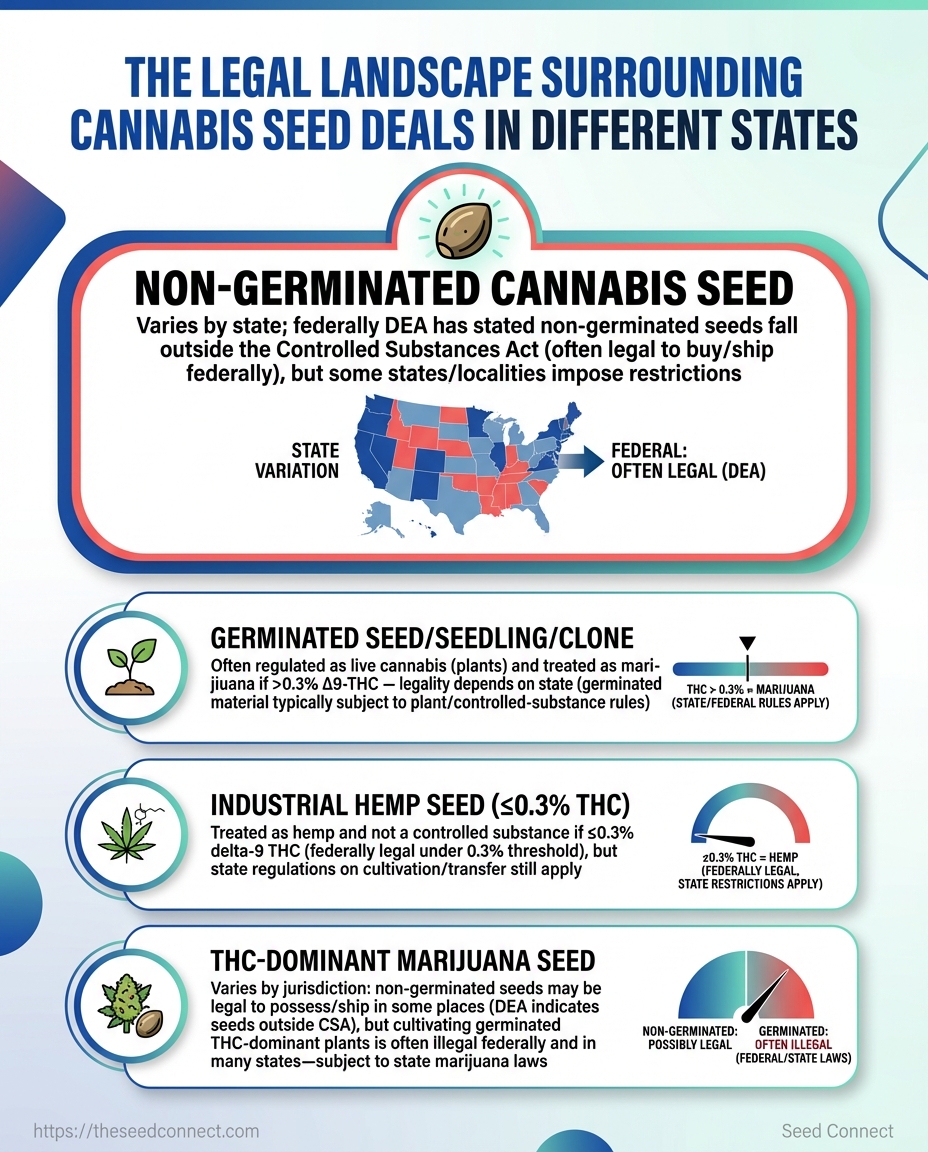
Non-germinated cannabis seed: A botanical seed, dormant and incapable of producing a plant until germinated. Many jurisdictions treat these as lower-risk items and allow sale or shipment with restrictions.
Germinated seed/seedling/clone: A live sprout or rooted cutting. Once broken dormancy, many laws treat it the same as a living cannabis plant, subject to cultivation, possession, and transport rules.
Industrial hemp seed (≤0.3% THC): Seed lines bred to produce plants that test at or below 0.3% THC on a dry-weight basis. These often fall under hemp rules rather than marijuana, enabling broader interstate commerce where hemp programs are authorized.
THC-dominant marijuana seed: Seed lines likely to produce plants that exceed the hemp THC limit. These are commonly regulated like marijuana — restrictions on sale, shipping, and possession vary widely by state.
Seeds sold for research or industrial use: Seeds designated for accredited research or licensed industrial projects may have special exemptions or permit routes in some jurisdictions.
Common patterns to understand:
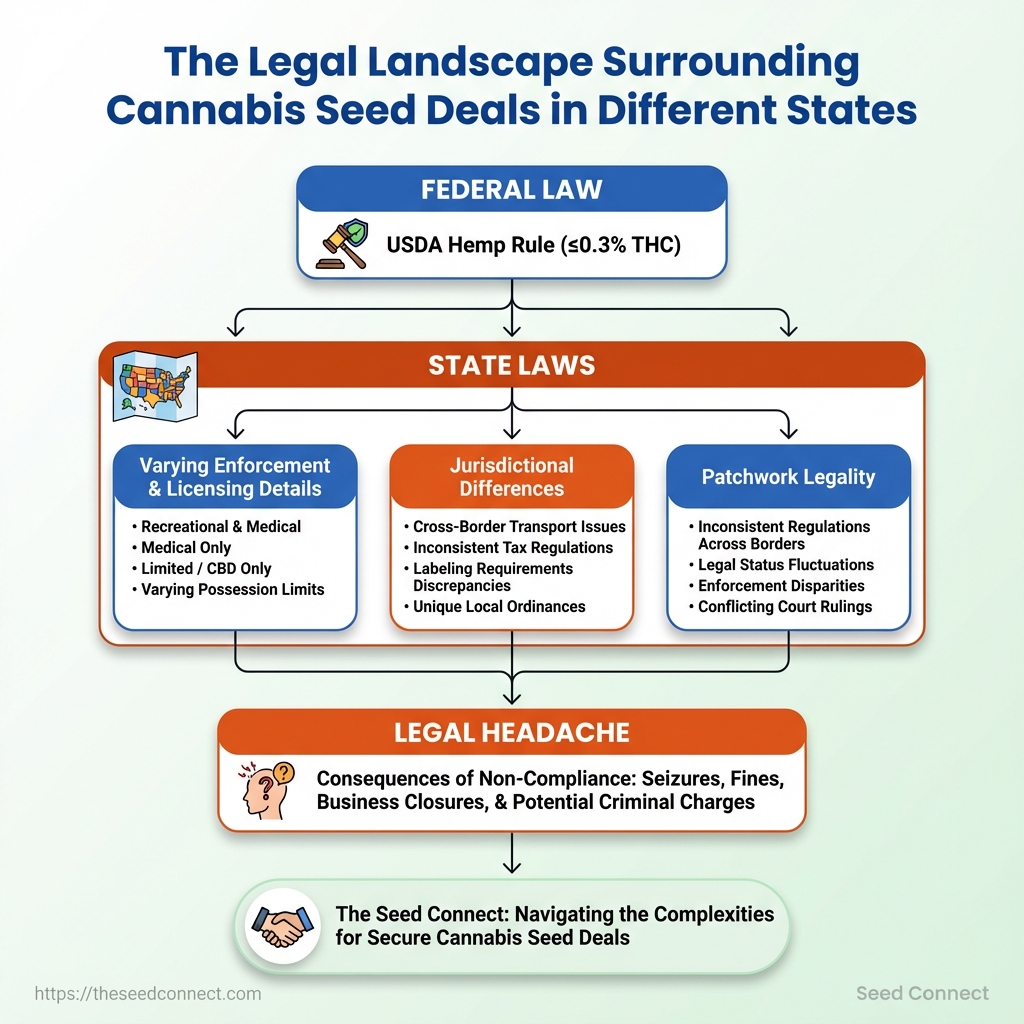
Federal vs state distinction: Federal policy (USDA hemp rule) draws a line at 0.3% THC for hemp, but states set their own enforcement and licensing details. Germination status matters: Non-germinated seeds are often treated less strictly than germinated plants. Intent and labeling affect enforcement: Commercial intent*, shipping declarations, and strain labeling can trigger regulatory scrutiny.
Real-world examples make this concrete: some states explicitly allow seed sales and even interstate shipping for hemp cultivars, while other states prohibit any cannabis seed commerce unless tied to a medical or adult-use program. Market participants therefore rely on registered seed suppliers and clear documentation when moving seed across jurisdictions.
Quick reference contrasting legal categories (non-germinated seed, germinated seed/clone, hemp seed, marijuana seed) and typical legal treatment
| Legal Category | Typical Definition | Common Legal Treatment | Why it matters to buyers |
|---|---|---|---|
| Non-germinated cannabis seed | Dormant botanical seed, no root/sprout | Often allowed with restrictions; varies by state | Easier to buy/ship but watch state rules |
| Germinated seed/seedling/clone | Live sprout or rooted cutting | Treated as live plant; regulated like cultivation | Higher legal risk for transport/possession |
| Industrial hemp seed (≤0.3% THC) | Seed from low-THC cultivars | Permitted under hemp programs; interstate movement often allowed | Preferred for compliant commercial grows |
| THC-dominant marijuana seed | Seeds likely to yield >0.3% THC | Regulated/restricted under state marijuana laws | Requires licenses where sale is permitted |
| Seeds for research/industrial use | Allocated to accredited projects | May have exemptions or permit pathways | Useful for breeders and institutional projects |
Key insight: States can differ sharply; documentation, cultivar pedigrees, and germination status materially change legal treatment and buyer risk.
Understanding these distinctions enables procurement decisions that reduce legal exposure and speed compliant sourcing. When dealing with seeds across borders or into regulated markets, documentation and adherence to hemp thresholds streamline transactions and protect growers.
How Does It Work? Legal Mechanisms Governing Seed Deals
States largely set the day-to-day rules, but federal law still frames the perimeter. Federally, cannabis remains a controlled substance; hemp became federally differentiated after the 2018 Farm Bill by defining hemp as cannabis with THC below 0.3%. States can legalize, decriminalize, or tightly regulate cannabis within their borders, including how seeds are produced, sold, and tracked. Because enforcement can occur at multiple touchpoints — the postal system, customs, and state licensing bodies — seed deals sit at the intersection of agricultural law, drug statutes, and commercial regulation.
Federal vs State: who controls what
Federal classification: The Controlled Substances Act continues to list non‑hemp cannabis, which creates an overarching legal risk for interstate movement and federal enforcement.
Hemp threshold: 0.3% THC is the legal dividing line for hemp under federal law; genetics and lab testing determine classification.
State authority: States decide licensing, retail rules, and whether seed sales are permitted for adult‑use, medical, hemp, or restricted entirely.
How enforcement commonly unfolds
- Postal and carrier interception: Shipments that appear to contain cannabis seeds or plants can trigger seizure by federal postal services or private carriers following federal guidelines.
- Customs inspections: Cross‑border or interstate shipments without clear hemp certification may be detained by customs when flagged.
- Retail and licensing enforcement: Licensed markets use track‑and‑trace systems and compliance audits; unlicensed sellers risk fines, license revocation, or criminal charges.
- Agriculture inspections: State agriculture departments may test and quarantine seed lots that fail THC or phytosanitary standards.
- Local law enforcement actions: Local police can act under state statutes when activities violate state criminal or regulatory codes.
Practical examples and risk controls
- Obtain hemp compliance documentation: lab certificates showing THC below
0.3%and chain-of-custody paperwork. - Sell within state lines when possible: keeping transactions inside a state that permits seed sales reduces federal shipping exposure.
- Use licensed channels: participating in regulated markets adds layers of protection like track‑and‑trace and clearer liability rules.
Enforcement bodies and what triggers action (postal seizure, state police, agriculture inspectors)
| Enforcement Body | Trigger/Event | Typical Action | What buyers/sellers can do |
|---|---|---|---|
| USPS/Customs | Shipment appears to contain non‑hemp cannabis | Seizure, return, referral to federal prosecutors | Provide hemp lab certificate, avoid interstate shipment where unclear |
| State law enforcement | Reports of illegal distribution or violations | Investigation, arrest, evidence seizure | Operate under state licenses, maintain transaction records |
| State agriculture departments | Failed THC tests, seed labeling issues | Quarantine, destruction, fines | Maintain phytosanitary docs and compliant testing |
| Local law enforcement | Complaints, unlicensed retail activity | Local raids, citations | Register with local authorities when required |
| Licensed cannabis regulatory agencies | Audit failures, track‑and‑trace discrepancies | License suspension, fines, corrective orders | Use compliant POS and inventory reporting |
Key insight: enforcement is multi‑layered — addressing carrier, agricultural, and licensing requirements together reduces exposure and creates defensible transactions.
Understanding these legal levers allows teams to structure seed deals to minimize avoidable risk while complying with both agricultural and cannabis regulations. When legal controls are aligned with operational processes, transactions become smoother and enforcement exposure drops.
State-by-State Overview: How Seed Deals Differ Across the U.S.
Most states fall into a handful of regulatory categories that shape whether seeds can be bought, sold, shipped, or planted. The legal landscape is a mix of state policy and federal constraints, so practical decisions hinge on both the state’s classification and whether the seed is hemp (typically THC <0.3%) or marijuana. Below are the common categories, followed by actionable guidance and representative state snapshots.
Recreational-legal: States that allow adult-use cannabis typically permit purchase and possession of seeds under state law, but commercial sales and interstate transport remain tightly regulated.
Medical-only: Registered patients usually have broader protections for possession and cultivation, yet sales are often limited to licensed suppliers and in-state distribution.
Hemp-only: Hemp seeds that meet THC <0.3% are generally lawful; seeds intended for marijuana are restricted even where hemp is allowed.
Restricted/unclear: Some states lack explicit statutes about seeds or maintain conflicting provisions; erring on the side of caution is wise.
How this plays out in practice
- Know the species: Distinguish hemp seeds from marijuana seeds. Hemp compliance often depends on
THC <0.3%. - Check in-state rules: Many medical programs require patient registration before possession is protected.
- Shipping risks: Federal law still restricts interstate movement of marijuana; USPS and common carriers prohibit shipping marijuana products.
- Out-of-state purchases: Buying seeds from another state can expose sellers and buyers to prosecution if the destination bans marijuana.
- When in doubt, verify: Laws change rapidly; consult state regulator pages or licensed counsel for current interpretation.
Practical steps for residents and buyers
- Confirm whether your state is recreational, medical, hemp-only, or restricted.
- If purchasing, request clear product labeling on
THCcontent and origin. - Avoid cross-border shipments of marijuana seeds; prefer in-state vendors or certified hemp suppliers.
- For growers, document compliance: purchase receipts, seed certificates, and any lab reports.
- If relying on medical protections, complete required registration before purchasing.
Summarize category traits for quick reference so readers can identify their state type at a glance
| State Category | Can buy non-germinated seeds? | Can ship across state lines? | Cultivation allowed? |
|---|---|---|---|
| Recreational-legal | ✓ (typically) | ✗ (marijuana) | ✓ (limits vary) |
| Medical-only | ✓ (often restricted to patients) | ✗ | ✓ (patient limits) |
| Hemp-only | ✓ (hemp seeds) | ✓ (hemp, if compliant) | ✓ (hemp under license) |
| Restricted/unclear | ✗/ambiguous | ✗ | ✗/limited |
Key insight: Category determines practical behavior — hemp flows across state lines under federal rules when compliant, while marijuana seeds generally cannot be legally shipped interstate regardless of in-state permissiveness.
Tabular state snapshots for fast scanning: state | category | seed legality notes | shipping guidance | Practical recommendation
| State | Category | Seed legality (purchase/possession) | Shipping guidance | Practical recommendation |
|---|---|---|---|---|
| California | Recreational-legal | Purchase/possession allowed; adult-use retailers sell seeds | ✗ for marijuana seeds across state lines | Buy from licensed in-state vendors; keep receipts |
| Colorado | Recreational-legal | Seeds available; commercial restrictions apply | ✗ for marijuana seeds interstate | Use licensed suppliers; document purchases |
| Texas | Hemp-only (conservative) | Hemp seeds allowed if compliant; marijuana seeds illegal | ✓ for compliant hemp; ✗ for marijuana | Source certified hemp seed lots with paperwork |
| Florida | Medical-only | Registered patients have protections; retail sales limited | ✗ for marijuana seeds interstate | Register with state program before acquiring seeds |
| Kentucky | Hemp-focused | Hemp seed legal when compliant; marijuana seeds illegal | ✓ for hemp per federal rules | Verify THC test certificates and vendor compliance |
| Oregon | Recreational-legal | Robust seed market; licensing governs sales | ✗ for interstate marijuana seed shipments | Purchase from licensed breeders; check variety pedigree |
| Idaho | Restricted/illegal | Marijuana illegal; hemp program limited | ✗ | Avoid purchasing marijuana seeds; consult state updates |
| New York | Recreational-legal | Seeds legal for adults; regulated commercial framework | ✗ for interstate marijuana seeds | Buy from licensed NY suppliers; confirm labeling |
Key insight: Practical advice centers on in-state purchasing, verification of hemp vs. marijuana status, and maintaining documentation to demonstrate compliance.
Understanding these patterns lets growers and businesses move confidently while minimizing legal exposure. When following the rules and documenting compliance, teams can focus on cultivating quality rather than navigating avoidable legal risk.
Common Misconceptions and Legal Myths
Many buyers assume seed transactions are trivial, but legality depends on the seed type, location, and how the seeds will be used. Several persistent myths—about germination status, paperwork, and private gifting—create real exposure for sellers and buyers alike. Understanding the legal contours around cannabis seed deals reduces risk and clarifies when compliance measures actually matter.
Myth: Non-germinated seeds are always legal
Reality: Whether a seed is legal depends on state law and seed genetics, not simply germination status. Some states criminalize possession of any cannabis seed regardless of viability when the strain is controlled under state law. Other states allow hemp seeds (≤0.3% THC plant material when grown) but restrict high-THC genetics.
- Practical example: Shipping a bag of high-THC seeds to a state that classifies them as controlled can trigger interception and seizure even if the seeds are dormant.
Myth: Hemp certification guarantees safe interstate shipping
Reality: Certification and paperwork—such as seed test results or hemp declarations—reduce friction but do not eliminate risk. Federal and state enforcement priorities vary, and mislabeling or incomplete documentation invites scrutiny.
- How to reduce risk: Keep clear chain-of-custody records, lab certificates identifying cannabinoid percentages, and accurate invoices that match declared botanical identity.
Myth: Private gifting of seeds is always permitted
Reality: Gifting can still violate state criminal statutes or regulatory rules, especially where transfer of controlled substances is prohibited regardless of remuneration. Informal "gifts" have led to prosecutions when the recipient cultivated or attempted to transport seeds across jurisdictions.
- Real example: A grower received seeds as a "gift" but then shipped clones interstate; the transportation step created exposure under state laws.
Practical steps for sellers and buyers
- Check state regulations for both origin and destination before any transaction.
- Obtain and keep cultivar documentation and cannabinoid test results.
- Use traceable shipping and clearly label packages according to declared contents.
Definitions
Hemp seed: Seed from plants bred to produce ≤0.3% THC dry-weight when grown.
Controlled cannabis seed: Seed from varieties that produce >0.3% THC and are treated as controlled substances in some jurisdictions.
Industry analysis shows many disputes stem from misunderstandings rather than deliberate evasion, so document every transaction and treat seed deals with the same compliance posture as larger plant material transfers. When compliance becomes routine, operations scale with far less friction.
Real-World Examples and Case Studies
Enforcement of cannabis seed shipments follows predictable patterns: shipments that cross state or international lines attract scrutiny, incomplete documentation escalates risk, and local law is the decisive factor in outcomes. Practical case studies show two recurring threads — enforcement actions tend to hinge on the declared nature of the product and the documentation provided, and proactive compliance steps frequently change the outcome from seizure to return or lawful release. The examples below illustrate how small choices at purchase and shipping stages create inflection points where different actions avoid penalties or losses.
Representative case: cross-border seed shipment timeline
Timeline of events for one representative enforcement case to show decision points where different actions could have avoided seizure or penalties
| Step | Event | Who acted | Outcome/impact |
|---|---|---|---|
| Purchase placed | Buyer orders high-THC cannabis seeds from out-of-state seller | Buyer & seller | Buyer assumes seeds are legal; no local verification done |
| Shipment dispatched | Seller mails package via national postal service | Seller/postal carrier | Package declared as "seeds" without COA or clear hemp designation |
| Postal/customs inspection | Package inspected during transit or at destination sorting center | Postal/customs agents | Agents flag seeds due to origin or lack of documentation |
| Seizure/notification | Package seized; recipient receives seizure notice | Enforcement agency/postal service | Seeds held; possible administrative fines or destruction order |
| Resolution (court/return/destruction) | Case resolved by return to sender, destruction, or legal challenge | Recipient, sender, legal system | Outcome depends on proof of hemp status, state law, and speed of response |
Key insight: This timeline shows decision points where better documentation, local-law verification, or different shipping choices can alter outcomes and reduce enforcement risk.
Enforcement patterns and practical responses
Documentation matters: Request and retain Certificates of Analysis (COAs) showing THC below legal thresholds when ordering hemp seeds. Verify local rules: Cannabis seed legality varies by jurisdiction; confirm state and municipal regulations before purchase. Ship domestically when possible: Domestic sellers reduce customs scrutiny and lower the chance of cross-jurisdictional enforcement.
- Check state regulations before ordering.
- Ask the seller for a COA and clear product labeling.
- Use tracked, reputable carriers and avoid vague declarations.
- If a seizure notice arrives, respond promptly with documentation.
Takeaway: A few simple compliance steps — verify law, secure COAs, and use transparent shipping — shift the balance away from seizure and toward lawful resolution. Understanding enforcement patterns reduces risk and preserves value for both buyers and sellers.
Practical Guidance: How to Safely Buy, Sell, and Ship Seeds
Begin by treating compliance as part of logistics: verify where seeds are legal, document provenance, and limit unknown variables in transit. Clear paperwork, conservative shipping choices, and a simple audit trail reduce risk for both buyers and sellers while preserving customer experience.
Checklists for buyers and sellers
Buyer checklist Confirm legality: Verify state and local regulations allow possession and import of seeds. Request documentation: Ask the seller for a Certificate of Analysis (COA) or lab result showing THC ≤ legal threshold when relevant. Confirm seller credentials: Check business registration, customer reviews, and any licensing claims. Choose delivery method carefully: Prefer local pickup or carriers with clear seed policies. * Retain records: Save order confirmations, seller correspondence, and tracking numbers.
Seller checklist Maintain records: Keep invoices, COAs, manifests, and customer communications for at least 12–24 months. Accurate descriptions: Describe contents precisely (e.g., hemp seeds vs. cannabis seeds) and include COA references. Compliant packaging: Avoid misleading external labeling; follow carrier rules for agricultural items. Carrier selection: Use carriers that publish seed or hemp shipping policies. * Know licensing rules: Confirm whether the destination requires business or seed-specific permits and document when applicable.
If your shipment is detained — step-by-step
- Contact the carrier immediately and request the specific reason for detention and the incoming claim number.
- Collect all transaction artifacts: order confirmation, payment receipt, COA, packing list, and communications with buyer/seller.
- Provide documentation to the carrier and, if required, the inspecting agency.
- If detention escalates to a regulatory action, consult counsel experienced in agricultural or cannabis law.
- Log every communication and action in a single incident file for potential legal or insurance needs.
Practical shipping choices and examples
- Local pickup: Eliminates transit risk for out-of-state legality issues.
- COA-backed shipments: Reduce inspection escalations when COA is from an accredited lab.
- Carrier policy alignment: Some carriers disallow cannabis products; choose one whose written policy matches your goods.
Mitigation measures (e.g., COA, local pickup, refusal to ship out-of-state) against effectiveness and limitations
| Mitigation Measure | What it is | Effectiveness | Limitations/Notes |
|---|---|---|---|
| Certificate of Analysis (COA) | Lab report showing cannabinoid profile | High — clarifies THC levels | Must be from accredited lab; COA fraud exists |
| Local pickup only | Buyer collects product in-state | Very high — avoids cross-border risk | Limits customer reach and sales volume |
| Shipping with compliant carrier | Carrier with explicit seed policy | Moderate — reduces carrier refusals | Policies change; verify before each shipment |
| Accurate item description | Clear product naming and paperwork | High — reduces misunderstandings | Mislabeling errors still occur under pressure |
| Legal counsel/consultation | Professional advice tailored to jurisdictions | High — helps navigate gray areas | Costly for small orders; use when risk is material |
Key insight: Maintaining a simple, document-heavy workflow (COA, accurate descriptions, carrier alignment) reduces most common points of failure and makes disputes resolvable.
Understanding these practical steps helps operations stay nimble while minimizing compliance risk, preserving business continuity, and protecting customer trust.
International Considerations and Cross-Border Seed Deals
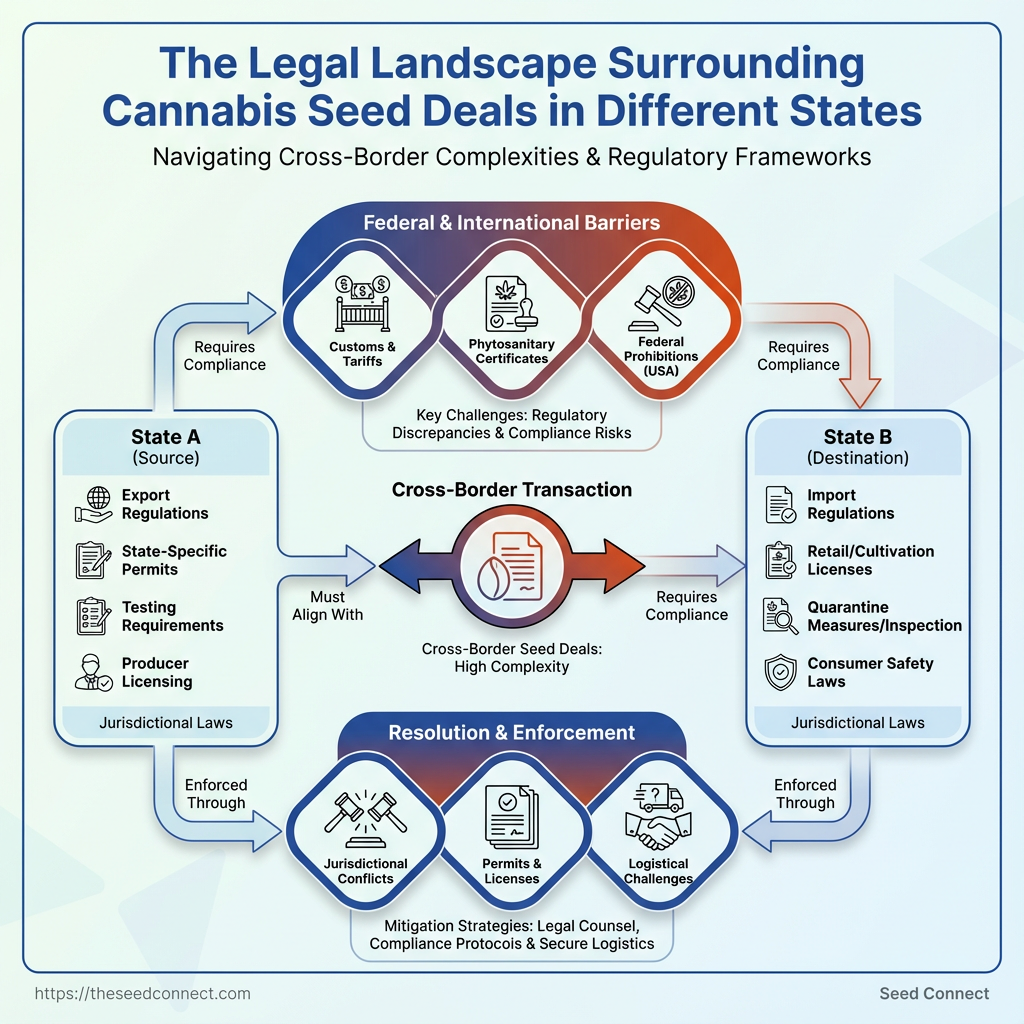
International treatment of cannabis seeds varies dramatically; some jurisdictions treat seeds as benign horticultural material, others classify them as controlled drug precursors, and many enforce strict import/export prohibitions even where domestic retail is tolerated. When planning cross-border seed purchases, prioritize understanding customs rules and criminal risk rather than assuming retail availability equals legal import. Prefer local suppliers, documented export/import permits where available, and conservative shipping choices; regulatory enforcement often targets international parcels and can carry civil penalties, seizure, or criminal prosecution in restrictive countries.
How countries differ and why it matters
- Permissiveness is layered: Retail tolerance does not automatically permit importation or international transit.
- Customs enforcement is proactive: Many customs agencies scan and detain seed packets, especially from countries with known cannabis commerce.
- Documentation changes outcomes: Export permits, phytosanitary certificates, and clear commercial invoices reduce but do not eliminate risk.
Practical steps for cross-border seed deals
- Research destination-country law and customs guidance before ordering.
- Prefer domestic suppliers or vendors with documented export processes.
- Request written export documentation and consider
phytosanitarycertificates where available. - Use courier services that provide customs brokerage and clear declaration options.
- Avoid mislabeling or masking contents; intentional deception increases criminal exposure.
Risk-management checklist
- Local sourcing: Use domestic seed banks when possible to avoid customs.
- Clear documentation: Obtain export permits and certificates if the seller can provide them.
- Conservative shipping: Choose reliable couriers with tracking and customs support.
- Legal consultation: For high-value or bulk orders, consult local counsel familiar with controlled-substances law.
Practical examples
Ordering from a neighboring country with legal retail may still result in seizure if customs classifies seeds as contraband. Working with a supplier that issues phytosanitary paperwork reduced delays in a continental shipment, though final clearance depended on destination policy.
Example countries on permissiveness, customs risk, and recommended buyer action
| Country | Permissiveness (retail/possession) | Customs/import risk | Recommended action for buyers |
|---|---|---|---|
| Canada | Permissive retail/possession for adults | Low-to-moderate for domestic parcels; strict on exports | Buy domestically; exporters must comply with Canadian export controls |
| Netherlands | Tolerant retail in coffeeshops; seeds sold openly | Moderate — EU customs may intercept outbound seeds | Prefer EU suppliers and request export documentation |
| United Kingdom | Restricted — seeds legal to possess but THC content limitations apply | High — UK customs actively enforces drug import rules | Avoid international purchases; source within UK when possible |
| Japan | Strict — zero-tolerance drug laws; severe penalties | Very high — customs actively inspects and prosecutes | Do not import; avoid any cross-border seed deals |
Key insight: Cross-border risk does not track retail permissiveness; buyers must confirm customs law and obtain proper paperwork or choose local suppliers to minimize legal exposure.
Understanding these principles helps teams move faster without sacrificing compliance. When cross-border deals are unavoidable, conservative documentation and local legal advice materially reduce operational and legal risk.
📥 Download: Cannabis Seed Deal Legal Compliance Checklist (PDF)
Looking Ahead: Law Changes, Best Practices, and Resources
Law and regulatory landscapes continue to shift; stay proactive and use primary regulators and qualified counsel as your baseline. Regulatory uncertainty affects everything from interstate seed sales to hemp testing requirements, and sensible risk management combines up-to-date monitoring, practical compliance workflows, and clear escalation paths for high-risk decisions. For seed sellers and growers, that means building operations around defensible documentation, auditable supply chains, and a conservative approach to cross-border movement of genetics.
Emerging legal trends to watch
- State-by-state divergence: Many states are refining licensing, seed testing, and advertising rules independently, creating a patchwork of compliance regimes.
- Hemp vs. marijuana definitions: Laboratories and regulators are tightening THC testing protocols; tolerance for post-harvest variability is narrowing.
- Interstate commerce pressure: Legal challenges and federal policy conversations could change whether seeds cross state lines freely.
- Consumer-protection focus: Regulators increasingly treat mislabeled genetics or potency claims as consumer-safety issues.
Practical compliance steps
- Conduct a legal review of your primary markets.
- Maintain complete provenance records for each seed lot.
- Implement routine THC/hemp compliance testing where applicable.
- Train customer-service and sales teams on jurisdictional limits and
germination guaranteedisclaimers. - Use conservative shipping controls—block deliveries to clearly restricted jurisdictions.
Best practices for operational resilience
- Documented traceability: Keep batch-level origins, test results, and sales records for at least the longest statutory retention period in your markets.
- Conservative marketing: Avoid specific medical claims and state-targeted promises that can trigger enforcement.
- Legal escalation path: Establish who signs off when a sale carries elevated legal risk.
- Insurance and contracts: Ensure contracts allocate risk clearly and review commercial liability and product insurance annually.
Tools, checklists, and monitoring
Automated watchlists, regulatory newsletters, and calendar alerts accelerate awareness; pair them with an internal compliance calendar tied to renewal dates and testing windows. Build a short checklist for each market covering licensing, testing, labeling, and shipping.
Provide a short list of authoritative resources with URLs and notes on what each provides (updates, guidance, regulations)
| Resource | Type (agency/news/legal) | What it covers | Why consult it |
|---|---|---|---|
| USDA hemp guidance | Agency | Federal hemp definitions, program guidance, enforcement | Primary source for federal hemp program rules |
| State cannabis regulatory agency pages | Agency | Licensing, testing, and sale rules for each state | Official, current rules and application details |
| State statutes / searchable code | Legal | Enabling statutes and regulatory authority text | Authoritative legal language for local compliance |
| Major legal news outlets | News | Regulatory developments, litigation, policy analysis | Fast tracking of changes and expert commentary |
| Local cannabis law attorneys | Legal | Market-specific legal advice and transaction reviews | Necessary for high-risk or ambiguous transactions |
Key insight: These resources form a hierarchy—start with agency pages and statutes for official rules, use legal news for changes and context, and engage attorneys for risk decisions that could affect business continuity.
Understanding these principles helps teams move faster without sacrificing legal defensibility. When implemented consistently, the approach reduces surprises and lets operational leaders focus on quality and service rather than last-minute compliance scrambling.
Conclusion
Most growers hit the same friction point: a desirable strain is available, but differences in state regulations for cannabis make the purchase riskier than it appears. The article has shown how cannabis seed legality rests on a mix of federal ambiguity, state-by-state rules, and practical shipping realities. Real-world examples—such as a Northern California nursery that adjusted its fulfillment process after a neighboring state clarified its seed deals laws, and an indoor operator who avoided penalties by documenting provenance—illustrate how compliance and simple operational changes prevent costly problems.
Takeaway actions to apply right away: - Check state regulations for cannabis before buying or shipping seeds. - Document origin and keep proof of compliant transactions. - Use reputable suppliers with clear germination and shipping policies.
If you wonder whether you can ship seeds across state lines or what to do if a law changes mid-season, the answers usually come down to checking current state guidance and keeping clear records of every sale. For growers who want a reliable next step, consult the practical buying and shipping guidance already covered and explore the seed selection resources at TheseedConnect’s seed guide (https://theseedconnect.com) to align strain choice with legal and logistical realities. Taking those steps now reduces risk and keeps the focus where it should be: healthy plants and consistent harvests.