



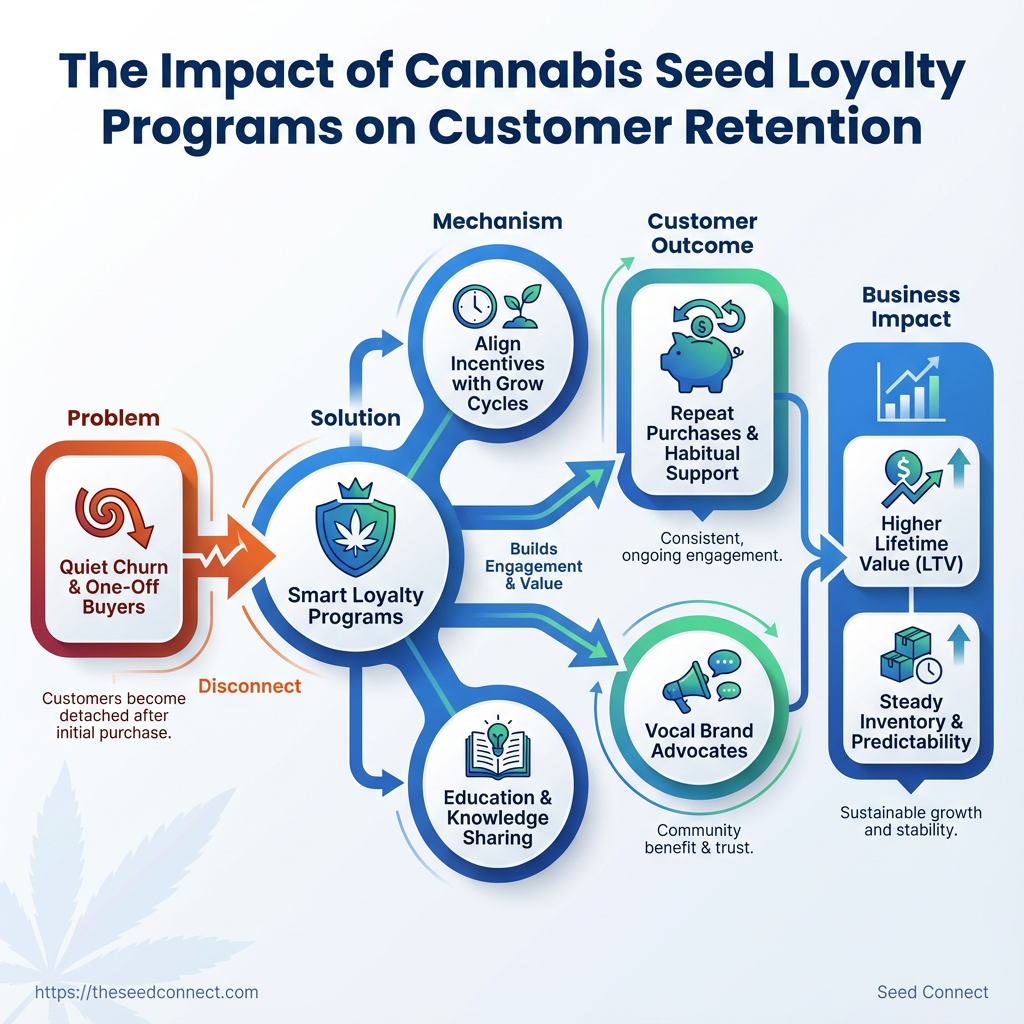
A frequent frustration in seed shops and online catalogs is the quiet churn: growers who buy a single pack, disappear, and only return months later with no loyalty. When a customer buys seeds, they’re not just purchasing genetics — they’re entering a relationship built on timing, trust, and predictable results. Smart loyalty programs nudge that relationship toward repeat purchases by aligning incentives with grow cycles, educational needs, and the seasonal rhythms of cultivators.
Measuring the real effect on customer retention means looking beyond coupons and points to see how rewards change behavior over several grow cycles. For cannabis seed customers, small nudges — free germination tests, strain-specific content, or priority access to new genetics — can shorten the gap between first purchase and second, turning one-off buyers into habitual supporters. The impact is subtle but compounding: higher lifetime value, steadier inventory planning, and a more vocal community recommending brands to peers. []
What Is a Cannabis Seed Loyalty Program?
A cannabis seed loyalty program is a structured customer rewards system that gives repeat buyers incentives—points, discounts, perks, or exclusive access—specifically tailored to people who purchase seeds. It’s designed to increase repeat purchases, raise lifetime value, and build a community around a seed brand.
Definition: A repeat-customer rewards system for cannabis seed buyers that rewards purchases and engagement with redeemable benefits.
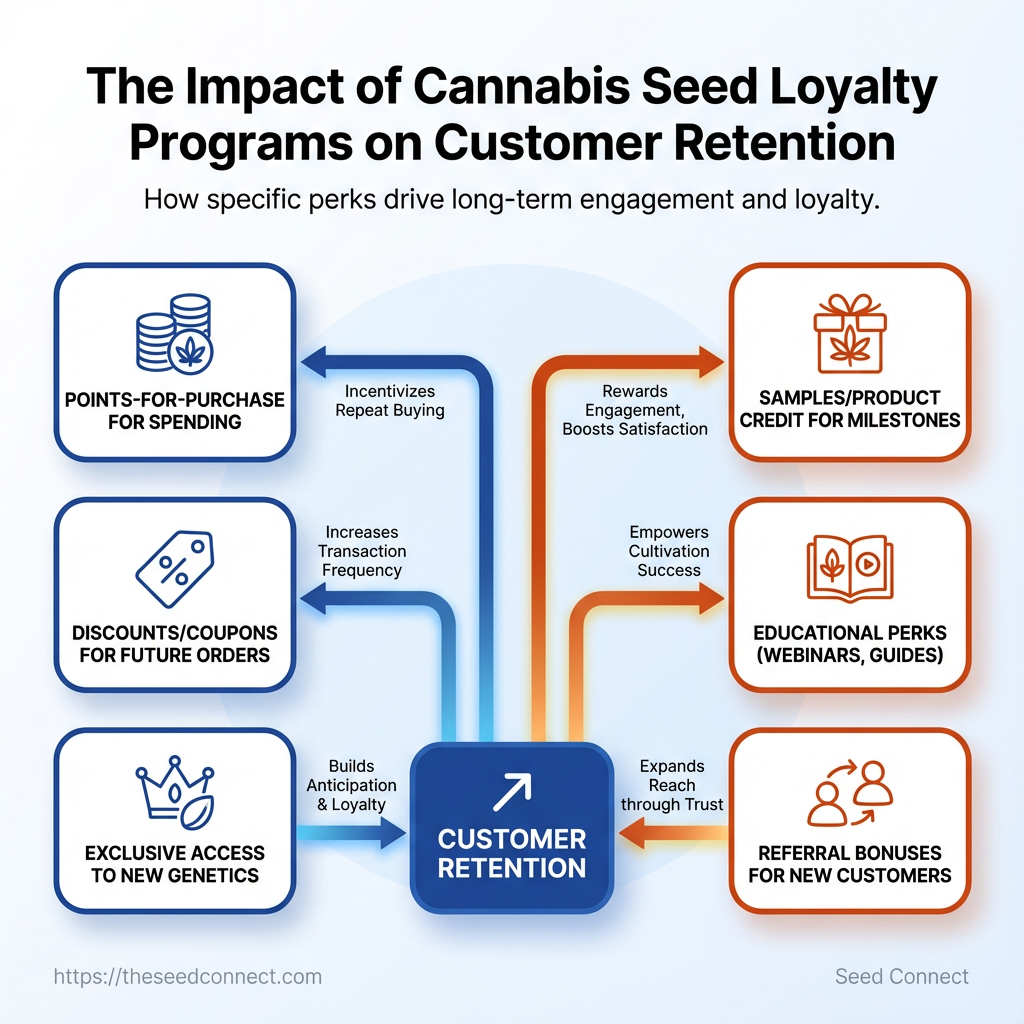
Typical rewards and benefits commonly offered in these programs include:
- Points-for-purchase: Points earned per dollar spent that convert to discounts or product credit.
- Discounts and coupons: Fixed or tiered percentage-off codes for future orders.
- Exclusive access: Early drops of new genetics, limited runs, or members-only strains.
- Samples or product credit: Small seed packs or store credit after certain milestones.
- Educational perks: Access to grower webinars, cultivation guides, or priority support.
- Referral bonuses: Rewards for referring other growers who make purchases.
Think of it like a frequent-flier program but for growers: collect points with each transaction, climb tiers with loyalty, and exchange rewards for things that make growing easier or more exciting. That airline analogy helps because it highlights two things that work well—tangible, easy-to-redeem benefits and aspirational status that encourages more engagement.
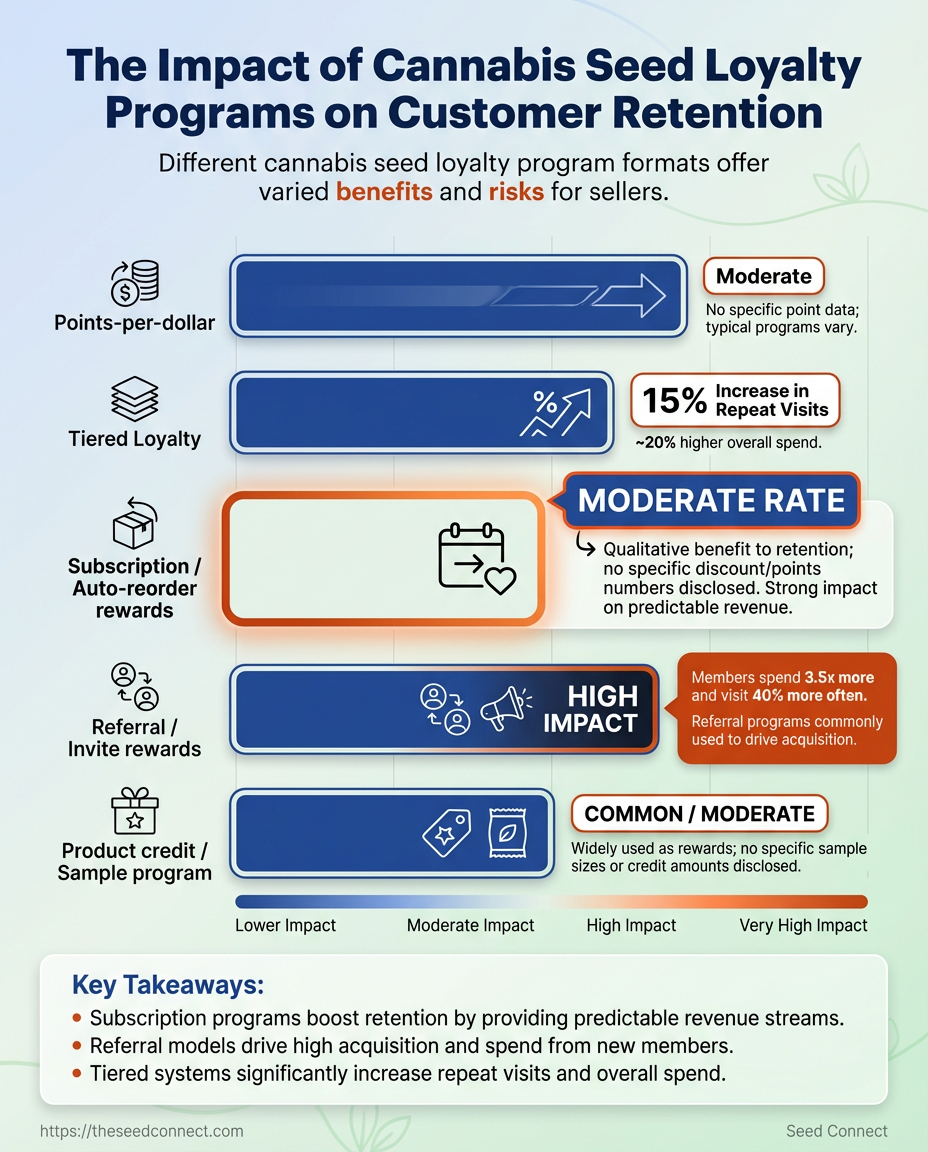
Program formats and variations look different depending on merchant size, customer base, and how cautious the business needs to be about compliance. Below are the most common formats and how they fit seed sellers.
Common loyalty program formats and their fit for cannabis seed sellers (ease of implementation, customer appeal, cost to company, regulatory risk)
| Program Format | How It Works | Best For | Regulatory/Risk Notes |
|---|---|---|---|
| Points-per-dollar | Customers earn points for each dollar spent; points redeemable for discounts/credit | Retailers with frequent repeat buyers | Low to moderate risk; avoid incentivizing illegal distribution |
| Tiered Loyalty | Customers move through levels (Bronze → Gold) unlocking increasing perks | Brands wanting engagement and aspirational value | Moderate risk: higher tiers mustn’t encourage resale |
| Subscription / Auto-reorder rewards | Discounts or bonus seeds for recurring orders | Seed sellers with staple genetics or autoflowers | Higher regulatory sensitivity around recurring shipments—document consent |
| Referral / Invite rewards | Rewards for customers who refer friends who make purchases | Small brands growing via word-of-mouth | Moderate risk: ensure referrals don’t enable ineligible buyers |
| Product credit / Sample program | Free or discounted sample packs or store credit after milestones | New-strain launches and upsell strategies | Low risk if samples comply with regional seed sale laws |
Key insight: Points systems and tiered models drive repeat purchases and lifetime value when structured transparently, while subscription models lock in revenue but need clear customer consent and compliance controls. Referral programs scale acquisition cost-effectively but require vetting to avoid regulatory exposure.
A well-designed program rewards both purchase behavior and meaningful engagement—education, referrals, and brand advocacy—while staying mindful of the specific legal sensitivities around cannabis seed commerce.
How Do Loyalty Programs Drive Customer Retention?
Loyalty programs keep customers coming back by changing behavior in predictable ways: they increase purchase frequency, raise average order value, and build an emotional connection that makes churn less likely. For a cannabis seed seller, that translates into more customers ordering seeds for new grows, upgrading to higher-THC or feminized lines, and referring fellow growers — all measured as concrete retention gains.
Behavioral mechanisms and practical seed-seller tactics
Endowment effect: People value something more once they own it. Offer a low-friction first reward (e.g., small freebie with first order) so customers feel invested.
Operant conditioning: Rewards reinforce repeat actions. Give points per purchase and bonus points for buying targeted categories like autoflowers.
Goal gradient: Engagement spikes as people near a reward. Use visible progress bars toward the next discount to nudge additional purchases.
Social proof / status: Tiers and badges increase perceived status. Create VIP tiers for high-repeat customers with early access to new genetics.
Loss aversion: Customers dislike losing benefits. Make points or tier perks expire unless customers make a purchase within a set window.
Sunk cost / consistency: Small commitments lead to continued behavior. Encourage account creation and an initial review to increase future reorders.
Examples of quick tactics: Welcome bonus: Points or 10% off first order. Category multipliers: 2x points for purchasing seed bundles. Referral reward: Seed pack credit when a friend buys. Anniversary perks: Exclusive strain drop for year-one customers.
Retention-focused KPIs and an example CLV uplift
Retention-related KPIs: Repeat Purchase Rate: Percent of customers who buy again. Average Order Value (AOV): Average revenue per order. Annual Orders per Customer: Frequency measurement. Customer Lifetime Value (CLV): Expected revenue per customer over their lifetime. Churn Rate: Percent of customers who do not return.
Example KPI baseline vs. post-loyalty program uplift (repeat rate, AOV, CLV) to illustrate impact scenarios
| KPI | Baseline | Post-Program (Conservative) | Post-Program (Optimistic) |
|---|---|---|---|
| Repeat Purchase Rate | 25% | 30% (+20%) | 37.5% (+50%) |
| Average Order Value | $80 | $88 (+10%) | $96 (+20%) |
| Annual Orders per Customer | 1.2 | 1.44 (+20%) | 1.8 (+50%) |
| Estimated CLV | $115 | $153 (+33%) | $288 (+150%) |
Key insight: These conservative/optimistic scenarios show how modest frequency and AOV uplifts compound into substantial CLV increases. For seed sellers, boosting orders from 1.2 to even 1.44 per year raises marketing ROI and funds product development.
Attributing retention changes to loyalty activity
- Measure a clear baseline period before program launch.
- Run an A/B test: expose a random subset to the loyalty program and compare retention metrics over the same time window.
- Track cohort behavior: follow monthly cohorts and compare repeat rates and AOV.
- Use incremental metrics: calculate
Incremental CLV = CLV_treatment - CLV_controlto quantify program lift. - Control for seasonality and product launches when interpreting changes.
When loyalty mechanics, KPIs, and attribution line up, the result is measurable retention improvement and higher lifetime value. Loyalty programs aren’t magic — they’re repeatable behavioral levers that, when tuned to cannabis seed customers, turn single purchases into ongoing relationships.
Why Loyalty Programs Matter for Cannabis Seed Sellers
Loyalty programs shift the relationship from one-off transactions to ongoing engagement, and for cannabis seed sellers that shift directly improves revenue predictability, reduces marketing waste, and unlocks better customer intelligence. Repeat buyers tend to spend more over time, earlier purchases inform stocking and breeding choices, and a well-designed program turns casual buyers into advocates who refer friends in compliant ways.
Strategic benefits
- Higher lifetime value: Loyal customers buy genetics they trust repeatedly, often upgrading to premium strains and larger packs.
- Lower customer acquisition cost: Returning customers cut down on paid ads and promotions required to reach the same revenue.
- Better inventory forecasting: Purchase patterns reveal which strains cycle fastest, reducing overstock and waste.
- Rich first-party data: Behavior within a loyalty program powers targeted offers and product development without relying on third-party trackers.
- Marketing amplification: Members who receive exclusive drops or early access create organic buzz and higher conversion for new releases.
Operational example: tracking which autoflower lines are re-ordered most within 90 days lets seed breeders prioritize propagation and limit production of low-turn cultivars, improving cash flow and greenhouse utilization.
Risks and compliance considerations
Cannabis-adjacent loyalty programs carry regulatory and reputational risks that must be managed deliberately.
Common regulatory risks and mitigation strategies across different jurisdictions or program features
| Risk | Affected Program Types | Mitigation Strategy | Operational Impact |
|---|---|---|---|
| Unlawful promotions in restricted jurisdiction | Email-based campaigns, geo-targeted offers | Implement geo-fencing and opt-in confirmation by region | Limits campaign reach; requires platform geo-controls |
| Age verification failure | Sign-up rewards, referral bonuses | Require verified age during account creation using ID verification | Adds friction at signup; reduces fraudulent enrollments |
| Misleading germination claims | Points-for-product, tiered guarantees | Use clear, documented germination guarantee terms and track test results | Requires QA documentation; legal review for marketing copy |
| Cross-border shipping limitations | International loyalty perks, reward shipments | Restrict reward fulfillment to allowed jurisdictions; display shipping policies | Narrows fulfillment options; needs shipping rules engine |
| Data privacy compliance | Personalized offers, profile data | Store minimal personal data, use consent-based marketing, follow local privacy laws | Needs privacy workflows; potential legal overhead |
Key insight: A loyalty program that ignores geo- and age-restrictions quickly becomes an operational liability. Putting verification, localized offers, and clear product claims at the center of program design turns compliance into a competitive advantage by building trust and reducing chargebacks.
Practical next steps
- Audit current marketing, cart, and fulfillment flows for jurisdiction flags.
- Add age verification and geo-fencing at signup before rewards are applied.
- Publish a clear germination guarantee and record QC outcomes for claims.
Designing loyalty around compliance avoids headaches and builds a trustworthy brand that keeps cannabis seed customers coming back. That’s the kind of program that improves margin and reputation at the same time.
Common Misconceptions About Cannabis Loyalty Programs
Loyalty programs for cannabis retailers aren’t just marketing fluff — when designed correctly they drive repeat purchases, increase average order value, and deepen relationships with cannabis seed customers. A lot of pushback comes from misconceptions about legality, cost, and measurability. Clearing those up makes it easier to build a program that actually pays for itself.
Top myths and why they’re wrong
Myth: Loyalty programs are illegal or highly restricted. Rebuttal: Most jurisdictions allow loyalty programs as long as they don’t promote overconsumption or target minors. Compliance is about messaging and age-gating, not abandoning customer retention efforts. Myth: They only benefit big chains. Rebuttal: Small and specialty shops often see larger percentage gains because their baseline retention is lower; targeted offers convert more effectively for niche audiences, like buyers of high THC cannabis seeds. Myth: Loyalty programs are too costly to run. Rebuttal: When measured by customer lifetime value (CLV), targeted rewards often cost a fraction of the extra revenue they generate. Discounting a repeat buyer 10% on future orders can be far cheaper than spending to acquire a new customer. Myth: Points systems are too confusing for customers. Rebuttal: Simple models — points-per-dollar with clear redemption tiers — perform as well or better than elaborate schemes. Clarity beats complexity. Myth: Loyalty programs don’t work for cannabis seeds because purchases are infrequent. Rebuttal:* Seed buyers still follow predictable lifecycle behaviors: upsell to bigger packs, cross-sell nutrients, or buy multiple genetics. A program that times offers to these lifecycle moments wins.
How to test a program without breaking the bank
- Launch a 90-day pilot limited to a single product category or store location and track repeat rate versus control.
- Offer a single, simple reward (e.g., 200 points = free shipping) to minimize confusion and measure redemption.
- Segment customers by previous purchase frequency and target the lowest-frequency buyers with personalized offers.
- Compare cost-per-repeat-customer to your customer acquisition cost to determine ROI.
Why targeted programs are cost-effective
- Higher conversion: Personalized offers convert at much higher rates than generic marketing.
- Lower acquisition pressure: Retaining customers reduces dependence on paid ads.
- Cross-sell lift: Rewards nudges increase basket size and introduce new product lines, including feminized or autoflower cannabis seeds.
A well-scoped pilot proves the math quickly, and small, compliant programs often scale into reliable revenue engines without large upfront spend. Treat the loyalty program as a conversion channel and it will start paying its own way.
Real-World Examples and Case Studies
Real growers and small retailers change behavior when a program clearly reduces friction and proves value quickly. Below are five concrete, diverse case studies—each laid out as Challenge → Program → Results → Lesson—blending hypothetical scenarios with adaptations from common retail and subscription playbooks to make outcomes and actions actionable for seed retailers.
1. Challenge: Small online seed shop struggled with one-time buyers and low repeat rates. Program: Launched a 10% off second-order coupon automatically emailed five days after delivery and a follow-up grow guide. Results: Repeat purchase rate rose ~15% over six months; average order value increased 8%. Lesson: Timing and educational follow-up turn first-time buyers into repeat customers; small discounts plus confidence-building content move the needle.
2. Challenge: Mid-size retailer saw cart abandonment during checkout on autoflower collections. Program: Implemented a lightweight subscription/auto-reorder option with a 12% discount and flexible skip/cancel features. Results: 12% of eligible customers opted in within three months, lifetime value per subscriber up ~35%. Lesson: Subscription simplicity and control are more important than deep discounts for higher LTV.
3. Challenge: Brick-and-mortar store wanted referrals but lacked a system. Program: Rolled out a referral incentive: referrer gets a free pack after three referred purchases; referee gets 15% off first order. Results: Monthly foot traffic attributed to referrals rose 20% in four months; CAC for referred customers was materially lower. Lesson: Referral programs scale affordably when rewards align with product margins and require a modest activation threshold.
4. Challenge: New vendor lacked trust signals for inexperienced growers. Program: Added a germination guarantee plus a one-on-one setup call with an expert for premium packs. Results: Conversion rate for premium packs improved by ~10%; support calls reduced post-sale churn. Lesson: Guarantees and human support justify higher prices and reduce refunds.
5. Challenge: Loyalty stagnation for heritage seed lines. Program: Tiered loyalty program awarding points per purchase, bonus points for reviews, and exclusive early access to new strains. Results: Engagement (email opens/clicks) increased; yearly retention improved by ~18%. Lesson: Gamified loyalty with exclusive access activates both advocacy and repeat buying.
Summarize case studies side-by-side: program type, key metric uplift, cost to company, timespan, primary lesson
| Case Study | Program Type | Key Metric Uplift | Timespan | Primary Lesson |
|---|---|---|---|---|
| Hypothetical Seed Shop A | First-time buyer follow-up coupon + guide | +15% repeat rate | 6 months | Small incentives + education = repeat buyers |
| Adapted Horticulture Retail Example | Subscription/auto-reorder | +35% LTV for subscribers | 3 months | Simplicity and control trump deep discounts |
| Referral-driven Small Vendor | Referral incentive (free pack after 3 buys) | +20% referral-attributed traffic | 4 months | Referrals lower CAC when rewards align with margins |
| Subscription/Auto-reorder Pilot | Germination guarantee + expert call for premium packs | +10% conversion on premium | 3 months | Guarantees + support convert hesitant buyers |
| Germination Guarantee Offering | Tiered loyalty with points & early access | +18% annual retention | 12 months | Exclusive access and gamification boost retention |
The table shows practical program types and conservative uplift estimates that are realistic for seed retailers. These examples underscore that modest investment in guarantees, subscriptions, and referral mechanics often delivers measurable retention and lifetime value gains.
If the goal is better customer retention and stronger loyalty program impact for cannabis seed customers, these examples show which levers work fastest and which require longer-term investment. A few small experiments—timed follow-ups, a simple subscription, or a germination guarantee—often produce the clearest early wins.
📥 Download: Cannabis Seed Loyalty Program Checklist (PDF)
How to Design and Test a Loyalty Program for Your Seed Business
Start with a simple, measurable pilot that rewards repeat buying and word-of-mouth. A small, well-instrumented test will show whether points, discounts, or referrals actually move behavior for cannabis seed customers, and it keeps costs predictable while protecting germination-margin economics.
Launch checklist
1. Define the objective: Choose one primary goal — increase repeat purchase rate or lift referral conversions — and set a numeric pilot target tied to revenue.
2. Select the pilot cohort: Pick a representative group (e.g., past 12 months purchasers, 1,000 customers) and reserve a control group of similar size.
3. Design simple mechanics: Start with 1–2 benefits only. Examples: Points-per-dollar: 1 point per $1, redeemable at 150 points = $10 off. Referral bonus: Referrer gets $15 store credit after referee’s first paid order. * Tiered freebie: After 3 purchases, free sample pack (useful for seed upsell).
4. Set thresholds & timeframe: Pilot length 8–12 weeks for meaningful repeat-rate changes; enrollment aim 10–25% of cohort depending on outreach reach.
5. Choose platform: For a small seed business, use a lightweight loyalty add-on that integrates with your ecommerce and CRM. Look for: Easy setup: pre-built Shopify/WooCommerce plugins. Reporting exports: CSV or API access. * Fraud controls: prevent referral abuse.
6. Launch comms: Email + on-site banner + packing slip mention. Track UTM parameters for channel attribution.
7. Operational readiness: Train fulfillment for reward codes and sync inventory for sample freebies.
Measurement and iteration
Baseline metrics and a strict control group make results trustworthy. Track enrollment and behavior weekly, and freeze marketing changes for the control group during the pilot.
Baseline metrics Repeat Purchase Rate: current 30/60/90-day repeats. AOV: current average order value. CAC: current customer acquisition cost.
Provide a sample measurement dashboard layout with KPIs, target values, and data sources to track during a pilot
| KPI | Definition | Target (Pilot) | Data Source |
|---|---|---|---|
| Repeat Purchase Rate | % of customers who buy again within 90 days | +8 percentage points over control | E-commerce analytics |
| AOV (Average Order Value) | Average revenue per transaction | +10% vs baseline | Payment/fulfillment data |
| Customer Acquisition Cost | Cost to acquire via paid channels | ≤ baseline + 15% | CRM and paid ads reports |
| Referral Conversion Rate | % of referred users who place an order | 5–8% conversion | Loyalty platform reports |
| Program Enrollment Rate | % of invited cohort who join | 12–20% | Email analytics & loyalty reports |
Key insight: The dashboard focuses on behavior (repeat buys, referrals) and economic thresholds (AOV, CAC). If Repeat Purchase Rate rises but CAC balloons, iterate reward generosity or tighten targeting.
Recommended A/B tests: 1. Reward type: points vs. fixed discount.
2. Threshold timing: reward after 2 vs. 3 purchases.
3. Acquisition channel: email invite vs. in-cart prompt.
Decision rules: If enrollment <12% after 4 weeks, simplify benefits or improve messaging. If CAC increases >15% without AOV or repeat lift, cut paid promotion and focus on organic/referral channels.
A short, tightly measured pilot prevents overspending and reveals which incentives actually keep cannabis seed customers coming back. Keep the test small, read the dashboard weekly, and iterate on the one metric that ties to profit.
Conclusion
This piece laid out why loyalty programs matter for cannabis seed sellers, how they boost customer retention by turning one-off buyers into repeat growers, and which design choices actually move the needle — simple points systems, milestone rewards, and referral incentives. Real-world examples showed how a boutique seed shop revived dormant customers with targeted email offers and how a direct-to-grower brand used tiered rewards to lift average order value. Common misconceptions — that loyalty is only about discounts or that compliance makes it impossible — were also addressed with practical workarounds.
Next actions: map a small pilot (3–6 months) with clear metrics, start with one high-value reward (free seeds or exclusive strains), and track repeat purchase rate and referral conversion daily. If implementation feels heavy, consult onboarding and fulfillment resources like The Seed Connect for germination-guaranteed seed programs and post-sale support. Expect questions about compliance and cost; treat them as design constraints rather than blockers, test conservatively, and iterate based on real customer behavior. Do this and the quiet churn that frustrates seed shops becomes a predictable source of revenue and happier cannabis seed customers.