


Importing cannabis seeds can be complicated.
You need to clearly understand international regulations, which differ greatly from country to country.
This guide is aimed at helping growers and sellers avoid common pitfalls by shedding light on the often-overlooked intricacies of compliance in various markets.
As the landscape continues to change, staying informed is your best strategy for successful transactions.
Why compliance matters for cannabis seed imports
Do you think a small packet of seeds is low risk? Remember, border agencies see them as agricultural cargo, not souvenirs.
This means import rules are more important than many sellers think.
Most countries have strict controls on seeds to stop pests, disease, and illegal trade.
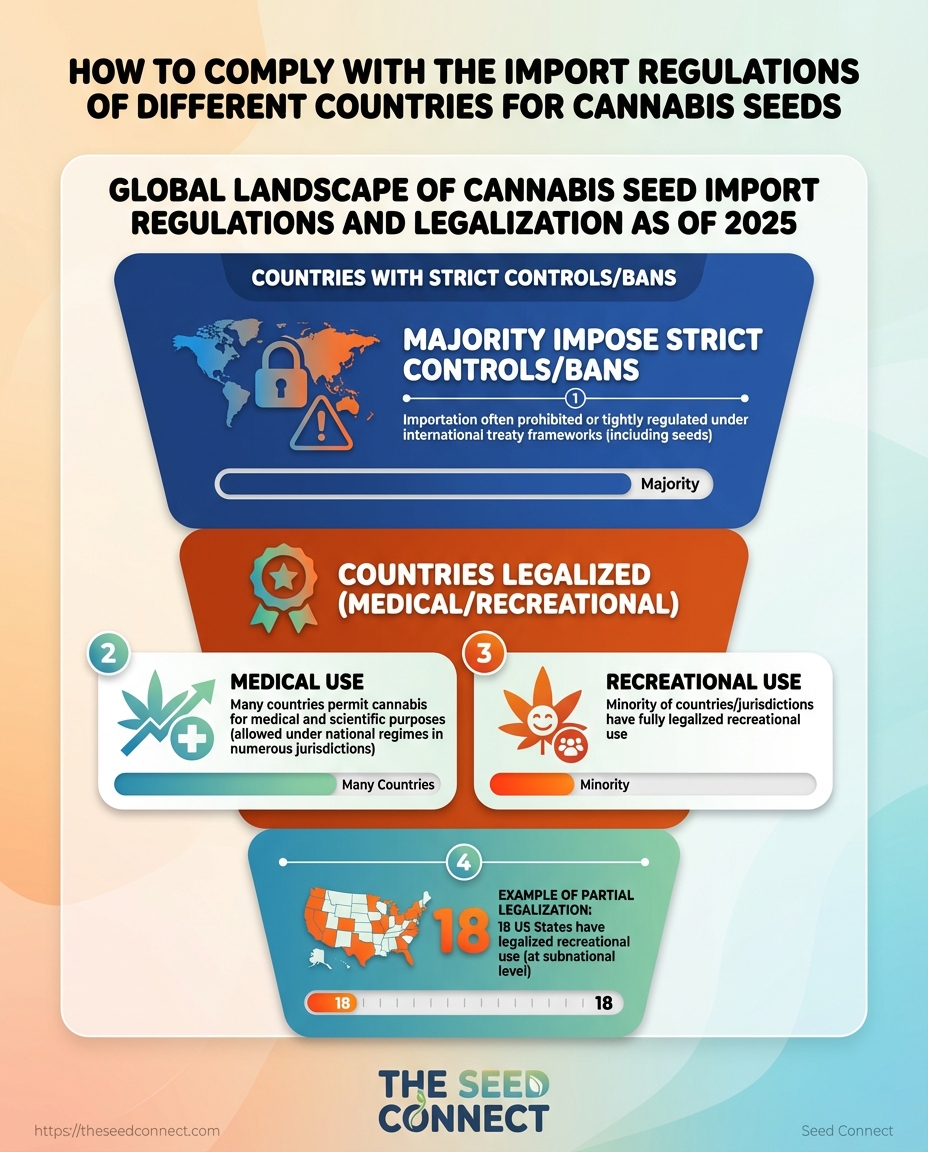
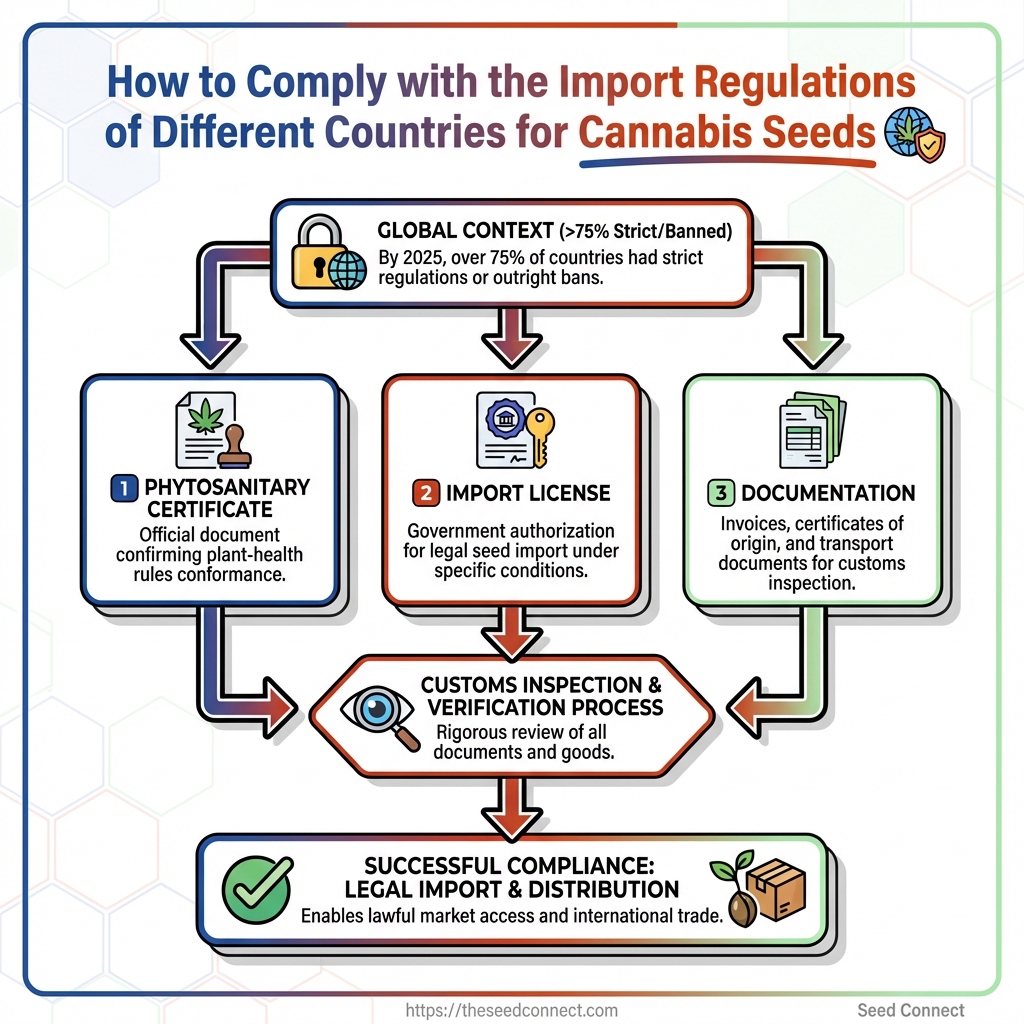
By 2025, around 75% of countries had strict rules or outright bans on cannabis seed imports.
In contrast, 30 countries had legalized cannabis use in some way.
Regulatory frameworks are patchwork: Health Canada, the United States Department of Agriculture (USDA), and the European Union each enforce different tests, permits, and paperwork.
Missing a phytosanitary certificate or the right import license can lead to seizures, fines, and legal exposure for both seller and buyer.
Core risks: legal exposure, seized shipments, damaged reputation
Borders are unforgiving.
A single failed shipment can mean criminal charges in some jurisdictions and steep administrative fines in others.
- Legal exposure: Operating in conflict with local import regulations can trigger investigations and penalties, especially where federal and state laws differ.
- Seized shipments: Without required documents like a phytosanitary certificate, customs can confiscate seeds and destroy them.
- Lost reputation: Publicized seizures or regulatory notices erode buyer trust and make partnerships harder to keep.
How following rules protects your business and customers
Compliance reduces financial, legal, and brand risk.
Paperwork shows due diligence, and following plant-health rules prevents biosecurity incidents that could harm growers.
- Reduced legal risk: Proper import licenses and adherence to
international import lawslower the chance of enforcement actions. - Fewer operational losses: Correct documentation cuts the probability of seizure and the cost of lost goods.
- Customer protection: Ensuring seeds meet local phytosanitary standards protects growers from introducing pests or failing germination tests.
s that matter
Phytosanitary certificate: An official document confirming seeds meet plant-health rules required by the importing country.
Import license: A government authorization that permits legal import of seeds under specific conditions.
Documentation: Invoices, certificates of origin, and transport docs that customs will inspect.
What this guide helps you do and the outcomes to expect
- Get paperwork right so shipments clear customs reliably.
- Match seed shipments to local rules to avoid litigation and fines.
- Build a traceable process that protects customers and brand value.
Expect fewer seizures, clearer audits, and improved buyer confidence when compliance is treated as part of quality control.
Core legal concepts and terms you need to know
Ever wonder why a pack of seeds can trigger a customs hold while a souvenir T‑shirt sails through? Familiarizing yourself with legal terms and how customs views plant materials can help ease your uncertainties when importing seeds.
This section defines the words customs officers and regulators use, shows how seeds get classified, and lists the common legal triggers that cause enforcement actions.
Armed with the correct terms, paperwork becomes predictable and conversations with regulators less stressful.
Regulatory context matters: as of 2025, about 75% of countries had strict regulations or outright prohibitions on cannabis seed imports, while 30 countries had legalized cannabis for medical or recreational use (2025 data).
That split explains why the same package can be legal to one inspector and illegal to another.
Key definitions you’ll see on paperwork and in enforcement
Seeds are simple, but the legal language is precise.
Read these phrases the way a customs officer will.
Seed: A botanical unit capable of producing a plant; legally treated as an agricultural commodity or, in some jurisdictions, as plant reproductive material.
Viability: A measure of whether a seed can germinate and produce a healthy plant; often demonstrated by germination tests or supplier guarantees. viability matters because viable seeds are more likely to be regulated as propagative material.
Hemp vs. cannabis: Hemp refers to Cannabis sativa varieties with low THC levels as defined by local law; cannabis can mean any Cannabis species and often implies psychoactive varieties.
Classification depends on chemical thresholds, not the seed’s appearance.
Controlled substance: A drug or plant product that national law restricts; in many places, certain cannabis varieties or any propagative cannabis material fall under this label and require specific permits.
How customs classifies seeds (and why that changes outcomes)
Customs can treat seeds three different ways depending on laws and paperwork.
- Agricultural product: Treated like grain or feed when non-viable or listed as commodity seed; usually requires phytosanitary clearance.
- Plant material: Treated as living material requiring phytosanitary certificates and possible import licenses to prevent pests and disease.
- Controlled item: Treated under drug or controlled-substance laws when the species or intended use falls under prohibitions; often requires special permits or is banned.
Customs terms and common legal triggers for enforcement
Customs enforcement usually follows paperwork mismatches and biological risk signals.
Watch for these triggers.
The infographic maps the decision flow: how a package moves from “agricultural” to “controlled” status based on documentation, seed viability, and species identification.
Use it as a quick reference when preparing shipments.
Common triggers include mismatched invoices, missing phytosanitary certificates, evidence the seeds are viable, mention of cannabis in paperwork, and lack of an import license when required.
Those items account for most holds and seizures.
Follow the definitions and classification cues above when preparing documentation.
Getting the language right reduces delays and lowers the risk of enforcement.
How countries differ: categories, examples, and practical implications
Ever shipped seeds and wondered why some countries treat them like hazardous cargo? Import rules for cannabis seeds can differ greatly.
These differences affect paperwork, shipping choices, and risks for sellers and buyers.
This section groups countries into clear categories, gives specific market examples, and shows what to do first when entering a new market.
Read this like a field manual — quick, practical, and focused on decisions you actually make.
Countries fall into four practical categories when it comes to cannabis seed importation.
Each category reflects typical permit needs, labelling expectations, and customs reactions.
Openly permitted: Many regulated markets allow seed imports with proper licensing and phytosanitary checks.
Permitted with restrictions: Imports are allowed but need extra documentation, state-level approvals, or limits on seed type (non-viable vs viable).
Restricted: Only certain entities (licensed producers, research bodies) can import seeds; commercial imports are heavily regulated.
Prohibited: Importing any cannabis seed is illegal and often criminalized.
Side-by-side country comparison (practical highlights for sellers and buyers)
| Country/Region | Import status (Permitted/Restricted/Prohibited) | Permit/documentation required | Label/packaging requirements | Typical customs action on non-compliance |
|---|---|---|---|---|
| United States (federal vs state) | Permitted federally for non-controlled hemp seeds; state rules vary | Customs declaration; USDA inspection for plant pests; state permits possible | Declare botanical name and origin; avoid THC claims | Seizure, detention, referral to USDA or state authorities |
| Canada | Permitted with licensing under Cannabis Act | Import permit/license; Health Canada oversight; phytosanitary certificate often required | Licensed-packaging rules; source and strain records | Return to sender, seizure, administrative fines (Health Canada enforcement) |
| European Union (member variability) | Permitted with strict phytosanitary controls | Phytosanitary certificate; member-state notifications | Origin, botanical name, health status per EU Plant Health Regulation | Detention for testing, destruction, or refusal at border |
| United Kingdom | Permitted with restrictions since post‑EU rules | Phytosanitary certificate; possible import licence | Clear origin and content labelling; compliance with GB plant health rules | Hold and inspection; refusal if documentation missing |
| Australia | Restricted — commercial imports tightly controlled | Import permit; quarantine inspection; treatment certificates | Strict biosecurity labelling; declaration of contents | Quarantine detention, destruction, heavy fines |
| Japan | Prohibited or highly restricted | Import generally prohibited for cannabis products; rare research exemptions | N/A for general imports | Criminal seizure and legal action |
| Singapore | Prohibited | Import banned; no permit for cannabis seeds | N/A | Seizure, severe criminal penalties |
| Germany | Permitted with phytosanitary and licensing nuances | Phytosanitary certificate; may require commercial permits | Botanical name, origin, and health declarations | Inspection and return or destruction if non-compliant |
| Netherlands | Permitted with regulatory checks | Phytosanitary certificate; business licensing advisable | Transparent origin labelling; no health claims | Detention and testing; possible confiscation |
The pattern is simple: stricter biosecurity frameworks demand phytosanitary documents and licences.
Missing or incorrect paperwork is the most common cause of seizures.
Practical takeaways by market: what to do first when selling to a new country
Start with a short compliance checklist before quoting or shipping.
- Confirm legal status: Check whether imports are permitted, restricted, or prohibited for that country.
- Identify required documents: Verify if a phytosanitary certificate, import permit, or business licence is needed.
- Align packaging: Ensure labels state botanical name, origin, and omit THC claims where required.
- Plan logistics: Use carriers experienced with agricultural imports and pre-clear customs when possible.
- Ask for buyer credentials: Require buyer’s import license or proof they are an approved business or researcher.
For strain-level details or packaging examples, consult Cannabis Seeds for reference materials and product descriptions.
Start every new market by confirming status and paperwork.
That small step prevents most customs headaches and keeps transactions moving.
Step-by-step compliance checklist before you ship
Ever stared at an order and wondered whether that destination will treat seeds like paper or a seizure risk? That uncertainty is the fastest way to lose time and money on international orders.
Use this checklist to verify all necessary steps and contacts before handing your package to a carrier.
It translates legal requirements into step-by-step actions sellers can complete for each order.
Start early.
Some permits and certificates take days or weeks to obtain, and carriers can refuse consignments at pickup.
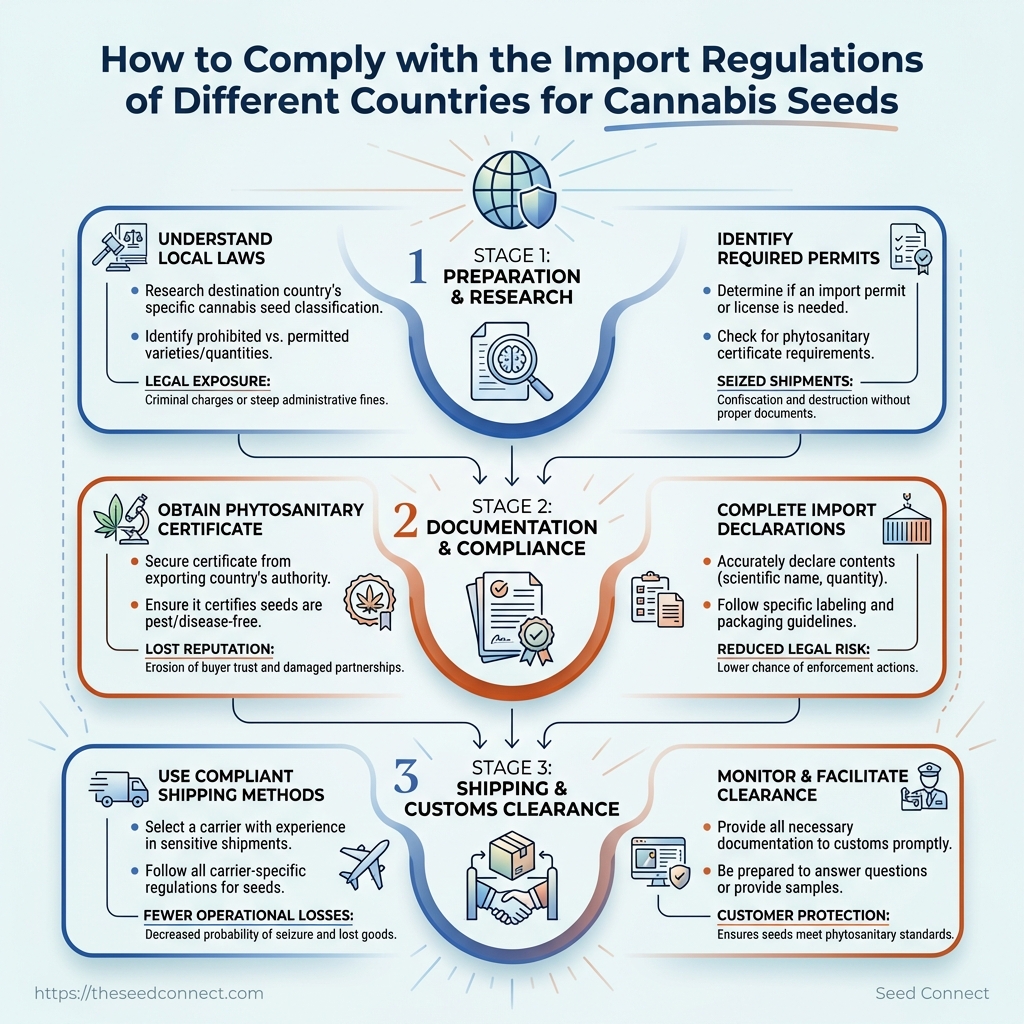
- Confirm legal permissibility for the destination country by checking that country’s import rules and any recent changes to plant-health or narcotics laws.
- Determine seed classification under destination law (
hempvscannabis) and document the legal basis for that classification.
- Request required import permits or licenses from the importer or competent authority; get written confirmation before shipping.
- Arrange a phytosanitary certificate through the national plant protection organization if the destination requires one.
- Verify carrier acceptance and declared route; some carriers ban seeds or require special declarations and routing.
- Prepare accurate customs forms and commercial invoices that match the certificates and labelling exactly.
- Assemble an order-level compliance folder: permits, certificates, invoices, and correspondence.
- Run a final risk check: high-profile destinations, past seizures on similar items, or unclear documentation should trigger legal counsel or customs-broker review.
Pre-shipment verification: product, destination rules, and risk assessment
| Action item | Why it matters | Who is responsible | Proof/document example |
|---|---|---|---|
| Confirm destination country allows import of seeds | Prevents automatic seizure or return; mirrors statutory bans or restrictions | Seller + Importer | Official correspondence from destination customs or agriculture ministry confirming allowance |
| Verify seed classification (hemp vs cannabis) under destination law | Classification changes permit requirements and criminal exposure | Seller with legal counsel | Legal opinion memo or statutory citation showing THC thresholds |
| Obtain required import permits or certificates | Many countries require formal permits before arrival | Importer (seller assists) | Import permit or import authorization letter issued by destination authority |
| Prepare phytosanitary certificate if required | Ensures plant-health compliance under EU and other regimes | Exporter via national plant protection organization | Phytosanitary certificate signed by NPPO (national plant protection organization) |
| Ensure correct labelling and packaging | Mislabelled goods lead to delays or fines | Seller | Pack list, labelled outer packaging showing botanical name and quantity |
| Declare contents accurately on customs forms | Accurate declarations avoid misclassification and seizures | Seller or customs broker | Commercial invoice and customs declaration with HS codes and description |
| Plan shipping route and carrier acceptance | Some carriers and transit countries prohibit seeds | Seller + Logistics provider | Carrier acceptance confirmation email and routing plan |
| Maintain order-level compliance records | Records support appeals and audits | Seller | Digital folder with permits, certificates, invoices, and emails |
Track every document at the order level so any question can be answered within minutes.
When in doubt, delay shipment until permits are clear.
Who to contact before shipping:
- Customs broker: Expert review of forms, tariff codes, and carrier requirements; arranges customs clearance.
- Specialized legal counsel: Legal opinion on classification and risk in the destination jurisdiction.
- National plant protection organization: For phytosanitary certification and export health checks.
- Destination embassy or trade office: Clarification on permit requirements and official contacts.
- Carrier compliance desk: Written confirmation that the carrier accepts seeds on the planned route.
Customs broker: A licensed agent who files customs entries and advises on tariff classifications and documentation.
Phytosanitary certificate: An export document from the NPPO confirming the seeds meet plant-health rules for the importer.
If you ship methodically and keep order-level records, you cut the odds of an unexpected seizure or refusal.
For sellers who want a practical source of compliant seeds and paperwork, services such as https://theseedconnect.com can be a useful reference when preparing documentation.
Documentation, labelling, and packaging best practices
Have you ever had a shipment slowed because a customs officer couldn’t trust the paperwork? A delay can lead to a seizure if import rules are strict.
This is why clear documentation and exact labels are very important.
Clear paperwork, unambiguous labels, and tamper-proof packaging cut inspection time and reduce risk of fines or loss.
With about 75% of countries imposing strict controls on cannabis seed imports as of 2025, treating every document as evidence of compliance keeps goods moving and paperwork defensible.
Practically, follow the importing country’s rules for invoices, phytosanitary certificates, permits, and declarations.
Make those documents readable at a glance and matched to the physical label on the package to avoid red flags under international import laws.
Required documents explained: invoices, phytosanitary certificates, permits, and declarations
Start all shipments with a complete commercial invoice and a clear statement of contents.
Customs officers use invoices to verify value, origin, and purpose.
Missing or vague invoices are the most common trigger for physical inspection.
Invoice: The commercial invoice must list itemized seed varieties, unit counts, value, HS tariff codes, and seller/buyer contact details.
Phytosanitary certificate: Official plant-health certification from the exporter’s national authority confirming the seeds meet the importing country’s biosecurity standards.
The EU often requires this for seeds.
Import/export permit: When a country requires licensing, include a copy of the import permit issued by the destination authority and the exporter’s license.
Customs declarations: Accurate CBP, SAD, or local equivalents that match invoice and permit details.
Declare botanical names, not slang, to avoid misclassification.
Packaging and labelling: what customs look for and how to avoid red flags
Customs looks for mismatches: label vs paperwork, unclear botanical names, and any suggestive branding that implies intent to cultivate where it’s restricted.
Neutral, factual labelling lowers suspicion and speeds clearance.
Aim for plain outer packaging and clear internal packing lists so inspectors can confirm contents without damage.
Use discreet branding and avoid cultivation imagery on exported packages.
- Bold description: Use the scientific name and quantity per packet (e.g., Cannabis sativa, 10 seeds).
- Clear origin: State country of origin and exporter contact details.
- Match paperwork: Ensure the pack label and commercial invoice are word-for-word identical.
- Non-descriptive outer packaging: Avoid logos or images suggesting illicit use.
- Tamper-evident seals: Use seals that show if a parcel was opened in transit.
The visual compares a compliant label and packing list with common non-compliant examples.
It highlights what to show on the outer box, inner pouch, and paperwork to prevent inspection delays.
Recordkeeping: what files to keep and for how long
Keep a single organized repository for every shipment’s invoice, permits, phytosanitary certificates, export declarations, and communications.
Consistency beats shortcuts when regulators ask for proof.
- Keep digital copies of all documents for a minimum of five years, unless local law requires longer.
- Retain correspondence with customs brokers, carriers, and import authorities for the same period.
- Archive batch tracking, seed lot numbers, and customer receipts to support traceability and any future claims.
Store records in searchable formats and back them up offsite.
Good records make audits manageable and protect against retrospective disputes about cannabis seed compliance and international import laws.
Well-prepared paperwork, neutral labelling, and tidy records remove most avoidable snags at customs and make import compliance a predictable part of your operation.
Choosing carriers and handling inspections or seizures
Ever had a courier tell you seeds can’t be shipped and felt the risk spike? Choosing the right carrier can significantly minimize delays and lower the chances of seizures during inspections.
Carrier rules vary by country and by service level.
With about 75% of countries enforcing strict rules or outright prohibitions on cannabis seed imports as of 2025, carrier acceptance is not a technicality — it’s risk management.
This section explains which couriers commonly accept or reject seed shipments, practical steps if customs detains or seizes a parcel, and how insurance and dispute processes can protect money and reputation.
- Common international courier stance: Most major international couriers restrict shipping of controlled plant material; check route-specific policies before booking.
- Service-level restrictions: Express services often have stricter prohibitions than economy routes and may hand over suspicious packages to customs quicker.
- Documentation gatekeepers: Carriers may require
commercial invoice,certificate of origin, or a phytosanitary certificate before accepting a shipment. - Country-specific holds: Routes to jurisdictions with strong agricultural rules — notably the EU, Canada, and the U.S. — face routine inspections and higher seizure rates.
- Declared value and content: Higher declared values invite tighter scrutiny; vague or incorrect content descriptions increase seizure probability.
Responding when customs detains or seizes a shipment
Act quickly and document everything.
Start by confirming the detention through carrier tracking and any written notices.
Keep communications concise and timestamped.
- Contact the carrier and request the official detention reason and a copy of any inspection report.
- Gather and prepare all original documents:
commercial invoice,packing list,certificate of origin, and any phytosanitary certificate relevant to the destination. - Notify the importer or recipient immediately and instruct them to contact their local agricultural or customs authority if necessary.
- If allowed, request an administrative review or appeal through the customs office; follow local timelines precisely.
- Engage legal counsel experienced in customs law when seizures involve significant value or criminal allegations.
This short walkthrough shows the exact documentation to request from carriers and the sequence of contacts to escalate a detained shipment.
When the destination is Canada, reference Health Canada rules under the Cannabis Act.
For U.S.-bound shipments, remember the USDA’s role plus state-level complications.
For EU entries, a valid phytosanitary certificate is often decisive.
Insurance and dispute resolution
Insurance reduces the financial hit but won’t fix regulatory non-compliance.
Protect shipments with a combination of carrier liability and third-party cargo insurance when allowed.
- Declared coverage: Check carrier limits and declare realistic values to avoid underinsurance.
- Third-party cargo insurance: Add gap coverage for regulatory seizures where carrier liability is excluded.
- Evidence packet: Keep a claims file with photos, tracking logs, communications, and all documents to speed claims and disputes.
- Reputation mitigation: Prepare a public statement template and customer support script to preserve trust if a high-value order is seized.
Phytosanitary certificate: A government-issued document verifying seeds meet plant-health standards.
Bill of lading: The contract of carriage the shipper gets from the carrier; keep the original for claims.
Platforms like https://theseedconnect.com can simplify documentation and offer support when dealing with detained shipments.
Choose carriers and prepare paperwork as if a shipment will be inspected.
That approach prevents most problems and makes the rare seizure a solvable one.
Practical examples and FAQs from real orders
Ever had an order sit in customs with no explanation? That lingering uncertainty is the single most common complaint from sellers and buyers working across borders.
Real orders reveal predictable mistakes and a short list of questions that keep coming back.
Regulations change fast.
Remember that 75% of countries had strict regulations or outright bans on cannabis seed imports as of 2025, so small errors invite big delays or seizures.
These examples show what actually happened and how teams fixed it.
Short case studies: common pitfalls and how they were fixed
- Missing phytosanitary certificate: A small vendor shipped seeds without a
phytosanitary certificate; the package was held for inspection. The fix was obtaining the certificate and resubmitting paperwork with a clear certificate of origin. Shipments cleared within 72 hours after documentation was corrected.
- Incorrect commodity code: An EU-bound package used the wrong HS code and triggered a plant‑health audit. Adding the correct HS code and a short technical description of the seed type eliminated the audit on re‑submission.
- State vs federal confusion in the U.S.: A buyer in a medical state assumed local legality covered imports. The carrier refused shipment once federal rules were checked. The resolution was cancelling the international leg and arranging a domestic transfer under USDA guidance.
- Unlabelled experimental genetics: Customs flagged unfamiliar cultivar names as potential non‑native species in the EU. Providing breeding records and a permit from the exporting country satisfied EU plant‑health concerns.
Top 10 FAQs buyers and sellers ask
- Do I always need a
phytosanitary certificate? Often yes for international shipments; many countries require it to certify pest-free status.
- Will a small sample get through unnoticed? Small size doesn’t guarantee safe passage—75% of countries had strict rules in 2025.
- Can I rely on a courier’s advice? Couriers know logistics but not legal nuance; confirm with regulatory guidance from Health Canada, USDA, or EU plant‑health rules when relevant.
- What paperwork speeds clearance? Clear invoice, certificate of origin,
phytosanitary certificate, and correct HS code.
- Are permits different for medical vs recreational markets? Yes—national regimes vary; what’s allowed for medical may still be restricted for personal or commercial import.
- Do I declare seeds as “plant material”? Use precise descriptions and legal terminology to avoid misclassification.
- How long does re‑export take after a seizure? Times vary; corrected paperwork can shorten timelines but expect days to weeks.
- Can private buyers import for research? Research imports often need special permits or licenses.
- Is lab testing required on arrival? Some jurisdictions require testing for pests or THC content; check local rules first.
- Who pays duties if returned or seized? Contracts should define responsibility; otherwise the shipper often bears costs.
When to get legal advice: red flags that require counsel
- Complex cross-border permits: Multiple national permits or conflicting rules by origin/destination.
- Seizure with criminal allegations: Any suggestion of criminal liability requires immediate counsel.
- Large commercial shipments: High-value or high-volume orders trigger tighter enforcement.
- Novel genetics or non‑native species concerns: If authorities question ecological risk, get legal help.
Practical paperwork and early legal checks prevent most headaches.
A little preparation saves days, not just dollars.
Ongoing compliance: monitoring law changes and scaling international sales
Ever wondered how a small change in a country’s rule can pause a week’s worth of orders? This sudden risk is why you need a regular monitoring routine instead of just checking the laws once.
Maintain a living compliance system that combines automated alerts, jurisdictional checklists, and clear escalation paths.
Track headline regulators—Health Canada, the United States Department of Agriculture (USDA), and EU Plant Health rules—because their updates often cascade into other markets.
Data helps prioritize effort.
As of 2025, about 75% of countries had strict rules or outright bans on cannabis seed imports, while 30 countries had legalized cannabis for medical or recreational use.
That split means monitoring must be continuous, not occasional.
Setting up a country-monitoring routine and alert sources
Start by mapping every market you ship to and assigning a risk tier: high, medium, low.
- Create a single spreadsheet or database that lists country, regulator contact, required certificates, and last-checked date.
- Subscribe to official feeds from national agencies (e.g., Health Canada, USDA, EU plant-health notices) and add RSS or email alerts.
- Use commercial regulatory-monitoring tools for automated country alerts, and tag alerts by impact (shipment hold, paperwork change, licensing).
- Schedule a monthly review for medium/low-risk countries and a weekly review for high-risk ones.
- Build an escalation flow so product, shipping, and legal teams act within 24–72 hours of a rule change.
What success looks like: updates captured within 48 hours and flagged orders paused before dispatch.
Internal policies and staff training for repeat compliance
Documented procedures stop guesswork.
- Policy: Define mandatory pre-shipment checks and who signs off on them.
- Training cadence: Run brief compliance refreshers every quarter and role-specific drills twice a year.
- Audit schedule: Conduct surprise file audits monthly for high-risk routes.
Phytosanitary certificate: A government-issued health document certifying seeds meet importing-country plant-health rules.
Import permit: A formal authorization from the destination country allowing the seed shipment.
Training should include sample seizure scenarios, decision trees, and clear owner assignments for remediation.
Using partners and third-party services responsibly
Partner risk is company risk.
Vet carriers, customs brokers, and fulfillment centers for seed-specific experience.
- Partner vetting checklist: proof of prior seed handling, local licensing knowledge, and insurance confirmation.
- Contract clauses: require notification timelines, liability for misdeclared paperwork, and cooperation in inspections.
- Data sharing: exchange only necessary shipment data and store audit trails for two years.
Suppliers and platforms such as platforms like https://theseedconnect.com can be useful references for compliant genetics and paperwork practices.
Keeping monitoring systems, trained staff, and careful partners in sync dramatically reduces surprise holds and scales international sales without multiplying legal risk.
Stay curious; small updates often have big consequences.
Close the loop on cross-border seed shipments
Staying informed about changing import rules can make all the difference between a smooth delivery and facing a seizure at customs.
Treat import regulations like a living checklist: accurate paperwork, correct HS codes, lab certificates, and carrier selection aren’t optional details — they determine whether a shipment clears or stalls.
The practical examples and the step-by-step compliance checklist showed how small fixes—clear labeling, a matching phytosanitary or lab report, and a carrier briefed on inspections—change outcomes for real orders.
Paying attention to those specifics turns international import laws from a guessing game into a repeatable process.
Start today by picking one target market and run the compliance checklist for that country: confirm required documents, verify HS codes, and call your chosen carrier to confirm inspection procedures.
Subscribe to the destination’s official import notices and consider tools like The Seed Connect for reliable seed sourcing and paperwork support as you scale.