

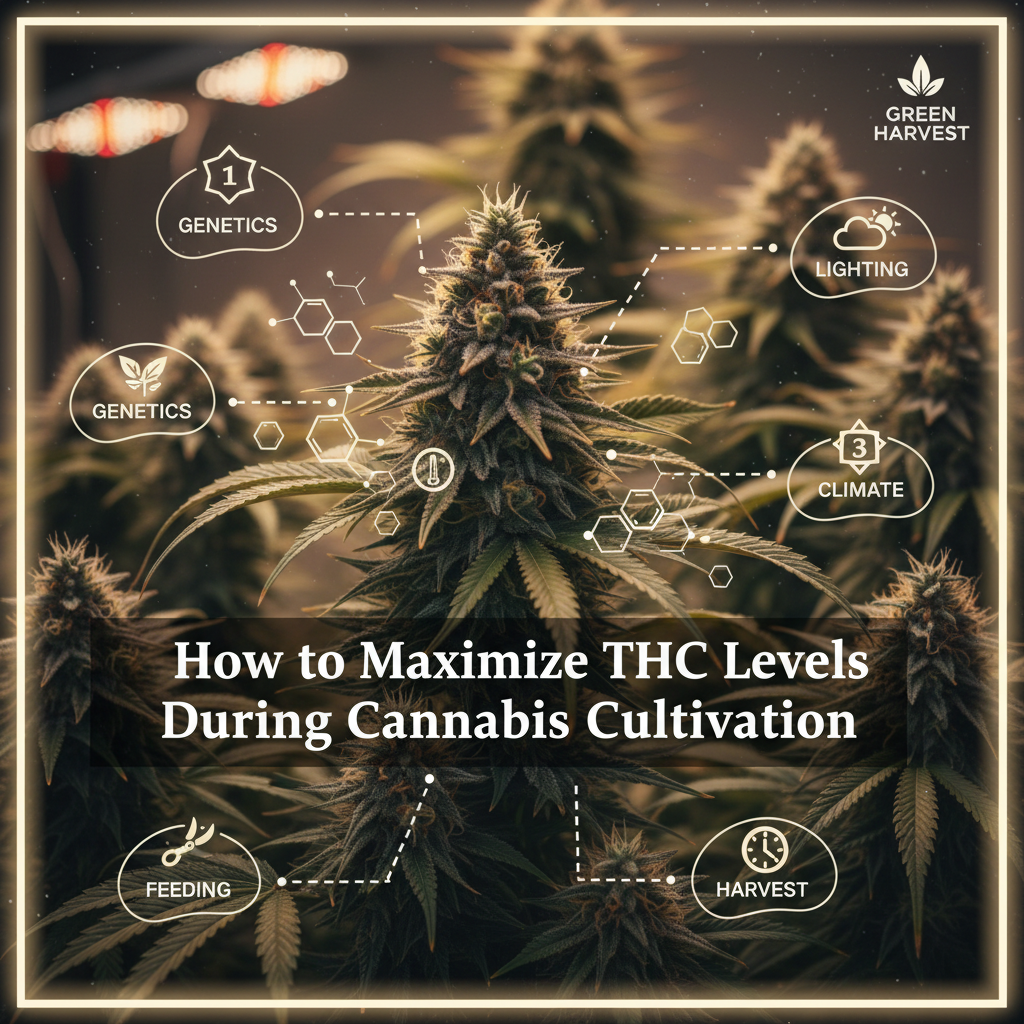
Learning How to Maximize THC Levels During Cannabis Cultivation starts with understanding that potency is influenced by both genetics and growing conditions. Genetics establish a plant’s THC potential, while factors such as light, nutrition, temperature, plant health, and harvest timing can influence how that potential is expressed.
The Seed Connect’s genetics content also makes an important point: high-THC genetics provide potential, not a guaranteed final percentage, because environmental conditions still affect the result. In this guide, The Seed Connect explains the main cultivation factors that can influence THC levels and which practices are worth focusing on.
Quick Answer: Maximizing THC is about aligning what the plant can convert into resin—without stressing it into “more inputs” mistakes. Choose genetics that match your grow schedule and space, keep late-flower light strong and even across the whole canopy, maintain a stable late-flower climate (temperature/humidity/VPD), feed conservatively with clean root-zone conditions, and time harvest based on trichome maturity (not only the calendar).
Table of Contents
What Really Affects THC Levels in Cannabis?
Two plants can look almost identical and still finish very differently at harvest.
That is where a lot of growers get tripped up.
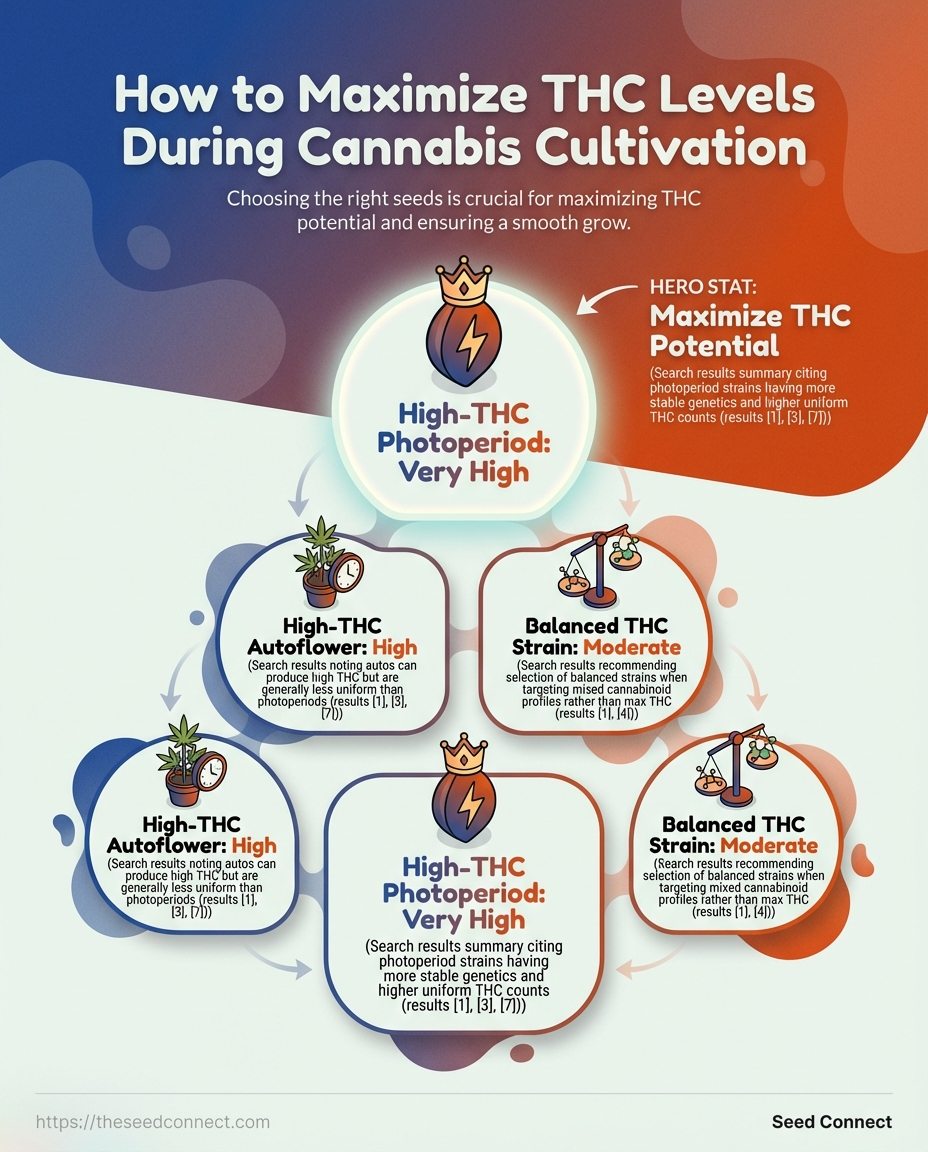
Genetics set the ceiling. If a plant’s lineage is not built for high cannabinoid production, no amount of fancy cultivation techniques will turn it into something it is not.
The strongest runs usually start with stable, well-bred material, then get pushed closer to their potential by the environment.
Growing conditions decide how close you get. Strong, direct light across the whole canopy matters, especially late in flower, because uneven light leaves potency on the table. Grow Weed Easy’s 2026 guide on bigger yields and more THC makes that point clearly, and it lines up with what experienced growers see in real rooms.
Hey Abby’s guide to growing cannabis with higher potency THC levels also notes that proper temperature and humidity can improve THC outcomes, while Soft Secrets’ article on climate, lighting, and CO2 ties potency to balanced indoor conditions.
The biggest misconception is that more input always means stronger flower. Extra nutrients do not automatically raise THC.
Neither does blasting the room with heat, or stacking on CO2 without fixing light, airflow, and plant health first.
- Genetics first: The cultivar decides the upper limit for THC potential.
- Light second: Buds need strong, even light exposure to develop fully.
- Climate matters: Temperature, humidity, and
VPDshape how efficiently the plant grows. - CO2 helps only in context: Enrichment around
800–1,000 ppmcan support heavier growth in well-lit rooms, but it is not magic. - Harvest timing counts: Cutting too early leaves potency unrealized; waiting too long can blur the effect and profile.
A lot of people trying to maximize THC chase one variable and ignore the rest.
The better move is simple: start with strong genetics, then give the plant the right environment to express them.
Strong cannabis starts before the first leaf unfurls.
After that, the room, the rhythm, and the timing do the rest.
Start With the Right Seeds
A flashy THC number on a seed pack can be a trap.
If the breeding line is messy, the plant may never live up to the label, no matter how careful the grow is.
The safer move is to start with proven genetics and stable traits.
That matters because strong genetics give your cultivation techniques something real to work with, instead of trying to rescue a weak line later.
Germination quality matters just as much.
A seed that sprouts quickly and evenly gives you a cleaner start, a more predictable canopy, and fewer surprises in the early weeks.
> GrowWeedEasy’s 2026 guide on bigger yields and more THC notes that every bud site needs strong, direct light to finish well, while Atami’s indoor growing guide on higher cannabis yields puts genetics right beside light, nutrients, and plant training as major drivers of output.
Comparing seed choices for THC-focused grows
| Seed option | THC potential | Flowering time | Grow difficulty | Best for |
|---|---|---|---|---|
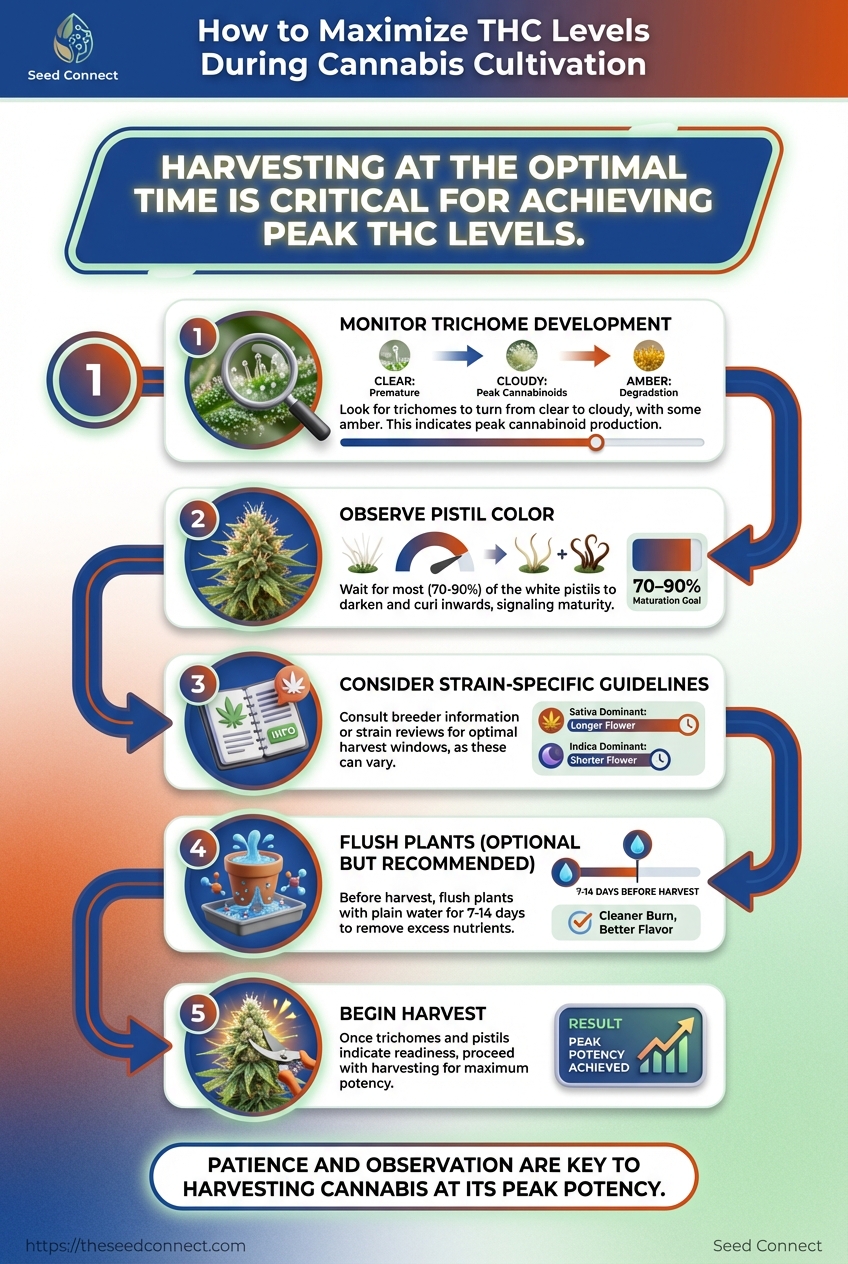
| High-THC photoperiod strain | Highest ceiling when the breeding line is proven | Usually 8-10+ weeks | Moderate to advanced | Growers who want more control and a longer finish |
| High-THC autoflower | Strong, with less room to stretch than elite photoperiods | Usually 10-12 weeks from seed | Beginner-friendly to moderate | Faster cycles and smaller spaces |
| Balanced THC strain | Moderate-high, with steadier overall expression | Usually 7-9 weeks | Beginner-friendly | Growers who want consistency over chasing one huge number |
| Seed Connect cannabis seeds | Curated genetics backed by a germination guarantee | Varies by cultivar | Easy to moderate, depending on the line | Growers who want vetted options and a cleaner start |
A solid breeder line usually beats a loud claim on a glossy label.
The point is not just to grow high THC cannabis once; it is to get repeatable results across more than one run.
Stable traits matter because they make the plant easier to read.
When a line throws uniform growth, you can apply cultivation techniques with more confidence, and the environment does its job without fighting the genetics.
Our Cannabis Seeds selection is built around that idea.
Clean germination, honest genetics, and a predictable start save a lot of frustration later.
Dial In the Light Environment
A flowering plant sitting under weak light is like a runner trying to finish a race in flip-flops.
The genetics may be there, but the room around the plant is quietly deciding how much resin it can make.
If the goal is to maximize THC, light is not a background detail.
It is one of the biggest levers in the room, especially once flowering starts.
Grow Weed Easy notes that buds need strong, direct light across the canopy to push production at harvest, and that simple idea still catches a lot of growers off guard in 2026 (Unlock Bigger Yields & More THC).
The trick is balance.
Too little light leaves flower sites underfed.
Too much heat or a badly shaped canopy can stress the plant and waste output, even when the fixture itself is strong.
Give flowering plants the intensity they can actually use
Flowering cannabis wants more punch than the vegetative stage.
Many growers chase brighter lights, but the real win comes from getting even coverage across the tops, not just blasting the center cola.
A practical way to think about it is this: if lower buds stay shaded, they usually lag behind.
That means the plant spends energy on parts that never really finish well.
High-intensity LEDs can help here, but only when the canopy is flat enough to catch that light evenly, as discussed in Soft Secrets’ guide to indoor climate and lighting with CO2.
Match the light schedule to the plant type
Photoperiod plants and autoflowers do not want the same routine.
Photoperiods usually need a flowering schedule change to trigger bud production, while autoflowers keep moving on their own timetable.
> Proper temperature and humidity also shape potency during flower, according to Hey Abby’s cannabis potency guide.
That matters because light is never acting alone.
If the room is too hot, the plant can’t use intense light as efficiently.
If the schedule is off, even a strong fixture can feel oddly underwhelming.
Balance distance, heat, and canopy coverage
This is where most cultivation techniques get real.
Fixture height changes both intensity and heat load, so the sweet spot is usually the place where the top of the canopy gets strong light without bleaching or curling.
- Start with canopy shape. Keep tops even so the light hits more flower sites at the same level.
- Check heat at bud height. Warm air near the top can cook the plant long before the leaves look unhappy.
- Watch the lower nodes. If the bottom half is dark, you are paying for light the plant never fully uses.
That balance is what separates a decent run from a true grow high THC cannabis setup.
Once the canopy is even and the light is matched to the room, the plant can spend more energy on dense, resin-heavy flowers.
Feed Plants for Resin Production Without Pushing Too Hard
A plant can be fed plenty and still make softer, less aromatic flowers if the mix is too hot.
When the goal is to grow high THC cannabis, the smarter cultivation techniques are usually the calmer ones.
The trick is to feed for steady growth, not for bragging rights on a bottle label.
Balanced nutrition keeps metabolism moving, while root-zone stress can slow uptake and dull cannabinoid development.
That idea shows up in broader grow guidance too, from Atami’s indoor cannabis yield guide on nutrients, light, CO2, and more to Hey Abby’s guide to growing cannabis with higher potency.
Support healthy growth with the right nutrient balance
| Factor | Why it matters | What to watch for | Common mistake |
|---|---|---|---|
| Nitrogen balance | Enough nitrogen supports healthy leaf function, but too much keeps plants too leafy in flower. | Dark, glossy leaves, heavy clawing, and weak bud development. | Keeping veg-level nitrogen too high after the stretch. |
| Phosphorus and potassium in flower | These support energy transfer, flower building, and overall bloom performance. | Dull bloom growth, weak stacking, or leaves fading too early. | Dumping in extra bloom food instead of feeding at a steady rate. |
| Micronutrients | Iron, magnesium, calcium, and trace elements keep enzymes and chlorophyll working. | Interveinal yellowing, twisted new growth, or stalled tops. | Ignoring micros because the plant is still “mostly green.” |
| Feed strength and runoff | A moderate feed with healthy runoff helps prevent salt buildup and lockout. | Rising EC, crispy tips, or a root zone that dries out unevenly. | Chasing bigger numbers without checking what the roots actually receive. |
A plant that gets clean, balanced food usually flowers with less drama.
Once the root zone starts fighting salts or swings in pH, resin production is often one of the first things to suffer.
Root health is the part growers miss most.
Fine roots do the real work, and they hate soggy media, stale air, and heavy-handed feeding.
A simple rhythm works best: feed moderately, keep the medium airy, and watch the plant instead of the bag directions.
If the leaves stay upright, the tips stay clean, and runoff stays in range, the plant has room to spend its energy where it matters.
Control the Climate Around the Plant
What happens when the canopy looks perfect, but the room keeps swinging from damp to dry? The plant spends energy coping instead of building clean, dense flower.
Flowering is where temperature, humidity, and airflow start acting like a team.
When the room stays comfortable and the air keeps moving, buds mature more evenly and the plant stays under less stress, which supports the conditions growers want when they try to maximize THC.
That matters even more if you are running a more advanced room.
Guidance from Hey Abby’s article on growing cannabis with high potency THC levels notes that proper temperature and humidity can positively affect THC levels, while Soft Secrets’ guide to indoor climate and lighting with CO2 puts climate control right beside VPD and CO2 as a core part of high-performance grows.
Keep the room calm
A lot of growers try to “force” results with hotter rooms or drier air.
That usually creates more stress than progress.
Instead, keep flowering conditions steady and boring.
A consistent room helps the plant move water predictably, keeps transpiration in a good range, and reduces the little stress spikes that can slow maturation.
- Hold temperature steady: Avoid big day-to-night swings that make the plant keep adjusting.
- Lower humidity as flowers fill out: Dense buds trap moisture fast, so the room should not feel muggy.
- Keep airflow gentle but constant: Leaves should flutter, not whip around.
- Match the room to the stage: A flowering space should feel different from veg, with less humidity and more attention to bud-zone air movement.
Airflow should move through the canopy
A fan blasting one side of the plant is not the goal.
Even airflow across and through the canopy helps stop still, humid pockets from forming deep inside the flowers.
That kind of pocket is where problems start.
It can also lead to uneven growth, with the outer tops drying out while the middle stays too damp.
A simple example: imagine two identical rooms, one with a soft cross-breeze and one with dead zones behind the plants.
The first usually finishes cleaner because the plant is never fighting stale air.
Stability beats drama
If CO2 is part of the setup, climate control matters even more.
MeritusGas’ guide to cannabis CO2 enrichment points out that around 800–1,000 ppm is a common target range for enrichment, but that only helps when the rest of the environment is already in order.
The same idea shows up in Atami’s article on higher cannabis yields with indoor growing, nutrients, light, CO2, and more: the best results come from the whole room working together, not one flashy input doing all the work.
Rooms that stay predictable usually grow better flower than rooms that keep making dramatic moves.
Calm climate, steady airflow, and fewer swings leave the plant free to do what it was bred to do.
Train and Prune With Purpose
A crowded plant usually spends too much energy defending weak inner growth.
The tops look busy, but the best flowers often sit in the shade.
That is why canopy work matters so much when the goal is to grow high THC cannabis.
A more open top lets more bud sites catch usable light, and a 2026 Grow Weed Easy guide on exposing every bud site to strong, direct light makes the same point from a yield angle.
Low-stress training is the gentler way to get there.
Instead of forcing the plant into a hard reset, you bend and tie stems so growth spreads outward, which lines up well with the broader cultivation techniques discussed in Atami’s guide on plant training and indoor yield.
- Start early, not late. Train while stems are still flexible, usually during vegetative growth, so the plant shapes itself without a fight.
- Keep the center open. Pull the tallest stems outward and create a flatter top. That keeps the middle from becoming a dark tangle.
- Prune with a purpose. Remove small, weak shoots and leaves that never see real light. Leave healthy fan leaves alone unless they are clearly blocking productive growth.
- Watch the recovery. If the plant pauses hard after a cut, the pruning went too far. A little slowdown is normal; a stalled plant is not.
There is a line between useful cleanup and overdoing it.
Heavy stripping can slow a plant down, and that matters more when flowering is already underway.
For that reason, many growers save bigger cuts for earlier growth and keep late flowering changes light, especially when they are following indoor cultivation techniques meant to support potency, as noted in Hey Abby’s guide to higher-THC cannabis growing.
A clean canopy does more than look tidy.
It helps the plant put its effort where the best flowers form, and that is where the payoff usually shows up.
Harvest at the Right Time for Peak Potency
What looks finished on day 56 can still be early.
The calendar gives a rough window, but trichomes tell the truth.
That matters because harvest timing changes the final effect, not just the yield.
A few extra days can shift the balance from sharper and more upbeat to heavier and more sedating, which is why this step matters so much when you want to maximize THC.
Read trichomes instead of guessing
A small loupe or pocket microscope beats guessing every time.
Check several buds from the top, middle, and lower canopy, because ripening never happens perfectly evenly.
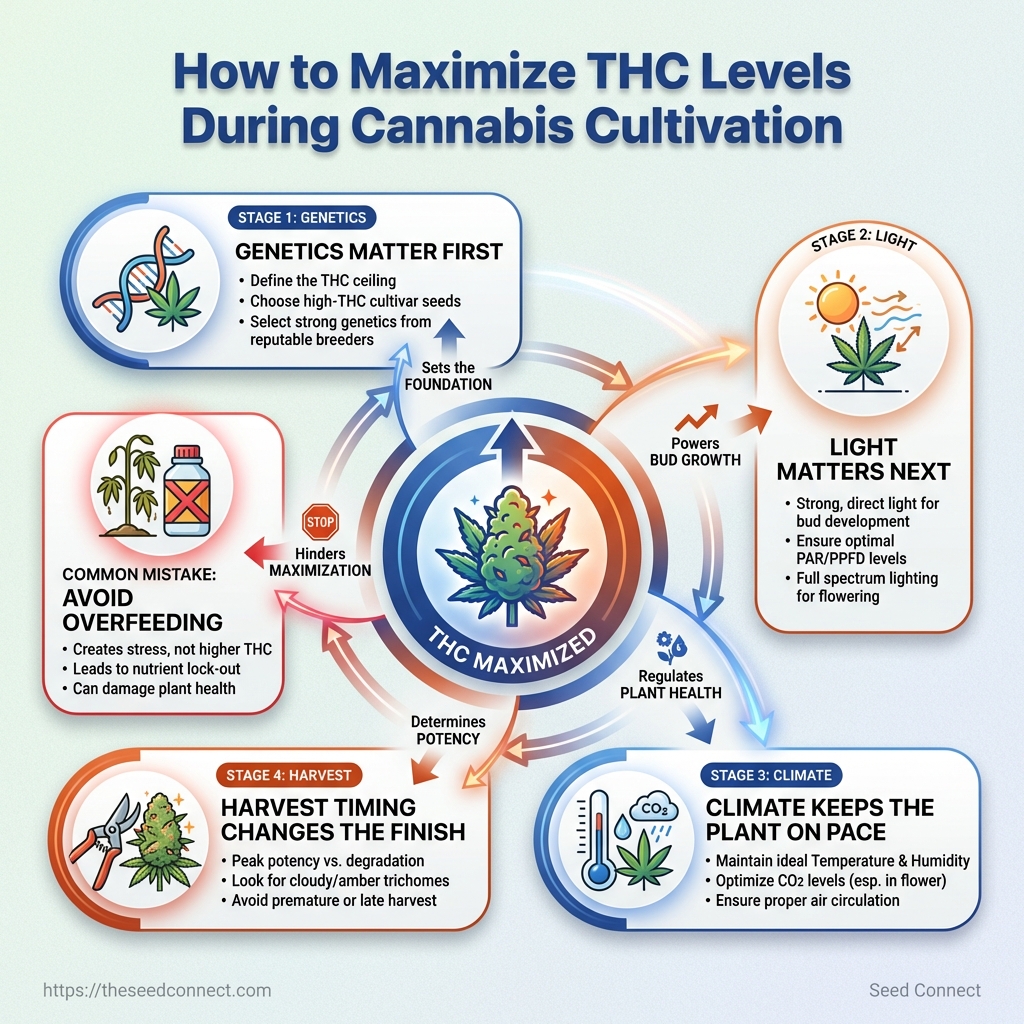
The trichomes are the tiny resin heads, and their color tells you where the plant stands. Clear usually means too early, cloudy is the classic potency window, and amber points to a more mature, heavier finish.
- Mostly clear: Wait longer. The plant is still building.
- Mostly cloudy: This is the sweet spot for many growers who want strong, bright effects.
- Some amber: Expect a rounder, calmer result.
- Mostly amber: The effect usually feels more sedating, and THC has started moving past peak freshness.
Grow Weed Easy notes that strong light on every bud site helps maximize THC near harvest, which is one reason even ripening matters so much in the final stretch: Grow Weed Easy’s 2026 guide on bigger yields and more THC.
Why harvest timing changes the effect
A plant chopped too early often feels less complete.
The aroma can seem thin, and the high may come across as racy instead of rounded.
Wait too long, and the profile shifts again.
Some growers like a little amber for a deeper finish, but pushing past that window can dull the brighter edge people usually want from high THC cannabis.
Don’t ruin the work after the cut
A perfect harvest can still lose quality fast in drying and curing.
Heat, direct light, and rushed airflow can flatten terpene loss, and that makes the flower feel weaker than it really is.
- Dry too hot: The outside crisps before the inside settles.
- Jar too early: Trapped moisture can lead to a harsh, grassy result.
- Over-dry first: The flower becomes brittle and loses aroma fast.
- Expose to light: Resin and scent take a hit.
A careful dry and cure does not create THC out of thin air.
It simply protects the quality already there, which is half the battle in good cultivation techniques.
A good harvest window, a calm dry, and a patient cure do more for final quality than most people expect.
If the goal is strong flower that still tastes and feels right, this is the moment to slow down.
Common Mistakes That Lower THC Potential
A lot of growers blame the plant when the real problem is the setup.
Too much food, too much light, stale air, or a weak seed line can quietly cap THC before the buds ever finish stacking.
Those mistakes are sneaky because each one looks fixable on its own.
In practice, they pile up fast and push the plant toward stress instead of resin production.
Overfeeding is a classic one.
Heavy nitrogen or salty feed can keep flowers from maturing cleanly, while light stress from an overcooked canopy can bleach tissue and slow the plant down.
Grow Weed Easy’s 2026 guide on stronger light exposure and THC makes the same point in a simple way: every bud needs usable, direct light, not just more watts.
Poor airflow causes its own problems.
Stale pockets around dense growth make the room feel heavier, and the plant spends energy coping instead of building better flowers.
The mistakes that show up most often
- Overfeeding: Dark, clawed leaves and stalled growth usually mean the plant is getting more than it can process.
- Light stress: Strong light only helps when the canopy can handle it without bleaching, curling, or fading.
- Poor airflow: Weak air movement traps moisture and heat around the plant, which slows clean flower development.
- Harvesting too early: The calendar is a guess; immature flowers often look ready before they actually are.
- Harvesting too late: Waiting too long can dull aroma and flatten the effect you were aiming for.
- Starting with weak genetics: No amount of care turns average breeding into elite flower.
Why genetics and timing matter so much
A strong grow can improve a good plant, but it cannot fully rescue a poor one.
That is why Atami’s indoor growing guide on light, nutrients, and genetics treats breeding quality as a real part of the final result, not an afterthought.
Timing matters just as much.
Hey Abby’s guide to potency and environment also points to temperature and humidity control as part of the potency picture, which is another reminder that finishing clean is a lot about restraint.
The growers who consistently maximize THC usually avoid heroic mistakes first.
That leaves the plant room to show what it already had in it.
A grow room can be dialed in perfectly and still miss the mark if the seed line is shaky.
That is why the first decision matters so much: quality genetics set the ceiling before the first leaf even opens.
When growers want to grow high THC cannabis, the smartest move is to start with seeds that fit the room instead of forcing the room to rescue weak genetics.
Grow guides keep pointing to the same big levers—strong direct light matters, but so do genetics, plant training, and the rest of the environment (according to Grow Weed Easy’s 2026 guide on bigger yields and more THC and Atami’s overview of indoor cannabis cultivation factors).
That is where our role fits in.
We focus on seeds that give growers a cleaner starting point, plus a germination guarantee and real support when a run needs a quick answer instead of guesswork.
A good match usually comes down to setup, not hype:
- Small spaces: Autoflowers can make sense when height and turnaround matter more than a long veg period.
- Controlled indoor rooms: Feminized seeds fit growers who want fewer surprises and a more predictable canopy.
- Potency-first runs: High-THC seed selections work best when the rest of the plan already supports strong light, stable climate, and patient finishing.
- Troubleshooting help: Expert support matters when a sprout stalls, a seedling looks off, or a choice between two varieties comes down to one detail.
There is also a practical side to the guarantee: if a seed does not pop, the problem is not just the lost seed—it is the lost time in a cycle that was planned around it.
A strong high-THC plan starts with seeds that fit the space, the schedule, and the grower’s patience. The rest of the cultivation techniques only work better when that first choice is solid.
Potency Is Built Piece by Piece
THC is what you get when genetics, environment, and the final finish all let the plant express what it’s capable of.
If you want the simplest example of how one “link” matters: harvest timing. A harvest that’s too early can leave peak potential unmade, while a careless finish after harvest (especially heat/light during dry and overly rushed curing) can take away quality that was already produced.
Run a quick grow audit and fix the biggest limiter first:
- Genetics fit: Does your strain match your space and schedule?
- Light coverage: Is the lower canopy getting usable light in late flower?
- Late-flower stability: Are temperature and humidity kept steady as buds pack in?
- Root-zone health: Are you avoiding salt buildup/pH issues by feeding moderately and watching runoff?
- Harvest by trichomes: Are you harvesting when maturity is actually there?
When those pieces are right, the rest of your cultivation choices have a chance to show up in the final flower.