



You open your inbox and discover a customs notice: a wording change abroad just stopped a seed shipment.
One line in a regulation can mean weeks of delay and major headaches.
The global picture is messy: countries and U.S. states vary in how they treat seeds, and policy moves faster than many growers expect.
With 33% of U.S. states legal for recreational use, the patchwork makes staying current on cannabis law changes essential.
Trusted sources track these updates in near-real time.
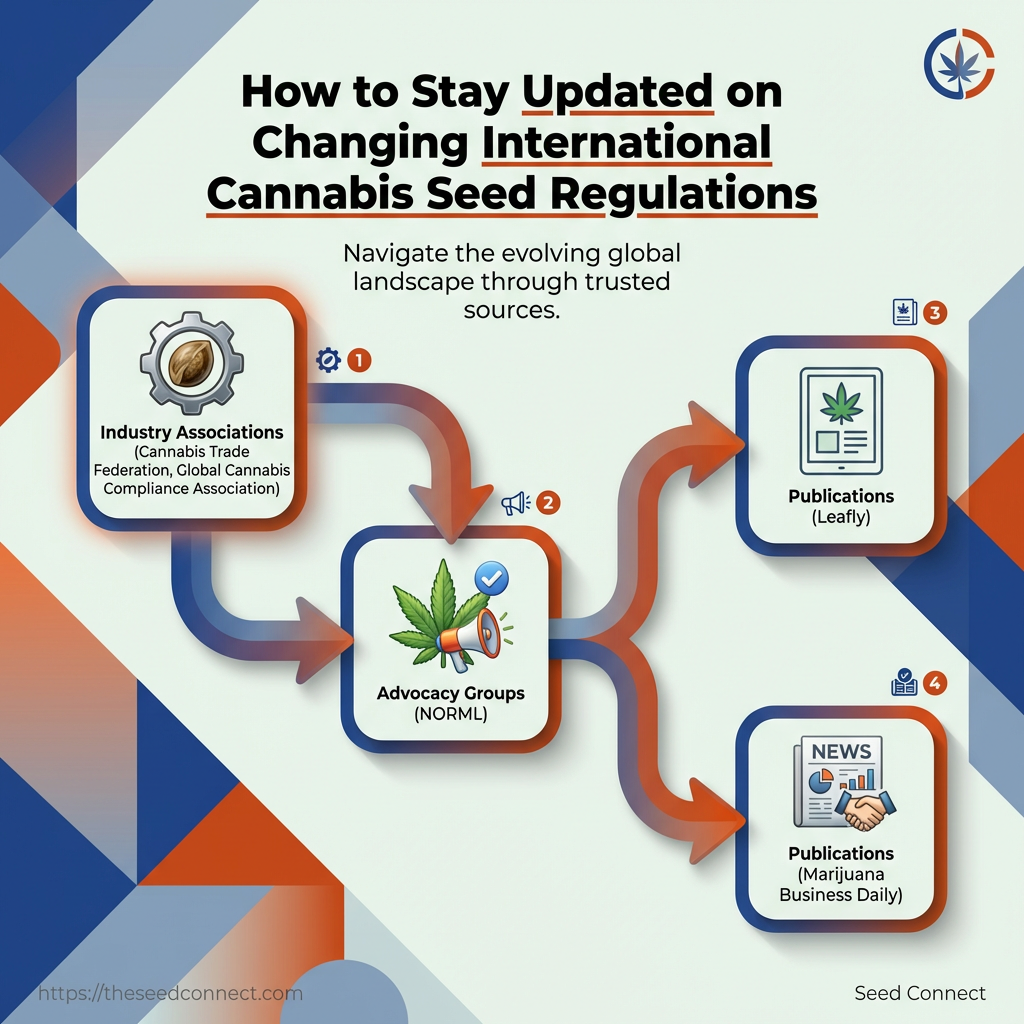
Groups like the Cannabis Trade Federation, Global Cannabis Compliance Association, and NORML, along with publications such as Leafly and Marijuana Business Daily, are invaluable.
To stay ahead of international cannabis seed regulations, build routines around alerts, source verification, and a compliance log.
Practical monitoring doesn’t require a legal degree.
With the right feeds, basic verification steps, and daily checks, teams can stay nimble as rules shift.
Table of Contents
Why international cannabis seed rules change (and what that means for you)
Operational steps: staying compliant when buying or shipping seeds
When to call for expert help and how to ask the right questions
You hit a roadblock: spotting the moment a law changes
Ever had a checkout fail mid-buy and felt your stomach drop? For cannabis businesses and home growers, that moment often signals more than a payment glitch. It can be the first sign that a customs rule, a payment-processing restriction, or a local ordinance just shifted under your feet.
Those micro-failures—an order held at customs, a suddenly blocked checkout, or a new label demand—are practical alarms. They announce that regulators or banks are enforcing a rule differently.
Because 33% of U.S. states allow recreational cannabis as of 2023, regulations are fragmented and change frequently across borders and even between neighboring counties.
Spotting the moment a law changes is both pattern recognition and quick verification.
A paused shipment means check three things immediately: the shipper’s note, the customs reason code, and whether the issue is systemic or isolated.
That first scan tells you whether you’re reacting to a one-off logistic hiccup or to an emergent legal shift that needs a different response.
The illustration shows a simple flow: order placed → customs check → hold/clearance.
It highlights the touchpoints where regulation changes most often affect the journey, like documentation checks or payment flags.
When that red flag appears, these next moves keep you ahead.
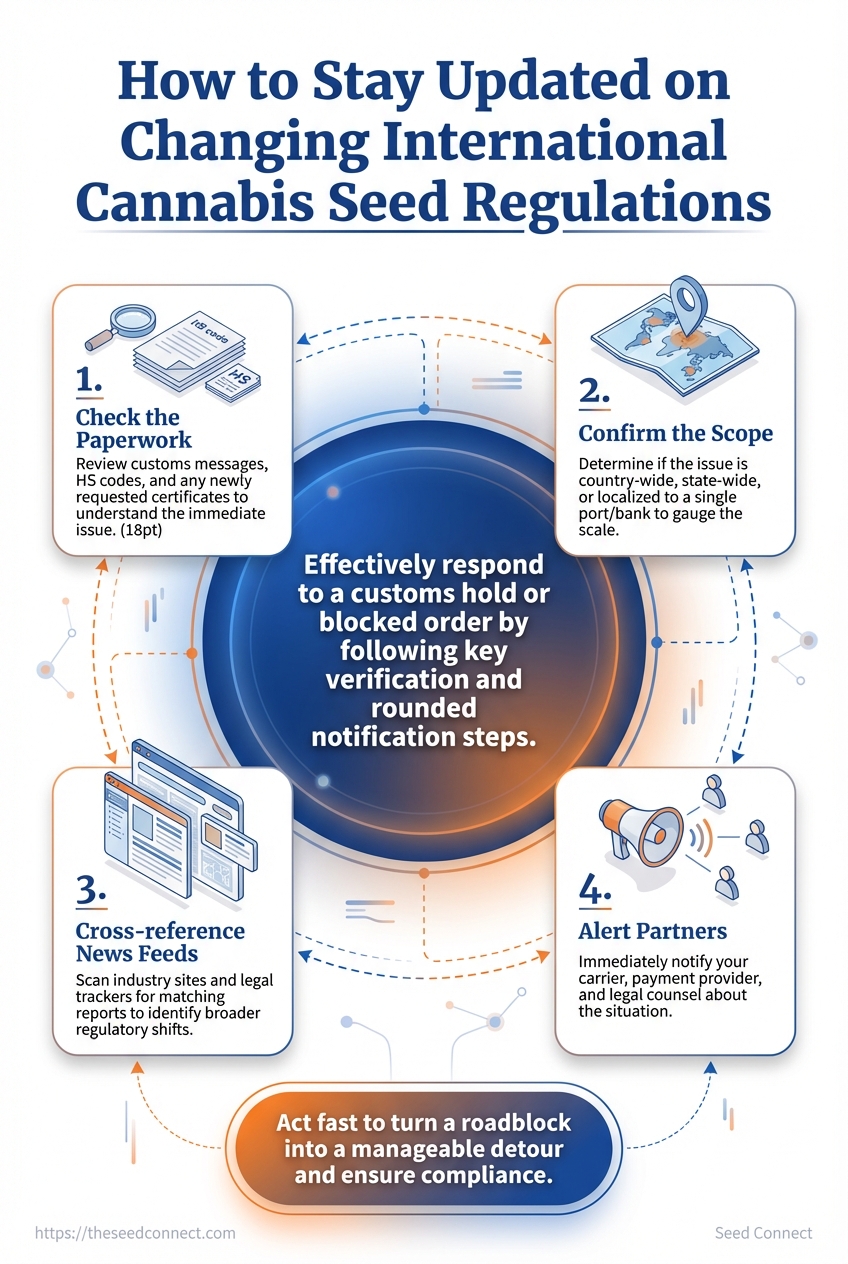
Check the paperwork: Review customs messages, HS codes, and any newly requested certificates.
Confirm the scope: Is this country-wide, state-wide, or a single port/bank?
Cross-reference news feeds: Scan industry sites and legal trackers for matching reports.
Alert partners: Notify your carrier, payment provider, and legal counsel immediately.
Verify the source.
Look for official agency notices or carrier reason codes before assuming a legal change.
Search industry trackers.
Services like Lexology and Westlaw, plus cannabis outlets such as Leafly and Marijuana Business Daily, often flag regulation updates faster than general news.
Tap the community.
Organizations like the Cannabis Trade Federation, the Global Cannabis Compliance Association, and NORML often discuss regulatory shifts and practical impacts.
Regulatory trigger: A specific event or enforcement action that indicates a change in how rules are applied. A short delay can mean a major legal shift because enforcement timing is the enforcement.
Acting fast—verify, notify, document—turns a roadblock into a manageable detour.
Stay curious and stay connected; that’s how you stay updated on cannabis regulations and keep operations moving.
Why international cannabis seed rules change (and what that means for you)
Regulatory shifts rarely happen in a vacuum.
Politics, international agreements, and enforcement trends push laws one degree at a time, and those degrees add up quickly for anyone buying or shipping seeds across borders. When a government changes tone—either tightening controls or relaxing them—that signals administrative rewrites, new customs practices, and sometimes sudden restrictions on shipping.
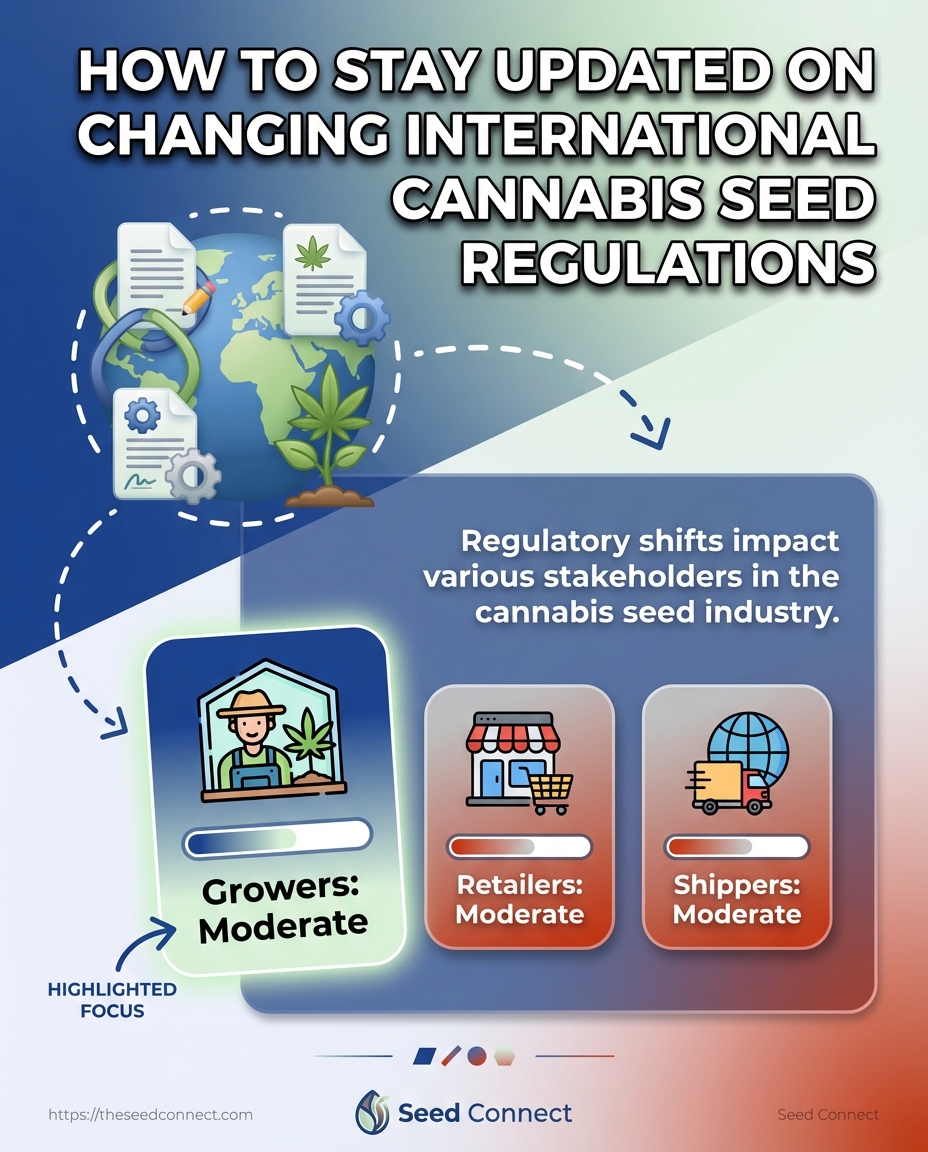
That ripple affects growers, retailers, and shippers differently depending on wording, definitions, and enforcement priorities.
Many people assume “legal” equals “safe to ship.” That isn’t true once definitions like viable seeds, genetic material, or commercial intent enter the text.
Small edits to a single clause can convert an ordinary parcel into evidence of wrongdoing.
Common drivers behind rule changes
Political shifts are the obvious driver.
Election results, coalition deals, and public referendums change priorities fast.
When a new party picks a harder stance, enforcement budgets and customs scrutiny often follow.
Treaty updates and international posture matter too.
States aligning with new treaty language or international guidance will adjust domestic law to stay compliant.
That can create rapid divergence between neighboring countries.
Enforcement trends are quieter but decisive.
Customs agencies adopt risk models that flag certain HS codes or sender countries.
A spike in seizures leads regulators to change administrative rules without a full legislative process.
Political shifts: Elections and government priorities reshape enforcement and legal language.
Treaty and international guidance: Changes at the international level prompt fast domestic updates.
Enforcement policy changes: Customs risk models and prosecutor priorities can change how laws are applied.
Administrative definitions: Small wording changes—like
viableversusnon-viable—directly affect shipping permissions.
How tiny wording changes break shipments (and what to watch)
Imagine a law replacing seeds for cultivation with seeds containing viable genetic material.
That single adjective can turn a permitted item into contraband for export-import controls.
Another typical shift is adding an intent element: possession with commercial intent versus possession for personal use.
That changes packaging, quantities, declarations, and whether an item gets seized.
To stay ahead, subscribe to legal update services (for example, Lexology or Westlaw), follow industry bodies like the Cannabis Trade Federation and NORML, and monitor compliance resources from the Global Cannabis Compliance Association.
Regulatory language moves slowly on paper and quickly in practice.
Stay alert, because a single line edit can change whether your next order arrives or disappears in customs.
Reliable primary sources to monitor regularly
Start where the law is written.
Monitor official government portals, customs pages, and national legal gazettes first — they publish the actual texts, guidance, and enforcement notices that change what you can ship or grow.
These sources are where temporary restrictions, tariff notices, import permits, and new criminal provisions appear before anyone else summarizes them.
Add industry legal trackers and a few high-quality news outlets to catch interpretations and practical guidance.
Services such as Lexology and Westlaw will flag amendments and regulations; cannabis-focused outlets like Leafly and Marijuana Business Daily surface the operational impact faster than most official Q&As.
Trade groups and compliance associations also push timely alerts when enforcement patterns shift.
What to check on government portals and customs pages
Government sites vary, but the same checklist applies across jurisdictions.
Look for newly published regulations, emergency measures, customs directives, and updated permit procedures.
Publication date: confirm when a rule was signed and its effective date.
Scope language: scan for terms like seeds, propagules, hemp, controlled substance, and import/export.*
Permits & forms: note any new permit numbers, supporting documents, or inspection requirements.
Customs notices: watch tariff codes (HS codes) and quarantine or phytosanitary holds.
Contact points: save the official email or helpline listed for import inquiries.
These items translate legal text into operational checks you can act on before a shipment is started.
Official gazettes and legislative trackers for top sending and receiving countries
Comparison table: Official gazettes and legislative trackers for top sending and receiving countries
Country/Region | Primary source (agency/portal) | Update frequency | What to watch for (keywords/sections) | How to access (RSS/email/portal link) |
|---|---|---|---|---|
United States (federal & selected states) | Federal Register; U.S. Customs and Border Protection; state legislative portals (e.g., California Legislative Information) | Federal Register: daily; CBP notices: as issued; state trackers: real-time during sessions | controlled substances, import permits, HS codes, state-exemptions, hemp definitions | RSS feeds and email alerts on Federal Register; CBP email notices; state bill‑tracking/alerts |
Netherlands | Staatsblad / Government.nl; Douane (Dutch Customs) | Staatsblad: daily publication of laws and decrees | Opium Act amendments, import restrictions, customs rulings | Official portal RSS/email bulletins; customs portal notifications |
Spain | Boletín Oficial del Estado (BOE); Agencia Tributaria customs announcements | BOE: daily | Penal code amendments, phytosanitary requirements, customs circulars | BOE email alerts and RSS; Agencia Tributaria portal |
Canada | Canada Gazette (Part I & II); Canada Border Services Agency (CBSA) | Canada Gazette: Part I regularly (weekly); Part II when regulations are registered | Schedule listings, regulatory amendments, import permits, hemp definitions | Gazette subscription emails/RSS; CBSA notices and trade bulletins |
Australia | Federal Register of Legislation; Australian Border Force notices | Federal Register: updated as laws are registered (frequent) | Controlled substances lists, permit conditions, biosecurity measures | RSS/email notifications on Federal Register; Border Force alerts |
Japan | Official Gazette (Kanpō); Japan Customs announcements | Kanpō: regular/daily for promulgations | Narcotics control acts, import clearance rules, quarantine | Kanpō subscription services; customs press releases |
Germany | Bundesgesetzblatt; Bundeszollamt (customs) | Bundesgesetzblatt: published when laws are promulgated (frequent) | Controlled substance listings, import/export provisions, phytosanitary rules | Bundesgesetzblatt portal and email alerts; customs circulars |
The table shows where to go first and what language signals mean a real change rather than a clarification.
Treat RSS/email options as operational lifelines; set them up before you need them.
Monitoring official texts prevents surprises.
If a legal phrase or customs notice looks unclear, treat that moment as a red flag and get the official reference before shipping.
Practical tools and feeds to stay ahead
Information comes faster than anyone can read.
The trick is not consuming everything — it’s funneling only the signals that predict change for your seeds, shipments, or product lines.
A small, well-tuned stack of alerts, RSS feeds, and newsletters will surface regulatory shifts before they become headaches.
Start with a two-layer approach: broad legal trackers for formal notices, and hyper-focused feeds for seed-specific chatter.
Use established legal services and industry outlets for confirmed text; use RSS and social streams to catch interpretations and enforcement whispers.
Remember: 33% of U.S. states had legalized recreational cannabis by 2023, which means rules move in different directions across jurisdictions — tailor feeds to the places you ship to or operate in.
What follows is a step-by-step for building that stack, plus the most useful trackers and practical tips for filtering noise.
How to set up tailored news alerts and RSS feeds
Create a Google Alert with targeted keywords.
Use queries like
intitle:"cannabis seed" OR "seed import" AND (regulation OR ban)and set delivery to daily.Capture web pages and blogs with RSS.
Add feeds to
FeedlyorInoreaderand group them under a collection namedseed-regs.Use advanced search operators to refine signals.
Try
site:gov "cannabis seed"orfiletype:pdf "phytosanitary"to catch official documents and notices.Set filters and rules inside your reader.
In
Inoreader, create an automation to tag articles containingfeminized,autoflower, orhigh THC.Create an escalation rule.
Flag items with words like
ban,customs seizure, orenforcementand forward them to a review folder for legal or logistics teams.Add social and forum monitoring.
Follow subreddits, LinkedIn groups, and hashtags in your reader; set keyword alerts for rapid interpretation from peers.
Archive snapshots.
Save important notices as PDFs or in a knowledge base with the capture date and jurisdiction for future audits.
This short walkthrough shows how to configure Google Alerts and wire them into Feedly or Inoreader, then build keyword filters for seed regulation.
Watch it to see the exact queries and automations in action.
Newsletters, legal trackers and industry feeds to subscribe to
Lexology: Daily legal updates and case alerts focused on legislative changes.
Westlaw alerts: Deep legal research notices and statute updates for jurisdictions you track.
Leafly newsletter: Industry-level reporting and practical news on market shifts.
Marijuana Business Daily: Business-focused regulatory coverage and enforcement reporting.
Cannabis Trade Federation: Advocacy updates and policy briefings that affect commerce.
Global Cannabis Compliance Association: Compliance resources and international regulatory analysis.
NORML: Reform-focused legal updates and ballot-measure tracking.
Filtering, tags and practical tips
Use narrow keywords:
cannabis seed,seed import,phytosanitary,seed phytosanitary certificate.Geo-tag feeds: Add the country/state keyword to filters to avoid cross-jurisdiction noise.
Daily digest: Set one daily digest for your legal team and one for operations.
Test and prune monthly: If a feed gives no useful items after four weeks, remove or tighten it.
For quick reference on varieties and sourcing while you manage feeds, platforms like https://theseedconnect.com offer searchable catalogs that can be cross-checked against alerts.
Keep the stack small, tuned, and reviewed regularly — that’s how you catch law changes before they disrupt business.
How to read and interpret a regulation update
Ever read a regulation update and felt like it was written in a different language? Legal texts hide the practical changes inside definitions, scope shifts, and a handful of operative clauses that actually change what you can do tomorrow.
Start by treating every update like a short story: who it targets, what actions it requires, and whether there’s a deadline.
Move from high-level language to operative clauses, then to penalties and enforcement notes.
Regulation reading is a pattern-recognition exercise.
Once you know the signals, you can sort updates into “informational” or “action-required” within minutes.
Definitions: Verify any new or changed definitions and compare them to your products or operations.
Scope: Check which actors (importers, carriers, retailers, growers) the rule names or implicitly covers.
Penalties: Look for criminal or civil penalties, increased fines, or license revocations.
Transit clauses: Spot language about cross-border transit, carriage, or in-transit exemptions.
Effective date and retroactivity: Note when the change starts and whether it applies to past activity.
A short, practical reading method
First, scan for titles and sections that contain operative verbs like “prohibit,” “require,” or “penalize.” Those are where obligations live.
Second, isolate the definition section and cross‑reference terms used in operative clauses.
A small wording change in a definition can expand regulation to new products.
Third, capture deadlines and transitional rules.
If a rule adds a reporting requirement with a 30‑day deadline, escalate it now.
Red flags vs. routine clarifications — how to prioritize response
Quick decision checklist
Update element | Why it matters | Immediate action | Who to notify (internal/external) |
|---|---|---|---|
New criminal penalties | Raises risk of prosecution and severe sanctions | Pause risky activities; consult counsel; document compliance steps | Legal counsel; compliance officer; senior leadership |
Change in definition of ‘seed’ or ‘cannabis’ | Alters which products fall under law | Map product catalog; update compliance matrix; notify partners | Product team; customs broker; legal |
Cross-border transit clause added | Affects shipments passing through jurisdictions | Halt affected routes; engage customs broker; seek guidance | Logistics; customs broker; legal |
Temporary import ban | Immediate supply disruption and compliance exposure | Secure inventory; notify customers; source alternatives | Procurement; inventory manager; sales team |
Clarification on packaging or labeling | Could invalidate current packaging or trigger fines | Update labels; pull non-compliant stock if required | Packaging; marketing; compliance |
Increased fines for paperwork errors | Higher financial liability for administrative mistakes | Audit recent filings; retrain staff; correct filings ASAP | Finance; compliance; operations |
New export licensing requirement | Prevents lawful export until licenses are obtained | Apply for license; suspend outbound shipments if needed | Export manager; legal; customs |
Changes to testing standards or THC thresholds | Determines pass/fail for batches and marketability | Retest inventory; update QC protocols; inform labs | QC; lab partners; legal |
Grandfathering clause for pre-existing stock | May allow temporary sale of existing inventory | Document manufacture/import dates; confirm applicability | Inventory; legal; sales |
New reporting/traceability obligations | Adds recurring administrative work and data needs | Implement tracking tools; assign data owners | IT; compliance; operations |
Regulatory text often contains both noise and signal.
This checklist separates the two so teams know when to act immediately and when to log a change for future policy updates.
When an update looks like a red flag, treat speed as a control.
For routine clarifications, schedule a compliance update and a communication to downstream teams. With practice, interpreting regulation updates becomes a routine part of operations rather than a crisis.
Operational steps: staying compliant when buying or shipping seeds
Shipping cannabis seeds across borders or even between states requires checklist discipline more than luck.
Start every transaction assuming there’s some legal nuance that could trigger a hold, seizure, or fine.
Treat paperwork, routing, and carrier choice as the critical controls that determine whether a shipment moves or stalls.
Operationally, the minimum actions are simple: confirm the legal status at the destination and along the route, secure whatever official documents the destination requires, and pick carriers with a proven track record handling botanical or regulated agricultural items. Keep a paper and digital audit trail for each shipment so you can demonstrate due diligence if customs asks questions.
Do not rely on verbal assurances from sellers or carriers.
Get written confirmations about compliance, and keep copies of invoices, packing lists, declarations, and any permits.
Insure higher‑value shipments and use tracked services to reduce time in customs.
Pre-purchase checks: destination rules, transit risks, and documentation
Begin by asking three questions for each order: is import allowed at the destination, will the package transit through jurisdictions that prohibit seed transit, and what documentation is mandatory?
Check laws and enforcement guidance at the destination authority and in any transit countries.
Confirm both import permissions and any seeds‑specific prohibitions.
Request written confirmation from the seller that the seeds match the declared taxonomy and content on paperwork.
Identify required documents: common items include invoices, detailed packing lists, and specific permits or phytosanitary certificates when demanded by the receiving country.
Plan routing to avoid unnecessary transits through countries with hostile enforcement records.
Choose transit windows to avoid public holidays and peak customs backlogs.
Keep contact info for the destination customs office and your carrier’s customs clearance team.
Packaging, declaration, and shipping partners to reduce hold risks
Packaging should be discreet, secure, and designed to prevent botanicals from being mistaken for other products.
Avoid misleading or provocative labels.
Bold, accurate declaration: Use clear, truthful descriptions on commercial invoices and customs forms.
Minimal organic packaging: Avoid loose soil or detritus that suggests active plant material.
Tamper‑evident inner seals: These reduce inspection time and demonstrate care.
Carrier selection: Prefer carriers with a customs brokerage and documented experience with agricultural shipments.
Record retention: Store all shipment records for at least 3 years to support audits or disputes.
The visual shows a short flowchart of the pre‑shipment checklist: verify law → choose carrier → prepare docs → track shipment.
It’s a quick reference for operational teams to follow before hitting “ship.” Phytosanitary certificate: A government‑issued document confirming plant materials meet the importing country’s health standards. Customs broker: A licensed agent who prepares and submits customs documentation and communicates with customs on your behalf.
A disciplined process and the right partner cut hold risks dramatically.
Keep records, ask for written confirmations, and route shipments deliberately — those steps protect the seed and your reputation.
When to call for expert help and how to ask the right questions
Not every compliance wrinkle needs an attorney.
Routine checks, documentation updates, and standard shipping procedures can often be handled in-house with a solid checklist and a few trusted references.
When a rule affects your business model, creates material legal risk, or requires an interpretation beyond plain language, bring in outside help. With 33% of U.S. states legalizing recreational cannabis, regulatory patchwork makes some questions too risky for internal guessing.
Which issues you can handle internally
Record-keeping and standard forms: Keep licenses, invoices, and chain-of-custody records current and scanned. Routine vendor checks: Verify suppliers, run basic sanctions screenings, and confirm shipping terms. Operational SOPs: Update standard operating procedures for packing, labeling, and age-verification workflows.
Issues that should trigger a legal opinion
Cross-border exports or imports: Any international shipment, unclear tariff classification, or customs hold needs counsel. Novel business models: If you plan dropshipping, white-labeling, or cross-state fulfillment with unclear legal precedent, consult an expert. Regulatory ambiguity or enforcement action: Receive a notice from customs, law enforcement, or a regulator? That requires immediate legal review. Contract disputes with material exposure: Large claims, intellectual property issues, or contract terms you don’t fully understand should go to a lawyer.
Questions to ask a lawyer or regulatory consultant
What is the legal risk?: Ask whether a specific action could trigger seizure, fines, or criminal exposure.
Which statute or regulation applies?: Request the exact law, clause, or customs code they’re relying on.
What compliance steps are required?: Ask for a step-by-step list you can implement immediately.
What documentation proves compliance?: Request templates or a checklist of preferred evidence.
What are the timelines and penalties?: Clarify deadlines and worst-case consequences.
How to prepare before the consult
Gather relevant documents: license copies, invoices, shipping records, and any government notices.
Create a concise timeline: list dates, actions taken, and communications with third parties.
Define desired outcomes: be clear whether you need prevention, defense, or transactional advice.
A focused consult saves time and money.
Asking targeted, evidence-based questions gets you practical answers you can act on.
Keeping internal stakeholders and customers informed
When a law or enforcement practice shifts, communication matters more than speed alone.
Clear, short messages prevent confusion, reduce support volume, and keep trust intact.
Customers and internal teams need different levels of detail delivered in formats they’ll actually read.
Start with a single-sentence headline, a one-paragraph explanation of who is affected, and a short action item.
That structure keeps notices scannable for customers and gives staff a concise script to use on calls and chats.
For internal stakeholders, add the legal source, operational impact, and the person accountable for next steps.
Crafting this as a repeatable process makes updates less chaotic.
It also helps the company stay current as cannabis law changes across states and countries — remember, roughly one-third of U.S. states had legalized recreational cannabis by 2023, so regulatory complexity is real and growing.
Writing short, customer-friendly notices
Keep the lead sentence focused on the customer’s question: “Does this affect my order?” Then answer plainly and give one next step.
Headline: One clear sentence stating the change impact.
Who it affects: One short line listing regions or customer types.
What to do: One actionable next step (refund, delay, follow-up link).
Tone: Calm, helpful, and non-legalistic.
Example subject lines and snippets:
Subject: Shipping delay for seeds to [Region]— “Orders to [Region] may be delayed due to a regulatory update.If your order is affected, expect an email with options within 48 hours.”
Subject: Update to cross-border shipping rules— “New paperwork is required for international shipments.If you placed an international order, check your account for required documents.”
Keep templates stored in a shared content file so support uses the same language.
Internal SOP updates and training for support staff
Treat each regulatory change as a mini project with a clear owner and a three-step rollout.
Identify operational impact and write a one-page SOP update.
Create a 15–30 minute training script for front-line staff and run a live Q&A.
Log the change in an internal change register with date, source, and owner.
Practical items to include in the SOP:
Escalation: Who to contact for legal clarifications.
Customer scripts: Two-sentence openings and three resolution paths.
Documentation: Exact documents customers must provide, with examples.
Trainings should be brief, role-specific, and recorded for new hires.
Involve the person who will own customer follow-ups so accountability is visible.
Keeping everyone aligned reduces mistakes and preserves customer confidence.
For those wanting a ready place to source compliant seeds and clear order policies, platforms like https://theseedconnect.com can serve as a user-friendly reference.
Conclusion
Keep a watchful eye — and one clear next step
One crisp line in a foreign regulation can pause a shipment for weeks, so the single most useful habit is simple: treat regulation monitoring as part of daily operations.
That means checking primary sources, parsing wording changes, and translating them into one-line actions for customs and logistics teams so nothing slips through because of an interpretive gap.
Remember the customs notice example where a tiny wording change stopped a seed shipment; that was avoidable with a short checklist and a reliable feed.
Use the practical tools and feeds discussed earlier to run that checklist automatically, and make sure legal language gets routed to someone who reads for intent, not just headlines.
Staying updated on cannabis regulations and tracking cannabis law changes internationally becomes manageable once it’s a routine, not an emergency.
Take a concrete step today: create a daily regulatory update email that aggregates feeds from primary regulators like the SEC, FINRA, and EPA.
Highlight changes relevant to your organization’s operations lead, summarizing key points and implications.
Include links to official documents and a brief analysis of impacts on compliance or reporting.
Use a clear subject line, such as “Daily Regulatory Update: SEC Changes and Compliance Implications.” This routine communication keeps your operations lead informed and promotes proactive compliance, helping your team adapt to regulatory shifts.
If you’re sourcing seeds, prefer vendors who publish compliance info — for example, <a href=”http://theseedconnect.com/marijuana-seeds/”>The Seed Connect cannabis seeds — and assign one person to own international law tracking so the next customs notice becomes a minor annoyance, not a crisis.