

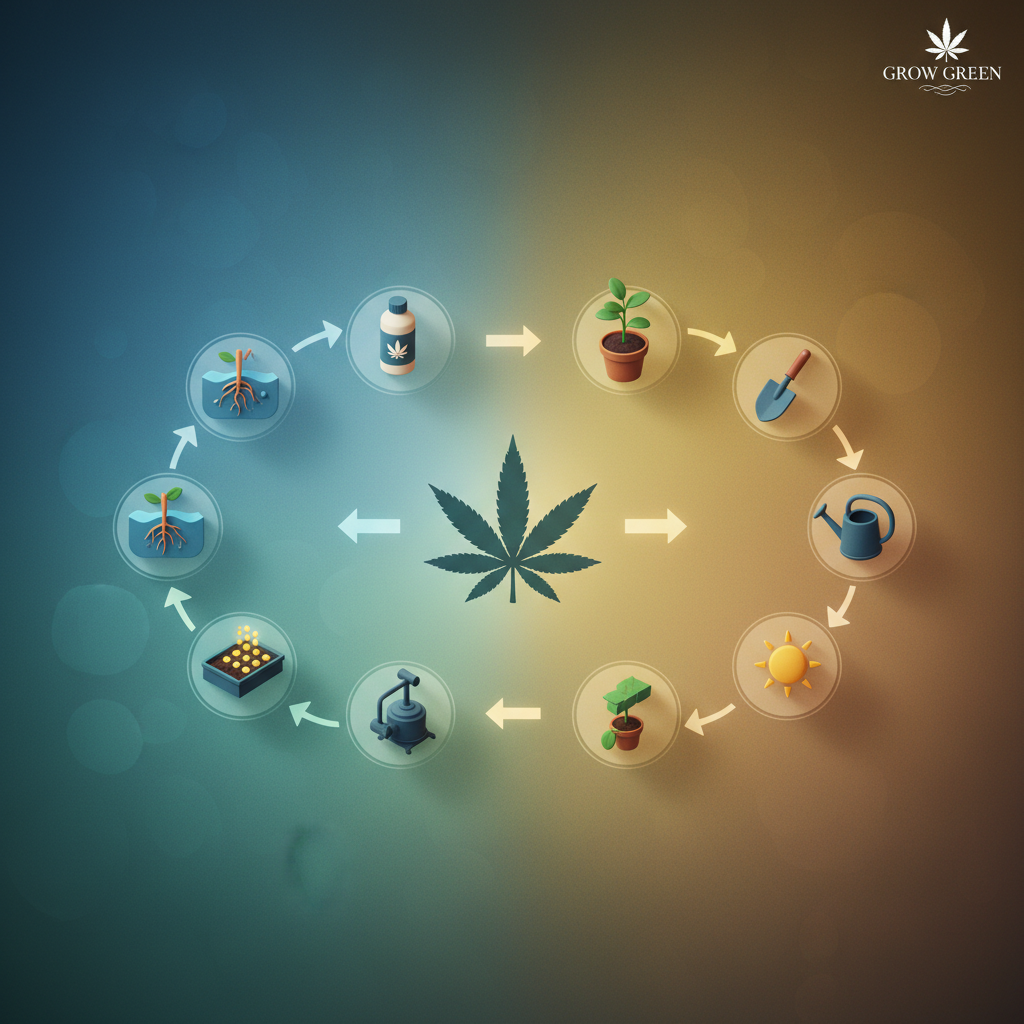
Choosing between Hydroponics vs Soil for Cannabis Cultivation usually comes down to how much control, monitoring, and maintenance you want in your grow. Hydroponic systems give growers tighter control over nutrient delivery and root-zone conditions, while soil offers a more forgiving growing environment that can be easier for beginners to manage.
In this guide, The Seed Connect compares both methods across cost, growth speed, nutrient management, maintenance, and overall difficulty so you can choose the cultivation style that best fits your setup and experience level.
Key Takeaway
- Hydroponics offers greater control and faster adjustments.
- Soil is generally more forgiving for beginners.
- Hydro usually requires more monitoring and equipment.
- Both methods can produce strong results.
- Choose based on your budget, skill level, and maintenance time.
Why growers keep asking this question
Why does one grower swear by hydroponics while another won’t give up soil cultivation for anything? Because these two cannabis growing methods feel different from day one, even before the first real harvest.
Hydroponics is a control-heavy world.
Roots sit in water or an inert medium, and the grower feeds everything on schedule.
That can mean faster growth and tighter control, but it also means mistakes show up fast.
Soil feels more forgiving.
The medium buffers small errors, holds moisture longer, and gives beginners a little breathing room.
Many growers like that it behaves more like a living system than a machine.
The real debate usually has less to do with theory and more to do with daily life.
Time, budget, skill, and patience shape the choice far more than any glossy claim about bigger buds.
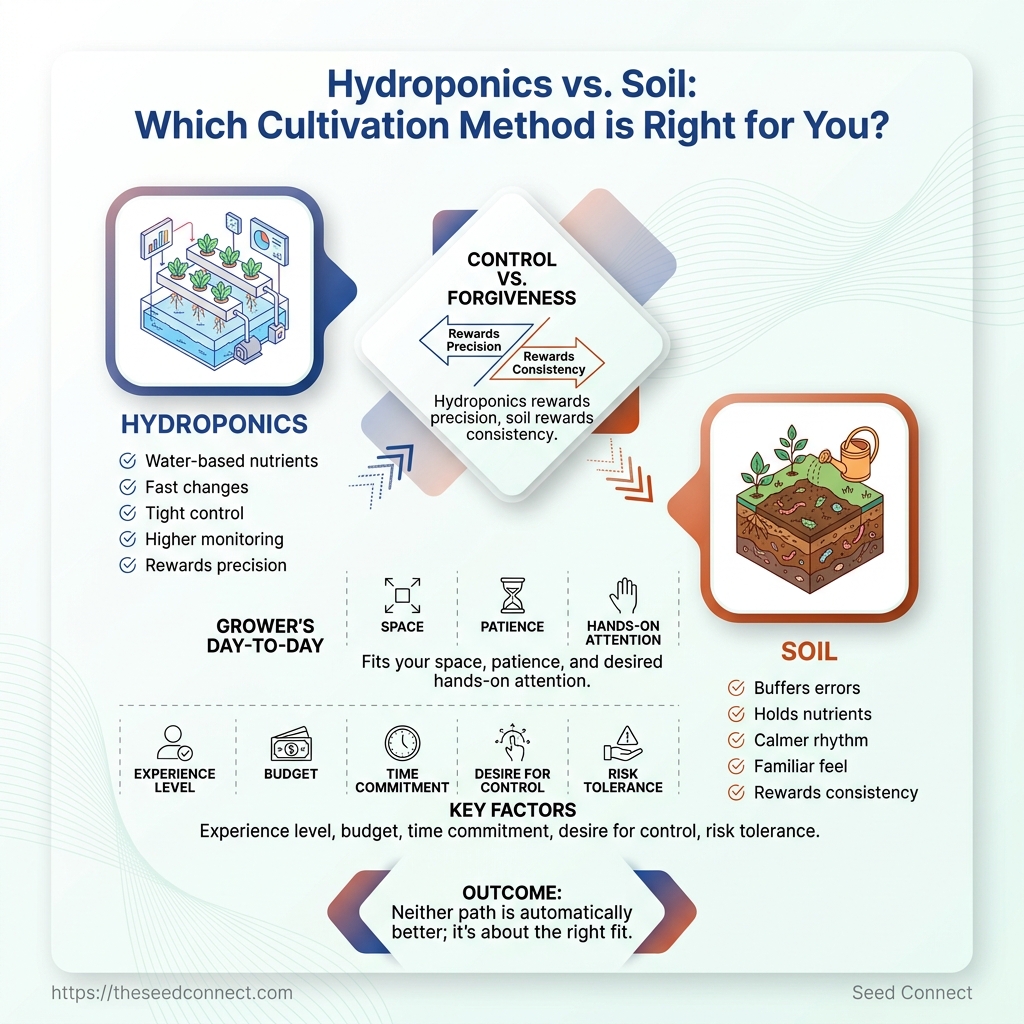
A simple way to think about it is this: hydroponics rewards precision, while soil cultivation rewards consistency.
One is not automatically better, and the “right” choice depends on how much control you want.
Experience level: New growers often prefer soil because it is easier to recover from small mistakes.
Budget: Hydroponics usually asks for more gear, more monitoring, and more upkeep.
Time commitment: If daily checks sound normal, hydroponics can work well.
If not, soil is calmer.
Desire for control: Hydroponics gives tighter control over feeding, pH, and root conditions.
Risk tolerance: Soil hides small errors better.
Hydroponics exposes problems sooner.
Growing style: Some growers want fast, hands-on adjustments.
Others want a slower, steadier rhythm.
A good example is a first-time indoor grower working after hours.
Soil often fits that routine better because it forgives missed watering and minor feed changes.
A more technical grower with a set schedule may enjoy the responsiveness of hydroponics instead.
That tension is exactly why growers keep asking the question.
They are not just choosing a medium; they are choosing a style of growing that has to fit real life.
How hydroponics works for cannabis
A hydroponic room changes the daily rhythm fast.
Instead of feeding the plant through soil, the roots sit in water or a inert medium and get nutrients in a measured solution.
That sounds simple, and that is exactly why it can go sideways.
The whole system depends on pH, nutrient strength, oxygen at the roots, and steady water movement.
In soil cultivation, the medium buffers a lot of mistakes.
Hydroponics gives you less cushion, but it also gives you tighter control over plant feed and root conditions.
Benefits, trade-offs, and common mistakes in hydroponic growing
Hydroponics works best when the grower likes routine.
Check the reservoir, confirm pH, watch the water level, and keep the system clean.
Miss one of those pieces, and the plant usually tells you quickly.
The payoff can be strong.
Roots often get nutrients faster than they do in soil, and that can mean quicker growth and more predictable feeding.
The trade-off is that small errors show up sooner, so sloppy mixing or stale water can become a headache fast.
|
Factor |
Hydroponics |
Why it matters |
|---|---|---|
|
Growth speed |
Often faster than soil cultivation |
Roots receive nutrients directly, so plants can move quickly when the system stays stable. |
|
Nutrient control |
Very precise |
Growers can fine-tune feed levels instead of waiting for soil to release nutrients. |
|
Water use |
Usually lower waste than hand-watering soil |
Recirculating systems reuse water, which can be efficient in a small grow room. |
|
Setup complexity |
Higher than soil cultivation |
Pumps, reservoirs, and timers add moving parts that need regular attention. |
|
Risk of error |
Higher |
pH swings, pump failures, and nutrient mistakes can affect the plant fast. |
|
Best for |
Careful growers who like monitoring |
Hydroponics rewards consistency more than guesswork. |
Common mistakes tend to be boring ones, which is the annoying part.
People overfeed, ignore pH drift, let water temperatures climb, or forget to clean lines and reservoirs.
A good hydro setup is really a water management system dressed up as a grow method.
Once that clicks, the day-to-day work makes more sense, and the difference from soil cultivation stops feeling mysterious.
The plants are still doing the same job.
The grower just has a much tighter steering wheel.
How soil cultivation works for cannabis
Why do so many growers still stick with soil when other cannabis growing methods look cleaner on paper? Because soil gives the plant a slower, steadier path, and that feels natural to a lot of people.
In soil cultivation, the roots grow through a mix that holds water, air, and nutrients at the same time.
The medium does more than anchor the plant.
It also acts like a buffer, which gives the grower a little more forgiveness when feeding or watering gets slightly off.
That margin matters.
A good soil mix can support strong root growth, steady uptake, and a calmer day-to-day routine, especially for people who do not want to chase every small change in the room.
Why growers like it: Soil is familiar, forgiving, and easy to read once you learn the plant’s cues.
What it rewards: Good structure, healthy microbes, and consistent watering usually lead to steady growth.
Where it bites back: Overwatering, compacted media, and weak drainage can slow everything down fast.
Healthy soil is not just dirt in a pot.
It is a living system, especially when growers use compost, worm castings, or other organic inputs that feed microbial life.
Those microbes help break down nutrients into forms the plant can absorb, which is one reason soil often pairs well with a slower, more hands-on style of care.
The trade-off is speed.
Soil usually moves more gradually than hydroponics, so problems can take longer to show and longer to fix.
That said, many growers prefer the extra cushion, especially when they want a more predictable rhythm and fewer daily adjustments.
Start with a light mix: Dense soil holds too much water and suffocates roots.
Water with patience: Let the top layer dry a bit before watering again.
Watch the root zone: If pots stay heavy for too long, drainage needs work.
Keep nutrients simple: Strong feeding schedules often do more harm than good in soil.
Mind pH and consistency: Soil can buffer small mistakes, but it cannot fix sloppy habits forever.
A common mistake is treating soil like a set-it-and-forget-it medium.
It still asks for attention, just a different kind.
When the mix is airy, the watering is measured, and the roots have room to breathe, soil cultivation gives cannabis a reliable, comfortable home.
For growers who want a more forgiving setup, soil still earns its place.
And if the genetics are strong from the start, that gentle pace can be a real advantage.
Hydroponics vs. soil: the side-by-side comparison
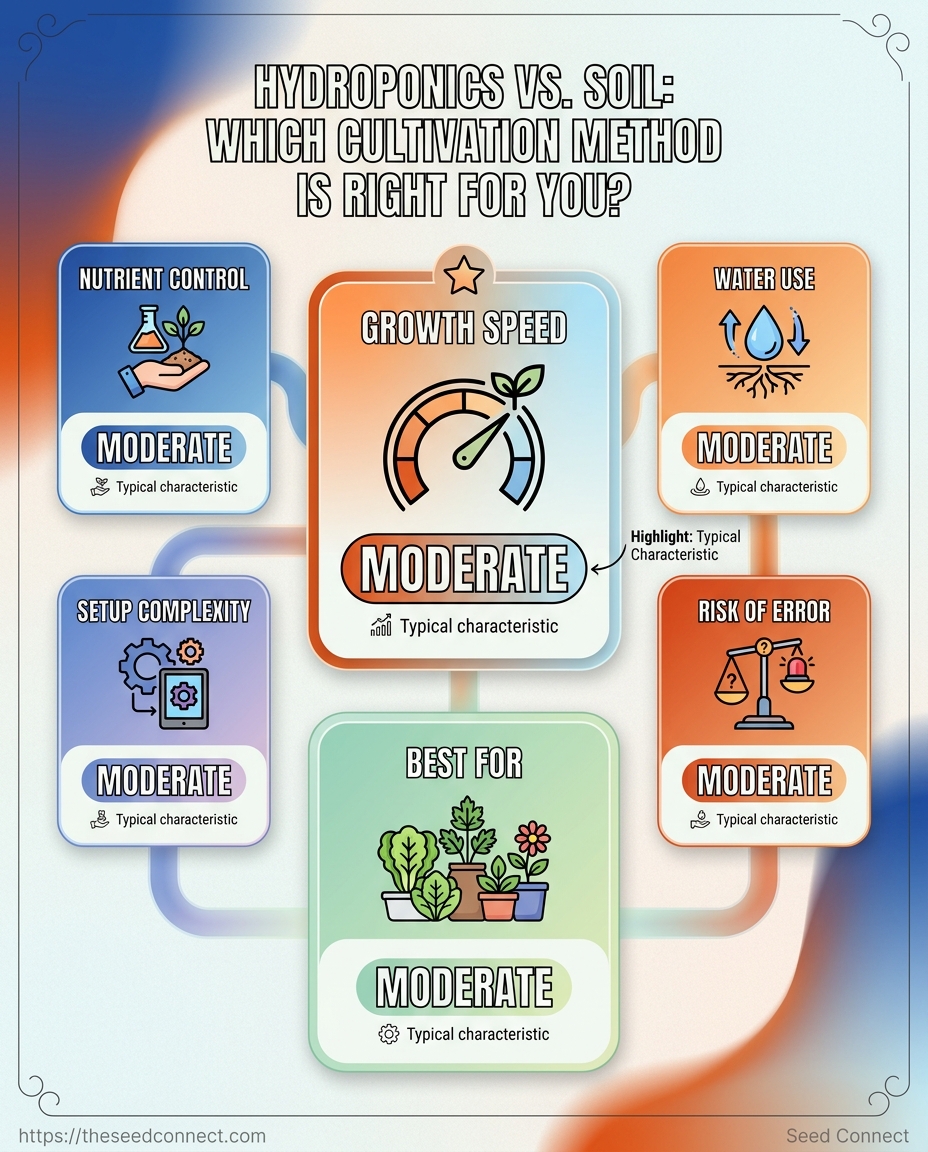
Which one wins depends on what you value most. Hydroponics usually pulls ahead on speed and raw control, while soil cultivation tends to win on forgiveness, simplicity, and that classic growing rhythm many people enjoy.
That tradeoff shows up fast.
A grower chasing tighter cycle times and precise feeding often gravitates toward hydroponics, while someone who wants fewer moving parts usually feels more at home in soil.
The funny part is that both can produce excellent cannabis.
The real difference is how much pressure you want on your day-to-day routine, because these cannabis growing methods ask for very different habits.
Side-by-side comparison
|
Category |
Hydroponics |
Soil cultivation |
Best choice for |
|---|---|---|---|
|
Growth rate |
Usually faster because roots get nutrients directly |
Usually slower, with steadier development |
Hydroponics if speed matters most |
|
Yield potential |
Often higher in controlled setups |
Can be strong, but usually less aggressive per square foot |
Hydroponics for maximum output in tight spaces |
|
Flavor and aroma |
Clean and consistent when dialed in well |
Often favored for richer, more layered expression |
Soil cultivation for growers chasing classic terpene character |
|
Initial cost |
Higher because of pumps, reservoirs, and monitoring gear |
Lower because the setup can stay simple |
Soil cultivation for budget-conscious starts |
|
Daily maintenance |
More hands-on and more technical |
Less frequent and easier to manage |
Soil cultivation for growers with busy schedules |
|
Error tolerance |
Low; mistakes show up quickly |
High; soil buffers many small mistakes |
Soil cultivation for new growers |
|
Equipment needs |
More gear, more moving parts |
Basic containers, medium, and decent watering habits |
Soil cultivation for low-complexity grows |
|
Beginner friendliness |
Better once the basics are learned |
Usually the easiest first run |
Soil cultivation for first-time growers |
Hydroponics rewards attention.
If pH drifts, feeding is off, or water temperature climbs, plants usually complain fast.
Soil gives you more breathing room.
That matters when you are still learning how a plant looks before it becomes a problem.
For beginners, hobby growers, and anyone who wants a calmer start, soil cultivation usually makes the most sense.
Hydroponics fits better once you already enjoy measuring, correcting, and keeping a close eye on the system.
A lot of experienced growers do both at different times.
They may start in soil to build confidence, then move to hydroponics when they want tighter control over growth rate and output.
That split is why this comparison never has a single winner.
The better method is the one that matches your patience, your setup, and how much daily tinkering you actually want.
Choosing the right method for your grow goals
A grow setup should fit your life, not fight it.
A tight budget, a small space, and a first run usually point in a very different direction than a roomy, dialed-in setup with some experience behind it.
That is where a lot of people get stuck.
They compare hydroponics and soil cultivation as if one has to win for everyone, when the smarter move is matching the method to your actual grow goals, comfort level, and patience for daily work.
Seed quality matters in both cannabis growing methods.
A strong seed gives you a cleaner start, more even early growth, and fewer excuses for the setup to go sideways later.
If the seed is weak, the method matters less than people think.
In hydroponics, that can mean a disappointing start in a system that expects consistency.
In soil cultivation, it can mean a slow, uneven plant that never really catches up.
Where Seed Connect fits into the decision
|
Need |
Why it matters |
How Seed Connect helps |
|---|---|---|
|
Reliable seed start |
A healthy start reduces early-stage setbacks in any setup |
We back our seeds with a germination guarantee, so growers can begin with more confidence |
|
Support for beginners |
New growers usually need fewer unknowns, not more |
Our expert grower support helps people choose seeds that fit their setup and goals |
|
Seed variety selection |
Different grow spaces call for different plant traits |
We offer feminized cannabis seeds, autoflower cannabis seeds, and high THC cannabis seeds |
|
Confidence in germination |
Early failure wastes time, space, and money |
Our germination guarantee gives added peace of mind before the first true leaves appear |
|
Expert growing advice |
The right seed still needs the right starting plan |
Our team helps narrow choices based on grow style, space, and experience |
A small apartment grow and a full indoor room do not need the same seed strategy.
Someone testing cannabis growing methods for the first time may want a simpler path, while a more advanced grower can choose based on finer details like training goals or harvest timing.
That is why our cannabis seeds page matters in the decision.
It is less about pushing one method and more about starting with genetics that suit the method you already have in mind.
Pick the setup that fits your reality, then choose seeds that can keep up.
That combination saves a lot of frustration later.
📥 Download: Download Template (PDF)