

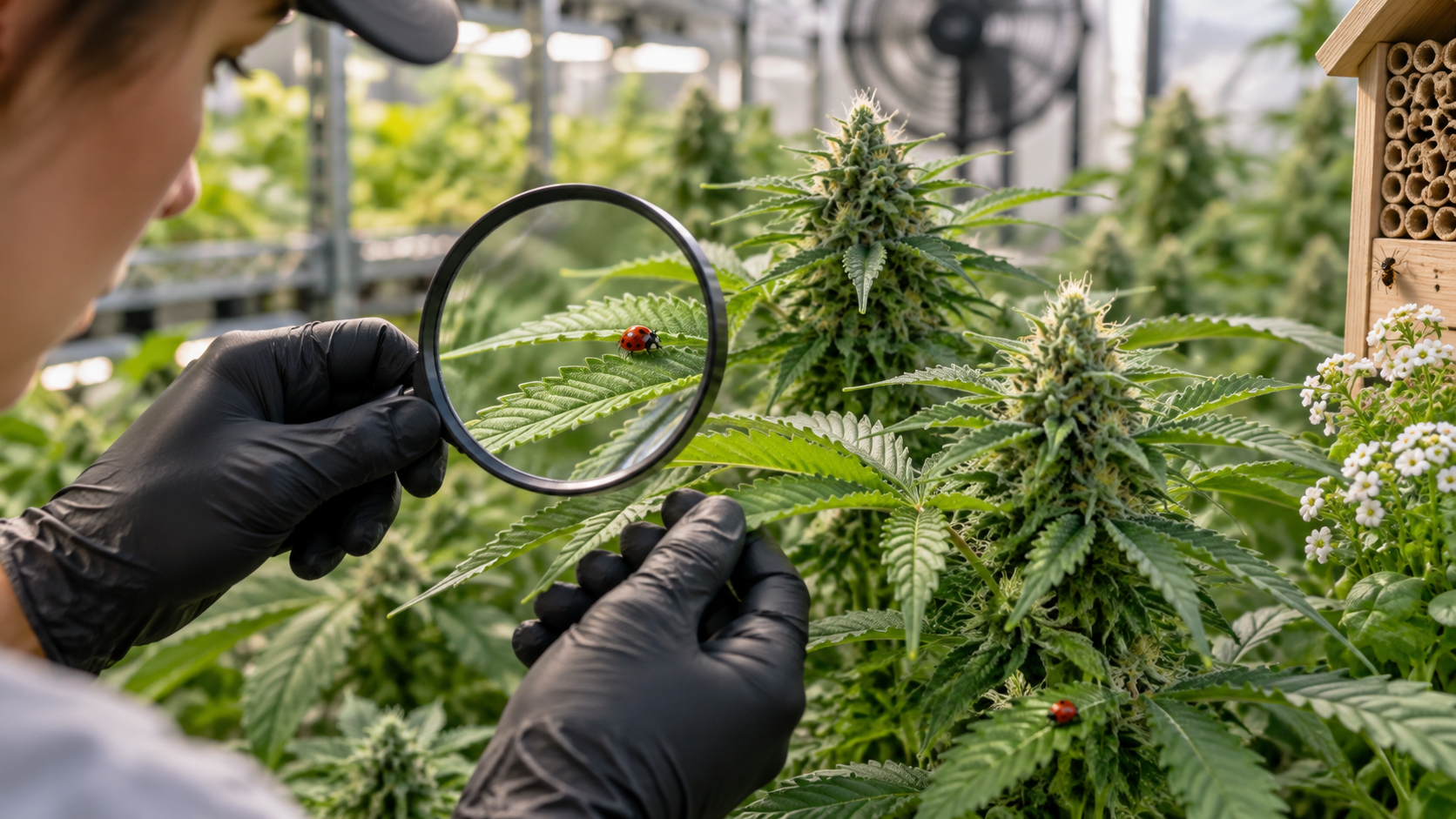
Sustainable pest management for cannabis works best when you stop treating pests as a spray problem and start treating them as a system problem.
The goal is not to eliminate every insect on sight. It is to prevent outbreaks, identify pests early, protect beneficial organisms, and use the lowest-risk control that will actually solve the problem.
That approach lines up closely with the EPA’s integrated pest management principles, which focus on monitoring, prevention, action thresholds, and choosing lower-risk controls before broad pesticide use. (US EPA)
For cannabis growers, that usually means combining sanitation, scouting, environmental control, beneficial insects, and targeted treatments only when pest pressure justifies them.
Table of Contents
What Sustainable Pest Management Actually Means
Sustainable pest management is not the same as “never use pesticides.”
A better way to think about it is:
prevent first, monitor constantly, and intervene proportionally.
The EPA describes IPM as a decision-making process rather than one single pest-control method. Its basic framework is to:
- set action thresholds
- monitor and identify pests
- prevent problems
- control only when necessary
That is useful for cannabis because grow rooms are small ecosystems. A broad treatment that kills the target pest may also harm predators, stress plants, leave residue, or disrupt future biological control.
A sustainable system tries to avoid that cycle.
If you want a deeper introduction to IPM itself, see The Seed Connect’s integrated pest management guide for cannabis cultivation.
Start With Prevention, Not Sprays
The easiest pest infestation to control is the one that never starts.
Good prevention usually includes:
- quarantining new plants
- inspecting clones before they enter the main room
- cleaning tools between plants
- removing dead leaves and plant debris
- sealing gaps around doors and vents
- avoiding standing water
- cleaning trays, benches, and pots
- keeping weeds away from outdoor grow areas
The EPA’s IPM guidance emphasizes prevention as the first line of defense because preventing pests from establishing is usually less disruptive than treating an established population later.
One overlooked risk is bringing pests in on new plants.
A clone can look healthy and still carry mites, thrips, aphids, or eggs on the underside of leaves.
Keep new plant material separate long enough to inspect it properly before adding it to the main crop.
For a deeper prevention checklist, see The Seed Connect’s best practices for preventing pest infestations.
Scout Before You Treat
Do not spray because you saw “something moving.”
First, identify what it is.
Some organisms are harmless, and others may actually be beneficial. The EPA specifically notes that accurate pest identification helps avoid unnecessary or incorrect pesticide use.
A simple scouting routine can include:
- checking the underside of leaves
- inspecting new growth
- looking for stippling, silvering, webbing, or sticky residue
- placing yellow or blue sticky cards
- checking the root zone for larvae
- recording where pests appear and how quickly numbers change
Keep notes.
You do not need a complicated spreadsheet. Even a basic weekly record can help you see whether a problem is stable, declining, or getting worse.
That is far better than guessing.
Common Cannabis Pests and Sustainable First Responses
| Pest | What You May Notice | Sustainable First Response |
|---|---|---|
| Spider mites | stippling, webbing, pale leaves | remove hotspots, improve sanitation, release predatory mites |
| Thrips | silver streaks, distorted growth | sticky traps, predatory mites, remove heavily damaged leaves |
| Aphids | curled growth, honeydew, clusters | beneficial insects, targeted soap treatment |
| Fungus gnats | adults near media, larvae in root zone | reduce excess moisture, use beneficial nematodes |
| Whiteflies | adults under leaves, yellowing | traps, parasitoid wasps, targeted treatment |
The point is not that one control solves every infestation.
It is that the pest should determine the response.
For identification help, The Seed Connect’s guide to common cannabis pests and solutions is a useful companion resource.
Use Biological Controls Early
Biological control uses living organisms to suppress pests.
Common examples include:
- predatory mites for spider mites or thrips
- parasitoid wasps for aphids or whiteflies
- beneficial nematodes for soil-dwelling larvae
- microbial products containing certain bacteria or fungi
These tools usually work best before the infestation explodes.
That is because biological control relies on predators or pathogens gradually reducing pest populations. It is not always an instant knockdown.
The EPA includes biologically based pest control among lower-risk IPM options and recommends evaluating less disruptive controls before broad pesticide applications.
If you plan to use beneficial insects, check:
- which pest they target
- temperature requirements
- humidity requirements
- whether recent sprays will harm them
- how many are needed
- whether they should be released preventively or after detection
Do not mix predators and pesticides blindly.
Organic Does Not Automatically Mean Safe
“Organic” sounds harmless, but that is not always true.
Products such as:
- neem-based products
- horticultural oils
- insecticidal soaps
- botanical extracts
can still damage plant tissue, harm beneficial insects, or leave undesirable residues if used incorrectly.
Always read the label.
Also remember that what is legal for ornamental plants or vegetables may not automatically be approved for cannabis in your state.
Use only products that are legal for your crop and jurisdiction.
The EPA’s IPM framework is useful here because it does not divide controls into “good natural” and “bad synthetic.” It focuses on choosing the most effective option with the lowest reasonable risk.
That is a much better decision rule.
Environmental Control Is Pest Control
A lot of pest pressure starts with the environment.
Poor climate control can create conditions that make infestations easier to establish.
Watch for:
- excessive humidity
- poor canopy airflow
- overwatering
- overcrowding
- wet media
- stagnant corners
- stressed plants
For example, fungus gnats often become worse in consistently wet growing media, while dense canopies can make it harder to spot mites or thrips early.
That is why pest management and climate management are closely connected.
If temperature, humidity, or airflow are unstable, fix that first. The Seed Connect’s grow room climate control guide explains how ventilation, circulation, temperature, and humidity work together.
Healthy plants in a stable room are easier to defend than stressed plants in a chaotic environment.
Protect Beneficial Insects
If you are using predators, avoid creating a situation where you kill them along with the pest.
Before applying any spray:
- check whether it is compatible with your beneficial insects
- avoid unnecessary whole-room treatment
- treat hotspots where practical
- follow re-entry intervals before releasing predators
- consider whether mechanical removal can reduce the population first
A sustainable pest program should preserve the controls that are already working.
That is one reason broad-spectrum spraying should not be the default.
Know When to Escalate
Sustainable does not mean passive.
Sometimes a pest population grows faster than biological control can manage it.
Escalation may be justified when:
- pest numbers keep rising
- plant damage is increasing
- beneficial insects are not keeping up
- flowers are being affected
- the infestation is spreading between rooms
- your economic or quality threshold has been crossed
The EPA’s IPM model uses exactly this logic: monitor first, define an action threshold, and then choose the most appropriate control once intervention is justified.
The key is to escalate deliberately, not emotionally.
Common Sustainable Pest Management Mistakes
Treating before identifying
A spray for mites may do nothing useful against fungus gnats.
Identify first.
Waiting too long
Biological controls are easiest to use when pest pressure is low.
Do not wait for an infestation to become obvious from across the room.
Overusing one treatment
Repeated use of the same control can reduce effectiveness and increase resistance pressure.
Ignoring the environment
If overwatering or poor airflow is creating the problem, spraying alone will not solve it.
Assuming one clean week means the pest is gone
Keep scouting after treatment.
Eggs and hidden life stages may remain.
A Simple Sustainable Pest Management Routine
A practical routine can be surprisingly simple.
Every week
- inspect leaves
- check sticky cards
- record pest numbers
- remove dead plant material
- clean tools
- inspect irrigation and standing water
When a pest appears
- identify it
- check how widespread it is
- remove heavily affected material if practical
- correct environmental causes
- use biological or mechanical control first where appropriate
- escalate only if monitoring shows the problem is worsening
After treatment
Do not assume success.
Recheck the same locations and compare pest counts.
If numbers are falling, stay the course.
If they are rising, change strategy.
Sustainable Pest Management Checklist
Before every grow, ask:
- Are new plants quarantined?
- Are tools cleaned between rooms?
- Are sticky traps in place?
- Is airflow reaching the whole canopy?
- Is the root zone staying too wet?
- Are pests being identified before treatment?
- Are beneficial insects being protected?
- Are treatments legal for cannabis in my area?
- Are pest counts recorded after treatment?
- Is the strategy changing when results show it should?
If you can answer yes to most of those, you already have the foundation of a sustainable IPM program.
Final Thoughts
Sustainable pest management for cannabis is not about finding one miracle product.
It is about building a system that makes outbreaks less likely, catches pests early, and uses the least disruptive control that will actually work.
Start with prevention.
Scout consistently.
Identify before treating.
Use beneficial organisms early when they make sense.
Keep the grow environment stable.
Then escalate only when monitoring shows that the crop needs more intervention.
That approach usually protects more than the plants. It also protects beneficial insects, flower quality, worker safety, and the long-term stability of the grow.
For growers who want the broader framework behind this approach, the EPA’s integrated pest management principles are a useful reference, while The Seed Connect’s cannabis IPM guide applies those ideas specifically to cultivation.