


Monster cropping cannabis is a plant-training and cloning technique that involves taking cuttings from a flowering cannabis plant, rooting them, returning them to vegetative growth, and then flowering them again later.
The technique is known for producing bushier plants with dense side branching. That can make it useful for growers who want to create a wider canopy, preserve desirable genetics, or experiment with a different plant structure. However, monster cropping takes longer than ordinary cloning and requires patience during the revegetation stage.
This guide explains how monster cropping works, when to use it, the main steps involved, its advantages and disadvantages, and how it compares with other cannabis plant training techniques.
Key Takeaway:
- Monster cropping starts with a flowering clone. The cutting is rooted and returned to vegetative growth before being flowered again.
- The main benefit is plant structure. Revegetated clones often produce dense lateral branching, which can make canopy training easier.
- Monster cropping takes longer than normal cloning. The plant must both develop roots and transition back from flowering to vegetative growth.
What Is Monster Cropping Cannabis?
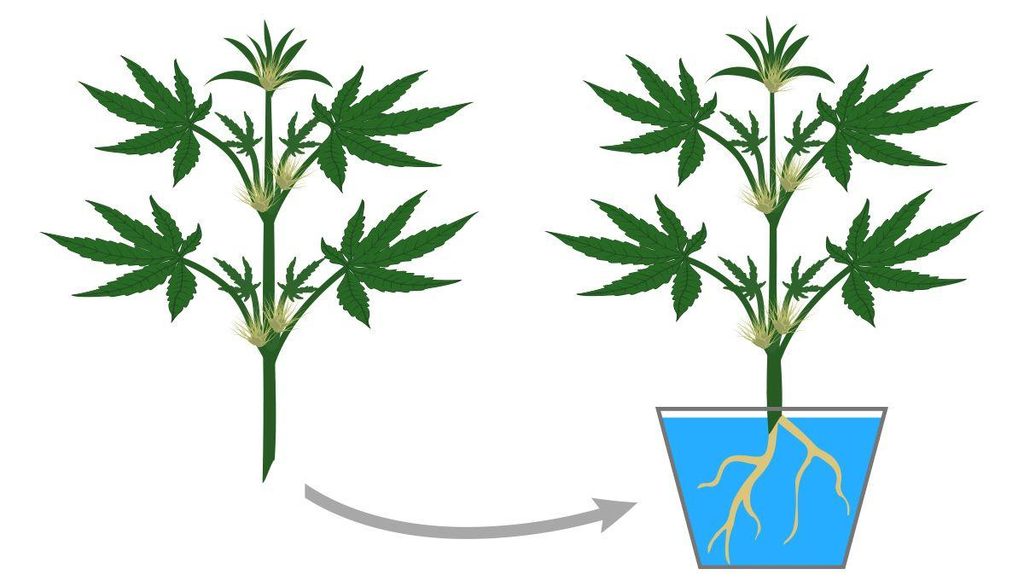
Monster cropping is a propagation technique where a clone is taken from a cannabis plant that has already entered the flowering stage.
Instead of allowing the cutting to remain in flowering conditions, the grower places it under a vegetative light schedule so the plant gradually returns to vegetative growth.
During this transition, the clone may produce unusual leaves, including single-bladed or irregular foliage. It can also develop a highly branched growth pattern.
This bushier structure is the main reason some growers use monster cropping.
It is important to understand that monster cropping does not create a new strain. A clone remains genetically identical to the donor plant, which is one of the main reasons vegetative propagation is used to preserve selected cannabis genetics. Research on cannabis cuttings also supports vegetative propagation as a practical way of producing genetically identical plants.
How Does Monster Cropping Work?
Photoperiod cannabis responds to changes in the amount of light and darkness it receives each day.
A common vegetative schedule is around 18 hours of light and 6 hours of darkness, while many growers use 12 hours of light and 12 hours of darkness to initiate flowering. Research on cannabis flowering photoperiods shows that flowering response can vary by cultivar, and some plants can flower successfully under longer photoperiods.
A cutting is taken from a flowering plant, rooted, and then placed back under vegetative lighting. Over time, the clone transitions from reproductive growth back into vegetative development.
During revegetation, growers may notice:
- irregular leaf shapes
- single-bladed leaves
- slower initial growth
- increased lateral branching
- dense, bushy development
Once normal vegetative growth returns, the plant can be trained and later switched back into flowering.
Steps to Monster Crop Cannabis
1. Choose a Healthy Flowering Plant
Start with a strong, healthy donor plant.
Avoid taking cuttings from plants showing serious nutrient problems, pests, disease, or severe environmental stress.
Choose a plant with traits you want to preserve, such as vigorous growth, desirable structure, aroma, or flowering characteristics.
2. Take a Healthy Cutting
Select a healthy branch with several nodes and enough leaf tissue to support the cutting during rooting.
Use clean, sharp pruning tools to avoid crushing the stem or introducing contamination.
Recent research on cannabis cuttings suggests that cutting size, fresh mass, leaf condition, and the presence of a healthy apical meristem can influence rooting success.
3. Place the Cutting in a Rooting Medium
Insert the cutting into a suitable propagation medium such as:
- propagation plugs
- coco-based plugs
- rockwool
- another clean rooting substrate
Rooting hormone may be used, but it is not always required. Research on cannabis propagation has found that indole-3-butyric acid, or IBA, can influence root development, although rooting response varies depending on cultivar, concentration, and propagation conditions.
The key is to provide stable moisture without keeping the root zone overly saturated.
4. Return the Cutting to Vegetative Growth
Place the cutting under a vegetative light schedule, commonly around 18 hours of light and 6 hours of darkness.
During this stage, focus on helping the clone develop roots and recover from the stress of being taken from a flowering plant.
Keep environmental conditions stable and avoid excessive light intensity while the cutting is still establishing roots. Cannabis lighting research commonly uses an 18/6 schedule during vegetative growth before transitioning plants into flowering conditions.
5. Allow the Plant to Fully Revegetate
This is the stage that requires patience.
The plant may initially produce strange-looking leaves or irregular growth. This does not necessarily mean something is wrong.
Wait until the plant begins producing healthy, normal vegetative growth again.
Once the plant is established, its naturally bushy structure can be shaped using methods such as low-stress training or other canopy-management techniques.
6. Flower the Plant Again
After the plant has fully returned to vegetative growth and reached the desired size, it can be switched back into flowering.
A 12/12 light schedule is commonly used to trigger flowering in photoperiod cannabis, although research shows flowering response can vary by cultivar and some varieties can flower under slightly longer photoperiods.
At this stage, the extra branching created during revegetation can help produce a wider canopy with multiple flowering sites.
Advantages of Monster Cropping
Bushier Plant Structure
One of the most noticeable effects of monster cropping is dense lateral growth.
Instead of developing mainly around one dominant vertical stem, revegetated plants may produce many side branches.
This can make them easier to spread across a grow space.
More Potential Flowering Sites
More branches can create more potential flowering sites across the canopy.
However, this does not guarantee higher yields. Final production still depends on genetics, lighting, root health, nutrition, environmental conditions, and canopy management.
Preserves Valuable Genetics
Monster cropping can be useful when a grower reaches flowering and realizes that a particular plant has characteristics worth preserving.
If vegetative clones were not taken earlier, flowering-stage cloning offers another opportunity to retain those genetics.
Useful for Canopy Training
The dense branching pattern can work well with other training methods.
Growers who want to compare approaches can also read The Seed Connect’s guides to topping cannabis and super cropping.
Disadvantages of Monster Cropping
It Takes More Time
Monster cropping is slower than regular cloning.
A normal vegetative clone mainly needs to root and grow.
A monster-cropped clone must:
- develop roots
- reverse from flowering
- return to normal vegetative growth
- grow large enough to flower again
That adds extra time to the cultivation cycle.
Rooting Can Be Less Predictable
Flowering cuttings may not always root as quickly or consistently as clones taken from healthy vegetative plants.
Plant health, genetics, environmental conditions, and cutting quality can all influence the result.
Growth Can Look Unusual
Revegetating plants can produce twisted, single-bladed, or irregular leaves.
For growers unfamiliar with revegetation, this can look like a plant-health problem even when the plant is simply transitioning back into vegetative growth.
It Requires More Space
Because the process takes longer, the plant occupies propagation and vegetative space for an extended period.
This can be inconvenient in small grow rooms.
Monster Cropping vs. Regular Cloning
| Feature | Monster Cropping | Regular Cloning |
|---|---|---|
| Cutting source | Flowering plant | Vegetative plant |
| Revegetation required | Yes | No |
| Speed | Slower | Faster |
| Growth structure | Often bushier | More predictable |
| Genetics preserved | Yes | Yes |
Regular cloning is usually better when speed and consistency are the main priorities.
Monster cropping is more useful when preserving flowering genetics or creating a highly branched plant structure.
Monster Cropping vs. Super Cropping
Monster cropping and super cropping are often confused, but they are different techniques.
Monster cropping involves taking flowering clones and returning them to vegetative growth.
Super cropping involves bending and stressing stems on an established plant to reshape the canopy and encourage lateral growth. The Seed Connect has a separate super cropping guide covering that technique in detail.
Monster cropping is primarily a cloning and revegetation technique, while super cropping is applied directly to an existing plant.
Common Monster Cropping Mistakes
Taking Weak Cuttings
Healthy cuttings have a better chance of developing roots and recovering successfully.
Avoid using damaged or heavily stressed branches.
Overwatering
Cuttings need moisture, but overly wet media can limit oxygen around the developing root zone.
Keep the rooting medium moist rather than saturated.
Expecting Fast Growth
Monster-cropped clones may take longer to establish than ordinary clones.
Give the plant enough time to develop roots and return to normal vegetative growth.
Flowering Again Too Soon
Do not immediately switch the plant back into flowering.
Wait until it is clearly producing healthy vegetative growth and has developed a strong structure.
Expecting Higher THC Automatically
Monster cropping does not guarantee more potent cannabis.
Potency depends mainly on genetics, lighting, environmental conditions, and overall cultivation quality—not simply on the cloning technique used.
Can You Monster Crop Autoflowers?
Monster cropping is generally better suited to photoperiod cannabis.
Autoflowering plants follow a relatively fixed developmental timeline and do not rely on the same light-cycle changes to initiate flowering.
Because monster cropping requires time for a flowering clone to return to vegetative growth, it does not fit well with the limited lifecycle of most autoflower cultivars.
For autoflowers, lower-stress training methods are usually more practical.
Does Monster Cropping Increase Yield?
Monster cropping may help create more branches and potential flowering sites, but it does not automatically increase yield.
Final yield depends on factors such as:
- genetics
- light intensity
- canopy management
- root health
- nutrition
- temperature and humidity
- pest and disease pressure
Cannabis research shows that lighting intensity and photoperiod can have substantial effects on plant growth and yield, reinforcing the point that plant architecture alone does not determine production.
Is Monster Cropping Worth It?
Monster cropping can be useful when you want to preserve a flowering plant or create a bushier canopy.
It may be worth trying if:
- you forgot to take clones before flowering
- you want to preserve desirable genetics
- you have enough time for revegetation
- you want a highly branched plant structure
It may not be the best choice if you need fast crop turnover or already have healthy vegetative mother plants available for cloning.
For a broader look at alternative training methods, see The Seed Connect’s complete guide to cannabis plant training.
Final Thoughts
Monster cropping cannabis is a specialized cloning technique that can help preserve desirable flowering genetics while producing dense, bushy growth.
Its main tradeoff is time. Flowering clones must root and return to vegetative growth before they can be flowered again.
For growers who value plant structure and genetic preservation, monster cropping can be useful. For growers who prioritize speed and predictability, conventional vegetative cloning is usually the simpler option.