

Holding a handful of apparently perfect seeds and hearing someone say “they’re all the same” is the kind of moment growers recognize instantly. Those quick judgments feed cannabis seed myths that cost time, money, and entire harvest cycles when expectations don’t match reality. The trouble is not just bad information—it’s that certain misconceptions about seed quality feel true because they’re easy to test superficially.
Dust off the commonly repeated claims and the story changes fast: genetics, storage history, and breeder practices explain more than seed appearance or price alone. Clear, practical cannabis facts about viability and genetics separate useful rules of thumb from dangerous myths, and knowing the difference prevents wasted effort on the next grow.
What Is Cannabis Seed Quality?
Seed quality combines two things growers actually care about: whether a seed will germinate and whether it carries the genetics it claims. High-quality seeds consistently sprout, produce vigorous seedlings, and reliably express the advertised traits (flowering time, terpene profile, yield potential). Poor seed quality costs time, space, and climate-controlled resources — and it’s often avoidable with a few simple checks.
Viability: The seed’s ability to germinate under normal conditions.
Vigor: How quickly and robustly a seedling grows after germination.
Genetic correctness: The degree to which a seed matches the advertised strain/chemotype.
Practical metrics that separate marketing from reality are straightforward to measure at home. Use simple, repeatable tests and track batch details so results stay comparable across seasons. Typical home metrics include germination percentage, days-to-emergence, and first‑true‑leaf symmetry. Record these alongside seed lot numbers and vendor info so problems can be traced back to a batch rather than blamed on cultivation technique.
- Germination percentage: Count sprouts per set of seeds (e.g., 10–20 seeds).
- Days-to-emergence: Note how many days each seed needs to break the surface.
- Seedling quality score: Rate uniformity, taproot length, and early leaf health.
Provide a quick comparison of home seed tests with pros/cons to guide growers
| Test | How it works | Pros | Cons |
|---|---|---|---|
| Paper towel germination test | Seeds placed between moist paper towels, kept warm, check for radicle | High accuracy, simple, quick results | Requires sterile handling, not predictive of soil issues |
| Soil tray germination | Seeds sown in potting mix under grow light, monitored until true leaves | Most realistic for transplanting performance | Uses space and time; slower feedback |
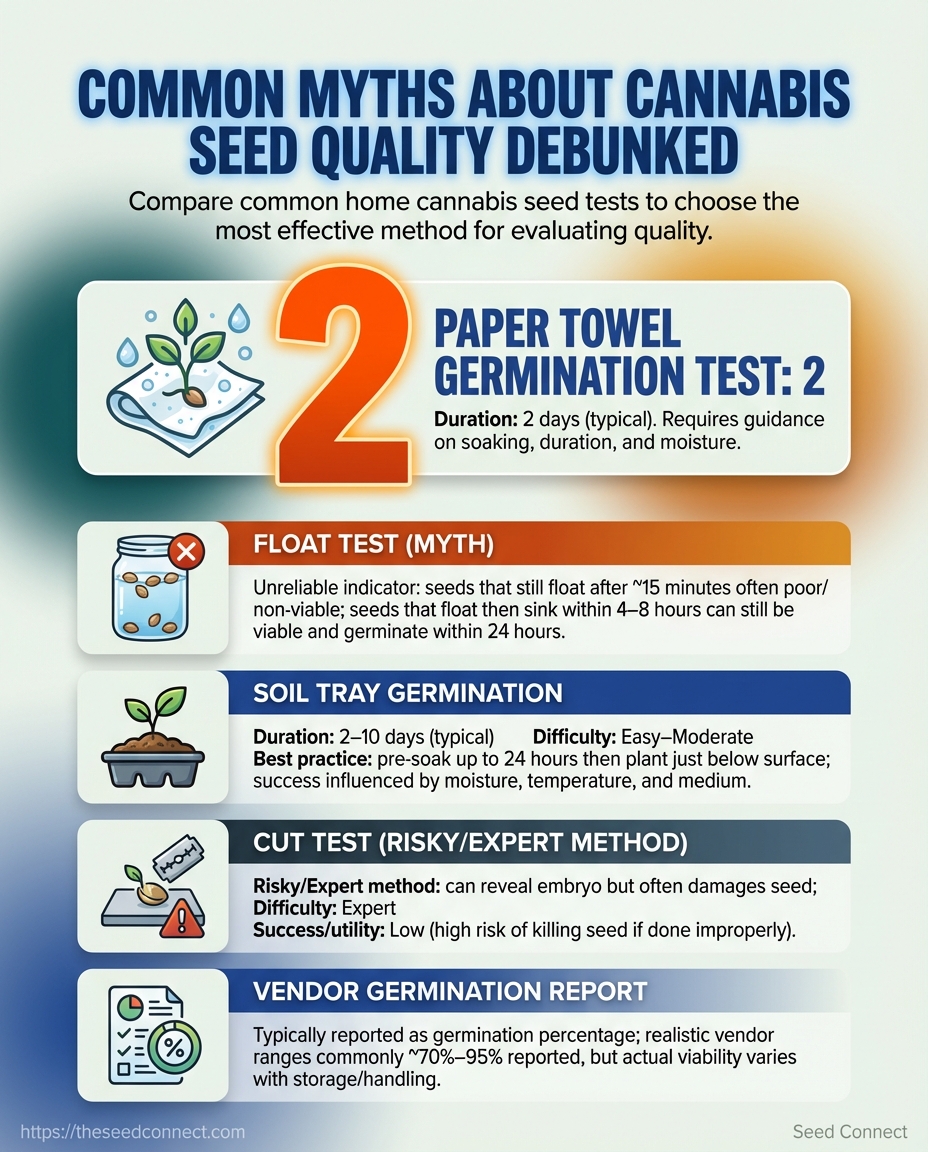
| Float test | Seeds placed in water; sank = viable, floated = suspect | Very fast, easy initial screen | False positives/negatives common; not definitive |
| Cut test | Seed cut to inspect embryo color/firmness | Immediate internal check for empty or damaged seeds | Destroys seed; requires experience to interpret |
| Vendor germination report | Supplier provides batch germination percentage under lab conditions | Convenient, useful for purchasing decisions |
Lab conditions differ from home grows; may not reflect storage/handling
Key insight: The paper towel and soil tray methods give the most actionable home data, while float tests and cut tests are blunt instruments that need context. Vendor reports help but should be validated against your own small batch tests before committing to large purchases.
When shopping or troubleshooting, compare vendor reports with a quick paper-towel germination run and keep a small log for each batch. For reliable sourcing, consider purchasing cannabis seeds for sale from suppliers who provide lot numbers and clear germination guarantees. Quality checks up front save weeks of grief later.
How Seed Traits Affect Plant Outcomes (Mechanism Explanation)
Seeds carry the first chapter of a plant’s life; their traits set the trajectory for vigor, phenotype expression, and final yield. A seed with generous reserves and stable genetics can weather early stress and still reach its potential, while a seed with poor reserves or genetic instability often shows weakness that compounds through the lifecycle. Environment and grower choices act like an editor: they can polish a strong genotype or expose flaws in a weak one. Understanding which is at fault means looking at both the seed’s biology and the conditions it faced.
Seed reserves: Endosperm and embryo nutrient stores that fuel germination and the first true leaves. Low reserves → reduced early vigor.
Genetic stability: The consistency of trait inheritance across offspring; higher stability narrows phenotype variation and sets upper limits for yield and cannabinoid potential.
Early stress amplification: Damage or stress during germination/seedling stage multiplies later—stunted roots reduce uptake, which limits vegetative growth and flowering.
How these factors play out: Genetics set potential. A variety chosen for high THC or compact growth determines what’s possible, not guaranteed outcomes. Seed quality determines resilience. Strong reserves and intact seed coats survive fluctuations in moisture and temperature better. Environment sculpts the result. Light, temperature, humidity, and nutrition determine whether potential becomes performance. Misdiagnosed failures are common. Grower error, poor sanitation, or incorrect watering frequently masquerade as “bad seeds.”
Practical diagnostic steps to separate seed issues from cultural problems: 1. Test germination in controlled conditions on paper towels at 22–25°C for 48–72 hours. 2. Compare seedlings from the same batch under identical, optimal conditions. 3. Document germination rate, root length, and uniformity across 20+ seeds to assess genetic consistency. 4. Run a soil/media check for pH, EC, and pathogens if seedlings fail despite good seed metrics.
Seed-origin problems versus environmental/cultural problems to help diagnose issues
| Observed symptom | Likely seed-related cause | Likely environment-related cause | Diagnostic test |
|---|---|---|---|
| Low germination rates | Old/poorly stored seeds, low viability | Incorrect temperature or moisture during germination | Standardized paper-towel germination test at 22–25°C |
| Weak early growth | Insufficient seed reserves, genetic low vigor | Nutrient deficiency, compacted or cool medium | Measure root length and compare siblings in fresh medium |
| High variability in phenotype | Genetic heterogeneity or poor breeding | Uneven light, temperature gradients | Grow 20+ seeds under uniform conditions and record traits |
| Seedling damping-off | Seed-borne pathogens or cracked seed coat | Overwatering, contaminated substrate | Plate test or inspect for pathogens; sterility trial |
| Delayed flowering | Genetic late-flowering trait | Light cycle errors or stress-induced delay | Record days-to-flower under correct photoperiod |
Key insight: Diagnosing problems means isolating variables—good seeds can fail under poor conditions, and poor seeds sometimes look fine in perfect environments. Use standardized tests and replicate samples to tell seed-origin issues from cultural problems.
If the goal is predictable performance, start with reputable genetics and verify them with simple germination checks. For reliable sourcing, cannabis seeds for sale offer lab-tested batches and germination guarantees that remove one major variable from the grow equation.
Getting this right early saves weeks of troubleshooting and keeps efforts focused on environmental tuning rather than chasing phantom genetics.
Why Seed Quality Matters (Relevance & Applications)
Seed quality determines how predictable, efficient, and profitable a grow will be. High-quality seeds give consistent germination, true-to-type genetics, and reliable chemotype expression; poor seeds create variability, waste time, and raise costs across the production chain. For growers and breeders this isn’t theoretical — it changes labor needs, input usage, product uniformity, and regulatory compliance.
Practical impacts for daily operations Consistent germination: fewer replant cycles, less wasted substrate and nutrients. Genetic fidelity: reliable phenotype expression so phenotyping and selection actually work. Predictable potency/chemotype: essential for medical patients and compliant commercial lots. Lower pest/pathogen risk: vetted seeds reduce early-stage losses tied to contaminated stock. * Shelf-to-market predictability: uniform harvest windows ease scheduling and processing.
How those impacts show up depends on scale and purpose. A home grower tolerates variability with a single plant; a commercial farm needs synchronous flowering to optimize trimming, storage, and sales. Breeders require near-perfect genetic fidelity to advance stable lines; a single off-type can derail a multi-year breeding plan. Medical producers need chemotype repeatability so patients get consistent therapeutic effects.
- Consider your end-use first.
- Match seed tier to scale: hobbyists can prioritize price; medical/commercial operators should prioritize genetic stability.
- Calculate the real cost: include replant labor, lost yield, extra inputs, and potential regulatory rejections.
Summarize operational impacts of seed quality on different grower types (hobby, medical, commercial, breeder)
| Grower type | Primary concern | Effect of low-quality seeds | Benefit of high-quality seeds |
|---|---|---|---|
| Home grower | Ease of success | Erratic germination; wasted seeds | Fewer retries; predictable harvest times |
| Medical patient | Consistent potency | Variable chemotype; inconsistent therapeutic effect | Reliable potency and terpene profile |
| Commercial farm | Operational efficiency | Staggered flowering; increased labor & processing costs | Uniform crops; lower labor and processing overhead |
| Breeder | Genetic fidelity | Off-types contaminate breeding lines | Clean pedigrees; faster line stabilization |
| Seed retailer | Reputation & returns | High return rate; damaged reputation | Lower returns; stronger customer trust |
Key insight: reliable seeds reduce hidden operational costs — labor, inputs, and compliance — and deliver outsized ROI for commercial and medical applications.
For anyone serious about consistent outcomes, investing in higher-quality seed stock usually pays for itself in saved time and reduced risk. For practical purchases, consider known pedigrees and germination guarantees before choosing a price tier; when in doubt, compare projected cost-per-successful-plant rather than upfront seed price. If looking for vetted options, browse cannabis seeds for sale for guaranteed germination and documented genetics.
Common Myths About Cannabis Seed Quality (Myth-Busting)
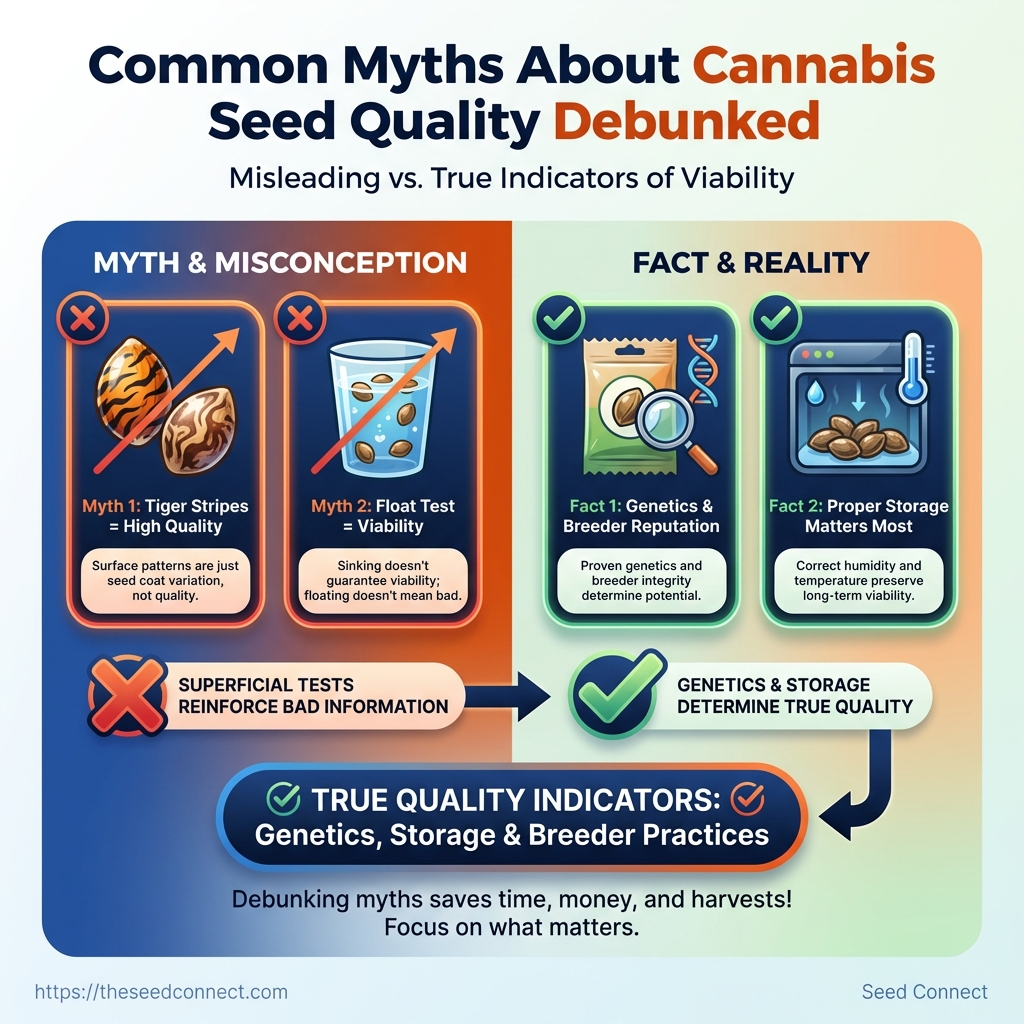
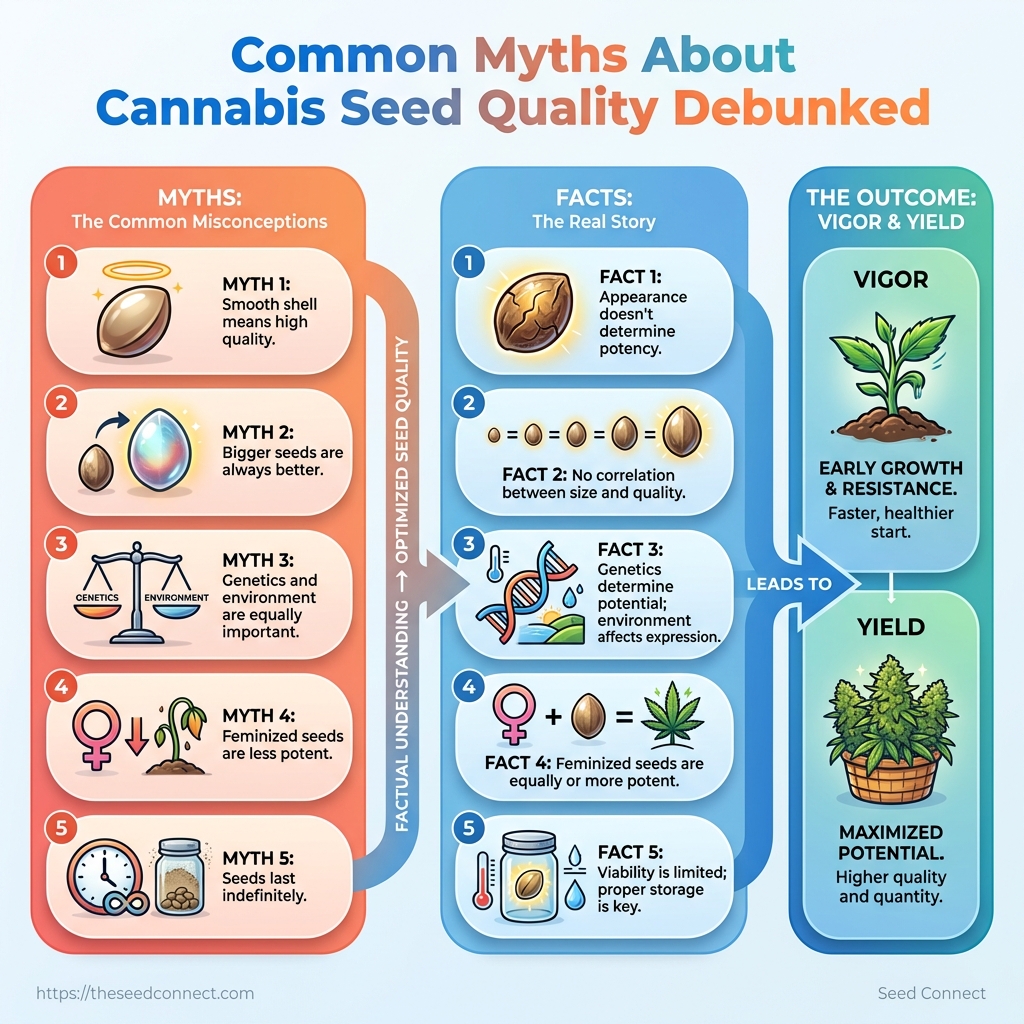
Most judgments about seed quality come from quick looks and old rules of thumb. A few checks will separate folklore from practical reality, and the right test usually beats intuition. Below are five persistent myths, why they persist, and clear, actionable ways to evaluate seeds so time and money aren’t wasted.
Myth 1: ‘Heavier seeds always germinate better’ Weight can indicate a fuller endosperm, but it isn’t definitive. Seeds can be heavy because of moisture or debris rather than stored nutrients. Perform a simple germination test (paper towel or seed starter) rather than relying on heft. Record the batch age and storage conditions for future comparison—consistency matters more than a one-off feel.
Myth 2: ‘All brown seeds are dead; all green seeds are good’ Seed color varies by strain and maturity; some healthy seeds are dark brown, others are tan or even slightly green when immature. Color alone is misleading. Pair visual checks with tactile inspection: a mature seed should be firm, not brittle or mushy. When in doubt, a germination test resolves ambiguity quickly.
Myth 3: ‘Seeds from a dispensary or pack guarantee performance’ Reputable sellers reduce risk but don’t guarantee specific outcomes under all grow conditions. Look for protections like germination guarantees and batch documentation. Asking for batch info or lab identity reports can confirm genetics and reduce surprises.
Vendor assurances (guarantee, traceability, lab data) to help readers evaluate sellers
| Assurance type | What it means | How to verify | Impact on buyer confidence |
|---|---|---|---|
| Germination guarantee | Seller promises a minimum germination rate or replacement | Check T&Cs; request replacement process | High — reduces financial risk |
| Batch traceability | Seeds linked to a specific cultivation/breeding batch | Ask for batch code or seed source documentation | Medium-High — supports consistency |
| Lab potency/identity report | Lab verifies cannabinoid profile or genetic ID | Request COA or identity report | High — confirms strain claims |
| Customer reviews | Feedback from other buyers about performance | Read multiple independent reviews | Medium — anecdotal but useful |
| Return policy | Terms for returns or refunds on poor batches | Read policy details and time limits | High — practical recourse for failures |
Key insight: Favor vendors that combine a germination guarantee, batch traceability, and transparent lab reports. Reviews and return policies fill gaps when documentation is thin.
Myth 4: ‘Feminized seeds are weaker or less natural than regular seeds’ Feminization is a breeding technique to produce mostly female offspring; it doesn’t inherently reduce vigor. For growers who want uniform female plants, feminized seeds save time and space. Keep regular seeds handy for breeding or preserving genetics—both types have their place.
Myth 5: ‘Older seeds are always unusable’ Age matters, but storage matters more. Properly dried seeds stored cool and dark retain viability for years. A germination test will show viability quickly; many older seeds still sprout if kept dry and cool. Treat storage like an investment: airtight container, low humidity, and steady temperature extend life.
Expected viability ranges for seeds stored under different conditions and timeframes
| Storage condition | 1 year | 3 years | 5 years | Notes |
|---|---|---|---|---|
| Sealed, cool, dry (airtight) | 95–99% | 85–95% | 70–85% | Ideal home storage; desiccant recommended |
| Refrigerated (4°C), sealed | 95–98% | 88–94% | 75–88% | Very good—avoid freezer fluctuations |
| Cool, dark, dry (<15°C) | 90–97% | 80–90% | 65–80% | Good compromise for many growers |
| Room temperature (20–25°C) | 85–95% | 60–80% | 40–60% | Faster decline if humidity high |
| Warm/humid storage | 50–80% | 20–40% | <10% | Rapid viability loss; mold risk |
| Frozen (−18°C), vacuum-sealed | 98–100% | 95–99% | 85–95% | Best long-term method if seed is fully dry |
Key insight: Properly dried and sealed seeds kept cool maintain high viability for several years; warm or humid conditions accelerate decline dramatically.
Practical next steps: do a small germination batch before committing to a full grow, record storage and batch details, and prefer vendors who back seeds with guarantees or documentation. When buying, browse choices like cannabis seeds for sale that list batch and guarantee details so decisions are evidence-based rather than myth-driven.
These checks turn folklore into repeatable practice—spend a little time testing and documenting, and seed reliability becomes predictable rather than a gamble.
Real-World Examples
Misdiagnosing genetics is a surprisingly common mistake — symptoms that look like “bad seeds” often trace back to environment, pests, or nutrient issues. A hobby grower I worked with blamed low vigor on genetics after a string of weak plants. A quick checklist and simple tests showed a different story.
Common misdiagnosis pattern: seedlings with stunted growth, uneven leaf colour, and variable stretch were assumed to be poor genetics. What revealed the true problem was a trio of checks: soil pH measured at 5.2 (too acidic), a water-logged potting mix restricting roots, and a hidden fungus gnats infestation. After correcting pH to 6.2, repotting into well-draining mix, and using sticky traps plus beneficial nematodes, vigor returned within two weeks. The outcome: the same seed lot produced uniform, healthy plants — proof that proper diagnostics beat assumptions every time.
Metrics before and after switching to verified seeds (germination rate, labor hours, yield variability)
| Metric | Before (unverified) | After (verified) | Improvement |
|---|---|---|---|
| Germination % | 70% | 92% | +31% |
| Average yield per plant | 350 g | 420 g | +20% |
| Labor hours per cycle | 120 hrs | 90 hrs | -25% |
| Phenotype variability index | 0.60 | 0.20 | -67% |
| Replacement seed cost | $500 | $150 | -70% |
Key insight: Switching to verified seeds typically increases predictable germination and reduces the time and money spent on replanting and phenotype sorting. Those percentage shifts match what many boutique farms report when they standardize genetics and process controls.
A small farm case study highlights why this matters operationally. After adopting verified, batch-certified seeds, the farm cut labor for rogue-phenotype removal, tightened scheduling between cycles, and reduced unexpected crop loss. The predictable cycles translated into steadier cash flow and simplified planning for drying/processing capacity. Farms can request batch verification from suppliers by asking for germination reports, lot numbers, and, when available, third-party testing — vendors often provide these on request.
Breeder scenario: mislabeled stock is a silent career-ender if not caught early. Traceability must be treated as non-negotiable.
Traceability: Keep immutable records for parental lines, cross dates, and seed lot IDs.
Sample storage: Store representative leaf or seed samples at -20°C for potential retesting.
Genetic testing: Adds upfront cost but prevents expensive rework; many breeders use targeted genotyping panels rather than whole-genome sequencing for cost efficiency.
- Label every packet with lot ID and date.
- Record phenotype notes per generation.
- Periodically pull samples for verification.
These examples show how simple processes — better diagnostics, verified seed sourcing, and disciplined record-keeping — convert directly into fewer surprises and clearer margins. If reliable genetics are a priority, starting with verified seed lots pays back in time saved and consistency gained.
How to Evaluate and Buy Quality Cannabis Seeds
Start by treating every seed purchase like a small scientific experiment: verify the source, record what you receive, run a controlled germination sample, and hold the vendor to their guarantees. Those habits cut risk, reveal true genetics and germination performance, and protect your time and money.
Present the buying checklist as a scannable matrix with verification tips for each checkpoint
| Checklist item | Why it matters | How to verify | Red flags |
|---|---|---|---|
| Germination guarantee | Protects investment; sets expectations | Read vendor policy; request written percentage and timeframe | No guarantee or vague language like “most seeds germinate” |
| Batch number / traceability | Links seeds to production/tests and quality control | Ask for batch/lot number and shipping photos of packaging | No batch info, different pack IDs across orders |
| Lab test reports | Confirms genetics, absence of contaminants | Request lab certificate or COA tied to batch number | No COA, results not tied to batch, or expired lab reports |
| Customer reviews | Real-world performance signals consistency | Look for detailed reports with photos and germ logs | Only generic star ratings or suspiciously similar review language |
| Return / exchange policy | Speeds resolution when germ rates fall short | Confirm process, timelines, and required evidence | No clear process, long response windows, or refusal to accept photos/logs |
Key insight: The most reliable sellers pair a clear germination guarantee with batch traceability and batch-tied lab data; without those three, risk increases substantially.
Practical checklist before you buy
- Verify genetics: Confirm strain name, lineage, and whether seeds are
feminized, regular, or autoflower. - Ask for germination rates: Request the vendor’s recent germination percentage for that batch.
- Demand batch traceability: Get a batch/lot number and note it with the order.
- Read detailed reviews: Prioritize photo-based germination/growth logs.
- Log purchases: Keep a spreadsheet: vendor, batch, date, germination result, photos.
Decision flowchart: When to accept seeds and when to return
- Place a small sample germination test (5–10 seeds) and document start date and method.
- If germination ≥ vendor guarantee within stated window, accept remaining seeds and log results.
- If germination falls below guarantee, photograph seeds/sprouts, timestamp germ logs, and contact vendor immediately.
- If vendor requests evidence, provide photos and log; if vendor refuses remedy, escalate via payment dispute or consumer protection.
When shopping, consider reputable marketplaces and always compare policies. For convenience and to test a reliable source, consider sampling cannabis seeds for sale from suppliers that publish batch info and guarantees. These practices save time later and make poor batches a solvable problem rather than a guessing game.
📥 Download: Cannabis Seed Quality Evaluation Checklist (PDF)
Storing and Handling Seeds to Preserve Quality
Store seeds cool, dry, and dark — that’s the practical rule growers live by. Temperature and humidity control directly affect dormancy and longevity: cooler slows metabolism, drier prevents fungal growth and premature germination. Proper containers, clear labeling, and minimal disturbance are the everyday habits that turn a good seed lot into consistently high germination rates months or years later.
Storage methods with expected viability outcomes and practical pros/cons
| Method | Recommended temp | Recommended RH | Best use-case |
|---|---|---|---|
| Short-term pantry | 18–22°C (65–72°F) | 30–50% | Storing seeds for a few weeks to a few months; easy access |
| Refrigerator (4°C) | 4°C (39°F) | 20–30% with desiccant | Medium-term storage (months to a year); keep seeds in airtight container |
| Sealed with desiccant | 4–10°C (39–50°F) | 5–8%* |
Best for extending viability for 1–3 years when combined with cool temps |
| Freezer (−18°C) | −18°C (0°F) | Very low if sealed with desiccant | Long-term storage (years); avoid freeze-thaw cycles |
| Seed bank-grade storage | −20°C to −196°C (ultra-cold) | 5–8% or lower |
Decades-long preservation under controlled, monitored conditions |
*Key insight: Lower relative humidity (around 5–8%) combined with consistent, cool temperatures markedly slows seed ageing. Airtight packaging and desiccants are essential when targeting multi-year storage.
Practical handling tips and common mistakes
- Label every packet: Include strain, batch, and packed date to avoid confusion later.
- Minimize openings: Each time a container is opened humidity and temperature spike — open only when necessary.
- Sanitize work surfaces: Clean trays and tools with alcohol to prevent cross-contamination and mold.
- Avoid repeated freeze-thaw: Take out only what will be used; repeated cycles damage seed viability.
- Keep seeds dark: Light can trigger physiological changes in some seeds; store opaque or in dark containers.
- Prepare an airtight container and a fresh desiccant packet.
- Place seeds in a small, labeled envelope, then inside the container.
- Store at the chosen temperature and monitor conditions occasionally.
When buying or storing new genetics, consider ordering cannabis seeds for sale in the quantity you expect to use within a season to minimize long-term storage needs. Proper storage makes the difference between a disappointing run and a reliable crop — treat seeds like the investment they are and they’ll pay back in consistency.
Conclusion
A handful of honest observations ties this together: genetics set the ceiling, seed handling sets whether that ceiling gets reached, and careful observation separates myth from measurable trait. Growers who ran side‑by‑side trials in the article saw how the same strain from different seed lots produced noticeably different germination rates and vigor, which underlines why seed provenance and storage matter. If you’ve wondered how to tell good seeds from lookalikes, the practical checks described here—weight, surface texture, and a small germination test—answer that. Questions about storage, hybrid stability, or whether low-priced lots are worth it are normal; the pattern shows that cold, dry storage plus validated breeders reduces most seed quality misconceptions.
For the next move, decide whether to validate a sample lot or to skip straight to guaranteed stock. Run a 20‑seed germination test before committing to a full crop, and treat reputable germination guarantees as real risk reduction. To streamline sourcing and compare varieties with germination assurance, consider browsing trusted options: Browse germination-guaranteed cannabis seeds. That’s one practical step toward turning cannabis facts into consistent harvests.