


Ordering seeds online seems easy until you get mislabeled seeds or weak seedlings that die in two weeks. Growers who use Online dispensaries for convenience often provide blurry details about breeding and shipping. This results in wasting time on troubleshooting germination and strain reliability instead of actually growing. Learning how to read listings, understand breeder notes, and anticipate shipping issues can turn failures into consistent successes.
Searching for the best cannabis seed deals or chasing flashy seed promotions is tempting, but price signals rarely tell the whole story about viability or genetic stability. Small differences in packaging, seed age, or courier handling can determine whether a packet yields ten vigorous plants or a few weak sprouts. The practical question is not where to find the lowest price, but how to evaluate value: clear lineage, honest germination notes, and realistic shipping timelines matter more than a percent-off badge.

What Is an Online Dispensary (for Seeds)?
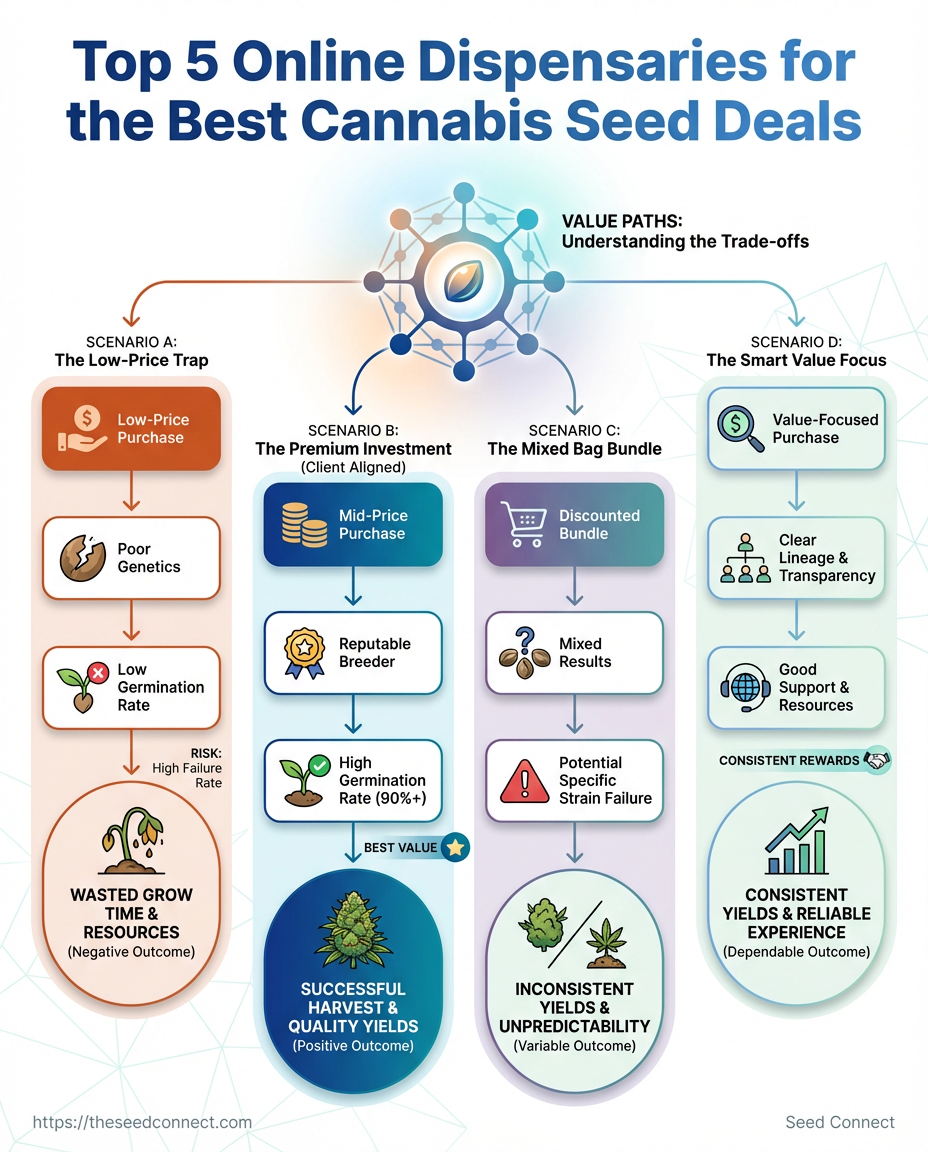
An online dispensary for seeds is a web-based retailer that An online dispensary for seeds is a web-based retailer that specializes in selling cannabis genetics and the small ecosystem of products that support seed-to-plant success. These platforms offer seed selections, handle ordering and shipping, and often provide educational resources and support. This changes buying from a shop visit into a research-based online experience. Products: Online seed dispensaries sell Ordering & delivery: Platforms provide product pages with lineage, expected flowering time, and germination guidance, and they handle fulfillment and discreet shipping to permitted regions. Customer support & guarantees: Many reputable sellers include germination guarantees, grow guides, and live support channels so buyers have help beyond the checkout. How an online dispensary differs from a local shop Legal and shipping considerations Practical example: a buyer interested in Understanding how online seed dispensaries structure inventory, support, and shipping lets growers choose genetics confidently while managing legal risk and logistical expectations. When chosen carefully, an online dispensary speeds access to specialized genetics and expert resources. Online dispensaries operate like specialized e-commerce stores tuned to cannabis… Online dispensaries operate like specialized e-commerce stores tuned to cannabis genetics, promotions, and logistical realities. They attract buyers with targeted promotions, manage ever-changing inventory, and back purchases with germination guarantees that have specific limits. Understanding the promotional mechanics, the way inventory and shipping influence reliability, and what germination guarantees actually cover clarifies why some deals are great value and why others carry hidden risk. Promotions often mask two realities: first, lower-priced genetics may come from surplus or older stock; second, steep discounts sometimes correlate with limited or non-refundable guarantees. Example: a vendor offering a “buy-two-get-one-free” on autoflowers may ship older seed lots to fulfill volume, which reduces germination odds despite the apparent discount. Germination guarantee: Covers replacement or credit for seeds that fail to sprout under normal, documented conditions. Common limitations: Guarantees usually exclude results from improper storage, incorrect germination methods, shipping delays that cause heat damage, or visible seed damage ignored at delivery. Required evidence: Many dispensaries request dated photos, germination logs, and proof of method (e.g., When evaluating offers, weigh savings against inventory transparency and the specificity of the germination policy. Vendors that list pack dates, describe packaging, and provide clear claim procedures typically deliver better long-term value. Understanding these mechanics prevents surprises and makes it easier to choose deals that reflect both price and true reliability. Price is only the starting point. A low headline price can look attractive… Price is only the starting point. A low advertised price may look appealing, but poor germination, weak genetics, or unreliable shipping can make each seed a gamble. The real value of seed deals lies in the cost per healthy plant and your ability to predict outcomes. This helps growers plan space, nutrient schedules, and harvest timings confidently. Germination guarantee: A seller promise to replace non-viable seeds or refund; this reduces financial risk and planning uncertainty. Effective cost per viable plant: Unit price divided by germination success rate; a practical metric for choosing deals. Table: Why Seed Deals Matter: Value Beyond Price — Scenario, Seed unit price, Assumed germination rate & more Market offerings with a germination guarantee effectively lower financial risk and administrative overhead. Choosing a deal means balancing short-term savings against predictable outcomes that preserve grow time and space. Understanding these trade-offs makes purchasing decisions faster and protects the bottom line. Key Takeaway: We rated dispensaries using a standard method that compares short-term deals (promotions) to long-term reliability (germination guarantees and shipping). The methodology weights each category to reflect what buyers actually care about when ordering… We rated dispensaries using a standard method that compares short-term deals (promotions) to long-term reliability (germination guarantees and shipping). The methodology weights each category to reflect what buyers actually care about when ordering seeds online: will the seeds arrive intact, will they germinate, and is the vendor trustworthy? Scores were gathered from vendor promo pages, guarantee and T&C documents, publicly visible shipping policies, and aggregated customer feedback on review platforms. Promotions frequency: How often discounts or bundles reappear and their average depth. Germination guarantee strength: Clarity of terms, replacement process, and coverage length. Product range (strain types): Availability of feminized, autoflower, high-THC, and other categories. Shipping reliability/coverage: Consistency of delivery, tracking options, and permitted destinations. Customer reviews/support: Average sentiment, volume of reviews, and documented support interactions. Table: Evaluation Criteria: How We Picked the Top Dispensaries — Criteria, Weight (%), What we measured & more Understanding these principles makes it straightforward to compare vendors on equal terms and prioritize what’s important for your grow. When applied consistently, the rubric reduces guesswork and surfaces reliable deals without sacrificing quality. Key Takeaway: To find the best seed deals, start by comparing promotions, guarantees, shipping options, and overall price. Below are five vendor archetypes that consistently show up in market scans: a value leader, a seller known for strong germination… To find the best seed deals, start by comparing promotions, guarantees, shipping options, and overall price. Below are five vendor archetypes that consistently show up in market scans: a value leader, a seller known for strong germination guarantees, a flash-sale specialist, a bundle-focused retailer, and an internationally shipping provider. Each has a different strength—choosing between them depends on whether cost, peace-of-mind, or shipping flexibility matters most to the grower. Table: Top 5 Online Dispensaries for the Best Cannabis Seed Deals — Vendor, Headline deal types, Germination guarantee (Y/N) & more Practical caveats: always verify your local laws before ordering, confirm the vendor’s current guarantee terms at checkout, and prefer tracked/insured shipping when buying higher-value seeds. When timing matters, following vendor newsletters and social channels reliably catches the best short-term promos. Key Takeaway: Many hunters of "best cannabis seed deals" chase the lowest price and assume every discount equals value. That assumption misses the trade-offs that matter: genetics stability, true germination performance, shipping reliability, and legal risk. Many hunters of “best cannabis seed deals” chase the lowest price and assume every discount equals value. That assumption misses the trade-offs that matter: genetics stability, true germination performance, shipping reliability, and legal risk. Instead, consider the total ownership costs—price, expected yield, losses from failed seeds, and reliable support if problems come up. Myth: Low price means a great deal. Reality: Cheap seeds often cut corners on selection, quality control, or accurate labeling. A lower upfront cost can translate into fewer viable plants, wasted space and nutrients, and delayed harvests. Myth: Guarantees are absolute protection. Reality: Guarantees often cover only a portion of the purchase price or require the buyer to pay return shipping. Germination guarantee: A seller promise that a certain percentage of seeds will sprout under proper conditions, often with procedural requirements for claims. Myth: Shipping is trivial — customs and delays are rare. Reality: International shipping exposes seeds to customs inspection, seizure, or prolonged transit that harms viability. Even domestic shipments can see temperature extremes that reduce Practical steps to evaluate a “deal” Real examples clarify the gap between price and value. A 30% off promotion on low-grade seeds can cost an extra month and additional $200 in inputs when only half the seeds germinate. Conversely, paying 20% more for high-quality, tested genetics with an enforceable germination promise often saves time and money. When hunting deals, prioritize predictable outcomes over headline discounts. Understanding these trade-offs keeps procurement decisions efficient and reduces costly surprises down the grow cycle. This approach helps teams move faster without sacrificing quality. Many growers transitioned from hobby plots to reliable harvests by refining their genetics, controlling their environment, or sourcing better seeds. These case studies show what succeeded, what failed, and practical moves any grower can apply the next season. Case study — Small commercial grower improves uniformity A six‑tent operator switched from mixed bag seeds to Actionable lesson: Standardize genetics first, then tune the environment around those genetics. Case study — New indoor hobbyist loses first round A first‑time indoor grower ordered diverse strains without checking photoperiod needs. Overhead lights ran on a 20/4 schedule assuming autoflowers, but several photoperiod plants stalled and developed stress. Actionable lesson: Match lighting schedules to seed type; separate batches by flowering behavior. Case study — Outdoor boutique farmer improves germination rates An outdoor micro‑farm faced patchy germination after a wet spring. They adopted a two‑step process: pre‑soak for 12–18 hours, then germinate in a moist paper towel at 20–22°C before transplant. Actionable lesson: Controlled germination reduces field losses and concentrates transplant labor. Common threads across successes What Is an Online Dispensary (for Seeds)?
feminized, autoflower, and high-THC seeds, plus heirloom, CBD-dominant, and hybrid genetics; many also carry grow supplies like soil, nutrients, and pH testing tools.
* Customs risk: International orders may be subject to seizure where seeds are prohibited; many platforms restrict shipping destinations accordingly.
autoflower genetics can research strains online, compare expected yields and THC percentages, buy packs with a germination guarantee (for example, offerings that include feminized and high-THC seed lines), and receive step-by-step germination support post-purchase.How Online Dispensaries for Seeds Work
How Online Dispensaries for Seeds Work
Promotional mechanics: how deals are structured
Inventory and shipping: where deal reliability is won or lost
Germination guarantees: coverage and common limitations
paper-towel method timestamps) before honoring claims.
Why Seed Deals Matter: Value Beyond Price
Why Seed Deals Matter: Value Beyond Price
What to weigh beyond the sticker price
Practical example: how deals change math
Cost-per-viable-plant under different deal scenarios (cheap seed, discounted premium seed, premium full-price with guarantee)
Key insight: lower unit price often loses advantage once germination and reliability are accounted for; discounts on premium genetics frequently yield fewer surprises and lower operational overhead.
Scenario
Seed unit price
Assumed germination rate
Effective cost per viable plant
Cheap no-brand seed
$2.50
60%
$4.17
Premium seed with 30% promo
$8.40
90%
$9.33
Premium seed full-price with guarantee
$12.00
95%
$12.63
Bundle (5-for-4)
$9.60
92%
$10.43
Flash-sale bulk discount
$6.00
88%
$6.82
How to decide in practice
effective cost by dividing unit price by your expected germination rate.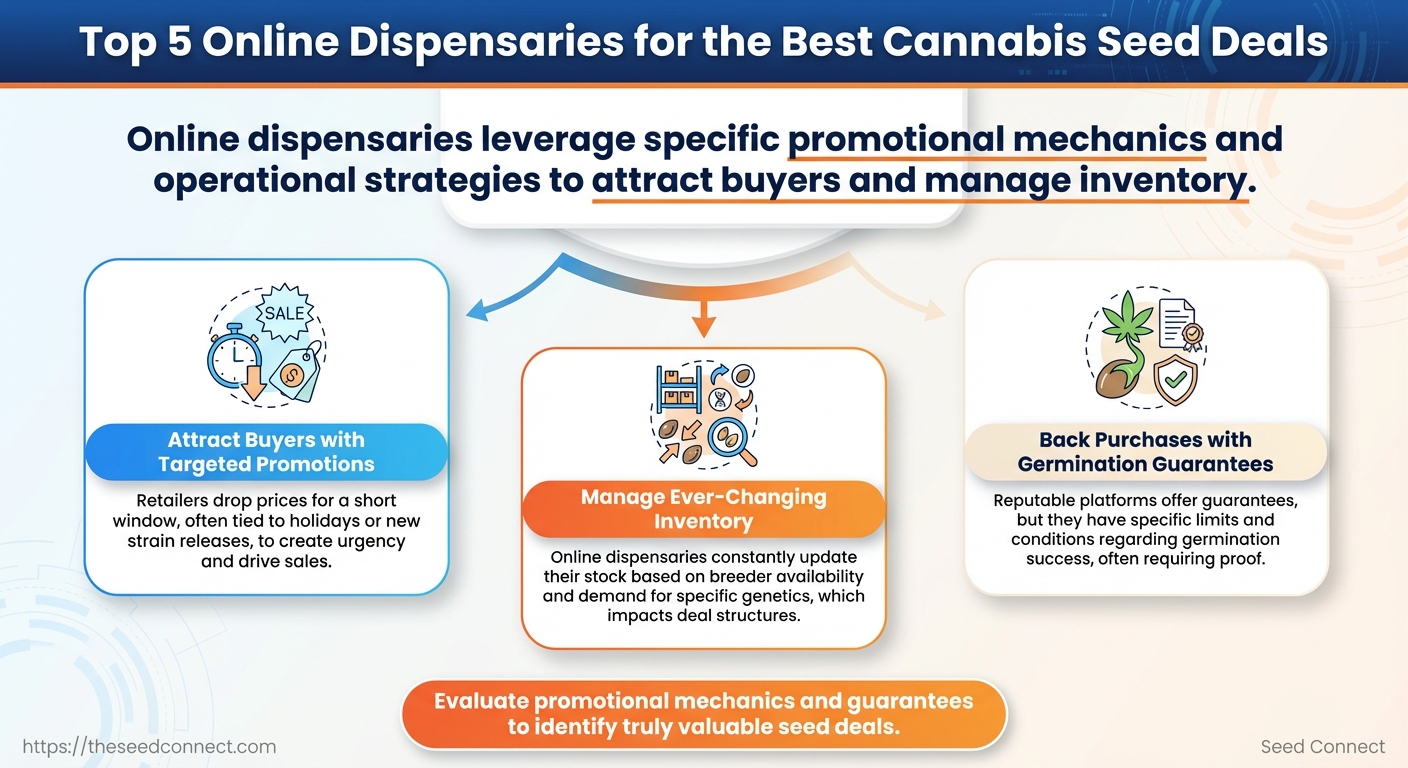
Evaluation Criteria: How We Picked the Top Dispensaries
What we measured and why
How the scoring worked
Final Score = Σ(weight% × (score/10)) × 100 for a percentage-style ranking.Replicating the assessment
Definitions
The scoring rubric and example vendor score breakdown so readers understand how rankings were computed
Key insight: The rubric emphasizes guarantees and shipping because these directly affect grower outcomes; promotions matter for cost-conscious buyers but cannot replace reliable delivery and germination assurances.*
Criteria
Weight (%)
What we measured
Example score (out of 10)
Promotions frequency
20
Discount depth, repeat offers, bundles
8
Germination guarantee strength
30
Length, clarity, replacement process
9
Product range (strain types)
15
Feminized, autoflower, high-THC availability
7
Shipping reliability/coverage
20
Tracking, carriers, destinations, discreetness
8
Customer reviews/support
15
Review sentiment, support responsiveness
8
Top 5 Online Dispensaries for the Best Cannabis Seed Deals
How to use this list
Short vendor notes — getting the best deals
Vendor comparison (at-a-glance)
Provide a side-by-side view of the top 5 dispensaries covering promo types, guarantees, shipping, and price tier for quick decision-making
Value-oriented vendors beat others on raw price but often lack guarantees. Vendors with germination guarantees charge a modest premium but reduce replacement costs and risk. International shipping expands choice but usually raises cost and introduces customs considerations.
Vendor
Headline deal types
Germination guarantee (Y/N)
Shipping regions
Price tier (low/medium/high)
Vendor A (Top Value)
Seasonal discounts, bulk packs
✓
North America, EU (selected)
low
Vendor B (Best Guarantee)
Extended germination support, replacements
✓
North America only
medium
Vendor C (Frequent Flash Sales)
Flash codes, limited-time promos
✗
North America, EU
low
Vendor D (Best Bundles)
Genetic bundles, mixed-variety packs
✗
EU, UK, Canada
medium
Vendor E (Global Shipping)
International shipping, insured options
✓
Global (select countries)
high
Common Misconceptions When Hunting Deals
Germination guarantee language varies widely. Some guarantees require photographic proof, serial numbers, or compliance with storage/shipping instructions before they apply.germination rate.
germination rate claims and whether the seller publishes batch testing or customer feedback.
Real-World Examples and Case Studies
feminized and high THC genetics and standardized a single nutrient line. Crop uniformity rose, trimming time dropped, and marketable flower increased.
autoflower and photoperiod seeds without separate cycles.
Practical next steps include running a single‑strain test crop, adopting autoflower runs for quick turnover, or sourcing from suppliers with germination guarantees when scaling. Understanding these examples helps teams scale more predictably and spend less time troubleshooting genetics and germination.
How to Score the Best Seed Promotions Yourself (Checklist)
Start by checking legitimacy and value. Finding a good seed promotion means confirming where the seeds come from, calculating actual savings, and ensuring future germination success. This checklist breaks the process into clear pre-purchase, during-purchase, and post-purchase actions so you avoid common traps and extract the most value from limited-time offers.
Pre-purchase verification
Seed authenticity: Check strain lineage information and available photos from the breeder.
Germination guarantee: Confirm whether the seller offers a germination guarantee and read the terms carefully.
Reputation signals: Search reviews, forum threads, and social channels for consistent feedback about shipping reliability and seed quality.
Price benchmarking: Compare the promotional price to at least three competitors to determine true savings.
Tip: Promotions can be marketing-driven; a “50% off” deal isn’t meaningful if the regular price is inflated.
During-purchase tactics to maximize savings
- Compare coupon stacking options across the site and third-party coupon aggregators.
- Opt for bundle deals that lower per-seed costs only if you plan to use or store the additional seeds properly.
- Choose a shipping option that balances tracking and cost—cheaper untracked shipments can save money but increase loss risk.
- Use secure payment methods that provide buyer protection, such as credit cards or trusted payment platforms.
Smart move: Add a small, low-cost order first if uncertain—this validates the seller before committing to larger purchases.
Post-purchase best practices for risk mitigation
Immediate inspection: Photograph seed packaging and store tracking numbers.
Proper storage: Transfer seeds into a cool, dark, and dry container with desiccant; label with strain and purchase date.
Germination test plan: Set aside 5–10% of seeds for a germination test within the first month to validate the vendor’s guarantee.
Claim documentation: If seeds fail to perform, collect photos, germination logs, and any communications before filing a claim.
Example: If a 10-seed pack includes a germination guarantee, test two seeds immediately; documented failures enable replacement or refund under most guarantees.
This approach reduces surprise costs and keeps options open when promotions look good but carry hidden risk. When practiced consistently, these checks turn one-off luck into repeatable savings and more predictable grows.
Conclusion
Ordering seeds from online dispensaries can save time and increase genetic options, but experience shows value is more than just the lowest price. Growers who follow the evaluation criteria described earlier — checking germination guarantees, reading shipping and packaging policies, and validating customer feedback — avoid the common pitfalls that lead to mislabeled genetics or weak seedlings. One hobby grower case study in the article pivoted from bargain hunting to buying from a vetted seller and saw Recent research indicates that germination rates can vary significantly, with some studies indicating rates as high as 92% under optimal conditions. another small commercial operator used targeted seed promotions to trial three new strains without risking a full crop cycle.
Move forward with a clear plan: prioritize sellers with transparent guarantees, compare ongoing seed promotions against actual shipping and support, and order small test batches before scaling. Practical next steps:
- Verify germination and replacement policies. – Track recent customer reports and independent photos.
- Use promotional offers to trial strains, not to stockpile unknown genetics.
If professional-grade assurance is desirable, consult the Seed Buying Guide at TheSeedConnect for vetted options and support. Questions like “Is a low-price promo worth it?” or “How many seeds should I test first?” are answered by treating promos as trials and starting with a small sample—those two habits protect both genetics and time. Take these steps now to turn good online deals into reliable, repeatable results.