


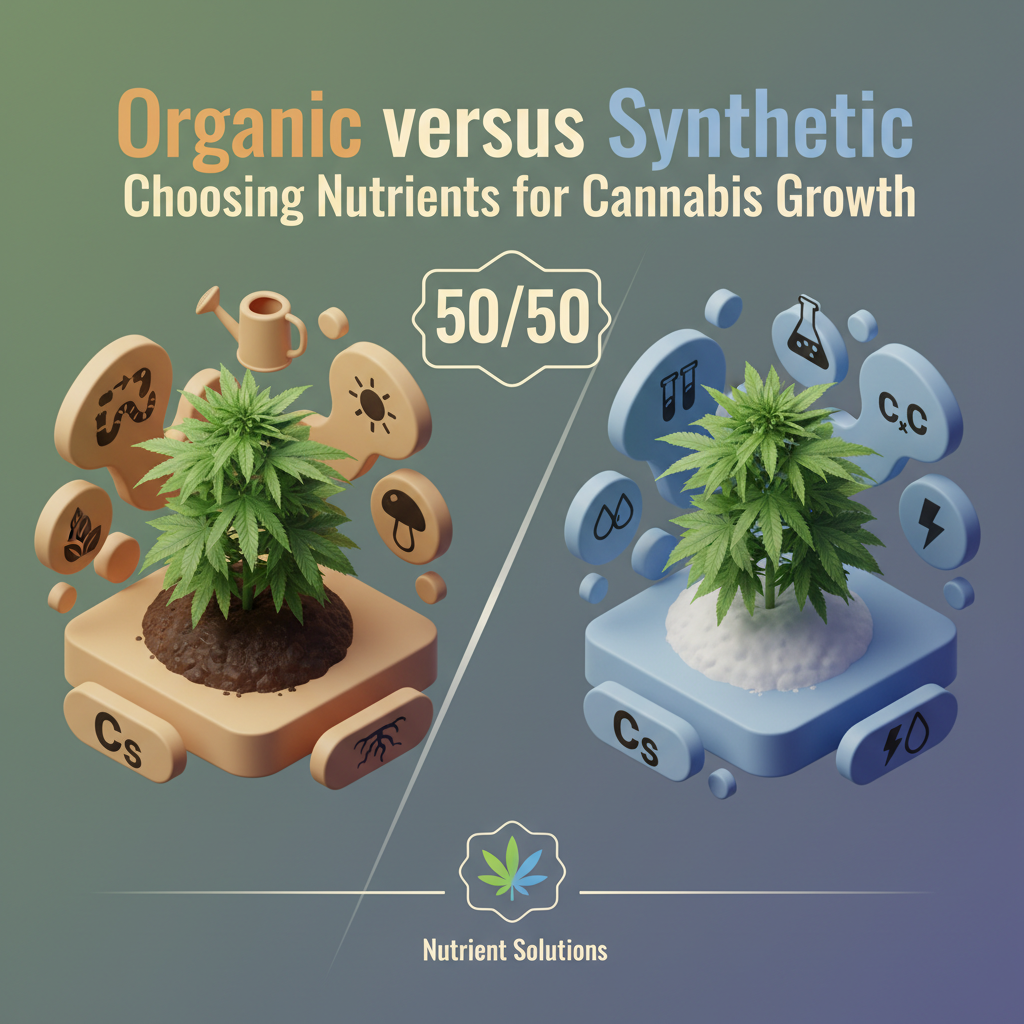
You’re standing over a tray of seedlings, trying to choose between organic and synthetic nutrients. That choice will shape flavor, terpene depth, pest resilience, and how plants respond to stress. Organic cannabis nutrients come from compost, bone meal, and fish emulsion, and they feed soil microbes.
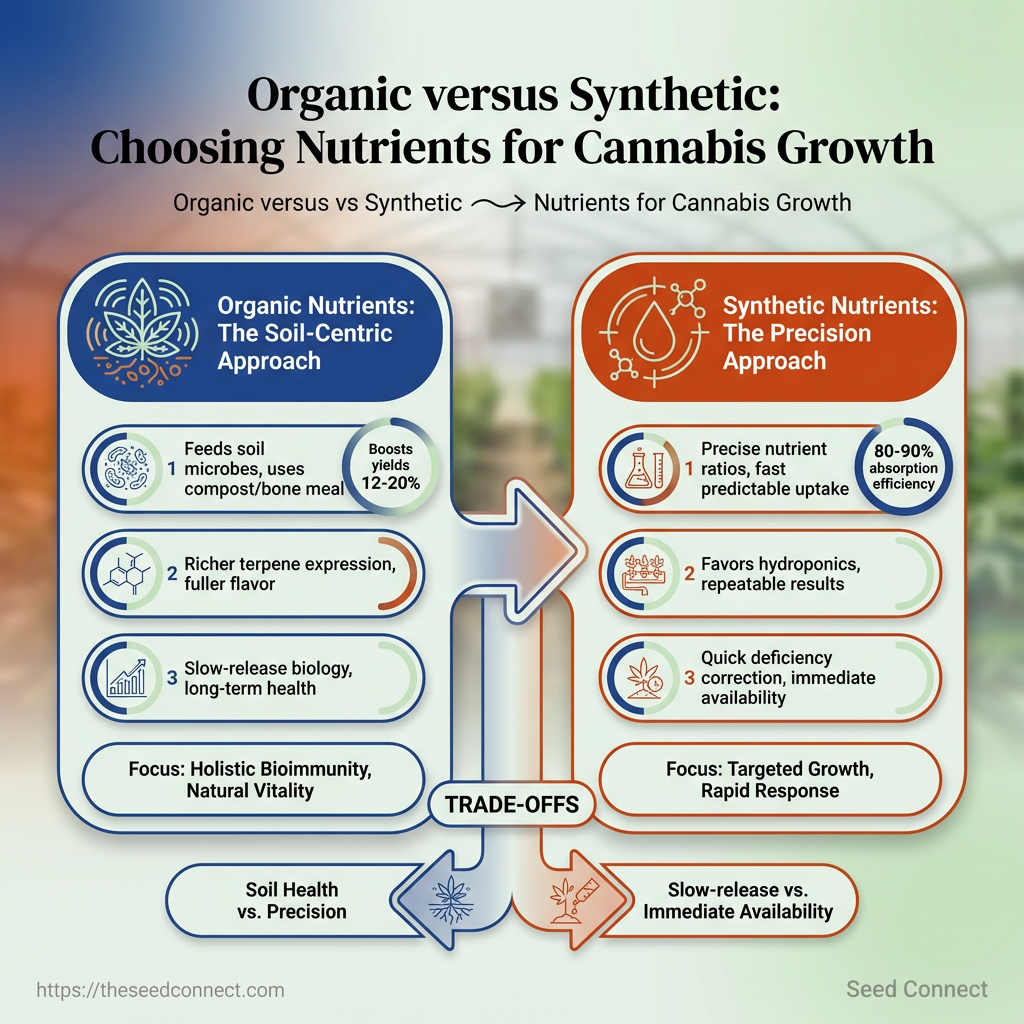
Studies suggest organic fertilizers can boost yields by 12–20%, though outcomes depend on strain and environment. Synthetic mixes deliver precise nutrient ratios for fast, predictable uptake.
They typically show nutrient absorption efficiencies around 80–90%, which favors hydroponics and quick deficiency correction.
Many growers report richer terpene expression and fuller flavor with organic methods.
Conversely, commercial and hydroponic operations often choose synthetic solutions for repeatable results and tight control.
Picking the right cannabis nutrients isn’t about purity tests; it’s about matching method to goals.
A few practical trade-offs—soil health versus precision, slow-release biology versus immediate availability—drive most decisions.
Knowing those trade-offs keeps experiments short and harvests predictable.
Table of Contents
Why this choice matters — the problem that brought you here
Staring at two bottles with confident labels is where most growers get stuck.
One promises instant growth; the other promises healthier soil and better flavor.
That clash of claims creates a fog of advice.
Forums, brand marketing, and well-meaning friends add conflicting tips.
Real trade-offs get lost in the noise: short-term speed versus long-term soil health, predictable uptake versus richer terpene profiles.
The fallout is practical.
You can spend more and get the same or worse harvest.
Or you can lock into a feeding plan that fits neither your space nor your goals.
Common problems that bring growers here:
-
Mixed messaging: Brands market outcomes, not trade-offs, making choices feel emotional rather than tactical.
-
Confusing metrics: Label numbers like
N-P-Kbecome gospel without context for stage or medium. -
Wrong fit for system: Hydroponic setups respond differently than soil—what works for one can harm the other.
-
Hidden costs: Synthetic regimes often need additives and flushing routines; organic systems demand time and inputs.
-
Flavor versus yield tension: Choosing for terpene-rich smoke may reduce raw growth speed.
Organic and synthetic nutrient choices aren’t theoretical; they have measurable effects.
Organic feeds — think compost, bone meal, fish emulsion — encourage microbial life and can boost yields by about 12–20% in some conditions.
Synthetic formulas deliver nutrients fast, with typical absorption efficiencies around 80–90%, which is why hydroponic growers favor them.
Brands illustrate those differences in practice.
FoxFarm emphasizes organic and soil-focused mixes for flavor and structure.
General Hydroponics builds synthetic blends for controlled, water-based systems. Botanicare spans both worlds with options aimed at soil health and concentrated feeds. Organic nutrients: Natural inputs (compost, bone meal, fish emulsions) that build soil microbiology and often improve terpene complexity. Synthetic nutrients: Chemically formulated salts designed for rapid, predictable uptake and precise dosing in soil or hydro systems. Growth goals: Your desired outcome — fastest harvest, biggest yield, or best flavor — which should drive nutrient choice, not label claims. This guide will cut through the marketing and give a clear way to choose cannabis nutrients based on real goals, not slogans.
You’ll leave knowing which trade-offs matter for your setup and how to pick a feeding path that actually delivers.
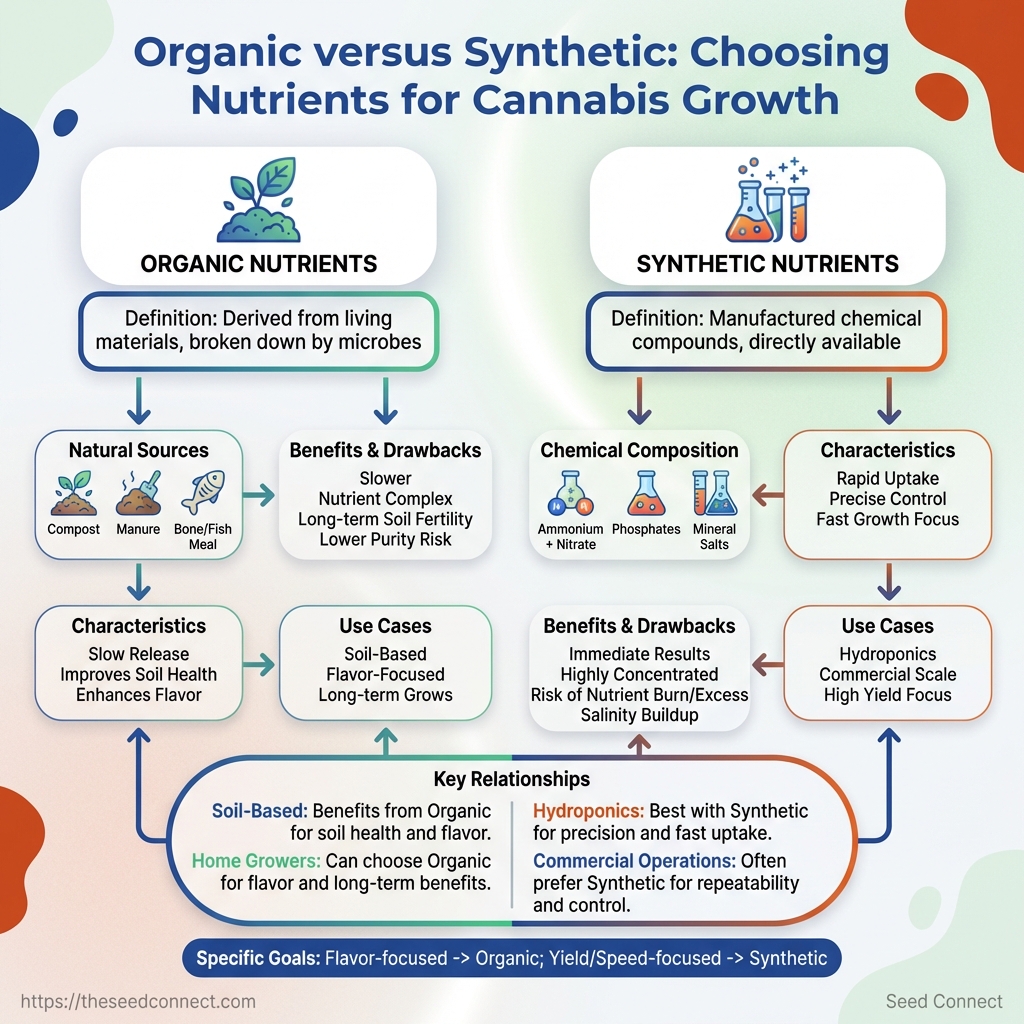
Nutrient basics for cannabis growers
Think of nutrients as the engine that turns light and CO₂ into dense buds.
Without the right fuel mix at the right time, plants stall, stretch, or burn.
This section explains what cannabis needs, how those elements move from medium into roots, and the language growers use when choosing products.
Expect practical distinctions between soil, soilless, and hydroponic uptake, plus clear definitions of N-P-K, chelates, and release types.
Understanding these fundamentals makes choosing between organic vs synthetic nutrients less mystifying.
You’ll see why some growers prefer the flavor lift of organics while others pick synthetic feeds for fast, precise corrections.
It’s critical to recognize that cannabis uptake varies based on the growing environment: In soil, nutrients gradually become available through microbial action; in soilless media, they may be quickly absorbed but require careful monitoring; while hydroponics allows for instant availability but demands precise control of concentration and pH levels.
Side-by-side: organic vs synthetic nutrients
Growers often ask which nutrient path gives better results: steady, soil-first organics or fast, precise synthetics.
Choosing depends on your system, goals, and patience.
Organic feeds tend to increase soil life and can boost flavor and long-term yields, while synthetic formulas deliver nutrients immediately and make diagnosis and control easier.
For cannabis growers chasing higher terpene complexity and soil health, organics can deliver measurable gains — studies report roughly 12–20% higher yields in some trials, depending on strain and conditions.
On the other hand, synthetic nutrients offer 80–90% nutrient absorption efficiency in many setups, which translates to rapid vegetative growth and quick corrections when deficiencies appear.
Both have legitimate places in modern grows; the choice comes down to trade-offs between performance, ease, and final product characteristics.
Head-to-head comparison table
|
Attribute |
Organic |
Synthetic |
Practical implication for growers |
|---|---|---|---|
|
Nutrient availability speed |
Slow to moderate — depends on microbial mineralization |
Immediate — dissolved ions available at feed time |
Use synthetics for rapid corrections; organics for steady, time-released feeding |
|
Consistency batch-to-batch |
Variable — composts and amendments differ by source |
Highly consistent when mixed per label |
Expect more testing and tweaks with organics; synthetics give repeatable results |
|
Control & adjustability |
Harder to fine-tune exact NPK at a moment |
Very precise; easy to dial ratios and ppm |
Hydro and precision vegging favor synthetic control |
|
Soil microbiome effect |
Enhances microbes and structure |
Neutral to suppressive depending on salts |
Organics build long-term soil resilience and disease resistance |
|
Suitability for hydroponics |
Generally poor — clogging and biofilm risk |
Designed for hydro (e.g., General Hydroponics Flora Series) |
Choose synthetics for DWC/ebb-and-flow; organics for soil and coco |
|
Runoff and salt buildup |
Lower salt accumulation |
Prone to salt and EC spikes without flushing |
Synthetic systems need regular leaching and EC monitoring |
|
Impact on terpene/flavor profile |
Tends to enhance terpene complexity and mouthfeel |
Can be clean but sometimes less complex |
Flavor-focused grows often prefer organics |
|
Starter cost vs ongoing cost |
Higher initial amendment cost; lower long-term input |
Lower startup; predictable recurring purchases |
Organics can pay back over seasons; synthetics have steady expenses |
|
Ease of diagnosis |
Symptoms may overlap due to biological activity |
Deficiencies show more clearly and quickly |
Beginners often find synthetics easier to troubleshoot |
Organics boost soil life, flavor, and—often—yield, but require more monitoring and variable inputs.
Synthetic nutrients give fast, repeatable responses and are the go-to for hydro growers and quick cycles.
When each type tends to perform better
Soil growers wanting richer terpene profiles or those building living soil should lean toward organic amendments.
Brands like FoxFarm and Botanicare offer organic-focused lines useful in that approach.
Hydroponic growers, or anyone needing quick fixes and tight control, benefit from synthetic formulas such as General Hydroponics’ Flora Series.
These shine when speed and predictability are priorities.
For mixed or transition setups, consider a hybrid approach: use organics to build soil health and targeted synthetics for specific corrective feeds.
Choose based on your system and the outcome you value most.
Organic feeds reward patience and flavor; synthetics reward speed and control.
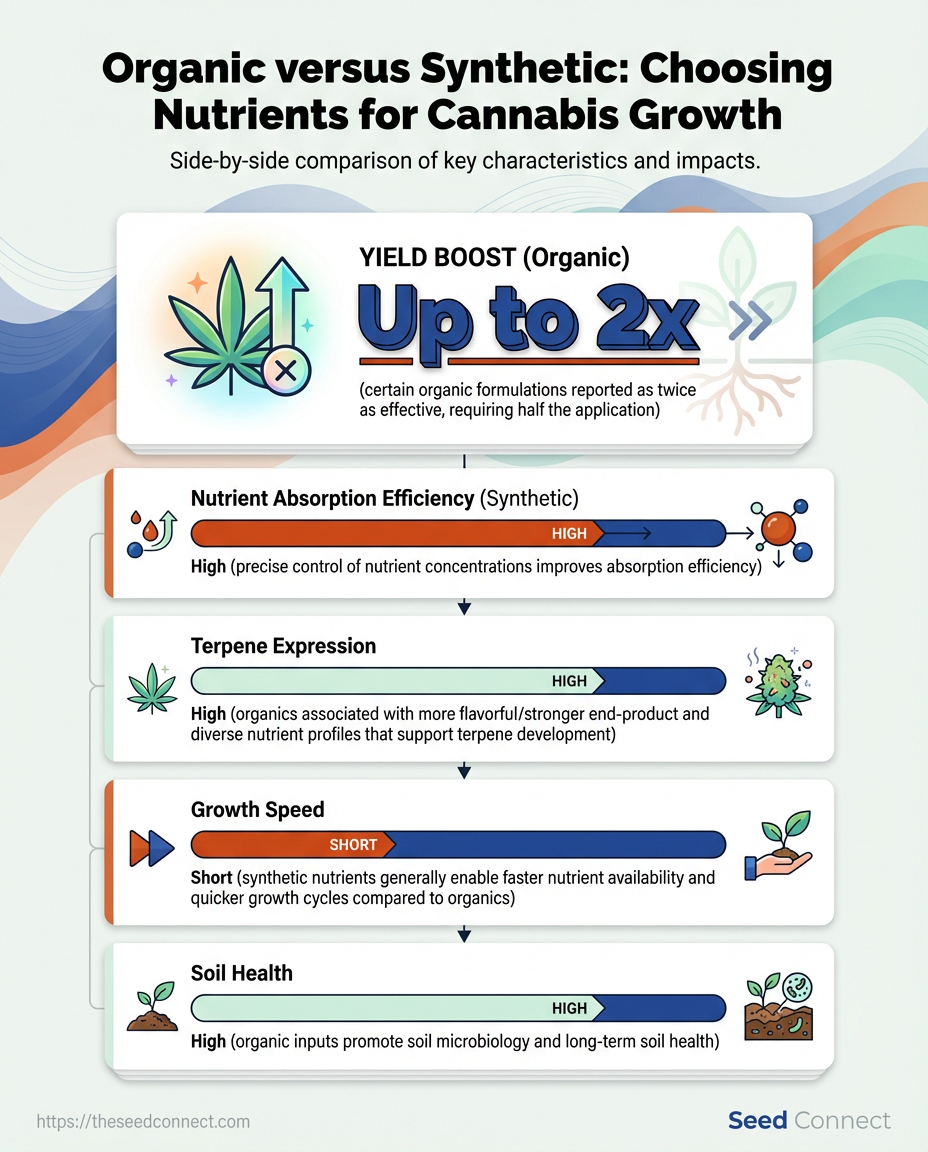
Plant health and yield: measurable effects beyond labels
Nutrients change more than growth rate; they reshape plant physiology in ways you can measure.
Across a full cycle, the source and timing of nutrients affect leaf area, stretch, calyx development, trichome density, and even terpene abundance.
Those are not marketing claims — they’re outcomes you can track.
Organic feeds often translate into slower, steadier nutrient availability and stronger soil biology.
That pattern frequently produces richer terpene expression and, in many trials, higher final yield — studies suggest 12–20% higher yield with organic fertilizers depending on strain and environment.
Synthetic formulas, by contrast, give 80–90% nutrient absorption efficiency, so growers see rapid changes and tighter control over short-term deficiencies.
Measuring those differences requires simple, repeatable metrics and a plan to compare them side-by-side.
Vegetative vigor: measurable signals and how to read them
Vegetative stage response is where differences first become obvious.
Faster shoot elongation, larger leaf area, and quicker node production are common with high-efficiency synthetic regimens such as General Hydroponics’ Flora Series in hydro systems. Measure weekly node count, leaf area index, and dry weight per plant at pre-flower.
These numbers tell you whether a feed is supporting structural growth or simply producing lush, weak foliage.
Flowering stretch and final bud set: timing wins over slogans
Flowering is where feed timing and form push outcomes.
Nutrient swings during the early bloom period influence stretch and calyx formation.
Organically fed plants tend to set denser buds with more calyx-to-leaf ratio, a pattern consistent with reported organic yield gains and products like FoxFarm’s Tiger Bloom.
Track calyx count, wet and dry bud weight, and grams-per-watt across treatments.
That gives a clean, comparable yield picture.
Terpenes, smoke quality and post-harvest effects
Flavor and aroma are biochemical products, not just marketing copy.
Organic feeding often boosts terpene richness, which many growers and labs confirm through sensory testing and terpene profiling.
Post-harvest stability also differs.
Plants with balanced organics can cure into smoother smoke and retain terpenes longer, while high-salt synthetic residues may accelerate terpene loss during storage.
The infographic maps nutrient needs by stage and flags when organic vs synthetic choices tend to matter most.
Use it to time switches, recognize deficiency cues, and plan harvest-impacting changes.
-
Metrics to track: Node count: nodes per week; Leaf area: cm² per plant; Calyx density: calyx per bud; Trichome coverage: subjective scale or microscope image; Yield: wet/dry grams and grams-per-watt.
-
Run a controlled side-by-side with identical genetics and environment.
-
Record the metrics above weekly and at harvest.
-
Compare yield, terpene profiles (if available), and curing outcomes.
Those numbers remove opinion from the debate.
Measured properly, nutrient choices become predictable tools for shaping health, yield, and final smoke quality.
Cost, sourcing, and international shipping considerations
Costs show up in two places: at purchase and during the grow.
Upfront expenses—soil, bottles of concentrated nutrients, pH meters, and amendments—create a visible sticker shock.
Ongoing costs—repeat nutrient mixes, microbial teas, flushing solutions, and replacement media—pile up across cycles and often exceed the first outlay over a single season.
Plan for both types of expense because they change choices.
A nutrient program that looks cheap per bottle can demand weekly additives that add more cost than a pricier, concentrated line.
And remember that source affects price: brand-name lines from firms like FoxFarm, General Hydroponics, or Botanicare often cost more up front but reduce troubleshooting time.
Upfront vs ongoing costs: what to budget for
Upfront costs should include tools and baseline supplies.
Expect bottles of base nutrients, a set of common amendments, reliable growing medium, and basic meters. Term: Upfront costs Description: Equipment and primary consumables bought once per grow or season, such as nutrient bases and soil. Term: Ongoing costs Description: Recurring purchases like booster bottles, microbial inoculants, and replacement media.
Practical budgeting steps:
-
List what you need for the first cycle and the next three cycles.
-
Multiply ongoing-item costs by planned cycles to get a true per-cycle cost.
Sourcing reliably and navigating shipping rules
Cross-border buying reduces price but adds complexity.
Many nutrient and amendment brands ship internationally, yet customs in some countries restrict liquid concentrates or organic inputs.
-
Know local restrictions: some regions ban particular organic inputs or require permits.
-
Choose reputable distributors: a reliable supplier reduces delays and mislabeling.
-
Factor shipping time and cold-chain needs: some live amendments lose potency in transit.
When sourcing internationally, follow a simple sequence: check customs rules, confirm supplier shipping policies, then choose insured freight.
That order avoids costly returns and quarantine holds.
Seed quality, nutrient choice, and the cost equation
Starting with high-quality seeds reduces risk and hidden costs.
Better seeds germinate more reliably and deliver predictable nutrient demands, cutting waste on trial-and-error feeding.
Seed-driven predictability matters because nutrient schedules differ for vigorous genetics versus finicky strains.
If you want a reference for genetics and seed choices, see Cannabis Seeds.
Organic feeds can boost flavor and sometimes yield (+12-20%), while synthetic mixes offer rapid uptake (80-90% absorption efficiency) and tight control.
Match your seed genetics to the nutrient path to avoid overspending on unnecessary amendments.
Careful budgeting and informed sourcing shrink surprises and keep the grow profitable.
Start with clear numbers, plan for trade friction, and prioritize seed quality to lower long-term costs.
📥 Download: Download Template (PDF)
Choosing nutrients for your grow style
Few choices influence your results more than matching nutrient strategy to how you grow.
Pick the wrong approach and you’ll fight deficiencies, waste product, or blunt flavor; pick the right one and feeding becomes predictable and low-stress.
This section gives a practical decision checklist for four common setups, shows when a hybrid organic-plus-synthetic plan makes sense, and explains how platforms like https://theseedconnect.com and their germination guarantee and grower support can simplify the decision.
Expect concrete examples, recommended product types from known lines, and small procedural steps you can apply tonight.
Decision checklist for your setup
Start by matching feeding complexity to your time and system control.
Hydroponic and commercial runs reward precise synthetic mixes, while outdoor and many hobbyist growers gain resilience from an organic base.
-
Hobbyist tent: Choose forgiving, slow-release organics or simple 2-part synthetics.
Good examples: FoxFarm soil amendments for ease; a basic Flora Series regimen from General Hydroponics if you want control.
-
Small commercial: Prioritize consistency and cost per gram.
Use concentrated synthetic lines that give 80–90% absorption efficiency to cut waste and speed turnover.
-
Outdoor runs: Favor organic inputs that build soil life and terpene complexity.
Botanicare’s organic options suit seasonal cycles and can improve flavor and marginal yields.
-
Hydroponic setups: Go synthetic for predictability and fast correction.
General Hydroponics’ Flora Series is designed for this environment.
Definitions to keep clear
Organic base: Natural amendments (compost, bone meal, fish emulsion) that feed microbes and release nutrients slowly. Synthetic boost: Precisely formulated salts and chelates that deliver immediately available N-P-K and micronutrients.
Hybrid approaches: when to mix and how to do it
Hybrid feeding works when you want soil health plus the emergency control synthetics provide.
Use an organic potting mix as the foundation, then add targeted synthetic foliar feeds or bloom boosters during high-demand phases.
-
Start with an organic-rich medium and slow-release amendments.
-
Monitor runoff EC and pH weekly.
Add a synthetic micro blend only if uptake drops or flowers stall.
-
Use foliar
0.5–1.0 g/Lsprays of targeted calcium or magnesium for short corrective windows. -
Phase synthetics out during flushes to preserve flavor benefits.
How a germination guarantee and expert support change things
A reliable germination guarantee removes the risk of re-seeding, which lets you invest in higher-quality amendments or pricier synthetic concentrates without fear of wasted seeds.
Expert support shortens the learning curve.
Grower guidance can translate your tent’s environmental limits into a feeding schedule and point you toward compatible brands like FoxFarm, General Hydroponics, or Botanicare for each phase.
This short decision-tree walkthrough helps you pick a path by answering constraints and goals.
It shows when hybrids make sense and which product types match each grow style.
Choosing nutrients by grow style turns feeding from guesswork into a repeatable plan.
Match your system, accept manageable trade-offs, and your plants will reward the clarity.
Feeding schedules, testing, and troubleshooting
Ever mixed a feed and watched leaves curl within a day? That moment separates guesswork from a disciplined feeding routine.
A clear schedule, simple tests, and a short troubleshooting checklist keep plants productive and calm.
Start with the plant’s medium and system, then match frequency and strength to plant stage.
Soil amended with organics needs gentler, less-frequent top-dresses; coco demands regular, balanced liquid feeds; hydroponic systems require tight EC/ppm control and quick corrections.
Follow manufacturer charts (for example, General Hydroponics for hydro setups or FoxFarm for soil blends) but expect to adapt to strain and environment.
Consistent testing is the bridge between feeding and results.
Measure runoff EC/ppm, track pH, and sample soil when something looks off.
Small corrective moves—diluting a feed, flushing, or correcting pH—usually stop problems before they escalate.
Sample feeding schedules: soil with organic amendment, coco/perlite, and hydroponics
| Grow medium & system | Stage | Frequency | Typical ppm/EC or amendment rate | Key check/observation | |—|—|—:|—|—| | Soil — organic amendment | Seedling | Light feed once at cotyledon stage | 100–300 ppm or light compost tea (1:10) | New leaves pale = skip feed | | Soil — organic amendment | Veg | Every 7–14 days top-dress or tea | 300–600 ppm; compost/top-dress 0.5–1 cup per plant | Vigorous node spacing; steady growth | | Soil — organic amendment | Flower | Every 7–14 days with bloom compost tea | 400–800 ppm; bone meal/kelp as needed | Terpene-rich aroma develops | | Soil — organic amendment | Flush | Final 7–14 days plain water | Runoff EC close to input; low ppm | Taste and smoke quality test later | | Coco/perlite — liquid organics | Seedling | Feed every 2–3 days, low strength | 400–600 ppm; EC 0.6–0.9 | Roots white and stringy | | Coco/perlite — liquid organics | Veg | Feed every 1–2 days | 600–900 ppm; EC 0.9–1.2 | Fast, compact growth | | Coco/perlite — liquid organics | Flower | Daily feeds, steady EC | 900–1200 ppm; EC 1.2–1.6 | Watch for tip burn | | Coco/perlite — liquid organics | Flush | 5–7 days flush before harvest | Low ppm run to near-water levels | Bud density and aroma checked | | Hydroponic — synthetic nutrients | Seedling | Continuous low-strength solution | 300–500 ppm; EC 0.6–0.9 | Stable pH, active root tips | | Hydroponic — synthetic nutrients | Veg | Continuous balanced feed | 600–900 ppm; EC 1.0–1.6 | Rapid uptake; adjust for 80–90% absorption | | Hydroponic — synthetic nutrients | Flower | Increase PK and maintain EC | 900–1400 ppm; EC 1.6–2.0 | Watch for salt build-up | | Hydroponic — synthetic nutrients | Flush | 48–72 hour clean-water flush | Runoff EC near input water | Clearer smoke post-flush | This checklist blends manufacturer feeding patterns with grower-tested ranges.
It’s safer to start low and raise strength than the reverse.
Common problems and first-response steps
Narrow, pale leaves or sudden wilting often mean a few predictable issues.
Respond fast with simple, reversible actions before changing feeds.
-
Nutrient lockout: Stop feeding and flush with pH-balanced water.
-
Nutrient burn: Cut feed concentration by 25–50% and check runoff ppm.
-
Deficiency (yellowing, spots): Confirm pH first, then correct specific element slowly.
-
Overwatering / root hypoxia: Improve drainage or aeration; let medium dry to target moisture.
-
Salt buildup: Perform a deep flush and switch to softer water or chelated nutrients.
Testing for success
Routine tests give early warnings and confidence.
Keep a log with dates, EC, pH, and visible notes.
-
Measure runoff EC/ppm after a feed.
Compare input vs runoff; a big jump suggests salt buildup.
-
Use basic soil tests for nitrate, phosphorus, and potassium when using organics.
Repeat monthly.
-
For harvest-level assurance, send flower samples to a lab for cannabinoid and pesticide analysis.
Final note: consistent, small checks beat infrequent, dramatic corrections.
Feed with a plan, test often, and keep the first response simple.
Conclusion
Make the nutrient choice into an experiment, not a guess
The single most important insight is simple: matching nutrient type to your grow style and measurement routine matters more than picking a trendy brand.
That seedling decision you hesitated over will determine terpene development, pest resilience, and how forgiving your plants are during heat or watering stress.
Treat nutrients as a management strategy, not a one-time purchase.
Remember the example about measurable differences beyond labels — flushing, runoff ppm, and terpene tests reveal outcomes that marketing cannot.
Rather than committing blindly to organic or synthetic, run a controlled comparison on two small trays to see how your strain responds under your lights and water.
Start by standardizing light, medium, and watering for both trays, then feed one with an organic regimen and the other with a mild synthetic schedule, logging EC/PPM and visual health weekly.
If you want a quick resource for diverse genetics to use in that trial, platforms like https://theseedconnect.com are an option.
Today’s action: label two identical seedling trays, choose one organic and one synthetic feeding plan, and record your first runoff PPM — results in four weeks will tell you far more than theory ever could.