

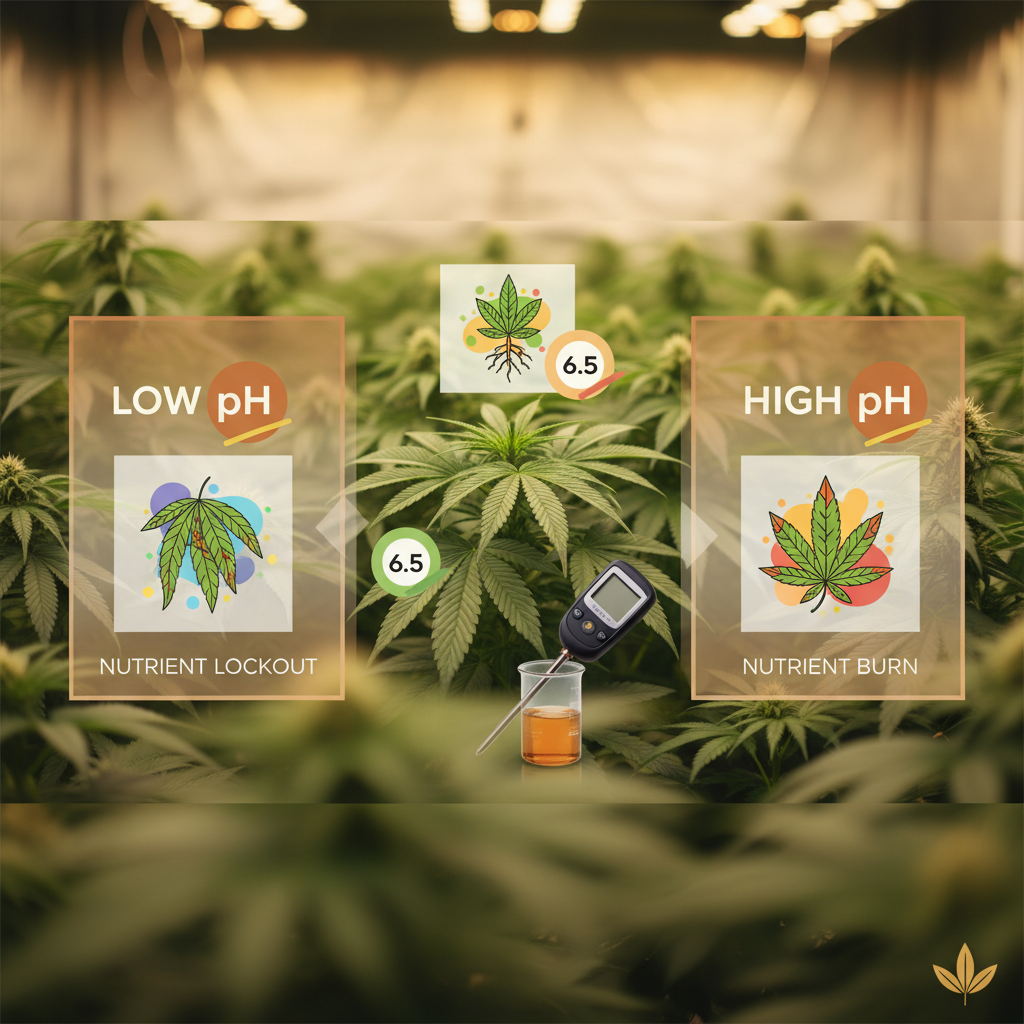
The role of pH levels in cannabis cultivation is closely connected to nutrient availability and healthy root development. Even when nutrients are present, cannabis plants may struggle to absorb them efficiently if the root-zone pH moves too far outside the suitable range.
In this guide, The Seed Connect explains how pH affects nutrient uptake, the common ranges used for soil, coco, and hydroponic systems, and how growers can test and adjust pH without creating unnecessary fluctuations.
Quick Answer: Maintain cannabis pH inside your medium’s working range because root-zone chemistry determines whether nutrients can actually be used (even if your feed recipe is “correct”).
Do this workflow:
1) Test inflow first with a calibrated pH meter (don’t rely on runoff alone).
2) Target the right range for your medium and growth stage.
3) Adjust in small steps, mix/circulate, then retest at the right time for your system.
4) If the plant symptoms don’t match your feed, use the symptom-to-diagnostic matrix.Bottom line: steady inputs + correct targets beat aggressive “guessing” every time.
Table of Contents
Why pH matters for cannabis growers
Ever had a plant that looked fed, watered, and still strangely unhappy? Often the culprit isn’t the nutrient mix—it’s pH.
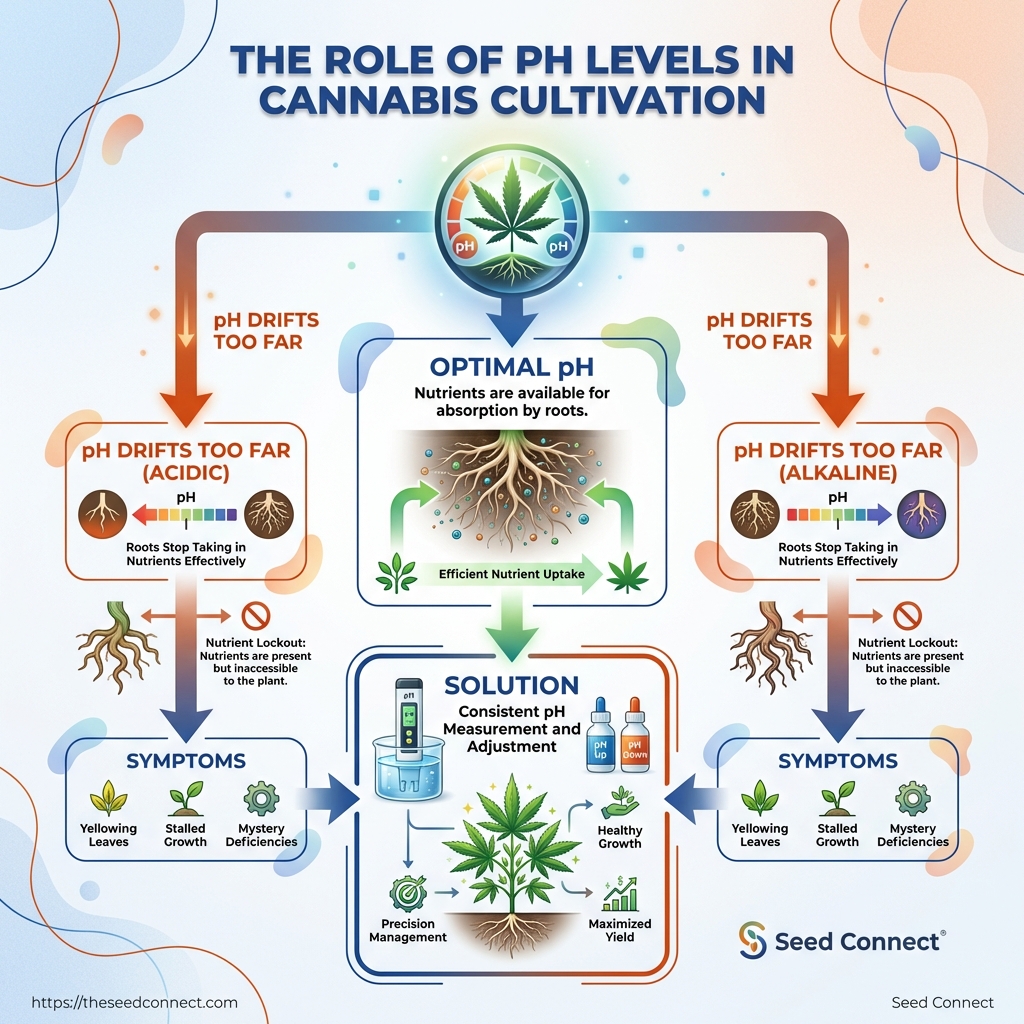
When the root zone drifts out of range, the plant can stop taking up food it already has access to. That’s why nutrient lockout can look like hunger: the fertilizer is present, but key ions aren’t available to the roots.
The impact goes beyond one leaf. pH influences the uptake of calcium, magnesium, iron, and other essentials, which affects growth speed and how smoothly plants develop through flowering. When uptake is steady, plants tend to look more uniform and predictable.
A few quick pointers on what to look for
If you suspect pH is the issue, don’t just add more nutrients—verify the chemistry first. pH problems also tend to show up as:
- Deficiency-like symptoms that don’t improve with “more feed”
- Unexplained unevenness (sometimes one side or one section of the canopy acts differently)
- Inflow and runoff/reservoir readings that don’t agree with the story you expect
For a structured, symptom-to-diagnostic checklist, jump to the Symptoms matrix in Section 10.
The numbers come next
We’ll give the exact working ranges by medium and growth stage in Section 8, so you can stop guessing and start steering the root zone with consistency.
pH basics and plant chemistry (what growers should understand)
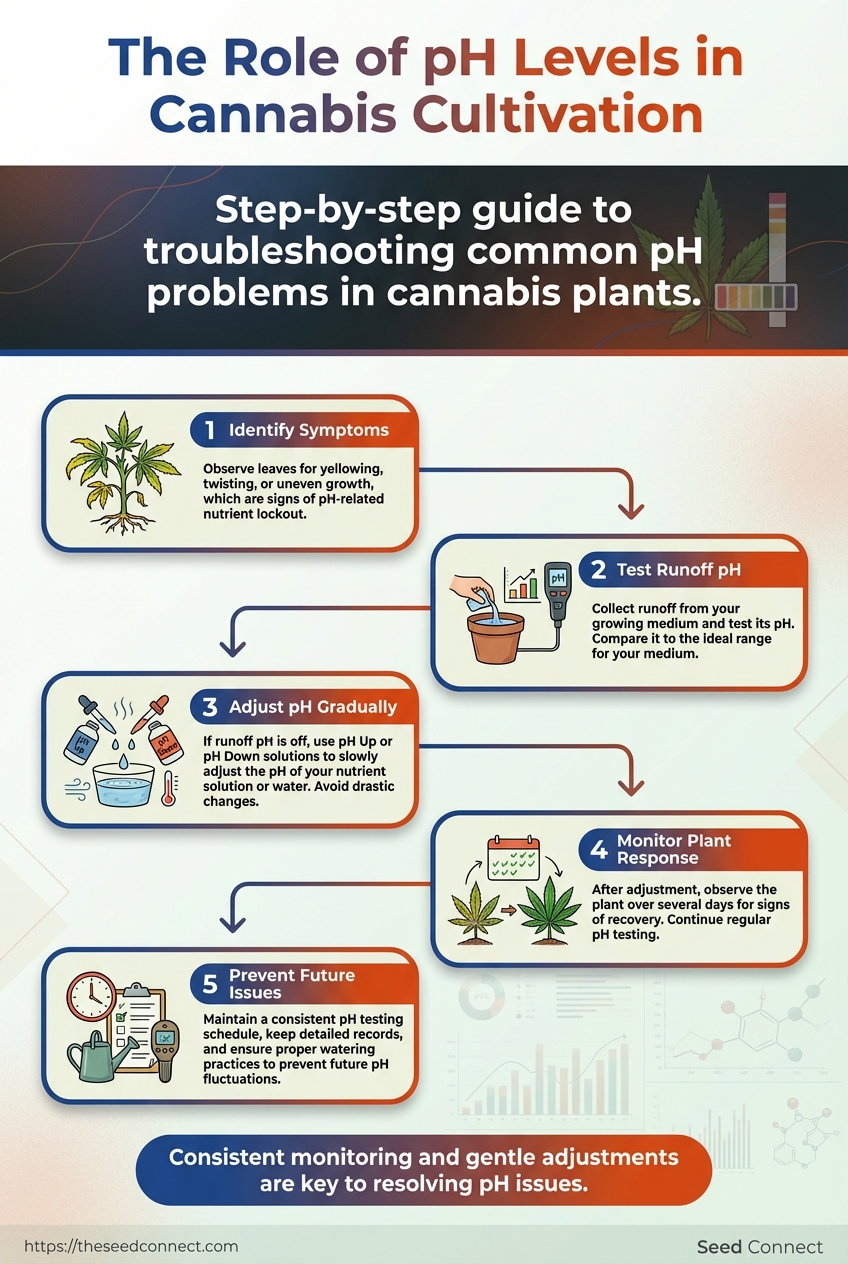
Why can two feed mixes that look nearly identical behave so differently in the root zone? Because pH decides which ions stay available to the plant, and which ones quietly slip out of reach.
At its simplest, pH measures how acidic or alkaline a solution is.
The scale runs from 0 to 14, with 7 sitting at neutral, lower numbers reading as acidic, and higher numbers as alkaline, as outlined in The Ideal pH level.
That scale matters because cannabis roots do not “eat” nutrients in a vacuum.
They absorb dissolved ions, and those ions behave differently depending on the chemistry around them, which is why Rio Coco Retail’s guide to cannabis pH levels places soil-based systems around 6.0–7.0 and hydroponic or water-solution systems around 5.5–6.5.
Some nutrients stay soluble more easily in slightly acidic conditions.
Others become harder for roots to access when the mix drifts too far up or down, even if the fertilizer label still looks perfect on paper.
That is where buffering capacity comes in.
Buffering is a medium’s ability to resist sudden pH swings, and coco behaves differently from soil because it does not hold pH as tightly; Coco for Cannabis specifically notes that coco buffers nutrient-solution pH less effectively than soil.
- Soil: Usually changes more slowly because organic matter and mineral particles help hold the chemistry steadier.
- Coco: Responds faster to what you pour in, so inflow pH matters more than guesswork later.
- Hydro systems: Move quickly, which makes small dosing errors show up faster in plant behavior.
Grow with Jane’s pH and EC meter guide places peat and soil irrigation around 6.0–6.5, while coco and hydroponic setups sit closer to 5.8–6.2, which lines up with the same chemistry story: the medium changes the target.
Small range differences are not nitpicking; they are the difference between nutrients being present and nutrients being usable.
When the chemistry fits the medium, everything feels calmer.
Leaves stop sending mixed signals, and the plant spends less time fighting its own root-zone environment.
Measuring pH: tools, best practices and common mistakes
A pH number is only useful if the number is real.
A cheap meter that drifts, or a strip that leaves you squinting at colors under bad light, can send a grower down the wrong path fast.
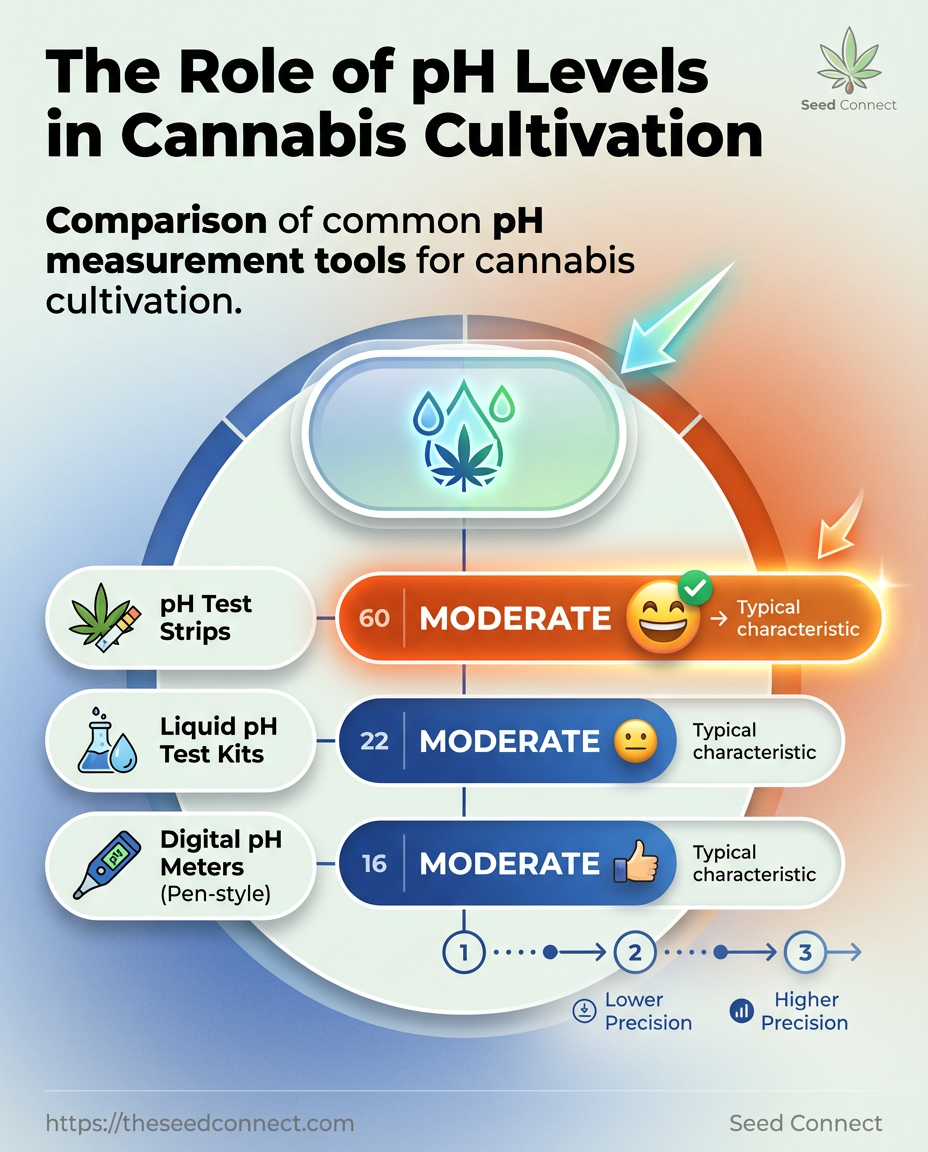
For most growers, a digital pH meter beats test strips because it gives a finer reading and is easier to track over time.
Coco for Cannabis notes that pH can be measured with liquid drops or a meter, but also warns that cheap meters are often unreliable and that probe care matters a lot (Coco for Cannabis).
That matters because pH adjustment cannabis work is about repeatable habits, not heroic guesses.
Picking the right tool
Test strips are fine for a rough check in a pinch.
They are cheap, quick, and good enough when you only need to know whether a mix is obviously off.
Meters are better when you want consistency.
Grow with Jane recommends calibration with pH 7.0 and pH 4.0 buffer solutions, then proper storage in probe solution so the sensor does not dry out (Grow with Jane).
Rio Coco Retail also notes that soil and hydro targets differ, so a stable tool matters when you are checking cannabis pH levels across different media (Rio Coco Retail).
- Best for precision: A calibrated digital meter
- Best for a fast sanity check: Test strips or drops
- Best for long-term use: A meter with replaceable or maintainable probes
Calibrating and caring for a meter
- Rinse the probe with clean water.
- Calibrate first in
pH 7.0, then confirm withpH 4.0. - Recheck calibration often, especially after cleaning or a hard drop.
- Store the probe in the solution the maker recommends.
- Never leave the tip dry on a shelf overnight.
That simple routine keeps readings from wandering.
Grow with Jane’s guide and Royal Queen Seeds’ meter calibration advice both stress that maintenance is part of the job, not an extra step (Royal Queen Seeds).
Where and when to test
Reservoir readings tell you what the plant is getting right now.
In coco and hydro, Coco for Cannabis recommends focusing on inflow pH rather than chasing runoff numbers, since runoff can mislead more than it helps (Coco for Cannabis).
Runoff still has a place as a trend check.
If it keeps drifting far from your input, that is a clue, not a verdict.
- Reservoir: Test before watering or dosing.
- Runoff: Use it as a pattern check, not a target in coco.
- Media samples: Use them when troubleshooting a stubborn issue.
A steady meter, a clean probe, and the same testing routine every time will teach you more than any lucky reading ever could.
That is the part most growers miss, and it is where the real control starts.
Adjusting pH: methods for soil, coco and hydroponics
A plant can look hungry even when the feed is fine.
When pH slips, the roots stop getting what is already there, and the deficiency look can fool even experienced growers.
Soil, coco, and hydro do not want the same treatment.
Soil usually sits near 6.0–7.0, while coco and hydro tend to live closer to 5.5–6.5, according to Rio Coco Retail’s cannabis pH guide and Coco for Cannabis’s pH adjustment guide.
That difference is why pH adjustment cannabis routines need different timing, different tools, and a different level of patience.
Safe acids and bases for pH adjustment
Soil is the slowest medium to correct.
Coco sits in the middle, and hydroponics reacts fastest.
That lines up with the lockout problem too.
EPM Earth’s nutrient lockout guide ties out-of-range pH to nutrient availability, which is why a strong correction can help fast, but a sloppy one can create a new problem just as quickly.
Medium-by-medium adjustment
- Soil: Correct on the next watering, not every hour. Soil holds change, so a gentle move is usually safer than a hard swing.
- Coco: Set the inflow first and keep it in range. Coco for Cannabis recommends staying in
5.5–6.5and letting the solution drift a little instead of forcing one exact number.
- Hydroponics: Adjust the reservoir, circulate well, and retest after mixing. Hydro can handle a faster correction, but it also punishes big jumps faster than the other two media.
A fast correction makes sense when the mix is wildly off and the roots are about to feel it.
Slow correction makes more sense when the root zone is already close and you just need to steer it back.
That habit keeps the canopy steadier, and it saves a lot of unnecessary second-guessing later.
Recommended pH ranges by medium and growth stage
A healthy plant in seedling mode does not want the same root-zone chemistry as a heavy flowering plant.
Young roots are less forgiving, while later growth can tolerate a slightly wider swing if the medium is stable.
The big difference comes down to where the roots live.
According to Rio Coco Retail’s cannabis pH guide, soil-based systems generally sit at 6.0–7.0, while hydroponic and water-solution systems usually run 5.5–6.5.
For coco, Coco for Cannabis’s pH guide keeps inflow in the 5.5–6.5 band and allows a little drift instead of chasing one perfect number.
That stage-by-stage difference matters because lockout does not wait politely.
EPM Earth’s nutrient lockout explainer ties out-of-range pH to the classic “fed but still deficient” look, which is exactly the kind of headache nobody wants mid-cycle.
Quick reference by stage and medium
| Growth stage | Soil ideal pH | Coco ideal pH | Hydroponics ideal pH | Why this range matters |
|---|---|---|---|---|
| Seedling | 6.0–6.3 | 6.1–6.3 | 5.8–6.0 | Gentle acidity supports early uptake without stressing delicate roots. |
| Early vegetative | 6.1–6.4 | 5.8–6.1 | 5.8–6.1 | Root expansion speeds up, and nutrient demand starts climbing. |
| Late vegetative | 6.2–6.5 | 5.8–6.2 | 5.8–6.2 | The plant is hungry now, so a stable range helps keep feeding consistent. |
| Early flowering | 6.2–6.5 | 5.9–6.2 | 5.8–6.2 | Bud set is sensitive to swings, especially in calcium and magnesium availability. |
| Late flowering | 6.3–6.6 | 6.1–6.3 | 5.8–6.2 | Slightly higher soil pH helps avoid sharp drops as nutrient demand changes. |
These ranges are practical working targets, not magic numbers carved in stone.
Soil gives you the most buffer, coco sits in the middle, and hydro stays the most precise because the root zone reacts fast.
The pattern is simple once you see it.
As the plant matures, soil usually drifts a touch higher, while coco and hydro stay tighter and lower than soil.
Mixed systems need a different mindset
A drip-to-soil setup should follow the soil target first, because the medium buffers the feed.
If the same drip line feeds coco, the target shifts downward and the inflow matters more than chasing runoff numbers, which Coco for Cannabis specifically warns against.
DWC with media is a little odd in a good way.
The reservoir wants the hydro range, but any added media can create small pockets that behave differently, so the safest move is to keep the solution steady and avoid big jumps.
A simple rule helps here: follow the medium that controls the roots longest.
If the plant spends most of its time in soil, use the soil band; if it lives in coco or water, use the tighter hydro-style band.
That keeps pH adjustment cannabis work calm instead of chaotic.
Keep the target tied to the medium, then nudge for the growth stage.
That is how cannabis pH levels stay useful instead of turning into another number to chase.
Troubleshooting common pH problems and persistent issues
A plant that looks “off” often leaves a trail of clues before the pH meter does.
Yellowing older leaves, clawed growth, or a reservoir that keeps drifting usually point to a chemistry problem hiding under the surface.
The tricky part is that pH problems rarely show up in neat little boxes.
In soil, coco, and hydro, the same symptom can come from a high root-zone pH, a low one, or a meter that is lying to you.
That is why growers who chase one number without checking the whole system usually end up in a loop.
Symptoms matrix for common pH problems
| Visible symptom | Likely pH issue (high/low/unstable) | Diagnostic test to run | Immediate corrective action | Follow-up monitoring |
|---|---|---|---|---|
| Yellowing of older leaves | Often high pH causing reduced access to mobile nutrients | Test inflow and root-zone pH on the same day | Bring the next feed back into the medium’s target band | Watch new growth, not just damaged leaves |
| Calcium/magnesium deficiency signs | Usually unstable pH or pH too low in coco/hydro | Check pH and EC together; compare runoff or solution to inflow | Correct the feed solution first, then retest after the next irrigation | Recheck after 24–48 hours and again after the next feeding |
| Stunted growth with dark leaves | Common with low pH or nutrient uptake stress | Compare root-zone pH against your medium’s target range | Ease pH back into range and avoid overfeeding while roots recover | Look for faster new growth and lighter, healthier tops |
| Rapid swings in reservoir pH | Unstable pH, often from salts, biology, or source water | Measure the reservoir at the same time each day for several days | Refresh the solution, clean the container, and recalibrate the meter | Track whether drift slows after the reset |
| Consistently low runoff pH | Salt buildup or a root zone holding too much acidity | Test inflow, runoff, and EC side by side | Pause aggressive corrections and address buildup in the medium | Check whether runoff starts matching inflow again |
Coco and hydro growers feel these problems fastest because the root zone buffers less.
Coco for Cannabis points out that coco should be managed by inflow pH, not by chasing runoff numbers, and that the nutrient solution usually belongs in the 5.5–6.5 range depending on the stage and system How to Measure and Adjust pH.
Rio Coco Retail also notes that pH directly affects nutrient availability, which is why the same feed can behave very differently once the root zone drifts out of range Mastering Cannabis PH Levels for Maximum Yield.
Persistent drift usually means something else is steering the tank.
That might be salt buildup, stressed roots, or source water with enough buffering power to keep pushing the number back where it wants to go.
Grow with Jane’s meter guide is worth respecting here, because calibration and proper storage matter more than most people admit How to use, calibrate and store pH and EC meters.
A simple habit goes a long way: test the same points, at the same time, with the same meter.
When the pattern is consistent, the fix gets a lot easier.
When the pattern keeps changing, the medium is usually telling on itself.
Advanced tips, testing cadences and record-keeping
How often should pH be checked once the room looks settled? More often than most growers think, but not so often that you start chasing noise.
The best cadence follows the medium.
Coco and hydro need tighter attention because they swing faster, while soil can tolerate a little more drift before it turns into trouble.
That fits published guidance from Coco for Cannabis on how to measure and adjust pH and Rio Coco Retail’s cannabis pH guide, both of which tie pH directly to nutrient availability.
A simple rhythm beats a complicated one.
Test every mix in coco or hydro, then spot-check runoff once or twice a week to watch for drift, not to “fix” the runoff itself.
Grow with Jane’s guide on how to use, calibrate and store pH and EC meters is a good reminder that a meter is only as useful as its calibration and storage routine.
A practical testing cadence
- Coco: Check every fresh feed, then log runoff twice weekly to catch slow shifts early.
- Hydro: Test each reservoir mix and again after top-offs, since small changes stack fast.
- Soil: Check weekly, plus after any major amendment or correction.
- Seedlings and transplants: Watch more closely for the first few irrigations, when roots are least forgiving.
Runoff logs that actually help
A notebook with one line per irrigation is enough.
Record inflow pH, runoff pH, EC or ppm, and the date, then circle anything that moves for three checks in a row.
That pattern matters more than a single weird reading.
Since nutrient lockout can show up when pH moves outside the working range, trend data tells you whether the problem is real or just a one-off hiccup, as noted by EPM Earth’s discussion of cannabis nutrient lockout.
When a lab sample earns its keep
Send a sample out when your numbers keep drifting after calibration, when runoff and inflow disagree for several days, or when symptoms keep spreading despite a clean mix.
Ask the lab for pH, EC, and basic mineral content, plus sodium, calcium, magnesium, and bicarbonates if water quality looks suspicious.
That paper trail turns pH adjustment cannabis work into a repeatable habit, not a guessing game.
Good logs save bad weeks, and sometimes they save whole runs.
What is the ideal pH range for cannabis grown in coco vs soil?
Soil-based cannabis generally targets a pH range of about 6.0–7.0 in the root zone. Coco and hydroponic/water-solution systems should be kept closer to 5.5–6.5, with coco commonly managed by keeping inflow in the 5.5–6.5 band.
How do I adjust cannabis pH, and should I measure pH of runoff or only inflow?
Adjust cannabis pH by measuring the actual liquid/root-zone pH with a calibrated digital pH meter, then correcting toward the target range for your medium (soil 6.0–7.0, coco/hydro 5.5–6.5). You should measure inflow as well—don’t rely only on runoff—because inflow pH often explains inconsistent feeding results and root nutrient availability.
Keep the Root Zone Honest
The biggest lesson is simple: nutrient problems often start with pH, not with the fertilizer bottle.
When cannabis pH levels drift out of range, roots stop taking up the good stuff even if everything looks right above the soil line.
That is why a plant can look “hungry” while the real issue is chemistry, not feeding.
That came through in the runoff-and-rescue examples from earlier sections.
A grower can add more nutrients, see no improvement, and accidentally make the lockout worse.
The smarter move is usually a small pH adjustment for cannabis at the right moment, paired with steady checks instead of guesswork.
Calibrate your meter, test today’s feed, and write down the runoff reading before the next watering. That one habit turns vague frustration into a clear pattern, which is one of the best cultivation tips cannabis growers can build early.
Once the numbers stay honest, the plant usually gets back to doing what it wants to do: grow.