

What THC Actually Is
Why does one cannabis compound change your mood while another mostly does not? That difference starts with THC, short for delta-9-tetrahydrocannabinol.
THC is the main psychoactive cannabinoid in cannabis.
In plain English, it is the compound most responsible for the classic “high,” along with changes in perception, coordination, and short-term memory.
Chemically, THC is identified as C21H30O2, with a molecular weight of 314.47 g/mol and CAS number 1972-08-3.
Those details matter in labs and regulatory settings, but the everyday idea is simpler: THC is the plant molecule that talks most strongly to the brain’s cannabinoid system.
It does that mainly by partially activating CB1 receptors, which are concentrated in the central nervous system.
That partial activation changes neurotransmitter release, so the effects can feel stimulating, foggy, relaxed, or intense depending on the dose and route.
The graphic below places THC beside cannabinoids like CBD and CBG, so the family tree feels less abstract.
It also makes the main split easy to see: THC sits on the psychoactive side, while other cannabinoids often behave differently in the body.
That comparison matters because “cannabinoids” is a broad label, not a single effect. Cannabinoids explained in one sentence: they are a class of plant compounds that interact with the body’s endocannabinoid system, and THC is the best-known member.
THC also has a real medical life.
The FDA regulates prescription cannabinoid medicines that contain THC or THC-like compounds, including Marinol (dronabinol) and Syndros (dronabinol oral solution), which are synthetic delta-9-THC products used for specific labeled indications.
Route changes the story, too.
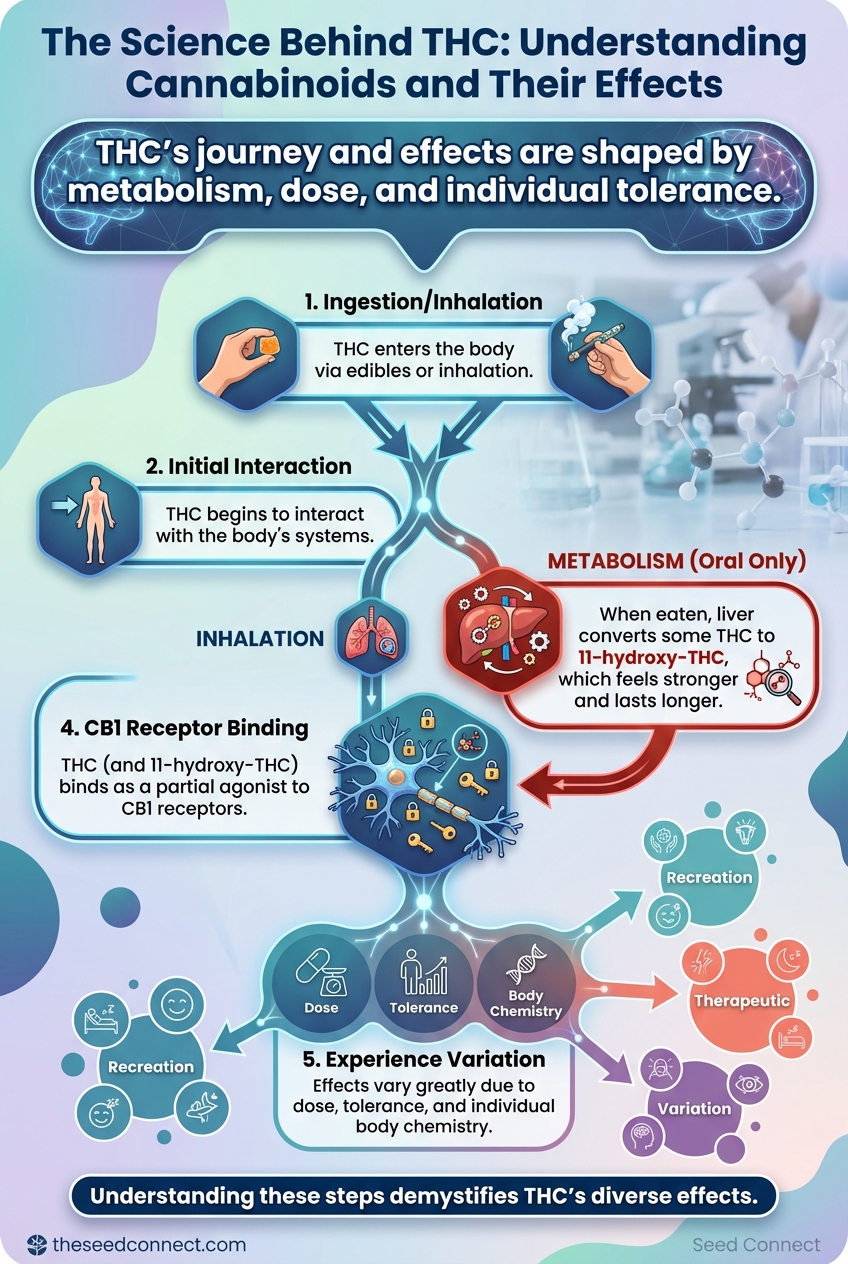
Inhaled THC tends to act faster, while oral THC is processed through the liver and can form 11-hydroxy-THC, which helps explain why edibles can feel stronger and last longer than expected.
For growers and readers alike, that is the useful frame: THC is not just “the strong one.” It is a specific molecule with a known receptor target, a defined chemical profile, and effects that shift with dose, timing, and metabolism.
That makes understanding THC less about hype and more about chemistry, biology, and context.
Once those pieces click, the rest of the cannabis conversation gets much easier to follow.
How THC Interacts With the Body
Why can the same cannabinoid make one person hungry, relaxed, and a little forgetful, while another person mostly feels sleepy? The answer sits in the endocannabinoid system, a network of receptors and signaling molecules that helps keep the body in balance.
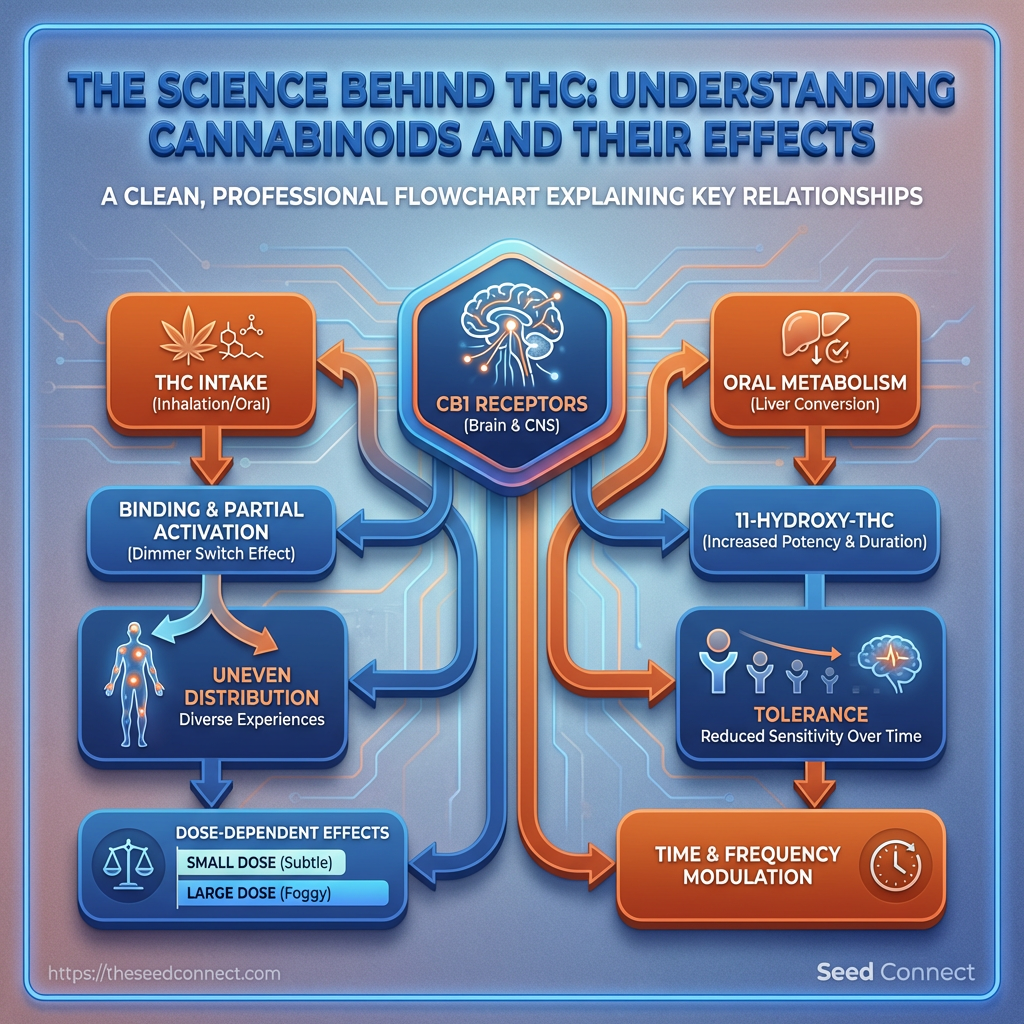
THC binds mainly to CB1 receptors, which are packed into the brain and central nervous system.
It does not flip them on like a light switch.
It acts more like a dimmer, partially activating them and changing how nerve cells release signals.
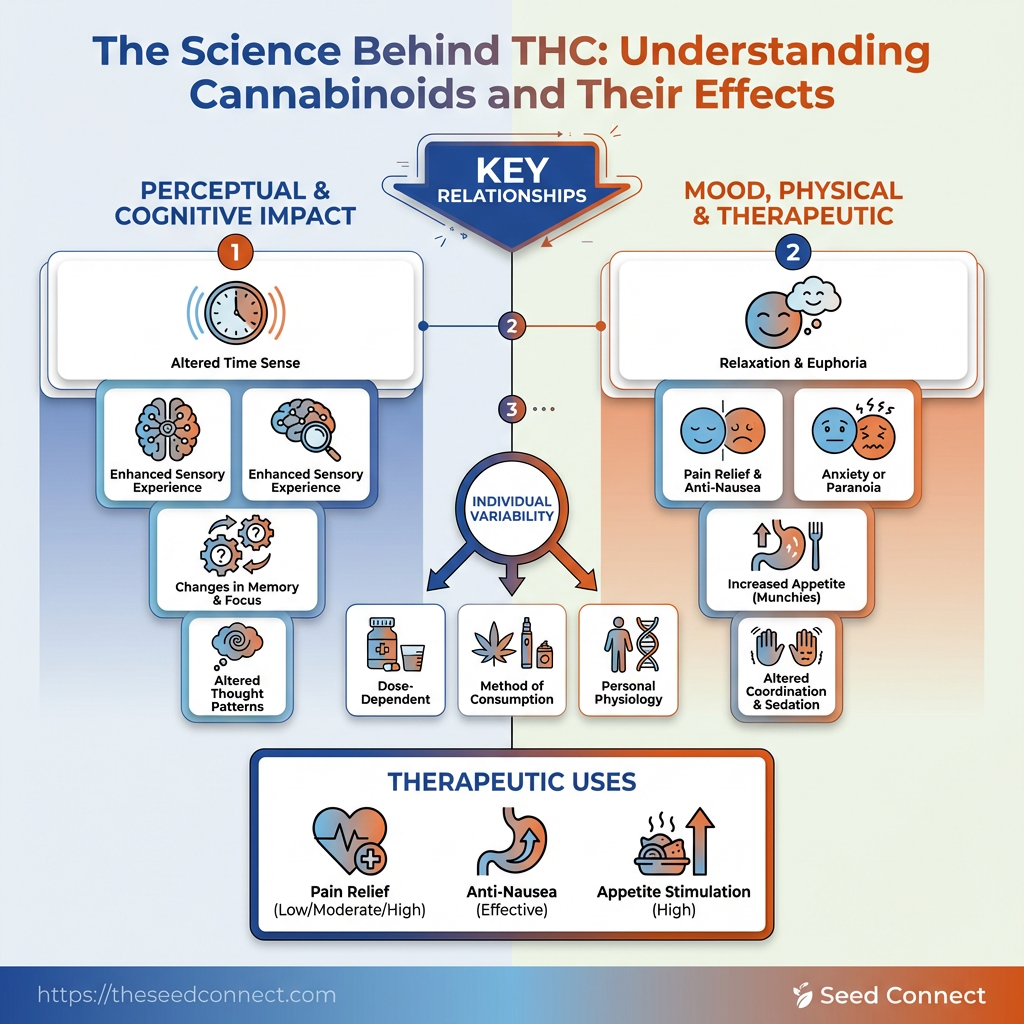
That shift helps explain many THC effects, from altered time sense to changes in coordination and memory.
A second piece matters too.
CB1 receptors are not evenly spread across the body, and that uneven distribution shapes the experience.
THC also affects appetite circuits, which is why the munchies are so common, and it can influence mood circuits, which is why the same dose can feel calming, edgy, or strangely intense depending on the person.
Why the response feels so different
The body does not treat inhaled and oral THC the same way.
When THC is eaten, the liver converts part of it into 11-hydroxy-THC, a metabolite that can feel stronger and last longer.
That is one reason oral products can catch people off guard.
A prescription THC medicine such as Marinol (dronabinol) uses the same basic pathway in a controlled form.
The medicine works because the body still sees dronabinol as a THC-like signal.
The big variables
- Dose: A small amount may feel subtle, while a larger amount can turn foggy fast.
- Tolerance: Regular exposure usually dulls the same dose over time.
- Route: Inhaled THC tends to hit faster; oral THC tends to last longer.
- Setting: Stress, noise, and unfamiliar surroundings can make the same dose feel harsher.
- Body chemistry: Sleep, food intake, and individual sensitivity all shift the response.
THC chemistry is only half the story.
The other half is context, and that is where understanding THC gets practical fast.
A good mental model is simple: receptors shape the effect, metabolism changes the timing, and real life changes the feel.
That mix explains why THC effects are predictable in broad strokes, but still personal in practice.
What Shapes THC Levels in the Plant
Ever notice two plants with the same strain name finishing very differently? That happens a lot, and the reason is usually not luck.
Genetics sets the ceiling. Some plants are wired to make more THC, while others naturally lean toward a broader cannabinoid mix. Environment decides how close the plant gets to that ceiling. That is a big part of understanding THC in a real grow room, not just on a label.
Light, feeding, temperature, humidity, and harvest timing all nudge the final result.
A plant with strong genetics can still underperform in a weak setup, and a so-so line can look better than expected when the conditions stay clean and steady.
Plant factors that change THC expression
| Factor | Effect on THC | What Growers Can Control | Why It Matters |
|---|---|---|---|
| Genetics | Sets the plant’s natural THC potential and cannabinoid balance | Seed line, breeder reputation, phenotype selection | The plant’s inherited chemistry comes first; cultivation can only work within that limit |
| Light intensity | Supports resin production when the canopy gets enough energy | Lamp strength, canopy distance, even light spread | Flowers usually pack more potential when light reaches them evenly |
| Nutrition | Balanced feeding helps the plant build healthy flowers and resin | Nitrogen levels, bloom nutrients, micronutrients, pH | Too much or too little feeding can slow flower development and reduce quality |
| Harvest timing | THC level and flower maturity change as trichomes develop | Watching trichome color and harvest window | Cutting too early or too late can shift potency and overall effect |
| Environment | Temperature, humidity, and airflow affect plant stress and resin quality | VPD, room temperature, air movement, moisture control | Stable conditions let the plant focus on flower development instead of survival |
The pattern is pretty consistent in real gardens.
Genetics does the heavy lifting, while cultivation conditions shape the final outcome.
That is why two growers can start with the same seed pack and end up with different results.
One keeps light even across the canopy and harvests at the right moment.
The other lets the room swing all over the place, and the plant pays for it.
- Stable genetics: Start with a line known for consistent cannabinoid expression.
- Even light: Keep the canopy in a strong, uniform light zone.
- Clean finish: Don’t rush harvest just because the calendar says it is time.
A simple way to think about it: the seed decides the potential, and the room decides the finish.
Once those two line up, THC levels tend to make a lot more sense.
THC Effects: What People Commonly Notice
A first THC experience can feel strangely familiar and wildly different at the same time.
One person gets chatty and relaxed, while another feels a little foggy and overly aware of every minute passing.
That range is the heart of THC effects.
The same molecule can feel playful, heavy, bright, or uncomfortable depending on dose, delivery method, tolerance, and plain old body chemistry.
At a basic level, people often notice euphoria, altered time sense, and a loosening of tension.
In practical terms, that might look like music sounding richer, a snack tasting amazing, or ten minutes feeling like forty.
A simple example helps.
Someone who inhales a small amount may feel a quick lift that fades sooner, while an oral product can come on later and last much longer because the liver changes how THC is processed.
The less pleasant side shows up too, and it is part of understanding THC rather than pretending it never happens. Anxiety, dry mouth, and short-term memory changes are common complaints, especially when the dose is too high or the setting feels tense.
This animated explainer shows why two people can react so differently to the same THC level.
It also ties together dose, tolerance, and product type in a way that makes the whole picture easier to follow.
- Euphoria: A lifted mood, light laughter, or a stronger sense of enjoyment.
- Altered time sense: Minutes can feel stretched out, especially during stronger effects.
- Relaxation: Muscles may feel looser, and stress can seem quieter for a while.
- Anxiety: Too much THC, or a bad environment, can tip the experience the wrong way.
- Dry mouth: Saliva production often drops, which is why water suddenly matters.
- Short-term memory changes: Recalling recent details can get clumsy for a few hours.
Why does the same level hit differently? Tolerance is a big reason.
So is whether THC is inhaled or eaten, since oral products usually behave differently after first-pass metabolism.
Sleep, food, stress, and even expectations can also color the experience.
That’s the real lesson here: THC effects are not one-size-fits-all.
Once those variables are clear, cannabinoids explained stops sounding abstract and starts making everyday sense.
Common Questions and Misunderstandings
Why does one cannabis product feel buzzy and another feel flat? That question usually comes down to more than the THC number on a label.
People often focus on potency alone, but understanding THC means looking at the whole chemical mix, not just one molecule.
THC and CBD are cousins, not twins. THC is the main intoxicating cannabinoid, while CBD does not create the same psychoactive high.
The difference matters because THC mainly acts on CB1 receptors in the central nervous system, and that receptor activity drives many of the familiar THC effects people notice.
THC and CBD are not interchangeable
CBD often gets treated like a softer version of THC.
That is not really accurate.
THC binds and activates CB1 receptors in a way that changes perception, memory, and coordination, while CBD behaves differently and does not produce the same intoxicating profile.
A simple way to think about it is this: THC tends to steer the experience, while CBD may change the edges of it.
That is one reason mixtures like nabiximols, the THC and CBD spray developed as Sativex, are discussed differently from THC-only products.
- THC: More likely to produce intoxication, stronger sensory shifts, and a clearer “high.”
- CBD: Not intoxicating in the same way, and often discussed for its balancing role in mixed formulas.
- Mixed products: The ratio matters as much as the ingredients themselves.
More THC does not always mean a stronger experience
A higher THC percentage can mean more intensity, but not always a better or even more noticeable one.
Route, dose size, tolerance, and the rest of the plant all shape how it feels.
Oral THC and inhaled THC can also feel different because the body handles them differently.
THC is metabolized in the liver, including to 11-hydroxy-THC, which helps explain why oral products can feel slower but sometimes more persistent.
THC is identified in chemistry references as C21H30O2, with a molecular weight of 314.47 g/mol and CAS number 1972-08-3.
Terpene profiles change the picture
Terpenes do not replace cannabinoids, but they can change how the experience is perceived.
Smell, flavor, and the overall feel of a cultivar often track with its terpene profile, which is why two high-THC plants can still land very differently.
A bright, citrus-heavy profile may feel sharper to some people, while earthy or pine-forward profiles can seem more grounding.
That is not magic.
It is the plant chemistry showing up in a way people actually notice.
- Myrcene-rich profiles: Often described as heavier or more relaxing.
- Pinene-forward profiles: Often associated with a cleaner, brighter feel.
- Limonene-heavy profiles: Often linked with a more upbeat aroma and impression.
The useful habit is simple: stop reading THC as the whole story.
Once you look at cannabinoids, dose, and terpenes together, the confusing parts of cannabis start making a lot more sense.
Reading THC Beyond the Number on the Label
The part worth remembering is simple: THC strength is only one piece of the puzzle.
Route, timing, body chemistry, and the other cannabinoids around it all shape the experience, which is why cannabinoids explained in plain language suddenly make the whole picture feel less mysterious.
That’s also why a strong edible can feel so different from a joint with the same listed amount.
The THC effects change because the body processes each one differently, and understanding THC means looking past the milligrams to the full context of how it was taken.
Compare dose, delivery method, and cannabinoid profile the next time you shop or plan a session.
If you grow, keep notes on genetics and conditions too, since those choices influence the final plant more than most people expect, and tools like https://theseedconnect.com can be a useful reference when you want to compare seed options with clearer genetics in mind.