


We receive a plain padded envelope with no logos and a return address that tells us nothing.
Inside are ten cannabis seeds that crossed three state lines without a problem.
Five years ago, that same order looked very different.
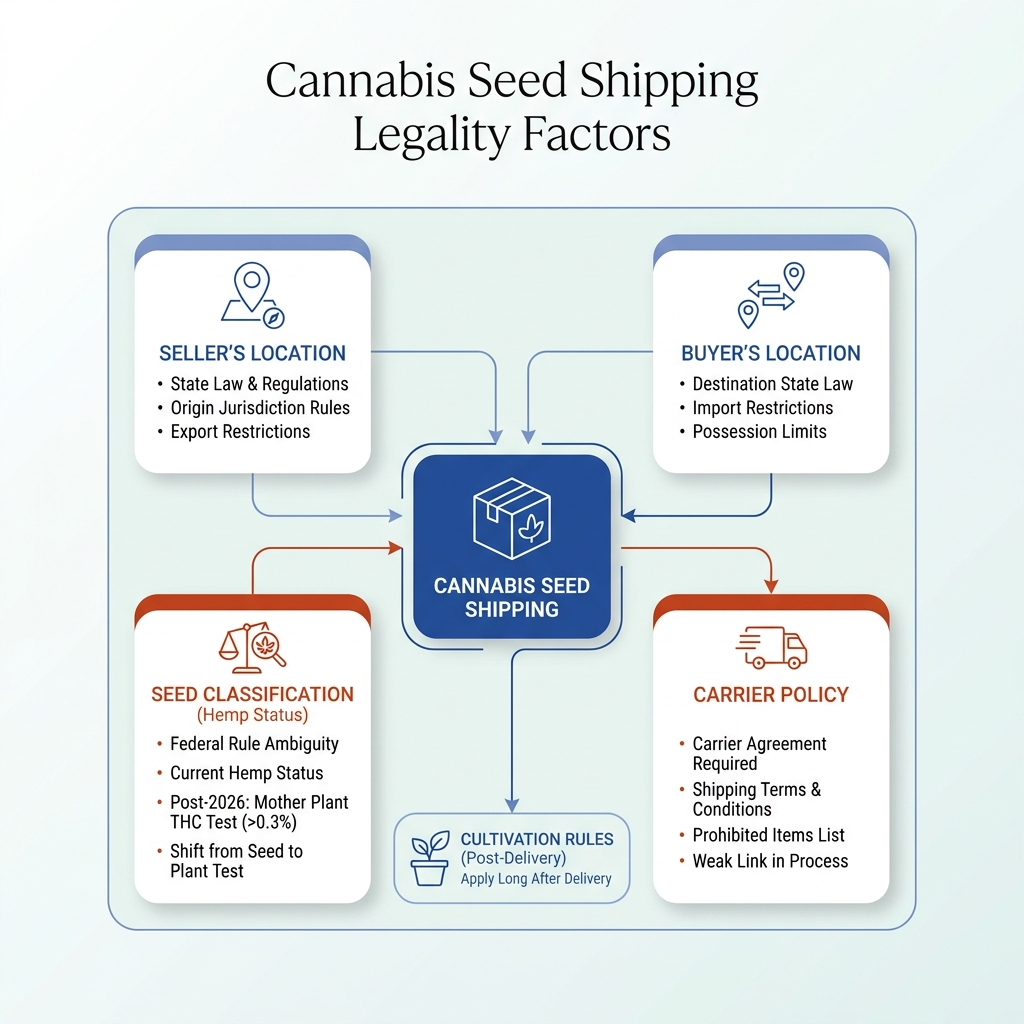
There is no single federal rule that answers whether cannabis seeds can legally be shipped.
It depends on the seller’s location, the buyer’s location, how the seeds are classified at that moment, and whether a carrier agrees to move them.
Classification just got harder.
Under H.R. 5371, enacted in November 2025, viable seeds from Cannabis sativa plants testing above 0.3% total THC lose their hemp status on December 11, 2026.
The legal test shifts from the seed itself to the mother plant.
Cannabis seed shipping regulations make more sense when you trace that whole path instead of stopping at the checkout box.
The weak links usually sit in boring places — carrier policy, destination state law, packaging, and the cultivation rules that apply long after delivery.
Quick Answer: S. is complex and depends on various factors, including the origin and destination of the shipment, as well as the THC content of the seeds. 3% THC will be excluded from the hemp definition, potentially leading to criminalization of many commercially sold seeds.
Always check local laws and ensure compliance before shipping.
What cannabis seed shipping regulations actually cover
Can you legally ship cannabis seeds in the United States? Many buyers think this is a simple yes-or-no question.
In reality, it involves four different questions that each have different rules.
Seed shipping is a complicated process with many legal factors. Each part of the transaction—who is involved, where it starts, where it goes, and how it’s handled—has its own legal rules.
If any part of this process has a problem, the shipment can be illegal or unusable, even if other parts are fine.
The key isn’t just whether the seeds are real; it’s understanding how rules apply to all parts of the shipping process.
One question may ask about shipping, another about the destination, a third about possession, and another about routing and paperwork.
So, the main task is not just deciding which part of one rule is correct.
It’s about making sure all four questions align before sending anything. Also, always check local laws on seed possession and growing to stay compliant.
Why Shipping Rules Matter to Home Growers
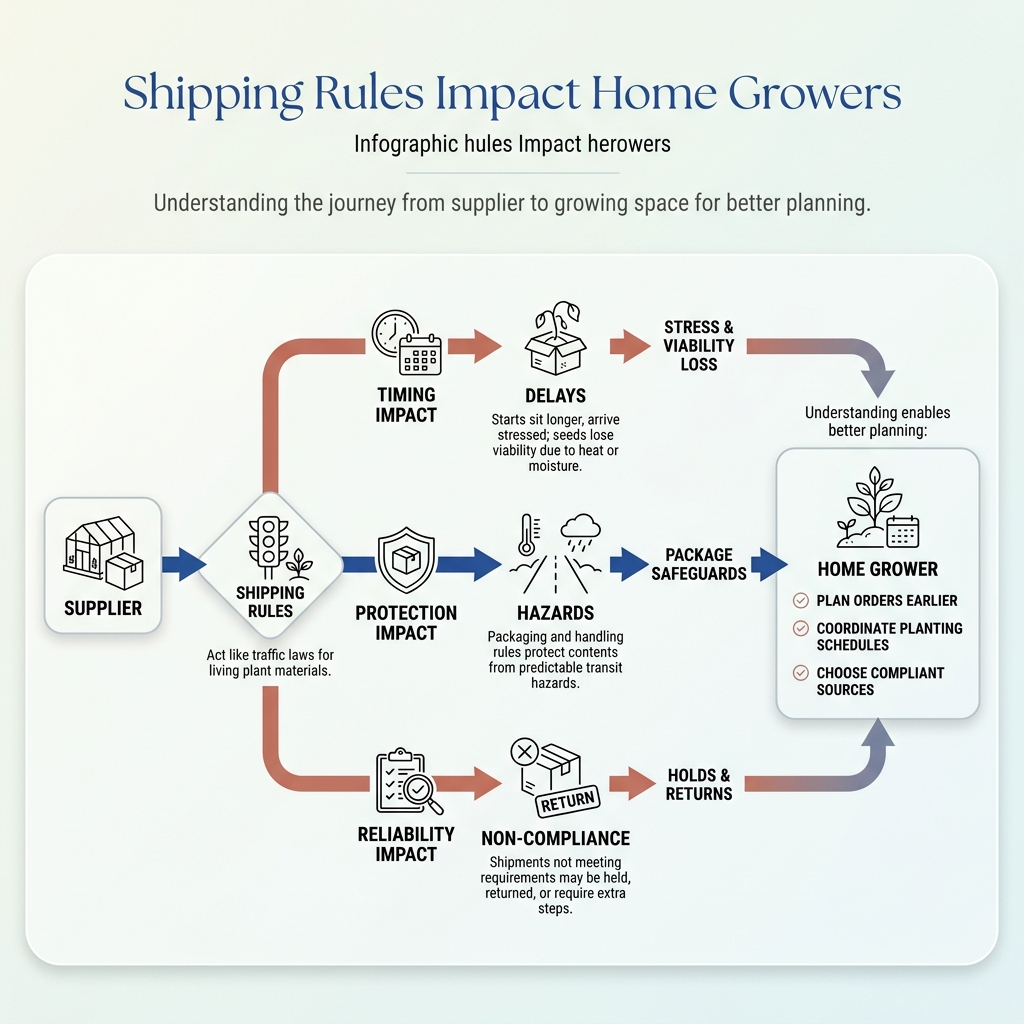
We need to understand shipping rules because they guide how our seeds travel from the supplier to our garden. They control how your seeds go from the supplier to your garden. This affects both legality and the health of your seeds. Understanding these laws helps home growers expect delays, avoid compliance issues, and ensure their seeds arrive healthy.
For instance, not following shipping rules can lead to seeds being held or sent back, disrupting your growing plans. By understanding these rules, growers can decide when and from whom to order, making the move from supplier to garden easier. Always remember to check local laws regarding seed cultivation to avoid any legal pitfalls.
How cannabis seed shipping works from seller to destination
Before our seed order arrives, it must pass several crucial legal checks, and any one of these can halt the process.
Think of it like a relay race with a referee for each handoff.
1. Product classification. Everything begins with what the item legally is.
The 2018 Farm Bill defined hemp as any part of the Cannabis sativa L. plant, including the seeds, if the plant tested at or below 0.3% THC when dried.
This is changing: Section 781 of H.R. 5371, effective November 12, 2026, states that hemp does not include viable seeds from plants with more than 0.3% THC. This change starts on December 11, 2026.
2. Origin and destination law. A shipment must follow rules at both the starting and ending points.
Even if a seller is in a state that allows seed sales, the laws of the destination state control what happens after arrival. Possession, shipment, and growing are separate issues.
3. Carrier policy. Carriers have their own rules in addition to state laws, so a package that can be legally sold might still be rejected.
For international entries, USDA APHIS guidance on plants and plant parts requires travelers to declare agricultural items to CBP and have a phytosanitary certificate for admissible seeds.
4. Seller guarantees. A seller controls packaging, dispatch timing, tracking, and germination support.
They can’t control what an inspector decides at a port, or what your state allows you to do with the plant once it’s grown.
Understanding these considerations is crucial for verifying the legality of your seed order before spending money. Always check local laws regarding seed possession and cultivation to ensure compliance.
Examples, edge cases, and common misconceptions
Imagine a grower in a state where home growing is legal.
She reads that rule, assumes the hard part is done, and orders seeds from an out-of-state seller.
Two weeks later, the tracking stops updating.
That gap between “I can grow here” and “I can receive here” catches more buyers than almost anything else.
A home-grow allowance covers what you can do with a plant.
It does not mention whether a package can legally cross state lines to get to you.
These are different permissions checked by different authorities.
Interstate orders also go through federal rules and carrier networks, where rules like the new hemp definition and customs checks apply.
Buying from a seller inside your own state avoids most of that.
Discreet packaging needs to be noted: plain boxes and unbranded labels protect privacy, but they don’t change legal classification or admissibility, and they don’t affect how an inspector classifies the contents.
| Common assumption | What may be missing | Better question to ask | Evidence to verify |
|---|---|---|---|
| Seeds are legal nationwide | Federal classification shifted. Section 781 of the FY2026 Agriculture Appropriations Act excludes viable seeds from Cannabis sativa plants above 0.3% total THC, effective December 11, 2026 | Which federal definition applies to these seeds right now? | The amended text of 7 U.S.C. § 1639o and its December 2026 effective date |
| A legal state allows every form of shipping | Federal law and published carrier terms apply regardless of state permission | Does federal law and the carrier both allow this route? | Carrier terms of service plus USDA APHIS entry requirements for plants and seeds |
| Discreet packaging means no risk | Packaging affects privacy, not legal classification or admissibility | Would this package clear inspection if someone opened it? | CBP declaration rules and carrier screening policies |
| Carrier acceptance means state-law compliance | Carriers screen parcels; they do not interpret your state’s statutes | Does my state permit possession of what actually arrives? | Your state statute or agriculture department page |
| A germination guarantee covers legal problems | A guarantee addresses seed viability, not legal outcomes | What exactly does the guarantee promise? | The seller’s written guarantee terms |
Treat each row as a checkbox: every assumption can be true in a narrow sense—and still mislead as a general rule. Always check local laws regarding seed possession and cultivation to ensure compliance.
A simple pre-order process for safer seed shipping choices
A practical pre-order process for safer seed shipping decisions
Most seed orders have issues before checkout.
Spending five minutes checking your situation can prevent refund requests and tracking delays that happen from a bad fit.
Start with local cultivation rules.
Check your state’s home growing laws before looking at seeds: a seed you can legally buy is not always one you can legally grow.
Then check the destination, not just the seller.
State seed control programs differ on labeling, testing, and entry requirements; the Association of American Seed Control Officials maintains a state-by-state directory covering all fifty states.
Ask the seller where the package comes from, how it’s packed, and what is included in the germination policy.
Vague answers are a signal.
Match seed type to your rules and space after that first legal check, never before.
Feminized, autoflower, and regular seeds carry different plant counts, timelines, and light needs.
Read the guarantee in writing: what triggers a replacement, what window applies, and whether you need photos or order details.
Finally, compare domestic and international options.
Domestic orders skip customs entirely.
International packages may face inspection, and growers importing seeds into the U.S. generally need a phytosanitary permit before anything clears.
Three promises deserve separate scrutiny.
Legal guidance tells you what a statute currently says; it cannot guarantee an inspector’s decision at a port.
Shipping promises cover handling and discretion, not delivery outcomes.
Germination guarantees address seed viability, not legal results.
None replace each other, and laws and carrier terms shift—the 2026 federal hemp redefinition is a live example of rules moving under sellers’ feet.
Our germination guarantee and discreet US shipping answer handling and viability questions directly, while the destination-law check stays yours.
Run the checks, then order with your eyes open.
Can you send seeds across state lines?
Sending seeds across state lines is legal only if both the origin and destination states allow it and if the seeds comply with federal and state regulations. The legality can vary based on the classification of the seeds and their THC content.
Is it now illegal for farmers to save seeds?
It is not illegal for farmers to save seeds, but regulations around certain types of seeds, particularly cannabis seeds, may become more stringent. Farmers need to stay informed about local and federal laws that may change their rights regarding seed saving.
Is it illegal to bring seeds from another country?
Bringing seeds from another country can be illegal depending on the type of seeds and import regulations. Specific seeds, like cannabis seeds, may face strict customs regulations and potential prohibitions, so it’s crucial to verify the rules before attempting to import seeds.
Why can’t you legally replant seeds?
Replanting seeds can be illegal depending on their classification under law, especially with cannabis seeds. As of December 11, 2026, seeds from Cannabis sativa plants testing above 0.3% THC will no longer be classified as hemp, complicating replanting rights.
Is it illegal to ship cannabis seeds?
The legality of shipping cannabis seeds is complex and depends on various factors such as the seeds’ THC content and the laws of the originating and receiving states. Effective December 11, 2026, many cannabis seeds may be deemed illegal to ship if they exceed the 0.3% THC threshold.
The Route Doesn’t End at Your Doorstep
That unmarked envelope is only the first leg of the journey.
What makes cannabis seed shipping regulations so frustrating is that no single rule covers the whole trip — classification, seller location, destination law, carrier policy, and your own state’s cultivation rules each get a vote.
A package that passes every checkpoint can still leave you vulnerable if the last one fails.
Before ordering, take five minutes on the least fun step: check what your state allows once you have those seeds.
Shipping success and growing rights are two different questions.
Our cannabis seeds for sale ship discreetly, but the diligence is yours — check your local cultivation rules today, before the envelope ever arrives.