


The Role of Genetics in Cannabis Seed Quality goes far beyond the strain name printed on a seed pack. Genetics establish the inherited potential for traits such as cannabinoid profile, plant structure, flowering behavior, vigor, and overall consistency, while environmental conditions influence how those traits are expressed.
Research published in Genetics has shown that key cannabis chemical traits, including THC and CBD chemotypes, can be inherited through specific genetic patterns. In this guide, The Seed Connect explains how genetics influence seed quality, why genetic stability matters, and what growers should look for when choosing seeds with more predictable characteristics.
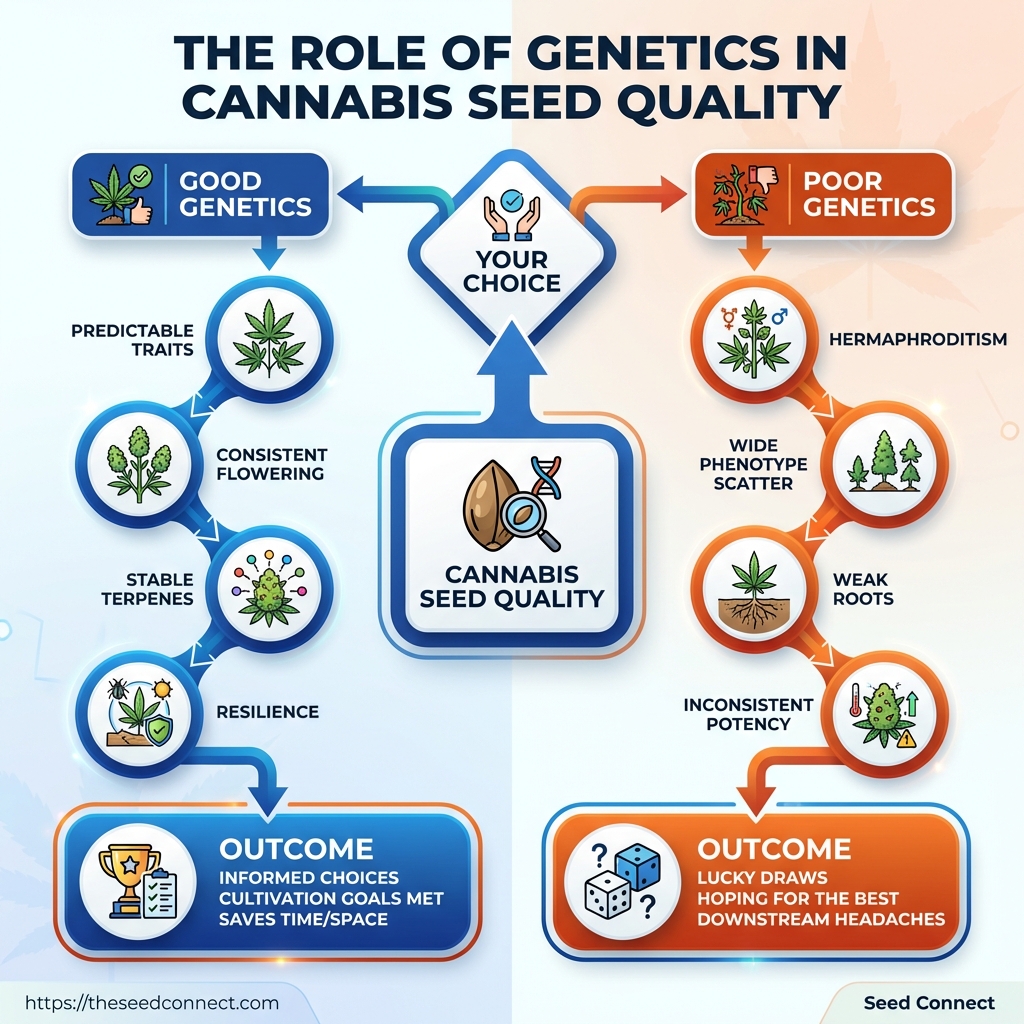
What Is Cannabis Genetics?
Cannabis genetics are the inherited instructions within a seed that dictate how a plant grows, smells, yields, and responds to its environment. Imagine genetics as a blueprint while everything in the grow tent represents the finished building. The genotype is the blueprint, while the phenotype is the building itself, including its paint, windows, and unique features.
Genetics: The DNA in a seed that encodes traits like cannabinoid potential, terpene profiles, vigor, and flowering rhythm.
Genotype: The plant’s genetic code — the alleles and combinations passed down from parents.
Phenotype: The observable traits a plant expresses under specific conditions: height, bud structure, color, aroma, and chemical makeup.
Stable genetics: Breeding that produces predictable offspring across generations; growers can expect consistent traits in most plants from the same seed line.
How breeders name and classify genetics matters because those names carry lineage clues and practical expectations. A breeder listing parents (for example, “Blueberry × Haze”) signals dominant characteristics to expect: fruity terpenes from Blueberry, uplifting sativa structure from Haze. Labels often include practical details:
- THC/CBD ranges: Typical potency windows rather than exact guarantees.
- Flowering time: Expected days to finish under the specified light schedule.
- Phenotype percentage: The breeder’s estimate of how many plants will show a particular expression (e.g., 40% indica-dominant, 60% sativa-dominant).
- Grow notes: Indoor/outdoor suitability, preferred training, and typical yields.
Phenotype variability is normal. Even with stable genetics, environmental interaction creates differences: nutrient regimes, light intensity, temperature swings, and stress can tilt expression. That’s why seasoned growers separate genotype from phenotype when selecting seeds for a project — breeding tells you potential, the grow tells you which potential shows up.
Practical example: a pack labeled with lineage and 60% single-phenotype means most plants will match the advertised profile, but expect a minority showing alternate traits. For consistency-sensitive projects — extraction runs or branded flower lines — choosing highly stabilized genetics or feminized, inbred lines reduces surprises. For exploration and low-cost experimentation, diverse phenotype packs can reveal interesting rare expressions.
Choosing seeds with clear lineage and phenotype notes saves time and crop risk; when consistency matters, opt for proven, stabilized lines like those found among reputable cannabis seeds for sale. Genetics set the limits and possibilities — the grow defines the outcome.
How Does Cannabis Genetics Work?
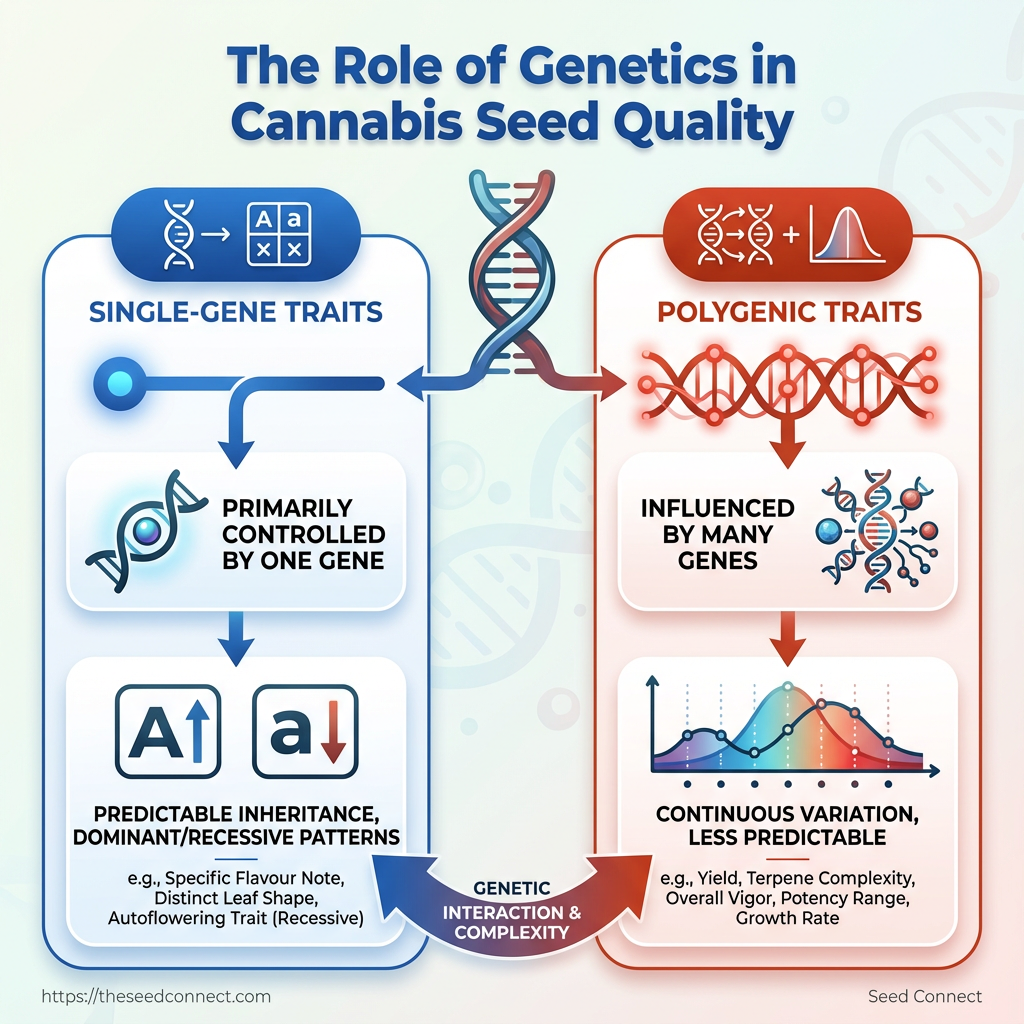
Cannabis genetics control which traits a plant shows and how reliably these traits are inherited by the next generation. This affects the quality and uniformity of seeds, their potency, growth habits, and how predictable a breeding cross will be for commercial use. Predictability depends on whether traits are controlled by single genes or multiple genes together. It also relies on the breeding method used to create a stable line.
Single-gene trait: A trait primarily controlled by one gene; often shows predictable inheritance and clear dominant or recessive patterns.
Polygenic trait: A trait influenced by many genes; yields continuous variation and is less predictable (examples: yield, terpene complexity, overall vigor).
What to expect in crosses
- Dominant alleles often appear in first-generation (F1) offspring more frequently than recessive ones, so visible traits can show up rapidly after a cross.
- Polygenic traits create a spread of phenotypes because recombination shuffles many contributing genes.
- Environment interacts with genetics: the same genotype can perform differently in another grow room, soil, or climate.
Breeding techniques change how quickly and reliably desired traits become fixed.
- Backcrossing a selected hybrid to a parent line repeatedly increases resemblance to that parent and improves genetic stability.
- Creating F1 hybrids by crossing two stable parents yields uniform, vigorous F1 plants but those offspring usually won’t breed true in subsequent generations.
- Stabilizing selection involves several generations of selecting individuals that meet the target phenotype to narrow variation.
Breeding techniques and their impact on seed uniformity, vigor, cost, and predictability
Table: How Does Cannabis Genetics Work? — Technique, How it works, Effect on uniformity & more
| Technique | How it works | Effect on uniformity | Time/cost to achieve | Best use case |
|---|---|---|---|---|
| Backcrossing | Repeatedly cross offspring back to one parent to recover specific traits | High (after multiple generations) | Medium–High (several generations) | Recovering parent traits, fixing resistance |
| F1 Hybridization | Cross two homozygous/stable parents to make F1s | Very high uniformity in F1 | Moderate (development of parents can be costly) | Commercial batches where uniformity and vigor matter |
| Stabilizing selection (multi-gen) | Select top individuals across generations | High, once stabilized | High (many generations of selection) | Developing true-breeding cultivars |
| Clonal selection | Select and propagate elite mother plants vegetatively | Perfect uniformity (clones) | Low–Medium (mother maintenance) | Small-scale production, ensuring consistent phenotype |
| Open-pollination | Natural pollination without controlled crosses | Low uniformity | Low cost | Preserving landrace diversity, seed production where uniformity isn’t required |
Key insight: backcrossing and stabilizing selection increase predictability but take time; F1s give instant uniformity and vigor but won’t reliably reproduce their traits when re-seeded.
Practical tips for breeders and growers: test promising lines across several environments before declaring stability, keep clear records of pedigrees, and decide whether the goal is a stable true-breeding variety or an F1 hybrid optimized for a single production run. For anyone sourcing genetics, look for breeders who document generations and testing—if shopping for seeds, reputable collections such as cannabis seeds for sale often note breeding method and stability in their descriptions.
Understanding these mechanisms makes it possible to choose the right seed type for the goal—uniform product at scale, rapid vigor for a single harvest, or a stable lineage to breed from. That clarity saves time and avoids surprises in the grow room.
Why Genetics Matter for Seed Quality
Genetics set the limits for what a seed can achieve. They influence the range of potency, the plant’s structure that affects yield, and the stressors it can resist. Good genetics offer predictable chemotypes (THC/CBD profiles), reliable flowering times, and inherited resistance traits like tolerance to powdery mildew. Genetics don’t work alone—your environment and handling also play a crucial role in bringing out that genetic potential.
Even with the best setup, weak genetics can lead to disappointing results.
Lab-tested chemotype data combined with proven lineage is the most reliable way to estimate what a seed lot will deliver, and experienced growers treat genetics as the single largest risk control when selecting seed stock.
How genetics translate to performance
- Potency range: Genetics define the biochemical pathways available for cannabinoids and terpenes; cultivation tunes expression.
- Yield architecture: Genetics govern node spacing, bud density, and flowering stretch—traits that respond predictably to training and nutrients.
- Resilience: Inherited resistance (e.g., fungal tolerance) is often qualitative and crucial in humid climates.
- Predictability: Uniform phenotype expression reduces surprise males, hermaphrodites, or wildly different plants in the same room.
Genotype: The inherited DNA blueprint determining potential traits.
Phenotype: The observable traits (height, bud structure, chemotype) resulting from genotype plus environment.
When genetics aren’t the limiting factor
Environment and handling convert potential into harvestable reality. Even elite genetics will underperform if seeds are stored in heat, humidity, or light, or if seedlings are stressed by poor germination technique.
- Proper storage: Cool, dry, dark conditions preserve viability; avoid fluctuating temperatures.
- Handling red flags: Inconsistent germination across a seed lot often signals poor storage or rough handling, not genetics.
- Cultivation limits: Nutrient imbalances, pests, or poor light delivery can cap yield and mask genetic advantages.
Practical verification and a sourcing tip
Look for seeds with lab-tested chemotype reports and documented parentage. If purchasing, consider reputable sources that guarantee germination and provide lineage details—cannabis seeds for sale can be a starting point when they include test data.
Quick reference matrix linking genetic traits to grower priorities.
Table: Why Genetics Matter for Seed Quality — Genetic Trait, Primary Benefit, Who benefits most & more
| Genetic Trait | Primary Benefit | Who benefits most | How to verify |
|---|---|---|---|
| High THC potential | Strong psychoactive potency | Recreational growers seeking potency | Lab cannabinoid profile, breeder notes |
| High CBD potential | Therapeutic applications, balanced effects | Medical growers | Certificate of analysis (COA) for CBD:THC ratio |
| Early flowering | Shorter grow cycles, fit tight schedules | Small spaces, climate-limited growers | Flowering time in breeder specs, trial logs |
| Fungal resistance | Lower crop loss in humid zones | Outdoor and greenhouse growers | Grower trial reports, breeder resistance claims |
| Uniform phenotype expression | Predictable canopy and harvest timing | Commercial cultivators | Photo galleries, grower testimonials, trial data |
The table shows how different genetic priorities map to grower needs and practical verification steps—use it to match seed selection to your climate, schedule, and end-use goals.
Choosing seeds with honest genetics and verifiable test data reduces surprises and preserves upside when paired with solid storage and cultivation. Pick genetics that fit the environment you can reliably provide, and the rest becomes execution.
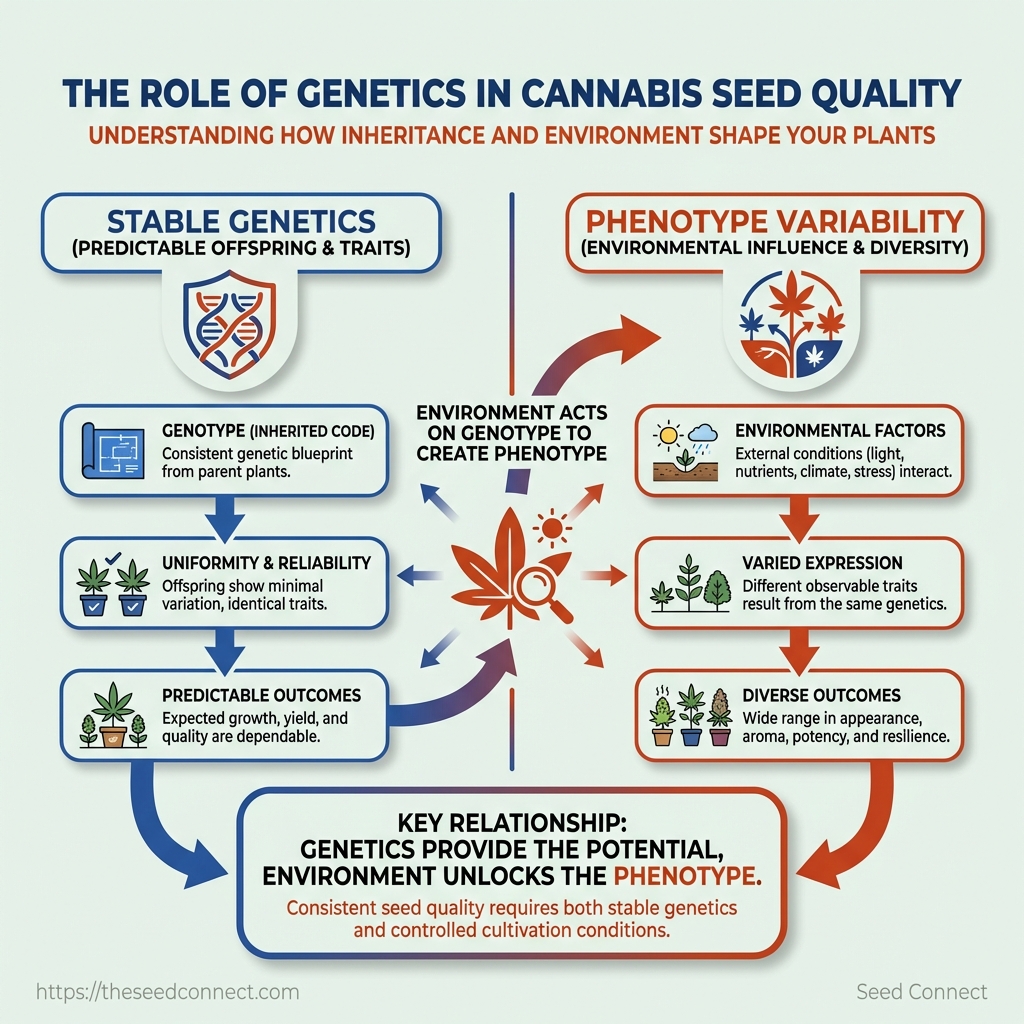
Key Takeaway: Genetics create a foundation, but they do not guarantee identical plants every time. Expect some variation.
Common Misconceptions About Cannabis Genetics
Genetics create a foundation, but they do not guarantee identical plants every time. Expect some variation. Even stable genetics can lead to different phenotypes, potency levels, and growth traits based on the environment and breeding methods. This misunderstanding can cause growers to overpay, mislabel crops, or unfairly blame seeds for issues that stem from cultural or environmental factors.
Predictability, potency, and labeling
Breeders can stabilize traits, but complete uniformity is rare outside of fully inbred lines. What growers actually see is a distribution of phenotypes.
- Genetics guide trends: A strain will tend toward certain smells, cannabinoid ranges, and structure, but individual plants can diverge.
- Environment modulates expression: Light, nutrients, training, and stress change how genes show up—potency and terpene profiles shift with cultivation.
- Label accuracy varies: Seed labels are only as reliable as the breeder’s quality control; third-party testing and transparent breeding notes matter more than marketing copy.
Two growers running the same seed batch in different climates often report different dominant terpenes and THC ranges. Price differences sometimes reflect packaging, rarity, and breeder reputation, not just seed quality.
Feminized seeds ≠ perfection
Feminized seeds greatly reduce the probability of male plants, but they don’t remove the biological risk of hermaphroditism.
Feminized: Seeds produced to yield predominantly female plants through techniques like colloidal silver or selective breeding.
Hermaphrodite: A plant that develops male and female reproductive parts, often triggered by stress or retained genetic tendency.
Breeder testing and disclosure about hermie rates are strong quality signals. A reputable breeder will note hermaphrodite frequency and describe how many generations they tested stability under different stressors.
- Breeder transparency: Prefer breeders who report hermaphrodite rates and run multiple stability generations.
- Stress management: Heat, light leaks, nutrient extremes, and irregular light schedules are common triggers for hermies—good husbandry reduces risk.
- Genetic tolerance varies: Some lines are more prone to switching under stress; that’s a genetic characteristic, not a packaging defect.
Practical angle
When shopping for seeds, evaluate lineage notes, ask about test generations, and consider grower reports rather than assuming price equals reliability. For a balanced starting point, sources that document breeding practices and sell cannabis seeds for sale can save time.
Understanding genetics as probabilistic instead of deterministic keeps expectations realistic and helps match seed choices to cultivation goals. Trust what genetics imply, but manage the environment to get the outcomes wanted.
Key Takeaway: Growers face different choices based on their need for diversity versus predictability. Landrace populations bring genetic breadth and local adaptations, but produce variable plants; stabilized cultivars trade some diversity for consistent traits…
Real-World Examples and Case Studies
Growers face different choices based on their need for diversity versus predictability. Landrace populations bring genetic breadth and local adaptations, but produce variable plants; stabilized cultivars trade some diversity for consistent traits and predictable harvests. Below are concrete examples showing how those trade-offs play out, an F1 hybrid case study, and a commercial breeder’s stability trial so procurement and breeding decisions rest on data rather than anecdotes.
Landrace vs stabilized cultivar: practical comparison
Side-by-side comparison of landrace vs stabilized cultivar characteristics for growers
Table: Real-World Examples and Case Studies — Characteristic, Landrace, Stabilized Cultivar & more
| Characteristic | Landrace | Stabilized Cultivar | Grower implication |
|---|---|---|---|
| Genetic diversity | High — many alleles, local adaptations | Low–moderate — selected alleles fixed | Research from FloraFlex shows that greater resilience vs pathogens is offered by genetic diversity compared to consistent traits |
| Predictability | Low — wide phenotype spread | High — uniform morphology and traits | Research from Paradise Seeds indicates expect variable harvest windows vs scheduled harvests |
| Typical yield range | Broad (low → moderate) | Narrow (consistent medium→high) | According to research from PSM, harder to estimate output from landraces |
| Resistance traits | Locally adapted resistances common | Targeted resistances bred in | Landrace useful for breeding; cultivars for production |
| Ideal grower profile | Researchers, breeders, preservationists | Commercial growers, craft producers | Choose based on tolerance for variability and need for uniformity |
Short analysis: Landraces are living libraries for breeding and long-term resilience; stabilized cultivars reduce operational risk and simplify scheduling. For most commercial operations, predictability outweighs the adaptive breadth of landraces.
F1 hybrid case study: vigor vs heredity
An F1 cross between two complementary parent lines produced vigorous, uniform plants in year one: fast vegetative growth, consistent flowering time, and tight canopy structure across a 100-plant trial. However, when seeds saved from those F1 plants were grown (the F2 generation), trait segregation reappeared—plant size varied by ±30%, and cannabinoid profiles split into distinct chemotypes. Practical implications follow:
- Buy new F1 seeds for production: F1 vigor and uniformity are strongest in the first generation.
- Avoid re-seeding F1 offspring for uniform crops: Saved seeds will not reliably reproduce F1 traits.
A breeder’s stability test (commercial perspective)
Example stability trial data: generations, phenotype ratios, germination rates, chemotype ranges
Table: Real-World Examples and Case Studies — Generation, Sample size, Germination rate & more
| Generation | Sample size | Germination rate | Main phenotypes (% of sample) | THC/CBD range |
|---|---|---|---|---|
| F1 | 200 | 94% | Hybrid-dominant (85%), Parent A-like (10%), Parent B-like (5%) | 18–24% / <1% CBD |
| F2 | 220 | 91% | Hybrid-dominant (55%), Parent A-like (25%), Parent B-like (20%) | 12–26% / <1% CBD |
| F3 | 210 | 90% | Stabilizing hybrid (70%), variants (30%) | 14–25% / <1% CBD |
| F4 | 200 | 92% | Uniform phenotype (85%), outliers (15%) | 15–24% / <1% CBD |
| Commercial release | 1000 | 93% | Market-stable phenotype (95%) | 16–23% / <1% CBD |
Short analysis: Commercial buyers look for high germination plus tight phenotype percentages. Multi-generation testing across environments provides confidence on expected variability and chemotype ranges.
Growers choosing genetics should match tolerance for variability with operational goals—seed quality genetics matter for scale, and understanding stability data helps avoid surprises. For growers who want predictable batches with a germination guarantee, sourcing tested lines or reputable suppliers of
Key Takeaway: Choosing genetics starts with asking questions instead of following emotions. Ask for concrete provenance, measurable performance, and clear guarantees — that’s the filter that separates reliable lines from hype. Choosing genetics starts with asking questions instead of following emotions. Ask for concrete provenance, measurable performance, and clear guarantees — that’s the filter that separates reliable lines from hype. Below is a practical checklist to request from breeders or seedbanks, a quick decision framework for different grower goals, and sample language to use when information is missing. Checklist: Questions to ask and data to request Lineage: Clear parentage tells you genetic expectations and potential heterozygosity. Lab Certificate: A lab report demonstrates chemotype rather than marketing copy. Stability Summary: Shows how predictable plants will be across runs. Decision framework: selecting genetics by grower goals Table: How to Choose High-Quality Genetics — A Grower Checklist — Grower goal, Recommended genetic type, Why it fits & moreHow to Choose High-Quality Genetics — A Grower Checklist
THC/CBD ranges and any pesticide/mycotoxin screens.
THC/CBD ranges to your tolerance and legal limits.
Map grower goals to recommended genetic types and practical considerations
| Grower goal | Recommended genetic type | Why it fits | Risk/consideration |
|---|---|---|---|
| Highest uniform potency | Stabilized feminized line | Predictable cannabinoid percentages and consistent phenotype | May sacrifice novelty; limited terpene diversity |
| Commercial yield consistency | Certified S1/backcrossed hybrids | Uniform growth, synchronized flowering, scalable metrics | Requires verified trial data; higher seed cost |
| Novel genetics/experimentation | F1 hybrids, landraces | Greater genetic diversity, unique traits for breeders | High phenotype variability; needs selection work |
| Medicinal CBD consistency | Chemotype-verified CBD-dominant lines | Lab-verified CBD:THC ratios, consistency for patients |
Must verify batch-to-batch lab certificates |
| Climate resilience | Hybridized for local conditions (e.g., heat/damp tolerant) | Better survival and stable yields in challenging microclimates | May compromise some cannabinoid profiles |
Key insight: Matching genetics to objective reduces surprises. Commercial operations lean toward stabilized, well-documented lines; hobbyists can accept variability for novelty; medicinal growers should demand chemotype verification and chain-of-custody proof.
Sample email prompts to request missing info
- Short ask for lineage and lab reports: “Please send parent strain names and any cannabinoid/terpene lab reports for Batch ID [X].”
- Request for stability data: “Can you share flowering-time ranges and phenotype percentages from at least two separate runs?”
- Clarify guarantees: “What’s your germination replacement policy and the procedure to claim it?”
Choosing seeds is an investment in predictability. The clearer the paperwork and the better the trial data, the fewer surprises during scaling — and if a breeder can’t provide basic lineage and lab proof, treat the genetics as experimental until proven otherwise.
Find quality options for comparison: cannabis seeds for sale
Practical Steps: From Buying to Germination
Start by buying deliberately: choose a trusted breeder, note batch details, and store seeds properly so their genetic potential isn’t lost before the first sprout. This short window—from purchase to seedling—determines whether breeding claims hold up and whether those claimed genetics actually match what appears in the grow tent.
Ordering checklist
- Choose reputable sources: Order from breeders with transparent genetics and customer feedback.
- Record batch data: Save order receipts, photos of seed lots, and breeder batch numbers.
- Buy a small test set: Order a few extra seeds beyond the number you plan to germinate to allow for variability.
- Order process: Place the order and immediately record the Seed ID/Batch, vendor name, date received, and any germination guarantees. Photograph the packaging and seed appearance.
- Short-term storage on arrival: Keep seeds in their original sealed packet until ready to germinate. Store in a cool, dark place — ideal is refrigeration at around
4°Cinside an airtight container with desiccant.
- Long-term storage: For months-long storage, maintain
4°C, stable humidity, and minimal light exposure. Avoid freeze–thaw cycles.
Germination routine and tracking
- Use a consistent method: Paper towel, starter plugs, or direct soil — pick one and apply it uniformly across the test batch.
- Log times: Note date/time of soaking, planting, and first taproot/leaf emergence.
- Early phenotype notes: Record leaf shape, cotyledon vigor, internode spacing, and any unusual coloration.
Phenotype tracking terms
Seed ID/Batch: Unique identifier from breeder or receipt.
Early phenotype notes: Observations during the first 2–3 weeks (leaf shape, growth rate, vigour).
Provide a quick tracking template and example rows for growers to copy
Table: Practical Steps: From Buying to Germination — Seed ID/Batch, Date planted, Germinated (Y/N) & more
| Seed ID/Batch | Date planted | Germinated (Y/N) | Days to germination | Early phenotype notes | Sex (if known) | Outcome |
|---|---|---|---|---|---|---|
| Sample 1 | 2026-01-05 | Y | 3 | Fast taproot, broad cotyledons | Unknown | Vegetative |
| Sample 2 | 2026-01-05 | Y | 5 | Slower, narrow leaves | Unknown | Vegetative |
| Sample 3 | 2026-01-05 | N | — | No taproot after 10 days | Unknown | Failed — retest |
| Sample 4 | 2026-01-05 | Y | 4 | Vigorous, short internodes | Unknown | Vegetative |
| Sample 5 | 2026-01-05 | Y | 2 | Extremely quick, dark green | Unknown | Vegetative |
This template turns anecdote into evidence: consistent entries let breeders’ claims be tested, and repetitive patterns reveal true genetics versus packaging hype.
If a seed lot underperforms, test a subset and consult seller policies; many reputable banks offer germination guarantees or replacement options. For dependable supply, consider ordering from established sources like cannabis seeds for sale. Tracking germination and early phenotype gives a factual basis for future orders and helps dial in cultivation choices for the genetics you actually grow.
Further Learning and Resources
If the goal is to get confident with cannabis genetics and seed quality, focus learning where transparency and data meet real-world grow reports. Start with resources that publish lab reports, breeding histories, and stable phenotype data, then triangulate that with forum-grown experience to understand variability under different conditions.
Recommended reading and databases
- Breeder catalogs with lab reports: Look for breeders that publish cannabinoid and terpene lab results alongside the lineage.
- Seed trial databases: Use databases that record germination rates and grower notes across climates and grow styles.
- Community growlogs: Forums and grow journals show how a variety performs outside controlled trials — treat them as anecdote-plus-patterns, not proof.
How to vet breeder pages (practical steps)
- Visit the breeder’s cultivar page and confirm the lineage details are clear and consistent.
- Check for recent lab test results (COA) linked to the cultivar; if none are present, flag that for follow-up.
- Scan growlog excerpts or trial summaries showing multiple runs to confirm stability claims.
- Cross-reference germination and vigor notes with seed retailer data and community reports before ordering.
What to look for on breeder pages
- Clear lineage: Parent strains named and described. Stability data: Multiple generations tested or mention of backcrossing. Lab transparency: Full Certificates of Analysis posted or downloadable.
- Grow notes: Expected height, flowering time range, and common quirks.
Community sources and how to use them
- Forums: Valuable for spotting environmental interactions and pest/disease tendencies.
- Social growlogs: Use photos to judge typical structure and bud formation.
- Discord or grow groups: Quick sanity checks on odd phenos, but verify before treating as fact.
s
Phenotype: Observable traits expressed by a plant (smell, yield, growth pattern) resulting from genetics + environment.
Certificate of Analysis (COA): Lab report showing cannabinoid and contaminant testing for a batch.
For practical purchasing, match breeder transparency with retailer guarantees; a solid option to start exploring is cannabis seeds for sale, which pairs product pages with germination support. Learn by comparing lab data, breeder notes, and several growlogs — that combination reveals what will actually perform in your tent or field.
Conclusion
Grasping cannabis genetics transforms your seed buying and growing experience. Genetics dictate vigor, uniformity, and final cannabinoid and terpene profiles, meaning that focusing on seed quality right from the start can save you months of frustration. Recall the breeder who stabilized a lineage to eliminate hermaphroditism and the indoor grower who switched to a proven pheno package—both saw far more consistent harvests. Practical checks—look for clear breeding records, stable parent lines, and germination guarantees—separate reliable packs from the mixed bags that start problems before the first sprout.