


Most growers learn that a packet of seeds can greatly affect their season. Problems can arise before harvest. These include poor germination, uneven growth, and unexpected plant traits. These problems often come from a few predictable issues.
These factors affect cannabis seed quality more than just price or breeder reputation.
Pay attention to storage history, breeder practices, and the visible seed quality indicators like color, weight, and shell integrity; they tell a lot about viability before you even crack a seed. Behind those surface signs lie deeper forces: parental genetics, drying and curing protocols, and how seeds were handled during packaging.
Understanding cannabis genetics goes beyond strain names. It’s also about stability, uniformity, and how reliably good traits are passed on to offspring. When those elements line up, germination rates climb and early growth is predictable; when they don’t, even expert growers face surprises.
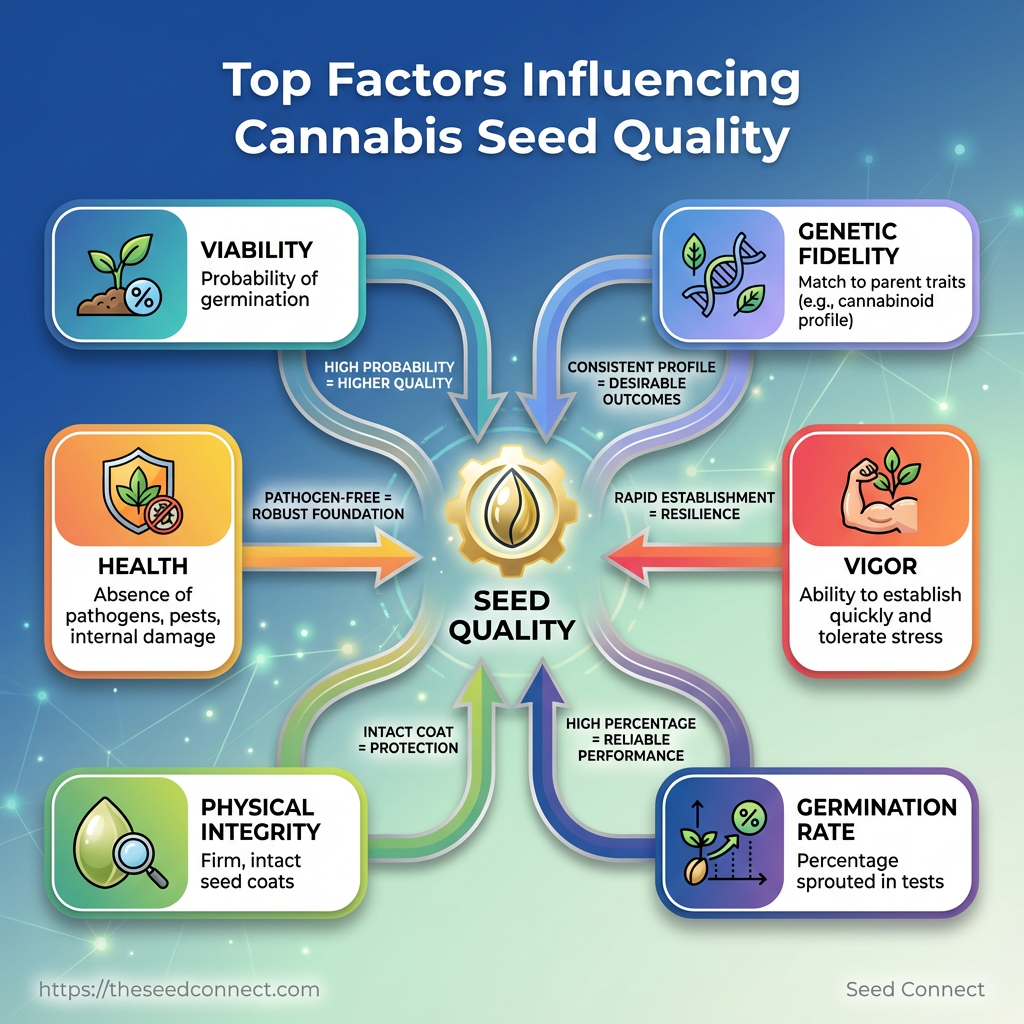
What Is Seed Quality?
Seed quality is more than just an attractive shell.
What Is Seed Quality?
Seed quality is not just about a pretty outer shell. It includes the likelihood that a seed will sprout, show desired traits, handle early challenges, and produce the expected characteristics at harvest. Think of seed quality as four key traits that help you determine if a seed is a smart choice or a gamble.
Viability: The probability a seed will germinate under good conditions. Most growers check viability first through germination trials.
Genetic fidelity: How closely a seed’s offspring match the parent plant’s traits like cannabinoid profile, flowering time, and growth habit. True-to-type genetics reduce surprises and help plan a grow.
Health: The absence of pathogens, pests, and internal damage. Healthy seeds are free of fungal spores, insect larvae, and internal rot that can kill seedlings even if the seed germinates.
Vigor: The seedling’s ability to establish quickly and tolerate mild stresses such as slight temperature swings, brief dryness, or transplant shock. High vigor shows in roots and fast, even emergence.
Practical indicators growers use to judge seed quality include:
- Physical integrity: Firm, evenly colored seeds with intact seed coats.
- Float test results: While not definitive, sinking seeds often correlate with higher viability.
- Germination rate: Percentage of seeds that sprout in controlled tests — a practical measure of
viability. - Uniformity: Consistent size and shape, indicating stable genetics.
- Freshness and storage: Properly stored seeds (cool, dry, dark) retain viability and vigor longer.
Common examples help ground these concepts. According to research from aliceseeds.com, a batch with 95% germination but wide phenotype variation signals excellent viability but inconsistent genetic fidelity. Conversely, true-to-type feminized seeds that only show 60% germination point to genetic fidelity but poor handling, storage, or seed health issues.
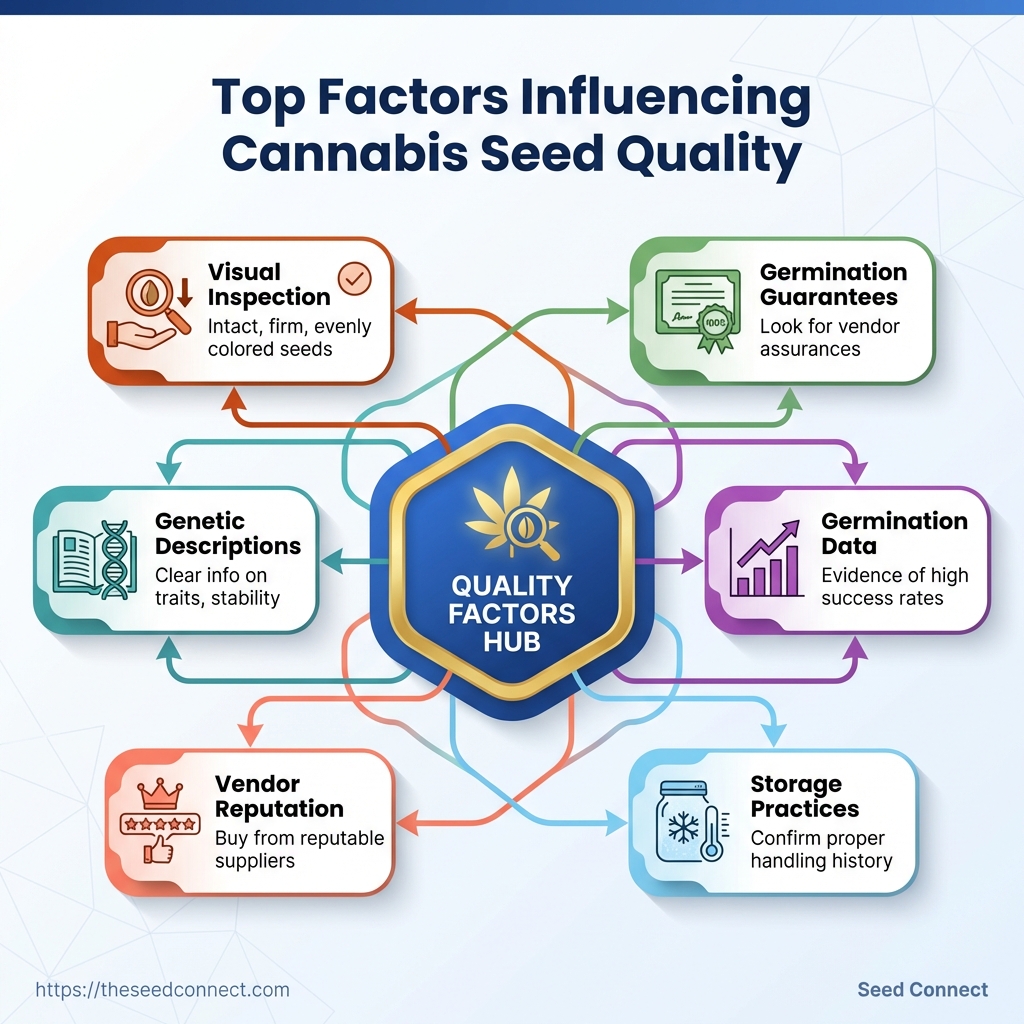
When shopping, look for vendors who provide germination guarantees, clear genetic descriptions, and visible germination data. For many growers, buying from reputable suppliers of cannabis seeds for sale removes a lot of uncertainty.
Understanding these components up front saves time, money, and frustration — good seeds make the rest of the grow exponentially easier.
How Does Seed Quality Work? (Mechanisms Behind Seed Performance)
Seed performance begins with genetics.
How Does Seed Quality Work? (Mechanisms Behind Seed Performance)
Seed performance begins with genetics. However, the details can make a big difference. Healthy parent plants, careful breeding, proper maturation, and handling determine if a seed grows into a strong, consistent plant or a weak, unpredictable one. Genetics set the ceiling for traits like cannabinoid potential, terpenes and growth habit.
Breeding and maturation determine how reliably those traits appear in offspring and how the seedling will be at first light.
- How genetics set expectations
- How breeding practices influence predictability
Hybrid vigor: Hybrid offspring often show heterosis — faster early growth and greater resilience — but may segregate in subsequent generations, reducing trait predictability.
Stabilized strain: A strain that has been inbred and selected across generations to produce consistent offspring for target traits.
Breeding mechanics and parent health
- Parent genotype matters. Elite parents with proven pedigrees pass on alleles that determine growth patterns and chemical profiles.
- Parent phenotype matters. Plants grown under stress or nutrient deficiency produce poor-quality pollen or seeds even if genetics are good.
- Stabilization vs. experimental crosses. Stabilized (inbred) lines give predictable offspring; experimental crosses can yield exceptional traits but far greater variability.
Maturation and seed development
- Observe seed morphology.
- Harvest when seeds are dark, firm, and rattle slightly; immature seeds are pale and soft and often fail to germinate.
- Apply proper drying and curing to preserve nutrient reserves and
germination rate.
Breeders use tactile and visual cues—seed color, firmness, calyx dryness—and often measure germination rate in test batches to determine harvest timing. Mis-timed harvests are a major source of poor-performing seed lots because immature embryos lack stored carbohydrates and lipids needed for the seedling’s first days.
Seed expectations across common genetics types (F1 hybrid, stabilized heirloom, landrace, experimental cross)
Table: How Does Seed Quality Work? (Mechanisms Behind Seed Performance) — Genetics Type, Predictability, Typical Vigor & more
| Genetics Type | Predictability | Typical Vigor | Recommended Use |
|---|---|---|---|
| F1 Hybrid | High for first generation | High vigor (heterosis) | Commercial growers wanting uniform crops |
| Stabilized Strain (inbred) | Very high | Moderate to high | Breeders and phenotype-stable production |
| Landrace | Moderate; local adaptation | Variable, often resilient | Conservation and breeding stock |
| Experimental Cross | Low to unpredictable | Can be very high or weak | Breeding programs and phenotype hunting |
| Ruderalis Hybrid | Moderate; auto traits present | Moderate; fast lifecycle | Small-space, quick harvest growers |
Understanding these mechanisms prevents surprises at germination and during the first critical weeks of growth, which is where most crop outcomes are decided.
Top Practical Factors Affecting Seed Quality
Seed viability starts with how seeds are produced, handled, and…
Top Practical Factors Affecting Seed Quality
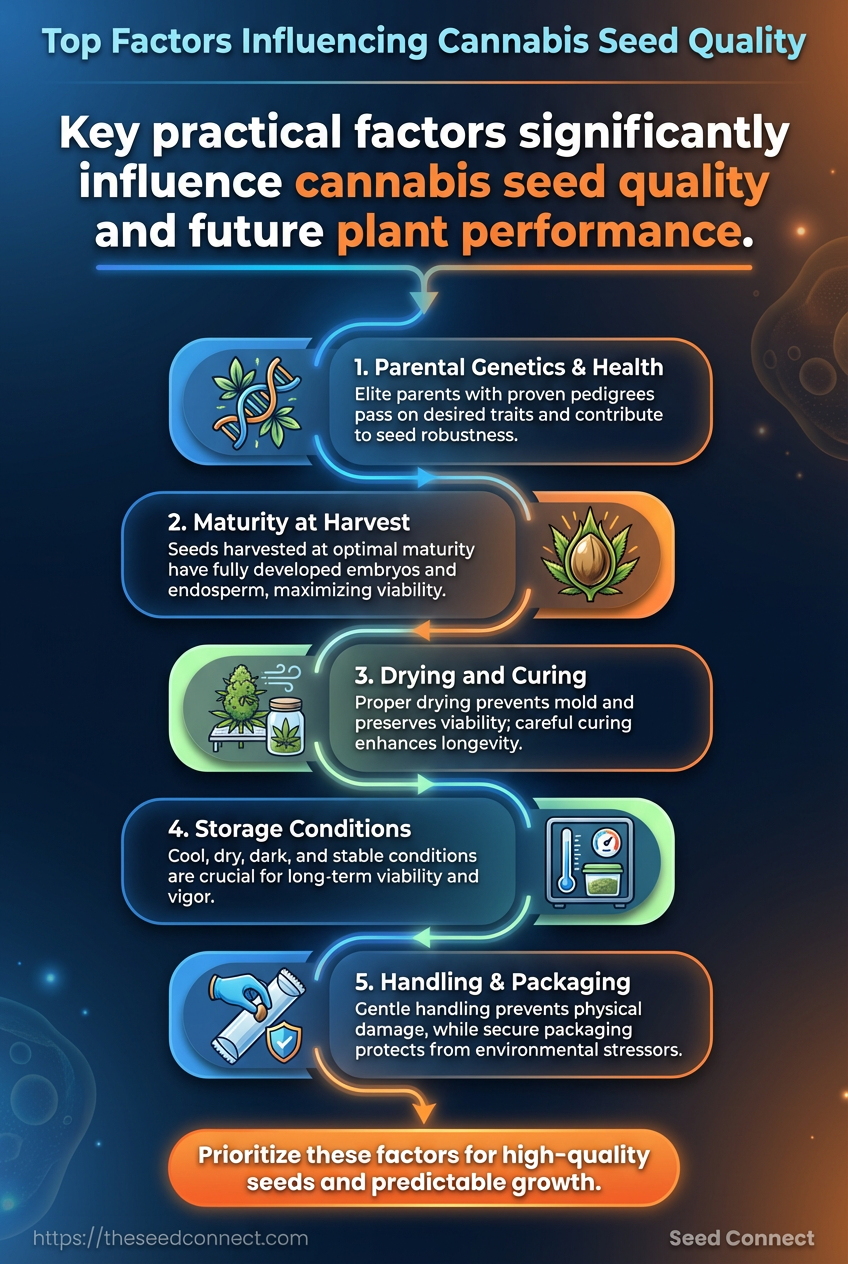
Seed viability depends on how seeds are produced, handled, and stored. Keeping seeds in cool, dark, and dry conditions helps them stay alive. In contrast, moisture, rough handling, and poor quality control lower germination rates and can cause disease. Below are the most tangible factors that determine whether a seed lot performs as promised, and practical checks to use when evaluating purchases or storing seed stock.
Storage conditions
Proper storage keeps metabolic activity low and prevents fungal growth. Recommended parameters are 2–8°C with 20–35% relative humidity whenever possible; darkness and stable temperatures matter as much as averages.
- Temperature: According to greenhousegrower.com, cooler is generally better; repeated temperature cycling shortens lifespan.
- Humidity: Keep RH low to avoid pre-germination and mold.
- Light: Store in opaque containers — light can raise internal temps and damage seed coats.
Summarize recommended storage parameters and expected lifespan under different conditions
Table: Top Practical Factors Affecting Seed Quality — Storage Condition, Recommended Range, Industry data suggests that expected viability may vary significantly under different storage conditions.
| Storage Condition | Recommended Range | Industry data suggests that expected viability may vary significantly under different storage conditions. |
|---|---|---|
| Cool & Dry (refrigerated) | 2–8°C, 20–35% RH |
Approximately 85–95% viability is often considered the best balance for home/research storage. |
| Room Temperature, Dry | 15–22°C, 30–40% RH | Approximately 70–85% viability is often viewed as a convenient short-term option. |
| Warm & Dry | 22–30°C, 20–30% RH | Approximately 50–70% viability is associated with a faster decline. |
| Humid Environment | >50% RH, variable temp | Less than 20% viability is often linked to a high risk of mold and sprouting. |
| Frozen (long-term) | −18°C or lower, desiccated | Approximately 90–99% viability is often considered the seed-bank standard, requiring proper drying. |
Handling and shipping
Physical damage and temperature swings in transit are serious threats.
- Physical trauma: Rough handling can crack seed coats and injure embryos.
- Temperature cycling: Repeated heating/cooling reduces viability.
- Arrival checks: Inspect seeds immediately for moisture, broken shells, or mold and document any issues.
If shipment is compromised, contact the seller promptly and request replacement or guidance. For reliable buys, consider vendors that offer a germination guarantee.
Production practices
Breeder protocols directly affect seed-borne disease and uniformity.
Disease Testing: Prevents seed-borne pathogens. Controlled Drying: Prevents internal moisture retention. Seed Cleaning & Sorting: Removes damaged seeds and debris.
Germination Guarantee: Protects buyers against poor lots. Traceability/Batch Records: Enables recalls and quality follow-up.
Breeder QA practices and what they mean for buyers
Table: Top Practical Factors Affecting Seed Quality — QA Practice, What It Prevents, Buyer Question to Ask & more
| QA Practice | What It Prevents | Buyer Question to Ask | Indicator on Product Page |
|---|---|---|---|
| Disease Testing | Seed-borne pathogens | “What tests are performed?” | Lab-test or certification noted |
| Controlled Drying | Internal moisture, mold | “How are seeds dried and at what RH?” | Drying protocol described |
| Seed Cleaning & Sorting | Low-quality/damaged seeds | “Do you sort by weight/size?” | Screening/sorting noted |
| Germination Guarantee | Low germ rates | “Is there a germination warranty?” | Guarantee terms listed |
| Traceability/Batch Records | Unidentified faults | “Can you trace this batch?” | Batch numbers and dates shown |
Seed age and shelf life
Seed viability declines over time; fresh seeds (within 1–3 years if stored well) are ideal. For older lots, run a small germination test: place 10 seeds on a moist paper towel, keep warm, and record percentage that pop in 7–10 days. That gives a realistic expectation before planting a full crop.
Good storage, gentle handling, and transparent breeder QA translate directly into more predictable germination and healthier plants—invest time in these details and the difference shows at harvest. If looking for reliable options, consider cannabis seeds for sale from suppliers that publish QA details and offer germination support.
Key Takeaway: Quality seeds play a crucial role in successful growing. Starting with genetics and dependable
germination ratechanges almost every downstream metric: yield per square meter, uniformity of plant size and timing, pest resilience, and the amount of…
Why Seed Quality Matters (Applications and Impact)
Quality seeds play a crucial role in successful growing. Starting with genetics and dependable germination rate changes almost every downstream metric: yield per square meter, uniformity of plant size and timing, pest resilience, and the amount of labor tied up in troubleshooting. For commercial growers working on a tight harvest schedule, this predictability is believed to boost revenue. For home growers perfecting their craft, it saves time and avoids wasted resources.
Effects on yield, uniformity, and harvest predictability
High-quality seeds deliver consistent phenotypes so plants respond similarly to the same feeding, light, and pruning regimes. That consistency produces three practical benefits:
- Higher average yield: genetically stable lines hit their yield potential more often.
- Tighter harvest window: uniform flowering means fewer staggered harvests and less drying/curing bottleneck.
- Simplified workflows: matching plant size reduces the need for spot pruning and ad-hoc light adjustments.
Commercial growers value predictability over occasional peak yields because predictable output allows tight scheduling of space, labor, and distribution. Hobbyists benefit too: less guesswork and fewer failed experiments.
Risk reduction: disease and genetic surprises
Seed quality isn’t just about genetics — it’s about sanitation and screening. Poor-quality seeds can carry pathogens or display unexpected hermaphroditism and off-phenotypes, which waste nutrients, space, and time.
- Purchase certified, clean stock from reputable sources.
- Quarantine and run early screening (visual inspection + small-scale germ tests).
- Cull anything that deviates from expected vigor or sex.
- Disease risk: reputable seed production includes QA to minimize seed-borne fungal or bacterial contamination.
- Genetic surprise: unstable genetics manifest as unexpected cannabinoid profiles or growth habits, forcing rework.
- Operational cost: any plant removed after week 4 still consumed weeks of lights, nutrients, and labor.
Practical example: switching from mixed-source seed lots to a single vetted pack reduced staggered flowering by multiple days in test runs, cutting labor hours during harvest week by a measurable margin.
Sourcing matters—when seed reliability is essential, consider buying cannabis seeds for sale from suppliers that offer germination guarantees and documented genetics. That small upfront choice saves cascading costs and headaches later. Trustworthy seeds make scheduling, budgeting, and scaling feel a lot less like guesswork.
Key Takeaway: Appearance alone doesn’t tell the full story. Shiny, dark, or plump seeds can be healthy, but so can pale or small seeds from proven genetics.
Common Misconceptions About Seed Quality
Appearance alone doesn’t tell the full story. Shiny, dark, or plump seeds can be healthy, but so can pale or small seeds from proven genetics. The important factors are the genetics, handling, and quality controls behind the seed. You can verify these through testing, documentation, and transparency from the seller.
Seeds and appearance
- Color and sheen: Some landrace or carefully bred varieties naturally produce lighter or mottled seeds; dark, glossy seeds are common but not definitive.
- Size and plumpness: Larger seeds sometimes house more reserves, yet small seeds from elite lines can germinate just as reliably.
- Surface flaws: Tiny scratches or dust aren’t automatic disqualifiers; deep cracks or misshapen seeds are legitimate red flags.
Practical checks that beat looks
- Ask for
harvest date, storage conditions, and batch numbers. - Request information on breeder QA steps, like germination tests or genetic lineage.
- Favor sellers offering a
germination guaranteeor documented test results over those relying on aesthetics as proof of quality.
Myth: expensive always equals better Paying more makes sense when the premium covers traceable genetics, independent testing, and reliable guarantees. Price alone isn’t proof of quality; transparency is. Evaluate the true cost by calculating cost per successful plant, not just price per seed.
How to evaluate price vs value
- Documented genetics: Higher value when the breeder provides stable lineage and phenotype descriptions.
- Testing and certificates: Pay more for seeds accompanied by germination data, pathogen testing, or stability reports.
- Support and guarantees: A clear
germination guaranteereduces effective cost by lowering replacement risk.
When premium seeds are worth it vs budget options
Table: Common Misconceptions About Seed Quality — Scenario, Best Seed Type, Cost Consideration & more
| Scenario | Best Seed Type | Cost Consideration | When to Upgrade |
|---|---|---|---|
| Commercial production | Feminized / documented hybrids | Higher upfront cost justified by yield predictability | Upgrade when ROI targets require uniformity |
| Hobby grow with experimentation | Mid-tier stable strains | Moderate spend for good genetics and support | Upgrade for unique traits or consistent outcomes |
| Phenohunting for breeding | Diverse heirloom/regular seeds | Mix of budget for numbers + premium testers | Upgrade when a phenotype shows breeding potential |
| Learning/gardening practice | Autoflower or low-cost feminized | Low cost to learn cycles and techniques | Upgrade after mastering basic grow skills |
| Low-budget starter projects | Budget packs or single seeds | Lowest upfront cost; higher replacement risk | Upgrade when expecting higher yields or quality buds |
If certainty matters, prioritize breeders who document harvest dates, storage, and QA rather than judging seed quality by gloss alone. For a practical starting point, consider reputable source options like cannabis seeds for sale where guarantees and genetics information are clear. Trust the paperwork and testing more than how a seed looks — that small shift in evaluation reduces surprises and improves your cost-per-successful-plant.
Key Takeaway: Breeding decisions and seed quality show up quickly in a grow—sometimes as a reliable harvest schedule, sometimes as a stack of lost hours. Below are three grounded examples that highlight how genetics, storage, and experimental crosses change…
Real-World Examples and Case Studies
Breeding decisions and seed quality show up quickly in a grow—sometimes as a reliable harvest schedule, sometimes as a stack of lost hours. Below are three grounded examples that highlight how genetics, storage, and experimental crosses change outcomes on the ground.
Case study 1 — High-quality breeder, predictable harvest A commercial grower switched to a reputable breeder and noticed consistent flowering windows across batches. The breeder provided batch traceability and a germination guarantee, which allowed the grower to schedule labor and drying space with confidence. That predictability reduced overtime and lost harvests when fewer plants reached target size than expected.
Practical benefits included:
- Reduced labor variability: crews scheduled against fixed flowering windows. Faster planning: fewer contingency purchases for replacement plants. Lower risk: documented batch history made quality issues easier to trace.
Case study 2 — Cheap seeds with poor storage, low germination A hobby operation bought a low-cost bulk lot; many seeds arrived desiccated and several failed to sprout. The initial cost savings evaporated after reordering and losing a month of crop time. Inspecting seeds on arrival and requesting seller policy clarification would have mitigated the problem.
When quality is uncertain, run a small germination test before committing to a large batch, and document communications with the seller so replacement claims are supported.
Case study 3 — Experimental cross yields variable phenotypes (when to pheno-hunt) An experimental cross produced a wide range of phenotypes—aroma, stretch, and cannabinoid hints varied dramatically. For breeders this is expected and valuable; for production growers it’s costly. Use pheno-hunt when the goal is new traits, not uniform yields.
Hobbyists benefit from variety and sensory discovery; commercial operations should stabilize lines or buy proven genetics.
Outline a pheno-hunting timeline and resource checklist
Table: Real-World Examples and Case Studies — Stage, Duration, Key Activities & more
| Stage | Duration | Key Activities | Resource Needs |
|---|---|---|---|
| Seedling selection | 2–3 weeks | Identify vigor, root health, discard weak individuals | Heat mat, humidity dome, labeling tags |
| Vegetative evaluation | 4–8 weeks | Monitor stretch, node spacing, pest resistance | Controlled light schedule, nutrient logs |
| Flowering and chemotype testing | 8–12 weeks | Evaluate bud structure, aroma, basic cannabinoid tests | Small-scale lab kits, sensory panel notes |
| Stabilization/re-selection | Multiple generations | Backcross or select desirable parents | Breeding space, record-keeping system |
| Final selection and preservation | Ongoing | Clone or seedbank chosen phenos | Drying/curing space, cold storage for seeds/clones |
These examples suggest that genetics and handling may matter more than sticker price. Choosing the right seeds—whether for a predictable commercial run or for the thrill of discovery—saves time, money, and frustration. For dependable options that include a germination guarantee and traceability, consider cannabis seeds for sale.
How to Evaluate and Buy High-Quality Cannabis Seeds (Actionable Checklist)
Start by treating seed buying like any careful purchase: verify provenance, confirm viability guarantees, and use simple tests once seeds arrive. A short script for comparing breeders keeps evaluations consistent: ask for harvest/pack date, germination guarantee, disease testing details, storage methods, and batch traceability. Those five points separate reputable breeders from hobby sellers.
Pre-purchase questions to ask breeders
- Ask for harvest/pack date. Fresh seeds germinate better; older seeds need higher care.
- Request a germination guarantee. Prefer explicit percentages and timeframe for claims.
- Confirm disease screening. Ask whether seed lots were tested for common pathogens.
- Clarify storage before shipping. Seeds stored in cool, dry, dark conditions retain viability.
- Ask about batch traceability. A lot number or batch code helps if problems arise.
Quick script to compare sellers consistently
- “What’s the harvest/pack date for this lot?”
- “Do you offer a written germination guarantee and what percentage?”
- “Were these seeds screened for molds or pests? Can you share the method?”
- “How were seeds stored prior to shipping?”
- “Is there a batch or lot number I can reference?”
Simple at-home tests and immediate checks when seeds arrive
- Inspect each seed visually and by feel.
- Paper towel germination test: Moisten a paper towel, place seeds spaced apart, fold, seal in a plastic bag, keep at
21–25°C. Check for taproot within3–7 days. This reliably estimates germination rate and helps decide how many seeds to start.
- Float test (use with caution): floating seeds often indicates emptiness, but sinking is not a guaranteed sign of viability; treat float results as low-confidence data.
- Look for red flags on arrival: soft or crushed shells, visible mold, an off or fermented smell, or obvious cracks.
- Track results in a simple log: seed ID → pack date → test date → germinated (Y/N) → notes.
Practical examples and data points
- Ordering two 10-seed packs from the same breeder and running a paper towel test often reveals pack-level variability; use the results to claim a replacement under a germination guarantee.
- If a breeder provides batch traceability, a failed germination claim resolves faster because shipping and storage windows can be inspected.
Provide a buyer’s quick-reference checklist with questions, ideal answers, and red flags
Table: How to Evaluate and Buy High-Quality Cannabis Seeds (Actionable Checklist) — Question to Ask, Ideal Answer, Red Flag & more
When choosing seeds, also consider genetics and whether the breeder documents parentage—this is where cannabis seeds for sale with clear info and guarantees earns trust. A little upfront diligence saves time and frustration once seeds hit the germination tray.
Conclusion
After walking through how seeds form, the practical factors that affect cannabis seed quality, and the checks that reveal true vigor, a few things stand out: storage and handling matter more than most growers expect, visible seed quality indicators often predict germination and uniformity, and solid cannabis genetics are the foundation for predictable phenotypes. Growers who tracked storage temperature and swapped suppliers after poor germ rates saw germination rebound within a season, and small commercial operations that audited seed lots reported fewer unexpected phenotypes at harvest. To tell a viable seed from a dud, pay attention to its weight, color, and try a simple squeeze test; if genetics are a concern, prioritize reputable breeding lines over flashy strain names.
For the next step, make seed sourcing deliberate: inspect seed quality indicators before purchase, store seeds cool and dry, and document germination outcomes so future orders improve. To sourcing while keeping genetics and quality front of mind, consider browsing reputable options—Browse high-quality cannabis seeds—as one practical resource among your next steps.