


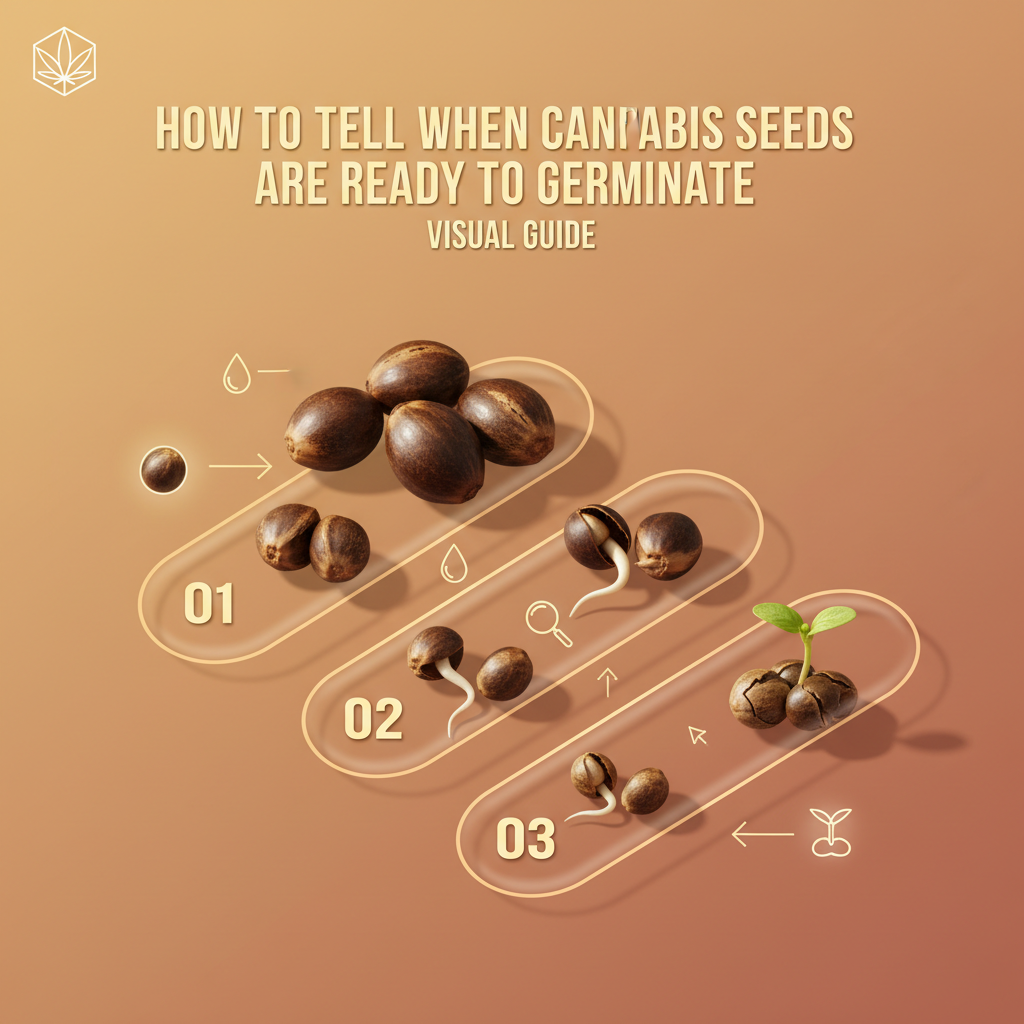
Before you germinate, treat seed appearance as a starting clue—not a final verdict.
Many growers get tripped up because cannabis seeds readiness isn’t always obvious from what you see at a glance.
A hard shell, deeper color, and good weight can be promising, but the most dependable information comes from germination signs and how the seed responds when handled gently.
If a seed looks pale, feels soft, or has odd wrinkling, it often means it needs more time to mature before you move to your next step.
Rushing can waste days and leave you wondering whether the issue was the seed, the timing, or your conditions.
Waiting too long can also hurt—especially if the seed sits in storage and gradually loses viability.
The trick is learning to read the seed the way an experienced grower would: look for maturity cues, note false alarms, and then commit only when the signs line up.
Once those signals start making sense, the process feels less like guesswork and more like timing you can trust.
Cannabis seeds are ready to germinate when they’re firm and fully formed (not pale, soft, or oddly wrinkled) and begin to swell after being placed in a moist, warm germination setup. The most reliable sign is when you see the first white root tip emerge within the first few days; if the seed stays unchanged or turns mushy, it wasn’t actually ready or conditions were off. Perform a gentle squeeze and wait for swelling before starting.
Table of Contents
- What We Mean by Cannabis Seeds Ready to Germinate
- The Most Reliable Germination Signs to Look For
- Simple Checks We Can Do Without Damaging the Seed
- Common Reasons Seeds Look Ready but Fail to Germinate
- How to Decide When to Germinate Cannabis Seeds
What We Mean by Cannabis Seeds Ready to Germinate
What if the biggest difference between a smooth start and a frustrating one came down to a seed you chose too early? That happens more often than people think.
Cannabis seeds readiness is really about maturity, not eagerness.
A seed that looks finished on the outside still needs the right internal development before it can wake up and grow well.
Timing matters because germination is the first real stress test.
If a seed is immature, damaged, or poorly stored, it may swell and stall, split weakly, or never open at all.
That’s why growers pay attention to germination signs before deciding when to germinate cannabis seeds.
A mature seed usually feels hard, has a dark brown or gray shell, and often shows mottled striping.
Pale color, a soft shell, or a flat shape usually point to an underdeveloped seed.
A few simple checks can save a lot of guesswork:
- Firm shell: A ready seed resists gentle pressure and does not crush easily.
- Dark, mottled color: Mature seeds often show brown, gray, or tiger-like patterns.
- Full shape: Healthy seeds look plump, not thin, shriveled, or collapsed.
- Dry exterior: Moist or soft seeds are more likely to fail before sprouting.
This stage sits right between seed selection and the first soak or paper towel method.
In other words, it is the gatekeeper moment in the cannabis seed journey.
A grower who skips this step may waste time trying to rescue weak seeds that were never ready.
A grower who checks maturity first usually gets a cleaner, more predictable start, and that early confidence matters when every seed counts.
Once you know what mature seeds look and feel like, the rest of the process gets simpler.
You spend less time guessing, and more time giving viable seeds the conditions they need to open cleanly and grow strong.
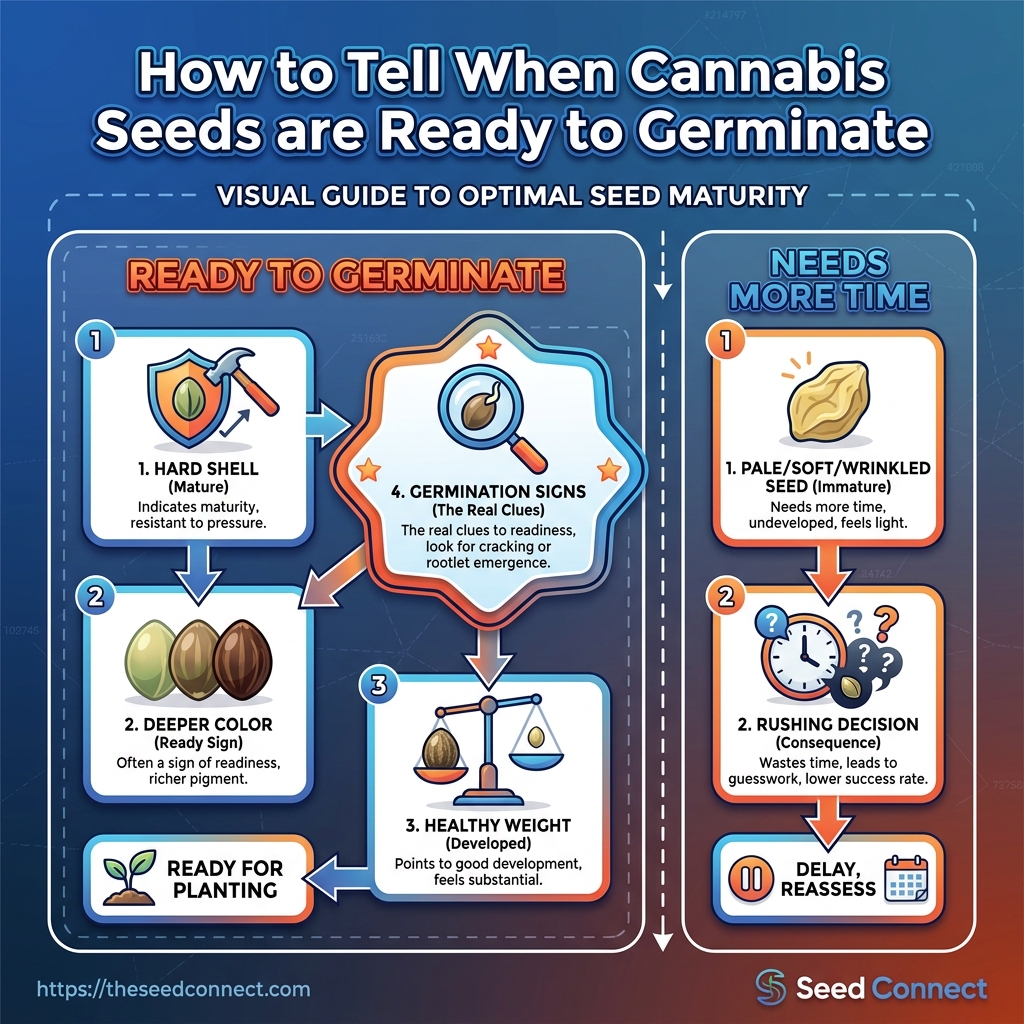
To spot a seed that’s truly ready, look for maturity cues that are consistent—not dramatic.
The best germination signs show up in the shell first, long before any soak or paper towel test.
When people ask about cannabis seeds readiness, the most reliable clues usually come from color, patterning, firmness, and how evenly the seed feels in your hand.
Color and pattern matter, but not in a “perfectly matching” way.
Mature seeds often show deeper browns, tans, or mottled striping, while pale green or chalky white seeds often need more time.
A healthy shell also tends to look finished, with a dry, hard surface rather than a dull, soft, or waxy one.
Texture tells you a lot. A ready seed usually feels firm under light finger pressure and doesn’t crush easily.
If it dents, feels spongy, or flakes, that’s a warning sign.
Size and shape matter too, because mature seeds are usually plump and fairly consistent within the same batch.
Here is the practical part: compare several seeds, not just one.
A single oddball can fool you, but a pattern across the batch is harder to ignore—and it helps answer when to germinate cannabis seeds without guessing.
Ready vs. not-ready seed signs
| Sign | Ready to Germinate | Not Ready Yet | What It Means |
|---|---|---|---|
| Color and pattern | Dark brown, tan, gray, or mottled striping | Pale green, very light tan, or chalky white | Mature color usually points to a finished seed coat |
| Shell firmness | Hard, solid, resists gentle pressure | Soft, dented, or brittle in a weak way | A firm shell usually means stronger internal development |
| Size and shape | Plump, full, and fairly uniform | Small, flat, pinched, or irregular | Full shape often suggests better seed maturity |
| Visible damage | Intact shell with no cracks or splits | Broken shell, deep cracks, or collapsed spots | Damage lowers the odds that the seed will survive |
| Surface texture | Dry, smooth, and finished-looking | Waxy, dull, rough, or soft-looking | The surface often reflects how complete the shell is |
Seeds that check most of the “ready” boxes tend to give growers fewer surprises.
One weak sign doesn’t always mean failure, but several weak signs usually point to a seed that should wait.
That’s why a quick visual check saves time later.
If the shell looks finished, feels firm, and the shape is consistent, you’re probably looking at a better candidate for germination.
Simple Checks We Can Do Without Damaging the Seed
A seed does not need to be poked, squeezed, or drowned in kitchen experiments to tell us something useful.
The trick is to read the outside with a light touch and a little patience.
That matters when cannabis seeds readiness is the real question, not guesswork.
A careful look can help separate a seed that is still settling from one that is ready for the next step.
The gentle squeeze test should feel almost boring.
Press the seed between clean fingers just enough to feel resistance, then stop.
A healthy seed usually feels firm and solid.
If it feels hollow, mushy, or gives way too easily, that is a warning sign.
Do not crack the shell to “see what happens.” That turns a simple check into a damaged seed.
The float test can be useful, but it is not a verdict.
A seed that sinks after a short soak is often the better candidate, while a seed that floats may still be fine if trapped air is the only issue.
It misleads when people leave seeds in water too long or assume floating always means failure.
A seed can float because of shell shape, trapped air, or surface tension.
Use it as one clue, not the whole story.
A closer look at the seed coat often says more than water ever will.
Tiny surface cracks, soft spots, or a shell that looks thin and papery usually mean the seed has been stressed or is aging out.
For readers sorting out when to germinate cannabis seeds, this is where discipline helps.
If the shell looks intact, feels firm, and responds well to handling, you are in much safer territory.
- Hold the seed gently between clean fingers or tweezers.
- Check the shell under light.
- Use the float test briefly if needed.
- Stop the moment something feels off.
It should feel firm, not brittle or squishy.
Look for cracks, dents, soft patches, or uneven texture.
Treat it as a clue, then remove the seed and avoid long soaking.
Rough handling solves nothing and often ruins a seed that was still usable.
A good batch of Cannabis Seeds makes these checks easier because strong genetics tend to show more consistency from the start.
That is the real win here: less guessing, less damage, and a much cleaner read on what is worth moving forward.
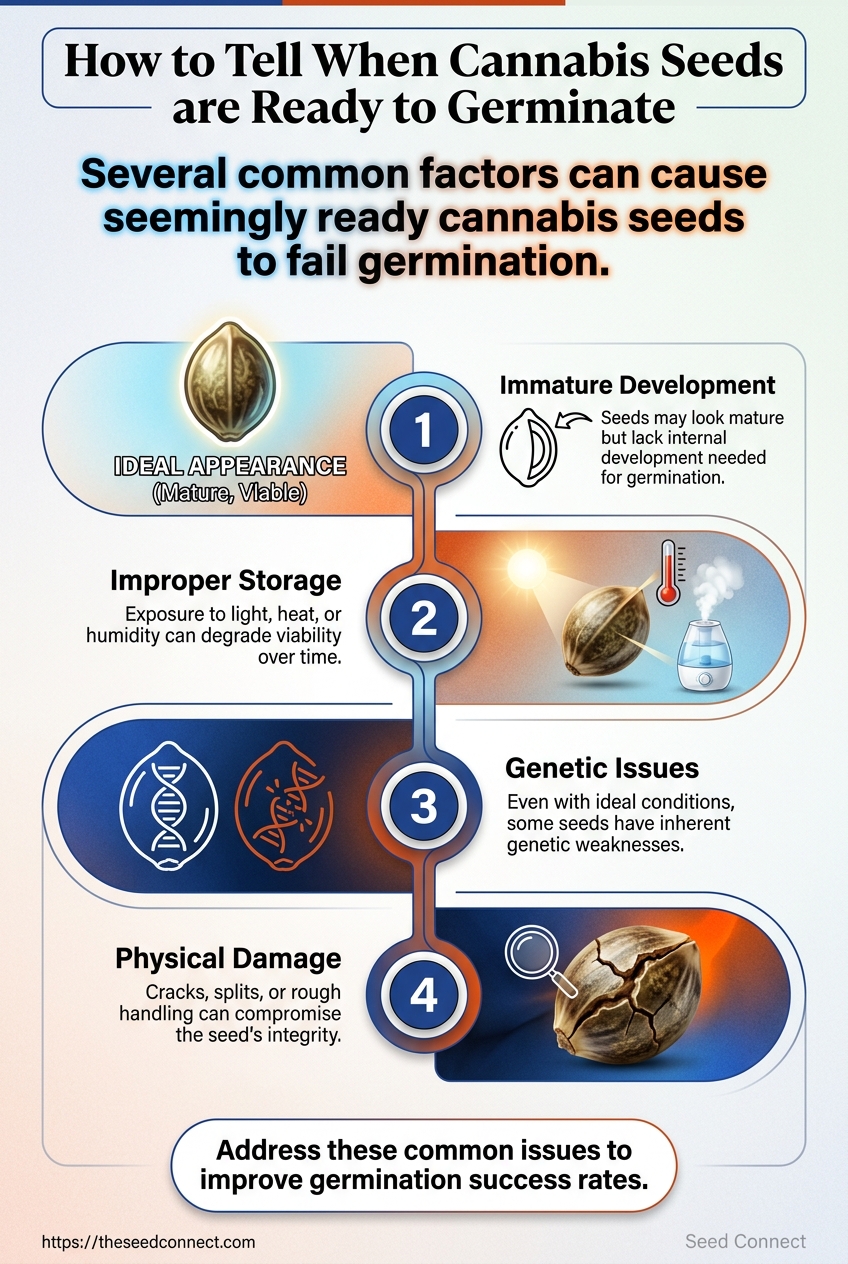
Sometimes the shell looks right, but the seed can still fail because the problem happened earlier—during development or storage—not during your current setup.
That mismatch is one of the most frustrating parts of reading cannabis seeds readiness by appearance alone.
The usual culprits are not mysterious.
Some seeds were never fully developed, some were damaged in storage, and some were exposed to mold, excess moisture, or heat before you ever held them.
Those issues can erase germination potential long before the seed reaches soil or water.
Immature seeds are the sneaky ones.
They can harden and darken enough to look ready, but the interior never caught up.
They often come from pods harvested a little early, so the shell may seem normal while the seed stays underbuilt and weak.
Storage damage is the other big one.
Seeds kept in warm rooms, humid containers, or places with repeated temperature swings age fast—even if they still look fine.
Time matters here, but so does the environment they lived in before you handled them.
Mold, moisture, and heat usually finish the job.
A seed that picked up dampness in storage can swell, soften, or develop invisible internal rot.
Heat speeds up the decline, and once it’s started, no amount of patience reliably fixes it.
A useful way to separate dormancy from poor quality is to think about recovery.
Dormant seeds may simply need stable conditions and a little more time, while weak seeds show signs of breakdown rather than hesitation.
- Dormant seed: usually still feels firm, looks intact, and came from proper storage, even if it is slow to respond.
- Poor-quality seed: often has a pale interior, damage, odd discoloration, or a history of heat and moisture exposure.
- Mold-affected seed: may carry blotches, a stale smell, or a softened shell that never bounces back.
- Immature seed: often looks finished outside but lacks the dense, settled feel of a mature one.
If a seed looks perfect but keeps failing, the problem is often hidden history—not bad timing.
That’s why figuring out when to germinate cannabis seeds depends on more than appearance alone.
That little bit of context saves a lot of wasted effort.
It also helps you spot the difference between a seed that needs patience and one that was never going to grow.
How to Decide When to Germinate Cannabis Seeds
What if the best time to start is not when a seed looks ready, but when your setup does?
That question matters because cannabis seeds readiness is only half the story.
The other half is your calendar, your storage conditions, and how quickly you can give seedlings a stable start.
A fresh seed that sits around for weeks can become a scheduling problem.
A stored seed can still be fine, but its timing should match your plan, not your impatience.
If the seeds were bought recently, the decision usually comes down to your next 7 to 10 days.
If they came from long-term storage, the real question is whether you have enough confidence in the seed, the environment, and your ability to watch the first stage closely.
- Use purchase timing as a clue.
- Treat long storage differently.
- Match germination to your grow plan.
- Wait if your schedule is messy.
Seeds bought recently are usually best germinated when you can monitor them daily for a few days.
Older seeds deserve a more deliberate start, especially if they were kept warm, humid, or moved often.
Start only when your space, lights, and next planting step are already lined up.
A rushed start often causes more stress than a slightly later one.
The cleanest decision comes from simple timing, not guesswork.
If you are still unsure, stage the process first: make sure your environment is ready, keep the seeds dry until the moment you commit, and start only when you can check progress without missing the first changes.
That approach works well for beginners and experienced growers alike.
It also fits a short inspection clip, where experienced growers usually focus on storage history, shell condition, and whether the seed still feels worth the first step.
- Fresh purchase: Good candidates for immediate planning, especially if your grow space is already prepared.
- Long storage: Better handled with extra caution, since age and storage quality matter more.
- Unclear timing: Wait until your setup is ready, not just the seed.
- Limited attention: Germinate when you can check daily, not when life is about to get hectic.
A lot of failed starts come from bad timing, not bad seeds.
When the plan is ready first, the seed gets a fair shot.
📥 Download Free Template
Get your free downloadable template.
Conclusion
Reading the Seed Before It Moves
Seed readiness usually isn’t a single “aha” moment—it’s a cluster of small, repeatable maturity cues.
Dark color, a firm shell, and a clean seam matter far more than wishful timing, and that’s the real test of cannabis seeds readiness.
When those germination signs line up, you’re looking at a seed that can handle the next step with less guesswork.
The most common mistake is treating “looks finished” as proof it’s internally ready.
The earlier shell example makes the point: a glossy, fully formed seed still failed the firmness check—so it needed more time, not more moisture.
That kind of patience usually saves more seeds than any fancy technique.
If you’re deciding when to germinate cannabis seeds today, start by selecting seeds that pass the look-and-feel test, then leave the doubtful ones for another day. Move forward with seeds that feel solid and look mature, and handle the rest as a separate batch. This simple habit turns uncertainty into a cleaner start.